
PROPERTIES OF LIPIDS 1 Hydrolysis This reaction of
- Slides: 24
PROPERTIES OF LIPIDS
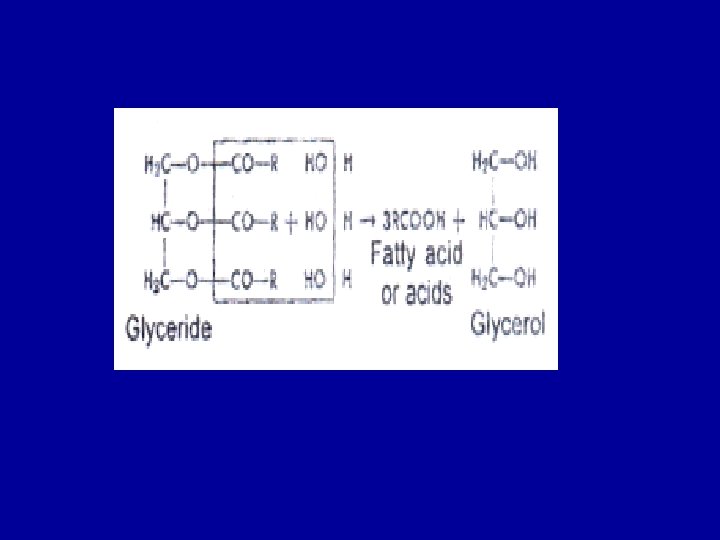
• 1. Hydrolysis: This reaction of hydrolysis of the glycerides of a fat may be readily accomplished by heating with water at high temperatures and pressures in an autoclave, preferably with addition of catalysts such as acids. • When boiled at ordinary pressure the action is very slow :
• The reactions of hydrolysis may be efficiently accomplished also by a lipase enzyme of pancreatic juice or the lipase of castor bean. • Lipases are wide spread in both plants and animals, and the storage qualities of animal and vegetables fats, which often contain some lipase may be improved by heating to inactivate the enzyme.
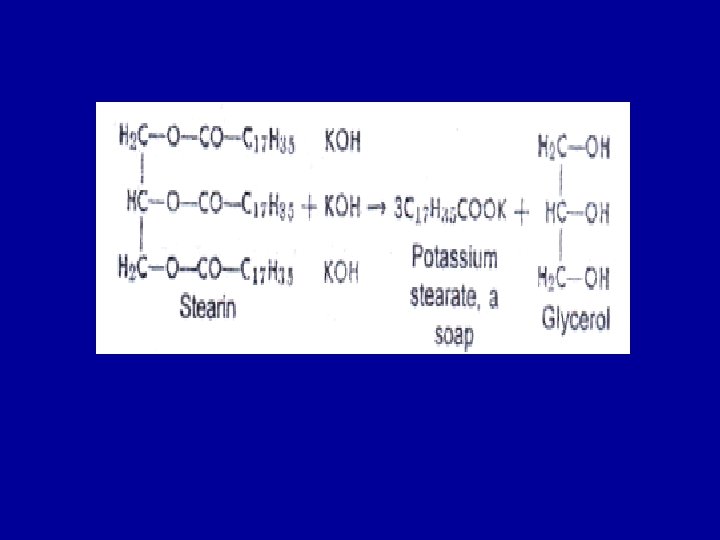
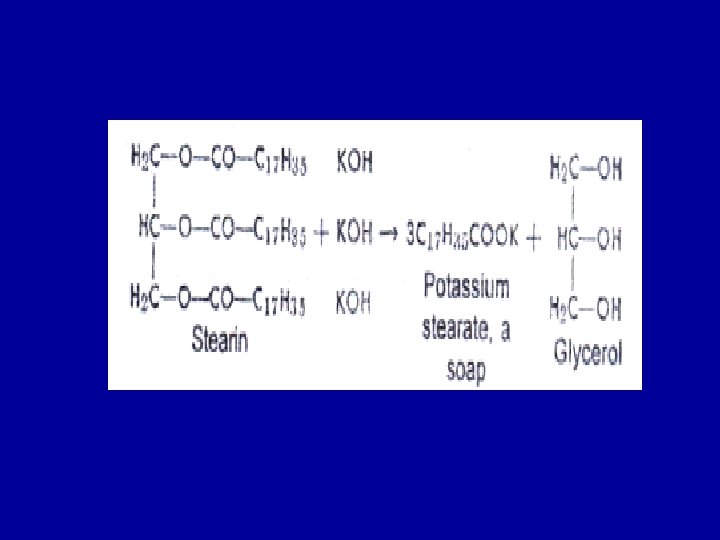
• 2. Saponification : The glycerides of the fat may be readily decomposed into glycerol and salts of the constituent fatty acids (Soaps) by boiling with strong bases such as sodium or potassium hydroxide. • Since fats are insoluble in water, the process is facilitated by the addition of alcohol which dissolves the fat :
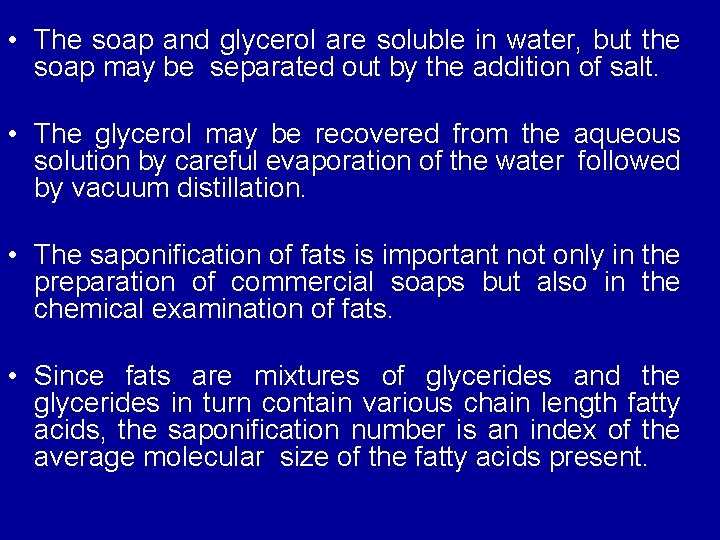
• The soap and glycerol are soluble in water, but the soap may be separated out by the addition of salt. • The glycerol may be recovered from the aqueous solution by careful evaporation of the water followed by vacuum distillation. • The saponification of fats is important not only in the preparation of commercial soaps but also in the chemical examination of fats. • Since fats are mixtures of glycerides and the glycerides in turn contain various chain length fatty acids, the saponification number is an index of the average molecular size of the fatty acids present.
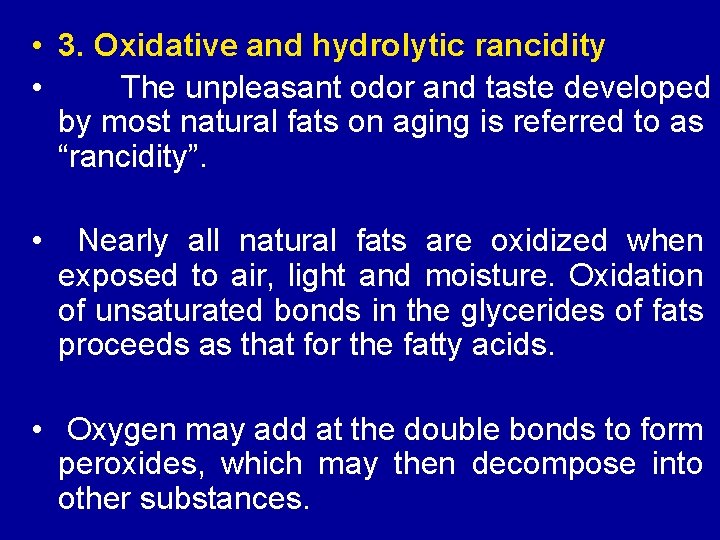
• 3. Oxidative and hydrolytic rancidity • The unpleasant odor and taste developed by most natural fats on aging is referred to as “rancidity”. • Nearly all natural fats are oxidized when exposed to air, light and moisture. Oxidation of unsaturated bonds in the glycerides of fats proceeds as that for the fatty acids. • Oxygen may add at the double bonds to form peroxides, which may then decompose into other substances.
• a) Hydrolytic rancidity • Rancidity may due to hydrolysis of component glycerides of a fat into free fatty acids and glycerol or a monoglycerides and diglycerides (Hydrolytic rancidity). • This is often hastened by the presence of lipolytic enzymes (lipases) in the tissue and microbes, which in the presence of moisture and warm temperature bring about hydrolysis. • Free fatty acid value is a measure of hydrolytic rancidity.
• b) Oxidative rancidity • Rancidity may also be caused by oxidative processes (Oxidative rancidity). • Oxidation at the double bonds on the unsaturated glycerides may form peroxides which then decompose by hydrolysis to from aldehydes, ketones and acids of smaller carbon chain causing objectionable odor and taste.
• This process is called oxidative rancidity. It is greatly increased by exposure to light. • • Nearly all natural fats are oxidized when exposed to air, light and moisture.
• It has been observed that highly refined fats and distilled fatty acids or their esters begin to absorb atmospheric oxygen almost immediately upon exposure to it, whereas natural fats often exhibit an “induction period” of variable duration before oxidation begins. • There are substances that prevent the oxidation of unsaturated glycerides and they are called “antioxidants”.
• Antioxidants are those compounds that prevent the oxidation of fat. tocopherol is the natural antioxidant present in plant and animal tissues. • The addition of minute amounts of certain synthetic compounds also prevents oxidation and they are called synthetic antioxidants. e. g. Propyl gallate, Isoamyl gallate, BHT, BHA, Nordiguaretic acid.
LIPID QUALITY INDICES
• 1. Free fatty acid value • Quality of lipid is can be assessed by determining the free fatty acid present and is expressed as acid number • It is defined as the number of milligrams of KOH required to neutralize the free fatty acids present in 1 g of fat, and is of value in determining rancidity due to free fatty acids. • The FFA content is determined by titration with a standard alkali. The free fatty acid value is an indication of the extent of hydrolytic rancidity.
• 2. Saponification Number: • The saponification number is defined as number of the milligrams of KOH required to saponify one gram of fat or oil. • Boiling with an alcoholic solution of strong alkali hydrolyzes triglycerides into glycerol and fatty acids are called saponification. •
• The glycerides of the fat may be readily decomposed into glycerol and salts of the constituent fatty acids (Soaps) by boiling with strong bases such as sodium or potassium hydroxide. • Since fats are insoluble in water, the process is facilitated by the addition of alcohol which dissolves the fat:
• The saponification of fats is important in the chemical examination of fats. • Since fats are mixtures of glycerides and the glycerides in turn contain various chain length fatty acids, the saponification number is an index of the average molecular size of the fatty acids present. • It is inversely proportional to the average molecular weight of the fatty acids in the fat.
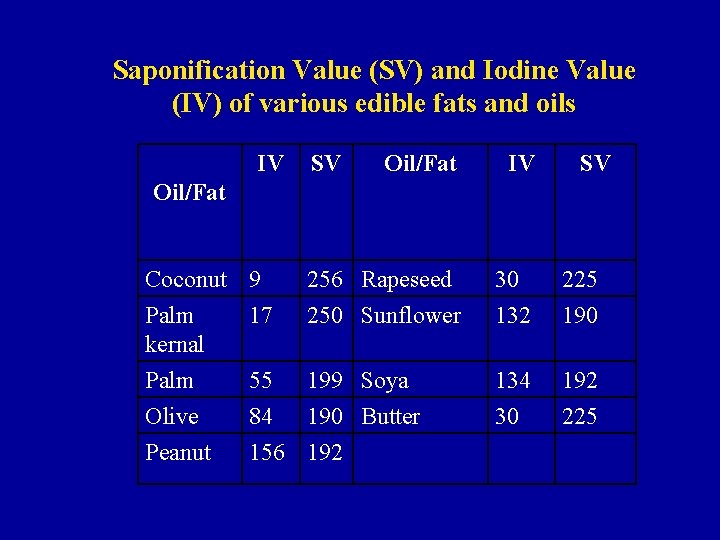
Saponification Value (SV) and Iodine Value (IV) of various edible fats and oils IV SV Oil/Fat IV SV Coconut 9 Palm 17 kernal 256 Rapeseed 250 Sunflower 30 132 225 190 Palm Olive 55 84 199 Soya 190 Butter 134 30 192 225 Peanut 156 192 Oil/Fat
• 3. Iodine number: In commercial practice it usual to measure the degree of unsaturation in oil which is reported as the iodine number. It is defined as the amount in grams of iodine absorbed by 100 g of fat. • The triglycerides of unsaturated fatty acids react with a definite amount of iodine, which adds across the double bond. It is often used to classify an unknown oil or fat into a particular class by determining the degree of unsaturation. e. g. cod liver oil have an iodine value between 155 and 170.
• 4. Peroxide value: It is used to indicate the degree to which a lipid has been oxidized. It is defined as the number of milliequivalents of peroxide per kilogram of fat. • The peroxide value gives an indication of the extent of oxidative rancidity. It is a measurement of the amount of oxygen absorbed at double bonds in unsaturated fatty acids contained in fish oil.
• Fresh oil usually has peroxide values of less than 1 meq/kg and may increase upto 10 meq/kg. • Values of the order of 10 to 20 meq/kg usually indicate rancidity. • The most common method of estimation is based on iodometric titration that measures the iodine liberated from potassium iodide by the peroxide present in the oil.
• 5. Thiobarbituric acid Value (TBA Value): • The 2 -thiobarbituric acid (TBA) reaction has been widely used to determine rancidity. • There is direct distillation of carbonyls and other reactive substances from acid media that yield a red colored compound upon heating with TBA reagent, which is measured spectorophotometrically. • The TBA- reactive substances provide an indication of quality. • If the value exceeds 1 -2 µ mole malonaldehyde/g of fat, the fat is considered as rancid