
Properties of Fluids What is a Fluid Fluids



- Slides: 29
Properties of Fluids
What is a Fluid? • Fluids include two states of matter –Liquids –Gases
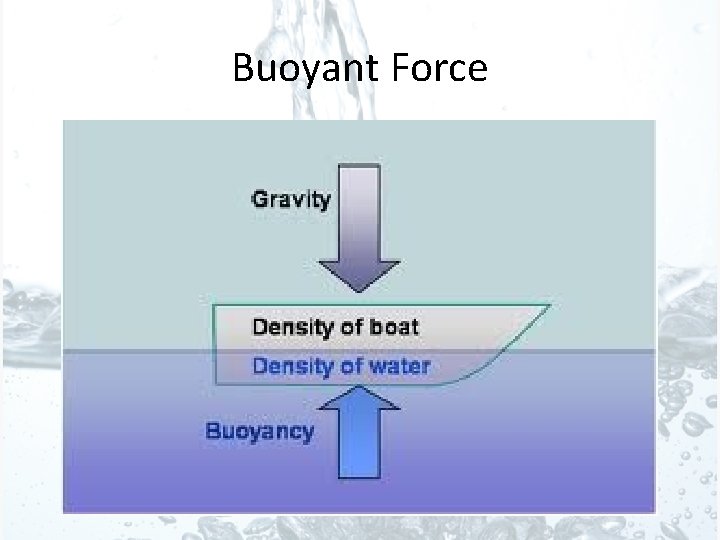
Sink or Float? • We have said that density is what determines whether an object will sink or float in a fluid. • This is only part of the story! • Another factor affecting this is called the buoyant force.
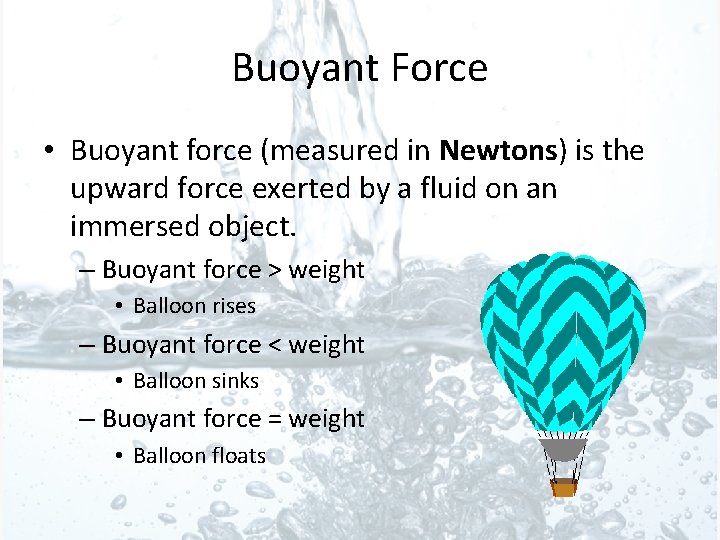
Buoyant Force • Buoyant force (measured in Newtons) is the upward force exerted by a fluid on an immersed object. – Buoyant force > weight • Balloon rises – Buoyant force < weight • Balloon sinks – Buoyant force = weight • Balloon floats
Buoyant Force
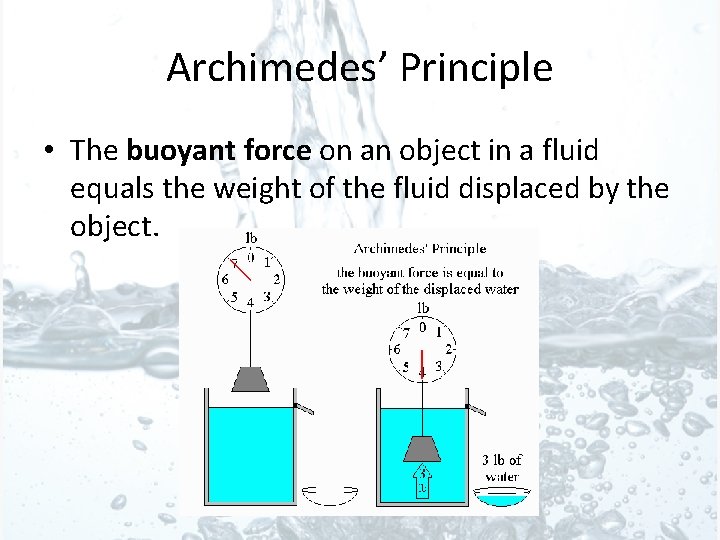
Archimedes’ Principle • The buoyant force on an object in a fluid equals the weight of the fluid displaced by the object.
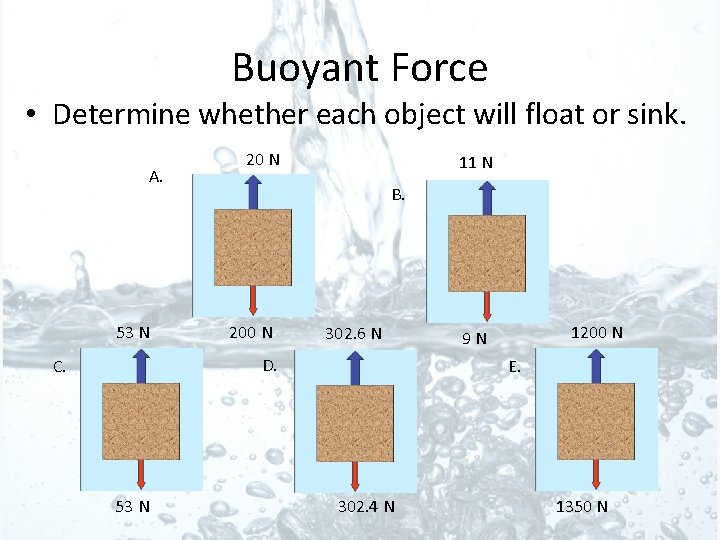
Buoyant Force • Determine whether each object will float or sink. A. 53 N 20 N 11 N B. 200 N 302. 6 N D. C. 53 N 1200 N 9 N E. 302. 4 N 1350 N
Calculating Buoyant Force of Water 1. How much water does the object displace? (In other words, what is the volume of the object? ) 2. One cubic foot of water has a buoyant force of about 62. 43 pounds. 3. Multiply the volume of the object (in ft 3) by 62. 43 to find the buoyant force. 4. If buoyant force is greater than the weight of the object, the object will float! If buoyant force is less than weight, the object will sink.
Example • A cube weighing 500 lbs. and measuring 3 x 6 x 2 ft is dropped into water. Will it float or sink? • First, find the volume (l x w x h). 3 x 6 x 2 = 36 ft 3 • Multiply by 62. 43 lbs to find the buoyant force. Buoyant force = 2, 247. 5 lbs • Compare buoyant force to the weight of the object. Buoyant force > weight Object will float
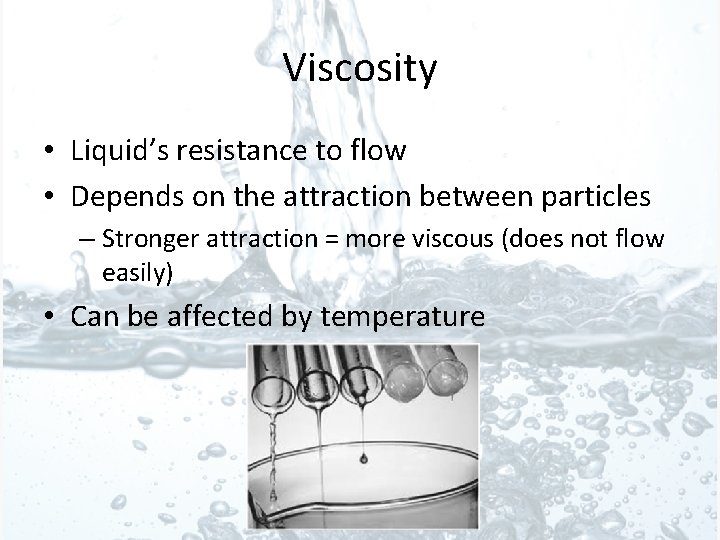
Viscosity • Liquid’s resistance to flow • Depends on the attraction between particles – Stronger attraction = more viscous (does not flow easily) • Can be affected by temperature
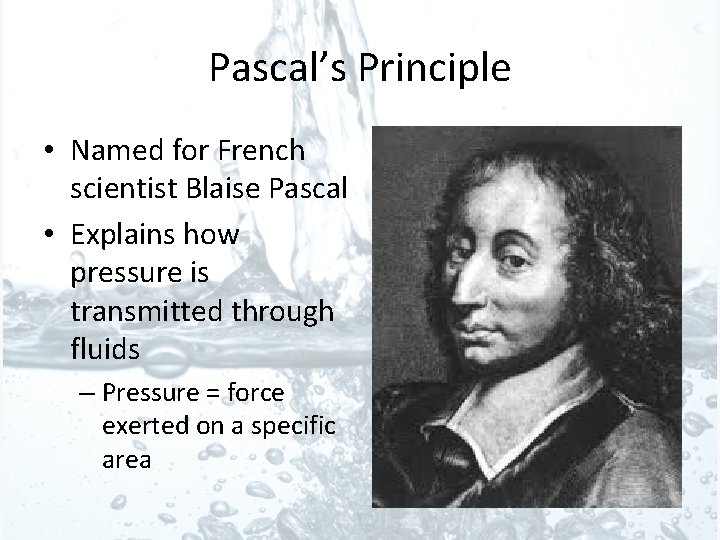
Pascal’s Principle • Named for French scientist Blaise Pascal • Explains how pressure is transmitted through fluids – Pressure = force exerted on a specific area
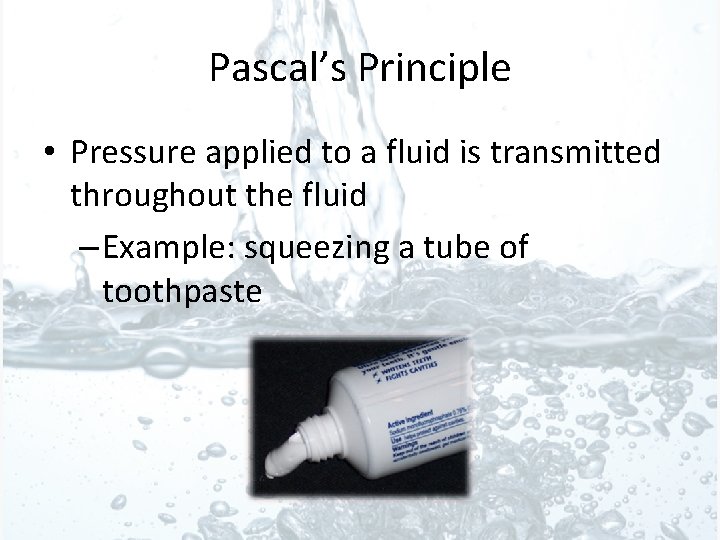
Pascal’s Principle • Pressure applied to a fluid is transmitted throughout the fluid – Example: squeezing a tube of toothpaste
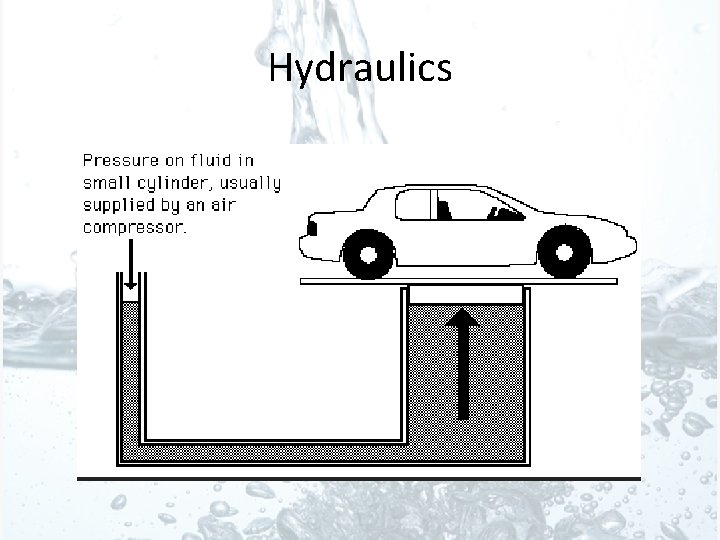
Applying Pascal’s Principle • Hydraulics machines are based on Pascal’s Principle. – Transmit pressure through a fluid to multiply force – Save us some work • Examples: hydraulic lifts, dentist chairs, hospital beds, etc.
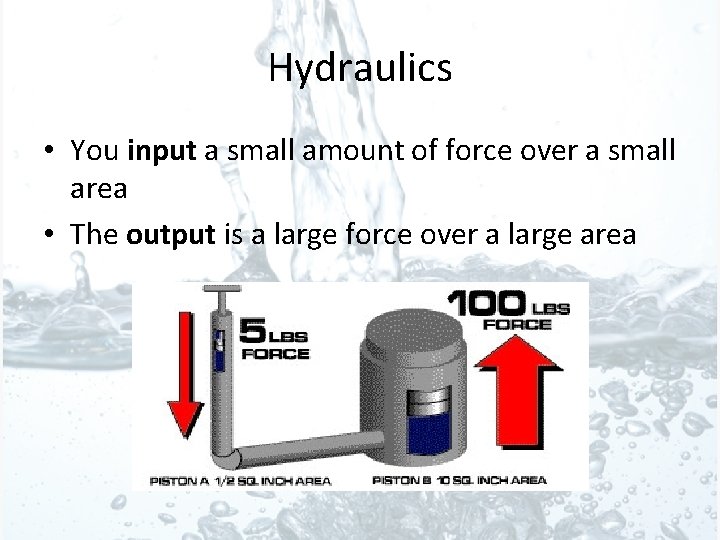
Hydraulics • You input a small amount of force over a small area • The output is a large force over a large area
Hydraulics
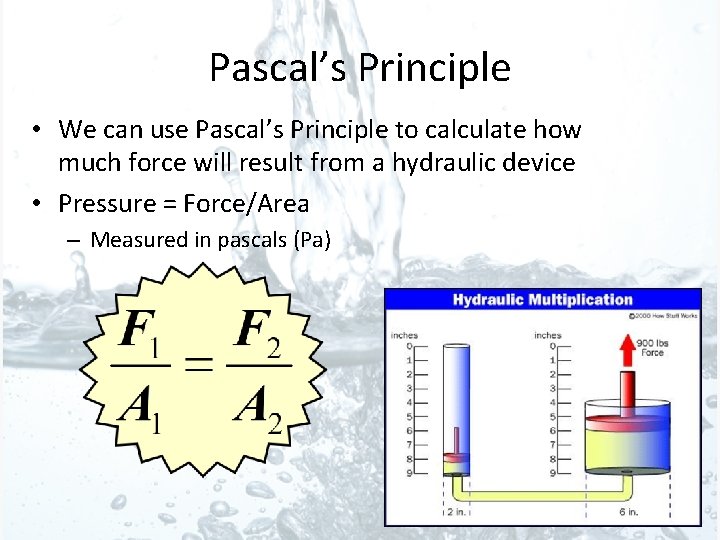
Pascal’s Principle • We can use Pascal’s Principle to calculate how much force will result from a hydraulic device • Pressure = Force/Area – Measured in pascals (Pa)
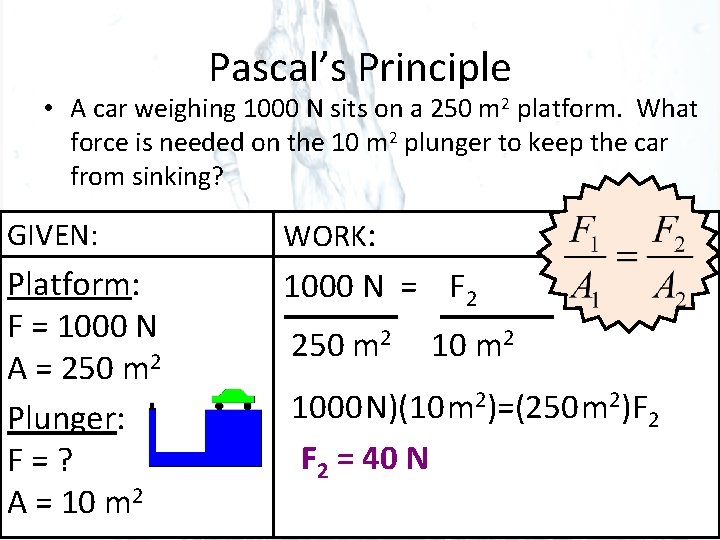
Pascal’s Principle • A car weighing 1000 N sits on a 250 m 2 platform. What force is needed on the 10 m 2 plunger to keep the car from sinking? GIVEN: WORK: Platform: F = 1000 N A = 250 m 2 Plunger: F=? A = 10 m 2 1000 N = F 2 250 m 2 10 m 2 (1000 N)(10 m 2)=(250 m 2)F 2 = 40 N
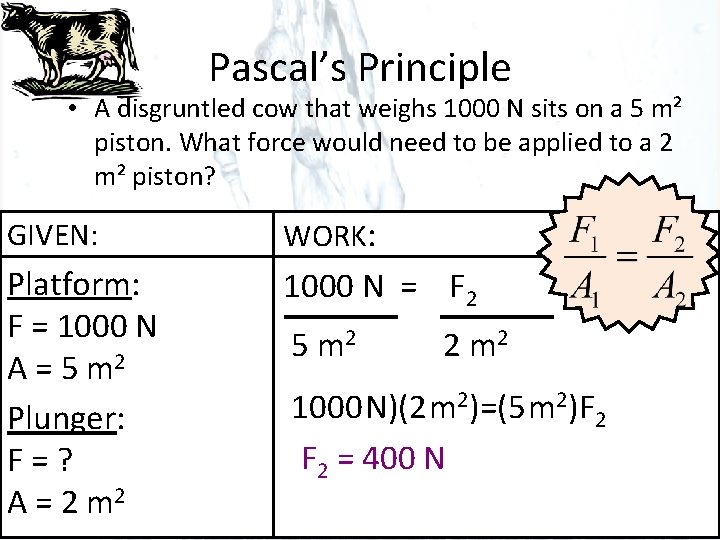
Pascal’s Principle • A disgruntled cow that weighs 1000 N sits on a 5 m² piston. What force would need to be applied to a 2 m² piston? GIVEN: WORK: Platform: F = 1000 N A = 5 m 2 Plunger: F=? A = 2 m 2 1000 N = F 2 5 m 2 2 m 2 (1000 N)(2 m 2)=(5 m 2)F 2 = 400 N
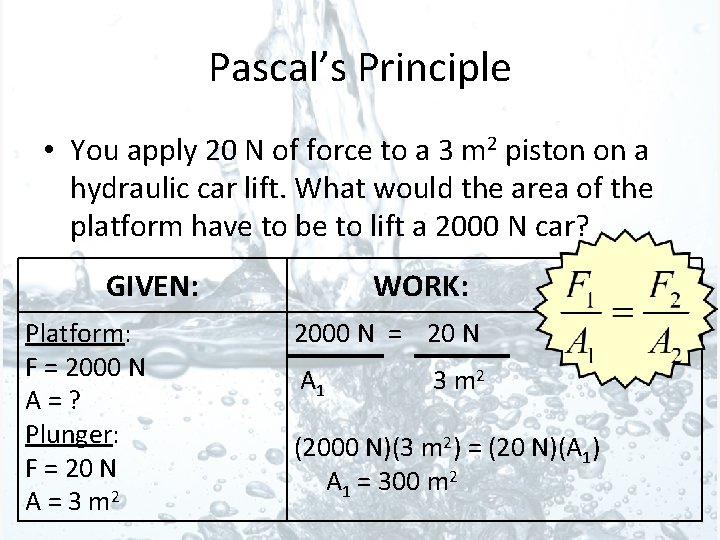
Pascal’s Principle • You apply 20 N of force to a 3 m 2 piston on a hydraulic car lift. What would the area of the platform have to be to lift a 2000 N car? GIVEN: Platform: F = 2000 N A=? Plunger: F = 20 N A = 3 m 2 WORK: 2000 N = 20 N A 1 3 m 2 (2000 N)(3 m 2) = (20 N)(A 1) A 1 = 300 m 2
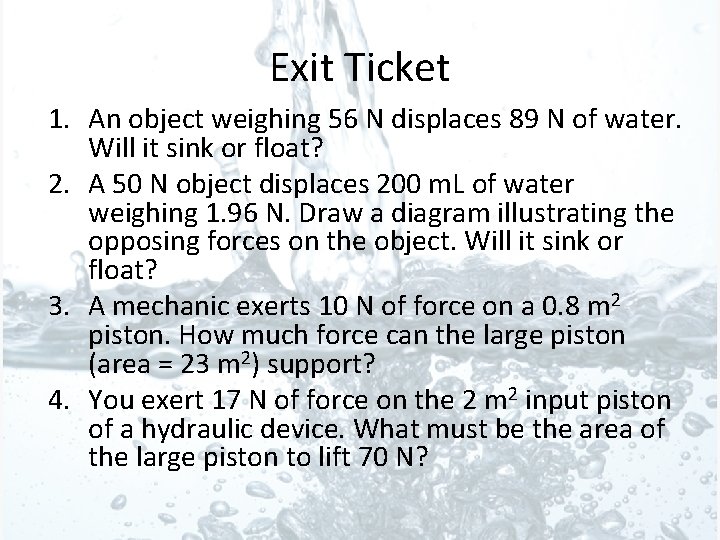
Exit Ticket 1. An object weighing 56 N displaces 89 N of water. Will it sink or float? 2. A 50 N object displaces 200 m. L of water weighing 1. 96 N. Draw a diagram illustrating the opposing forces on the object. Will it sink or float? 3. A mechanic exerts 10 N of force on a 0. 8 m 2 piston. How much force can the large piston (area = 23 m 2) support? 4. You exert 17 N of force on the 2 m 2 input piston of a hydraulic device. What must be the area of the large piston to lift 70 N?
Quiz Review • Matching: – Kinetic Theory of Matter – Law of Conservation of Mass – Law of Conservation of Energy – Buoyant force – Archimedes’ Principle – Viscosity – Pascal’s Principle
Quiz Review • Archimedes’ Principle problems: – Buoyant force vs. Weight – Will objects sink or float? – An object weighing 33 N displaces 72 N of water. Will it sink or float? – A 50 N object displaces 200 m. L of water weighing 1. 96 N. Draw a diagram illustrating the opposing forces on the object. Will it sink or float? – An object weighing 23 N is dropped into an overflow can. The displaced water is collected in a 40 N beaker. If the weight of the beaker full of water is 61 N, did this object sink or float?
Quiz Review • Pascal’s Principle Problems – A hydraulic hospital bed requires 10 N of force to be exerted on a 0. 5 m 2 piston. If the area of the bed is 5 m 2, what is the maximum weight for a patient it can lift? – A mechanic needs to lift a 5000 N truck. If he exerts a 30 N force on a 1 m 2 piston, what must be the area of the platform the truck sits on?
Pascal’s Practice • A mechanic exerts 10 N of force on a 0. 8 m 2 piston. How much force can the large piston (area = 23 m 2) support? • You exert 17 N of force on the 2 m 2 input piston of a hydraulic device. What must be the area of the large piston to lift 70 N? • A hydraulic lift has a 3000 N car on the 40 m 2 large piston. How much force needs to be exerted on the small piston (area= 5 m 2)?
Bernoulli’s Principle As the velocity (speed) of a fluid increases, the pressure of the fluid decreases.
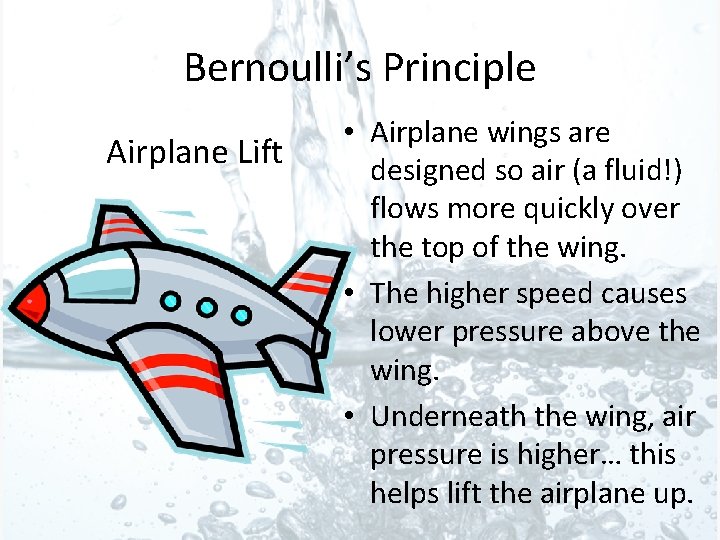
Bernoulli’s Principle Airplane Lift • Airplane wings are designed so air (a fluid!) flows more quickly over the top of the wing. • The higher speed causes lower pressure above the wing. • Underneath the wing, air pressure is higher… this helps lift the airplane up.