
Properties of elements and compounds Why is it

- Slides: 13
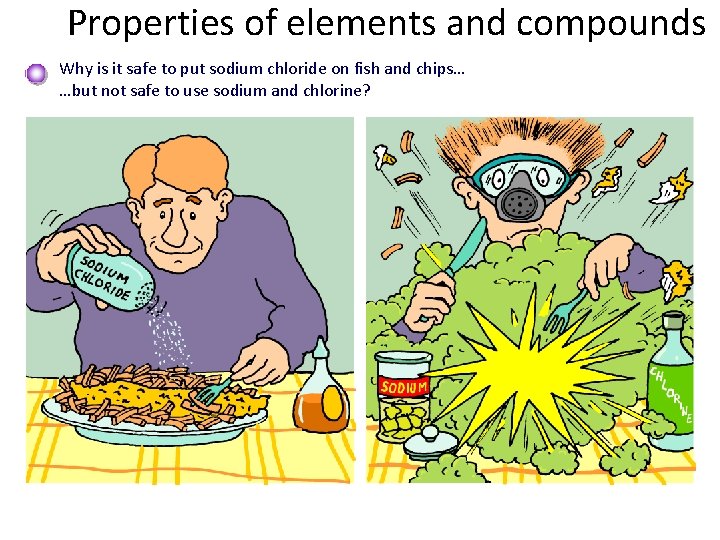
Properties of elements and compounds Why is it safe to put sodium chloride on fish and chips… …but not safe to use sodium and chlorine?
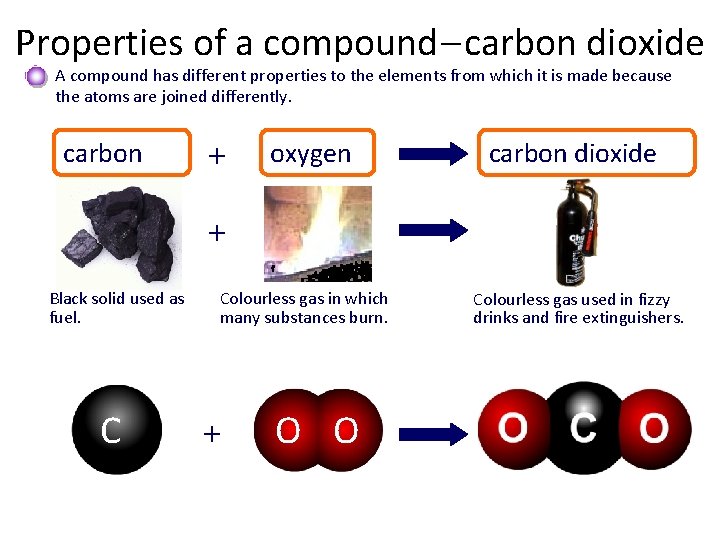
Properties of a compound – carbon dioxide A compound has different properties to the elements from which it is made because the atoms are joined differently. carbon + oxygen carbon dioxide + Black solid used as fuel. C Colourless gas in which many substances burn. + O O Colourless gas used in fizzy drinks and fire extinguishers.
A compound is not a mixture The atoms in a mixture of hydrogen gas and oxygen gas, which have not reacted with each other, look like this… The atoms in water, the compound made when hydrogen and oxygen react and their atoms become chemically joined to each other, look like this…
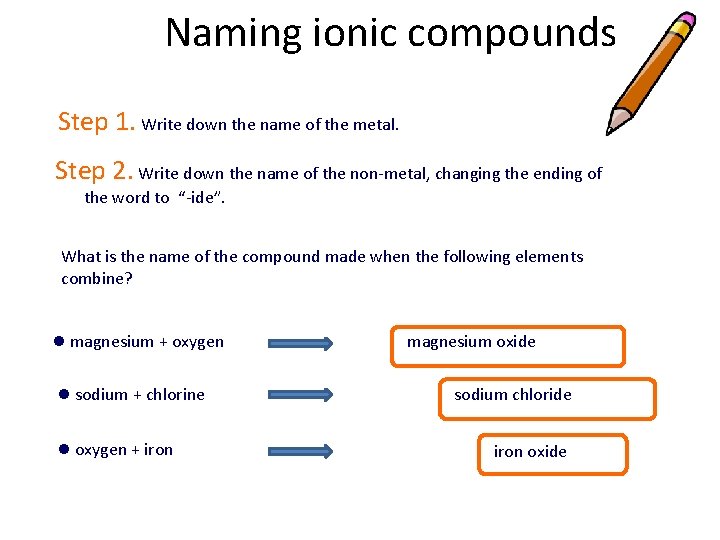
Naming ionic compounds Step 1. Write down the name of the metal. Step 2. Write down the name of the non-metal, changing the ending of the word to “-ide”. What is the name of the compound made when the following elements combine? l magnesium + oxygen l sodium + chlorine l oxygen + iron magnesium oxide sodium chloride iron oxide
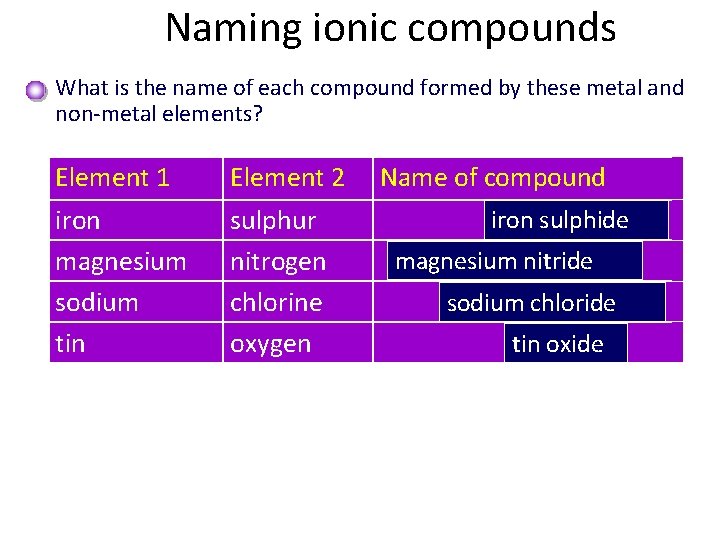
Naming ionic compounds What is the name of each compound formed by these metal and non-metal elements? Element 1 Element 2 iron magnesium sodium tin sulphur nitrogen chlorine oxygen Name of compound iron sulphide magnesium nitride sodium chloride tin oxide
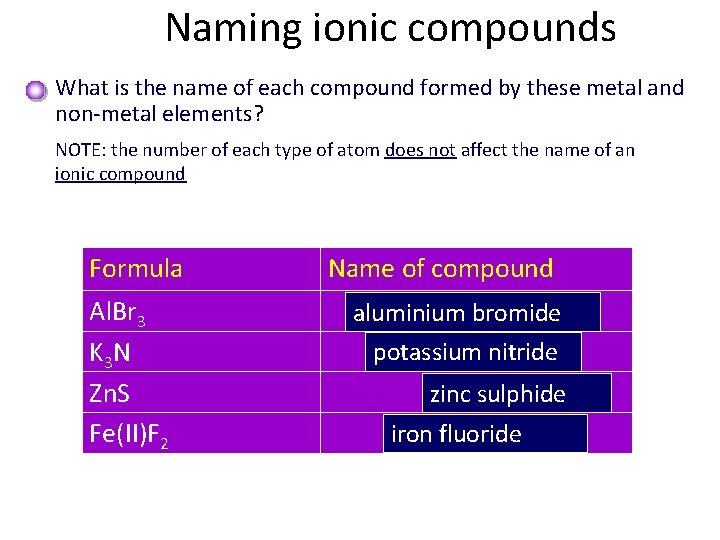
Naming ionic compounds What is the name of each compound formed by these metal and non-metal elements? NOTE: the number of each type of atom does not affect the name of an ionic compound Formula Al. Br 3 K 3 N Zn. S Fe(II)F 2 Name of compound aluminium bromide potassium nitride zinc sulphide iron fluoride
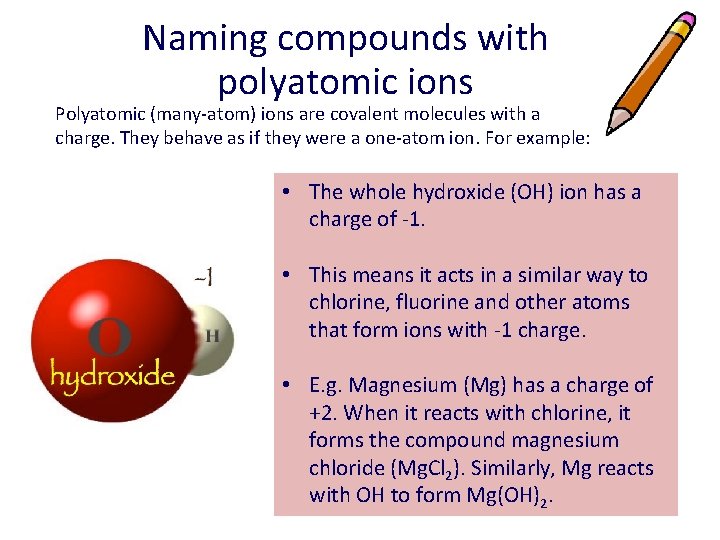
Naming compounds with polyatomic ions Polyatomic (many-atom) ions are covalent molecules with a charge. They behave as if they were a one-atom ion. For example: • The whole hydroxide (OH) ion has a charge of -1. • This means it acts in a similar way to chlorine, fluorine and other atoms that form ions with -1 charge. • E. g. Magnesium (Mg) has a charge of +2. When it reacts with chlorine, it forms the compound magnesium chloride (Mg. Cl 2). Similarly, Mg reacts with OH to form Mg(OH)2.
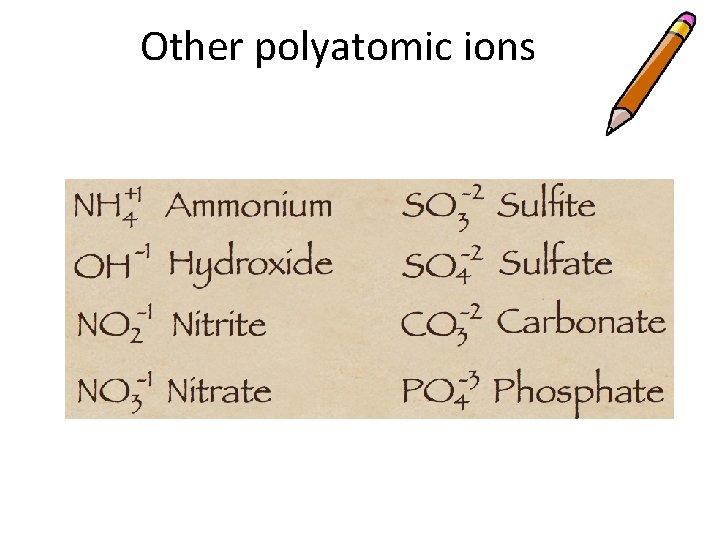
Other polyatomic ions
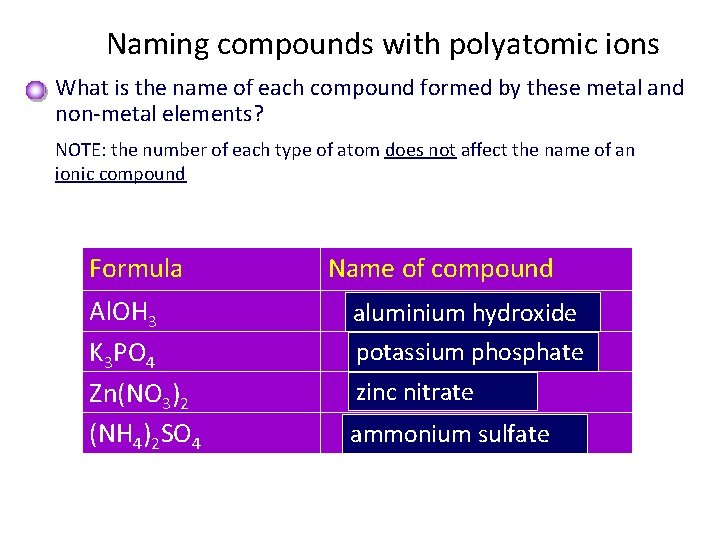
Naming compounds with polyatomic ions What is the name of each compound formed by these metal and non-metal elements? NOTE: the number of each type of atom does not affect the name of an ionic compound Formula Al. OH 3 K 3 PO 4 Zn(NO 3)2 (NH 4)2 SO 4 Name of compound aluminium hydroxide potassium phosphate zinc nitrate ammonium sulfate
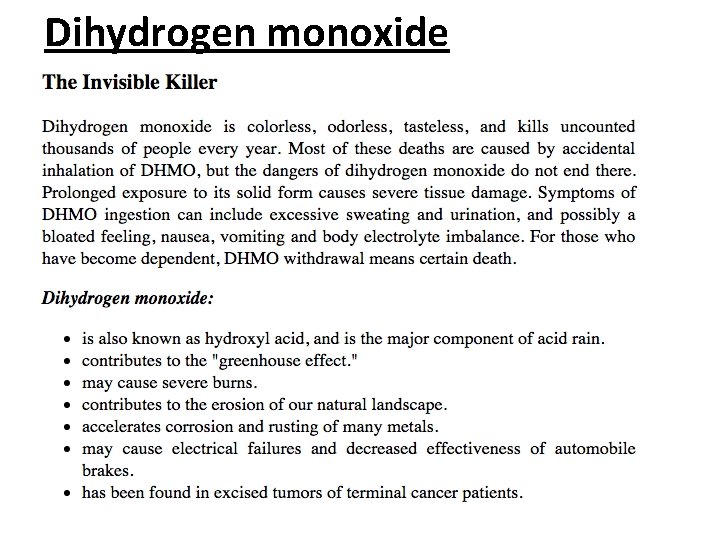
Dihydrogen monoxide
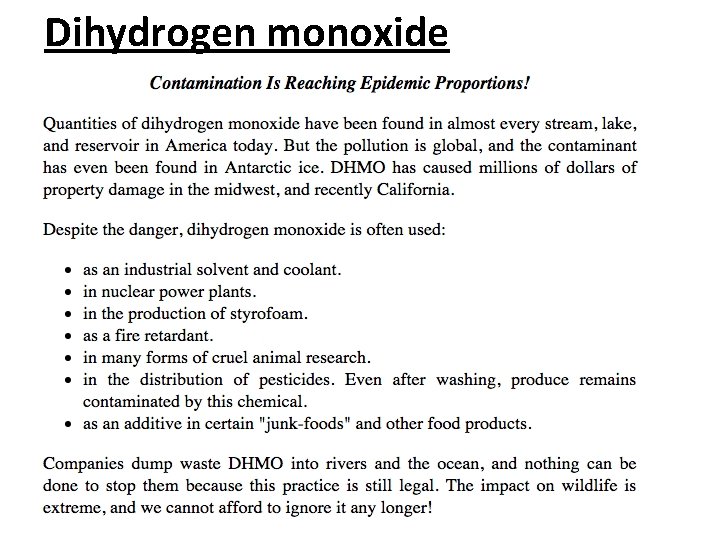
Dihydrogen monoxide
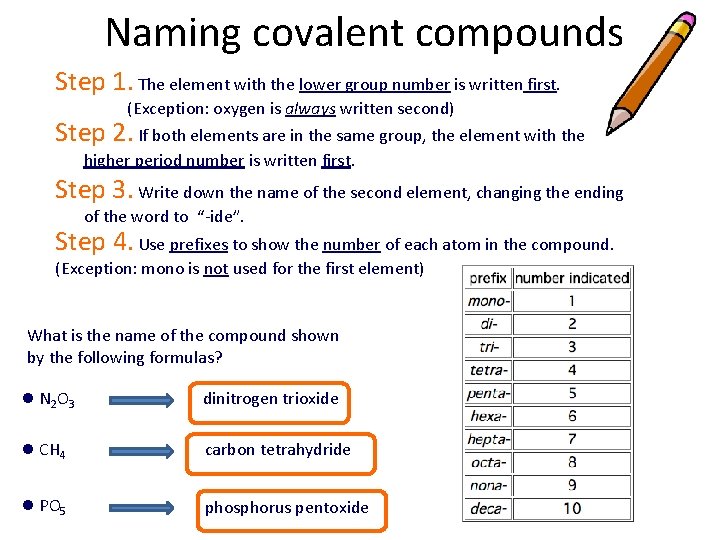
Naming covalent compounds Step 1. The element with the lower group number is written first. (Exception: oxygen is always written second) Step 2. If both elements are in the same group, the element with the higher period number is written first. Step 3. Write down the name of the second element, changing the ending of the word to “-ide”. Step 4. Use prefixes to show the number of each atom in the compound. (Exception: mono is not used for the first element) What is the name of the compound shown by the following formulas? l N 2 O 3 dinitrogen trioxide l CH 4 carbon tetrahydride l PO 5 phosphorus pentoxide
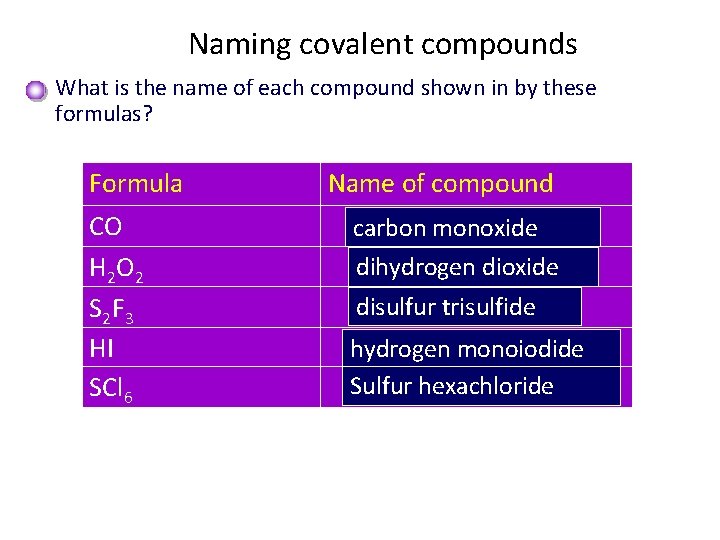
Naming covalent compounds What is the name of each compound shown in by these formulas? Formula CO H 2 O 2 S 2 F 3 HI SCl 6 Name of compound carbon monoxide dihydrogen dioxide disulfur trisulfide hydrogen monoiodide Sulfur hexachloride