
Properties of Electromagnetic Radiation Chapter 5 Concepts Electromagnetic


- Slides: 58
Properties of Electromagnetic Radiation Chapter 5 Concepts: • Electromagnetic waves • Types of spectra • Temperature • Blackbody radiation • Dual nature of radiation • Atomic structure • Interaction of light and matter • Emission and absorption lines • Doppler shift 1
Radiation carries information • • • How hot is the Sun? How does it compare to other stars? What is the chemical composition of stars? What is the nature of gas clouds between the stars? How do stars and gas clouds orbit in galaxies? How do we know that the Universe is expanding? Radiation – light, radio waves, infrared, etc. – travels as electromagnetic waves 2
What is light? • Light is an example of electromagnetic (EM) radiation • Electromagnetic radiation can be treated either as – waves – photons (“particles” of radiation) • Both natures have to be considered to describe all essential properties of radiation 3
What is a wave? • A wave is the transfer of energy from one point to another, without the transfer of material between the points • A wave is manifested by a periodic change in the properties of a medium that it travels through 4
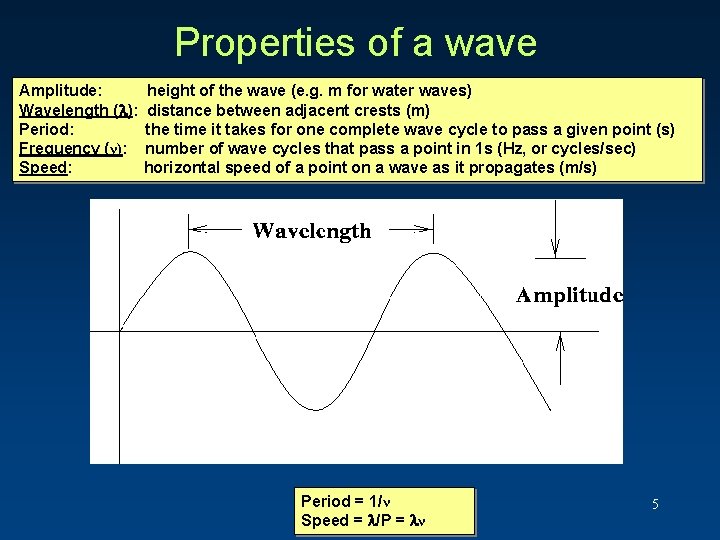
Properties of a wave Amplitude: Wavelength ( ): Period: Frequency (ν): Speed: height of the wave (e. g. m for water waves) distance between adjacent crests (m) the time it takes for one complete wave cycle to pass a given point (s) number of wave cycles that pass a point in 1 s (Hz, or cycles/sec) horizontal speed of a point on a wave as it propagates (m/s) Period = 1/ν Speed = /P = ν 5
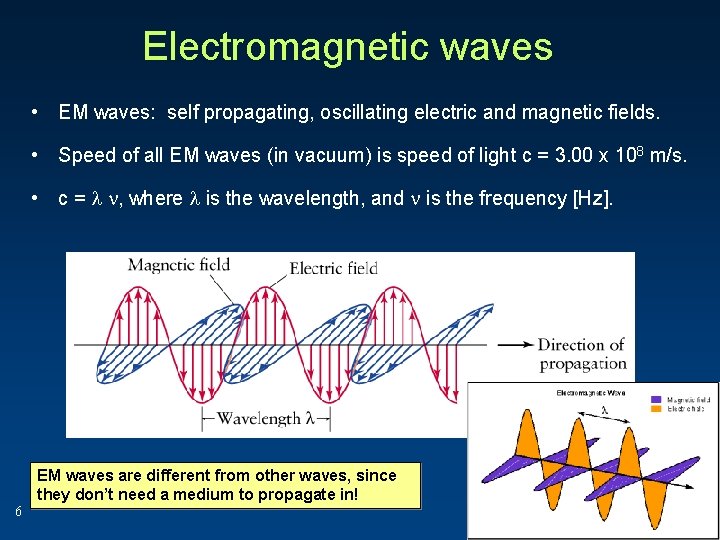
Electromagnetic waves • EM waves: self propagating, oscillating electric and magnetic fields. • Speed of all EM waves (in vacuum) is speed of light c = 3. 00 x 108 m/s. • c = , where is the wavelength, and is the frequency [Hz]. 6 EM waves are different from other waves, since they don’t need a medium to propagate in!
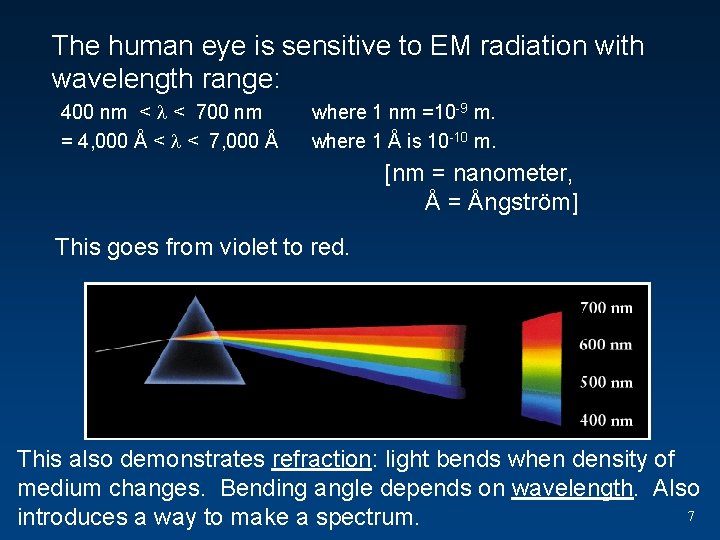
The human eye is sensitive to EM radiation with wavelength range: 400 nm < < 700 nm = 4, 000 Å < < 7, 000 Å where 1 nm =10 -9 m. where 1 Å is 10 -10 m. [nm = nanometer, Å = Ångström] This goes from violet to red. This also demonstrates refraction: light bends when density of medium changes. Bending angle depends on wavelength. Also 7 introduces a way to make a spectrum.
The electromagnetic spectrum There’s much more beyond the visible! In order of increasing wavelength: Gamma rays, X rays, Ultraviolet (UV), Visible, Infrared (IR), Microwaves, Radio. Note use of nm, m, mm, cm, m, km 8 frequen cy
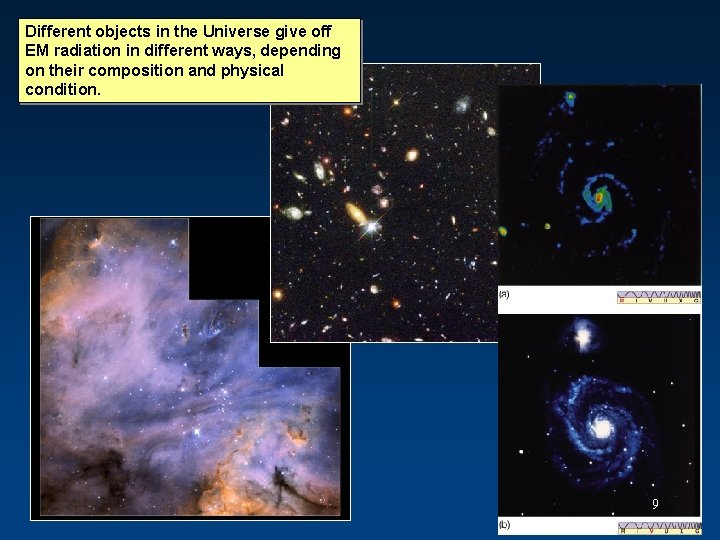
Different objects in the Universe give off EM radiation in different ways, depending on their composition and physical condition. 9
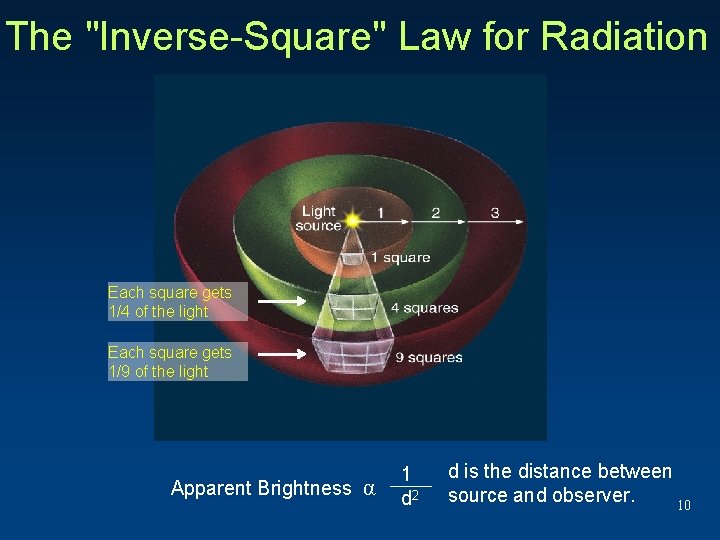
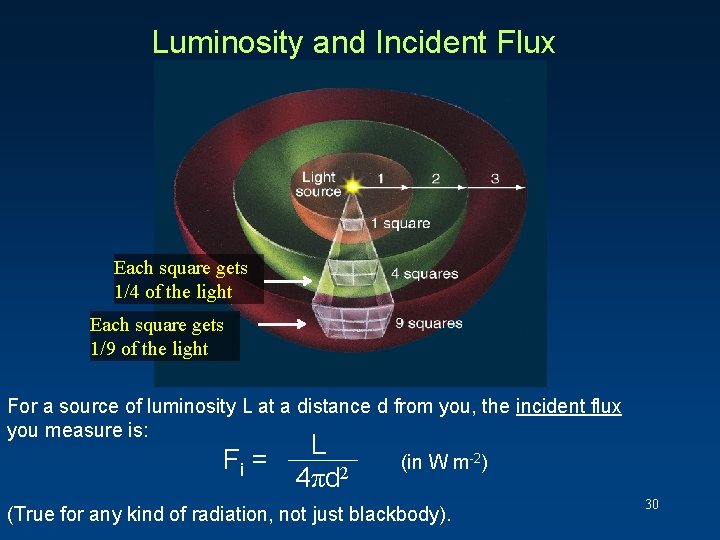
The "Inverse-Square" Law for Radiation Each square gets 1/4 of the light Each square gets 1/9 of the light Apparent Brightness α 1 d 2 d is the distance between source and observer. 10
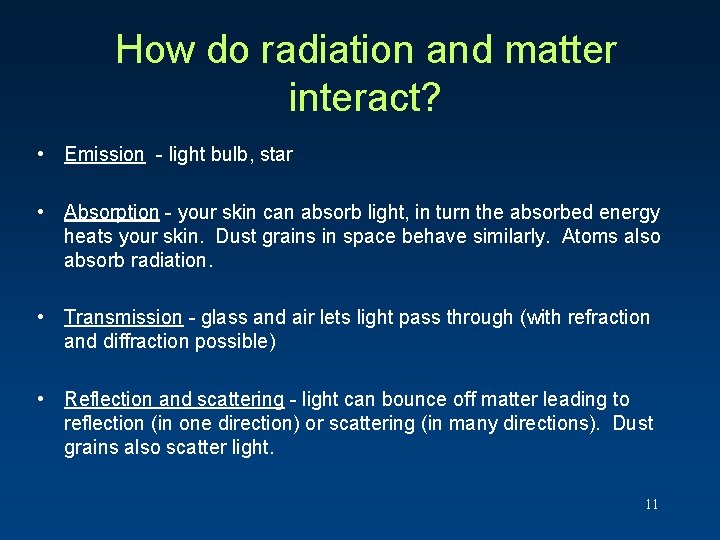
How do radiation and matter interact? • Emission - light bulb, star • Absorption - your skin can absorb light, in turn the absorbed energy heats your skin. Dust grains in space behave similarly. Atoms also absorb radiation. • Transmission - glass and air lets light pass through (with refraction and diffraction possible) • Reflection and scattering - light can bounce off matter leading to reflection (in one direction) or scattering (in many directions). Dust grains also scatter light. 11
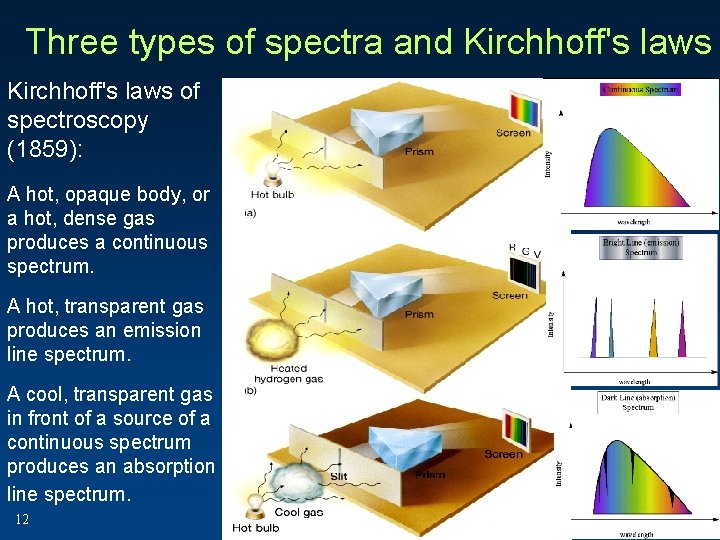
Three types of spectra and Kirchhoff's laws of spectroscopy (1859): A hot, opaque body, or a hot, dense gas produces a continuous spectrum. A hot, transparent gas produces an emission line spectrum. A cool, transparent gas in front of a source of a continuous spectrum produces an absorption line spectrum. 12
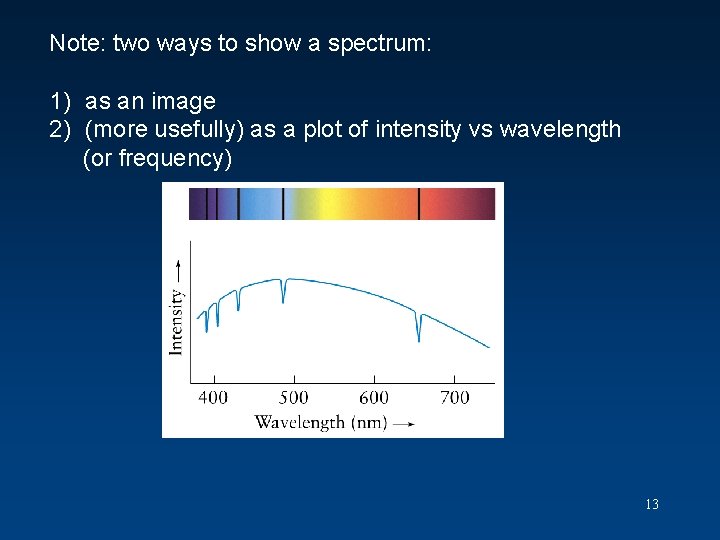
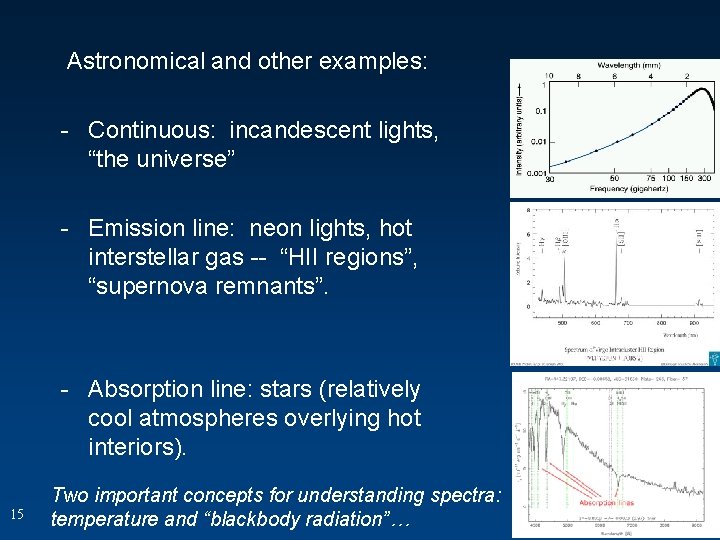
Note: two ways to show a spectrum: 1) as an image 2) (more usefully) as a plot of intensity vs wavelength (or frequency) 13
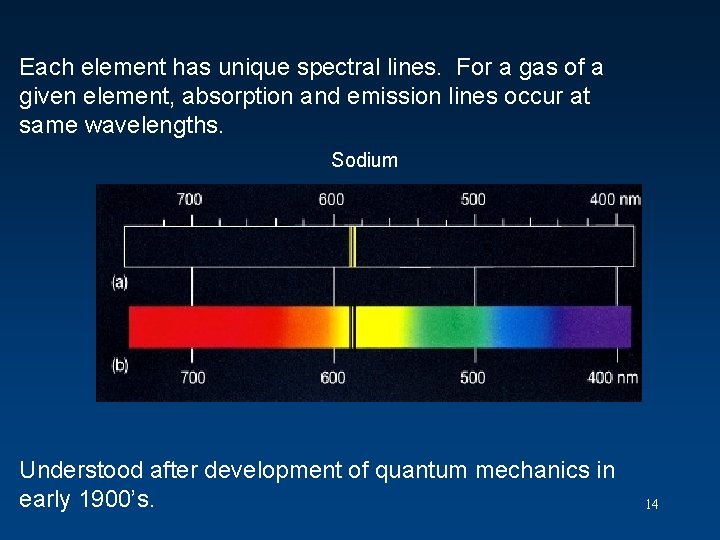
Each element has unique spectral lines. For a gas of a given element, absorption and emission lines occur at same wavelengths. Sodium Understood after development of quantum mechanics in early 1900’s. 14
Astronomical and other examples: - Continuous: incandescent lights, “the universe” - Emission line: neon lights, hot interstellar gas -- “HII regions”, “supernova remnants”. - Absorption line: stars (relatively cool atmospheres overlying hot interiors). 15 Two important concepts for understanding spectra: temperature and “blackbody radiation”…
Temperature • A measurement of the internal energy content of an object. • Solids: higher temperature means higher average vibrational energy per atom or molecule. • Gases: higher temperature means more average kinetic energy (faster speeds) per atom or molecule. • If it gets cold enough, all motion will stop. How cold is that? • Corresponds to a temperature of -273° C (-459° F) absolute zero. 16
Kelvin temperature scale • An absolute temperature scale in which the temperature is directly proportional to the internal energy of the object. – – – Related to Celsius scale, but a different zero point T(K) = T( C) + 273 C 0 K: absolute zero – all motion stops 273 K: freezing point of water 373 K: boiling point of water See box 5. 1 How do temperature and energy relate? 17
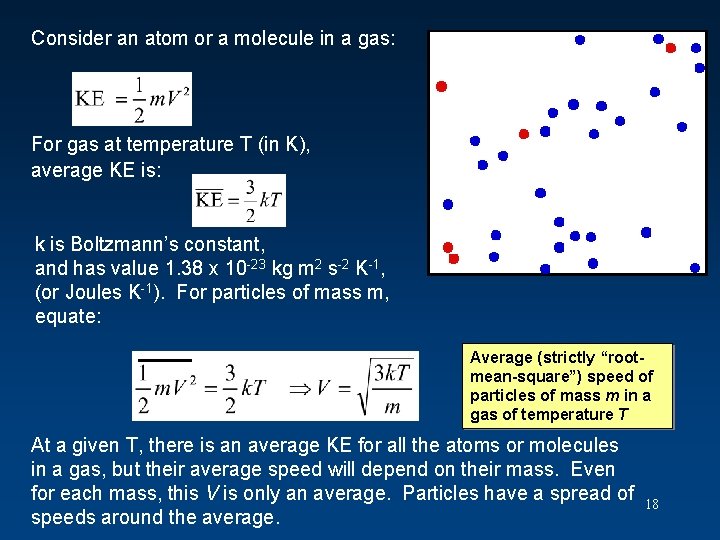
Consider an atom or a molecule in a gas: For gas at temperature T (in K), average KE is: k is Boltzmann’s constant, and has value 1. 38 x 10 -23 kg m 2 s-2 K-1, (or Joules K-1). For particles of mass m, equate: Average (strictly “rootmean-square”) speed of particles of mass m in a gas of temperature T At a given T, there is an average KE for all the atoms or molecules in a gas, but their average speed will depend on their mass. Even for each mass, this V is only an average. Particles have a spread of speeds around the average. 18
Blackbody (thermal) radiation • A blackbody is an ideal object that absorbs all radiation at all wavelengths: perfect absorber. Charcoal is a decent example. – No reflected light, no transparency • But it re-emits radiation with a continuous spectrum of characteristic shape • The more radiation an object absorbs and re-emits, the higher the temperature. • The spectrum of its radiation has no contribution from reflected light. It’s all re-emitted radiation, and spectrum depends on its temperature only (not on , e. g. , composition). • Hot, dense objects, like light bulb filaments or stars, shine with a spectrum that is approximately that of a blackbody, despite their 19 temperature being due to internally generated energy.
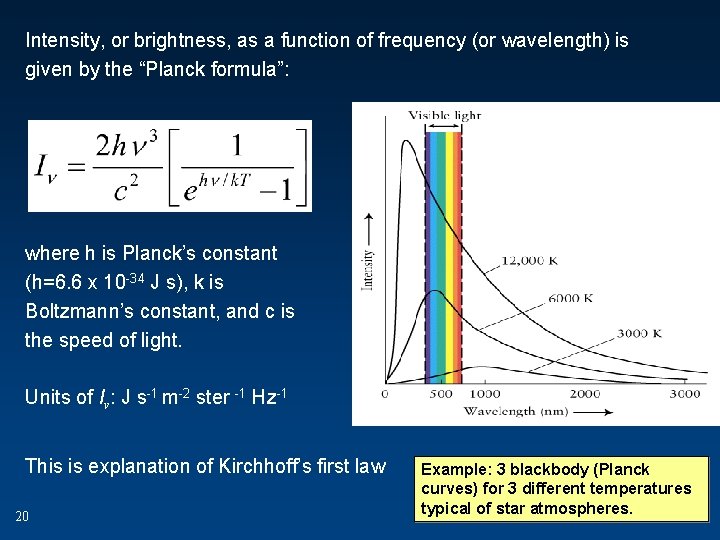
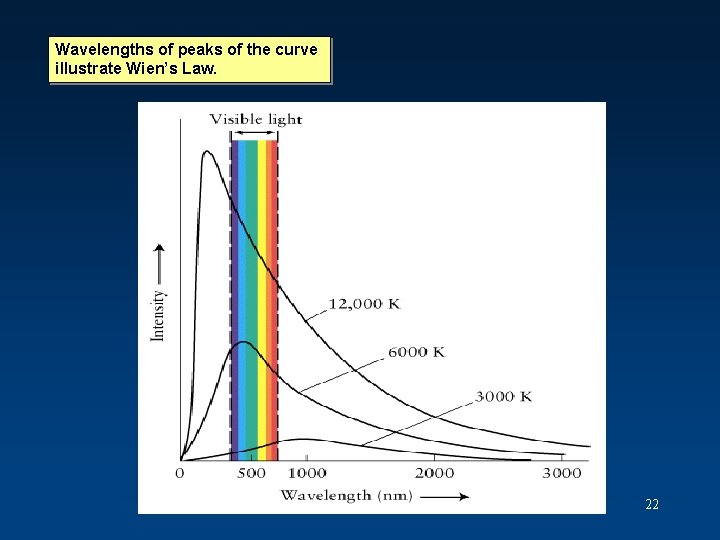
Intensity, or brightness, as a function of frequency (or wavelength) is given by the “Planck formula”: where h is Planck’s constant (h=6. 6 x 10 -34 J s), k is Boltzmann’s constant, and c is the speed of light. Units of Iν: J s-1 m-2 ster -1 Hz-1 This is explanation of Kirchhoff’s first law 20 Example: 3 blackbody (Planck curves) for 3 different temperatures typical of star atmospheres.
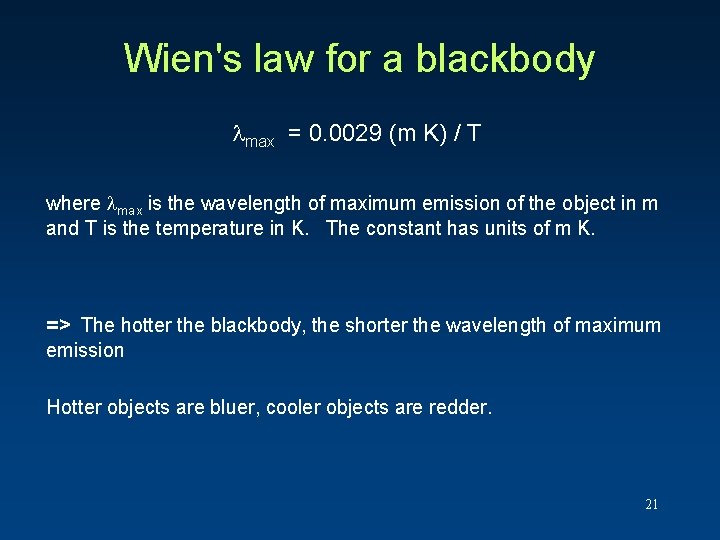
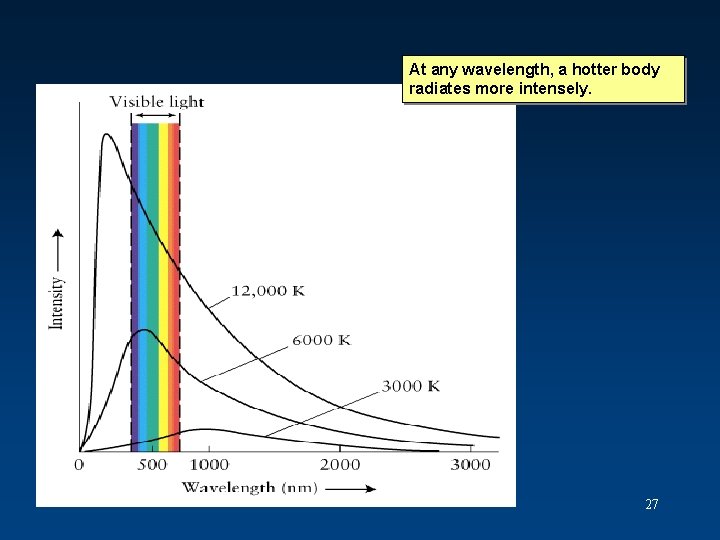
Wien's law for a blackbody max = 0. 0029 (m K) / T where max is the wavelength of maximum emission of the object in m and T is the temperature in K. The constant has units of m K. => The hotter the blackbody, the shorter the wavelength of maximum emission Hotter objects are bluer, cooler objects are redder. 21
Wavelengths of peaks of the curve illustrate Wien’s Law. 22
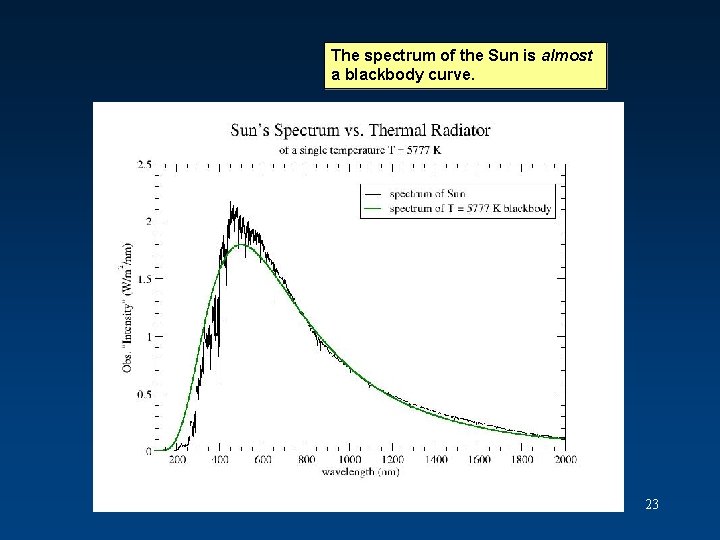
The spectrum of the Sun is almost a blackbody curve. 23
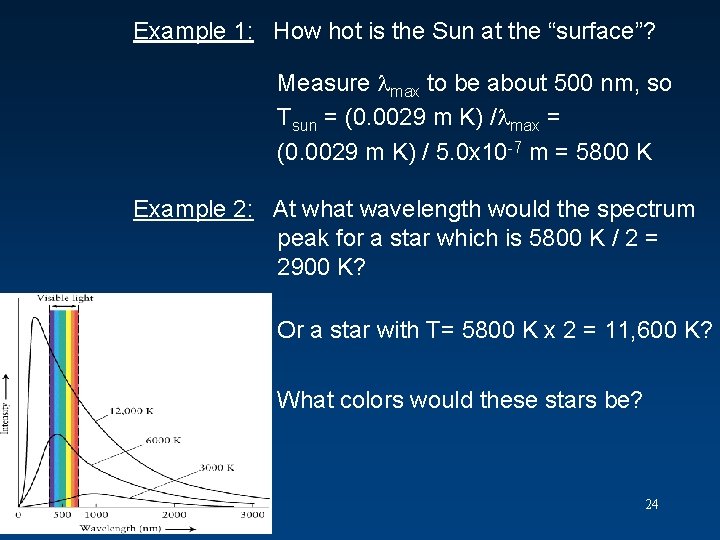
Example 1: How hot is the Sun at the “surface”? Measure max to be about 500 nm, so Tsun = (0. 0029 m K) / max = (0. 0029 m K) / 5. 0 x 10 -7 m = 5800 K Example 2: At what wavelength would the spectrum peak for a star which is 5800 K / 2 = 2900 K? Or a star with T= 5800 K x 2 = 11, 600 K? What colors would these stars be? 24
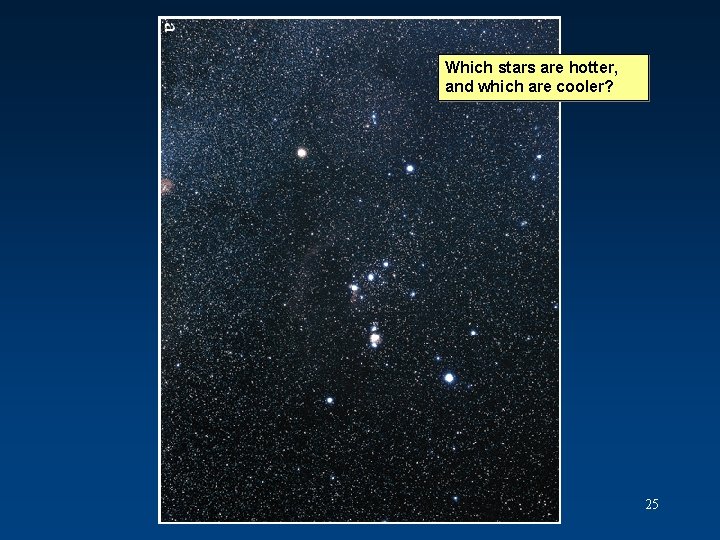
Which stars are hotter, and which are cooler? 25
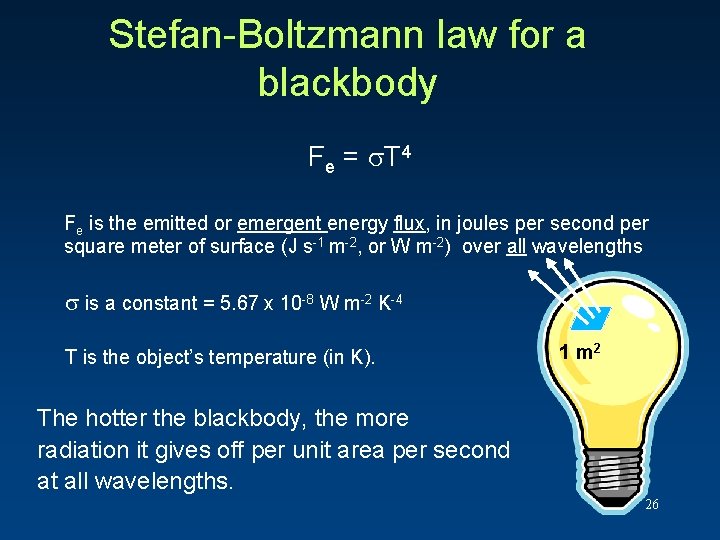
Stefan-Boltzmann law for a blackbody Fe = T 4 Fe is the emitted or emergent energy flux, in joules per second per square meter of surface (J s-1 m-2, or W m-2) over all wavelengths is a constant = 5. 67 x 10 -8 W m-2 K-4 T is the object’s temperature (in K). 1 m 2 The hotter the blackbody, the more radiation it gives off per unit area per second at all wavelengths. 26
At any wavelength, a hotter body radiates more intensely. 27
Example: If the temperature of the Sun were ten times what it is now, how much more energy would emerge from a unit area on the Sun every second? See box 5 -2 for more examples. 28
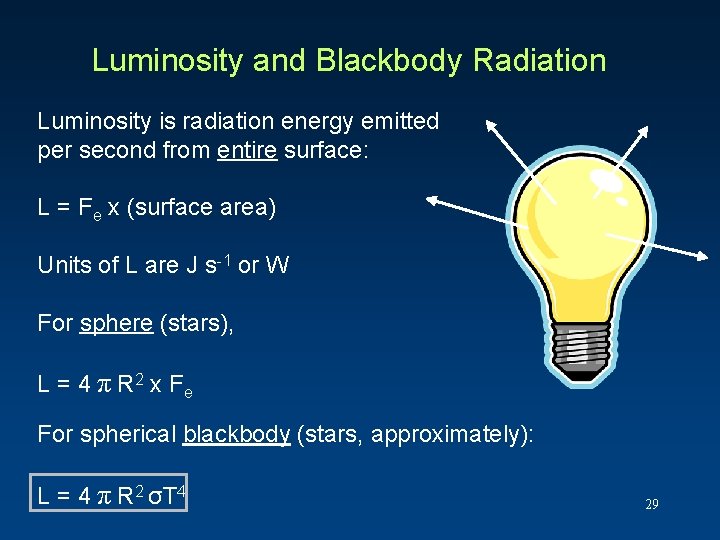
Luminosity and Blackbody Radiation Luminosity is radiation energy emitted per second from entire surface: L = Fe x (surface area) Units of L are J s-1 or W For sphere (stars), L = 4 π R 2 x F e For spherical blackbody (stars, approximately): L = 4 π R 2 σT 4 29
Luminosity and Incident Flux Each square gets 1/4 of the light Each square gets 1/9 of the light For a source of luminosity L at a distance d from you, the incident flux you measure is: L Fi = 4πd 2 (in W m-2) (True for any kind of radiation, not just blackbody). 30
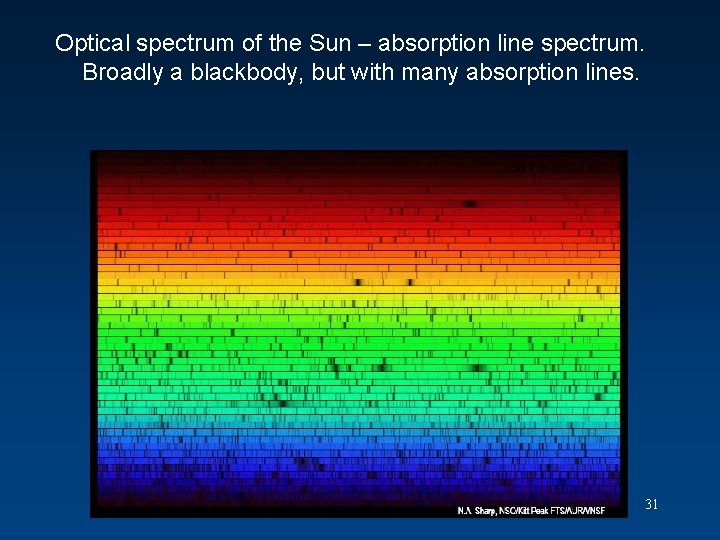
Optical spectrum of the Sun – absorption line spectrum. Broadly a blackbody, but with many absorption lines. 31
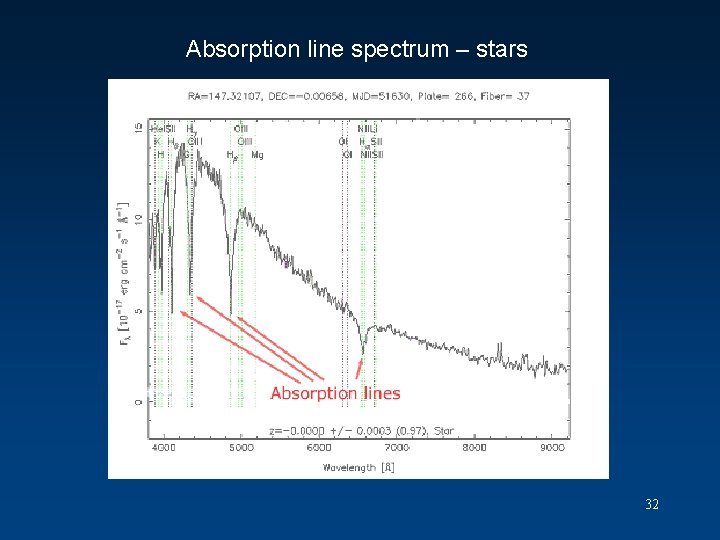
Absorption line spectrum – stars 32
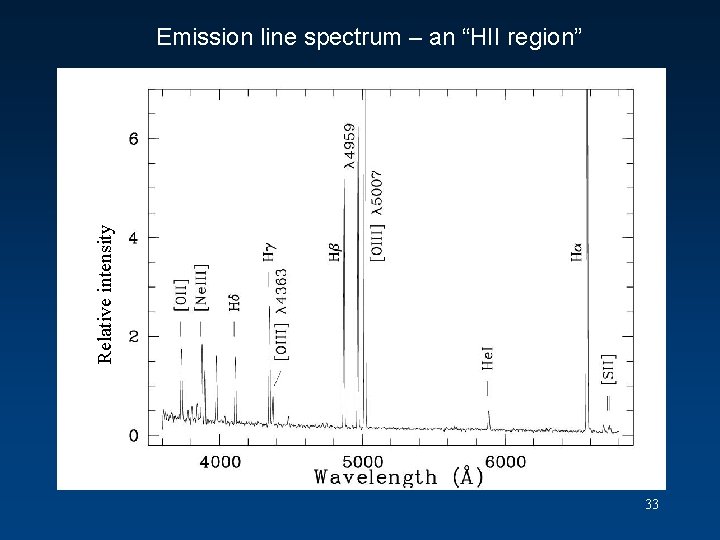
Relative intensity Emission line spectrum – an “HII region” 33
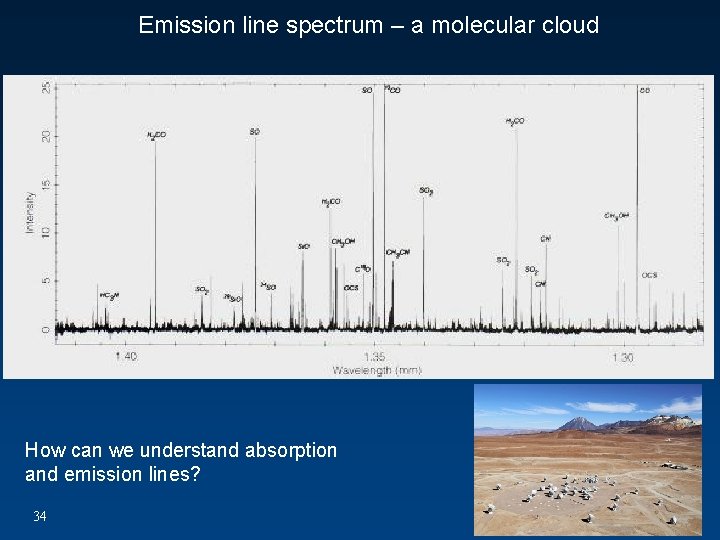
Emission line spectrum – a molecular cloud How can we understand absorption and emission lines? 34
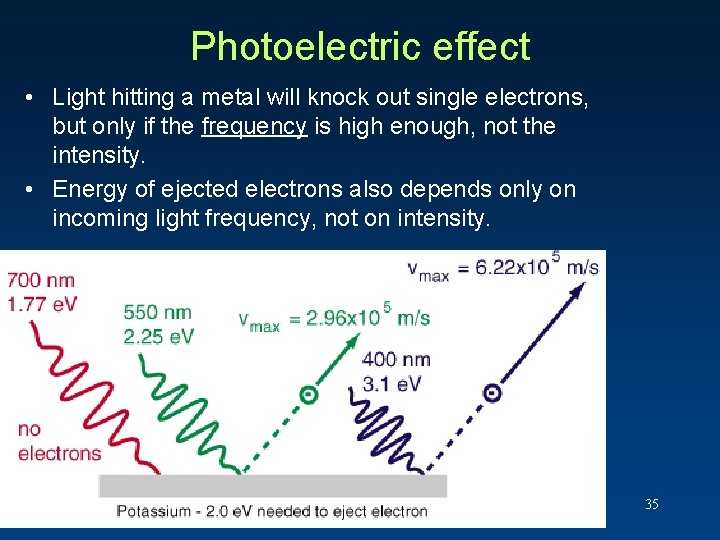
Photoelectric effect • Light hitting a metal will knock out single electrons, but only if the frequency is high enough, not the intensity. • Energy of ejected electrons also depends only on incoming light frequency, not on intensity. 35
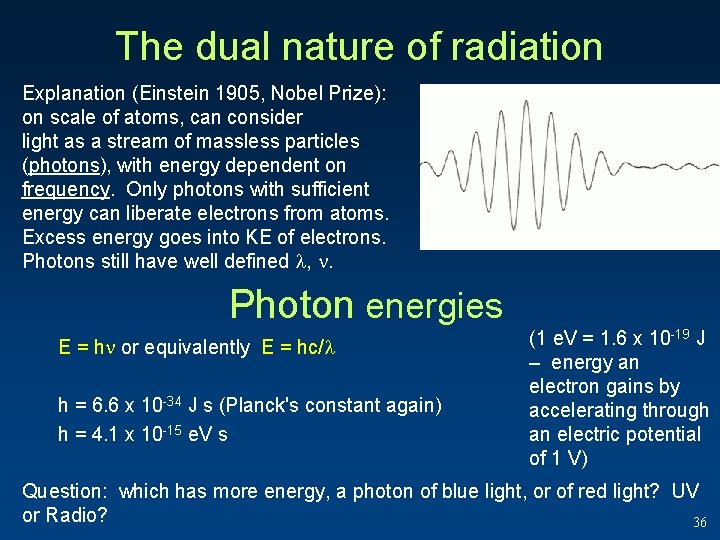
The dual nature of radiation Explanation (Einstein 1905, Nobel Prize): on scale of atoms, can consider light as a stream of massless particles (photons), with energy dependent on frequency. Only photons with sufficient energy can liberate electrons from atoms. Excess energy goes into KE of electrons. Photons still have well defined , . Photon energies E = h or equivalently E = hc/ h = 6. 6 x 10 -34 J s (Planck's constant again) h = 4. 1 x 10 -15 e. V s (1 e. V = 1. 6 x 10 -19 J – energy an electron gains by accelerating through an electric potential of 1 V) Question: which has more energy, a photon of blue light, or of red light? UV or Radio? 36
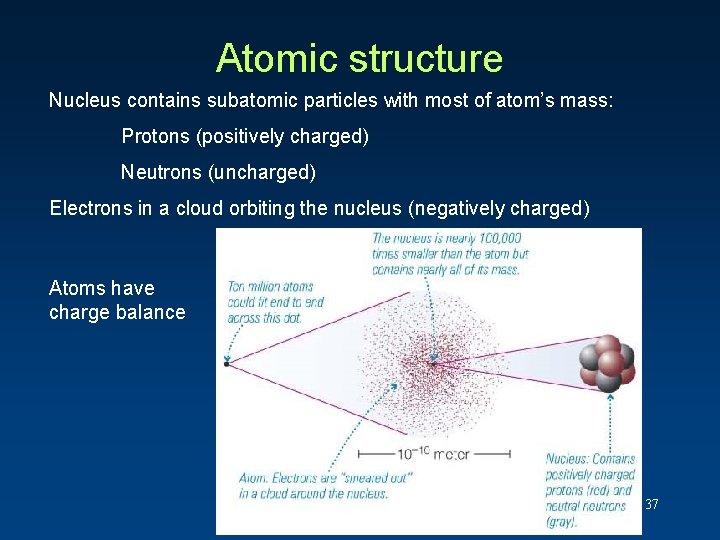
Atomic structure Nucleus contains subatomic particles with most of atom’s mass: Protons (positively charged) Neutrons (uncharged) Electrons in a cloud orbiting the nucleus (negatively charged) Atoms have charge balance 37
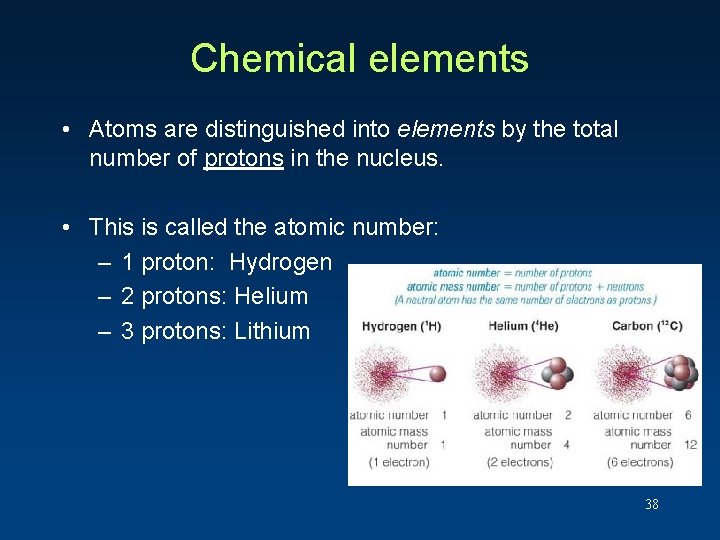
Chemical elements • Atoms are distinguished into elements by the total number of protons in the nucleus. • This is called the atomic number: – 1 proton: Hydrogen – 2 protons: Helium – 3 protons: Lithium etc. 38
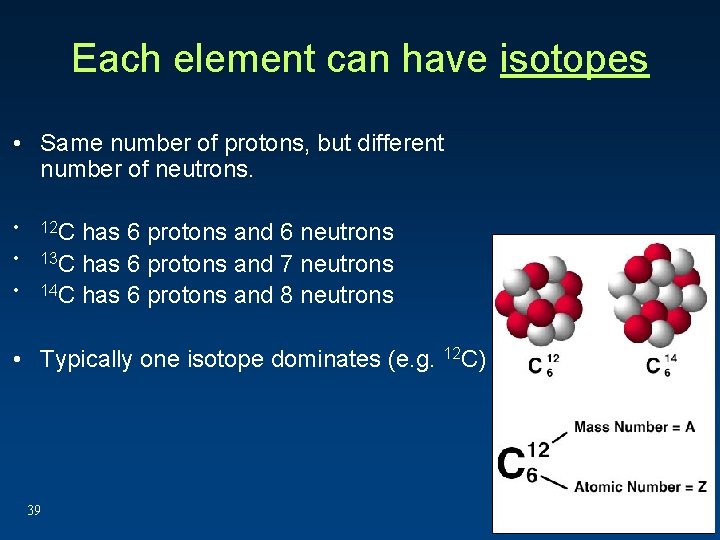
Each element can have isotopes • Same number of protons, but different number of neutrons. • • • 12 C has 6 protons and 6 neutrons 13 C has 6 protons and 7 neutrons 14 C has 6 protons and 8 neutrons • Typically one isotope dominates (e. g. 12 C) 39
How is energy stored in atoms? • Atoms can contain energy in three ways: • Mass energy E=mc 2 (because of their mass, more when we discuss Sun) • Kinetic energy (because of their motion) • Electric potential energy (because of arrangement of electrons), important here because it is altered by EM radiation • To understand how the atom reacts to EM radiation (and to interpret the results!) we need to know how atoms gain and release electric potential energy. 40
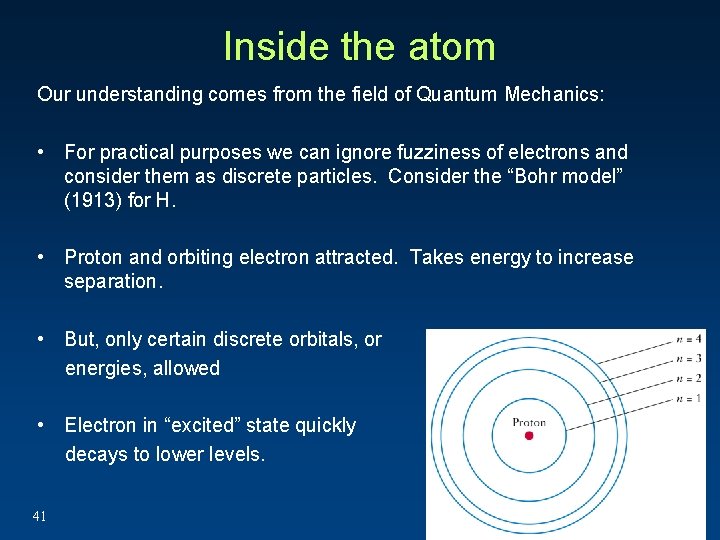
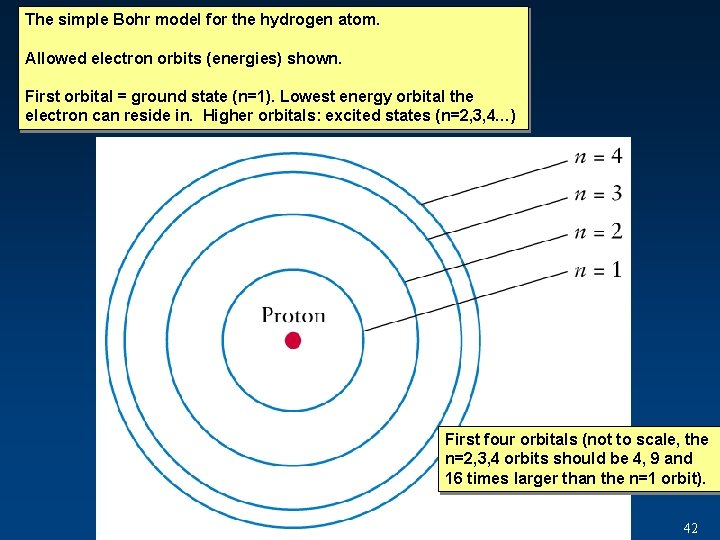
Inside the atom Our understanding comes from the field of Quantum Mechanics: • For practical purposes we can ignore fuzziness of electrons and consider them as discrete particles. Consider the “Bohr model” (1913) for H. • Proton and orbiting electron attracted. Takes energy to increase separation. • But, only certain discrete orbitals, or energies, allowed • Electron in “excited” state quickly decays to lower levels. 41
The simple Bohr model for the hydrogen atom. Allowed electron orbits (energies) shown. First orbital = ground state (n=1). Lowest energy orbital the electron can reside in. Higher orbitals: excited states (n=2, 3, 4…) First four orbitals (not to scale, the n=2, 3, 4 orbits should be 4, 9 and 16 times larger than the n=1 orbit). 42
Emission and Absorption • Electrons can get into excited states by either – Colliding (with other atoms or free electrons) – Absorbing photons • Absorption: only photons with exact energy (or frequency) to cause an excitation are absorbed, ALL others pass through unaffected (exception: ionization, see later). • Electrons get out of excited states by emitting photons in random directions. 43
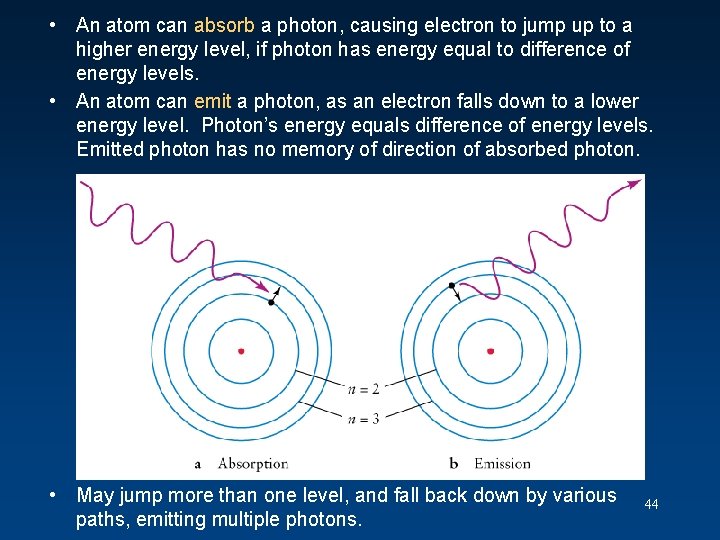
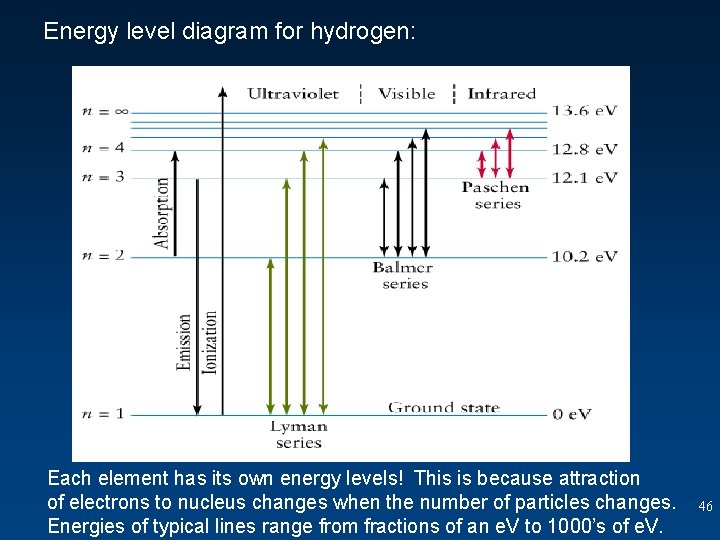
• An atom can absorb a photon, causing electron to jump up to a higher energy level, if photon has energy equal to difference of energy levels. • An atom can emit a photon, as an electron falls down to a lower energy level. Photon’s energy equals difference of energy levels. Emitted photon has no memory of direction of absorbed photon. • May jump more than one level, and fall back down by various paths, emitting multiple photons. 44
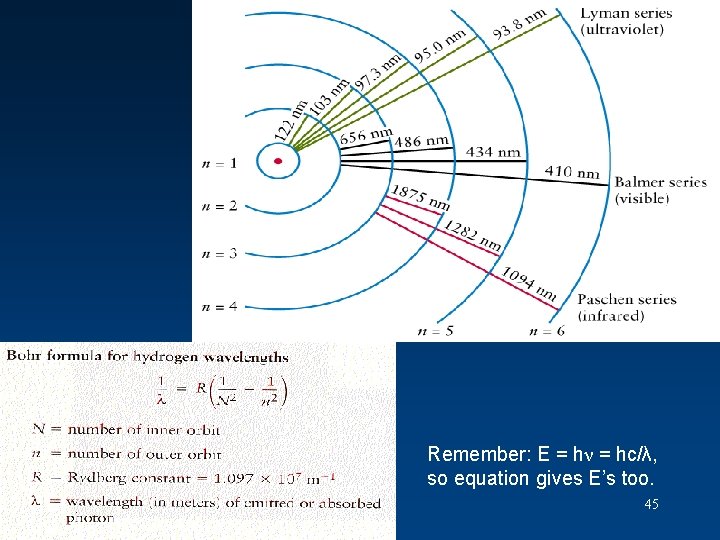
Remember: E = hν = hc/λ, so equation gives E’s too. 45
Energy level diagram for hydrogen: Each element has its own energy levels! This is because attraction of electrons to nucleus changes when the number of particles changes. Energies of typical lines range from fractions of an e. V to 1000’s of e. V. 46
Ionization • If an atom or a molecule absorbs enough energy from a photon or a collision, an electron can escape the nuclear attraction => positive ion. For H in ground state, takes at least a 13. 6 e. V photon. Any extra photon energy goes into KE of electron. • By adding electrons, you can get a negative ion • Each ion has its own energy levels • N II: N with one electron removed, O III: O with two electrons removed, etc. Takes higher energy photons to remove more electrons (e. g. O II: 13. 6 e. V, O III: 35 e. V). 47
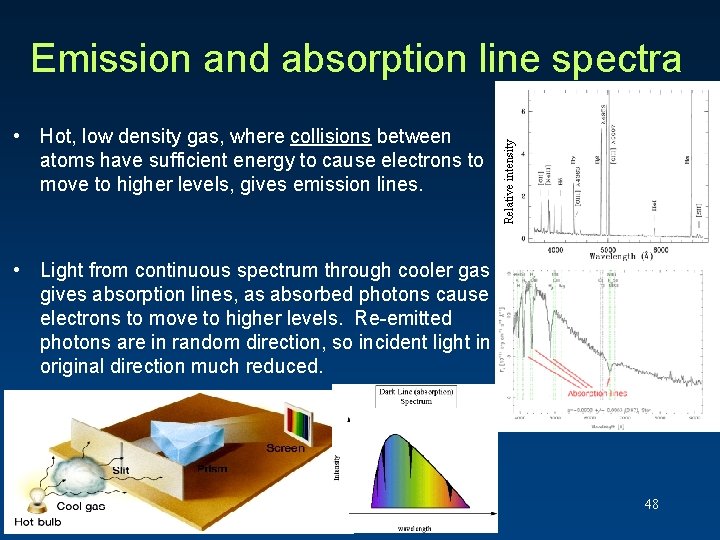
• Hot, low density gas, where collisions between atoms have sufficient energy to cause electrons to move to higher levels, gives emission lines. Relative intensity Emission and absorption line spectra • Light from continuous spectrum through cooler gas gives absorption lines, as absorbed photons cause electrons to move to higher levels. Re-emitted photons are in random direction, so incident light in original direction much reduced. 48
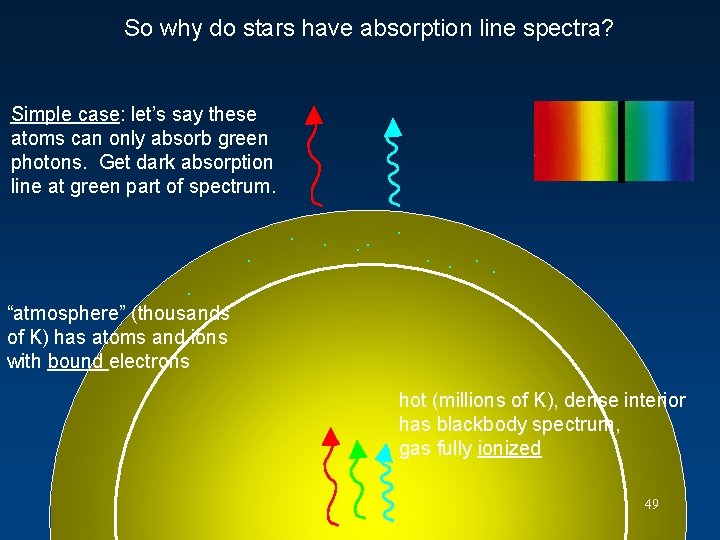
So why do stars have absorption line spectra? Simple case: let’s say these atoms can only absorb green photons. Get dark absorption line at green part of spectrum. . . “atmosphere” (thousands of K) has atoms and ions with bound electrons . . hot (millions of K), dense interior has blackbody spectrum, gas fully ionized 49
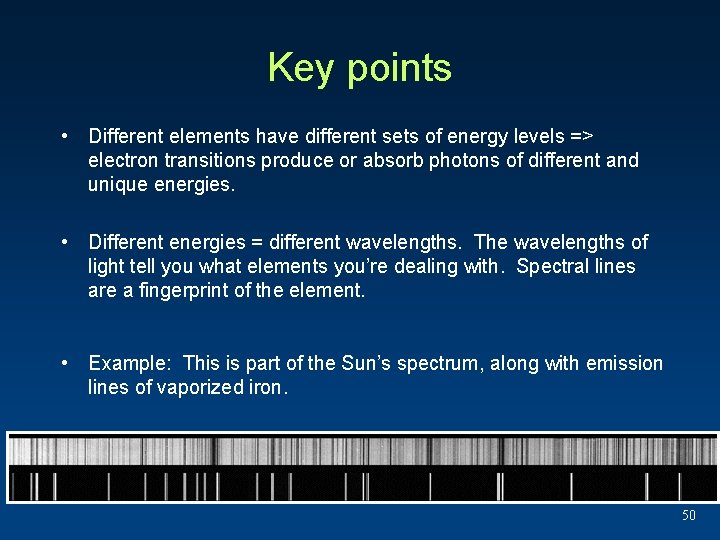
Key points • Different elements have different sets of energy levels => electron transitions produce or absorb photons of different and unique energies. • Different energies = different wavelengths. The wavelengths of light tell you what elements you’re dealing with. Spectral lines are a fingerprint of the element. • Example: This is part of the Sun’s spectrum, along with emission lines of vaporized iron. 50
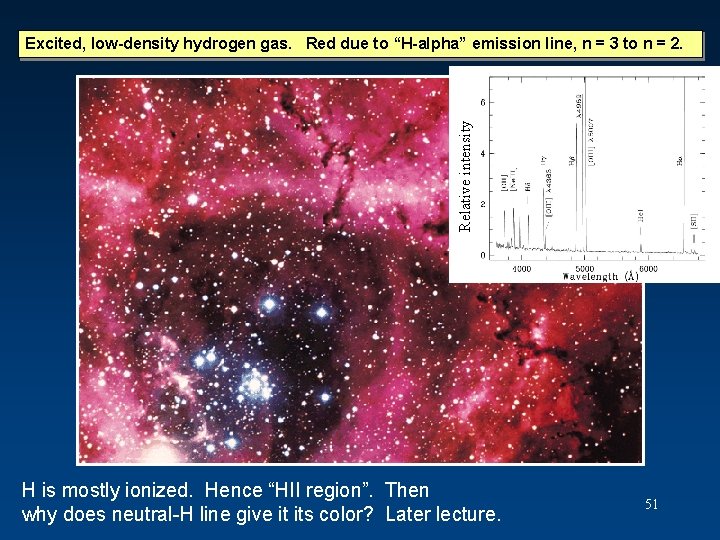
Relative intensity Excited, low-density hydrogen gas. Red due to “H-alpha” emission line, n = 3 to n = 2. H is mostly ionized. Hence “HII region”. Then why does neutral-H line give it its color? Later lecture. 51
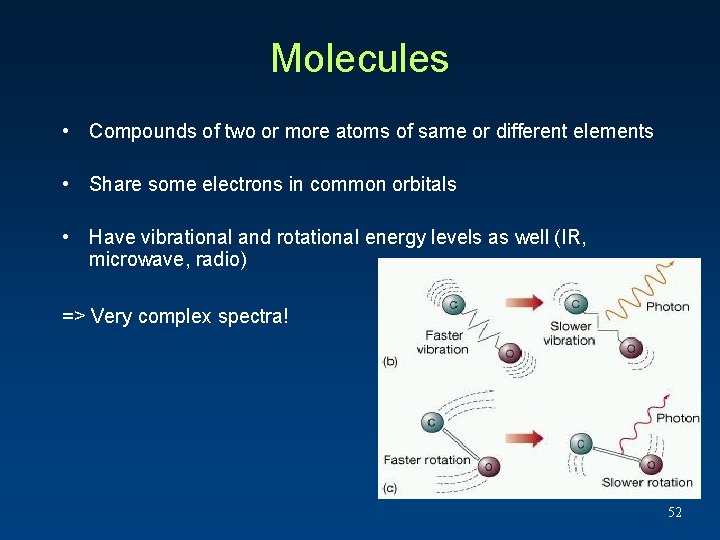
Molecules • Compounds of two or more atoms of same or different elements • Share some electrons in common orbitals • Have vibrational and rotational energy levels as well (IR, microwave, radio) => Very complex spectra! 52
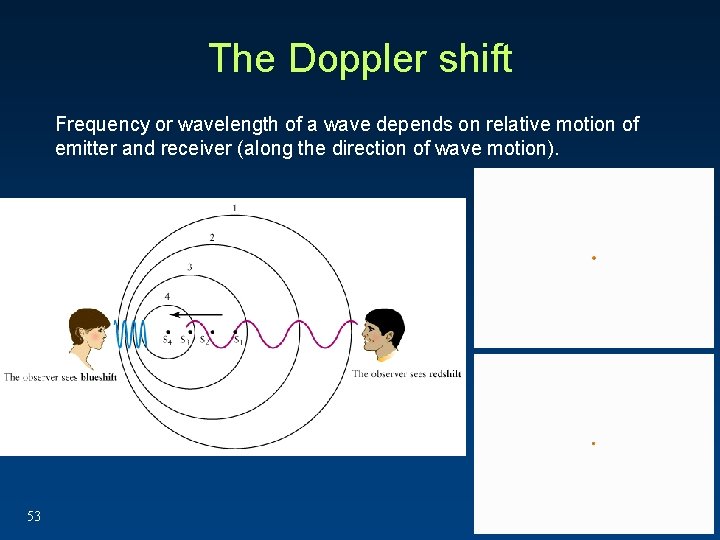
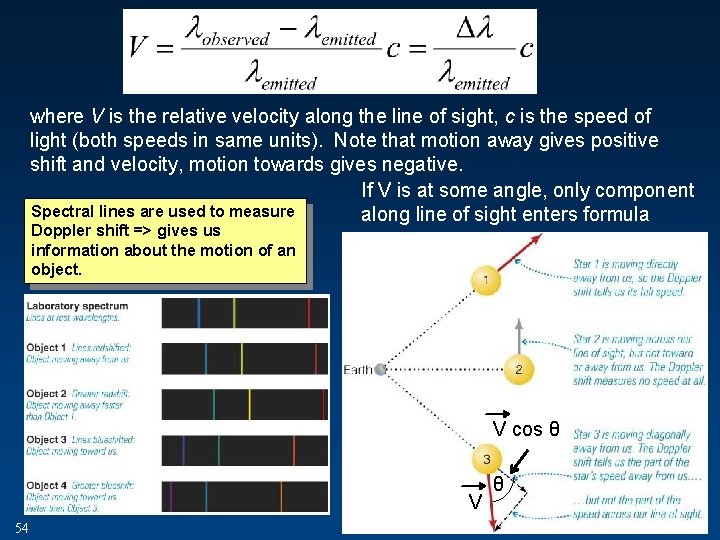
The Doppler shift Frequency or wavelength of a wave depends on relative motion of emitter and receiver (along the direction of wave motion). 53
where V is the relative velocity along the line of sight, c is the speed of light (both speeds in same units). Note that motion away gives positive shift and velocity, motion towards gives negative. If V is at some angle, only component Spectral lines are used to measure along line of sight enters formula Doppler shift => gives us information about the motion of an object. V cos θ V 54 θ
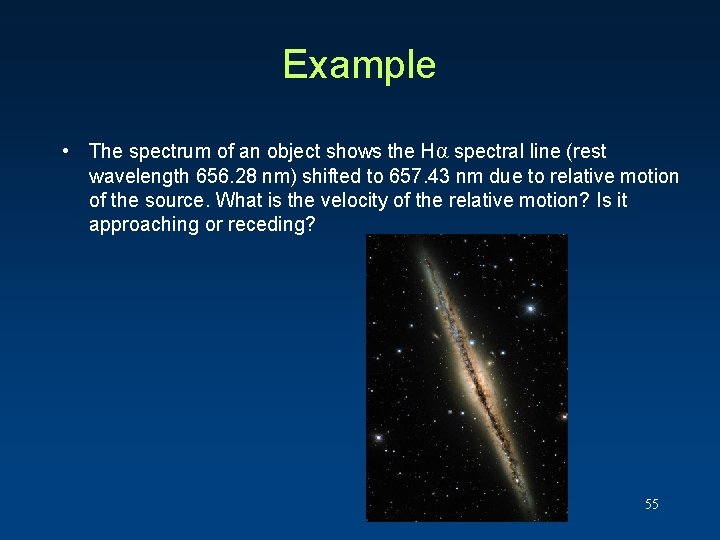
Example • The spectrum of an object shows the Hα spectral line (rest wavelength 656. 28 nm) shifted to 657. 43 nm due to relative motion of the source. What is the velocity of the relative motion? Is it approaching or receding? 55
Spectroscopy is an important tool! The spectrum of an objects tells us: • Which atoms and molecules are present, and in which proportions • Which atoms are ionized, and in which proportions • How excited the atoms are, which tells us about the physical state (cold, hot, dense) • How the object is moving Particles emit and absorb radiation in other ways too. We’ll examine them as they arise. 56
57
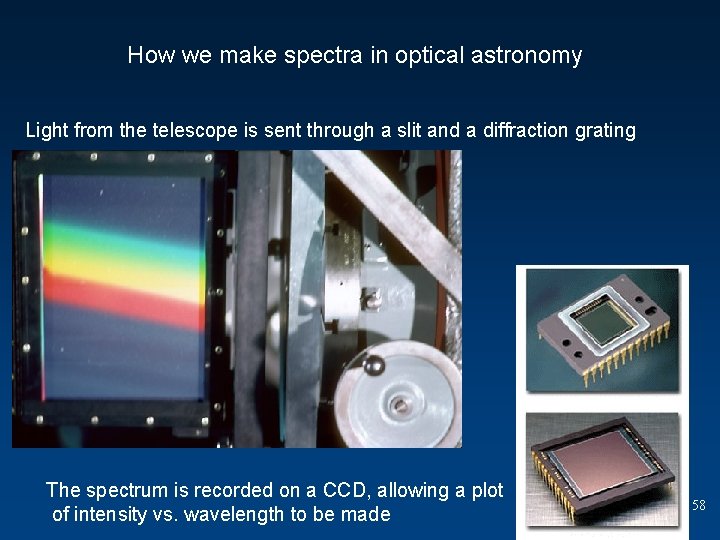
How we make spectra in optical astronomy Light from the telescope is sent through a slit and a diffraction grating The spectrum is recorded on a CCD, allowing a plot of intensity vs. wavelength to be made 58