
Properties of Concrete Introduction Overview What is concrete
- Slides: 39
“Properties of Concrete” Introduction
Overview • What is concrete made of? • What Is Concrete Used For? • Why Is Concrete Used? • Why Do We Reinforce Concrete? • Curing of concrete
What is concrete made of?
What is concrete made of? • Concrete is basically a mixture of two components: – Paste – Aggregates • Paste (Portland cement, water, and air) • Aggregates (sand, gravel, crushed stone)
CEMENT • Cement (Dry powder of very fine particles) is a building material made by grinding calcined limestone and clay into a fine powder • Portland Cement chemical composition – Limestone, shale and clay • Ca. O (lime) • Al 2 O 3 (Alumina) • SO 3 (Sulfite)
CEMENT • When mixed with water, forms a paste • it undergoes chemical changes (chemical reaction-Hydration) • Glue paste coats all the aggregates together • hardens and forms a solid mass
WATER • Water good for drinking is good for concrete……
WATER • needed for two purposes: – chemical reaction with cement – workability • only 1/3 of the water is needed for chemical reaction • extra water remains in pores and holes • results in porosity • Good for preventing plastic shrinkage cracking and workability • Bad for permeability, strength, durability.
AGGREGATES • • • cheap fillers hard material provide for volume stability reduce volume changes provide abrasion resistance
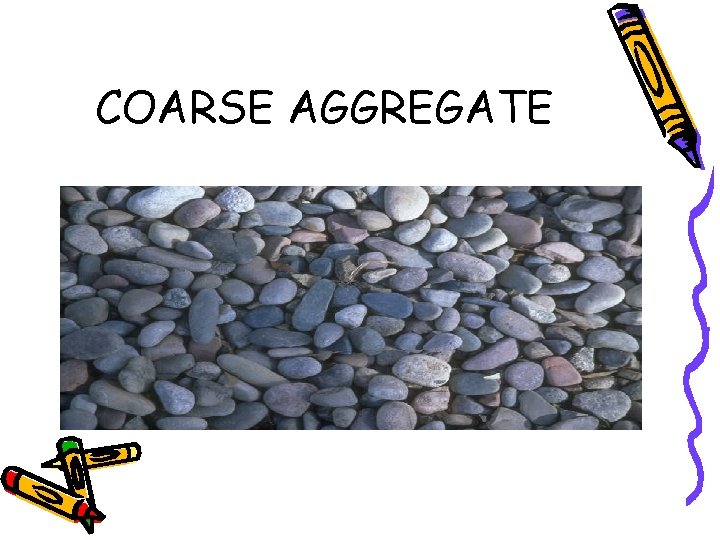
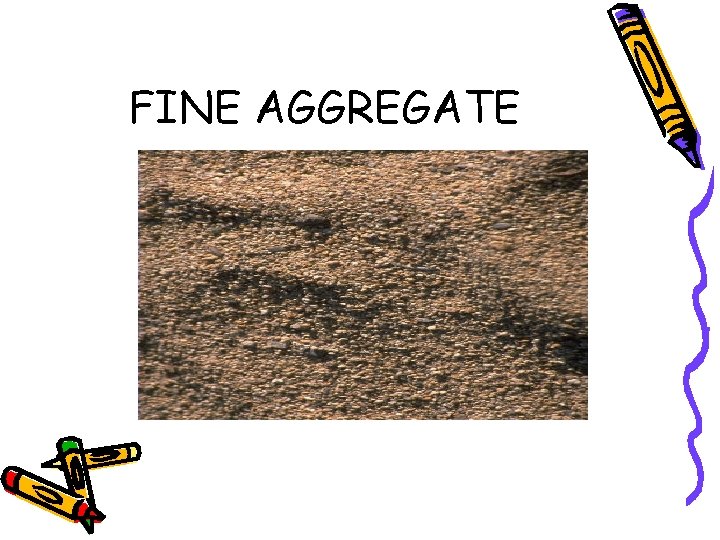
AGGREGATE • Aggregate are divided into two groups: – Fine - AASHTO M-6 or ASTM C-33 – Coarse - AASHTO M-80 or ASTM C-33 • Fine aggregate consist of natural or manufactured sand with particle size up to 3/8 inch • Coarse aggregate particles are retained on the #4 sieve and range up to 6 inches
COARSE AGGREGATE
FINE AGGREGATE
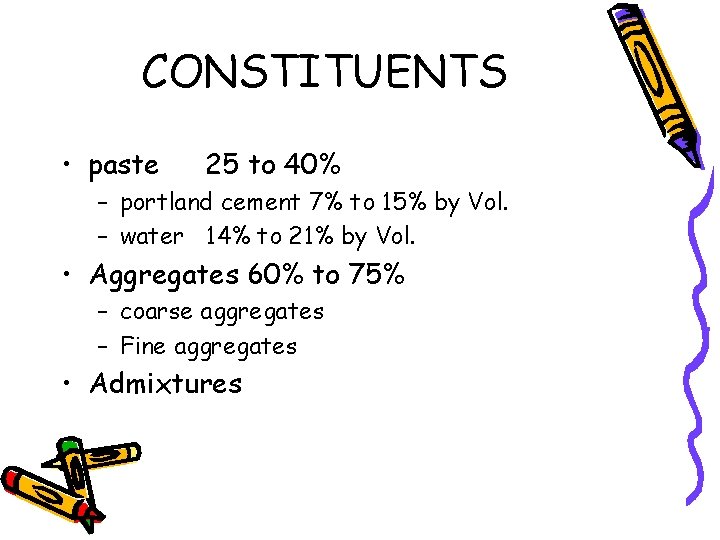
CONSTITUENTS • paste 25 to 40% – portland cement 7% to 15% by Vol. – water 14% to 21% by Vol. • Aggregates 60% to 75% – coarse aggregates – Fine aggregates • Admixtures
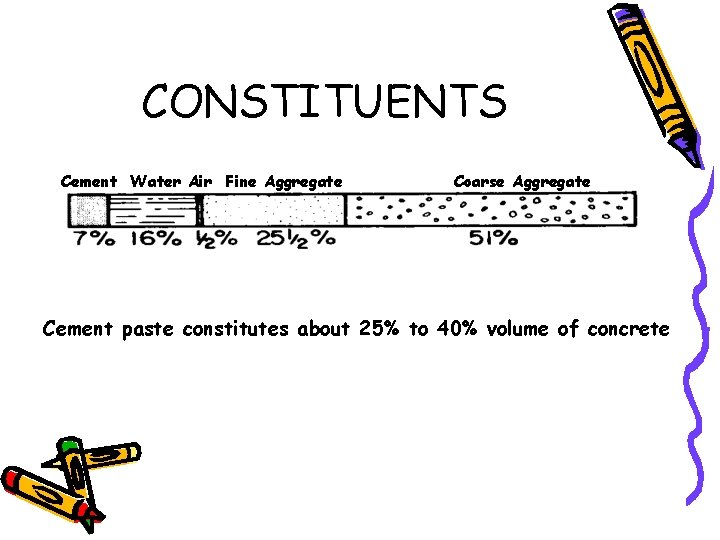
CONSTITUENTS Cement Water Air Fine Aggregate Coarse Aggregate Cement paste constitutes about 25% to 40% volume of concrete
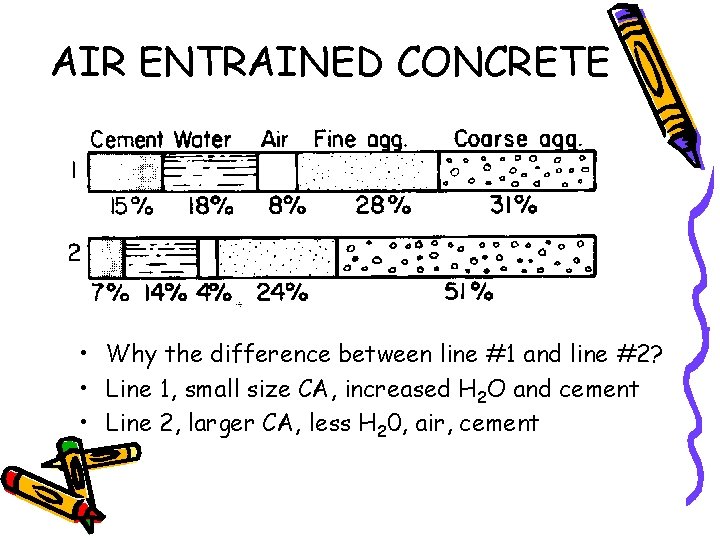
AIR ENTRAINED CONCRETE • Why the difference between line #1 and line #2? • Line 1, small size CA, increased H 2 O and cement • Line 2, larger CA, less H 20, air, cement
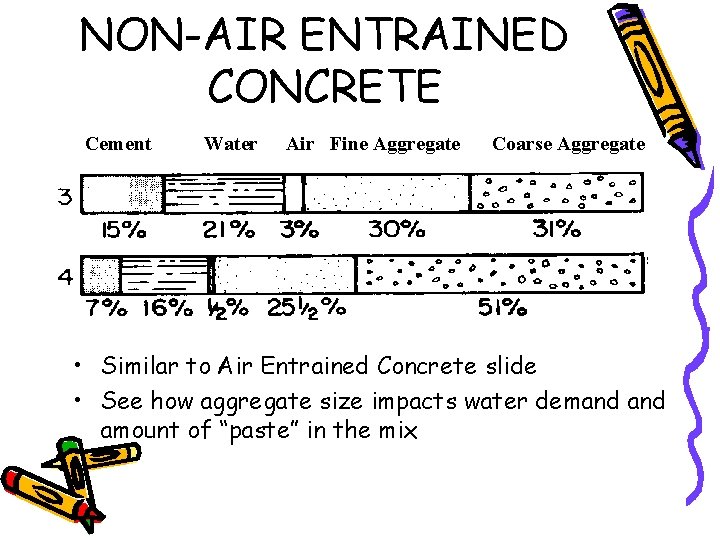
NON-AIR ENTRAINED CONCRETE Cement Water Air Fine Aggregate Coarse Aggregate • Similar to Air Entrained Concrete slide • See how aggregate size impacts water demand amount of “paste” in the mix
ADMIXTURES • Plastic and hardened properties of concrete may be changed by adding admixtures • Admixtures are commonly used to: • • increase set time decrease set time increase workability adjust other concrete properties • reduce water demand • entrain air • inhibit corrosion
ADMIXTURES • chemical – – retarders accelerators water reducing air entraining • mineral – fly ash – silica fume – slags
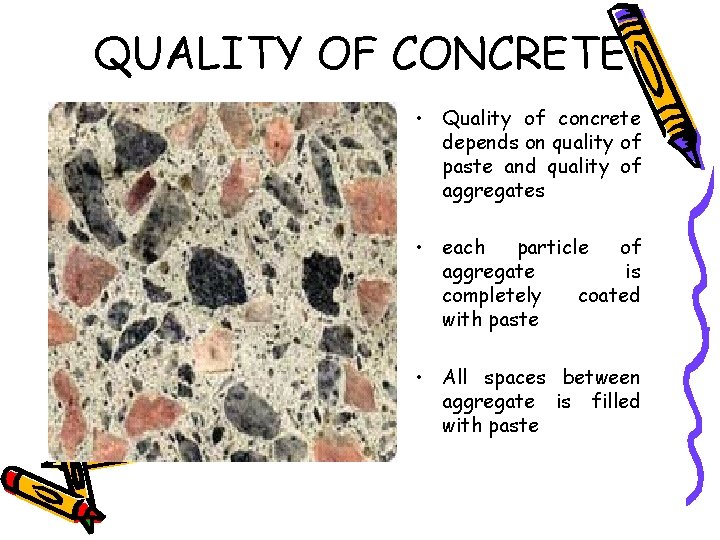
QUALITY OF CONCRETE • Quality of concrete depends on quality of paste and quality of aggregates • each particle of aggregate is completely coated with paste • All spaces between aggregate is filled with paste
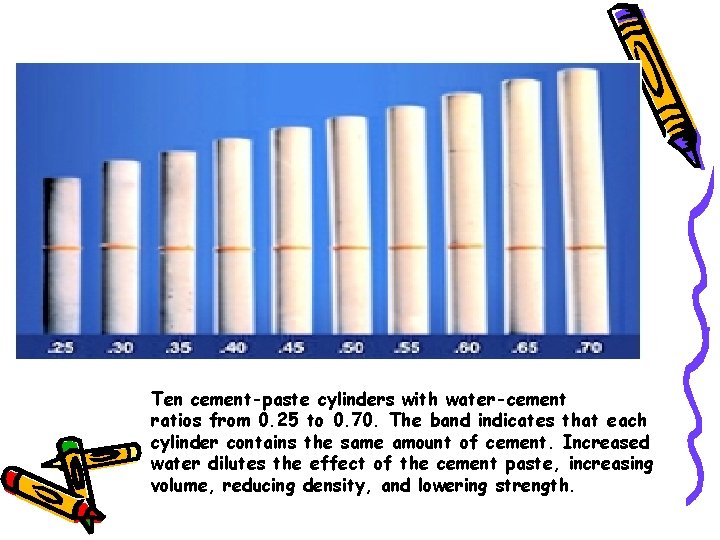
QUALITY OF CONCRETE Is determined by: • W/C Ratio – • Advantage of reducing water – Increased compressive and flexural strength – lower permeability – increased resistance to weathering – reduced shrinkage cracking tendencies • The less water used, the better quality of concrete, provided it can be consolidated properly.
Ten cement-paste cylinders with water-cement ratios from 0. 25 to 0. 70. The band indicates that each cylinder contains the same amount of cement. Increased water dilutes the effect of the cement paste, increasing volume, reducing density, and lowering strength.
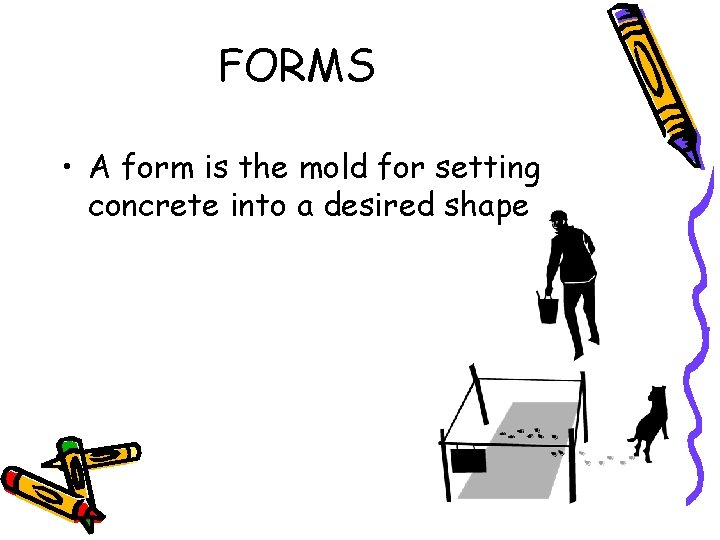
FORMS • A form is the mold for setting concrete into a desired shape
What Is Concrete Used For?
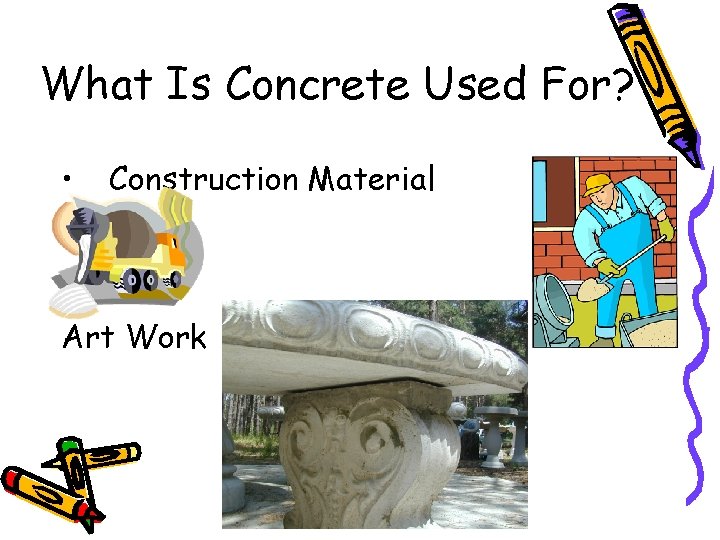
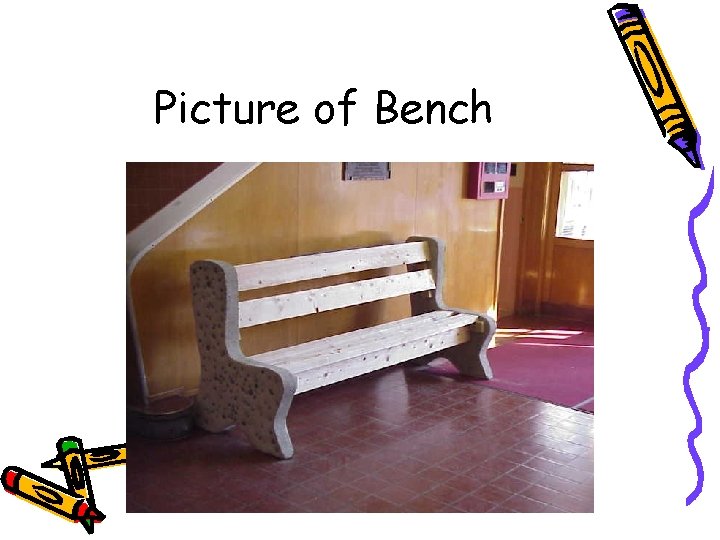
What Is Concrete Used For? • Construction Material Art Work
Picture of Bench
Why Is Concrete Used?
Why Is Concrete Used? • Economics – Inexpensive, readily available • Material Properties – – Long Lasting Molded into a desired shape Great insulator Hard
Material Properties (cont. ) • Great Compressive Strength (up to 8000 psi and even more than that) • Poor Tensile Strength (almost 0) – Reinforcement methods ($)
Why Do We Reinforce Concrete?
Why Do We Reinforce Concrete? • Prevent cracking due to tension forces
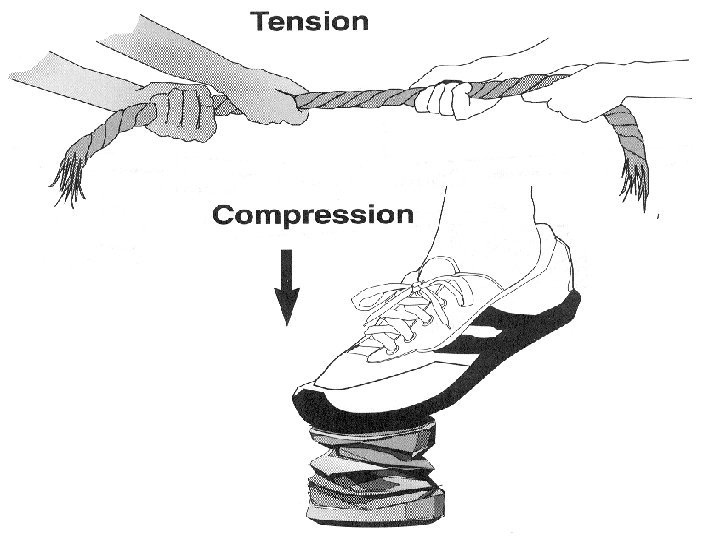
Question • What is the difference between tension and compression?
Question • Why would concrete never be used in tension?
How Do We Reinforce Concrete? • Steel rebar – Excellent in tension, poor in compression
CURING OF CONCRETE
CURING OF CONCRETE • Over time concrete will cure, which is a hardening process. • Concrete has a 28 day curing time, this is the amount of time it takes to be considered completely cured
Curing • • Critical to durable concrete Increases strength Decreases permeability Increases durability
Curing Concrete • How concrete is cured: – – – Ponding or Immersion Spraying or Fogging Wet Coverings Impervious Paper Plastic Sheets Membrane-Forming Curing Compounds
Questions? • Remember: – Use Common Sense – Temperature effects on your body have very similar effects on concrete – If you are not sure, ASK!!!