
PROPERTIES OF AMINO ACIDS A PHYSICAL PROPERTIES Solubility
PROPERTIES OF AMINO ACIDS

A. PHYSICAL PROPERTIES Solubility : Most of the amino acids are usually soluble in water and insoluble in organic solvents. Melting point : Amino acids generally melt at higher temperatures, often above 200°C. Taste : Amino acids may be sweet (Gly, Ala, Val), tasteless (Leu) or bitter (Arg, Ile), Monosodium glutamate (MSG; ajinomotto) is used as a flavouring agent in food industry.
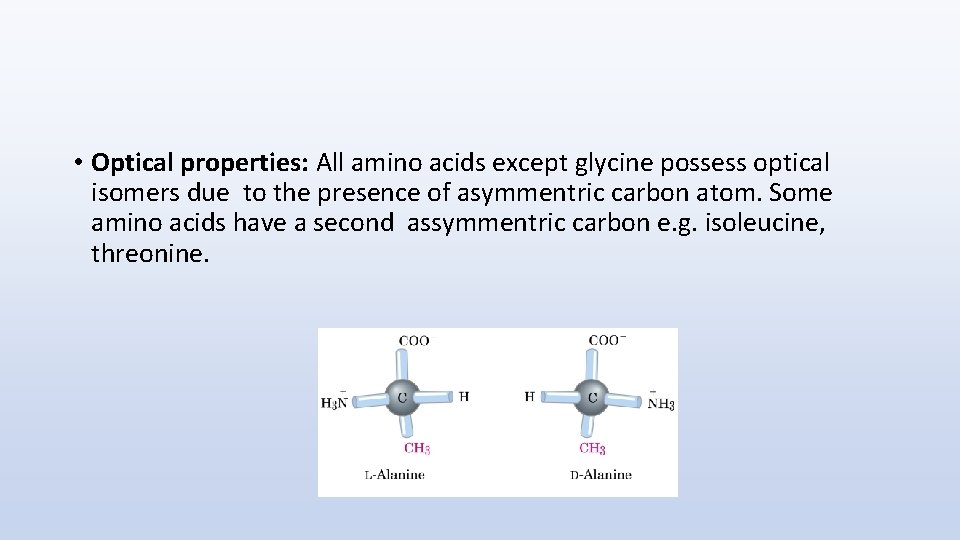
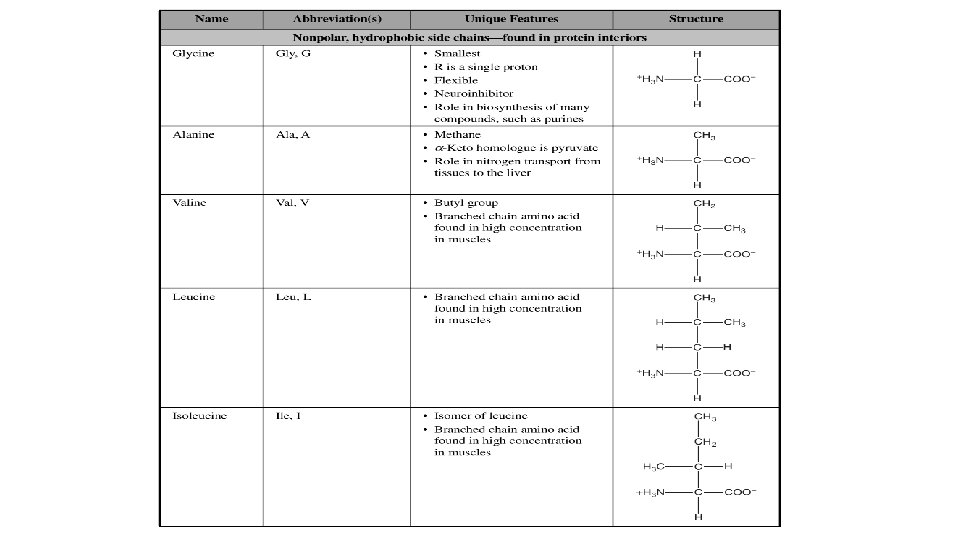
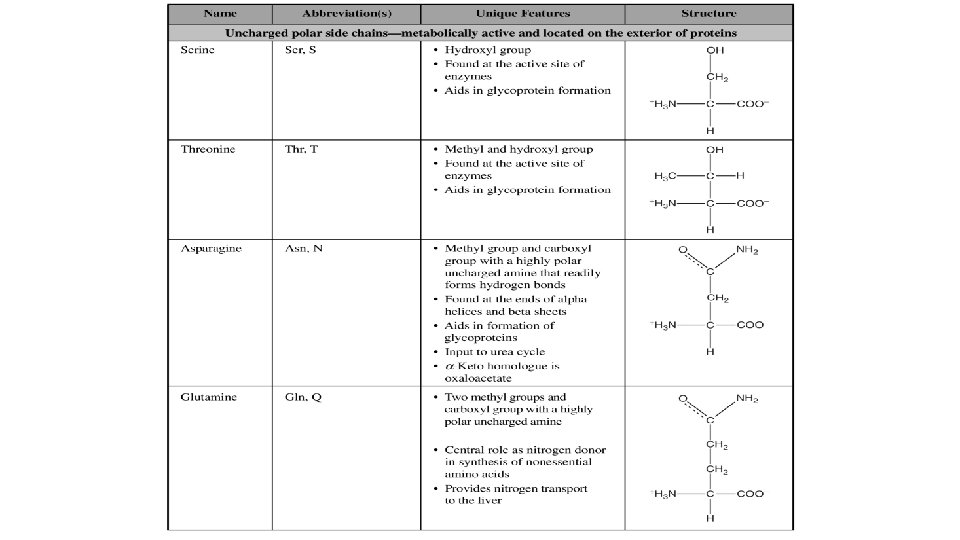
• Optical properties: All amino acids except glycine possess optical isomers due to the presence of asymmentric carbon atom. Some amino acids have a second assymmentric carbon e. g. isoleucine, threonine.

• Amino acids as ampholytes : amino acid contains both acidic(-COOH) and basic (-NH 2) groups. They can donate a proton or accept a proton , hence amino acids are regarded as ampholytes
Zwitterion or dipolar ion: • In zwitterions of amino acids with uncharged side chain, the +ve and –ve Charges cancel one another • Amino acids in which the +ve and –ve charges are balanced is at its isoelectric point • The p. H at which this balancing occurs is isoelectric p. H • An amino acids is least soluble at its isoelectric p. H • Increases solubility at lower p. H as well as at higher p. H
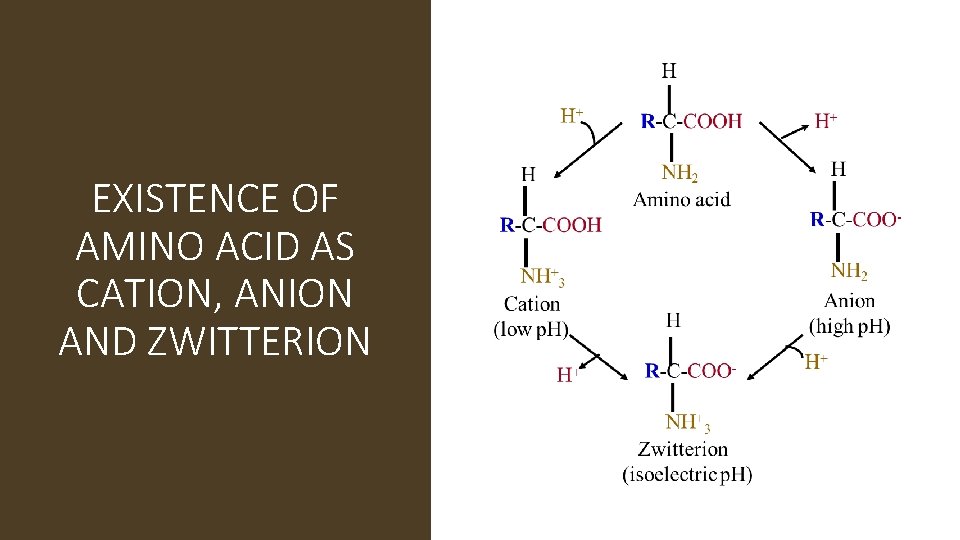
EXISTENCE OF AMINO ACID AS CATION, ANION AND ZWITTERION
Isoelectric p. H (symbol p. I): the p. H at which a molecule exists as a zwitter ion and carries no net charge making the molecule electrically neutral
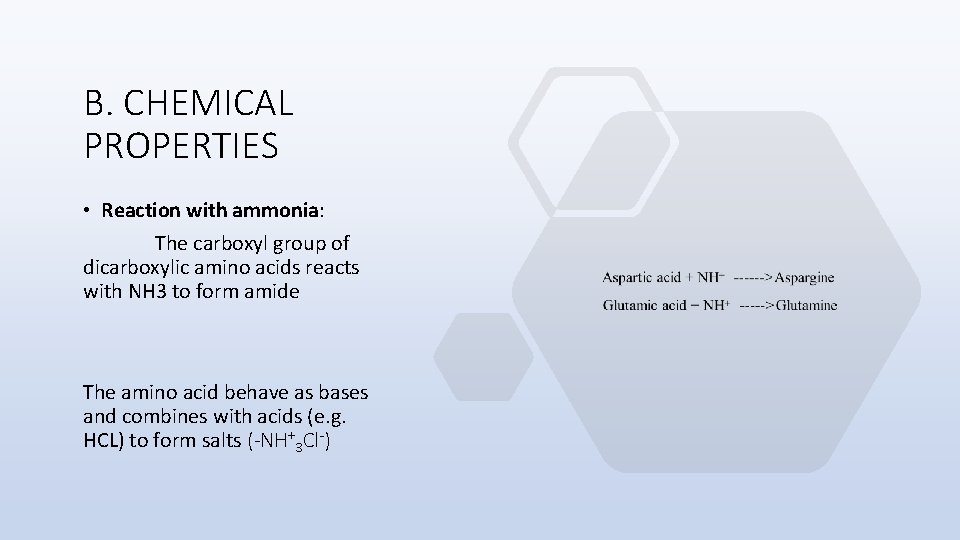
B. CHEMICAL PROPERTIES • Reaction with ammonia: The carboxyl group of dicarboxylic amino acids reacts with NH 3 to form amide The amino acid behave as bases and combines with acids (e. g. HCL) to form salts (-NH+3 Cl-)
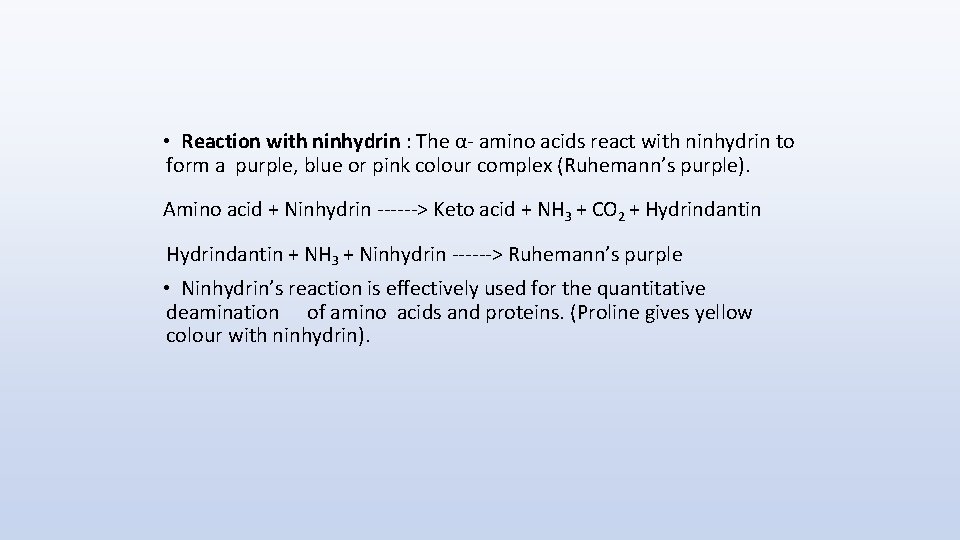
• Reaction with ninhydrin : The α- amino acids react with ninhydrin to form a purple, blue or pink colour complex (Ruhemann’s purple). Amino acid + Ninhydrin ------> Keto acid + NH 3 + CO 2 + Hydrindantin + NH 3 + Ninhydrin ------> Ruhemann’s purple • Ninhydrin’s reaction is effectively used for the quantitative deamination of amino acids and proteins. (Proline gives yellow colour with ninhydrin).
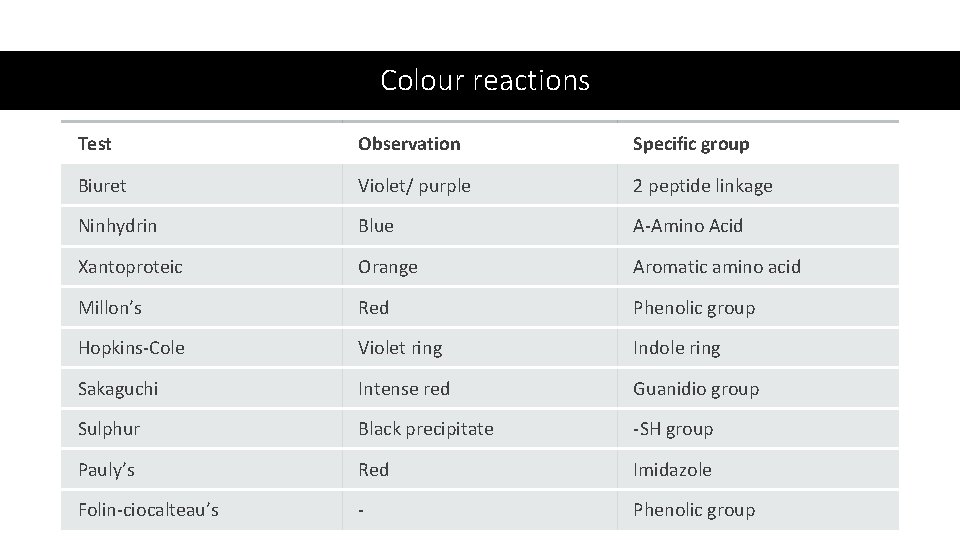
Colour reactions Test Observation Specific group Biuret Violet/ purple 2 peptide linkage Ninhydrin Blue Α-Amino Acid Xantoproteic Orange Aromatic amino acid Millon’s Red Phenolic group Hopkins-Cole Violet ring Indole ring Sakaguchi Intense red Guanidio group Sulphur Black precipitate -SH group Pauly’s Red Imidazole Folin-ciocalteau’s - Phenolic group
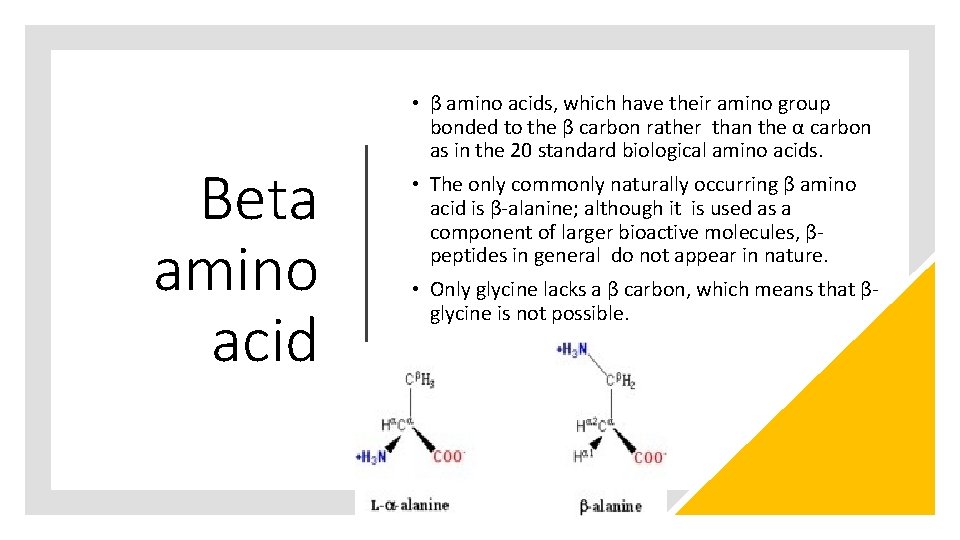
Beta amino acid • β amino acids, which have their amino group bonded to the β carbon rather than the α carbon as in the 20 standard biological amino acids. • The only commonly naturally occurring β amino acid is β-alanine; although it is used as a component of larger bioactive molecules, βpeptides in general do not appear in nature. • Only glycine lacks a β carbon, which means that βglycine is not possible.
BETA ALANINE • Also known as 3 -aminopropanoic acid, • It is a non-essential amino acid and is the only naturally occurring beta-amino acid. • Not to be confused with alanine, beta- alanine is classified as a non- proteinogenic amino acid as it is not used in the building of proteins • β-Alanine is the rate-limiting precursor of carnosine • Supplementation with β-alanine has been shown to increase the concentration of carnosine in muscles
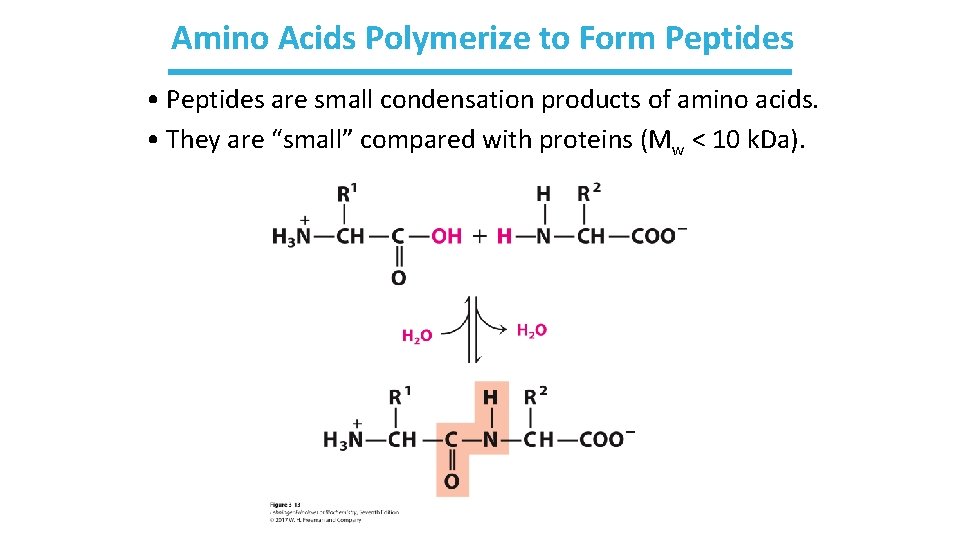
Amino Acids Polymerize to Form Peptides • Peptides are small condensation products of amino acids. • They are “small” compared with proteins (Mw < 10 k. Da).
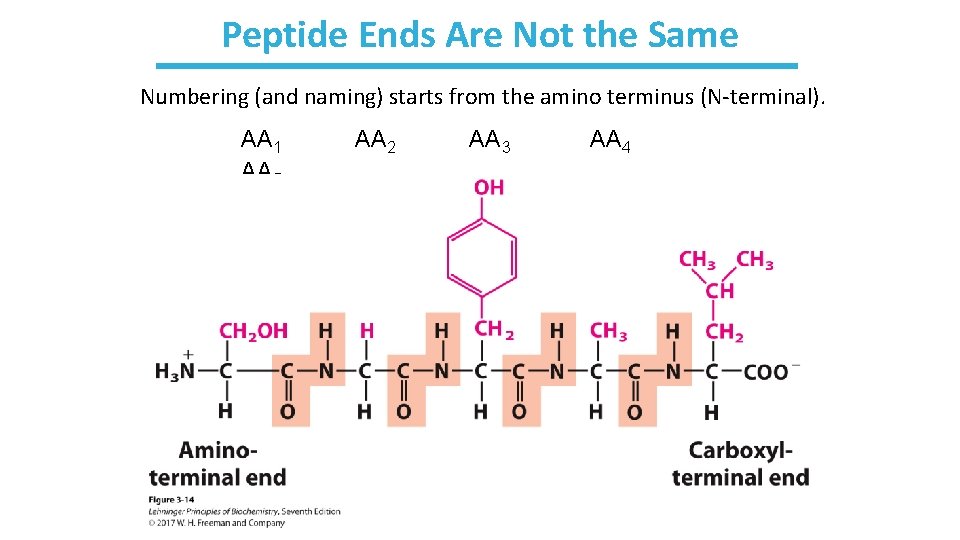
Peptide Ends Are Not the Same Numbering (and naming) starts from the amino terminus (N-terminal). AA 1 AA 5 AA 2 AA 3 AA 4
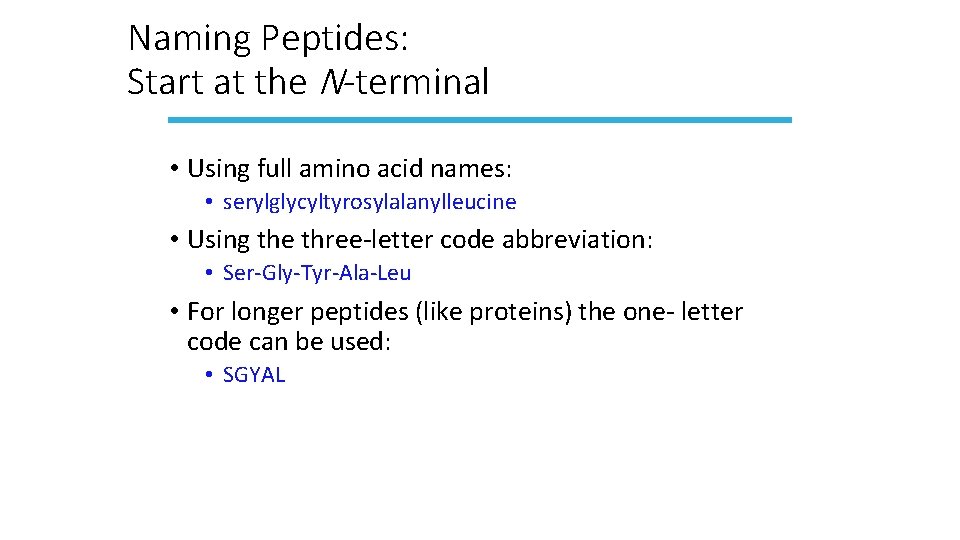
Naming Peptides: Start at the N-terminal • Using full amino acid names: • serylglycyltyrosylalanylleucine • Using the three-letter code abbreviation: • Ser-Gly-Tyr-Ala-Leu • For longer peptides (like proteins) the one- letter code can be used: • SGYAL
- Slides: 20