
Properties of Acids and Bases According to Boyle
Properties of Acids and Bases According to Boyle • In 1661 Robert Boyle summarized the properties of acids as follows: • 1. Acids have a sour taste. • 2. Acids are corrosive. • 3. Acids change the color of certain vegetable dyes, such as litmus, from blue to red. • 4. Acids lose their acidity when they are combined with alkalies.
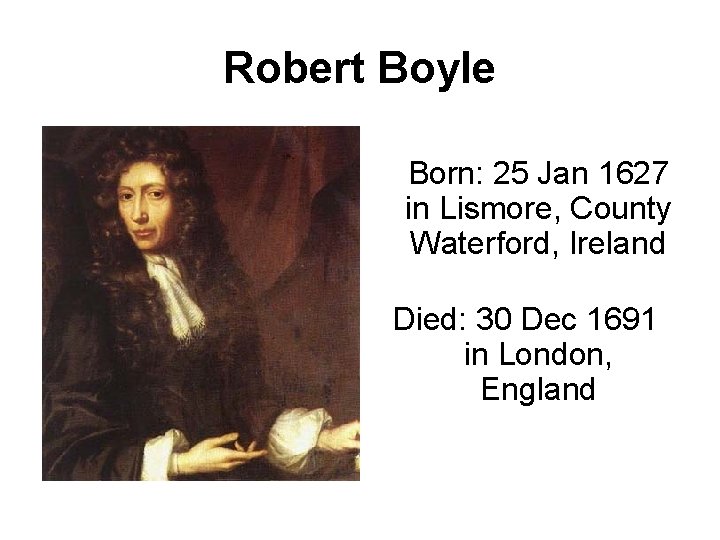
Robert Boyle Born: 25 Jan 1627 in Lismore, County Waterford, Ireland Died: 30 Dec 1691 in London, England
Properties of Acids and Bases According to Boyle • The name "acid" comes from the Latin acidus, which means "sour", and refers to the sharp odor and sour taste of many acids. Examples: • Vinegar tastes sour because it is a dilute solution of acetic acid in water. • Lemon juice tastes sour because it contains citric acid. • Milk turns sour when it spoils because lactic acid is formed. • The unpleasant, sour odor of rancid butter stems from butyric acid that form when fat spoils.
Properties of Acids and Bases According to Boyle • In 1661 Boyle summarized the properties of alkalies as follows: • Alkalies feel slippery. • Alkalies change the color of litmus from red to blue. • Alkalies become less alkaline when they are combined with acids.
Properties of Acids and Bases According to Boyle • In essence, Boyle defined alkalies as substances that consume, or neutralize, acids: • Acids lose their characteristic sour taste and ability to dissolve metals when they are mixed with alkalies. • Alkalies even reverse the change in color that occurs when litmus comes in contact with an acid.
Properties of Acids and Bases According to Boyle • Eventually alkalies became known as bases because they serve as the "base" for making certain salts.
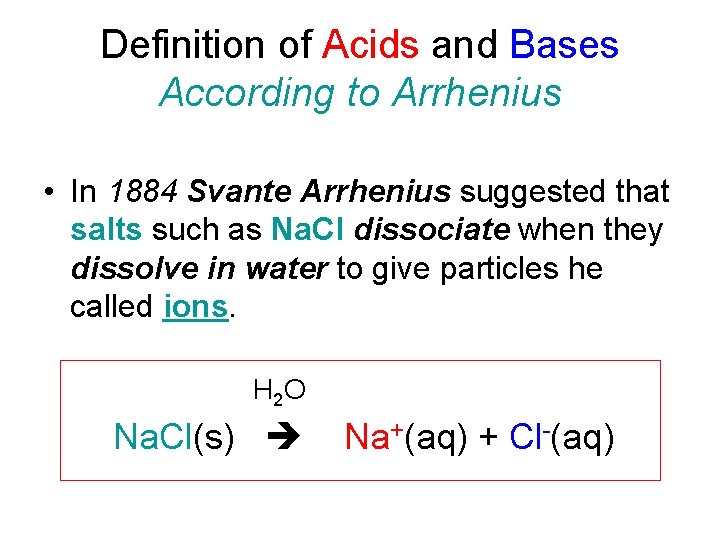
Definition of Acids and Bases According to Arrhenius • In 1884 Svante Arrhenius suggested that salts such as Na. Cl dissociate when they dissolve in water to give particles he called ions. H 2 O Na. Cl(s) Na+(aq) + Cl-(aq)
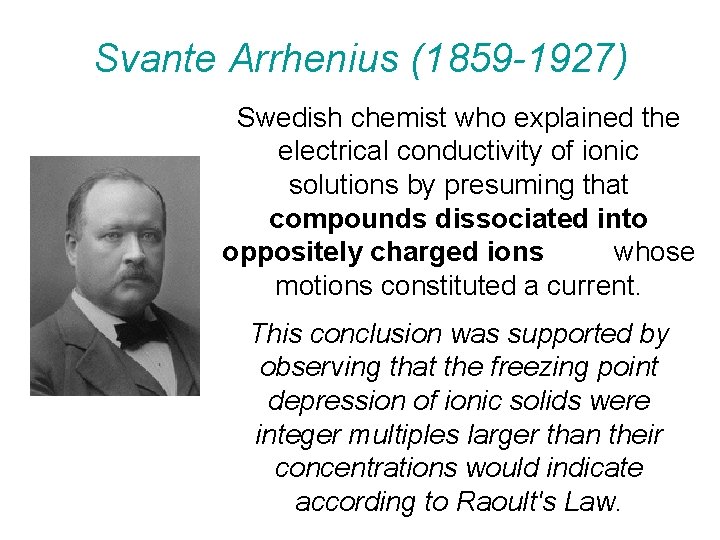
Svante Arrhenius (1859 -1927) Swedish chemist who explained the electrical conductivity of ionic solutions by presuming that compounds dissociated into oppositely charged ions whose motions constituted a current. This conclusion was supported by observing that the freezing point depression of ionic solids were integer multiples larger than their concentrations would indicate according to Raoult's Law.
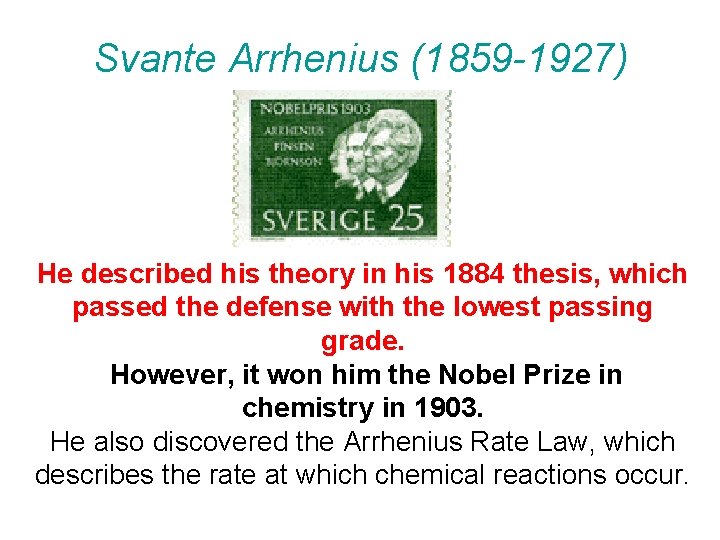
Svante Arrhenius (1859 -1927) He described his theory in his 1884 thesis, which passed the defense with the lowest passing grade. However, it won him the Nobel Prize in chemistry in 1903. He also discovered the Arrhenius Rate Law, which describes the rate at which chemical reactions occur.
Definition of Acids and Bases According to Arrhenius • Three years later Arrhenius extended this theory by suggesting that acids are neutral compounds that ionize when they dissolve in water to give H+ ions and a corresponding negative ion.
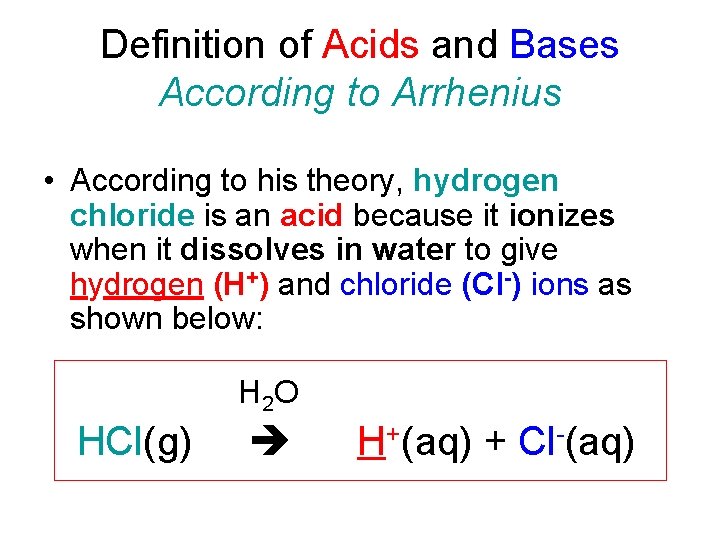
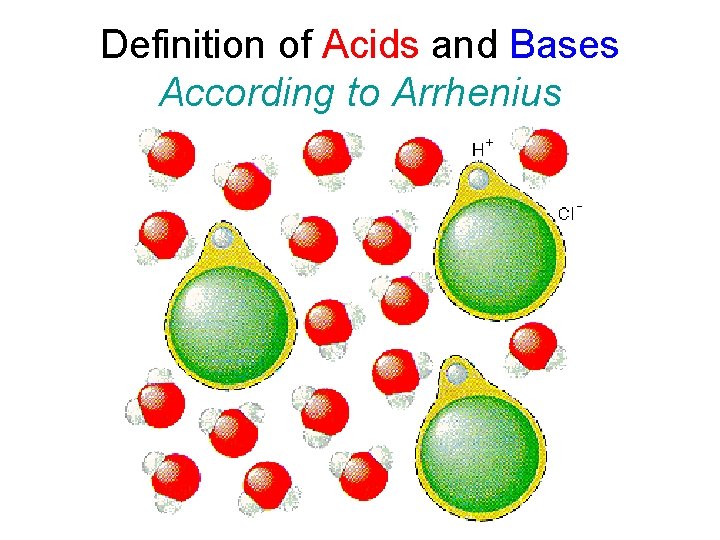
Definition of Acids and Bases According to Arrhenius • According to his theory, hydrogen chloride is an acid because it ionizes when it dissolves in water to give hydrogen (H+) and chloride (Cl-) ions as shown below: H 2 O HCl(g) H+(aq) + Cl-(aq)
Definition of Acids and Bases According to Arrhenius
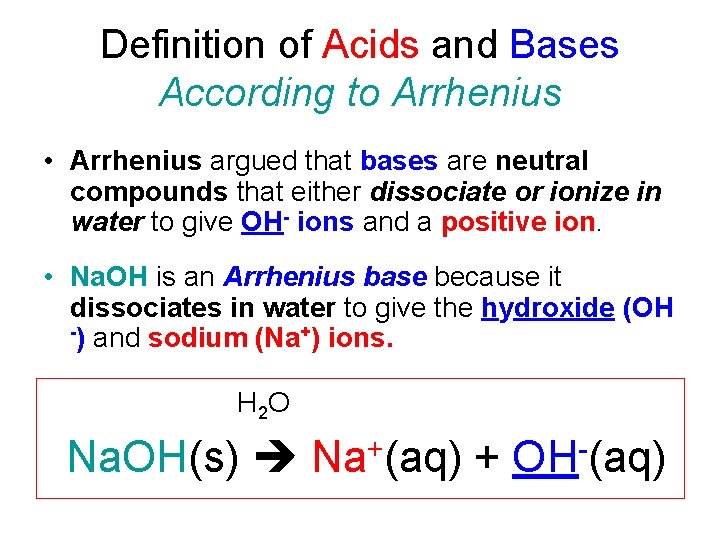
Definition of Acids and Bases According to Arrhenius • Arrhenius argued that bases are neutral compounds that either dissociate or ionize in water to give OH- ions and a positive ion. • Na. OH is an Arrhenius base because it dissociates in water to give the hydroxide (OH -) and sodium (Na+) ions. H 2 O Na. OH(s) + Na (aq) + OH (aq)
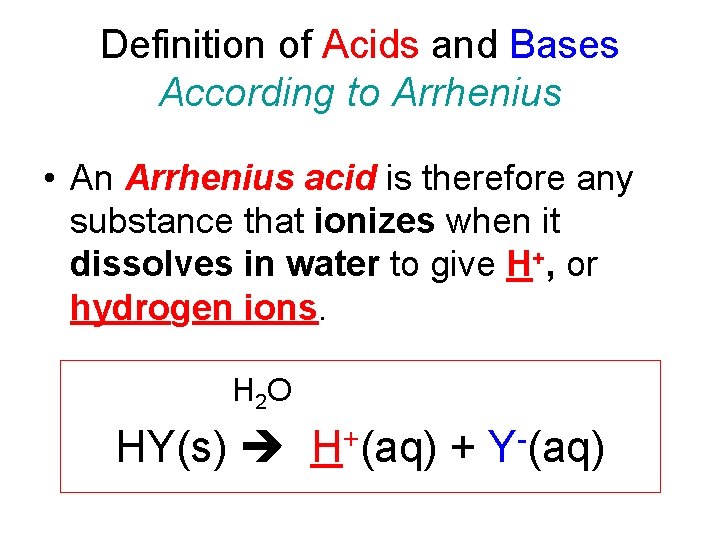
Definition of Acids and Bases According to Arrhenius • An Arrhenius acid is therefore any substance that ionizes when it dissolves in water to give H+, or hydrogen ions. H 2 O HY(s) H+(aq) + Y-(aq)
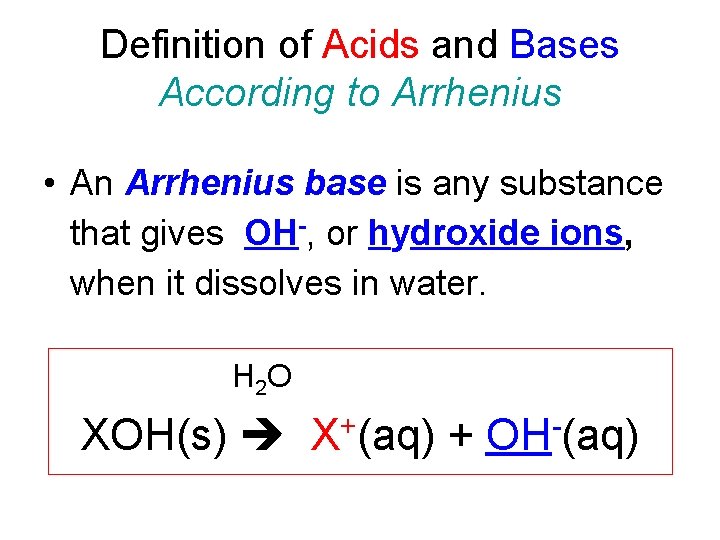
Definition of Acids and Bases According to Arrhenius • An Arrhenius base is any substance that gives OH-, or hydroxide ions, when it dissolves in water. H 2 O XOH(s) X+(aq) + OH-(aq)
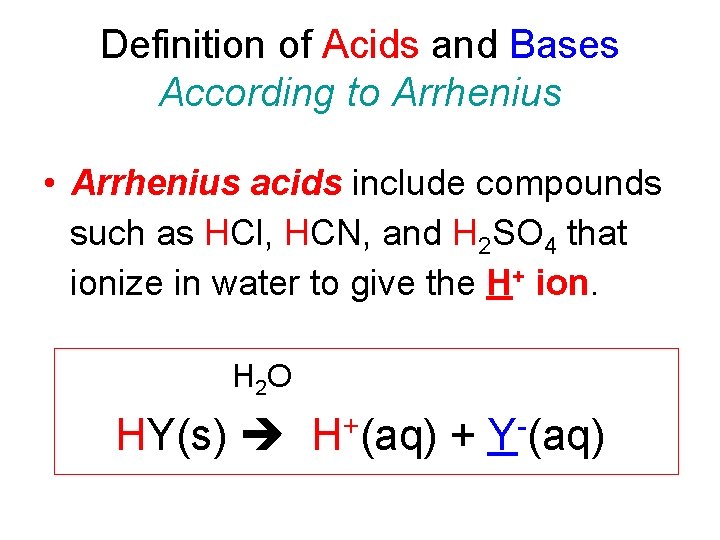
Definition of Acids and Bases According to Arrhenius • Arrhenius acids include compounds such as HCl, HCN, and H 2 SO 4 that ionize in water to give the H+ ion. H 2 O HY(s) H+(aq) + Y-(aq)
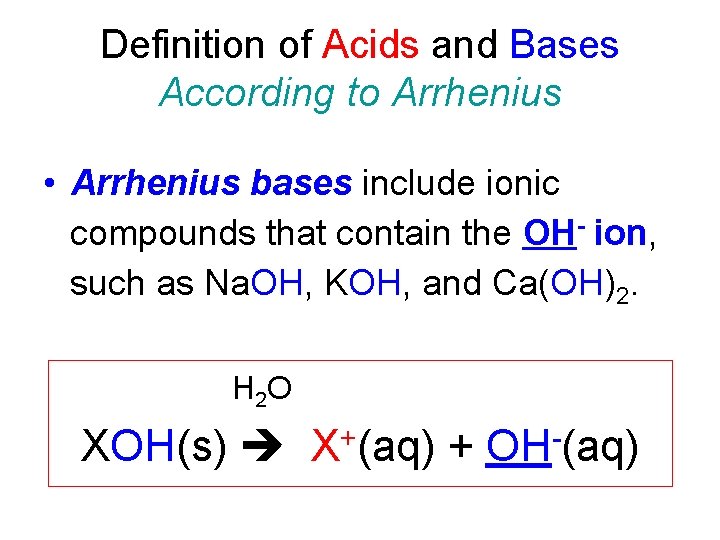
Definition of Acids and Bases According to Arrhenius • Arrhenius bases include ionic compounds that contain the OH- ion, such as Na. OH, KOH, and Ca(OH)2. H 2 O XOH(s) + X (aq) + OH (aq)
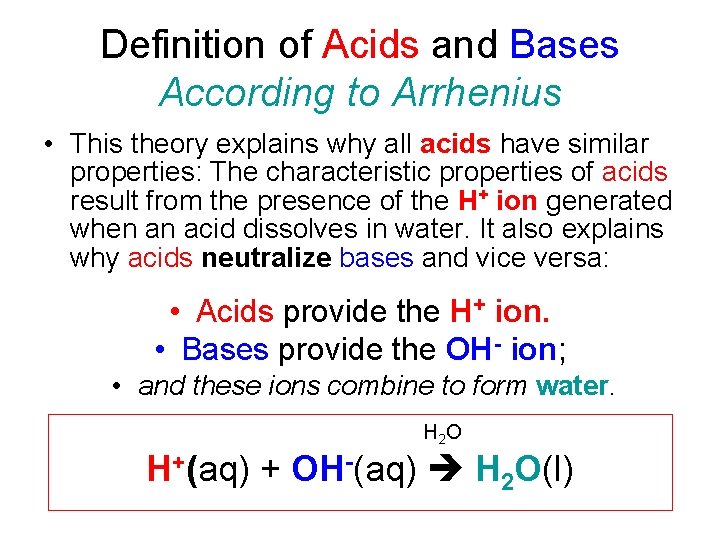
Definition of Acids and Bases According to Arrhenius • This theory explains why all acids have similar properties: The characteristic properties of acids result from the presence of the H+ ion generated when an acid dissolves in water. It also explains why acids neutralize bases and vice versa: • Acids provide the H+ ion. • Bases provide the OH- ion; • and these ions combine to form water. H 2 O H+(aq) + OH-(aq) H 2 O(l)
Definition of Acids and Bases According to Arrhenius The Arrhenius theory has several disadvantages: • It can be applied only to reactions that occur in water because it defines acids and bases terms of what happens when compounds dissolve in water. in
Definition of Acids and Bases According to Arrhenius • The Arrhenius theory doesn't explain why some compounds, - in which hydrogen has an oxidation number of +1 (such as HCl), - dissolve in water to give acidic solutions, whereas others (such as CH 4) do not.
Definition of Acids and Bases According to Arrhenius • The Arrhenius theory doesn't explain why only the compounds that contain the OHion can be classified as Arrhenius bases.
Definition of Acids and Bases According to Arrhenius • The Arrhenius theory doesn't explain why only the compounds that contain the OHion can be classified as Arrhenius bases. • The Arrhenius theory can't explain why other compounds (such as Na 2 CO 3) have the characteristic properties of bases.
Definition of Acids and Bases According to Brønsted The Brønsted, or Brønsted-Lowry, model is based on a simple assumption:
Definition of Acids and Bases According to Brønsted The Brønsted, or Brønsted-Lowry, model is based on a simple assumption: Acids donate H+ ions to other ions or molecules, which act as a base.
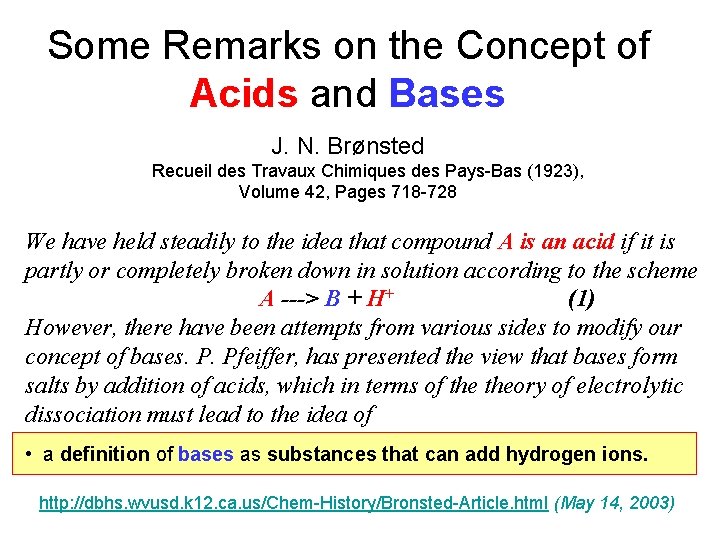
Some Remarks on the Concept of Acids and Bases J. N. Brønsted Recueil des Travaux Chimiques des Pays-Bas (1923), Volume 42, Pages 718 -728 We have held steadily to the idea that compound A is an acid if it is partly or completely broken down in solution according to the scheme A ---> B + H+ (1) However, there have been attempts from various sides to modify our concept of bases. P. Pfeiffer, has presented the view that bases form salts by addition of acids, which in terms of theory of electrolytic dissociation must lead to the idea of • a definition of bases as substances that can add hydrogen ions. http: //dbhs. wvusd. k 12. ca. us/Chem-History/Bronsted-Article. html (May 14, 2003)
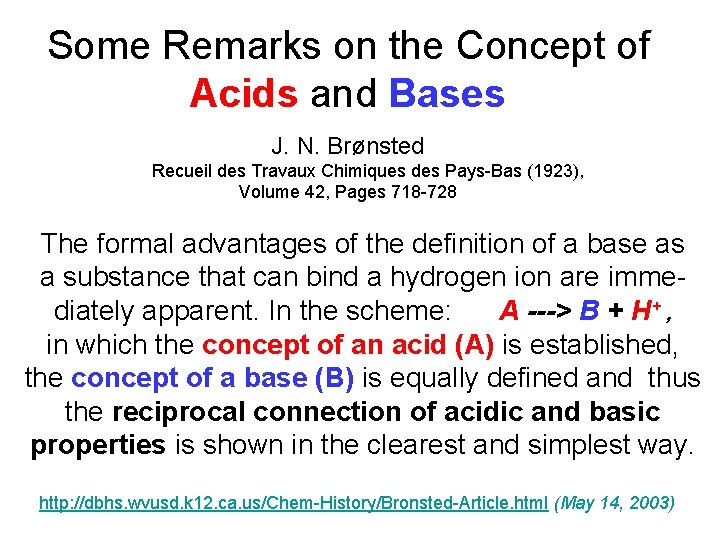
Some Remarks on the Concept of Acids and Bases J. N. Brønsted Recueil des Travaux Chimiques des Pays-Bas (1923), Volume 42, Pages 718 -728 The formal advantages of the definition of a base as a substance that can bind a hydrogen ion are immediately apparent. In the scheme: A ---> B + H+ , in which the concept of an acid (A) is established, the concept of a base (B) is equally defined and thus the reciprocal connection of acidic and basic properties is shown in the clearest and simplest way. http: //dbhs. wvusd. k 12. ca. us/Chem-History/Bronsted-Article. html (May 14, 2003)
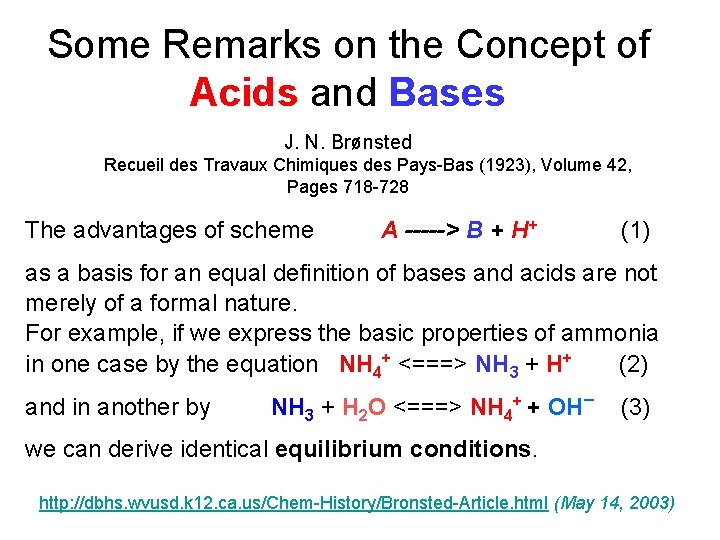
Some Remarks on the Concept of Acids and Bases J. N. Brønsted Recueil des Travaux Chimiques des Pays-Bas (1923), Volume 42, Pages 718 -728 The advantages of scheme A -----> B + H+ (1) as a basis for an equal definition of bases and acids are not merely of a formal nature. For example, if we express the basic properties of ammonia in one case by the equation NH 4+ <===> NH 3 + H+ (2) and in another by NH 3 + H 2 O <===> NH 4+ + OH¯ (3) we can derive identical equilibrium conditions. http: //dbhs. wvusd. k 12. ca. us/Chem-History/Bronsted-Article. html (May 14, 2003)
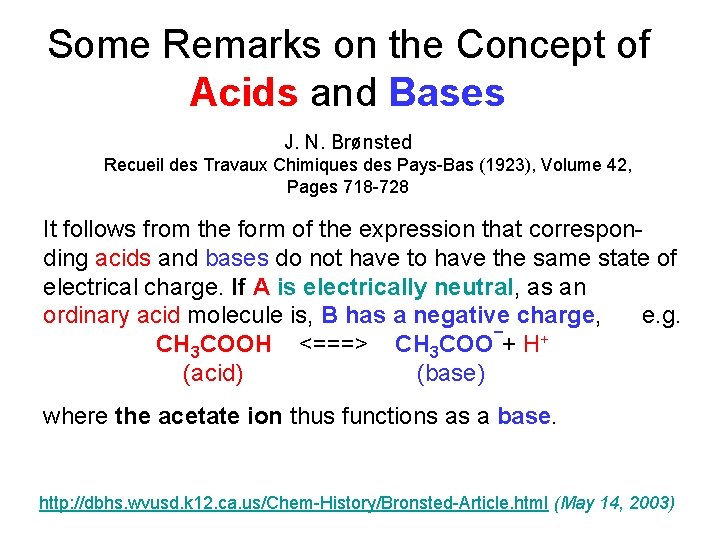
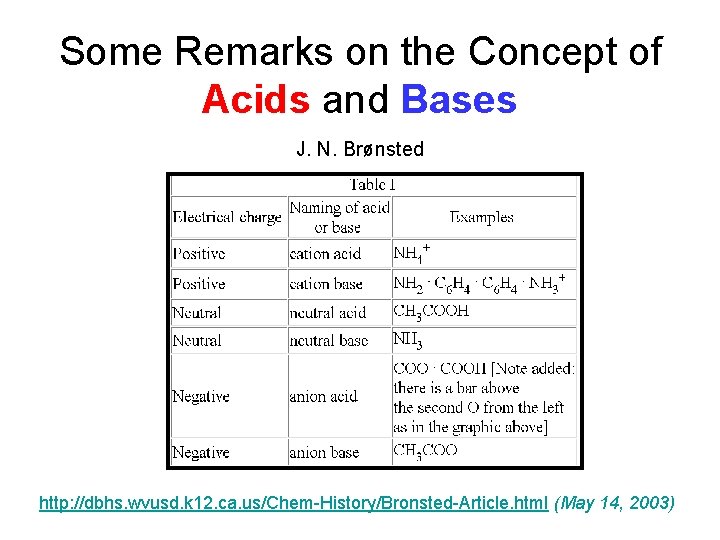
Some Remarks on the Concept of Acids and Bases J. N. Brønsted Recueil des Travaux Chimiques des Pays-Bas (1923), Volume 42, Pages 718 -728 It follows from the form of the expression that corresponding acids and bases do not have to have the same state of electrical charge. If A is electrically neutral, as an ordinary acid molecule is, B has a negative charge, e. g. CH 3 COOH <===> CH 3 COO¯+ H+ (acid) (base) where the acetate ion thus functions as a base. http: //dbhs. wvusd. k 12. ca. us/Chem-History/Bronsted-Article. html (May 14, 2003)
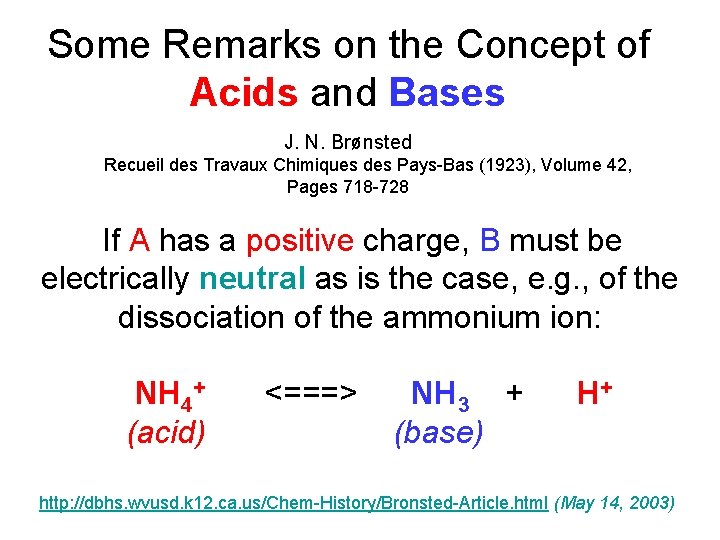
Some Remarks on the Concept of Acids and Bases J. N. Brønsted Recueil des Travaux Chimiques des Pays-Bas (1923), Volume 42, Pages 718 -728 If A has a positive charge, B must be electrically neutral as is the case, e. g. , of the dissociation of the ammonium ion: NH 4+ (acid) <===> NH 3 + (base) H+ http: //dbhs. wvusd. k 12. ca. us/Chem-History/Bronsted-Article. html (May 14, 2003)
Some Remarks on the Concept of Acids and Bases J. N. Brønsted http: //dbhs. wvusd. k 12. ca. us/Chem-History/Bronsted-Article. html (May 14, 2003)
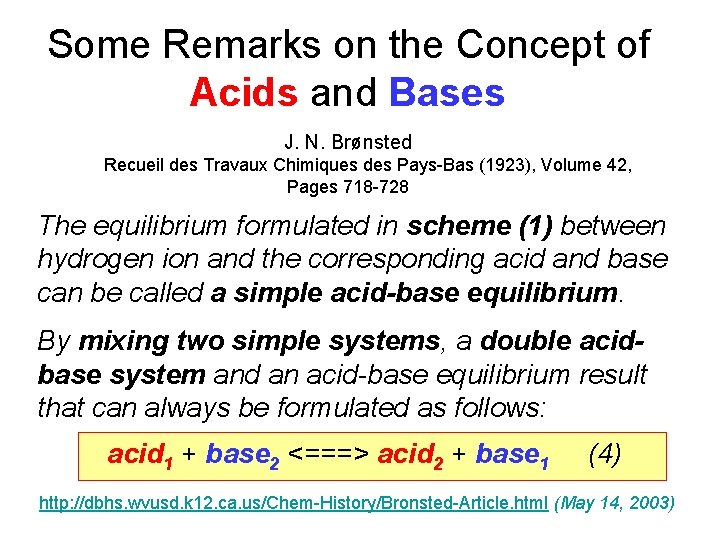
Some Remarks on the Concept of Acids and Bases J. N. Brønsted Recueil des Travaux Chimiques des Pays-Bas (1923), Volume 42, Pages 718 -728 The equilibrium formulated in scheme (1) between hydrogen ion and the corresponding acid and base can be called a simple acid-base equilibrium. By mixing two simple systems, a double acidbase system and an acid-base equilibrium result that can always be formulated as follows: acid 1 + base 2 <===> acid 2 + base 1 (4) http: //dbhs. wvusd. k 12. ca. us/Chem-History/Bronsted-Article. html (May 14, 2003)
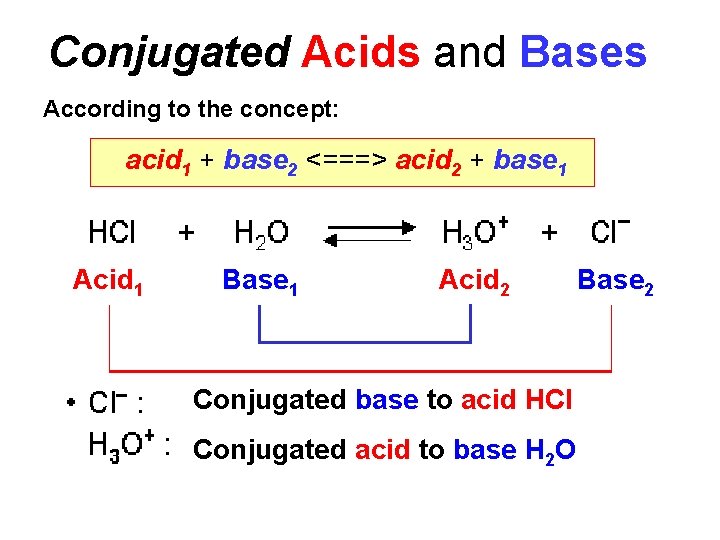
Conjugated Acids and Bases According to the concept: acid 1 + base 2 <===> acid 2 + base 1 Acid 1 Base 1 Acid 2 Conjugated base to acid HCl Conjugated acid to base H 2 O Base 2
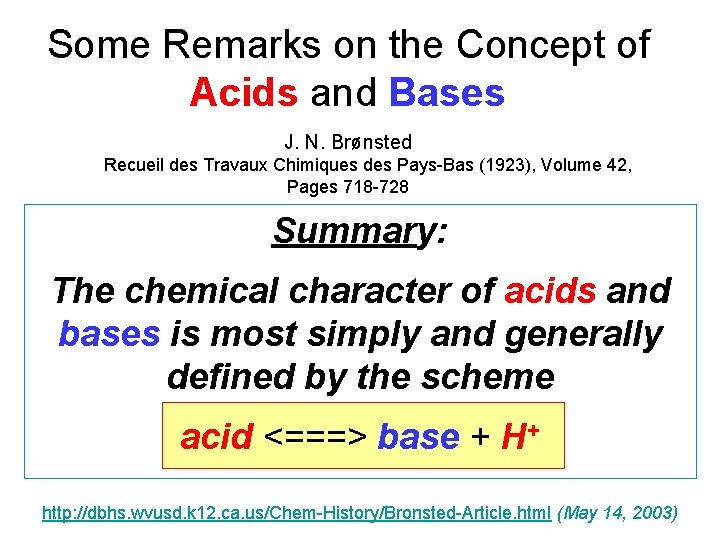
Some Remarks on the Concept of Acids and Bases J. N. Brønsted Recueil des Travaux Chimiques des Pays-Bas (1923), Volume 42, Pages 718 -728 Summary: The chemical character of acids and bases is most simply and generally defined by the scheme acid <===> base + H+ http: //dbhs. wvusd. k 12. ca. us/Chem-History/Bronsted-Article. html (May 14, 2003)
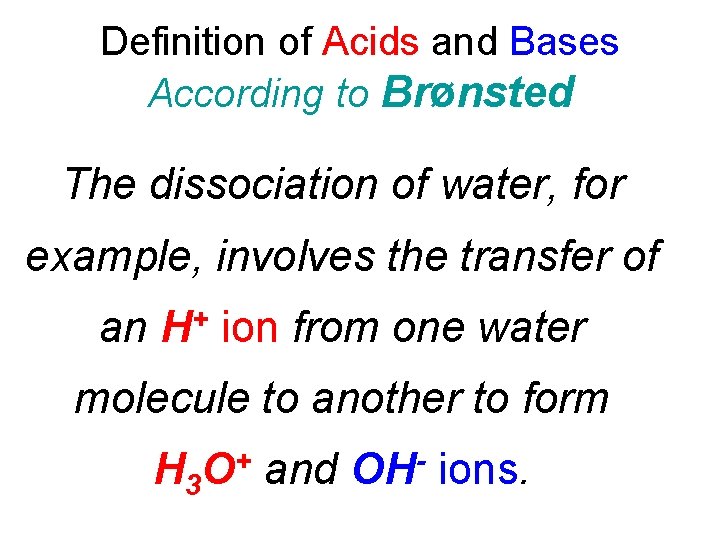
Definition of Acids and Bases According to Brønsted The dissociation of water, for example, involves the transfer of an H+ ion from one water molecule to another to form H 3 + O and OH ions.
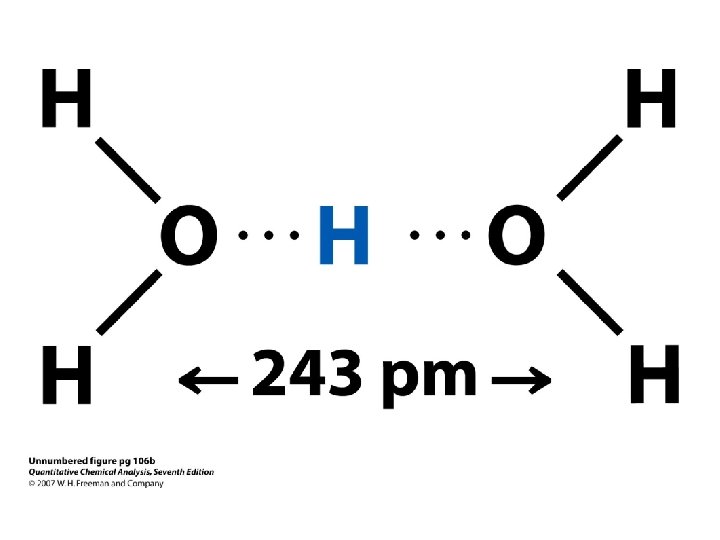
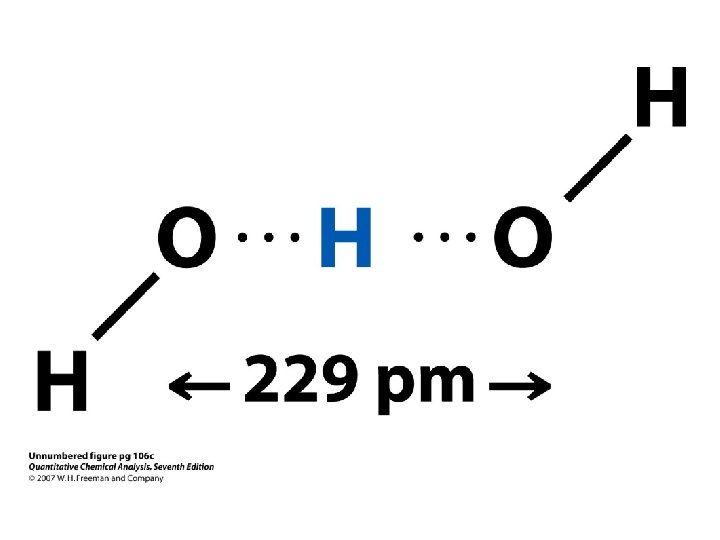
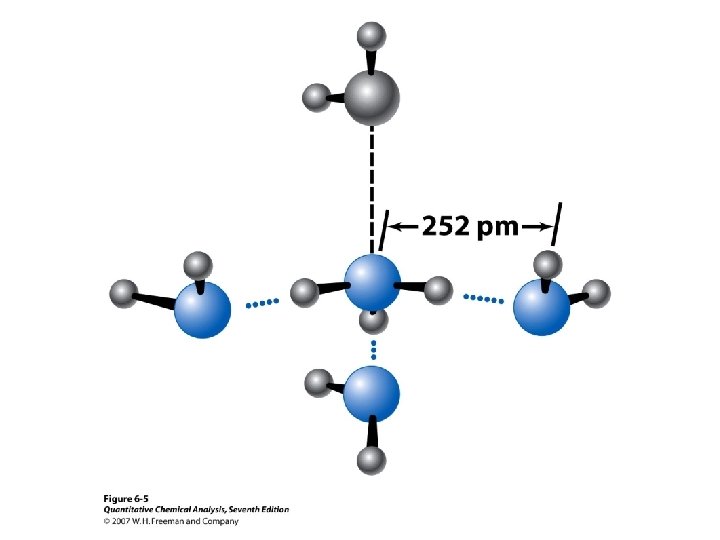
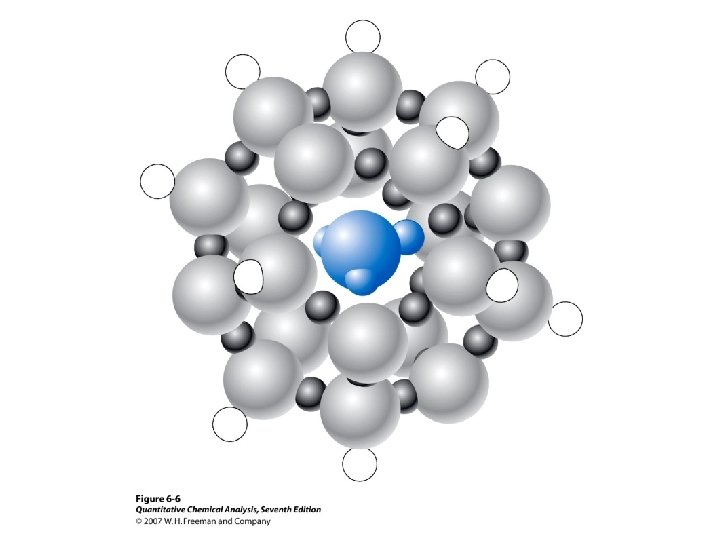
Definition of Acids and Bases According to Brønsted • According to the Brønsted model and definition of acids and bases, HCl doesn't dissociate in water to form H+ and Cl- ions.
Definition of Acids and Bases According to Brønsted • According to the Brønsted model and definition of acids and bases, HCl doesn't dissociate in water to form H+ and Cl- ions. • Instead, an H+ ion is transferred from HCl to a water molecule to form H 3 O+ and Cl- ions, as shown in the following figure.
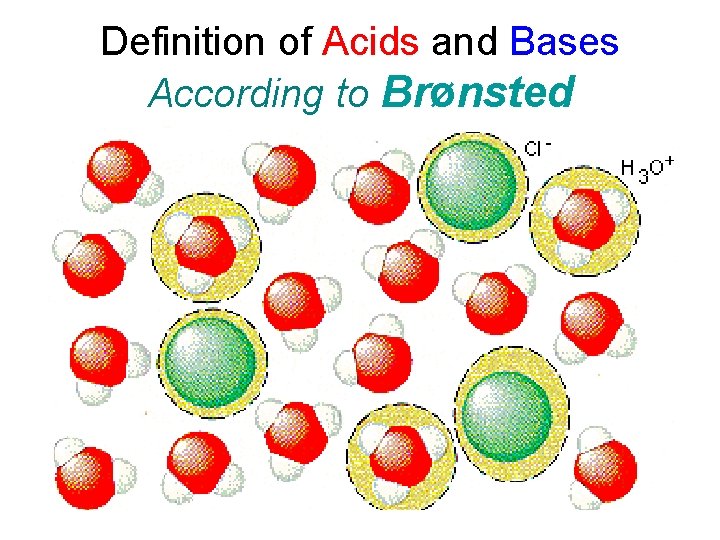
Definition of Acids and Bases According to Brønsted
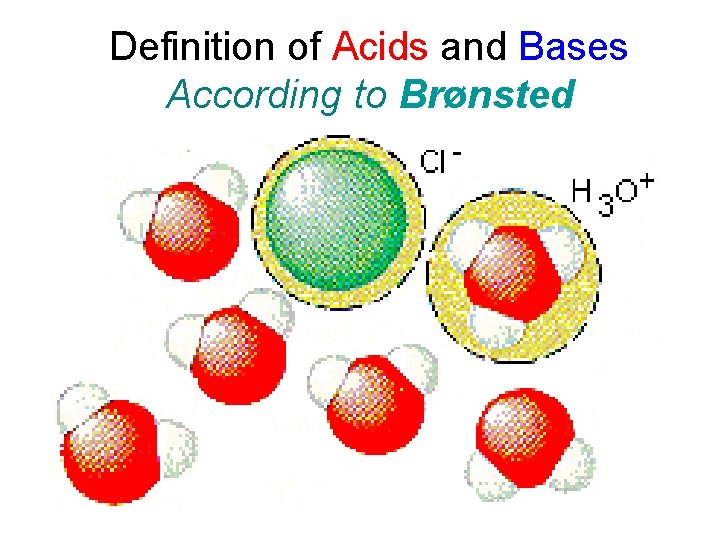
Definition of Acids and Bases According to Brønsted
The Role of H+ and OH- Ions in Aqueous Solutions • Because oxygen (EN = 3. 44) is much more electronegative than hydrogen (EN = 2. 20), the electrons in the HO-bonds in water aren't shared equally by hydrogen and oxygen.
The Role of H+ and OH- Ions in Aqueous Solutions • Therefore, the electrons are drawn toward the oxygen atom in the center of the molecule and away from the hydrogen atoms on either end.
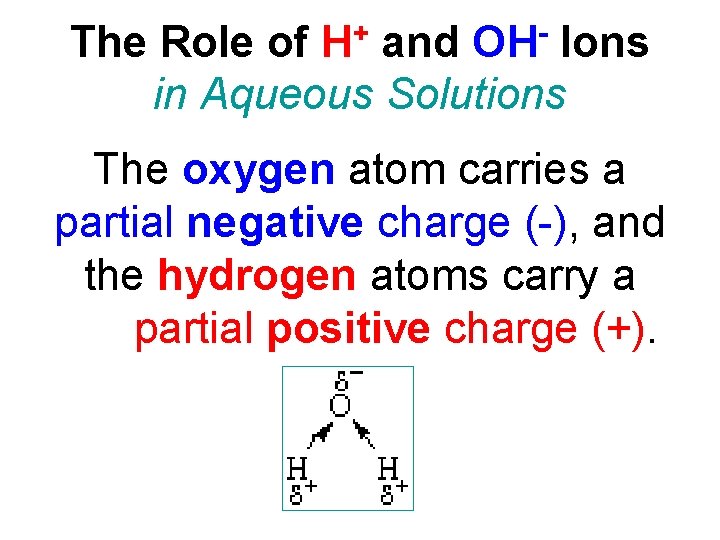
+ H OH The Role of and Ions in Aqueous Solutions The oxygen atom carries a partial negative charge (-), and the hydrogen atoms carry a partial positive charge (+).
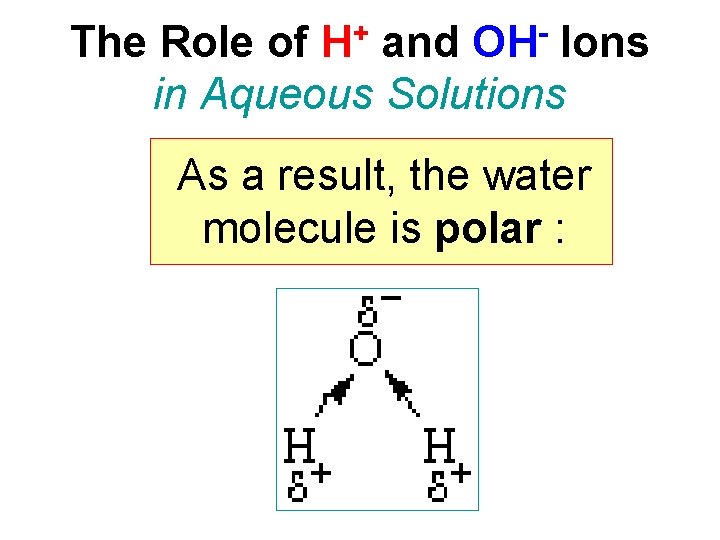
+ H OH The Role of and Ions in Aqueous Solutions As a result, the water molecule is polar :
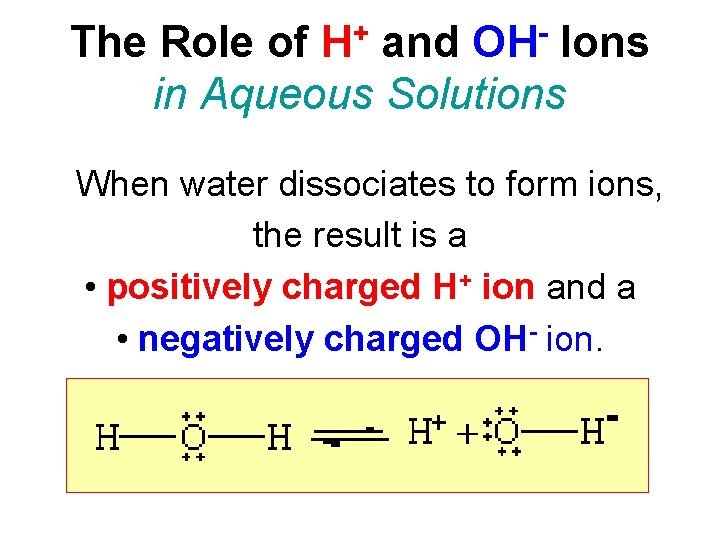
+ H OH The Role of and Ions in Aqueous Solutions When water dissociates to form ions, the result is a • positively charged H+ ion and a • negatively charged OH- ion.
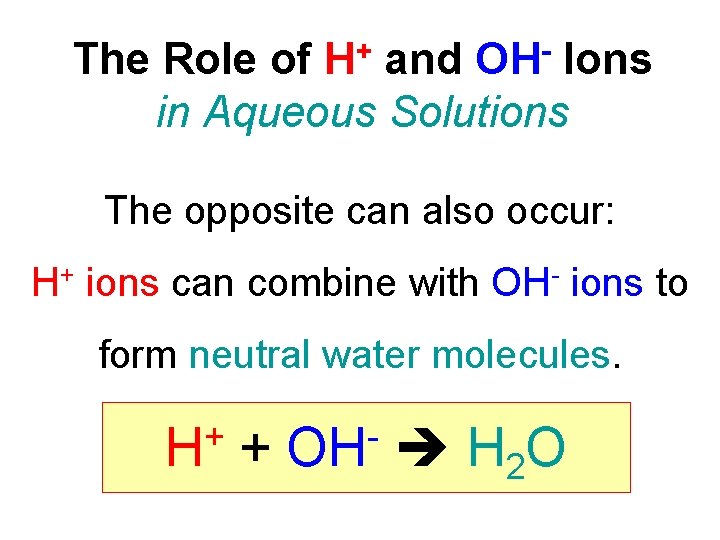
The Role of H+ and OH- Ions in Aqueous Solutions The opposite can also occur: H+ ions can combine with OH- ions to form neutral water molecules. + H + OH H 2 O
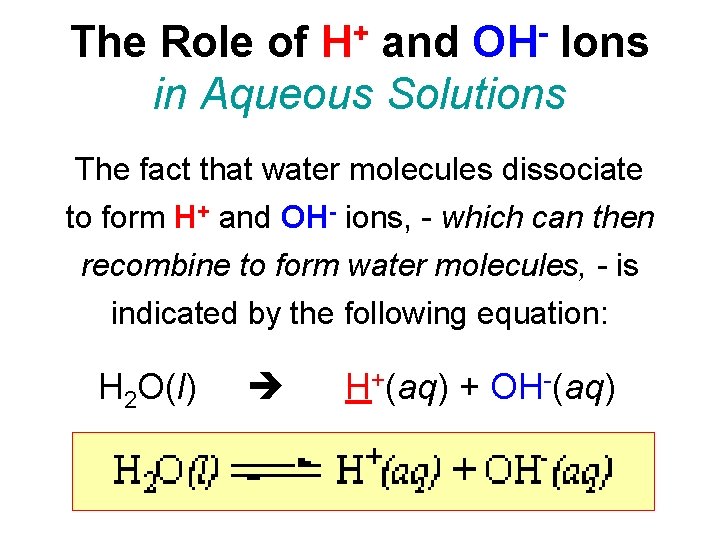
+ H OH The Role of and Ions in Aqueous Solutions The fact that water molecules dissociate to form H+ and OH- ions, - which can then recombine to form water molecules, - is indicated by the following equation: H 2 O(l) H+(aq) + OH-(aq)
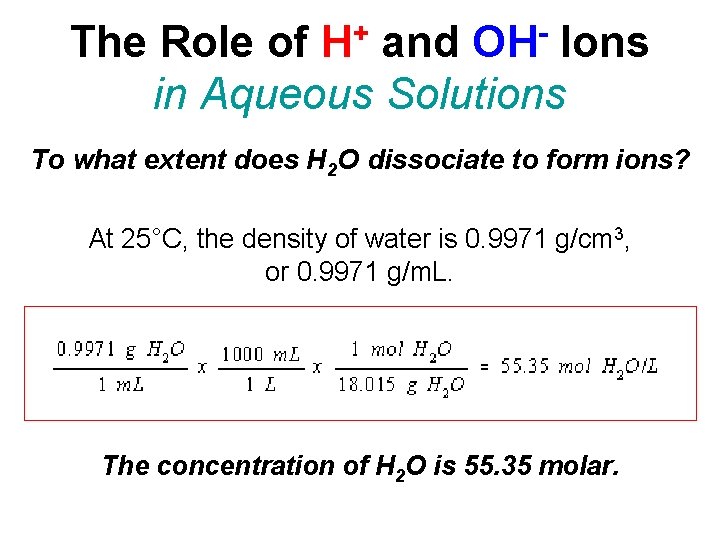
+ H OH The Role of and Ions in Aqueous Solutions To what extent does H 2 O dissociate to form ions? At 25°C, the density of water is 0. 9971 g/cm 3, or 0. 9971 g/m. L. The concentration of H 2 O is 55. 35 molar.
+ H OH The Role of and Ions in Aqueous Solutions To what extent does H 2 O dissociate to form ions?
+ H OH The Role of and Ions in Aqueous Solutions To what extent does H 2 O dissociate to form ions? The concentration of the H+ and OH- ions formed by the dissociation of neutral H 2 O molecules at this temperature is only 1. 0 x 10 -7 mol/L.
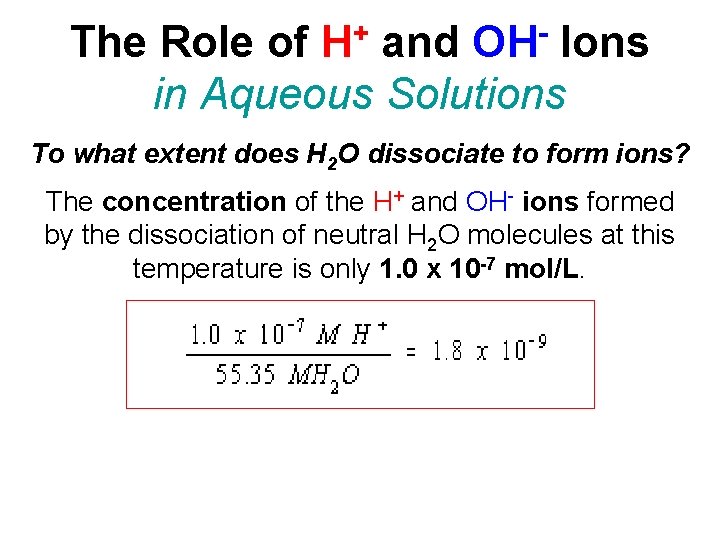
+ H OH The Role of and Ions in Aqueous Solutions To what extent does H 2 O dissociate to form ions? The concentration of the H+ and OH- ions formed by the dissociation of neutral H 2 O molecules at this temperature is only 1. 0 x 10 -7 mol/L.
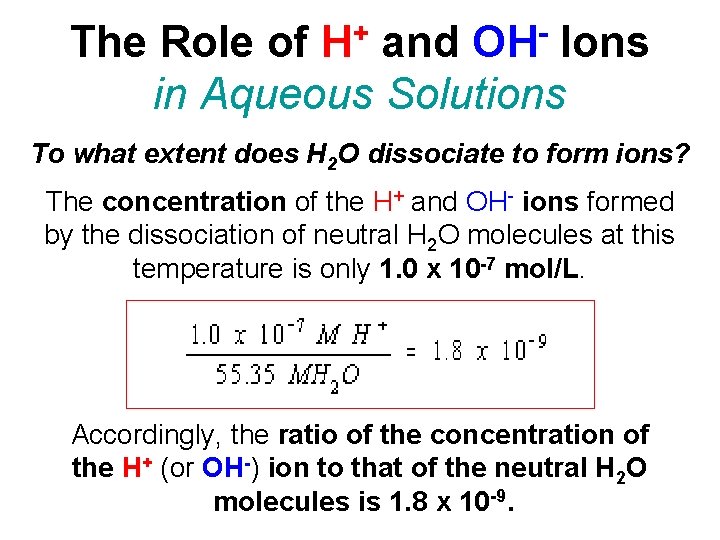
+ H OH The Role of and Ions in Aqueous Solutions To what extent does H 2 O dissociate to form ions? The concentration of the H+ and OH- ions formed by the dissociation of neutral H 2 O molecules at this temperature is only 1. 0 x 10 -7 mol/L. Accordingly, the ratio of the concentration of the H+ (or OH-) ion to that of the neutral H 2 O molecules is 1. 8 x 10 -9.
The Role of H+ and OH- Ions in Aqueous Solutions To what extent does H 2 O dissociate to form ions? At 25°C only about 2 parts per billion (ppb) of the H 2 O molecules dissociate into ions.
Definition of Acids and Bases The Operational Definition The fact that water dissociates + to form H and OH ions in a reversible reaction is the basis for an operational definition of acids and bases that is more powerful than the definitions proposed by Arrhenius.
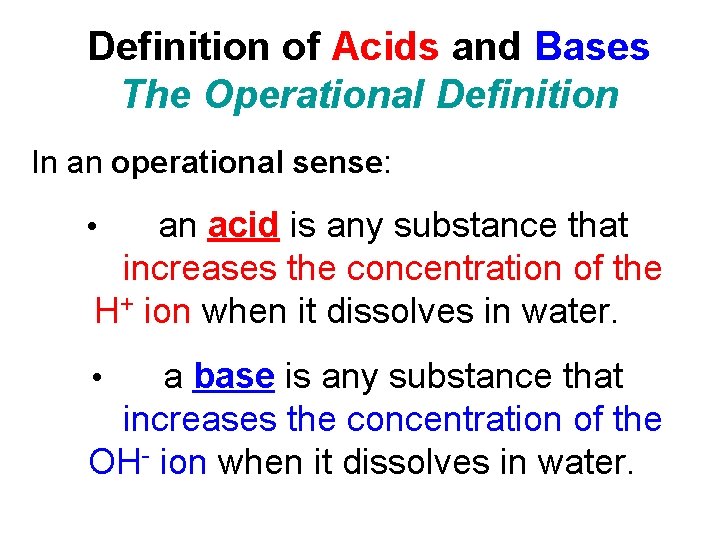
Definition of Acids and Bases The Operational Definition In an operational sense: an acid is any substance that increases the concentration of the H+ ion when it dissolves in water. • a base is any substance that increases the concentration of the OH- ion when it dissolves in water. •
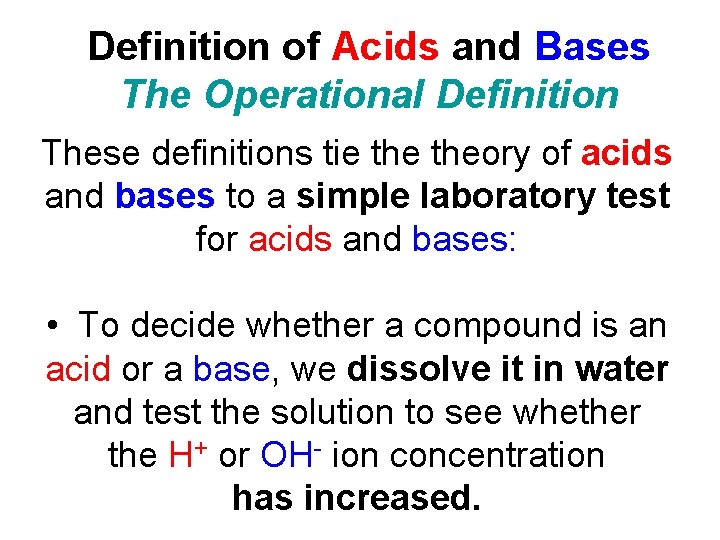
Definition of Acids and Bases The Operational Definition These definitions tie theory of acids and bases to a simple laboratory test for acids and bases: • To decide whether a compound is an acid or a base, we dissolve it in water and test the solution to see whether the H+ or OH- ion concentration has increased.

p. H Meter Measures Acidity • The U. S. Geological Survey analyzes hundreds of thousands of water samples every year. Many measurements are made right at the field site, and many more are made on water samples back at the lab. The p. H is an important water measurement which is often measured both at the sampling site and in the lab. There are large and small models of p. H meters. Portable models are available to take out in the field and larger models, such as this one, are used in the lab.
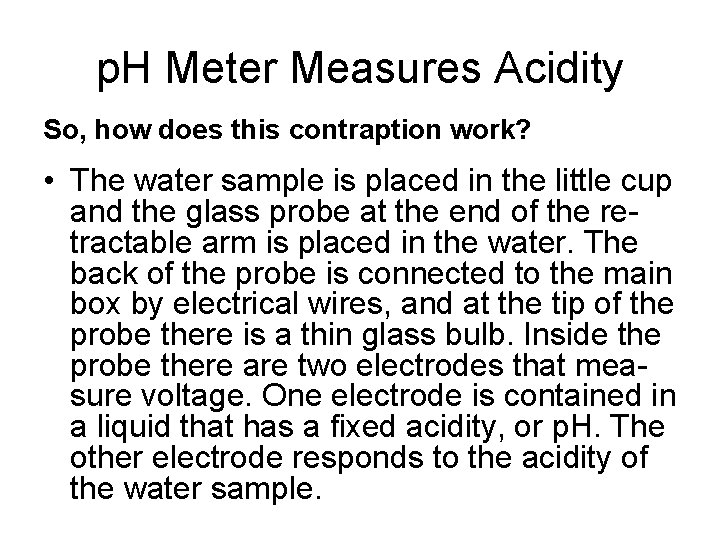
p. H Meter Measures Acidity So, how does this contraption work? • The water sample is placed in the little cup and the glass probe at the end of the retractable arm is placed in the water. The back of the probe is connected to the main box by electrical wires, and at the tip of the probe there is a thin glass bulb. Inside the probe there are two electrodes that measure voltage. One electrode is contained in a liquid that has a fixed acidity, or p. H. The other electrode responds to the acidity of the water sample.
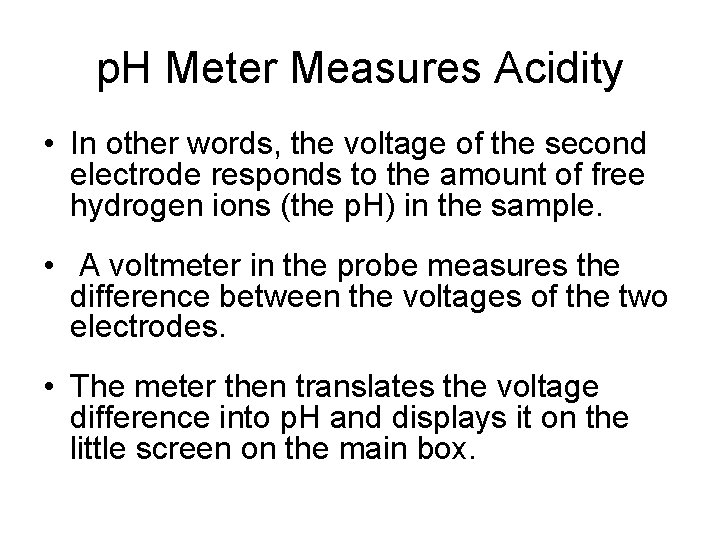
p. H Meter Measures Acidity • In other words, the voltage of the second electrode responds to the amount of free hydrogen ions (the p. H) in the sample. • A voltmeter in the probe measures the difference between the voltages of the two electrodes. • The meter then translates the voltage difference into p. H and displays it on the little screen on the main box.
p. H Meter Measures Acidity • Before taking a p. H measurement, the meter must be "calibrated. " The probe is immersed in a solution that has a known p. H, such as pure water with a neutral p. H of 7. 0. The knobs on the box are used to adjust the displayed p. H value to the known p. H of the solution, thus calibrating the meter.
- Slides: 62