
Properties and changes of materials Investigating thermal insulators
- Slides: 8
Properties and changes of materials Investigating thermal insulators Year 5 Age 9 - 10
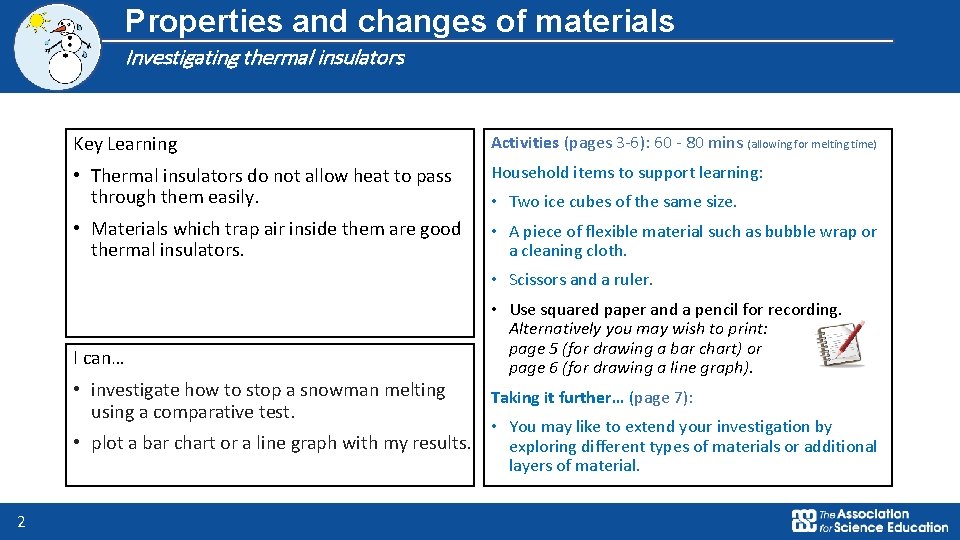
Properties and changes of materials Investigating thermal insulators Key Learning Activities (pages 3 -6): 60 - 80 mins (allowing for melting time) • Thermal insulators do not allow heat to pass through them easily. Household items to support learning: • Materials which trap air inside them are good thermal insulators. • A piece of flexible material such as bubble wrap or a cleaning cloth. • Two ice cubes of the same size. • Scissors and a ruler. I can… • investigate how to stop a snowman melting using a comparative test. • plot a bar chart or a line graph with my results. 2 • Use squared paper and a pencil for recording. Alternatively you may wish to print: page 5 (for drawing a bar chart) or page 6 (for drawing a line graph). Taking it further… (page 7): • You may like to extend your investigation by exploring different types of materials or additional layers of material.
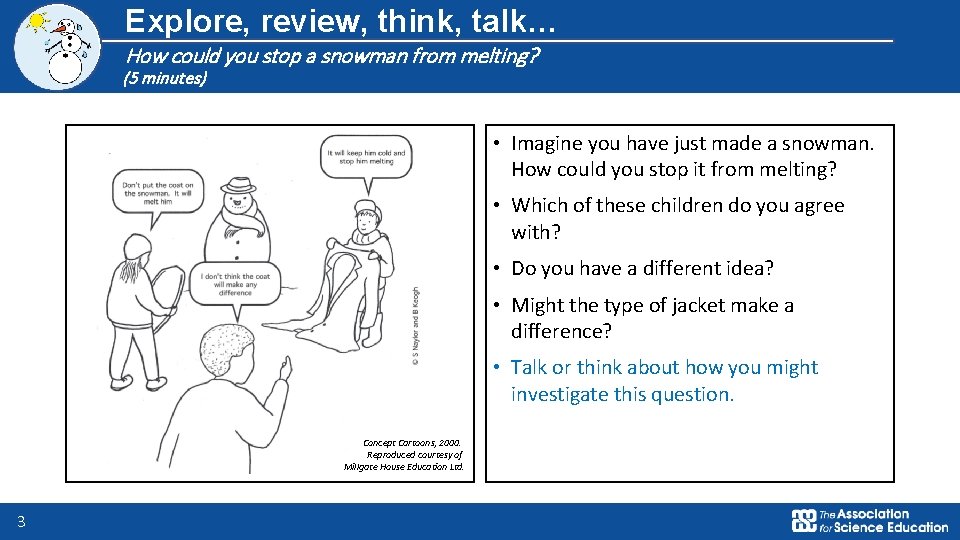
Explore, review, think, talk… How could you stop a snowman from melting? (5 minutes) • Imagine you have just made a snowman. How could you stop it from melting? • Which of these children do you agree with? • Do you have a different idea? • Might the type of jacket make a difference? • Talk or think about how you might investigate this question. Concept Cartoons, 2000. Reproduced courtesy of Millgate House Education Ltd. 3
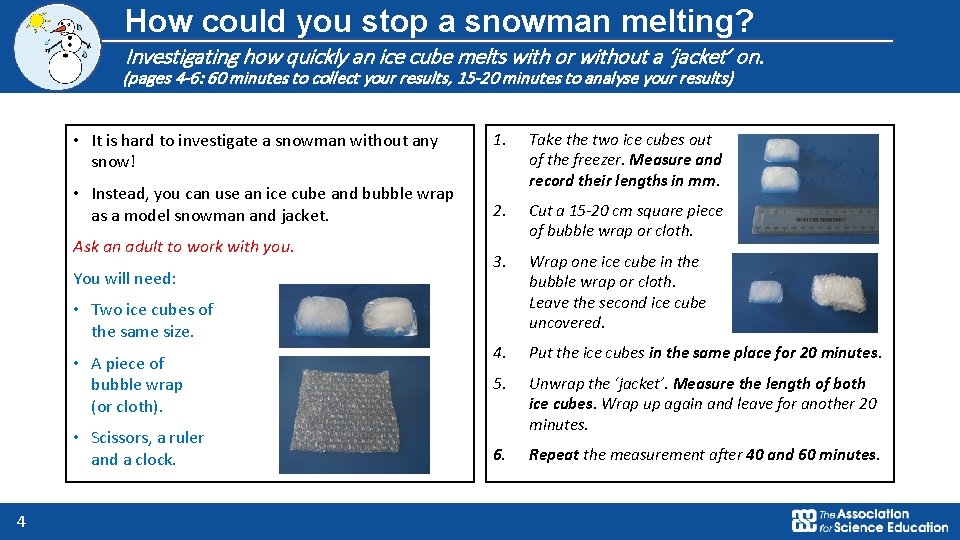
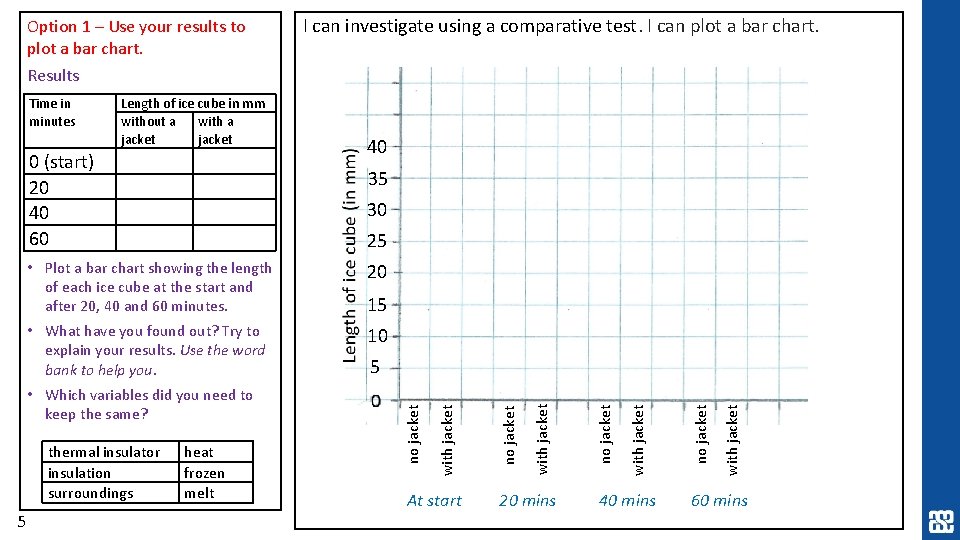
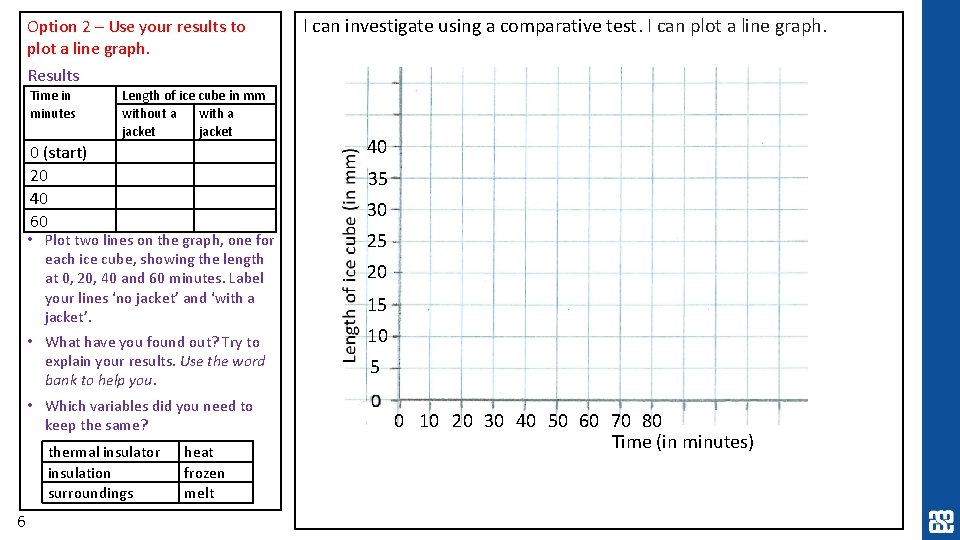
How could you stop a snowman melting? Investigating how quickly an ice cube melts with or without a ‘jacket’ on. (pages 4 -6: 60 minutes to collect your results, 15 -20 minutes to analyse your results) • It is hard to investigate a snowman without any snow! • Instead, you can use an ice cube and bubble wrap as a model snowman and jacket. Ask an adult to work with you. You will need: • Two ice cubes of the same size. • A piece of bubble wrap (or cloth). • Scissors, a ruler and a clock. 4 1. Take the two ice cubes out of the freezer. Measure and record their lengths in mm. 2. Cut a 15 -20 cm square piece of bubble wrap or cloth. 3. Wrap one ice cube in the bubble wrap or cloth. Leave the second ice cube uncovered. 4. Put the ice cubes in the same place for 20 minutes. 5. Unwrap the ‘jacket’. Measure the length of both ice cubes. Wrap up again and leave for another 20 minutes. 6. Repeat the measurement after 40 and 60 minutes.
Option 1 – Use your results to plot a bar chart. I can investigate using a comparative test. I can plot a bar chart. Results Length of ice cube in mm without a with a jacket 0 (start) 20 40 60 35 30 25 • Plot a bar chart showing the length of each ice cube at the start and after 20, 40 and 60 minutes. 20 • What have you found out? Try to explain your results. Use the word bank to help you. 10 At start 20 mins 40 mins with jacket no jacket with jacket heat frozen melt 5 no jacket thermal insulator insulation surroundings 15 with jacket • Which variables did you need to keep the same? 5 40 no jacket Time in minutes 60 mins
Option 2 – Use your results to plot a line graph. I can investigate using a comparative test. I can plot a line graph. Results Time in minutes Length of ice cube in mm without a with a jacket 0 (start) 20 40 60 35 30 • Plot two lines on the graph, one for each ice cube, showing the length at 0, 20, 40 and 60 minutes. Label your lines ‘no jacket’ and ‘with a jacket’. • What have you found out? Try to explain your results. Use the word bank to help you. • Which variables did you need to keep the same? thermal insulator insulation surroundings 6 40 heat frozen melt 25 20 15 10 5 0 10 20 30 40 50 60 70 80 Time (in minutes)
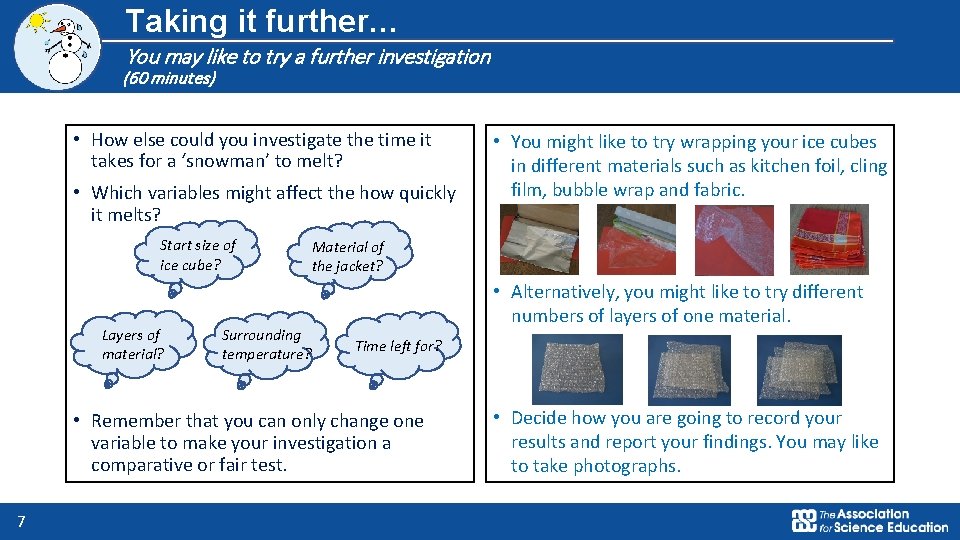
Taking it further… You may like to try a further investigation (60 minutes) • How else could you investigate the time it takes for a ‘snowman’ to melt? • Which variables might affect the how quickly it melts? Start size of ice cube? Layers of material? Surrounding temperature? Material of the jacket? • Alternatively, you might like to try different numbers of layers of one material. Time left for? • Remember that you can only change one variable to make your investigation a comparative or fair test. 7 • You might like to try wrapping your ice cubes in different materials such as kitchen foil, cling film, bubble wrap and fabric. • Decide how you are going to record your results and report your findings. You may like to take photographs.
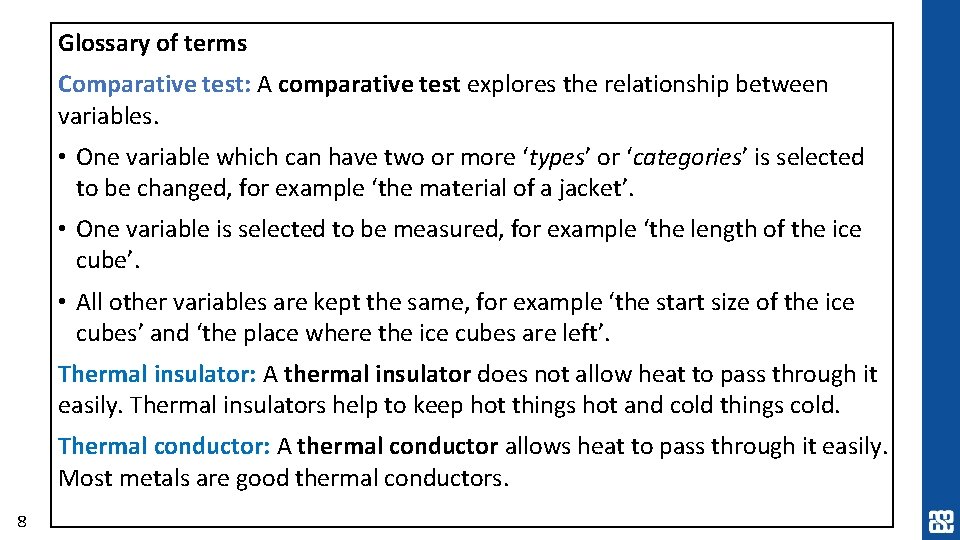
Glossary of terms Comparative test: A comparative test explores the relationship between variables. • One variable which can have two or more ‘types’ or ‘categories’ is selected to be changed, for example ‘the material of a jacket’. • One variable is selected to be measured, for example ‘the length of the ice cube’. • All other variables are kept the same, for example ‘the start size of the ice cubes’ and ‘the place where the ice cubes are left’. Thermal insulator: A thermal insulator does not allow heat to pass through it easily. Thermal insulators help to keep hot things hot and cold things cold. Thermal conductor: A thermal conductor allows heat to pass through it easily. Most metals are good thermal conductors. 8