
Propagation The mechanism by which a wave travels
Propagation The mechanism by which a wave travels is called propagation.
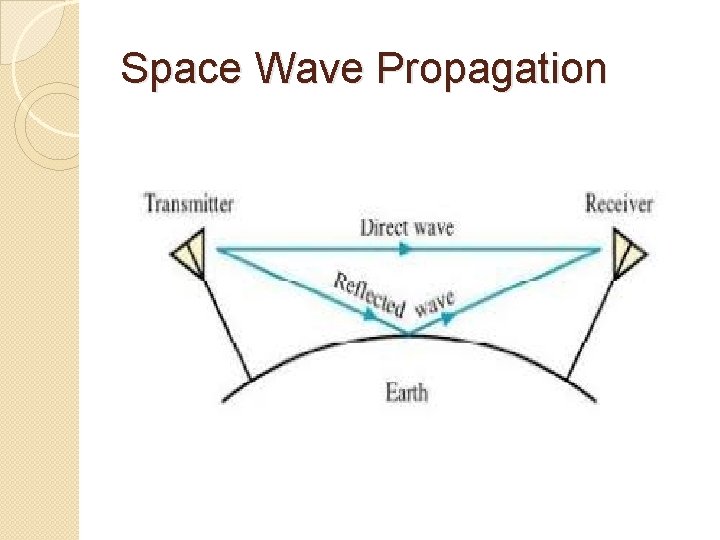
Space Wave Propagation �It is the type of propagation in which a wave reaches the receiving antenna directly and/or after reflection from the earth. �Frequencies used in this type of propagation are VHF(30 MHz 300 MHz) UHF(300 MHz -3000 MHz) and Microwave(More than 3000 MHz)
Space Wave Propagation

Space Wave Propagation
Space Wave Propagation �Earths curvature affects the SWP it creates a path difference and hence phase difference between reflected and direct wave.
Space Wave Propagation �Maximum distance between Tx and Rx Antenna on earth depends on antenna height and is limited to horizon. �It may be up to the 15% more than the optical horizon as shown in figure in above slide. �Distance between transmitter and receiver is given by the below equation.
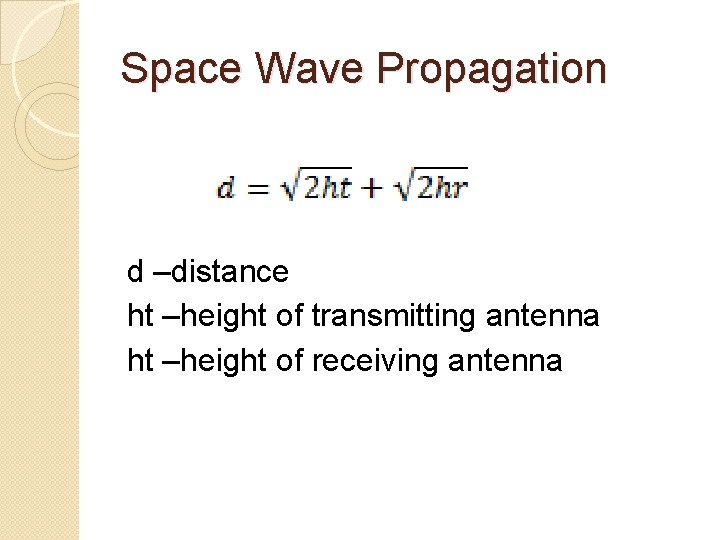
Space Wave Propagation d –distance ht –height of transmitting antenna ht –height of receiving antenna

Space Wave Propagation �Fading is also an important factor in SWP due to multipath fading and changes in atmospheric conditions field strength changes.
Sky Wave Propagation �In this type of propagation wave is directed towards the sky and reflected or refracted by the ionosphere(top most layer of earth’s atmosphere). �For long distance communication on earth we use SWP.

Sky Wave Propagation
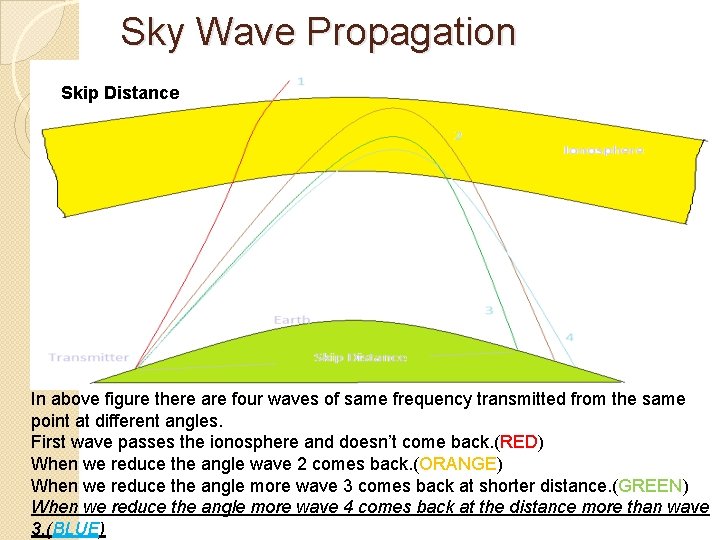
Sky Wave Propagation Skip Distance In above figure there are four waves of same frequency transmitted from the same point at different angles. First wave passes the ionosphere and doesn’t come back. (RED) When we reduce the angle wave 2 comes back. (ORANGE) When we reduce the angle more wave 3 comes back at shorter distance. (GREEN) When we reduce the angle more wave 4 comes back at the distance more than wave 3. (BLUE)
Sky Wave Propagation �Skip Distance It is the minimum distance between transmitter and the point where wave comes back after reflection/refraction from ionosphere. Skip Distance Depends on � 1. Frequency of wave � 2. Critical frequency of ionosphere
Sky Wave Propagation �Maximum Usable Frequency(MUF) It is the highest frequency that can be used for transmission between two points via reflection from the ionosphere at a specified time, independent of transmitter power.
Sky Wave Propagation �Critical Frequency: The highest frequency which can be reflected back from ionosphere at vertical incidence is called critical frequency.
Sky Wave Propagation �Virtual Height The apparent height of a layer in the ionosphere, determined from the time required for a radio pulse to travel to the layer and return, assuming that the pulse propagates at speed of light
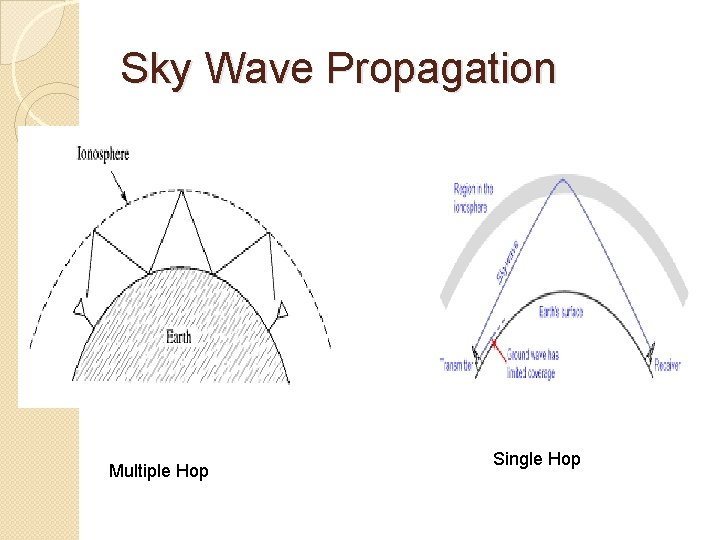
Sky Wave Propagation Multiple Hop Single Hop
Sky Wave Propagation �When the distance between the transmitter and receiver is so large that can not be achieved usingle hop in that case we use multiple hop sky wave propagation.
Sky Wave Propagation �Layers in the Ionosphere �There are four ionized layers or regions in the ionosphere. They are called the D, E, F 1 and F 2 layers. All four layers are present during daytime. At night, the F 1 and F 2 layers thin out and tend to merge into one F layer. The D and E layers disappear at night. These layers have a lower degree of ionization. After the Sun sets, the intensity of the ultra-violet radiation decreases, recombination of the ionized particles occurs and the lower ionized layers will dissolve. Just before sunrise, ionization is at its lowest point.
Sky Wave Propagation �D-Layer �The D-layer, which is present during the day only, has the least ionization and therefore has the least effect on radio propagation. However, it almost completely absorbs radio waves of lower frequencies (up to 10 MHz). The ionization is proportional to the angle of elevation of the Sun and is the greatest at noon.
Sky Wave Propagation � E-Layer � The Kennelly-Heaviside layer is a layer of ionised gas occurring between roughly 90 -150 km. It reflects medium-frequency radio waves (up to about 20 MHz), and because of this reflection radio waves can be propagated beyond the horizon. Propagation is affected by time of day. During the daytime the solar wind presses this layer closer to the Earth, thereby limiting how far it can reflect radio waves. On the night side of the Earth, the solar wind drags the ionosphere further away, thereby greatly increasing the range which radio waves can travel by reflection, called sky wave. The extent of the effect is further influenced by the season, and the amount of sunspot activity. This is the lowest useful ionized layer, and normally dissolves after sunset.
Sky Wave Propagation �F-Layer �The F region contains ionized gases at a height of around 150 -800 km above sea level. It has the highest concentration of free electrons and ions anywhere in the atmosphere. �During daytime when solar radiation is much higher than during the night time, the F layer splits into two sub-layers: the F 1 and F 2 layer with average virtual heights of 200 and 500 Km. � After sunset these two layers merge again into a single F region.
Duct Propagation
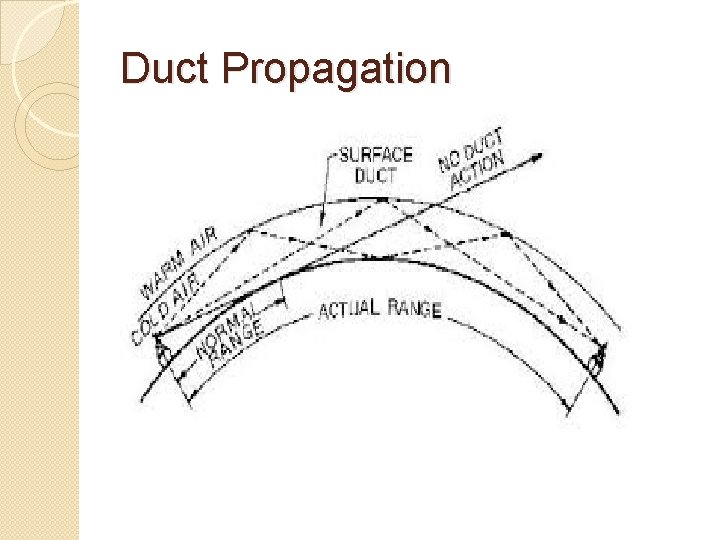
Duct Propagation �In duct propagation due to density variation of atmosphere/air formation of a duct takes place and signal face less attenuation than it would face in the absence of duct. �Such type of propagation is not stable for a long time because of variation of temperature and density of atmosphere.
- Slides: 23