
Propagation of Light Through Atmospheric Turbulence Lecture 5

Propagation of Light Through Atmospheric Turbulence Lecture 5, ASTR 289 Claire Max UC Santa Cruz January 26, 2016 Page 1
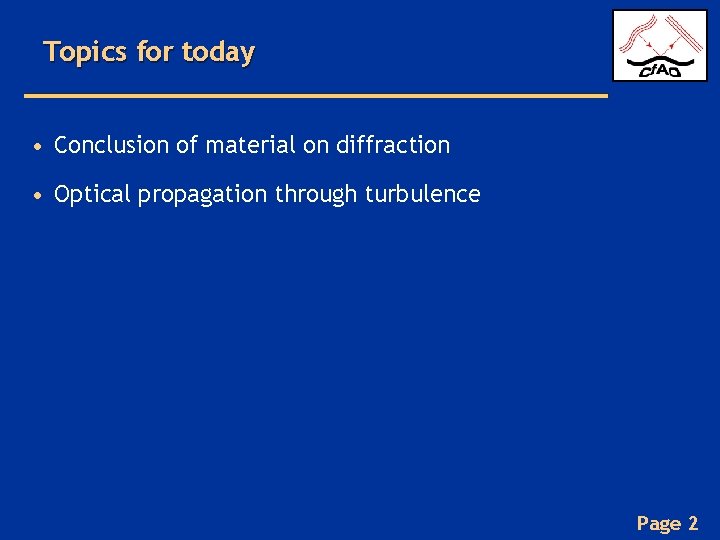
Topics for today • Conclusion of material on diffraction • Optical propagation through turbulence Page 2
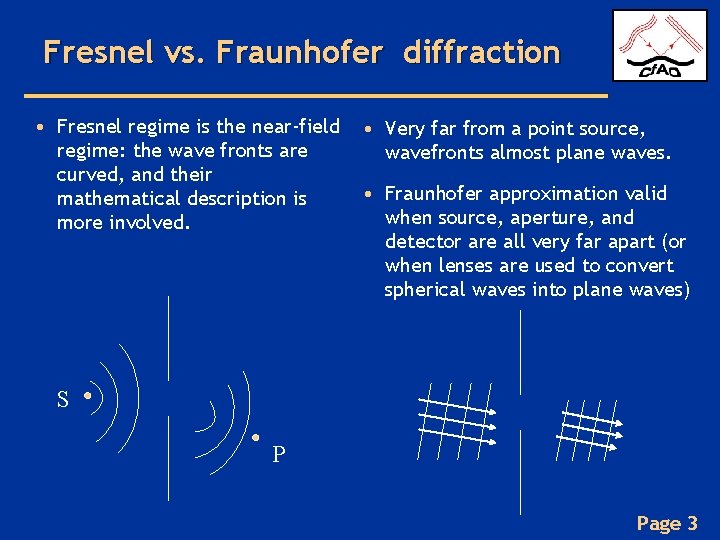
Fresnel vs. Fraunhofer diffraction • Fresnel regime is the near-field regime: the wave fronts are curved, and their mathematical description is more involved. • Very far from a point source, wavefronts almost plane waves. • Fraunhofer approximation valid when source, aperture, and detector are all very far apart (or when lenses are used to convert spherical waves into plane waves) S P Page 3
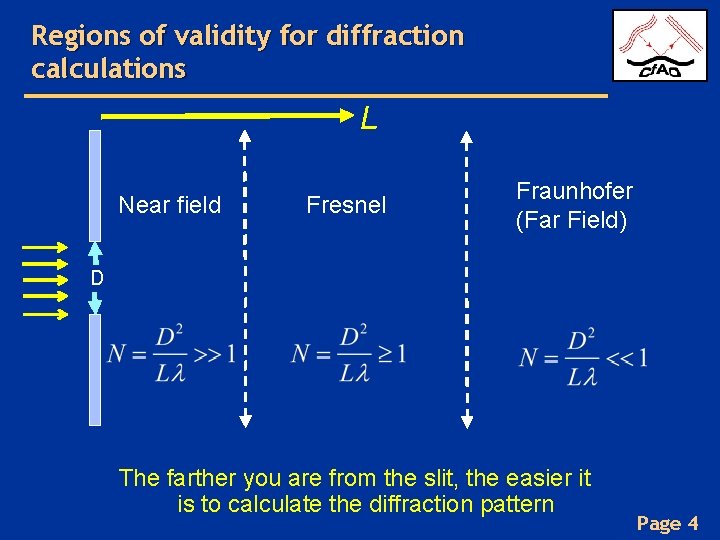
Regions of validity for diffraction calculations L Near field Fresnel Fraunhofer (Far Field) D The farther you are from the slit, the easier it is to calculate the diffraction pattern Page 4
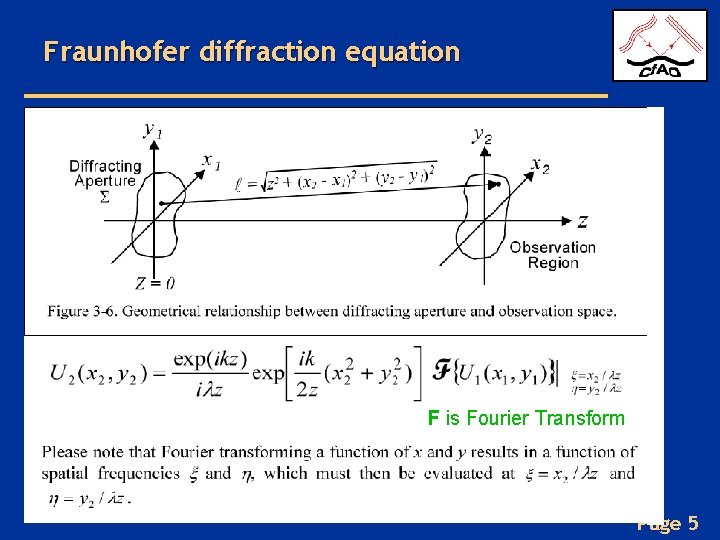
Fraunhofer diffraction equation F is Fourier Transform Page 5
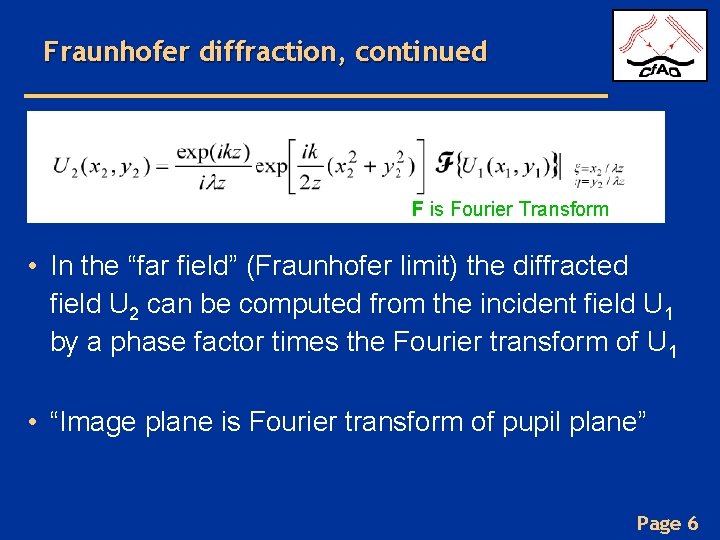
Fraunhofer diffraction, continued F is Fourier Transform • In the “far field” (Fraunhofer limit) the diffracted field U 2 can be computed from the incident field U 1 by a phase factor times the Fourier transform of U 1 • “Image plane is Fourier transform of pupil plane” Page 6
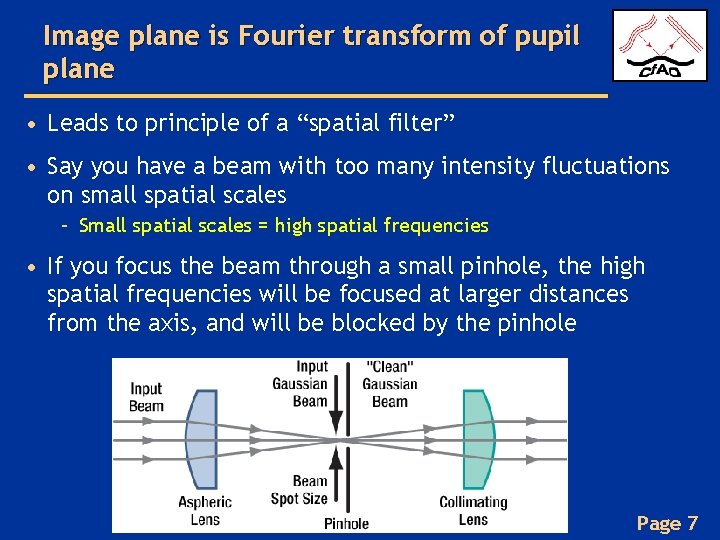
Image plane is Fourier transform of pupil plane • Leads to principle of a “spatial filter” • Say you have a beam with too many intensity fluctuations on small spatial scales – Small spatial scales = high spatial frequencies • If you focus the beam through a small pinhole, the high spatial frequencies will be focused at larger distances from the axis, and will be blocked by the pinhole Page 7
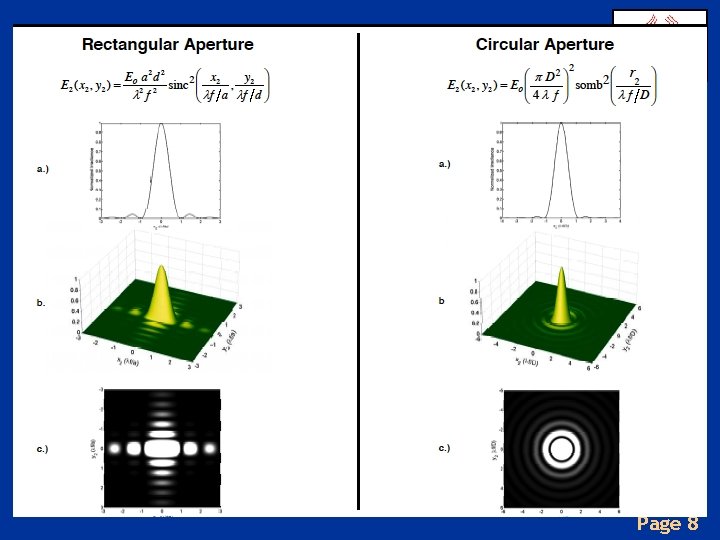
Page 8
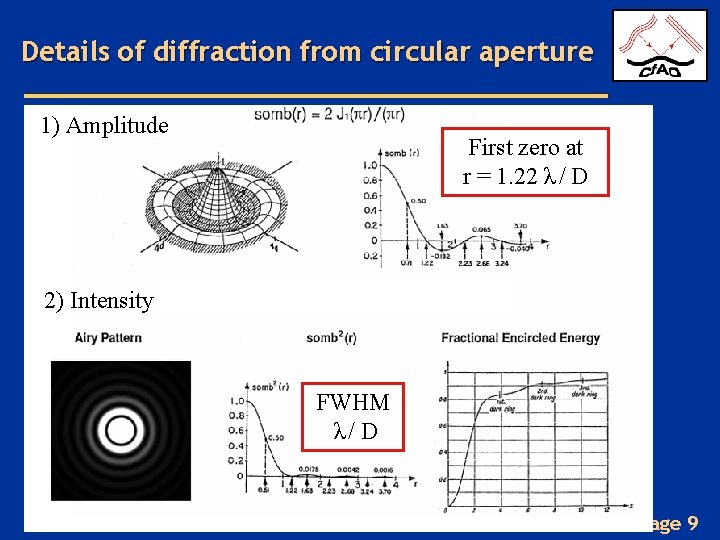
Details of diffraction from circular aperture 1) Amplitude First zero at r = 1. 22 λ / D 2) Intensity FWHM λ/ D Page 9
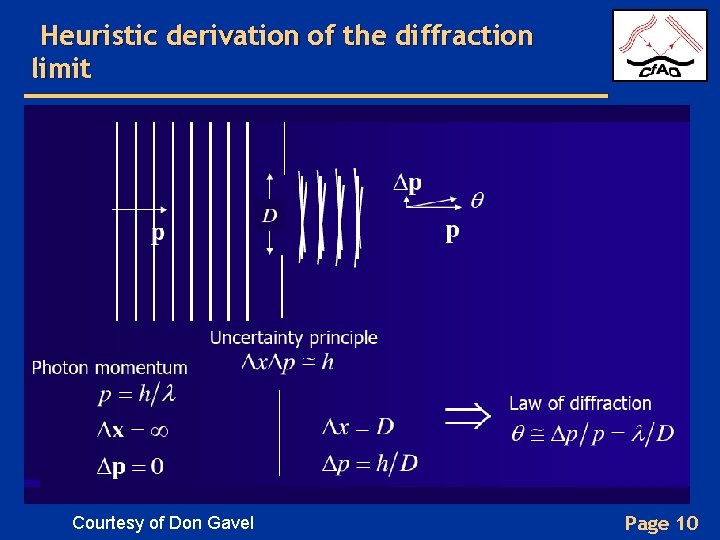
Heuristic derivation of the diffraction limit Courtesy of Don Gavel Page 10
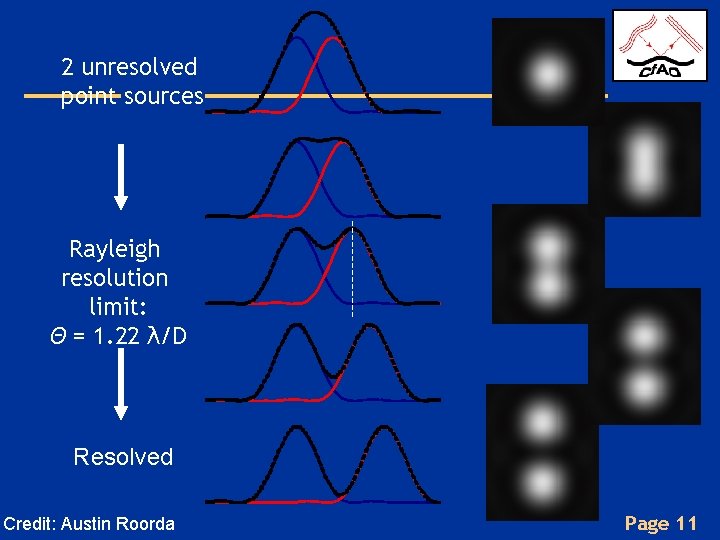
2 unresolved point sources Rayleigh resolution limit: Θ = 1. 22 λ/D Resolved Credit: Austin Roorda Page 11
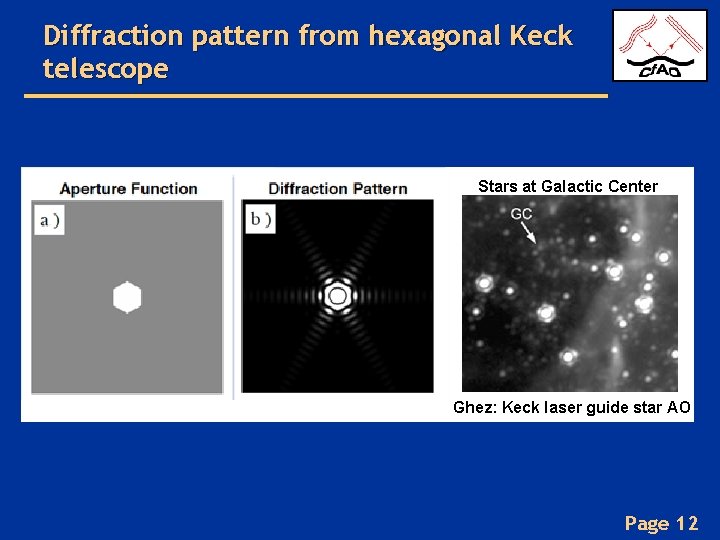
Diffraction pattern from hexagonal Keck telescope Stars at Galactic Center Ghez: Keck laser guide star AO Page 12
Outline of today’s lecture on optical propagation through turbulence 1. Use phase structure function Dϕ ~ r 2/3 to calculate statistical properties of light propagation thru index of refraction variations 2. Use these statistics to derive the atmospheric coherence length, r 0 3. Use r 0 to calculate key quantities for AO performance Philosophy for this lecture: The full derivations are all in the Quirrenbach reading. I will outline them here. You will be asked to fill in the gaps in a future homework assignment. Page 13
Philosophy for this lecture • The full derivations are all in the Quirrenbach reading. • I will outline them here so you can see how the arguments go. • You will fill in the gaps in the derivations in a future homework assignment, based on the Quirrenbach reading. Page 14
Review: Kolmogorov Turbulence • 1 -D power spectrum of velocity fluctuations: k = 2π / l Φ(k) ~ k -5/3 (one dimension) • 3 -D power spectrum: Φ 3 D(k) ~ Φ / k 2 Φ 3 D(k) ~ k -11/3 (3 dimensions) • Valid for fully developed turbulence, over the “inertial range” between the outer scale L 0 and the inner scale l 0 Page 15
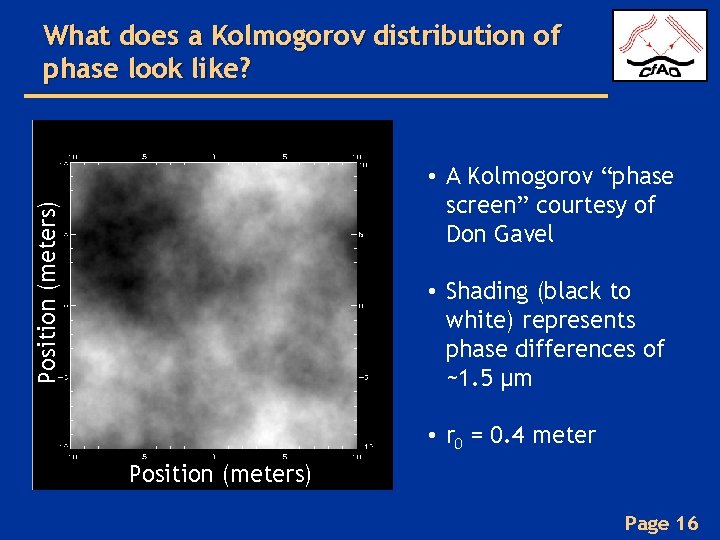
What does a Kolmogorov distribution of phase look like? Position (meters) • A Kolmogorov “phase screen” courtesy of Don Gavel • Shading (black to white) represents phase differences of ~1. 5 μm • r 0 = 0. 4 meter Position (meters) Page 16
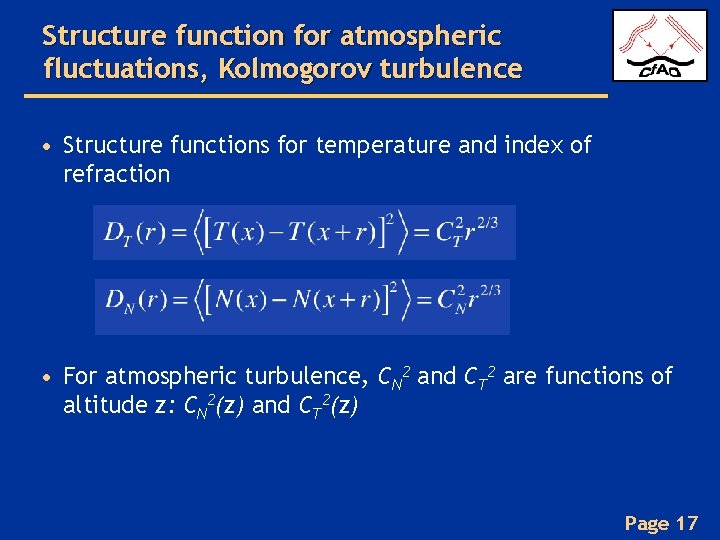
Structure function for atmospheric fluctuations, Kolmogorov turbulence • Structure functions for temperature and index of refraction • For atmospheric turbulence, CN 2 and CT 2 are functions of altitude z: CN 2(z) and CT 2(z) Page 17
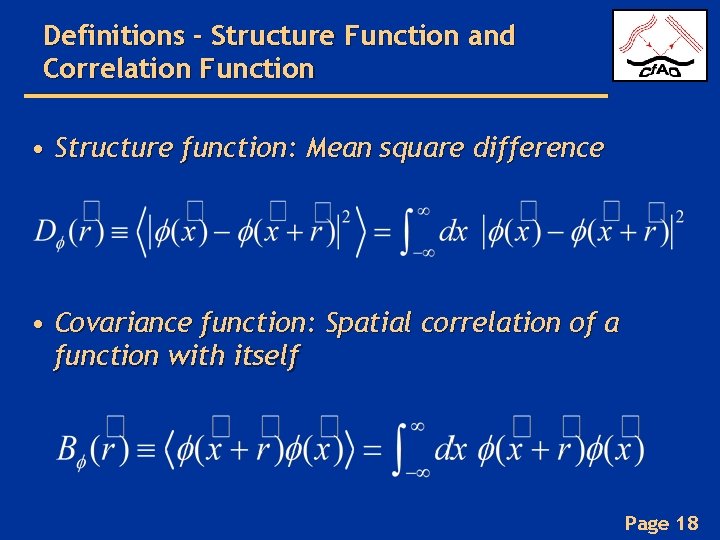
Definitions - Structure Function and Correlation Function • Structure function: Mean square difference • Covariance function: Spatial correlation of a function with itself Page 18
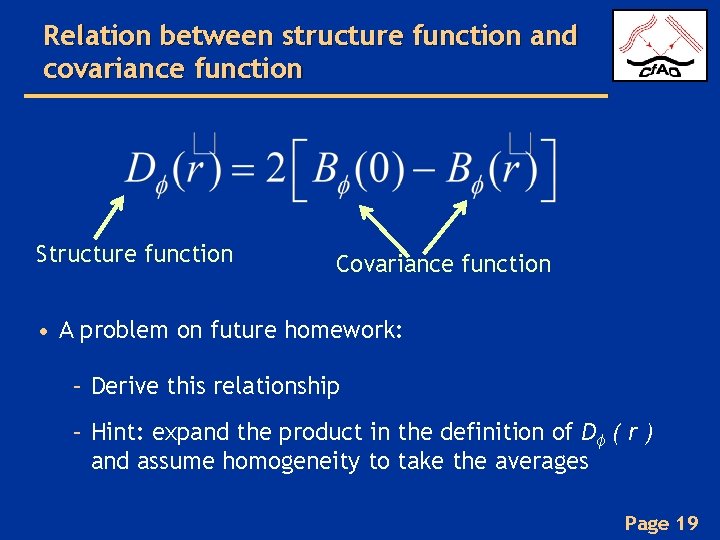
Relation between structure function and covariance function Structure function Covariance function • A problem on future homework: – Derive this relationship – Hint: expand the product in the definition of Dϕ ( r ) and assume homogeneity to take the averages Page 19
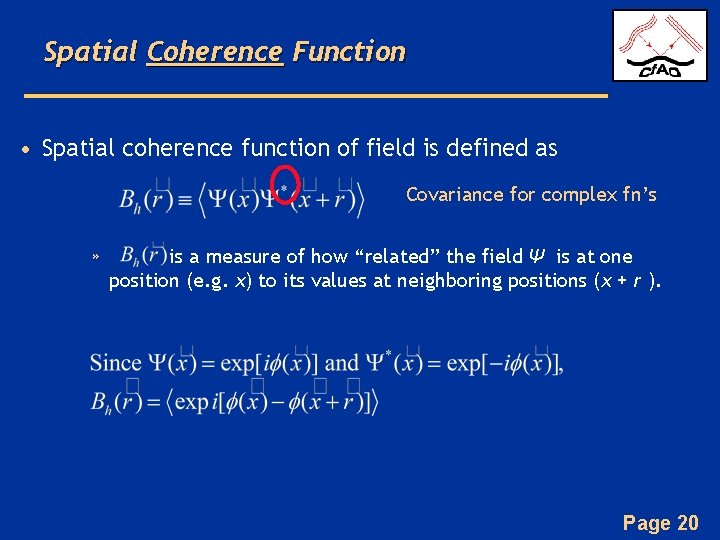
Spatial Coherence Function • Spatial coherence function of field is defined as Covariance for complex fn’s » is a measure of how “related” the field Ψ is at one position (e. g. x) to its values at neighboring positions (x + r ). Page 20
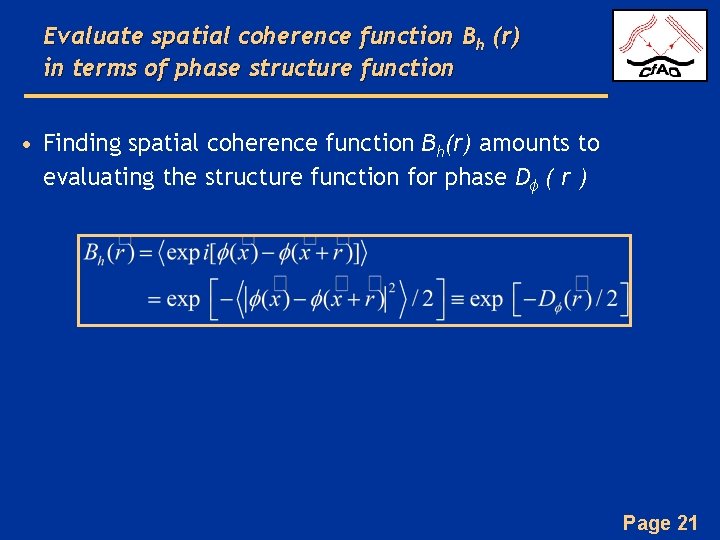
Evaluate spatial coherence function Bh (r) in terms of phase structure function • Finding spatial coherence function Bh(r) amounts to evaluating the structure function for phase Dϕ ( r ) Page 21
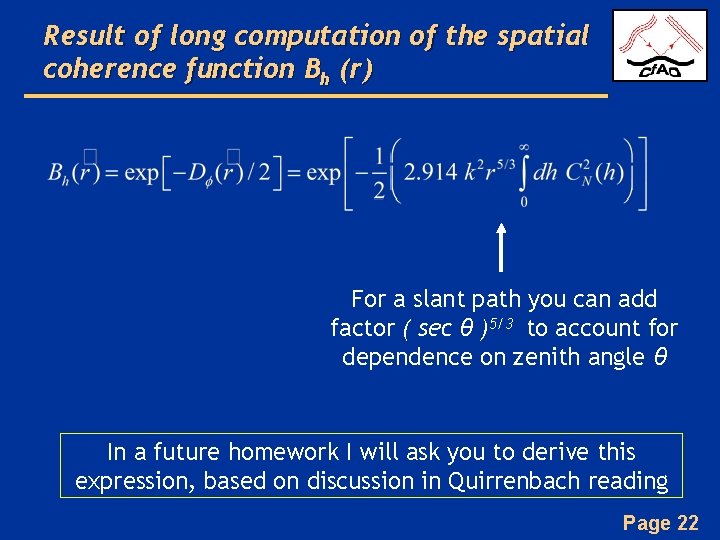
Result of long computation of the spatial coherence function Bh (r) For a slant path you can add factor ( sec θ )5/3 to account for dependence on zenith angle θ In a future homework I will ask you to derive this expression, based on discussion in Quirrenbach reading Page 22
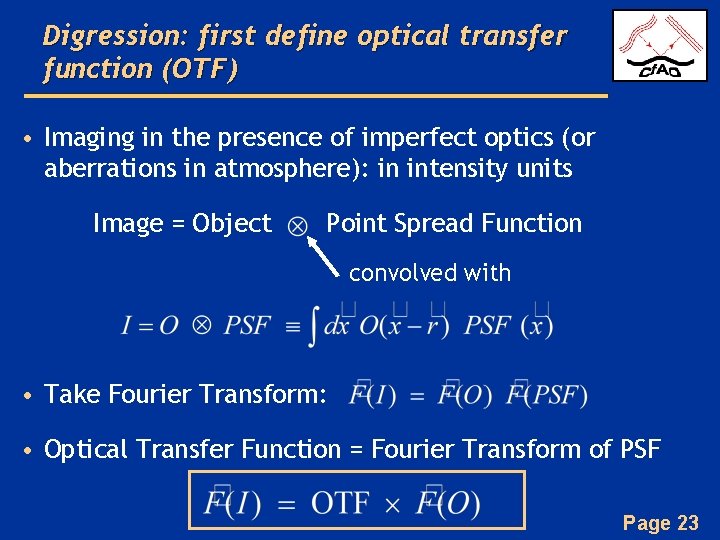
Digression: first define optical transfer function (OTF) • Imaging in the presence of imperfect optics (or aberrations in atmosphere): in intensity units Image = Object Point Spread Function convolved with • Take Fourier Transform: • Optical Transfer Function = Fourier Transform of PSF Page 23
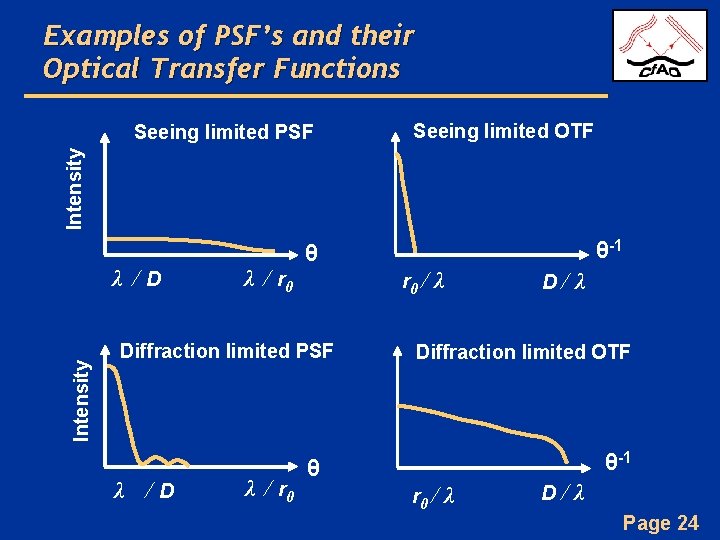
Examples of PSF’s and their Optical Transfer Functions Seeing limited OTF Intensity Seeing limited PSF Intensity λ /D λ / r 0 / Diffraction limited PSF λ /D λ / r 0 θ-1 θ λ D /λ Diffraction limited OTF θ-1 θ r 0 / λ D /λ Page 24
Derive the atmospheric coherence length, r 0 • Define r 0 as the telescope diameter where optical transfer functions of telescope and atmosphere are equal: OTFtelescope = OTFatmosphere • We will then be able to use r 0 to derive relevant timescales of turbulence, and to derive “Isoplanatic Angle”: – Describes how AO performance degrades as astronomical targets get farther from guide star Page 25
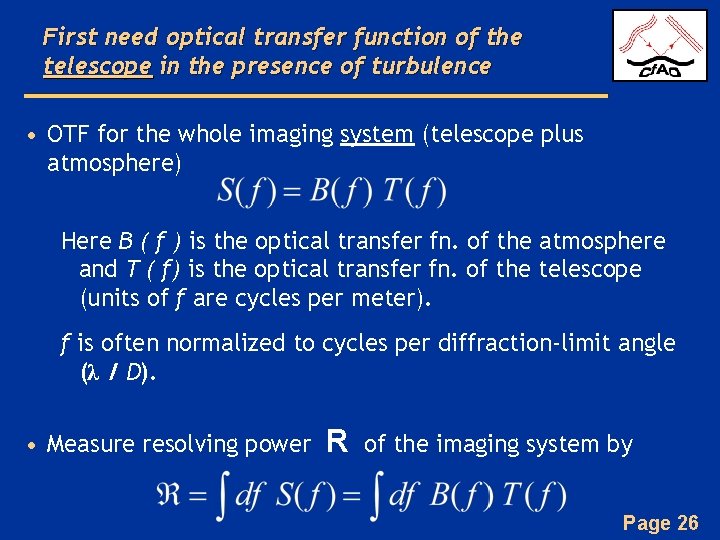
First need optical transfer function of the telescope in the presence of turbulence • OTF for the whole imaging system (telescope plus atmosphere) Here B ( f ) is the optical transfer fn. of the atmosphere and T ( f) is the optical transfer fn. of the telescope (units of f are cycles per meter). f is often normalized to cycles per diffraction-limit angle (λ / D). • Measure resolving power R of the imaging system by Page 26
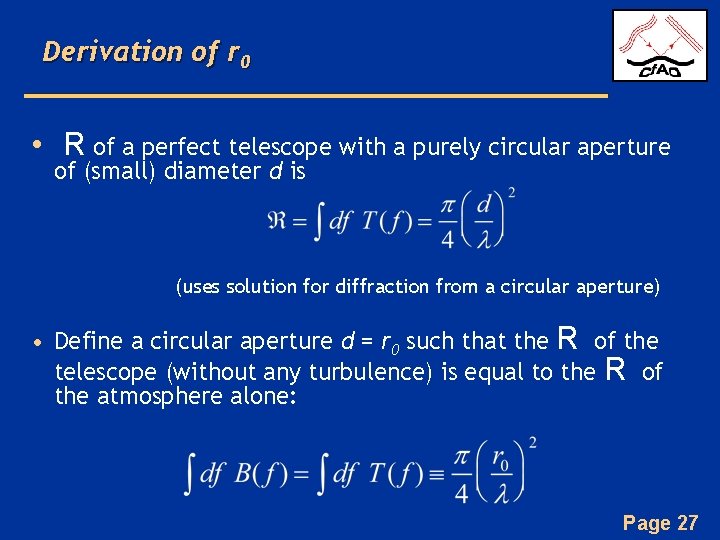
Derivation of r 0 • R of a perfect telescope with a purely circular aperture of (small) diameter d is (uses solution for diffraction from a circular aperture) • Define a circular aperture d = r 0 such that the R of the telescope (without any turbulence) is equal to the R of the atmosphere alone: Page 27
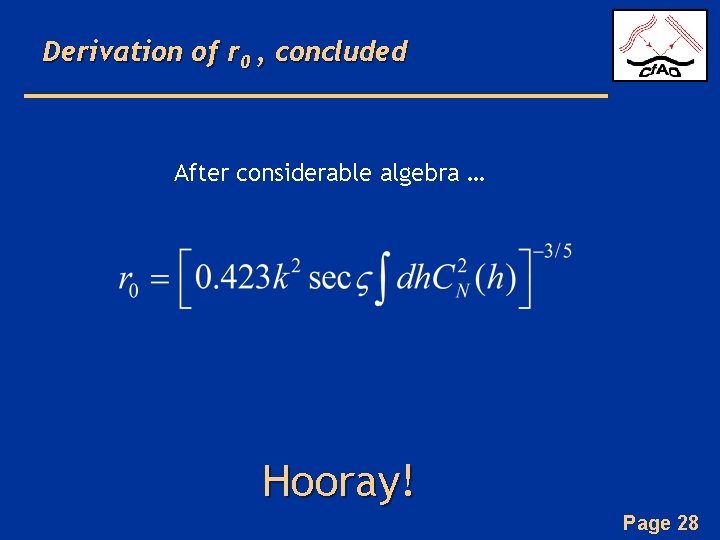
Derivation of r 0 , concluded After considerable algebra … Hooray! Page 28
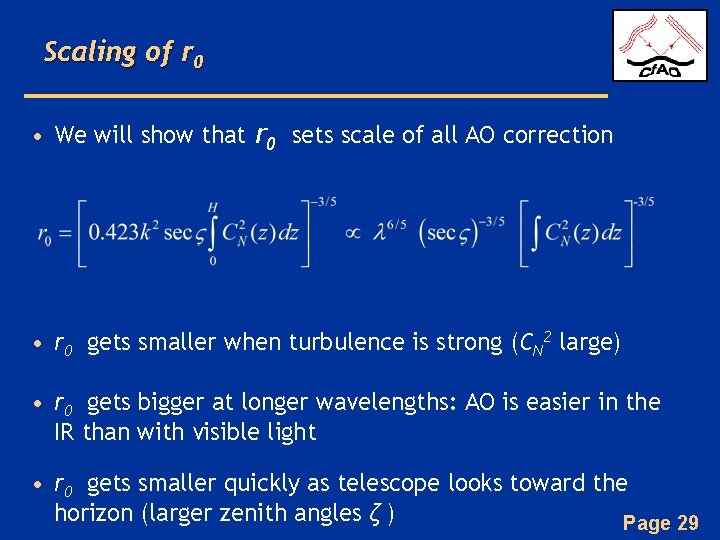
Scaling of r 0 • We will show that r 0 sets scale of all AO correction • r 0 gets smaller when turbulence is strong (CN 2 large) • r 0 gets bigger at longer wavelengths: AO is easier in the IR than with visible light • r 0 gets smaller quickly as telescope looks toward the horizon (larger zenith angles ζ ) Page 29
Typical values of r 0 • Usually r 0 is given at a 0. 5 micron wavelength for reference purposes. • It’s up to you to scale it by λ 6/5 to evaluate r 0 at your favorite wavelength. • At excellent sites such as Mauna Kea in Hawaii, r 0 at λ = 0. 5 micron is 10 - 30 cm. • But there is a big range from night to night, and at times also within a night. Page 30
Several equivalent meanings for r 0 • Define r 0 as telescope diameter where optical transfer functions of the telescope and atmosphere are equal • r 0 is separation on the telescope primary mirror where phase correlation has fallen by 1/e • (D/r 0)2 is approximate number of speckles in short -exposure image of a point source • D/r 0 sets the required number of degrees of freedom of an AO system • Can you think of others? Page 31
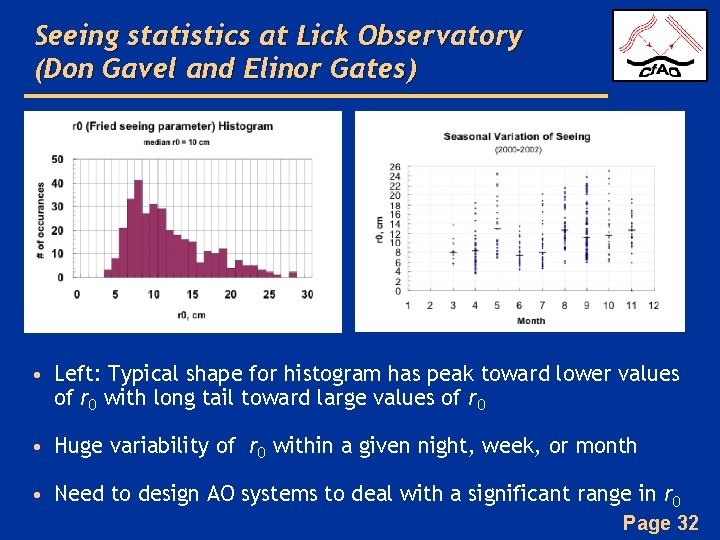
Seeing statistics at Lick Observatory (Don Gavel and Elinor Gates) • Left: Typical shape for histogram has peak toward lower values of r 0 with long tail toward large values of r 0 • Huge variability of r 0 within a given night, week, or month • Need to design AO systems to deal with a significant range in r 0 Page 32
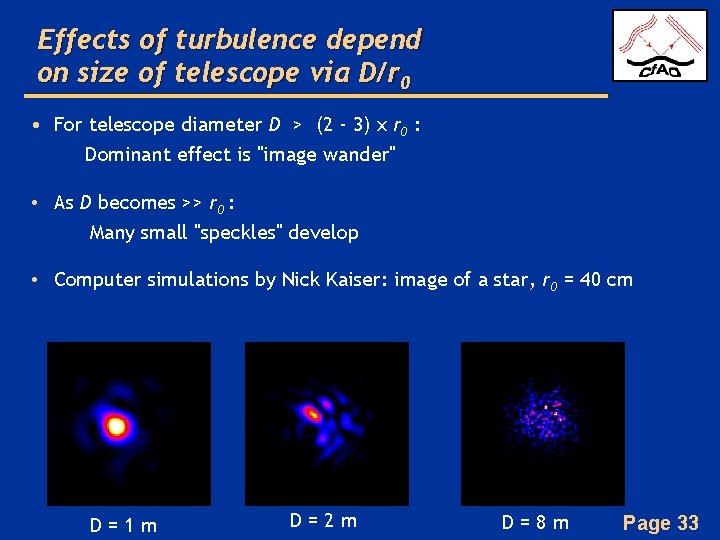
Effects of turbulence depend on size of telescope via D/r 0 • For telescope diameter D > (2 - 3) x r 0 : Dominant effect is "image wander" • As D becomes >> r 0 : Many small "speckles" develop • Computer simulations by Nick Kaiser: image of a star, r 0 = 40 cm D=1 m D=2 m D=8 m Page 33
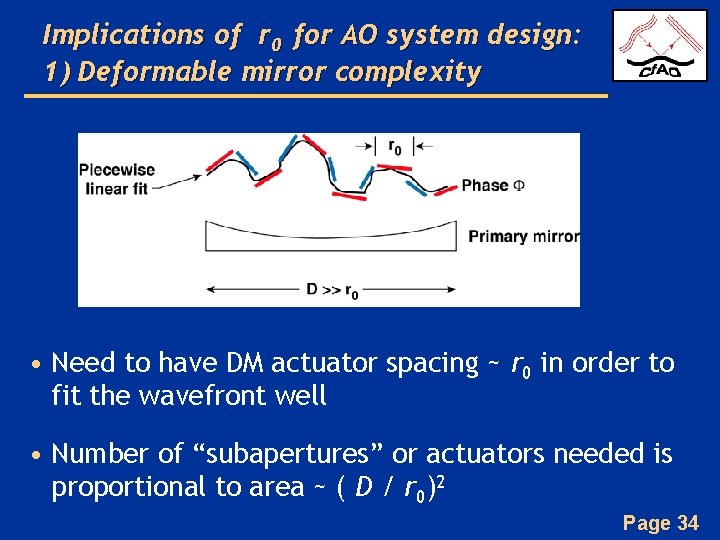
Implications of r 0 for AO system design: 1) Deformable mirror complexity • Need to have DM actuator spacing ~ r 0 in order to fit the wavefront well • Number of “subapertures” or actuators needed is proportional to area ~ ( D / r 0)2 Page 34
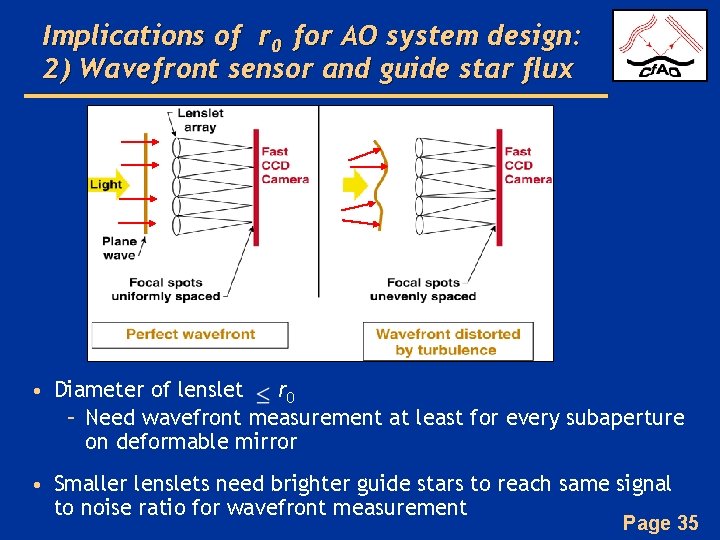
Implications of r 0 for AO system design: 2) Wavefront sensor and guide star flux • Diameter of lenslet r 0 – Need wavefront measurement at least for every subaperture on deformable mirror • Smaller lenslets need brighter guide stars to reach same signal to noise ratio for wavefront measurement Page 35
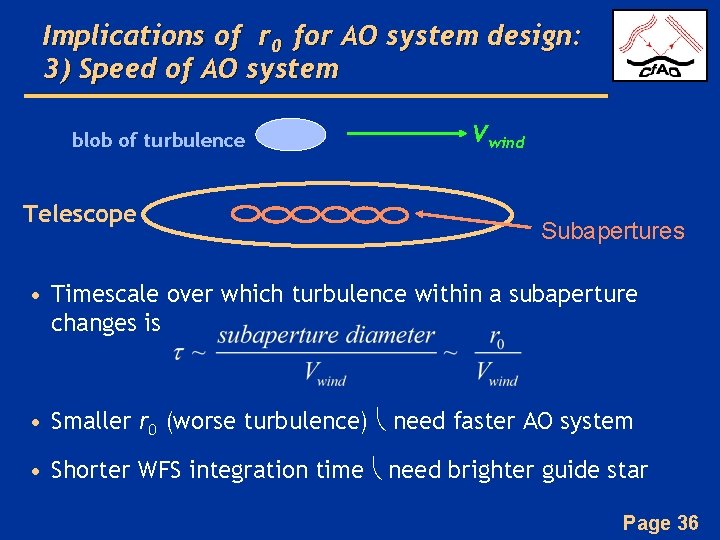
Implications of r 0 for AO system design: 3) Speed of AO system blob of turbulence Telescope Vwind Subapertures • Timescale over which turbulence within a subaperture changes is • Smaller r 0 (worse turbulence) need faster AO system • Shorter WFS integration time need brighter guide star Page 36
Summary of sensitivity to r 0 • For smaller r 0 (worse turbulence) need: – Smaller sub-apertures » More actuators on deformable mirror » More lenslets on wavefront sensor – Faster AO system » Faster computer, lower-noise wavefront sensor detector – Much brighter guide star (natural star or laser) Page 37
Interesting implications of r 0 scaling for telescope scheduling • If AO system must work under (almost) all atmospheric conditions, will be quite expensive – Difficulty and expense scale as a high power of r 0 • Two approaches: – Spend the extra money in order to be able to use almost all the observing time allocated to AO – Use flexible schedule algorithm that only turns AO system “on” when r 0 is larger than a particular value (turbulence is weaker than a particular value) Page 38
Next: All sorts of good things that come from knowing r 0 • Timescales of turbulence • Isoplanatic angle: AO performance degrades as astronomical targets get farther from guide star Page 39
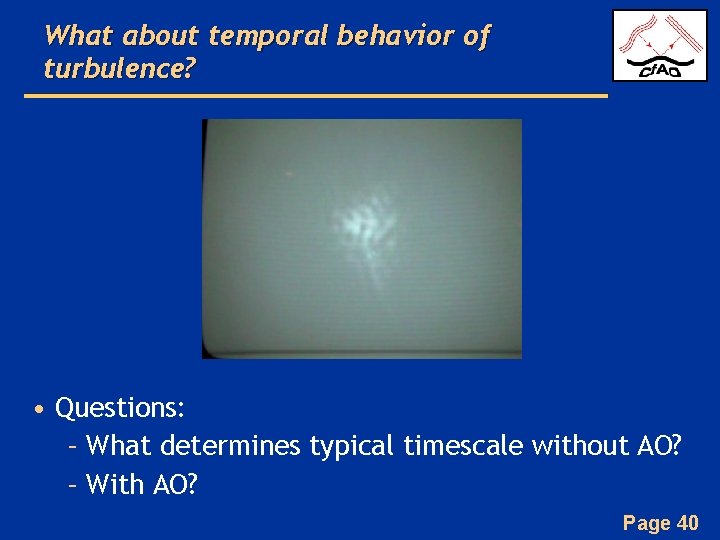
What about temporal behavior of turbulence? • Questions: – What determines typical timescale without AO? – With AO? Page 40
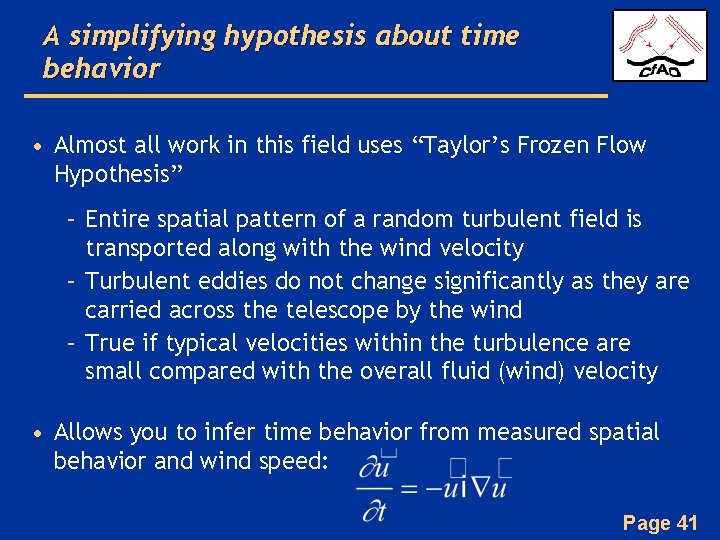
A simplifying hypothesis about time behavior • Almost all work in this field uses “Taylor’s Frozen Flow Hypothesis” – Entire spatial pattern of a random turbulent field is transported along with the wind velocity – Turbulent eddies do not change significantly as they are carried across the telescope by the wind – True if typical velocities within the turbulence are small compared with the overall fluid (wind) velocity • Allows you to infer time behavior from measured spatial behavior and wind speed: Page 41
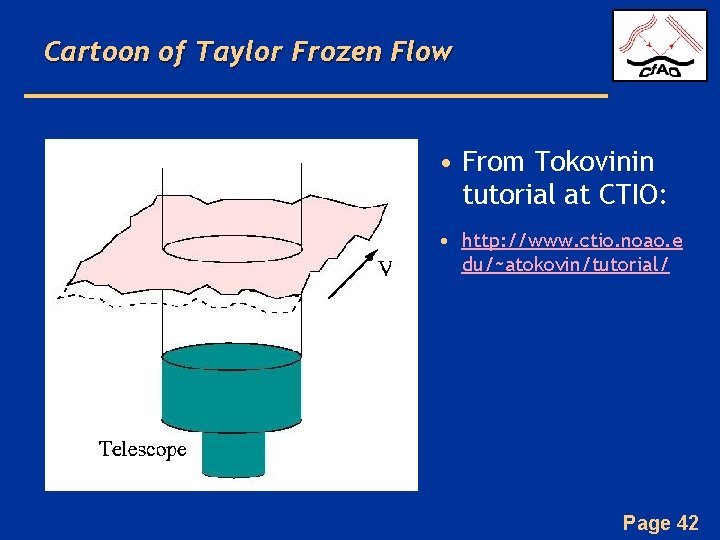
Cartoon of Taylor Frozen Flow • From Tokovinin tutorial at CTIO: • http: //www. ctio. noao. e du/~atokovin/tutorial/ Page 42
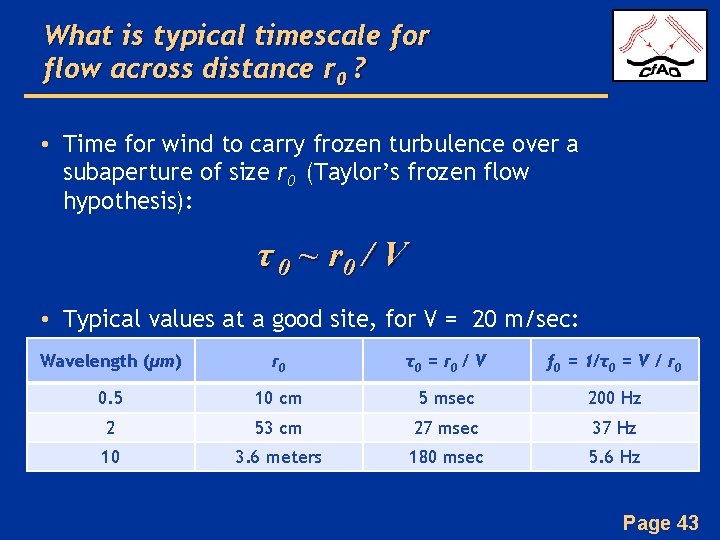
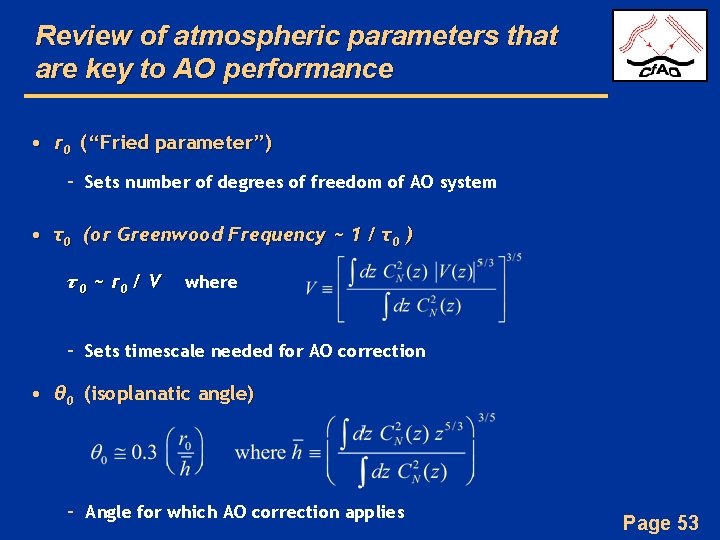
What is typical timescale for flow across distance r 0 ? • Time for wind to carry frozen turbulence over a subaperture of size r 0 (Taylor’s frozen flow hypothesis): τ 0 ~ r 0 / V • Typical values at a good site, for V = 20 m/sec: Wavelength (μm) r 0 τ0 = r 0 / V f 0 = 1/τ0 = V / r 0 0. 5 10 cm 5 msec 200 Hz 2 53 cm 27 msec 37 Hz 10 3. 6 meters 180 msec 5. 6 Hz Page 43
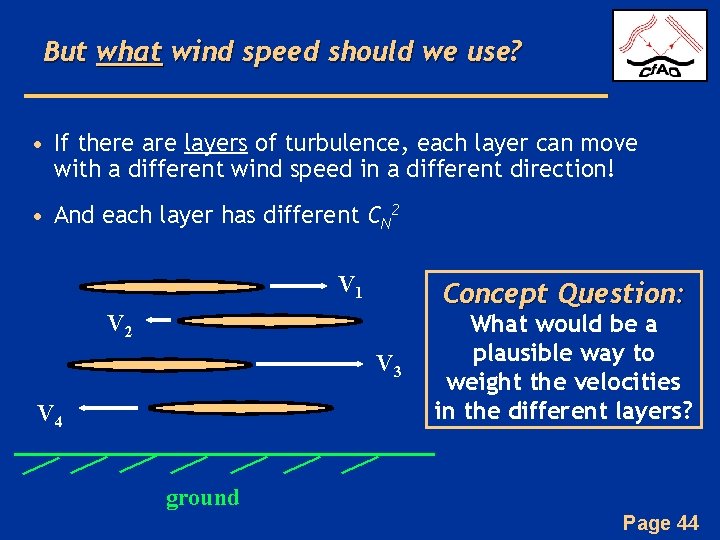
But what wind speed should we use? • If there are layers of turbulence, each layer can move with a different wind speed in a different direction! • And each layer has different CN 2 V 1 Concept Question: V 2 V 3 V 4 What would be a plausible way to weight the velocities in the different layers? ground Page 44
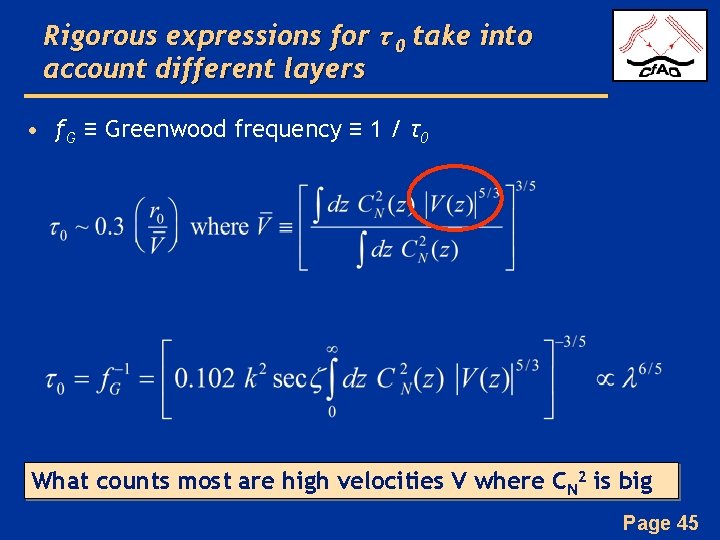
Rigorous expressions for τ 0 take into account different layers • f. G ≡ Greenwood frequency ≡ 1 / τ0 What counts most are high velocities V where CN 2 is big Page 45
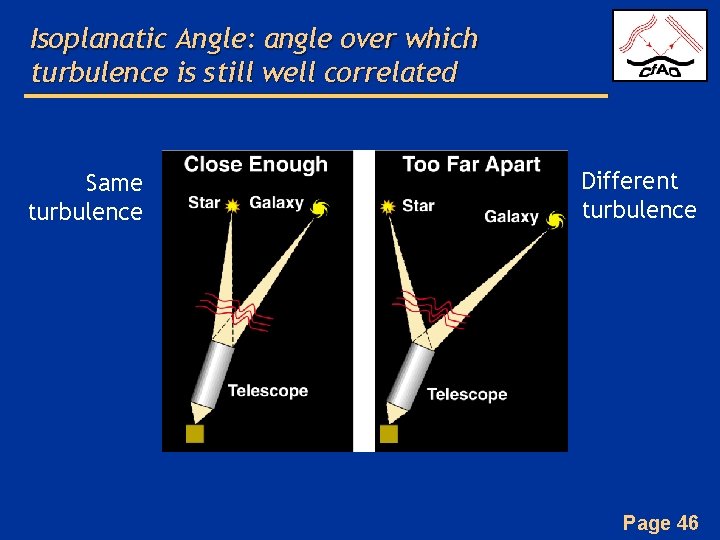
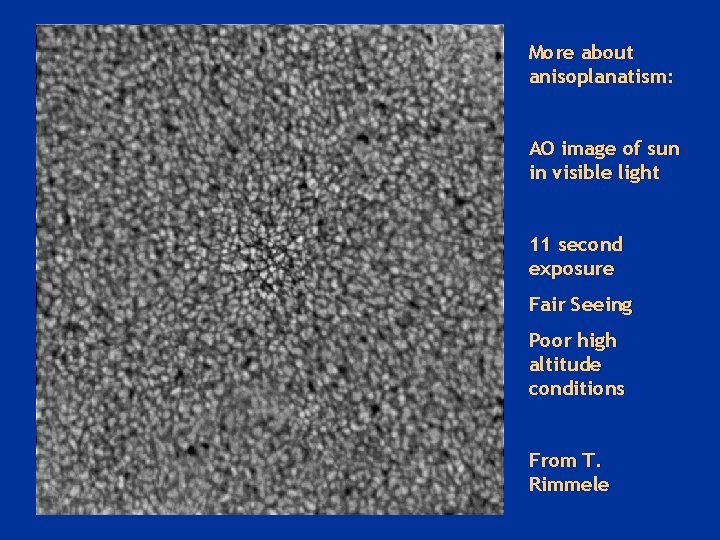
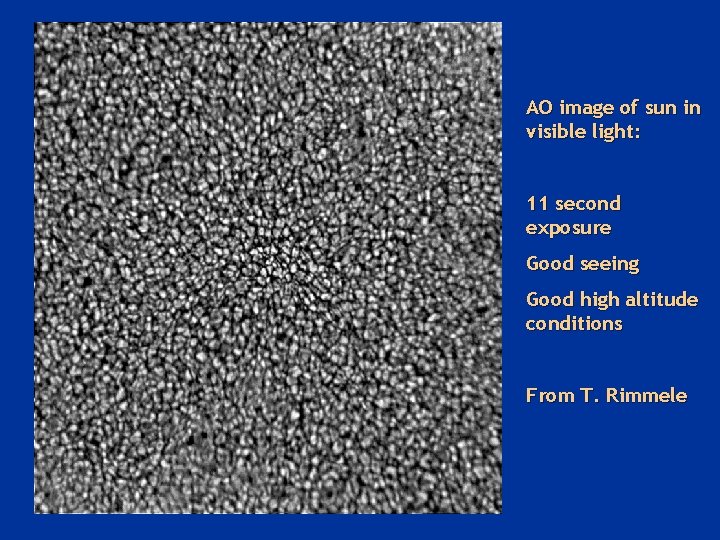
Isoplanatic Angle: angle over which turbulence is still well correlated Same turbulence Different turbulence Page 46
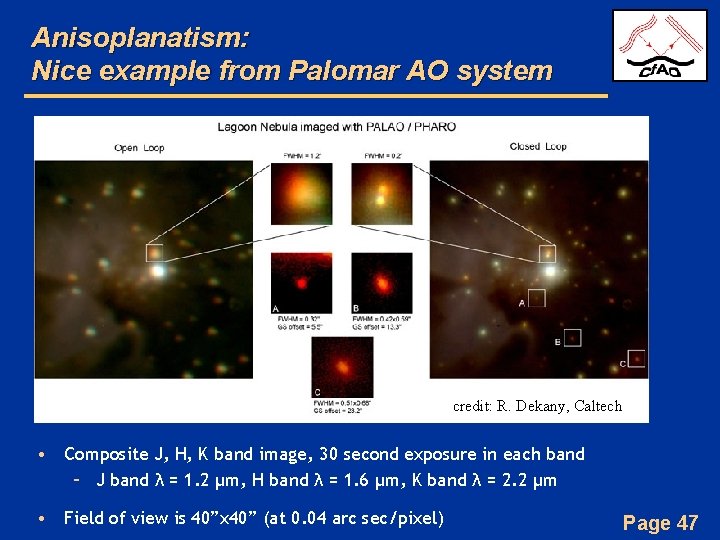
Anisoplanatism: Nice example from Palomar AO system credit: R. Dekany, Caltech • Composite J, H, K band image, 30 second exposure in each band – J band λ = 1. 2 μm, H band λ = 1. 6 μm, K band λ = 2. 2 μm • Field of view is 40”x 40” (at 0. 04 arc sec/pixel) Page 47
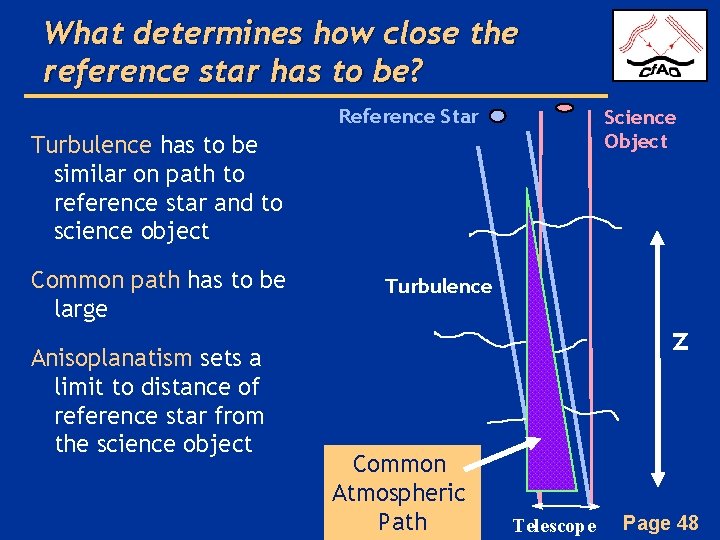
What determines how close the reference star has to be? Reference Star Science Object Turbulence has to be similar on path to reference star and to science object Common path has to be large Anisoplanatism sets a limit to distance of reference star from the science object Turbulence z Common Atmospheric Path Telescope Page 48
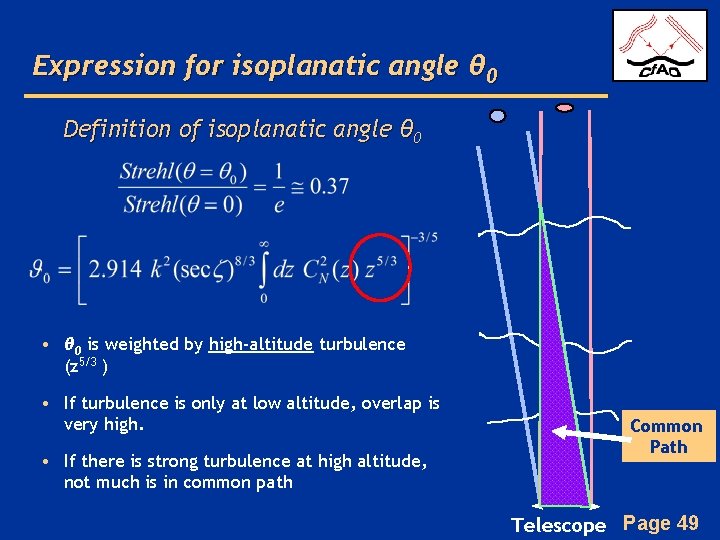
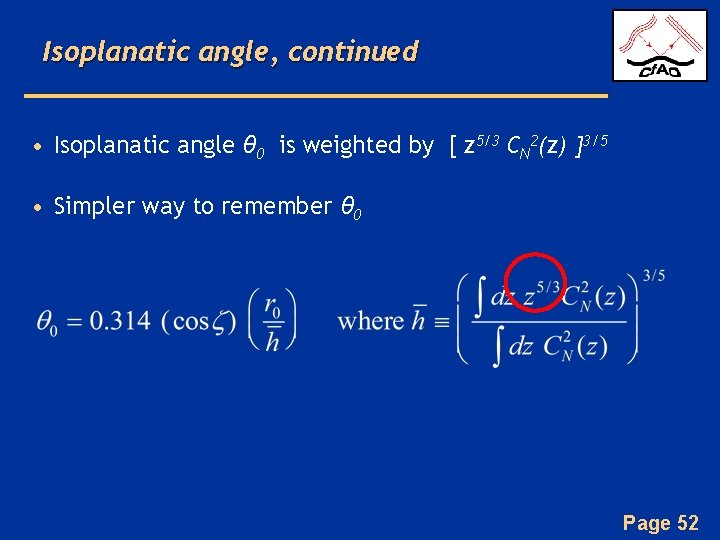
Expression for isoplanatic angle θ 0 Definition of isoplanatic angle θ 0 • θ 0 is weighted by high-altitude turbulence (z 5/3 ) • If turbulence is only at low altitude, overlap is very high. • If there is strong turbulence at high altitude, not much is in common path Common Path Telescope Page 49
More about anisoplanatism: AO image of sun in visible light 11 second exposure Fair Seeing Poor high altitude conditions From T. Rimmele
AO image of sun in visible light: 11 second exposure Good seeing Good high altitude conditions From T. Rimmele
Isoplanatic angle, continued • Isoplanatic angle θ 0 is weighted by [ z 5/3 CN 2(z) ]3/5 • Simpler way to remember θ 0 Page 52
Review of atmospheric parameters that are key to AO performance • r 0 (“Fried parameter”) – Sets number of degrees of freedom of AO system • τ0 (or Greenwood Frequency ~ 1 / τ0 ) τ 0 ~ r 0 / V where – Sets timescale needed for AO correction • θ 0 (isoplanatic angle) – Angle for which AO correction applies Page 53
- Slides: 53