
Proofs of Correctness An Introduction to Axiomatic Verification
- Slides: 40
Proofs of Correctness: An Introduction to Axiomatic Verification CEN 5035 Software Engineering Prepared by Stephen M. Thebaut, Ph. D. University of Florida
Important info for students: • “Intro to Proofs of Correctness” is an elementary introduction to the verification material covered in CEN 4072/6070, Software Testing & Verification. • Therefore, if you have already taken CEN 4072/6070, you will NOT be tested on this material in Exam 2. • Instead, you will be tested on Sommerville Chaps 16 and 25 (“Software reuse” and “Configuration management”), which will NOT be covered in class.
Outline • • • Introduction Weak correctness predicate Assignment statements Sequencing Selection statements Iteration
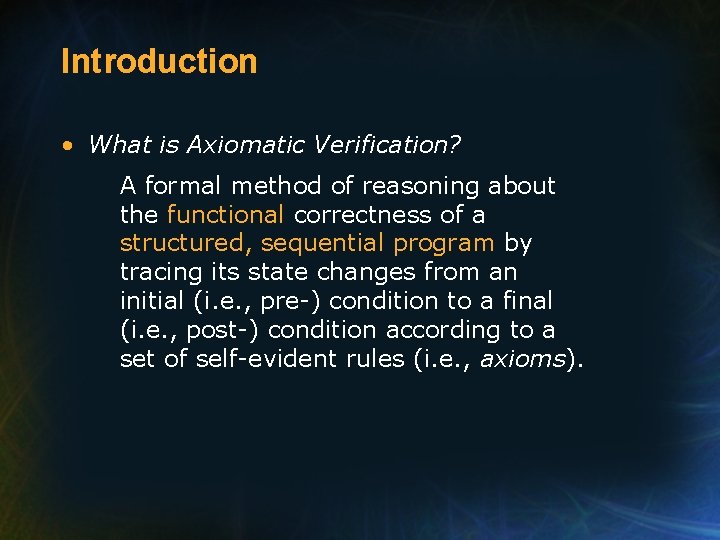
Introduction • What is Axiomatic Verification? A formal method of reasoning about the functional correctness of a structured, sequential program by tracing its state changes from an initial (i. e. , pre-) condition to a final (i. e. , post-) condition according to a set of self-evident rules (i. e. , axioms).
Introduction (cont’d) • What is its primary goal? To provide a means for “proving” (or “disproving”) the functional correctness of a sequential program with respect to its (formal) specification.
Introduction (cont’d) • What are the benefits of studying axiomatic verification? – Understanding its limitations. – Deeper insights into programming and program structures. – Criteria for judging both programs and programming languages. – The ability to formally verify small (or parts of large) sequential programs.
Introduction (cont’d) • Bottom line: even if you never attempt to “prove” a program correct outside this course, the study of formal verification should change the way you write and read programs.
Weak Correctness Predicate • To prove that program S is (weakly) correct with respect to pre-condition P and post-condition Q, it is sufficient to show: {P} S {Q}. • Interpretation of {P} S {Q}: “if the input (initial state) satisfies pre-condition P and (if) program S executes and terminates, then the output (final state) must satisfy post-condition Q. ”
Weak Correctness Predicate (cont’d) • Note that {P} S {Q} is really just a “double conditional” of the form: (A Л B) C where A is “P holds before executing S”, B is “S terminates”, and C is “Q holds after executing S”. • Therefore, what is the one and only case (in terms of the values of A, B, and C) for which {P} S {Q} is false?
Weak Correctness Predicate (cont’d) • Thus, {P} S {Q} is true unless Q could be false if S terminates, given that P held before S executes. • What are the truth values of the following assertions? (1) {x=1} y : = x+1 {y>0}
Weak Correctness Predicate (cont’d) • Thus, {P} S {Q} is true unless Q could be false if S terminates, given that P held before S executes. • What are the truth values of the following assertions? (2) {x>0} x : = x-1 {x>0}
Weak Correctness Predicate (cont’d) • Thus, {P} S {Q} is true unless Q could be false if S terminates, given that P held before S executes. • What are the truth values of the following assertions? (3) {1=2} k : = 5 {k<0}
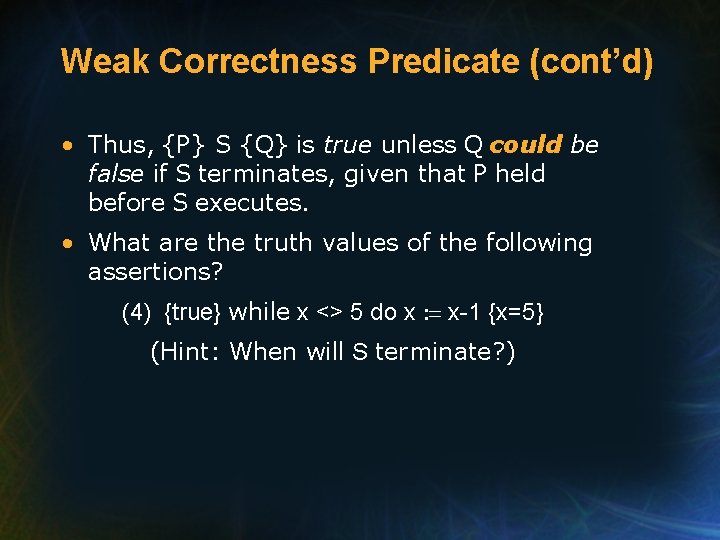
Weak Correctness Predicate (cont’d) • Thus, {P} S {Q} is true unless Q could be false if S terminates, given that P held before S executes. • What are the truth values of the following assertions? (4) {true} while x <> 5 do x : = x-1 {x=5} (Hint: When will S terminate? )
Weak Correctness Predicate (cont’d) • We now consider techniques for proving that such assertions hold for structured programs comprised of assignment statements, if-then (-else) statements, and while loops. (Why these particular constructs? )
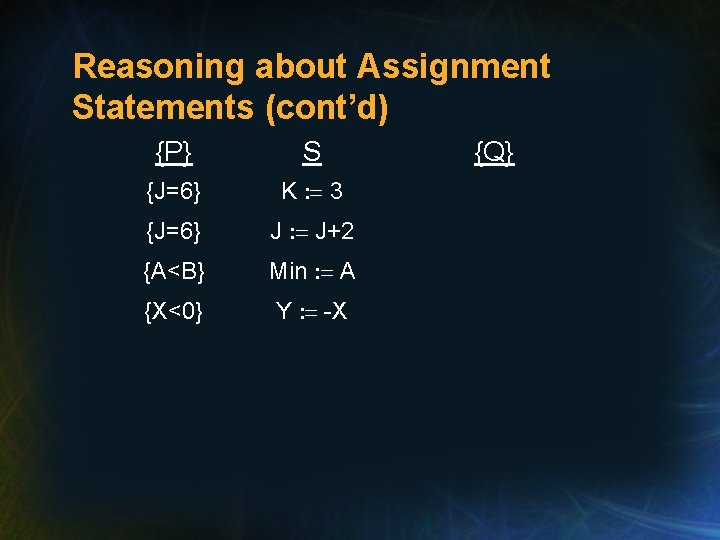
Reasoning about Assignment Statements • For each of the following pre-conditions, P, and assignment statements, S, identify a “strong” post-condition, Q, such that {P} S {Q} would hold. • A “strong” post-condition captures all afterexecution state information of interest. • We won’t bother with propositions such as X=X’ (“the final value of X is the same as the initial value of X”) for the time being.
Reasoning about Assignment Statements (cont’d) {P} S {J=6} K : = 3 {J=6} J : = J+2 {A<B} Min : = A {X<0} Y : = -X {Q}
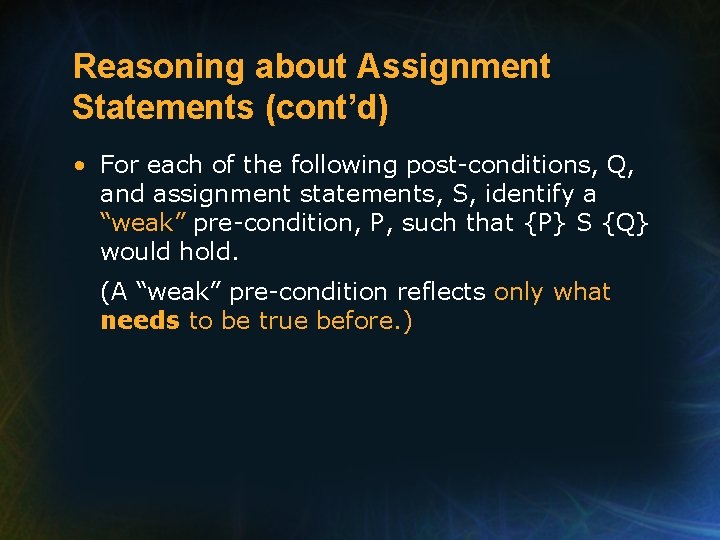
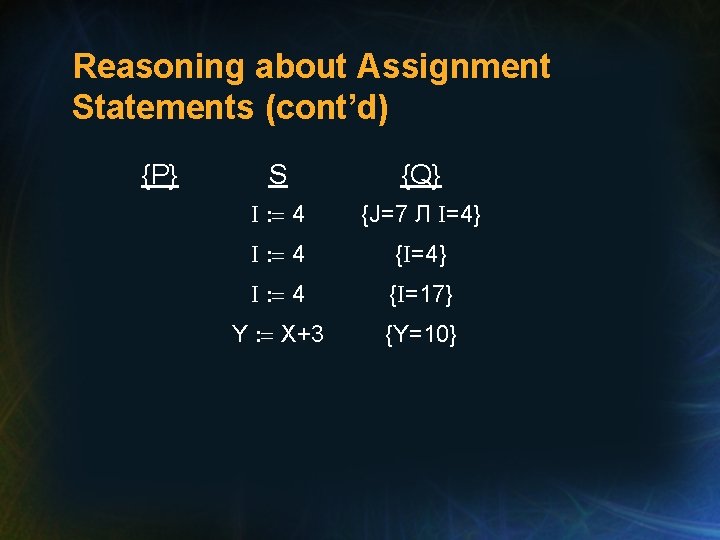
Reasoning about Assignment Statements (cont’d) • For each of the following post-conditions, Q, and assignment statements, S, identify a “weak” pre-condition, P, such that {P} S {Q} would hold. (A “weak” pre-condition reflects only what needs to be true before. )
Reasoning about Assignment Statements (cont’d) {P} S {Q} I : = 4 {J=7 Л I=4} I : = 4 {I=17} Y : = X+3 {Y=10}
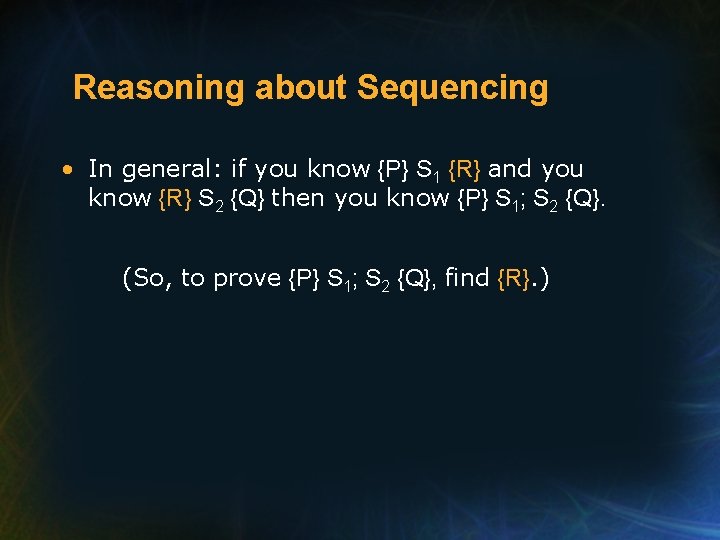
Reasoning about Sequencing • In general: if you know {P} S 1 {R} and you know {R} S 2 {Q} then you know {P} S 1; S 2 {Q}. (So, to prove {P} S 1; S 2 {Q}, find {R}. )
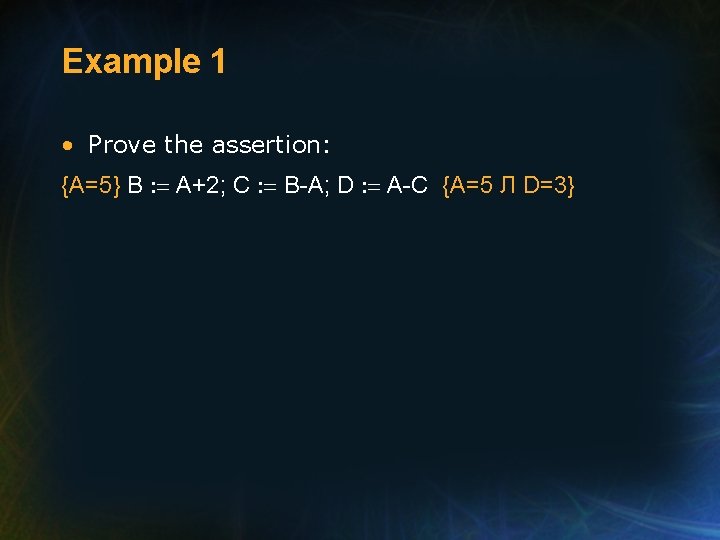
Example 1 • Prove the assertion: {A=5} B : = A+2; C : = B-A; D : = A-C {A=5 Л D=3}
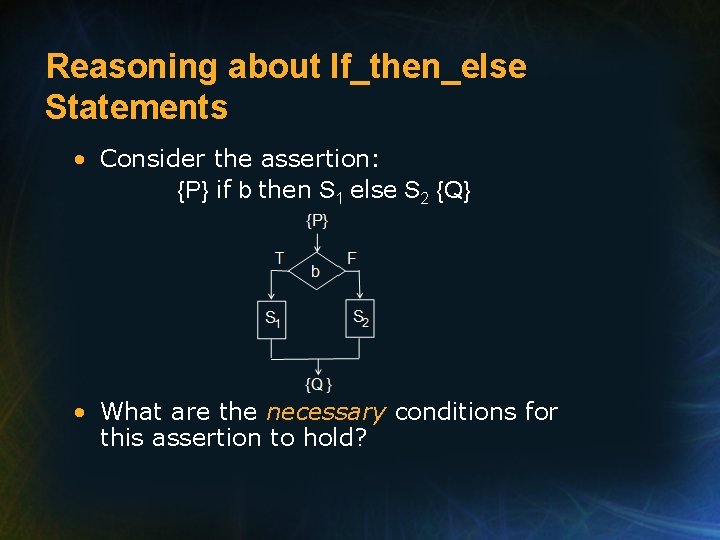
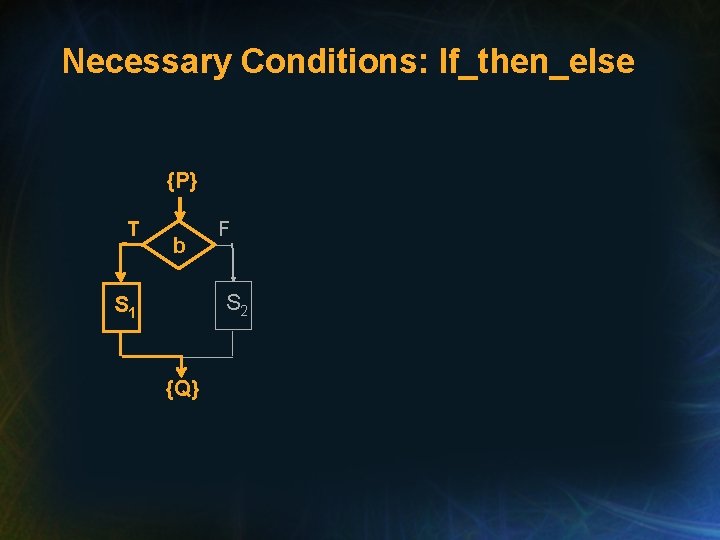
Reasoning about If_then_else Statements • Consider the assertion: {P} if b then S 1 else S 2 {Q} • What are the necessary conditions for this assertion to hold?
Necessary Conditions: If_then_else {P} T b F S 2 S 1 {Q}
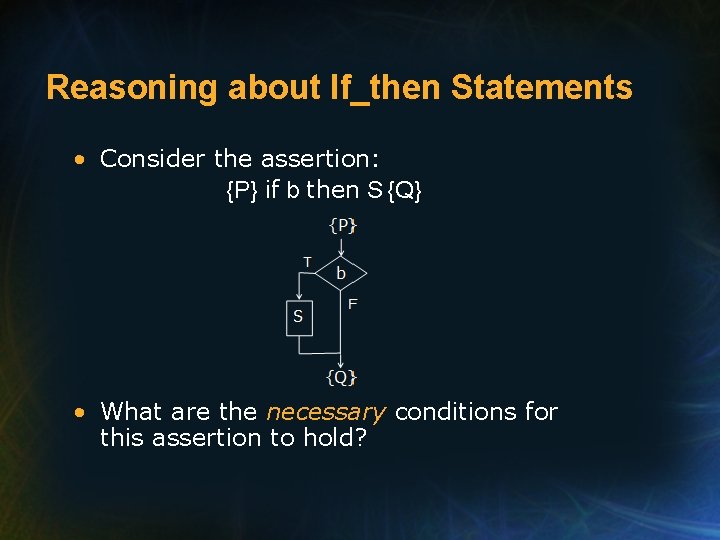
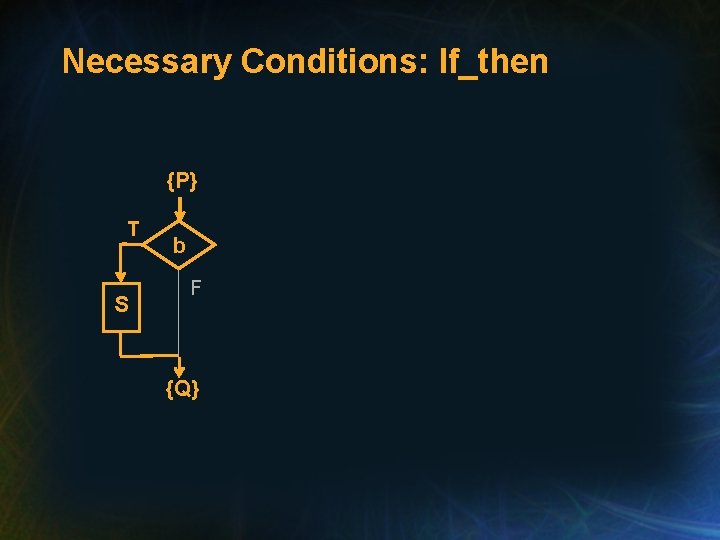
Reasoning about If_then Statements • Consider the assertion: {P} if b then S {Q} • What are the necessary conditions for this assertion to hold?
Necessary Conditions: If_then {P} T S b F {Q}
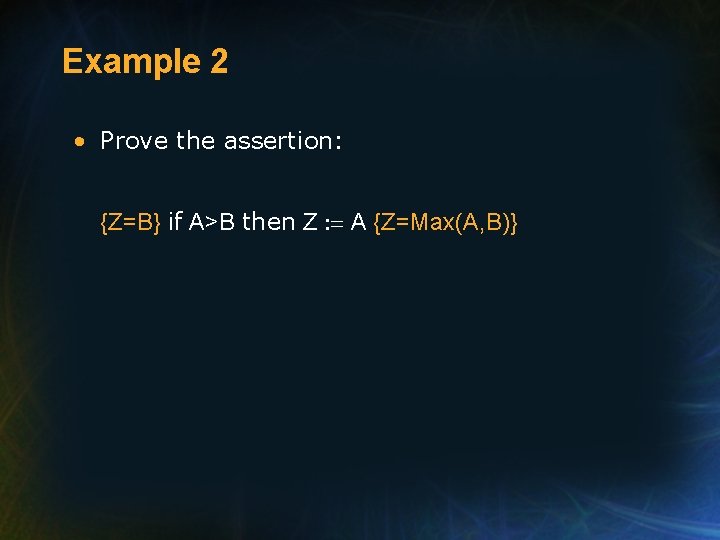
Example 2 • Prove the assertion: {Z=B} if A>B then Z : = A {Z=Max(A, B)}
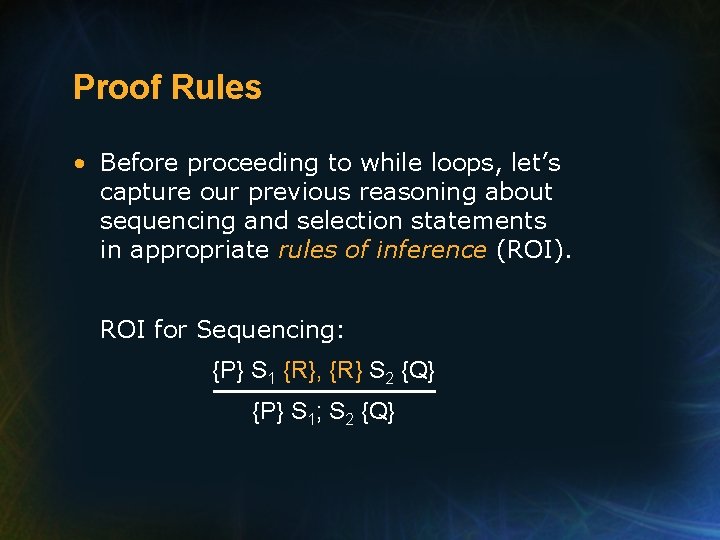
Proof Rules • Before proceeding to while loops, let’s capture our previous reasoning about sequencing and selection statements in appropriate rules of inference (ROI). ROI for Sequencing: {P} S 1 {R}, {R} S 2 {Q} {P} S 1; S 2 {Q}
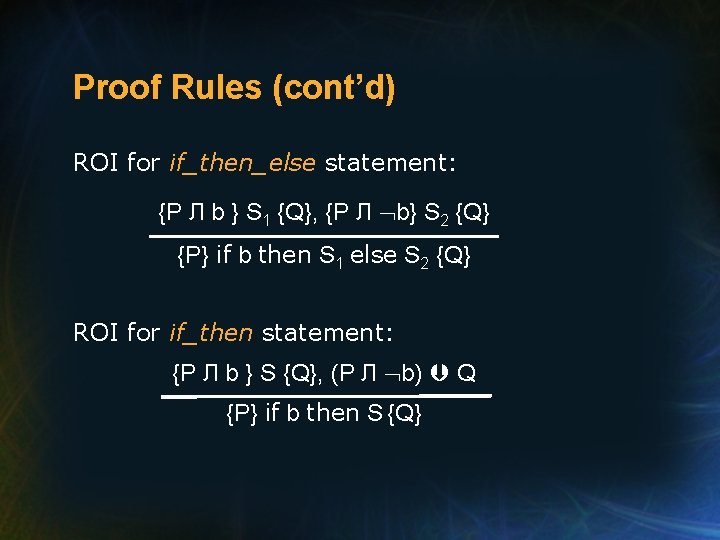
Proof Rules (cont’d) ROI for if_then_else statement: {P Л b } S 1 {Q}, {P Л b} S 2 {Q} {P} if b then S 1 else S 2 {Q} ROI for if_then statement: {P Л b } S {Q}, (P Л b) Q {P} if b then S {Q}
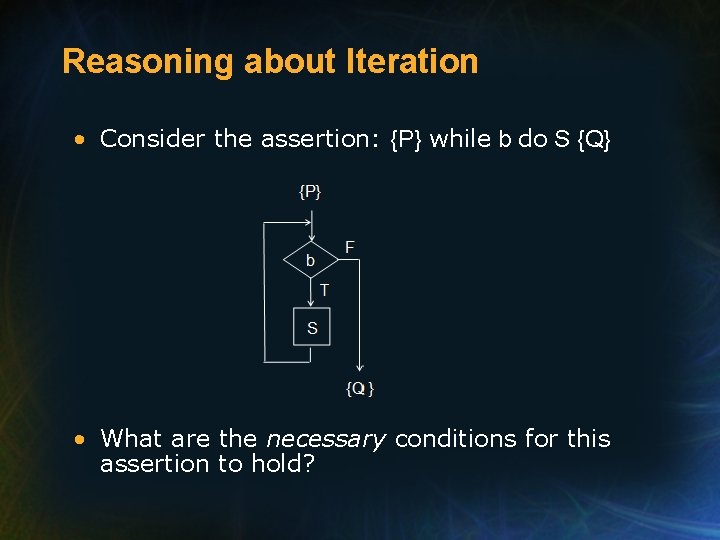
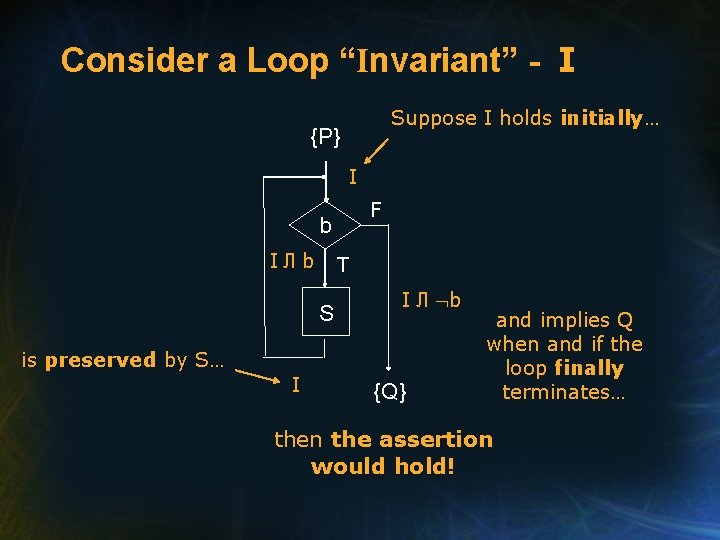
Reasoning about Iteration • Consider the assertion: {P} while b do S {Q} • What are the necessary conditions for this assertion to hold?
Consider a Loop “Invariant” - I Suppose I holds initially… {P} I F b IЛb T S I Л b is preserved by S… I {Q} and implies Q when and if the loop finally terminates… then the assertion would hold!
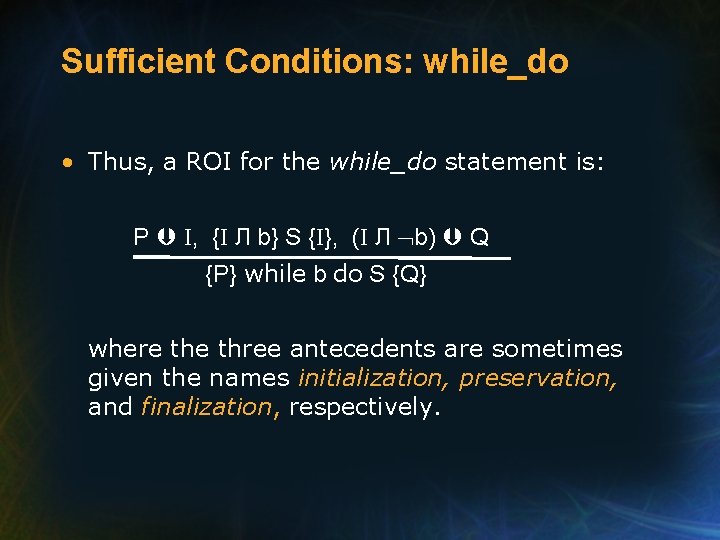
Sufficient Conditions: while_do • Thus, a ROI for the while_do statement is: P I, {I Л b} S {I}, (I Л b) Q {P} while b do S {Q} where three antecedents are sometimes given the names initialization, preservation, and finalization, respectively.
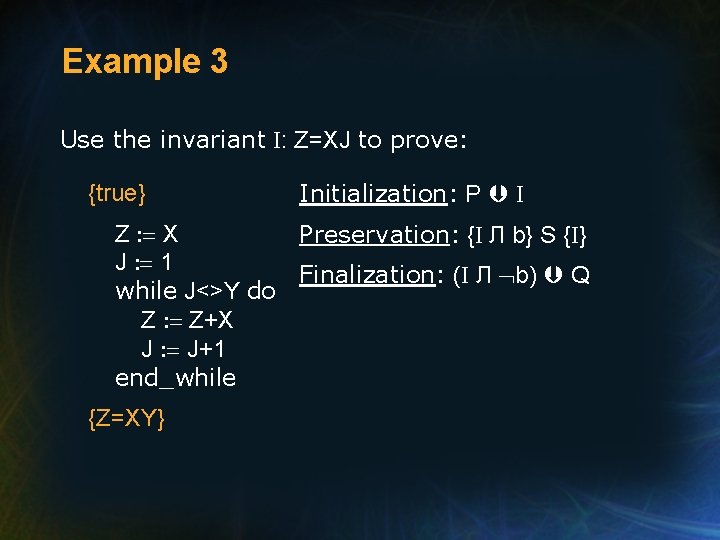
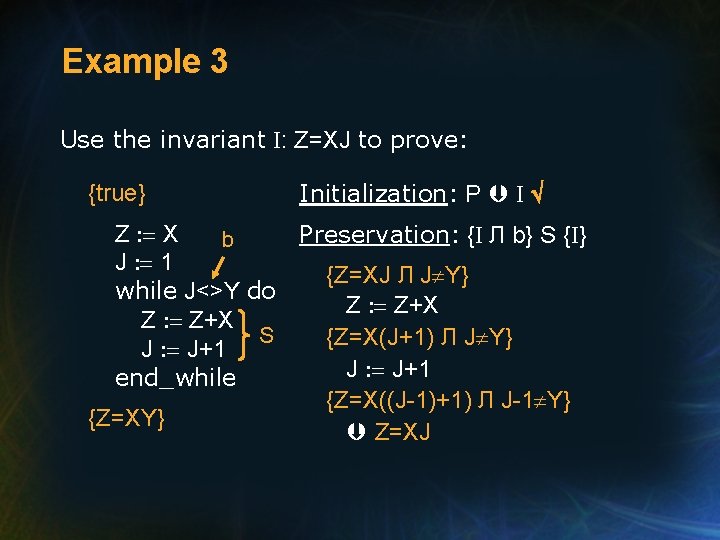
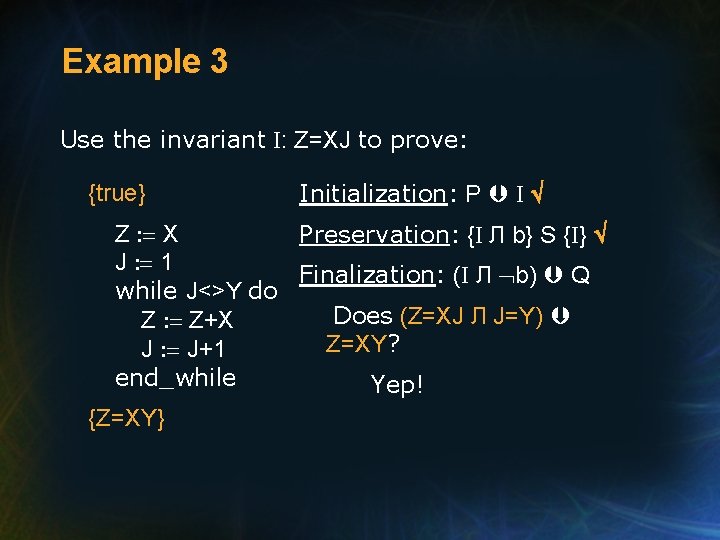
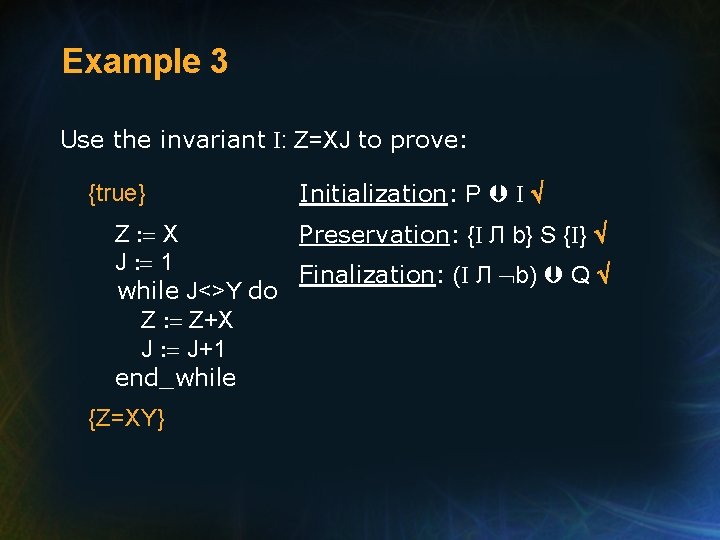
Example 3 Use the invariant I: Z=XJ to prove: {true} Initialization: P I Z : = X Preservation: {I Л b} S {I} J : = 1 Finalization: (I Л b) Q while J<>Y do Z : = Z+X J : = J+1 end_while {Z=XY}
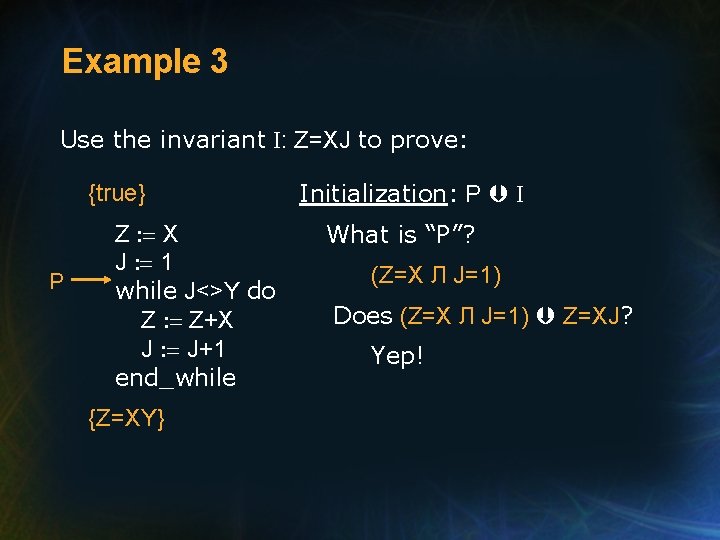
Example 3 Use the invariant I: Z=XJ to prove: {true} P Z : = X J : = 1 while J<>Y do Z : = Z+X J : = J+1 end_while {Z=XY} Initialization: P I What is “P”? (Z=X Л J=1) Does (Z=X Л J=1) Z=XJ? Yep!
Example 3 Use the invariant I: Z=XJ to prove: {true} Initialization: P I Z : = X Preservation: {I Л b} S {I} b J : = 1 {Z=XJ Л J Y} while J<>Y do Z : = Z+X S {Z=X(J+1) Л J Y} J : = J+1 end_while {Z=X((J-1)+1) Л J-1 Y} {Z=XY} Z=XJ
Example 3 Use the invariant I: Z=XJ to prove: {true} Initialization: P I Z : = X Preservation: {I Л b} S {I} J : = 1 Finalization: (I Л b) Q while J<>Y do Does (Z=XJ Л J=Y) Z : = Z+X Z=XY? J : = J+1 end_while Yep! {Z=XY}
Example 3 Use the invariant I: Z=XJ to prove: {true} Initialization: P I Z : = X Preservation: {I Л b} S {I} J : = 1 Finalization: (I Л b) Q while J<>Y do Z : = Z+X J : = J+1 end_while {Z=XY}
Exercise • See WHILE LOOP VERIFICATION EXERCISE on course website
Some Limitations of Formal Verification • Difficulties can arise when dealing with: – parameters – pointers – synthesis of invariants – decidability of verification conditions – concurrency
Some Limitations of Formal Verification (cont’d) • In addition, a formal specification: – may be expensive to produce – may be incorrect and/or incomplete – normally reflects functional requirements only • Will the proof process be manual or automatic? Who will prove the proof?
That’s all, folks, but If you like formal verification… • Take CEN 6070, Software Testing & Verification and learn about: – deriving invariants using the Invariant Status Theorem, – proving termination using the Method of Well -Founded Sets, – Predicate transforms (“weakest preconditions”) – function-theoretic verification (prove the correctness of loops without invariants!) – and MUCH more!
Proofs of Correctness: An Introduction to Axiomatic Verification CEN 5035 Software Engineering Prepared by Stephen M. Thebaut, Ph. D. University of Florida