
Pronto Raster A C library for Map Algebra
Pronto Raster: A C++ library for Map Algebra Alex Hagen-Zanker a. hagen-zanker@surrey. ac. uk
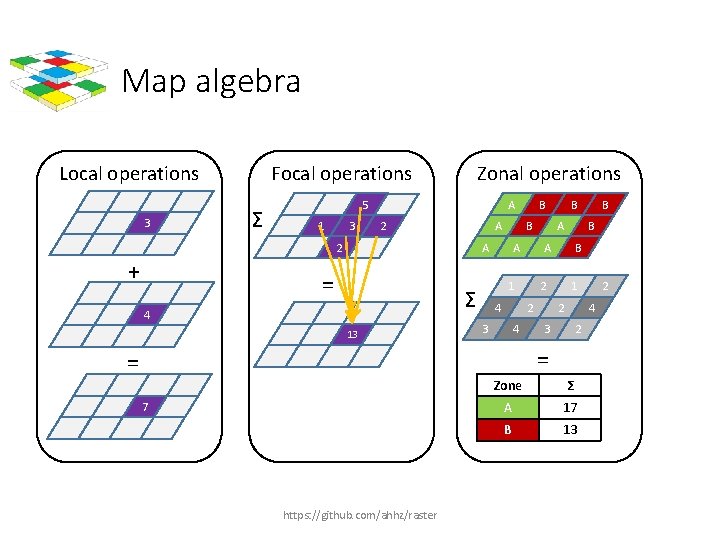
Map algebra Local operations 3 Focal operations Σ Zonal operations A 5 1 3 A 2 + B A 2 = 13 A 4 B 1 2 7 https: //github. com/ahhz/raster 2 4 3 2 = = B B 2 2 3 B A 1 Σ 4 B Zone Σ A 17 B 13
That is basic! Don’t we have tools? • Geodata management: GDAL, Proj, Geo. TIFF, etc. • Image processing: Open. CV, GIL, etc. • Linear algebra: Eigen, Blitz, UBLAS, etc. • Scripting languages: Arc. GIS Python, PC Raster, R raster, Geotrellis • GIS software: Raster Calculator and specific tools in QGIS, SAGA Arc. GIS All of these facilitate Map Algebra operations, but none meets all (my) requirements https: //github. com/ahhz/raster
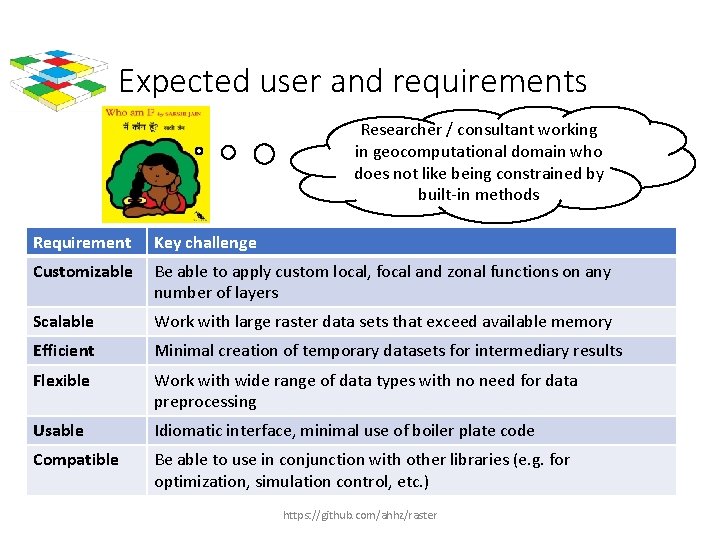
Expected user and requirements Researcher / consultant working in geocomputational domain who does not like being constrained by built-in methods Requirement Key challenge Customizable Be able to apply custom local, focal and zonal functions on any number of layers Scalable Work with large raster data sets that exceed available memory Efficient Minimal creation of temporary datasets for intermediary results Flexible Work with wide range of data types with no need for data preprocessing Usable Idiomatic interface, minimal use of boiler plate code Compatible Be able to use in conjunction with other libraries (e. g. for optimization, simulation control, etc. ) https: //github. com/ahhz/raster
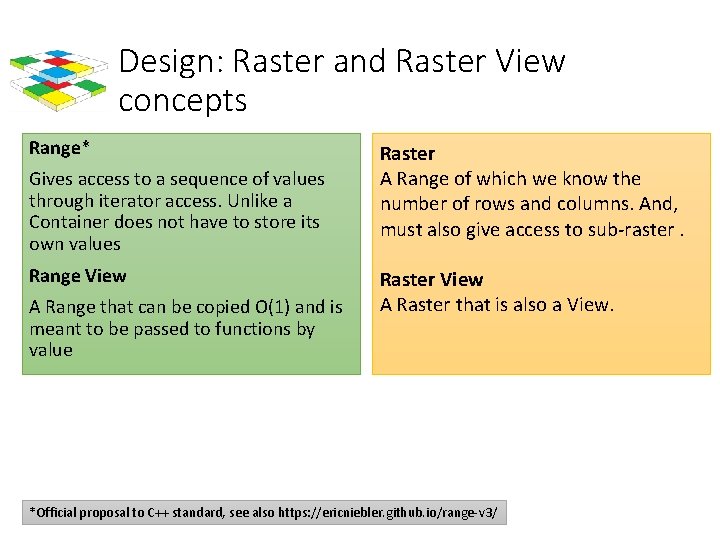
Design: Raster and Raster View concepts Range* Gives access to a sequence of values through iterator access. Unlike a Container does not have to store its own values Range View A Range that can be copied O(1) and is meant to be passed to functions by value Raster A Range of which we know the number of rows and columns. And, must also give access to sub-raster. Raster View A Raster that is also a View. *Official proposal to C++ standard, see also https: //ericniebler. github. io/range-v 3/ https: //github. com/ahhz/raster
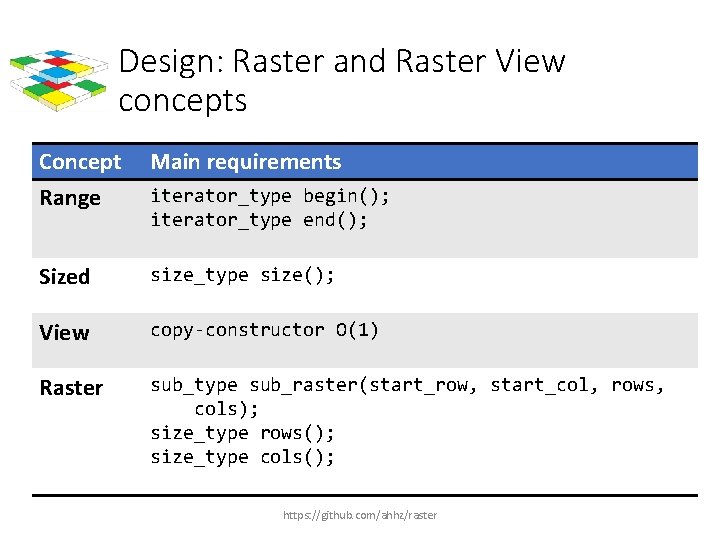
Design: Raster and Raster View concepts Concept Range Main requirements Sized size_type size(); View copy-constructor O(1) Raster sub_type sub_raster(start_row, start_col, rows, cols); size_type rows(); size_type cols(); iterator_type begin(); iterator_type end(); https: //github. com/ahhz/raster

Using the Raster concept (1) #include <pronto/raster/io. h> namespace pr = pronto: : raster; Use GDAL to open a raster dataset as a model of the Raster View concept int main() { auto ras = pr: : open<int>("my_file. tif") int sum = 0; for(auto&& v : ras) { sum += v; } Use range-based for-loop to iterate over all values in the raster } https: //github. com/ahhz/raster
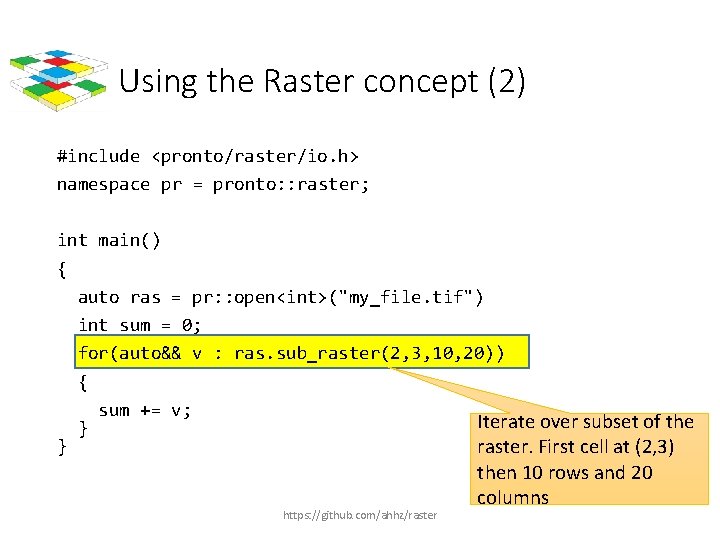
Using the Raster concept (2) #include <pronto/raster/io. h> namespace pr = pronto: : raster; int main() { auto ras = pr: : open<int>("my_file. tif") int sum = 0; for(auto&& v : ras. sub_raster(2, 3, 10, 20)) { sum += v; Iterate over subset of the } } raster. First cell at (2, 3) https: //github. com/ahhz/raster then 10 rows and 20 columns
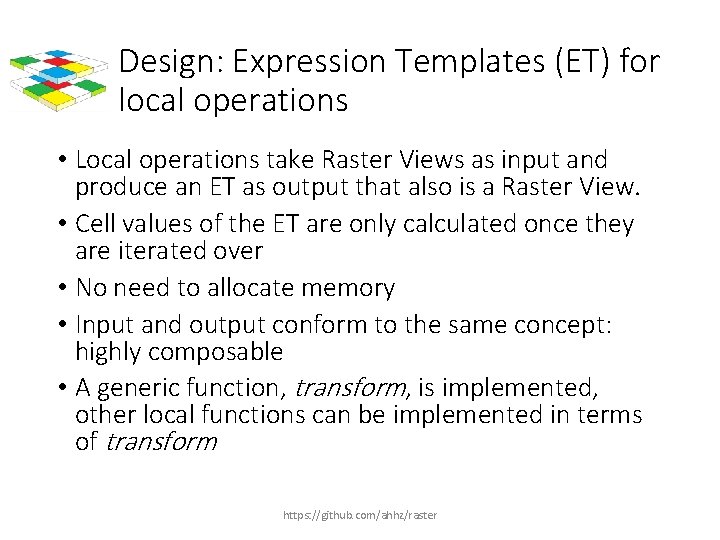
Design: Expression Templates (ET) for local operations • Local operations take Raster Views as input and produce an ET as output that also is a Raster View. • Cell values of the ET are only calculated once they are iterated over • No need to allocate memory • Input and output conform to the same concept: highly composable • A generic function, transform, is implemented, other local functions can be implemented in terms of transform https: //github. com/ahhz/raster
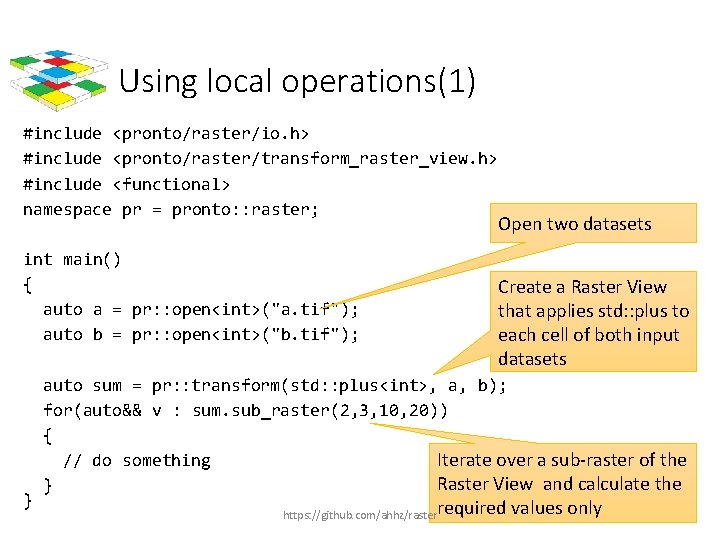
Using local operations(1) #include <pronto/raster/io. h> #include <pronto/raster/transform_raster_view. h> #include <functional> namespace pr = pronto: : raster; int main() { auto a = pr: : open<int>("a. tif"); auto b = pr: : open<int>("b. tif"); } Open two datasets Create a Raster View that applies std: : plus to each cell of both input datasets auto sum = pr: : transform(std: : plus<int>, a, b); for(auto&& v : sum. sub_raster(2, 3, 10, 20)) { Iterate over a sub-raster of the // do something Raster View and calculate the } required values only https: //github. com/ahhz/raster
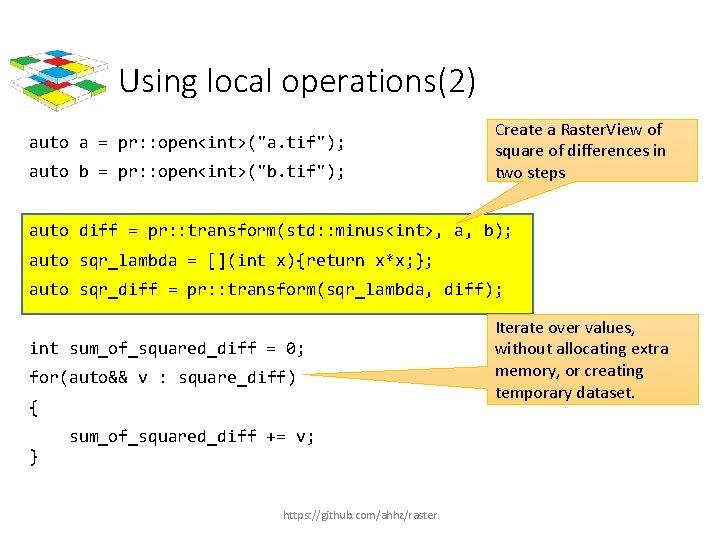
Using local operations(2) auto a = pr: : open<int>("a. tif"); auto b = pr: : open<int>("b. tif"); Create a Raster. View of square of differences in two steps auto diff = pr: : transform(std: : minus<int>, a, b); auto sqr_lambda = [](int x){return x*x; }; auto sqr_diff = pr: : transform(sqr_lambda, diff); int sum_of_squared_diff = 0; for(auto&& v : square_diff) { } sum_of_squared_diff += v; https: //github. com/ahhz/raster Iterate over values, without allocating extra memory, or creating temporary dataset.
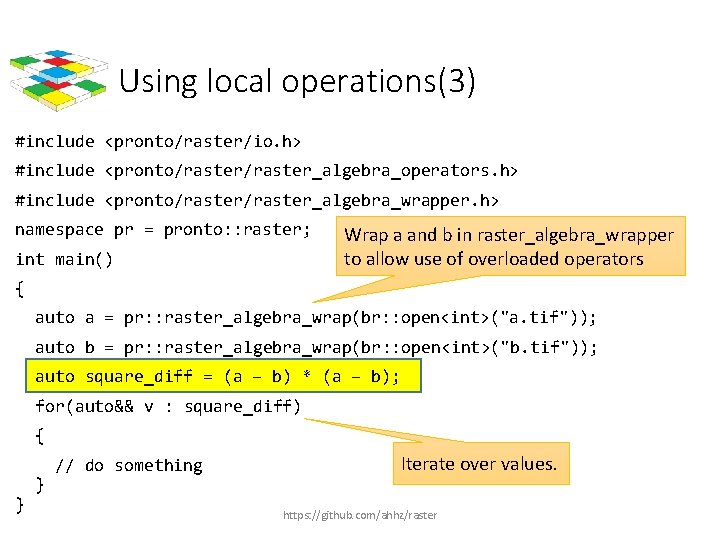
Using local operations(3) #include <pronto/raster/io. h> #include <pronto/raster_algebra_operators. h> #include <pronto/raster_algebra_wrapper. h> namespace pr = pronto: : raster; int main() Wrap a and b in raster_algebra_wrapper to allow use of overloaded operators { auto a = pr: : raster_algebra_wrap(br: : open<int>("a. tif")); auto b = pr: : raster_algebra_wrap(br: : open<int>("b. tif")); auto square_diff = (a – b) * (a – b); for(auto&& v : square_diff) { } } // do something Iterate over values. https: //github. com/ahhz/raster
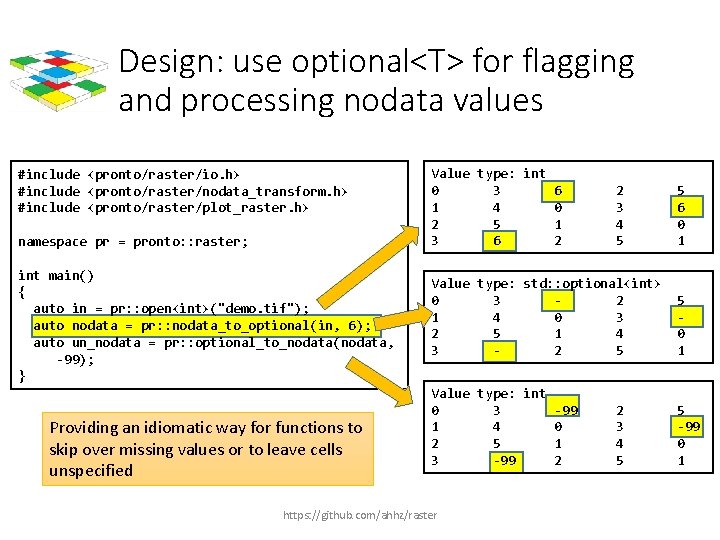
Design: use optional<T> for flagging and processing nodata values #include <pronto/raster/io. h> #include <pronto/raster/nodata_transform. h> #include <pronto/raster/plot_raster. h> namespace pr = pronto: : raster; int main() { auto in = pr: : open<int>("demo. tif"); auto nodata = pr: : nodata_to_optional(in, 6); auto un_nodata = pr: : optional_to_nodata(nodata, -99); } Providing an idiomatic way for functions to skip over missing values or to leave cells unspecified Value type: int 0 3 6 1 4 0 2 5 1 3 6 2 2 3 4 5 5 6 0 1 Value type: std: : optional<int> 0 3 2 1 4 0 3 2 5 1 4 3 2 5 5 0 1 Value type: int 0 3 -99 1 4 0 2 5 1 3 -99 2 5 -99 0 1 https: //github. com/ahhz/raster 2 3 4 5
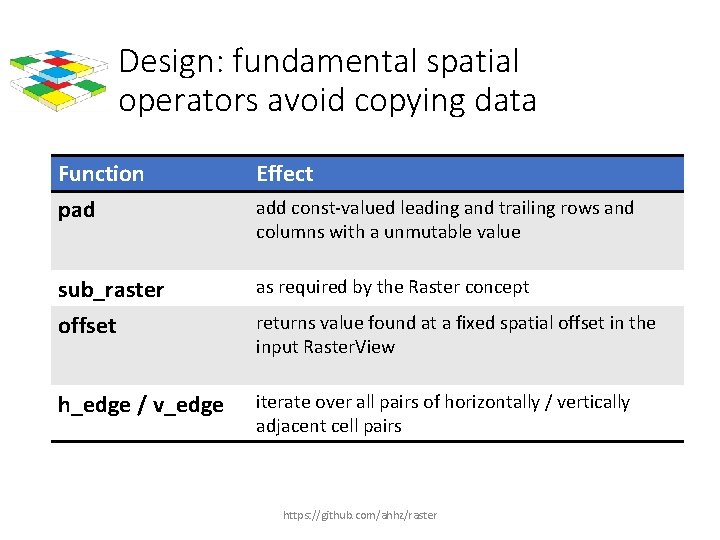
Design: fundamental spatial operators avoid copying data Function pad Effect sub_raster offset as required by the Raster concept h_edge / v_edge iterate over all pairs of horizontally / vertically adjacent cell pairs add const-valued leading and trailing rows and columns with a unmutable value returns value found at a fixed spatial offset in the input Raster. View https: //github. com/ahhz/raster
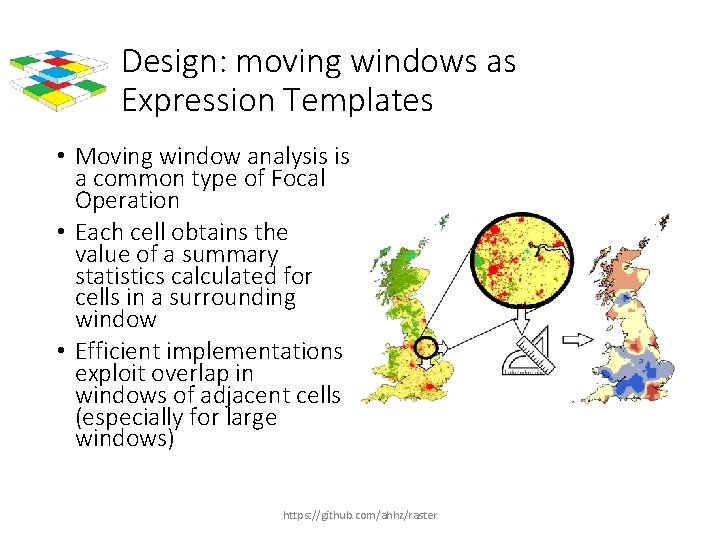
Design: moving windows as Expression Templates • Moving window analysis is a common type of Focal Operation • Each cell obtains the value of a summary statistics calculated for cells in a surrounding window • Efficient implementations exploit overlap in windows of adjacent cells (especially for large windows) https: //github. com/ahhz/raster
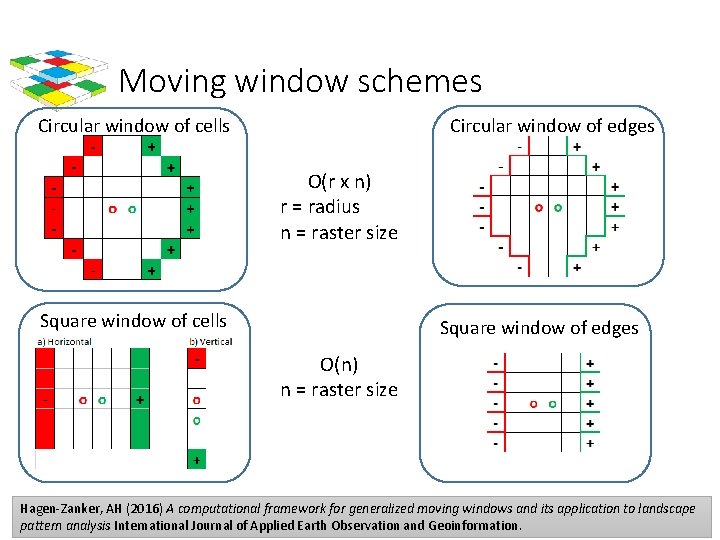
Moving window schemes Circular window of edges Circular window of cells O(r x n) r = radius n = raster size Square window of cells Square window of edges O(n) n = raster size Hagen-Zanker, AH (2016) A computational framework for generalized moving windows and its application to landscape https: //github. com/ahhz/raster pattern analysis International Journal of Applied Earth Observation and Geoinformation.
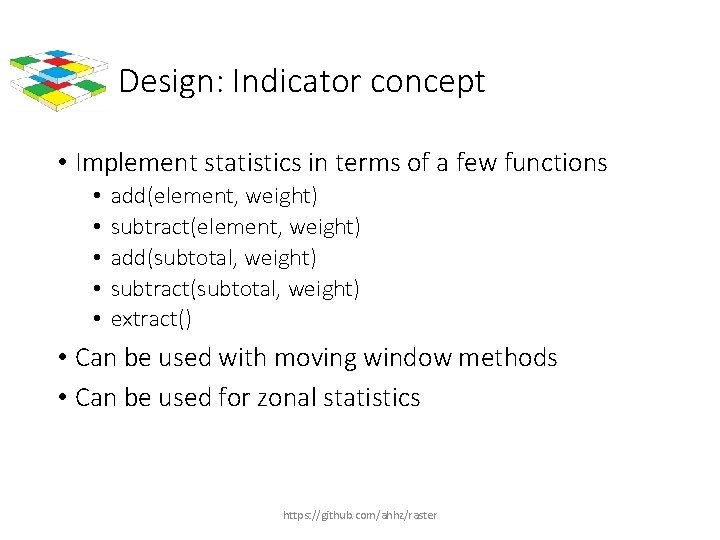
Design: Indicator concept • Implement statistics in terms of a few functions • • • add(element, weight) subtract(element, weight) add(subtotal, weight) subtract(subtotal, weight) extract() • Can be used with moving window methods • Can be used for zonal statistics https: //github. com/ahhz/raster
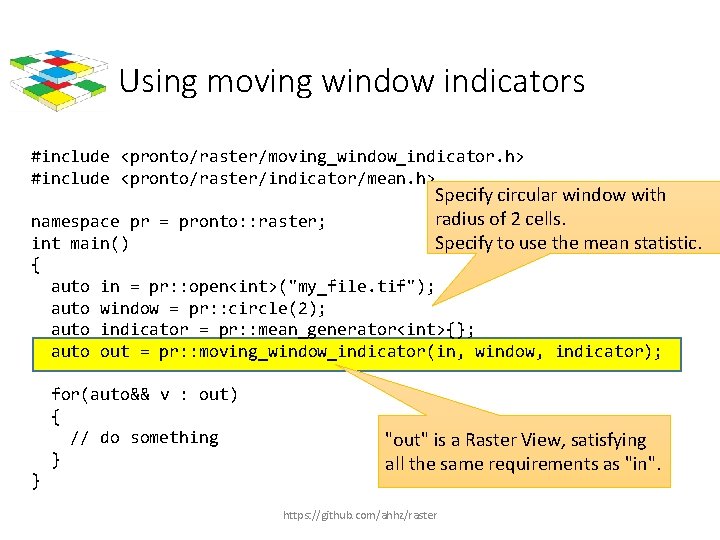
Using moving window indicators #include <pronto/raster/moving_window_indicator. h> #include <pronto/raster/indicator/mean. h> Specify circular window with radius of 2 cells. Specify to use the mean statistic. namespace pr = pronto: : raster; int main() { auto in = pr: : open<int>("my_file. tif"); auto window = pr: : circle(2); auto indicator = pr: : mean_generator<int>{}; auto out = pr: : moving_window_indicator(in, window, indicator); for(auto&& v : out) { // do something } } "out" is a Raster View, satisfying all the same requirements as "in". https: //github. com/ahhz/raster
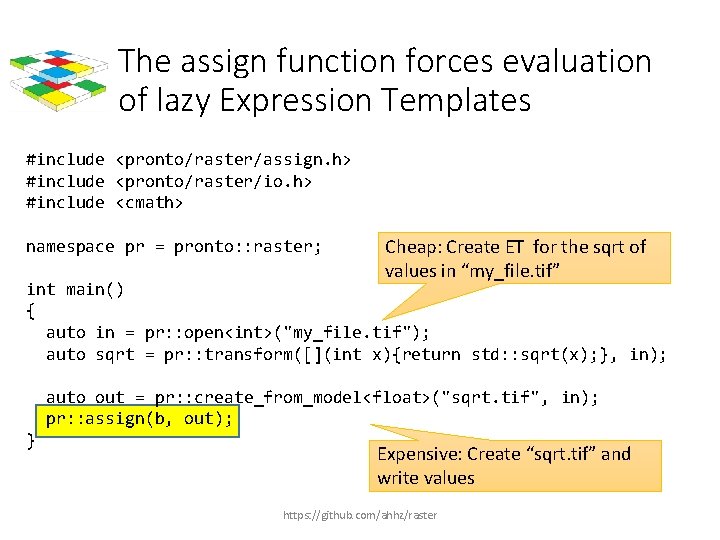
The assign function forces evaluation of lazy Expression Templates #include <pronto/raster/assign. h> #include <pronto/raster/io. h> #include <cmath> namespace pr = pronto: : raster; Cheap: Create ET for the sqrt of values in “my_file. tif” int main() { auto in = pr: : open<int>("my_file. tif"); auto sqrt = pr: : transform([](int x){return std: : sqrt(x); }, in); auto out = pr: : create_from_model<float>("sqrt. tif", in); pr: : assign(b, out); } Expensive: Create “sqrt. tif” and write values https: //github. com/ahhz/raster
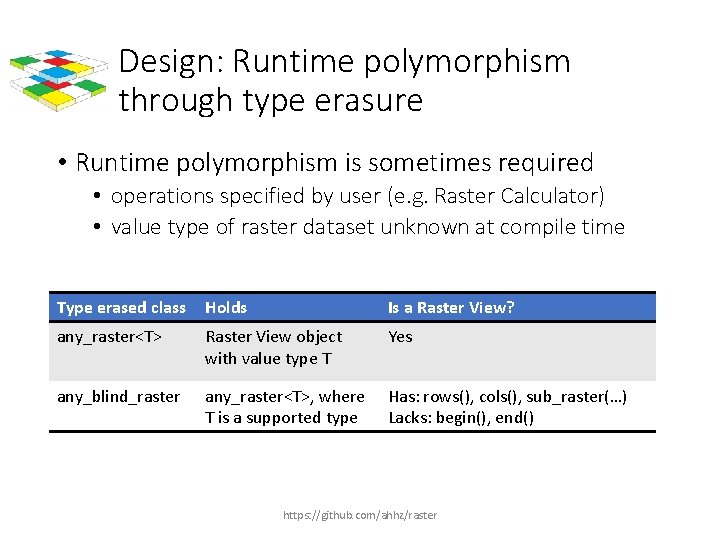
Design: Runtime polymorphism through type erasure • Runtime polymorphism is sometimes required • operations specified by user (e. g. Raster Calculator) • value type of raster dataset unknown at compile time Type erased class Holds Is a Raster View? any_raster<T> Raster View object with value type T Yes any_blind_raster any_raster<T>, where T is a supported type Has: rows(), cols(), sub_raster(…) Lacks: begin(), end() https: //github. com/ahhz/raster
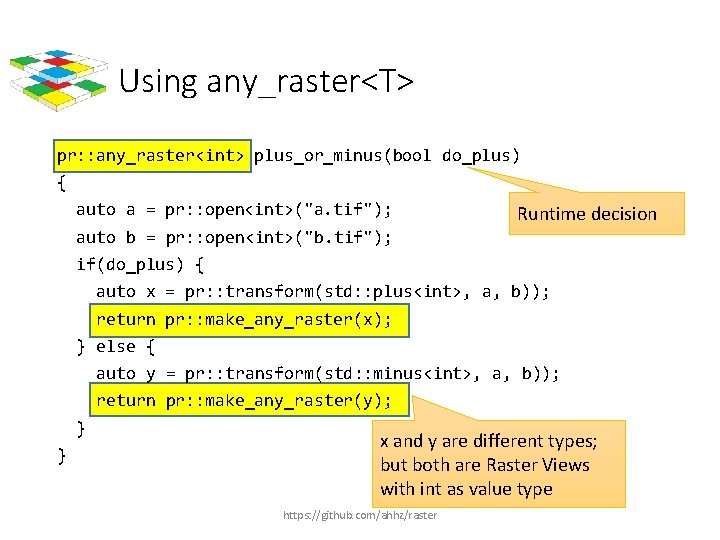
Using any_raster<T> pr: : any_raster<int> plus_or_minus(bool do_plus) { auto a = pr: : open<int>("a. tif"); Runtime decision auto b = pr: : open<int>("b. tif"); if(do_plus) { auto x = pr: : transform(std: : plus<int>, a, b)); return pr: : make_any_raster(x); } else { auto y = pr: : transform(std: : minus<int>, a, b)); return pr: : make_any_raster(y); } } x and y are different types; but both are Raster Views with int as value type https: //github. com/ahhz/raster
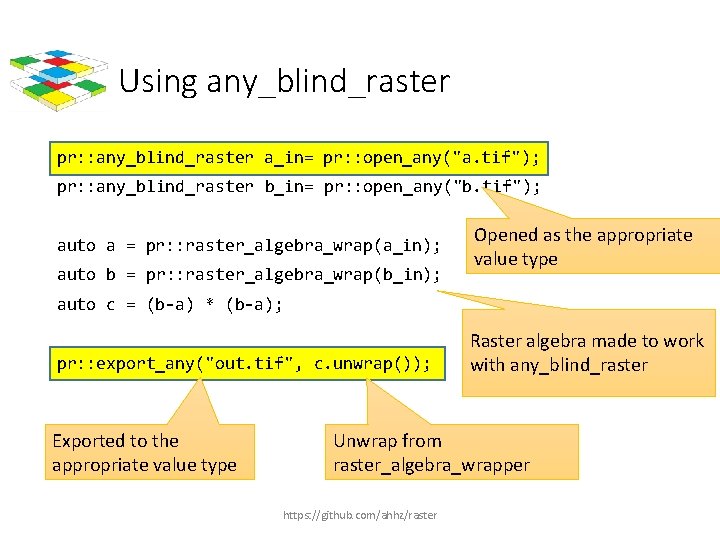
Using any_blind_raster pr: : any_blind_raster a_in= pr: : open_any("a. tif"); pr: : any_blind_raster b_in= pr: : open_any("b. tif"); auto a = pr: : raster_algebra_wrap(a_in); auto b = pr: : raster_algebra_wrap(b_in); Opened as the appropriate value type auto c = (b-a) * (b-a); pr: : export_any("out. tif", c. unwrap()); Exported to the appropriate value type Raster algebra made to work with any_blind_raster Unwrap from raster_algebra_wrapper https: //github. com/ahhz/raster
Future music: Parallel processing • The sub_raster() requirement of Raster Views combined with the Expression Template design allows doing calculation for only a part of the raster • For local operations and moving window indicators only the assign function needs to be parallelized • Split the rasters into sub-raster blocks • Assign all blocks asynchronously • And… rest of library needs to be thread safe https: //github. com/ahhz/raster
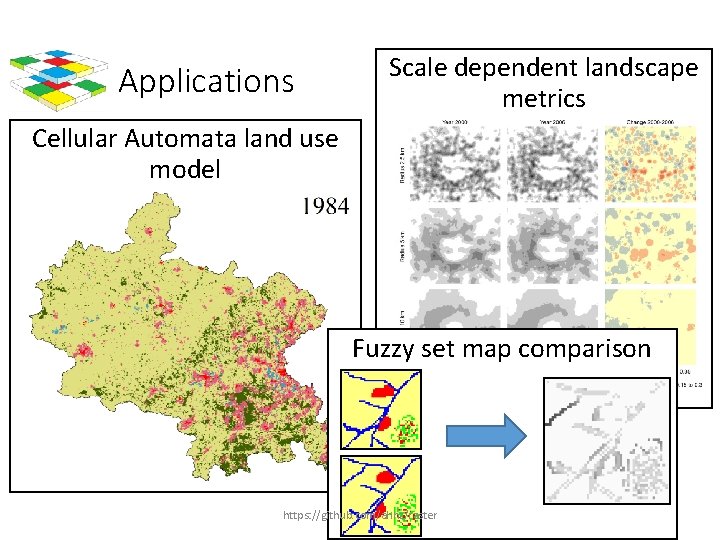
Applications Scale dependent landscape metrics Cellular Automata land use model Fuzzy set map comparison https: //github. com/ahhz/raster
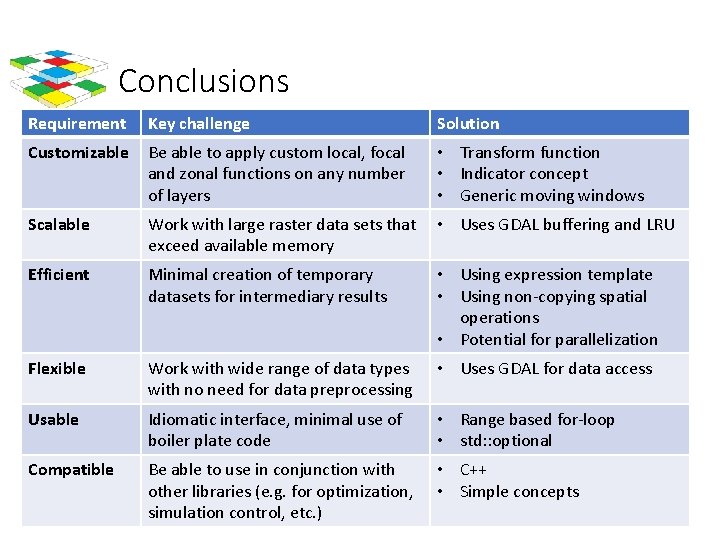
Conclusions Requirement Key challenge Solution Customizable Be able to apply custom local, focal and zonal functions on any number of layers • Transform function • Indicator concept • Generic moving windows Scalable Work with large raster data sets that exceed available memory • Uses GDAL buffering and LRU Efficient Minimal creation of temporary datasets for intermediary results • Using expression template • Using non-copying spatial operations • Potential for parallelization Flexible Work with wide range of data types with no need for data preprocessing • Uses GDAL for data access Usable Idiomatic interface, minimal use of boiler plate code • Range based for-loop • std: : optional Compatible Be able to use in conjunction with other libraries (e. g. for optimization, simulation control, etc. ) • C++ • Simple concepts

Thank you! github. com/ahhz/raster a. hagen-zanker@surrey. ac. uk https: //github. com/ahhz/raster
- Slides: 26