
Pronto Pharma A quick speedy knowledge review Objectives

Pronto. Pharma A quick & speedy knowledge review

Objectives Review the sections of the NAPLEX Exam as is currently organized Simulate a NAPLEX Exam to review the material and determine your simulated score Learn selected pharmacy knowledge based questions (Q and A format)

NAPLEX Sections Change in NAPLEX structure of the competency statements Revised blueprint to include 2 Competence Areas Competence Area 1: Ensure Safe and Effective Pharmacotherapy and Health Outcomes (approximately 67% of exam) Competence Area 2: Safe and Accurate Preparation, Compounding, Dispensing, and Administration of Medications and Provision of Health Care Products (approximately 33% of exam)

NAPLEX Grading/Scoring The NAPLEX consists of 250 multiple-choice questions. Of these, 200 questions will be used to calculate the test score (remaining 50 items serve as experimental questions and do not affect score) A tabulated or "scaled" score of 75 or higher (out of a possible 150) is required for passing Reported scores represent a mathematically calculated "ability measure" of the applicant based on an algorithm developed by the National Associations of Boards of Pharmacy (NABP) Applicants not obtaining a score of 75 or higher are given a performance profile, which details their relative areas of strength and weakness
NAPLEX Changes Test is now 6 hours long You are allowed a maximum of 5 attempts to pass the NAPLEX ($575/attempt) After a failed attempt, you must wait 45 days to next attempt the NAPLEX The questions do not involve high-tech clinical pharmacy or equipment The previously popular K-type questions have been phased out of the NAPLEX exam K type questions have multiple combination choices of answers 1) A only 2) both A and C 3) both B and D 4) A, B and C 5) All of the Above.

Practice Exam Question 1 Other than angina, what medical problem can result in dull chest pain? A) Hypertension B) GERD C) Asthma D) Diabetes E) Hypercholesterolemia

Practice Exam Question 2 A 46 -year-old man inquires about quitting smoking. He currently smokes 9 cigarettes per day. He admits that he is a chronic gum chewer and he is concerned about weight gain upon quitting. His past medical history is significant for hypertension, depression, epilepsy, and seasonal allergies. He has tried nicotine patches in the past with limited success. What is the most appropriate treatment option for this patient? (hint-may be off label for TC) A) Bupropion 150 mg twice daily B) Nicotine gum 4 mg every 1 -2 hours C) Nicotine patch 21 mg daily D) Nortriptyline 25 mg twice daily E) Clonidine 0. 1 mg patch daily
Practice Exam Question 3 Harold Smith, a 68 y/o male with h/o hypertension, hyperlipidemia, Type II Diabetes, and COPD presents to your pharmacy asking for his blood pressure to be taken, According to the Eighth Report of the Joint National Committee on Prevention, Detection, Evaluation, and Treatment of High Blood Pressure (JNC 8), what is this patient’s goal blood pressure reading? A) <150/90 mm Hg B) <140/90 mm Hg C) <145/90 mm Hg D) <140/80 mm Hg E) <130/80 mm Hg
Practice Exam Question 4 With respect to plasma protein binding, acidic drugs mainly bind to which of the following? A) Alpha-1 -acid glycoprotein B) Albumin C) Ion channel D) P-450 enzymes E) P-glycoprotein
Practice Exam Question 5 A 43 -year-old HIV-positive man presents for a follow up. He was diagnosed about 1 year ago, at which time his CD 4 count was 450 cells/mm 3. Currently he presents with purple skin lesions, which are diagnosed as Kaposi's sarcoma. Patient is moderately obese and has diet-controlled diabetes and hyperlipidemia. His doctor is considering starting HAART regimen for his AIDS and wants your input on initial therapy. Question: Which medication is likely to increase patient's morbidity? A) Nevirapine B) Stavudine C) Indinavir D) Maraviroc E) Raltegravir

Your NAPLEX will begin now… Feel free to squat, run in place, or exercise while completing your NAPLEX You will be given 50 questions, answers will be given immediately after each question so please keep track of your total correct Suggestion tally mark correct vs incorrect Suggestion for your grading: # Questions answered correctly # Questions answered -10% = your percentage (75% or higher)

Question 1 Avelox is also known as? A) Ciprofloxacin B) Gatifloxacin C) Levofloxacin D) Moxifloxacin E) Ofloxacin
Question 2 SH: S. F. has worked as an engineer for 30 years, drinks 2 glasses of wine weekly, and is a nonsmoker. S. F. exercises 4 days per week (aerobics and swimming). She does not currently monitor her diet. FH: Her father died from an MI at age 45, mother (age 84) has diabetes, otherwise alive and well. Two sisters alive and well. Question: Which of the following does not contribute to SF’s increased risk of cardiovascular disease? A) Rheumatoid Arthritis B) Methotrexate and Folic Acid C) Ibuprofen D) Dyslipidemia E) Hypertension
Question 3 SH: A patient lives at home with her husband, daughter, and 2 grandchildren. She works part-time for an insurance company. She quit smoking about 10 years ago and does not consume alcohol. FH: Unknown, as the patient was adopted Vitals: BP 154/86; P 55; RR 18 Question: The patient presents today to refill a pravastatin prescription. Which of the following patient education points will you discuss with this patient? Mark All that Apply A) Take in the morning first thing without food B) Get liver function test every 3 months while on this medication C) If you miss a dose, take is a soon as remember, do not double up if it is too close to your next dose D) if you notice muscle aches while taking this medication, call your prescriber right away E) It is important to follow a low cholesterol diet while taking this medication
Question 4 Adam is a 51 -year-old highway construction worker. He presents to the pharmacy counter noting that he spends a great deal of time in the sun (job). He notes now, that after being in the sun for 3 -4 hours, his face, neck, and the back of his hands are sunburned. In the past, he could stay in the sun all day without burning. His skin does not blister or form hives. He doesn’t use sunscreen routinely Medication profile 8/7/08 HCTZ 50 mg QD 12/17/07 Metoprolol 50 mg BID Increased from 25 mg BID on 7/24/08 12/17/07 Lansoprazole 30 mg QD Increased from 15 mg QD on 4/22/08 5/7/02 ASA 325 mg QD Question: Which recommendation is correct? A. A very water resistant sunscreen should be reapplied every 40 minutes for optimal protection. B. A sunscreen with SPF 30+ will provide moderate sunburn protection. C. If he is wearing shorts instead of long pants, he should apply 1 teaspoon of sunscreen to each leg for maximal protection. D. It is not necessary to apply sunscreen on cloudy days. E. A water resistant sunscreen product should be reapplied every 80 minutes.
Question 5 A 16 -year-old patient calls the pharmacist. His mother purchased Dr. Scholl's Ingrown Toenail Pain Reliever. He cannot read the directions for use and would like help. Question: The pharmacist should tell him which of the following? A. The product should be used 4 times daily B. The product should not be used by patients under the age of 18 years C. The product should not be used if the patient is diabetic D. The product should not be used longer than 2 weeks E. The product may be used if there is discharge from under the toenail
Question 6 SH: J. B. drinks rarely (less than once a week) and does not smoke. She is an aspiring model currently working at a department store. FH: Maternal grandmother had diabetes and paternal grandmother had a stroke Question: Which of the following counseling points should this patient be told about Latisse? A) Blurred vision is to be expected after the first few applications of Latisse B) Increasing frequency of use of this medication will increase eyelash growth C) If the medication gets into the patient’s eye, she should thoroughly rinse her eyes with water immediately D) Pigmentation of the eyelids and iris may occur; iris pigmentation is likely to be permanent E) In case of a missed dose of Latisse, the patient may apply double the amount during the next application

Question 7 A 42 -year-old man diagnosed with psoriasis asks the pharmacist about its causes. The pharmacist should mention that its primary etiology is thought to be due to which of the following? A) Bacteria B) Sun Damage C) Fungi D) Genetic Defect E) Specific Virus
Question 8 Patient Name: Wilbur Miles Address: 815 Lark Age: 72 Sex: Male Race: Caucasian Height: 170 cm Weight: 86 kg Allergies: NKDA BP: 154/92 DIAGNOSES Hypertension, Hyperlipidemia, mild seasonal allergies 7/2 HPI: W. M. , accompanied by his wife, presents with concerns regarding symptoms of worsening memory loss and confusion. He is having difficulty remembering names/recent events, and performing tasks involving multiple steps. He has become disoriented to time and location on several occasions and frequently forgets which of his daily medications he has taken. He scored a 24 on the MMSE (Mini-Mental State Examination) and underwent a physical/neuro exam, which resulted in his diagnosis of mild Alzheimer’s disease. FH: Father died at age 81 from an MI, mother died at age 87 from heart failure; mother had Alzheimer’s disease. SH: Married, retired mechanic. Nonsmoker, drinks about 1 alcoholic beverage per day, denies illicit drug use. The medication initiated on 7/2 must be titrated up to a minimal effective dose of 16 mg daily (Razadyne). What is the minimum time that should be allowed between dose adjustments for this medication? A. 3 days B. 5 days C. 1 week D. 2 weeks E. 4 weeks
Question 9 10/2 – Patient presents with severe pain and tingling on upper left abdomen as well as flu-like symptoms. Examination reveals a rash on upper left abdomen that the patient claims is new as of the morning of the examination; the patient is diagnosed with herpes zoster. She is currently taking Aciphex, Diovan, Calcium, Valtrex, MVI, Zyprexa and Fosamax Question: What is the mechanism of action of the medication for her HTN? A) ACE Inhibitor B) Beta-Blocker C) Calcium Channel Blocker D) Thiazide Diuretic E) Angiotensin II Receptor Blocker
Question 10 Where is a tinea corporis infection typically located? A) Feet B) Body C) Groin D) Scalp E) Nail
Question 11 JC is a 17 -year-old varsity basketball player for the local high school. He comes to the pharmacy today and asks for your opinion about his feet. The itching and scaling he is experiencing are almost identical to an episode 6 months ago when his doctor diagnosed "Athlete's Foot. " He holds a box of Lamisil AT in his hands and asks if there is anything else he should do. Question: You recommend all of the following EXCEPT? A) Change athletic shoes often B) Wear sandals or water shoes in the locker room C) Wear nylon or wool socks instead of cotton socks D) Put powder in shoes daily E) Wash dirty clothes and towels in hot water
Question 12 What are the two active ingredients in Maxzide 37. 5 mg/25 mg? A) Spironolactone and hydrochlorithiazide B) Triamterene and furosemide C) Triamterene and hydrochlorithiazide D) Spironolactone and furosemide E) Hydralazine and hydrochlorithiazide
Question 13 What side effects are seen with Valtrex 1 gm? A) Tinnitus and renal failure B) Photosensitivity and constipation C) Headache and nausea D) Abdominal pain and vertigo E) Ankle edema and thrombotic thrombocytopenic purpura
Question 14 What is the reason that ethanol does not have a listed elimination half-life in most drug resources? Correct answer: It follows a zero order kinetics Explanation: The clearance of ethanol is dependent on the dose and decreases with increasing blood level. Its kinetic profile is zero order with no constant elimination half-life To Note: We can never assume how long a patient may be intoxicated for
Question 15 Which route of administration is inappropriate for nitroglycerin? A) Transdermal B) Intravenous C) Sublingual D) Topical E) Oral

Question 16 Which of the following dextrose solutions is isotonic? A) 50% dextrose in water B) 20% dextrose in water C) 10 % dextrose in water D) 5% dextrose in water E) 2. 5% dextrose in water
Question 17 What has the greatest potential to interact negatively with Zyban? A) Cheese B) Alcohol C) Grapefruit juice D) Licorice E) Chocolate
Question 18 A 17 -year-old male cocaine addict develops substernal chest pain and is rushed to the emergency room by his friends. They reveal that he had been smoking 'crack' when the symptoms developed. An ECG is consistent with anterior wall myocardial ischemia. This effect on the heart is attributed to the drug. What is the mechanism of this effect? A) Direct inhibition of beta-adrenergic receptors B) Direct stimulation of adenosine receptors C) Direct stimulation of beta-adrenergic receptors D) Indirect inhibition of alpha-adrenergic receptors E) Indirect stimulation of alpha-adrenergic receptors
Question 19 What should the patient be advised of when taking Haldol? A) Take Haldol every evening before bedtime B) Take Haldol with food to prevent nausea C) Haldol may cause increased excitability and insomnia D) Do not discontinue Haldol therapy without consulting a healthcare provider E) Muscle rigidity and dyskinesia are common side effects that will dissipate over time
Question 20 Which of the following statements below is TRUE? A. To prevent tinea pedis reinfection, patients should be instructed on the importance of wearing socks made of wool or synthetic fabrics. B. To prevent tinea cruris reinfection, patients should be counseled on the importance of washing contaminated clothes in soap and cold water. C. In the treatment of tinea ungium, the course of oral itraconazole therapy may conclude before the complete resolution of the nail discoloration. D. Tolnaftate is the only nonprescription medication approved for the prevention and treatment of tinea capitis (ringworm). E. It is not necessary to treat tinea ungium if a patient is experiencing concomitant tinea pedis

Question 21 Which of the following statements is true regarding topical application of nitroglycerin ointment? A. It should only be applied after symptoms occur B. The dose to be applied is measured in mg C. The dose to be applied is measured in inches D. The appropriate dose amount should be applied to the skin area with maximal rubbing in E. There is no need to cover the applied area with plastic wrap
Question 22 Patient Name: Willard Stone Address: 1816 Quinlan Age: 64 Sex: M Race: Caucasian Height: 5' 11" Weight: 179 Allergies: NK DIAGNOSES: Depression, Motion sickness, Psoriasis Xerostomia, BPH, Shingles, Insomnia On 7/30 Willard picked up MTX 2. 5 mg (2 tablets weekly) #12. What counseling advice should Mr. Stone be given on 7/30? A. Stay well hydrated while taking this medication. B. Each dose must be taken in the morning, preferably with breakfast. C. If a dose is forgotten, skip it and return to the normal schedule. D. Do not take with a high-fat meal. E. The urine may discolor red to brown.
Question 23 A patient purchased Collyrium for Fresh Eyes Eye Wash (boric acid/sodium borate) for an eyelash in his eye. He calls later to ask the pharmacist how to use it. He is puzzled about the eyecup that was packaged inside the product. What should the pharmacist advise? A. Before using the eyecup, rinse it with alcohol B. Discard the eyecup without using it C. Use the eyecup by placing it against the eye with the eyewash D. Only use the eyecup after warming it to body temperature E. Rinse the eyecup in hot water before using it
Question 24 Which of the following questionnaires can be administered to determine a patient's level of nicotine dependence? A. CAGE B. Fagerstrom C. CRAFFT D. DAST
Question 25 A male & his partner have been using Detane Gel (benzocaine) prior to sex. They use spermicidally lubricated latex condoms. His partner has developed a rash, burning, & itching in the genital area since he started using it. He asks the pharmacist if Detane might have caused it. What should the pharmacist tell him? A. Benzocaine in Detane can cause the symptoms listed. The couple should discontinue and see if the condition improves B. Detane is not responsible. The partner should explore the possibility of allergy to a douche product C. Detane is not responsible. The partner may have an allergy to latex rubber in the condoms D. Detane is not responsible. The partner may have an allergy to the spermicidal lubricant in the condoms E. Detane is not responsible. He may have contracted genital herpes
Question 26 A patient with seborrheic dermatitis asks the pharmacist for assistance in choosing a product. Which of the following contains ingredients approved by the FDA for treatment of seborrheic dermatitis? A. MG 217 Medicated Tar Lotion (coal tar solution) B. Nizoral A-D (ketoconazole) C. Pan. Oxyl Bar (benzoyl peroxide) D. Purpose Gentle Cleansing Bar (sodium tallowate, sodium cocoate, glycerin) E. Zapzyt Cleansing Bar (sulfur)
Question 27 A mother is asking for assistance. Her 6 -year-old son has white bumps on his fingers that appear to be warts. The warts do not seem to bother him but he keeps injuring the warts. She is also afraid someone else in the family will "get these things. ” A child with warts on the hands should be counseled to use a nonprescription product that contains what concentration of salicylic acid? A. 10% B. 17% C. 25% D. 60% E. 80%

Question 28 Which of the following federal laws is related to approval of generic drugs? A. Food and Drug Act (1906) B. Food, Drug, and Cosmetic Act (1938) C. Durham-Humphrey Amendment (1951) D. Kefauver-Harris Amendment (1962) E. Hatch-Waxman Act (1984)
Question 29 A 7 -year-old white male is brought in by his mother to the pharmacy. The boy complains of perianal itching, worsening at night. She used a flashlight at night to take a look around the anus area and found a small worm. What is the most common side effect of the medication used to treat his condition? A. Hepatotoxicity B. Renal toxicity C. Stomach pain D. Constipation E. Headache
Question 30 A 23 -year-old woman with plaque psoriasis on the scalp asks the pharmacist to recommend a product. Which of the following is effective? A. DHS Tar Shampoo (coal tar extract) B. Head & Shoulders Intensive Treatment (selenium sulfide) C. Head & Shoulders (zinc pyrithione) D. Lomalux Psoriasis Liquid (potassium, sodium, bromide, nickel, zinc, sulfur) E. Nizoral A-D (ketoconazole) The only nonprescription ingredients proven safe and effective for psoriasis are coal tar, hydrocortisone, and salicylic acid, in appropriate concentrations
Question 31 HPI: Patient presents to ED with c/o dizziness and palpitations the previous 6 days; ECG reveals atrial fibrillation with ventricular rate of 128 bpm. FH: Mother and father both had cardiovascular disease, brother has Type 2 diabetes. SH: Married, no children; denies illicit drug use, alcohol, and smoking. Test Results: Transesophageal echocardiogram Presence of thrombus: Negative Question: After the initial cardioversion, this patient has recurrent episodes of atrial fibrillation. Which one of the following anti-arrhythmics should be recommended for chronic therapy? A) Amiodarone B) Esmolol C) Flecainide D) Ibutilide E) Sotalol
Question 32 HPI: Patient (67 y/o male) is newly diagnosed with Parkinson's disease and accompanying depression FH: Father had CAD, mother had diabetes SH: Married, 2 grown children, has worked as a store manager for 23 years; denies smoking or illicit drug use, drinks about 1 alcoholic beverage per week and drinks 1 cup of coffee per day Immunization History: Influenza vaccine 2 years ago, pneumococcal vaccine 7 years ago, tetanus booster 8 years ago Question: Which of the following vaccinations should be recommended to this patient? A) Influenza only B) Pneumococcal only C) Influenza, pneumococcal, and herpes zoster D) Influenza, pneumococcal, and tetanus E) Tetanus booster only
Question 33 What is a common side effect of Paxil? A) Hypertriglyceridemia B) Hyperglycemia C) Hypertension D) Decreased libido E) Increased libido
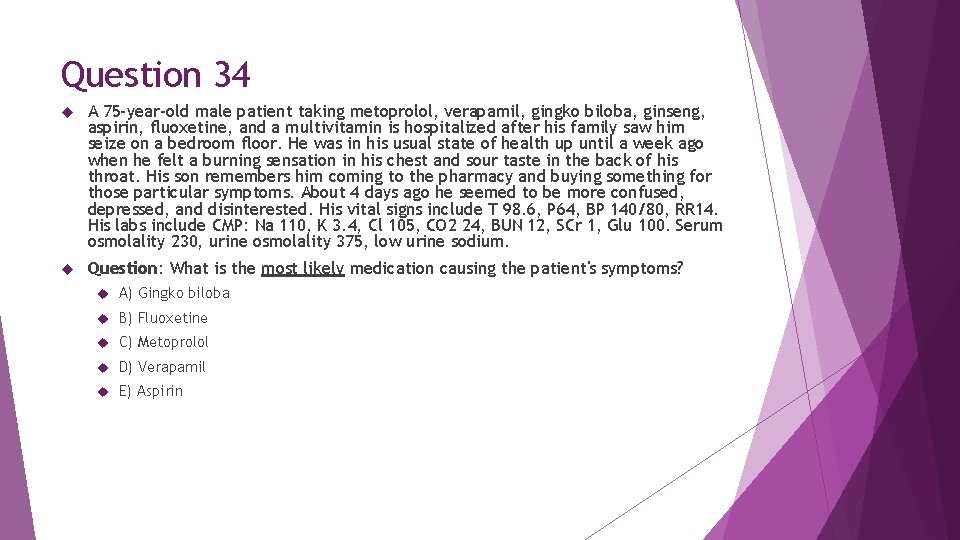
Question 34 A 75 -year-old male patient taking metoprolol, verapamil, gingko biloba, ginseng, aspirin, fluoxetine, and a multivitamin is hospitalized after his family saw him seize on a bedroom floor. He was in his usual state of health up until a week ago when he felt a burning sensation in his chest and sour taste in the back of his throat. His son remembers him coming to the pharmacy and buying something for those particular symptoms. About 4 days ago he seemed to be more confused, depressed, and disinterested. His vital signs include T 98. 6, P 64, BP 140/80, RR 14. His labs include CMP: Na 110, K 3. 4, Cl 105, CO 2 24, BUN 12, SCr 1, Glu 100. Serum osmolality 230, urine osmolality 375, low urine sodium. Question: What is the most likely medication causing the patient's symptoms? A) Gingko biloba B) Fluoxetine C) Metoprolol D) Verapamil E) Aspirin
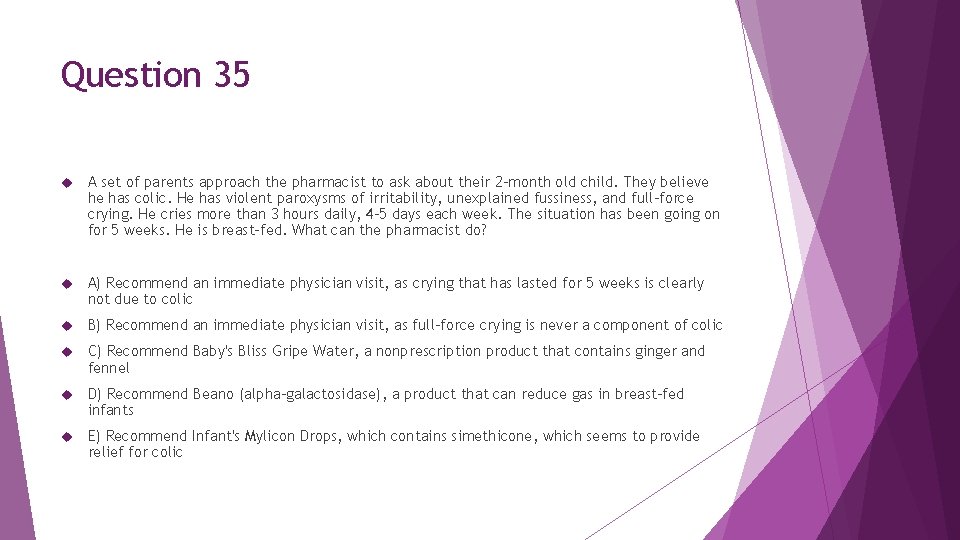
Question 35 A set of parents approach the pharmacist to ask about their 2 -month old child. They believe he has colic. He has violent paroxysms of irritability, unexplained fussiness, and full-force crying. He cries more than 3 hours daily, 4 -5 days each week. The situation has been going on for 5 weeks. He is breast-fed. What can the pharmacist do? A) Recommend an immediate physician visit, as crying that has lasted for 5 weeks is clearly not due to colic B) Recommend an immediate physician visit, as full-force crying is never a component of colic C) Recommend Baby's Bliss Gripe Water, a nonprescription product that contains ginger and fennel D) Recommend Beano (alpha-galactosidase), a product that can reduce gas in breast-fed infants E) Recommend Infant's Mylicon Drops, which contains simethicone, which seems to provide relief for colic
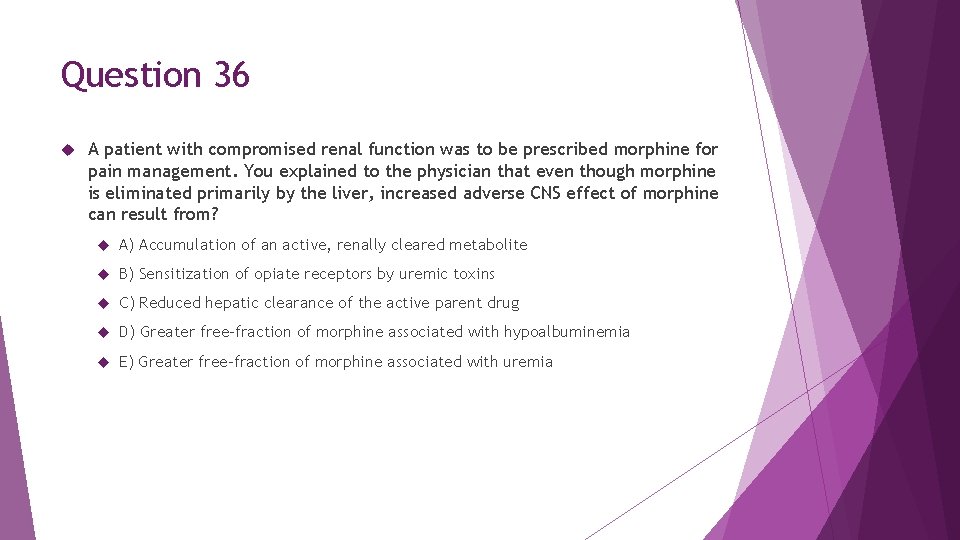
Question 36 A patient with compromised renal function was to be prescribed morphine for pain management. You explained to the physician that even though morphine is eliminated primarily by the liver, increased adverse CNS effect of morphine can result from? A) Accumulation of an active, renally cleared metabolite B) Sensitization of opiate receptors by uremic toxins C) Reduced hepatic clearance of the active parent drug D) Greater free-fraction of morphine associated with hypoalbuminemia E) Greater free-fraction of morphine associated with uremia
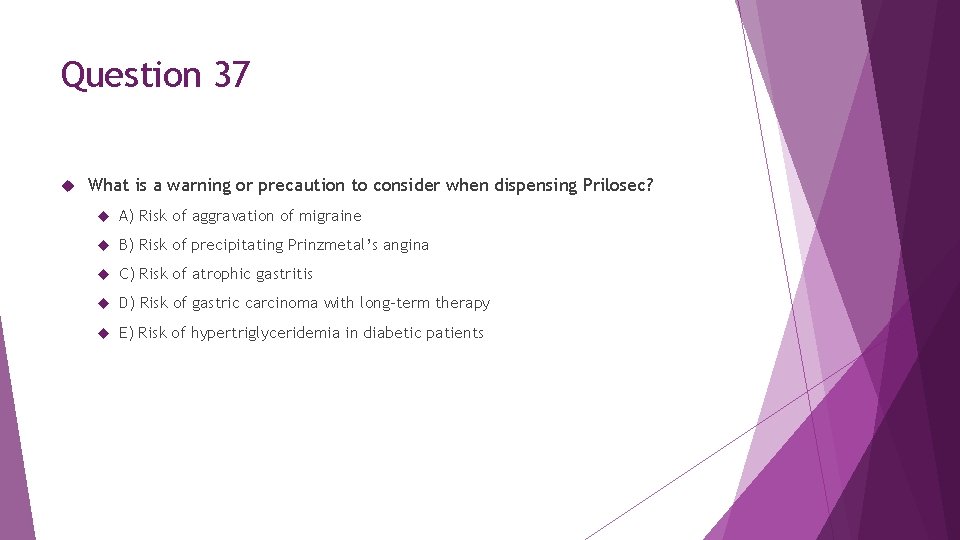
Question 37 What is a warning or precaution to consider when dispensing Prilosec? A) Risk of aggravation of migraine B) Risk of precipitating Prinzmetal’s angina C) Risk of atrophic gastritis D) Risk of gastric carcinoma with long-term therapy E) Risk of hypertriglyceridemia in diabetic patients

Question 38 A weakly acidic drug with a p. Ka of 3. 5 would be most soluble at which p. H? A) p. H = 2 B) p. H = 3 C) p. H = 4 D) p. H = 5 E) p. H = 6

Question 39 Serum protein binding is important in comparing the antimicrobial effect of different antibiotics because of which of the following? A) Only the bound drug can reach the site of infection B) Only the bound drug can be eliminated C) Only the bound drug can be absorbed orally D) Only the unbound drug can reach the site of infection E) Only the bound drug can exert a pharmacological effect
Question 40 How long should patients use a laxative product before consulting a physician? A) 3 days B) 5 days C) 7 days D) 14 days E) 3 weeks
- Slides: 51