
Pronouns Pages 8 11 in your Grammar Handbook
Pronouns Pages 8 -11 in your Grammar Handbook
Pronouns �A pronoun is a word that takes the place of one or more nouns or pronouns. � The word that the pronoun refers to is called the antecedent. � There are seven types of pronouns: › › personal demonstrative relative indefinite interrogative reflexive/intensive possessive
Personal pronouns � Personal pronouns refer to the one speaking (first person), the one spoken to (second person), and the one spoken about (third person).
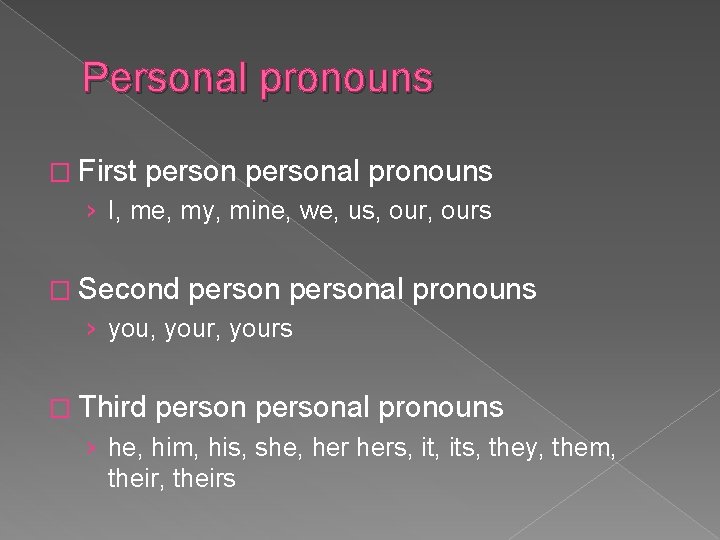
Personal pronouns � First personal pronouns › I, me, my, mine, we, us, ours � Second personal pronouns › you, yours � Third personal pronouns › he, him, his, she, hers, its, they, them, theirs
Pronouns 5. A reflexive pronoun refers to the subject of a sentence and functions as a complement or as an object of a preposition. 6. An intensive pronoun emphasizes its antecedent and serves no grammatical purpose.
Reflexive Pronouns � First person reflexive pronouns › myself, ourselves � Second person reflexive pronouns › yourself, yourselves � Third person reflexive pronouns › himself, herself, itself themselves
Examples of Reflexive and Intensive Pronouns Elena treated herself to a snack. The dog gave itself a bath. Albert himself organized the fundraiser.
Pronouns 8. An interrogative pronoun introduces a question. Whom Which What Whose
Pronouns 9. A relative pronoun introduces a subordinate clause. that which whose whom
Pronouns 10. An indefinite pronoun refers to one or more
List of indefinite pronouns all another anybody anyone anything both each either everyone everything few many more most much neither nobody none nothing one other several somebody something such
Pronouns 11. A possessive pronoun shows ownership. Examples: your, my, our, theirs, etc.
Pronouns 12. A demonstrative pronoun points out a specific person, place thing or idea. It takes the place of what it points out. Examples this that these those
- Slides: 13