
PronounAntecedent Agreement Cant We All Just Agree What
- Slides: 18
Pronoun-Antecedent Agreement Can’t We All Just Agree?
What do you need to understand about pronoun-antecedent agreement? • What’s a pronoun? • What’s an antecedent? • What’s a pronoun-antecedent agreement error?
What is a Pronoun? • A pronoun is a word that takes the place of a noun or other pronoun – It can take the place of a subject word • (I, you, he, she, it, we, they) – It can take the place of an object word • (me, you him, her it, us, them) – It can take the place of a possessive word • (my, mine, yours, his, hers, its, ours, theirs)
What is an Antecedent? • An antecedent is the word that the pronoun replaces. Eric dropped his book onto the floor. • (Eric is the antecedent because the pronoun “his” replaces the name. ). When Anna saw the book drop, she picked it up and handed it to him. • (The “book” is the antecedent because “it” replaces it. ) Then Eric and Anna went to lunch because they were starving. • (“Eric and Anna” are the antecedent because “they” renames the two people. )
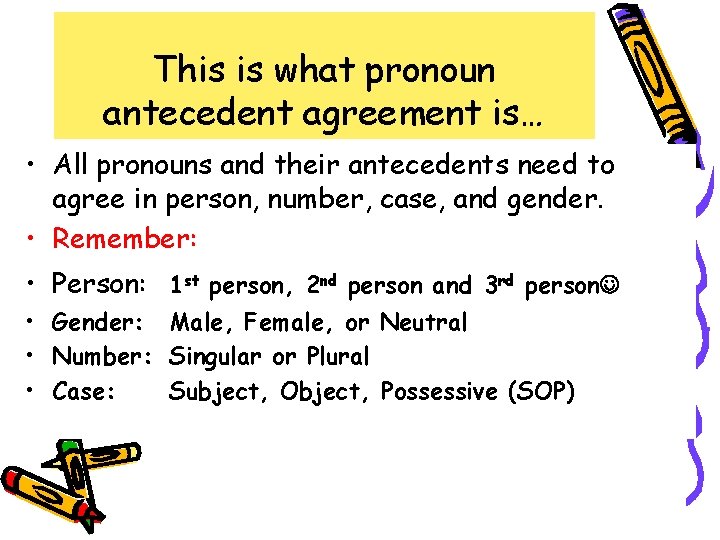
This is what pronoun antecedent agreement is… • All pronouns and their antecedents need to agree in person, number, case, and gender. • Remember: • Person: 1 st person, 2 nd person and 3 rd person • Gender: Male, Female, or Neutral • Number: Singular or Plural • Case: Subject, Object, Possessive (SOP)
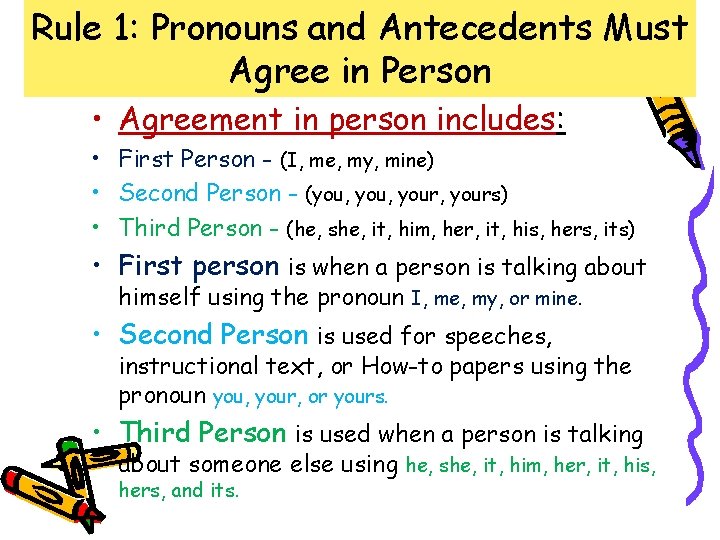
Rule 1: Pronouns and Antecedents Must Agree in Person • Agreement in person includes: • First Person - (I, me, my, mine) • Second Person - (you, your, yours) • Third Person - (he, she, it, him, her, it, his, hers, its) • First person is when a person is talking about himself using the pronoun I, me, my, or mine. • Second Person is used for speeches, instructional text, or How-to papers using the pronoun you, your, or yours. • Third Person is used when a person is talking about someone else using he, she, it, him, her, it, his, hers, and its.
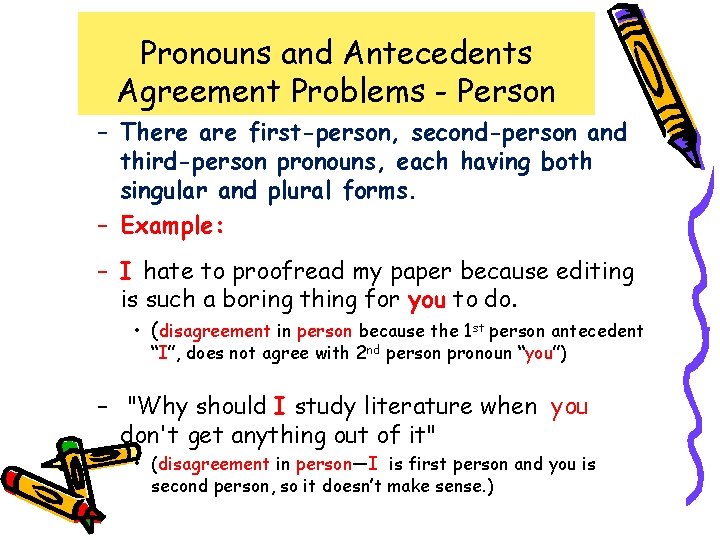
Pronouns and Antecedents Agreement Problems - Person – There are first-person, second-person and third-person pronouns, each having both singular and plural forms. – Example: – I hate to proofread my paper because editing is such a boring thing for you to do. • (disagreement in person because the 1 st person antecedent “I”, does not agree with 2 nd person pronoun “you”) – "Why should I study literature when you don't get anything out of it" • (disagreement in person—I is first person and you is second person, so it doesn’t make sense. )
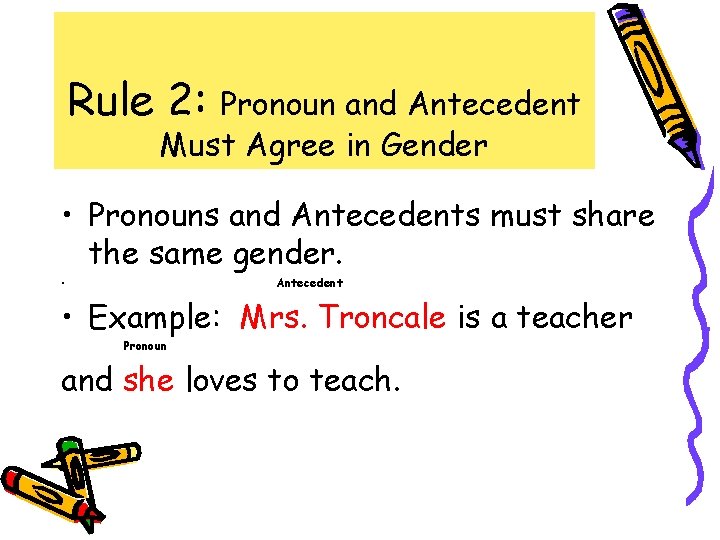
Rule 2: Pronoun and Antecedent Must Agree in Gender • Pronouns and Antecedents must share the same gender. Antecedent • • Example: Mrs. Troncale is a teacher Pronoun and she loves to teach.
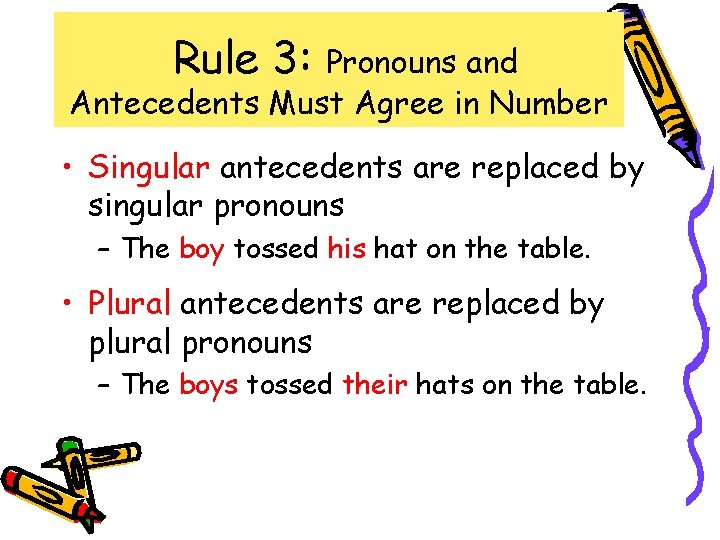
Rule 3: Pronouns and Antecedents Must Agree in Number • Singular antecedents are replaced by singular pronouns – The boy tossed his hat on the table. • Plural antecedents are replaced by plural pronouns – The boys tossed their hats on the table.
Rule 3 Continued: Indefinite. Pronoun Agreement • An indefinite pronoun does not refer to a specific person, place, thing, or idea. • Indefinite pronouns often do not have antecedents. However, indefinite pronouns may act as antecedents, so you need to know how to make the pronoun replacing it agree.
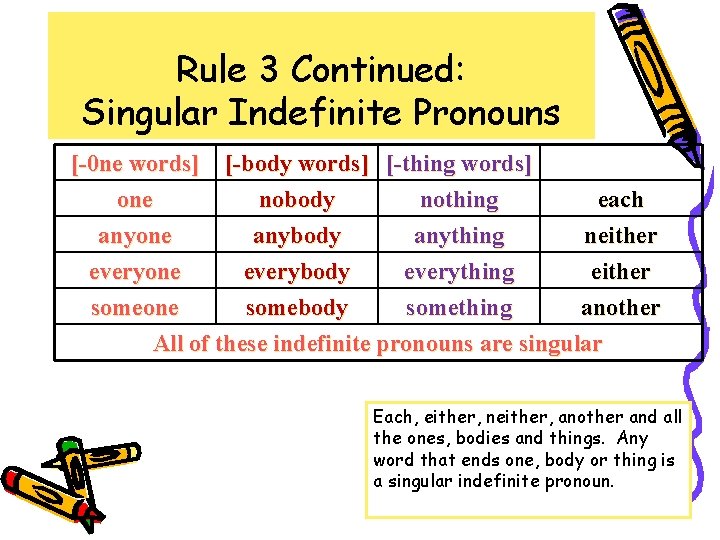
Rule 3 Continued: Singular Indefinite Pronouns [-0 ne words] one anyone everyone [-body words] [-thing words] nobody nothing each anybody anything neither everybody everything either someone somebody something another All of these indefinite pronouns are singular Each, either, neither, another and all the ones, bodies and things. Any word that ends one, body or thing is a singular indefinite pronoun.
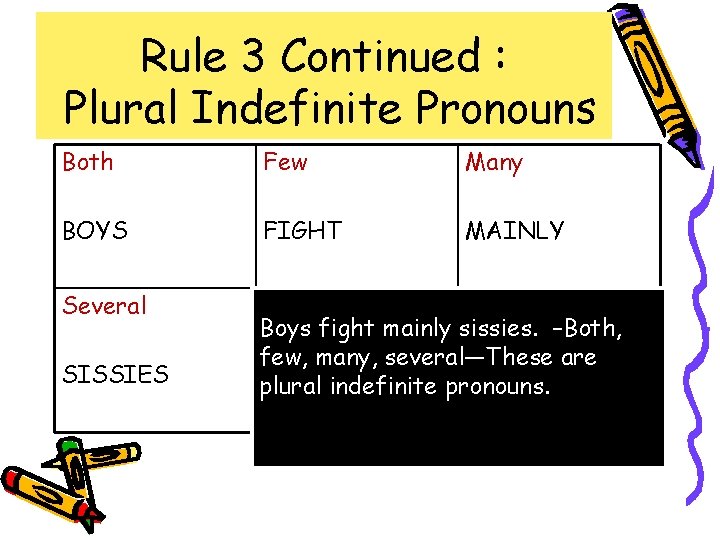
Rule 3 Continued : Plural Indefinite Pronouns Both Few Many BOYS FIGHT MAINLY Several SISSIES Boys fight mainly sissies. –Both, few, many, several—These are plural indefinite pronouns.
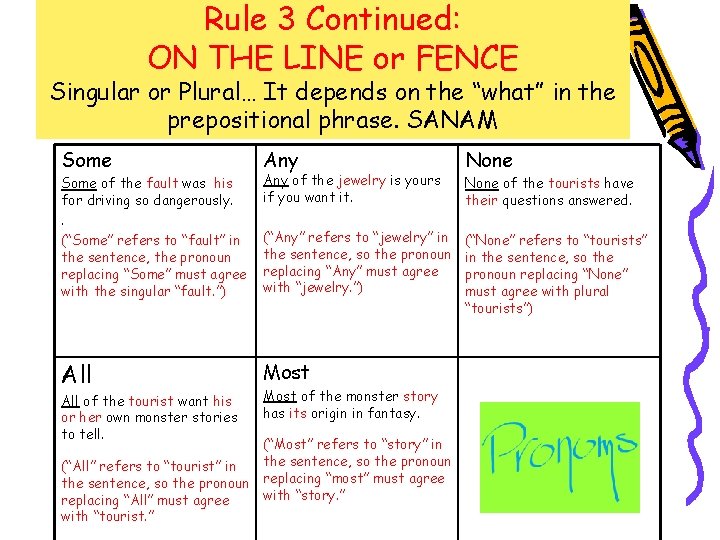
Rule 3 Continued: ON THE LINE or FENCE Singular or Plural… It depends on the “what” in the prepositional phrase. SANAM Some Any Some of the fault was his for driving so dangerously. . (“Some” refers to “fault” in the sentence, the pronoun replacing “Some” must agree with the singular “fault. ”) Any of the jewelry is yours if you want it. All Most All of the tourist want his or her own monster stories to tell. (“Any” refers to “jewelry” in the sentence, so the pronoun replacing “Any” must agree with “jewelry. ”) Most of the monster story has its origin in fantasy. (“Most” refers to “story” in the sentence, so the pronoun (“All” refers to “tourist” in the sentence, so the pronoun replacing “most” must agree with “story. ” replacing “All” must agree with “tourist. ” None of the tourists have their questions answered. (“None” refers to “tourists” in the sentence, so the pronoun replacing “None” must agree with plural “tourists”)
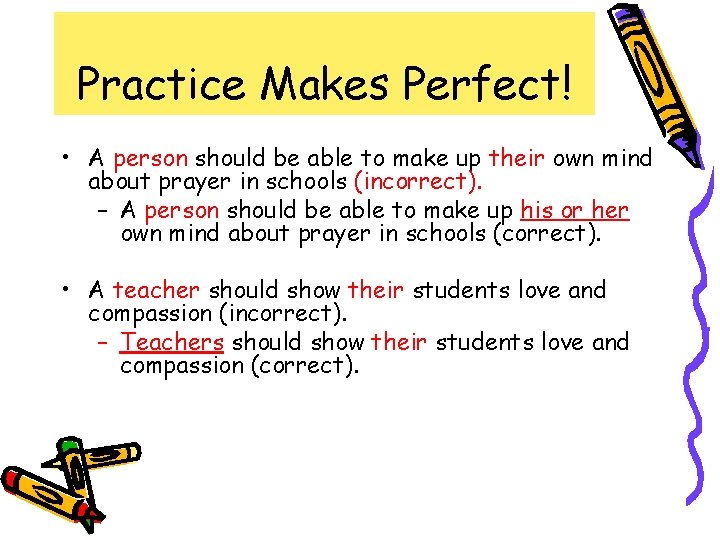
Practice Makes Perfect! • A person should be able to make up their own mind about prayer in schools (incorrect). – A person should be able to make up his or her own mind about prayer in schools (correct). • A teacher should show their students love and compassion (incorrect). – Teachers should show their students love and compassion (correct).
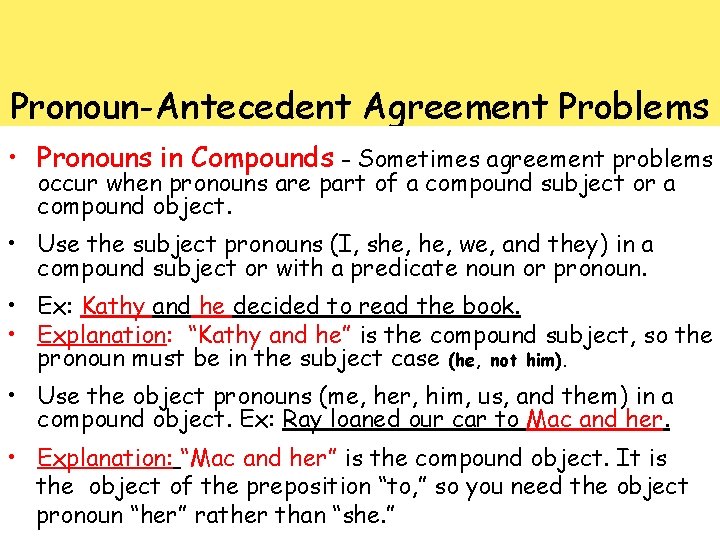
Pronoun-Antecedent Agreement Problems • Pronouns in Compounds – Sometimes agreement problems occur when pronouns are part of a compound subject or a compound object. • Use the subject pronouns (I, she, we, and they) in a compound subject or with a predicate noun or pronoun. • Ex: Kathy and he decided to read the book. • Explanation: “Kathy and he” is the compound subject, so the pronoun must be in the subject case (he, not him). • Use the object pronouns (me, her, him, us, and them) in a compound object. Ex: Ray loaned our car to Mac and her. • Explanation: “Mac and her” is the compound object. It is the object of the preposition “to, ” so you need the object pronoun “her” rather than “she. ”
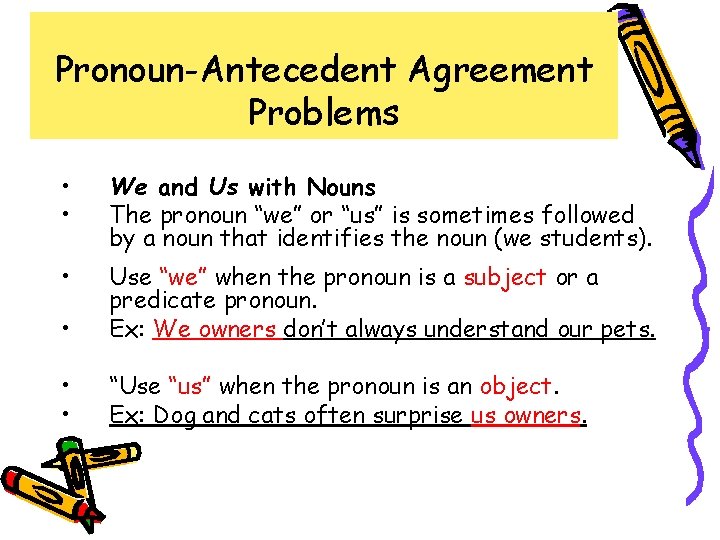
Pronoun-Antecedent Agreement Problems • • We and Us with Nouns The pronoun “we” or “us” is sometimes followed by a noun that identifies the noun (we students). • • Use “we” when the pronoun is a subject or a predicate pronoun. Ex: We owners don’t always understand our pets. • • “Use “us” when the pronoun is an object. Ex: Dog and cats often surprise us owners.
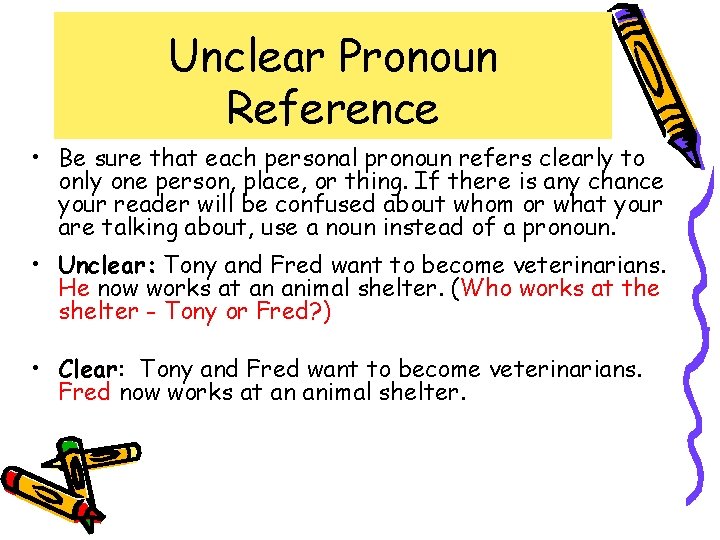
Unclear Pronoun Reference • Be sure that each personal pronoun refers clearly to only one person, place, or thing. If there is any chance your reader will be confused about whom or what your are talking about, use a noun instead of a pronoun. • Unclear: Tony and Fred want to become veterinarians. He now works at an animal shelter. (Who works at the shelter - Tony or Fred? ) • Clear: Tony and Fred want to become veterinarians. Fred now works at an animal shelter.
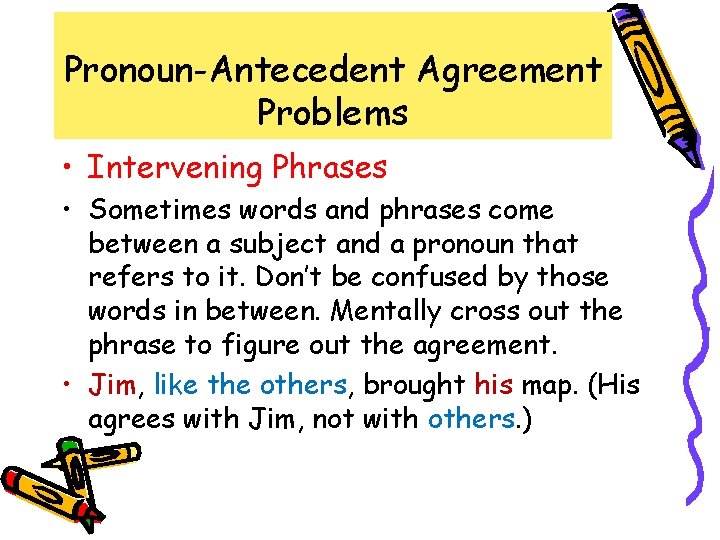
Pronoun-Antecedent Agreement Problems • Intervening Phrases • Sometimes words and phrases come between a subject and a pronoun that refers to it. Don’t be confused by those words in between. Mentally cross out the phrase to figure out the agreement. • Jim, like the others, brought his map. (His agrees with Jim, not with others. )