
Promotion Guidance LTS Track Professor Moira FischbacherSmith Vice

Promotion Guidance LTS Track Professor Moira Fischbacher-Smith Vice Principal Learning and Teaching
Focus for the session 1. Distinctiveness of the LTS role 2. Focus and meaning of the criteria 3. Value and purpose of the Account of Professional Practice 4. Nature of evidence 5. Tips for promotion applications 6. Planning for future applications
Teaching and Uof. G Promotions Research intensive University, irrespective of career track • teaching should be research-led • teaching should be done in a scholarly, evidencebased way • teaching is more than ‘just’ standing in front of the class for x number of hours • a range of contributions to a high quality student experience can be taken into account • your influence over others in engaging with improving Image source: www. scottish-places. info the student experience also counts
Learning, Teaching & Scholarship Track – Background & Purpose • Creation and evolution of L&T Track: • Decision to create a teaching-focused track (10+ years ago) • Recently, clearer expression of the learning and teaching element; • Change to the categories; • Creation of Account of Professional Practice; and • Alignment with UKPSF • Growing recognition of the distinctive nature of the track and associated contribution to the University • Development of external profile • Expectation of development across the levels and so progressively changing
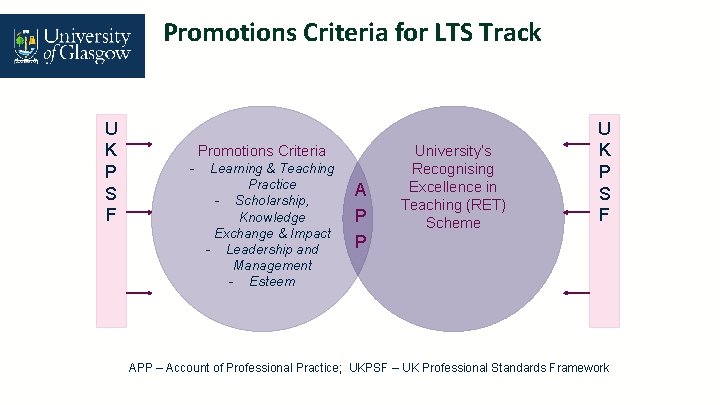
Promotions Criteria for LTS Track U K P S F Promotions Criteria - Learning & Teaching Practice - Scholarship, Knowledge Exchange & Impact - Leadership and Management - Esteem A P P University’s Recognising Excellence in Teaching (RET) Scheme U K P S F APP – Account of Professional Practice; UKPSF – UK Professional Standards Framework
Clarifying Scholarship “The normal expectation of candidates applying for promotion on the LT&S track would be that their output is increasingly characterised by scholarship, i. e. work that relates to the study and practice of learning and teaching within an HE setting. ” (Source: Guidance Information) “Scholarship of learning and teaching [that] can include disciplinary research where the research demonstrably influences pedagogy and assessment design. ” (Source: Promotion criteria).
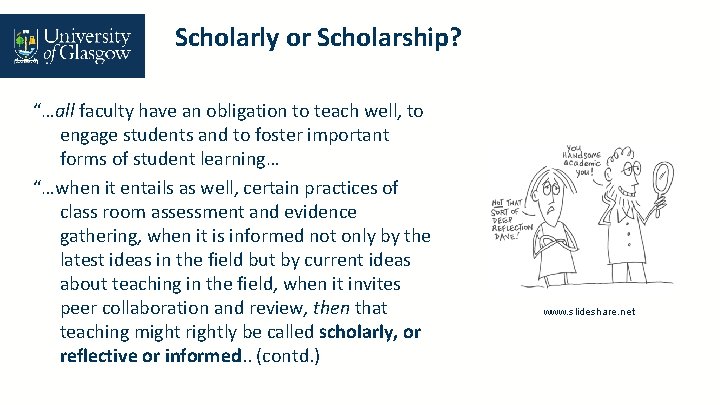
Scholarly or Scholarship? “…all faculty have an obligation to teach well, to engage students and to foster important forms of student learning… “…when it entails as well, certain practices of class room assessment and evidence gathering, when it is informed not only by the latest ideas in the field but by current ideas about teaching in the field, when it invites peer collaboration and review, then that teaching might rightly be called scholarly, or reflective or informed. . (contd. ) www. slideshare. net
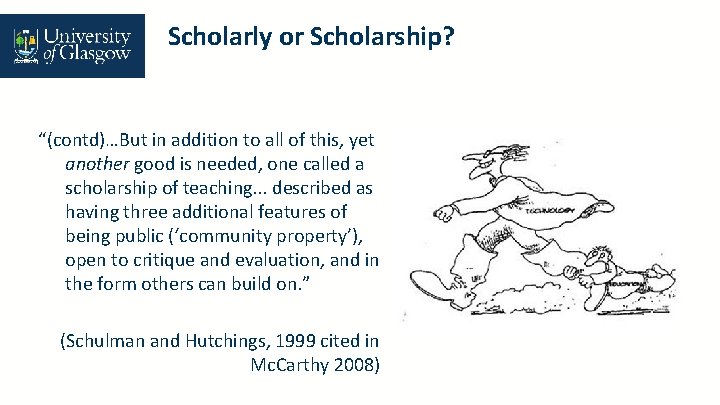
Scholarly or Scholarship? “(contd)…But in addition to all of this, yet another good is needed, one called a scholarship of teaching. . . described as having three additional features of being public (‘community property’), open to critique and evaluation, and in the form others can build on. ” (Schulman and Hutchings, 1999 cited in Mc. Carthy 2008)
Scholarship of Learning & Teaching “In my view, the purpose of scholarly teaching is to impact the activity of teaching and the resulting learning, whereas the scholarship of teaching results in a formal, peer-reviewed communication in the appropriate media or venue, which then becomes part of the knowledge base of teaching and learning in higher education. ” (Richlin, 2001) (Emphasis added). “…making the private public. . ” (Stephen Marshall, UNSW)
Evidencing Scholarship • “Evidence should take the form of external-facing outputs that can include: per-reviewed journal publications of international standing; external policy and professional reports; monographs; text books; book contributions; professional guidance on learning and teaching (such as QAA, Advance HE reports/guidance); dictionaries, scholarly editions; catalogues; contributions to major databases; or other corpora of knowledge. ” • validated by peers and influence others beyond the institution e. g. through professional recommendations, evidence of citation, adoption of guidance or materials by other institutions, and other similar indications that the outputs are high quality.
Role of the APP (Account of Professional Practice) • Evidencing Learning and Teaching Practice, alongside Scholarship, Knowledge Exchange and Impact. • Intention is that this is a key element of promotion, and where the distinctiveness of the track is most obvious. • Emphasis is on nature and impact of activities, and on rationale for approach. • Guiding questions are provided for each grade of promotion. Aligned to UKPSF and influenced by questions in HEA fellowship.
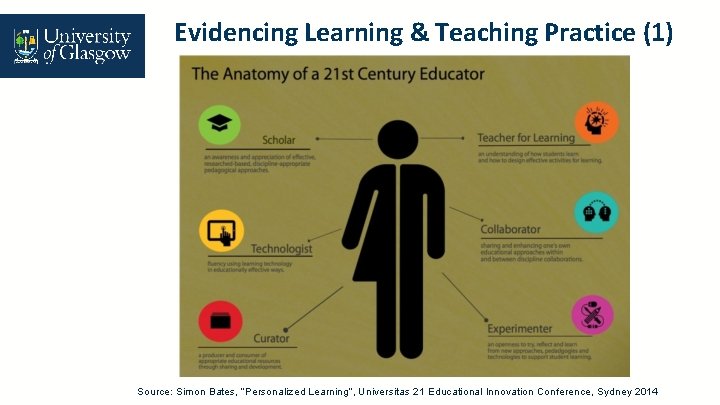
Evidencing Learning & Teaching Practice (1) Source: Simon Bates, “Personalized Learning”, Universitas 21 Educational Innovation Conference, Sydney 2014
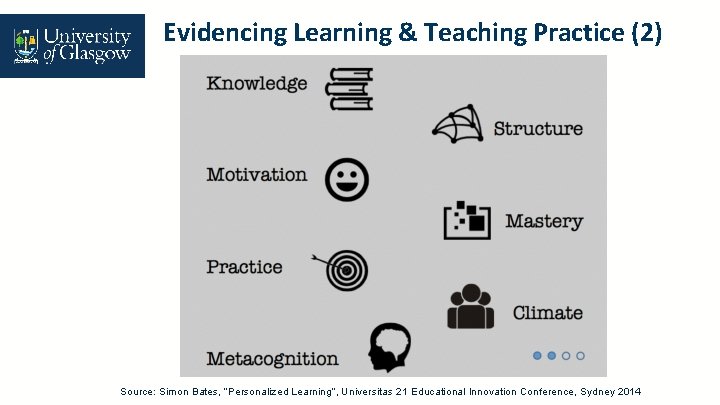
Evidencing Learning & Teaching Practice (2) Source: Simon Bates, “Personalized Learning”, Universitas 21 Educational Innovation Conference, Sydney 2014
What constitutes ‘evidence’? (3) Course evaluations Engagement with online forums NSS, PTES, FYSLES, PRES results and open comments Impact of interventions might be demonstrated through: • more engagement with students; greater numbers of students going to study abroad; increased reflexivity amongst the cohort; comments from students, external examiners and partners. • Set out how you use research and to what effect. • Show the link between your approach to teaching and the graduate attributes framework – be clear about the different dimensions of the teacher role that you are evidencing. • •
What constitutes ‘evidence’? (4) • Consider the features of the UKPSF https: //www. heacademy. ac. uk/sites/default/files/do wnloads/UKPSF_2011_English. pdf to help guide your narrative about what you do, why and how. • Include the roles you have with colleagues (eg as mentor, coordinator), and what behaviours that has inculcated. • LTDF or other internal funding whilst not counting as external income, can be used to demonstrate strength in innovation, engagement with University priorities and impact across the institution.
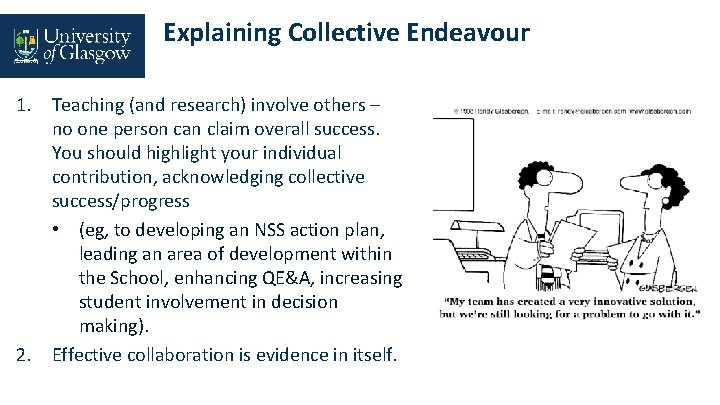
Explaining Collective Endeavour 1. Teaching (and research) involve others – no one person can claim overall success. You should highlight your individual contribution, acknowledging collective success/progress • (eg, to developing an NSS action plan, leading an area of development within the School, enhancing QE&A, increasing student involvement in decision making). 2. Effective collaboration is evidence in itself.
Personal observations on applications to date… Less successful when they…. • Focus solely on quantity or frequency of activity. So instead, try to include quality and effect/impact. • Provide limited contextual information (eg, scale of a programme, diversity of cohort, range of student needs). • Provide limited insight into the link between what is on the form and the University’s aims and objectives. • Focus on only delivery of teaching, and neglect the range of tasks associated with programme delivery such as recruitment/conversion, embedded WRL elements and the external benefits of that, and the benefits of all this to student learning and the student experience.
Try to … • Leave the reader with a clear sense of the person behind the form. Remember, the panel members are unlikely to know you so try to be comfortable that the form represents all that we need to know. • Look at the UK Professional Standards Framework (PSF). • Try to think through the questions in the APP guidance and shape your account in light of them. • Let others read your application and be open to their critique. • Remember that promotion panels cannot reward effort, they have to focus on the range of criteria and demonstrable achievement. • If you struggle to fill in the form, write freely on a separate document in light of comments here, and then translate that into the form.
Thinking ahead… • How can you best align your priorities and activities with the full range of tasks within your job role and with local and University priorities? • What plans do you have for evaluating your own (or others’) learning and teaching and for associated scholarship? • What development needs do you have are there others you can work with to meet them? • Would mentoring be beneficial? Where might that come from? • How can P&DR best support discussion of these areas of work? • Can you contribute to or form a community of scholars that would help achieve goals of your own and of others? • What can you change/do, and what do you need others to change/do?

Questions? … #Uof. GWorld. Changers @Uof. Glasgow
- Slides: 20