
Promoting Social Emotional Inclusion in Education By Julie
Promoting Social Emotional Inclusion in Education By Julie Johnson, M. Ed, TVI, ATS, RYT Natasha Baebler, MAT, E-RYT
The idea of neurodiversity is really a paradigm shift in how we think about kids in special education. Instead of regarding these students as suffering from deficit, disease, or dysfunction, neurodiversity suggests that we speak about their strengths. Neurodiversity urges us to discuss brain diversity using the same kind of discourse that we employ when we talk about biodiversity and cultural diversity. -ASCD, “Neurodiversity in the Classroom” -
The Pitfalls of not Addressing Neurodiversity
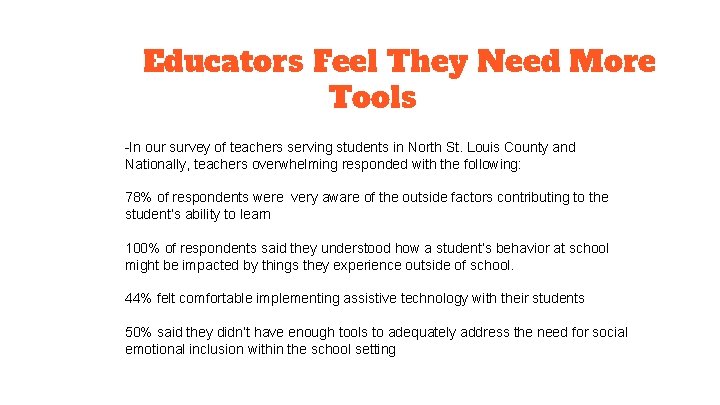
Educators Feel They Need More Tools -In our survey of teachers serving students in North St. Louis County and Nationally, teachers overwhelming responded with the following: 78% of respondents were very aware of the outside factors contributing to the student’s ability to learn 100% of respondents said they understood how a student’s behavior at school might be impacted by things they experience outside of school. 44% felt comfortable implementing assistive technology with their students 50% said they didn’t have enough tools to adequately address the need for social emotional inclusion within the school setting
Current Barriers to Addressing Neurodiversity ● Little training is available to teachers in this area in a way that doesn’t overwhelm many with content ● Teachers say they feel tired and overwhelmed by the day to day need of every child in the classroom ● Administrators don’t feel adequately prepared ( with IEP supports in place)
Ways to recognize when a student is demonstrating neurodiverse thinking Going Deeper with Neurodiversity Instances that can cause Neurodiversity seen in our educational communities: -Adverse Childhood Experiences -Birth Trauma -Medical Trauma
Our Guiding Framework for Social Emotional Inclusion + Neurodiversity using CASEL’s Guide to Social Emotional Learning Self-awareness: Know your strengths and limitations, with a well-grounded sense of confidence, optimism, and a “growth mindset. ” Self-management: Effectively manage stress, control impulses, and motivate yourself to set and achieve goals. Social awareness: Understand the perspectives of others and empathize with them, including those from diverse backgrounds and cultures. Relationship skills: Communicate clearly, listen well, cooperate with others, resist inappropriate social pressure, negotiate conflict constructively, and seek and offer help when needed. Responsible decision-making: Make constructive choices about personal behavior and social interactions based on ethical standards, safety, and social norms.
Signs of Social Emotional Learning Needs Among Students with Disabilities ● Students prefer to talk to adults over peers ● Struggles to self-advocate for needs and wants ● Resistant to using accommodation and modifications/Assistive Technology around other students ● Challenges managing anxiety ● Lacks language around talking about their disability with peers
Adverse Childhood Experiences (ACES) Observations of students in the Fit. Abilities program combined with response to the survey reflect a high need to address the reality of the compounding impact of Adverse Childhood Experiences and Visual Impairment on the lives and educational experiences of students in the Fit. Abilities program. More on ACES from the ACES Too High Website: “ACEs” comes from the CDC-Kaiser Adverse Childhood Experiences Study , a groundbreaking public health study that discovered th childhood trauma leads to the adult onset of chronic diseases, depression and other mental illness, violence and being a vict violence, as well as financial and social problems. The ACEhas Study published about 70 research papers since. 1998 Hundreds of additional research papers based on the ACE Study have also been published. The 10 ACEs the researchers measured: — Physical, sexual and verbal abuse. — Physical and emotional neglect. — A family member who is: ● ● ● depressed or diagnosed with other mental illness; addicted to alcohol or another substance; divorce in prison.
Medical Trauma “Medical traumas are psychological traumas that result from medical diagnosis and/or medical intervention. Threat of serious injury or threat to life due to illness is now encompassed within the DSM definition of psychological trauma. This means that medical patients can be evaluated as having illness-related trauma disorders. ” -Social Work Today -Medical trauma impacts many students with and without IEPS. -Medical trauma impacts: -Students with visual impairments -students with autism -Student with cerebral palsy Who else?
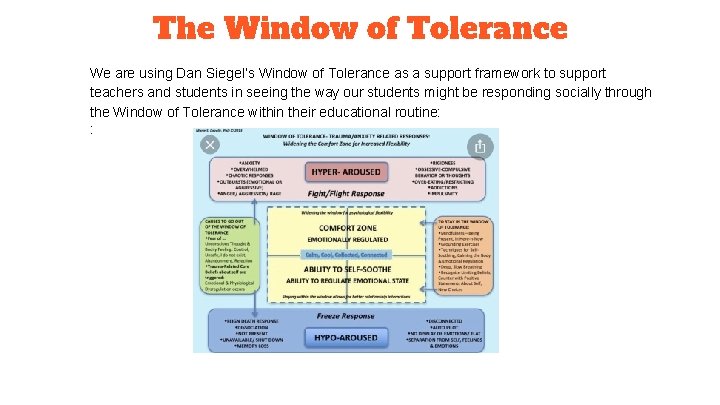
The Window of Tolerance We are using Dan Siegel’s Window of Tolerance as a support framework to support teachers and students in seeing the way our students might be responding socially through the Window of Tolerance within their educational routine: :
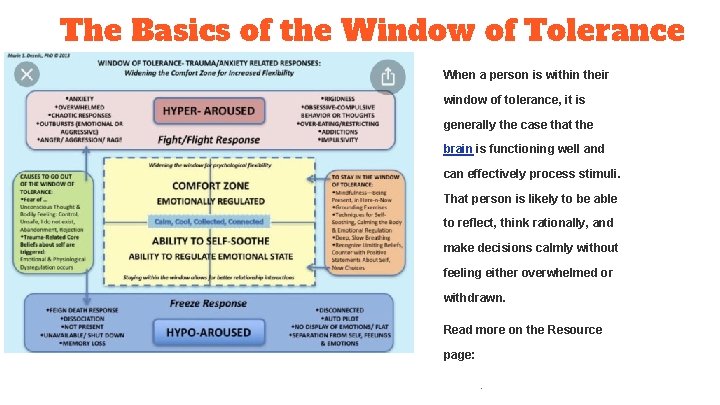
The Basics of the Window of Tolerance When a person is within their window of tolerance, it is generally the case that the brain is functioning well and can effectively process stimuli. That person is likely to be able to reflect, think rationally, and make decisions calmly without feeling either overwhelmed or withdrawn. Read more on the Resource page: .
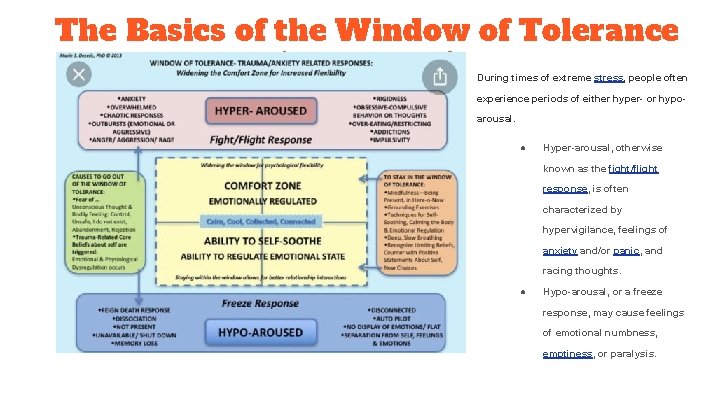
The Basics of the Window of Tolerance (continued) During times of extreme stress, people often experience periods of either hyper- or hypoarousal. ● Hyper-arousal, otherwise known as the fight/flight response, is often characterized by hypervigilance, feelings of anxiety and/or panic, and racing thoughts. ● Hypo-arousal, or a freeze response, may cause feelings of emotional numbness, emptiness, or paralysis.
How the Window of Tolerance Impacts Social Emotional Inclusion Self-awareness: Know your strengths and limitations, with a well-grounded sense of confidence, optimism, and a “growth mindset. ” Self-management: Effectively manage stress, control impulses, and motivate yourself to set and achieve goals. Social awareness: Understand the perspectives of others and empathize with them, including those from diverse backgrounds and cultures. Relationship skills: Communicate clearly, listen well, cooperate with others, resist inappropriate social pressure, negotiate conflict constructively, and seek and offer help when needed. Based on the Window of Tolerance Framework, it is very challenging for our students who are facing the adversity of the impact of visual disability, medical and/or diverse childhood experiences to relate to their peers without specific, direct guidance from the trusted adults in their lives. The teachers in our survey and the Fit Abilities Team are seeing our students struggle the most with the Self-Management and the Relationship Skill Building development within Casel’s Social Emotional Learning Framework
Ways to Use Tools Multimodal instruction using: -Yoga -Mindfulness -Technology
Using Yoga as Our Primary Tool to Build Resilience Why Yoga? Yoga is accessible and adaptable It’s a tool that can easily be accommodated or modified to meet the needs of the student. Yoga can be done in small time increments It can be done in 5 -10 minute increments throughout the school day to support social emotional development and overall student learning so students can potentially access their own personal Window of Tolerance. Yoga can easily be embedded into the classroom with chair yoga or mindfulness practices that promote relationship building We have potential to support our students ability to maintain their window of tolerance by embedding the skills into their school day with mindfulness practices (mindfulness journaling, play dough, mindful breathing) or doing chair yoga at their desk alongside their peers Yoga can be used to directly teach academic skills It can easily be embedded into a teacher’s lesson to promote academic learning and social emotional inclusion
Yoga Activities for the Classroom -Mudras -Yoga Spinner -
Mindfulness Why Mindfulness? Mindfulness can support student’s ability to expand their awareness beyond their survival responses within the scope of their normal routine. Can Improve Emotional Regulation Students can use mindfulness activities to become self-aware of the names of emotions and how emotions show up in their day to day interactions. If it’s accessible, teacher can also teach mindful breathing techniques within their educational routine Has potential to improve social and communication skills Mindful journaling activities can help students cultivate social emotional language awareness Can support teaching decision making skills Mindfulness can also support students plant the seeds for making pos Easy to adapt into a lesson plan for teachers Much like yoga, mindfulness can be used in 2 -10 minute increments within the classroom with mindful journaling activities, group questions, etc.
Technology ● Embedding technology, both educational and assistive, can support a student with neurodiversity in practicing their mindfulness skills using technology ● Students with a dedicated assistive technology device also benefit since discerning when it’s appropriate for them to use their device is a mindfulness practice all in one ● Combining Technology and mindfulness also teaches all students mindful use of technology
Mindful Use of Technology ● Blending mindfulness with technology, we can inclusively teach our students that they have the ability to control technology and not be controlled by it ● When students are using the technology within the classroom and/or their own assistive technology, teachers can facilitate a simple mindful practice by simply asking their students a few of the following statements: 1. Do you ever check in with the state of your mind as you engage with technology? 1. If you use assistive technology, check in with your mind to consider how you will determine when you will be using your device. What words, sensations, texture or colors might be present for you? 1. Perhaps every time we hear a beep, it can remind us to check in with our breath, our mind and our bodies.
Inclusion Circles - ● ● Circles can be content based It can provide a space for emotional, social and moral development It is routine and can facilitate modeling and teaching empathy in both a direct and student lead approach Circles promote a trauma-sensitive learning environment for administration, teachers and students Possible Topics for Inclusion Circles: Parent/Teacher Involvement Math Circles What is Friendship Gossip Positive Relationship Building Mindful Use of Technology Circle Yoga Circle Self-Care Circle Welcome Back after Classroom Absence Circle Finding Out What Students Already Know (Pre-Test Circle)
The Structure of an Inclusion Circle A. Group Guidelines (students help come up with rules and are guided by adult) B. Check-In -Giving adults and students and opportunity to check in with where they are A. Mindful Moment B. 1 -2 questions to facilitate discussion questions on building positive relationships and teaching empathy (teachers also need to participate in the circle) A. 3 -4 Content/Community Building related questions B. Check out. Ask questions such as: -What was something you liked about circle today? -Was there something you didn’t like? -Is there something you would like to do different next time
Resources Neurodiversity in the Classroom http: //www. ascd. org/publications/books/113017/chapters/Neurodiversity@-The-New-Diversity. aspx Neurodiversity: What You Need to Know https: //www. understood. org/en/friends-feelings/empowering-your-child/building-onstrengths/neurodiversity-what-you-need-to-know Teach, Breathe, Learn: Mindfulness In and Out of the Classroom by Meena Srivinivasan Circle Forward: Building Restorative School Community by Carolyn-Watson
Contact Julie Johnson Special School District of St. Louis County jajohnson@ssdmo. org Natashas Baebler UD for Yoga natasha@udforyoga. com
- Slides: 24