
Promoting Reflective Teaching in Adult ESL through Peer


- Slides: 21
Promoting Reflective Teaching in Adult ESL through Peer Mentoring
Overview 1. 2. 3. 4. 5. 6. Introductions Background Mentoring Collaborating with a Peer Context Preparatory work
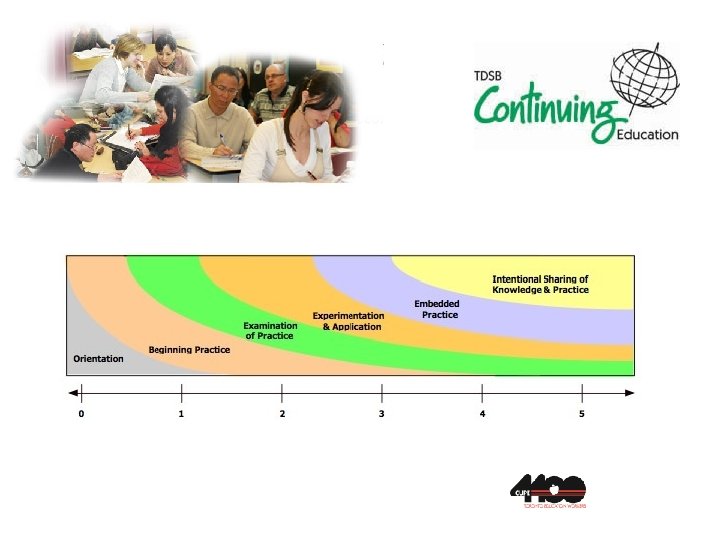
Background and Context • • Models of Professional Development TDSB precursors Adult ESL examples Reflective teaching
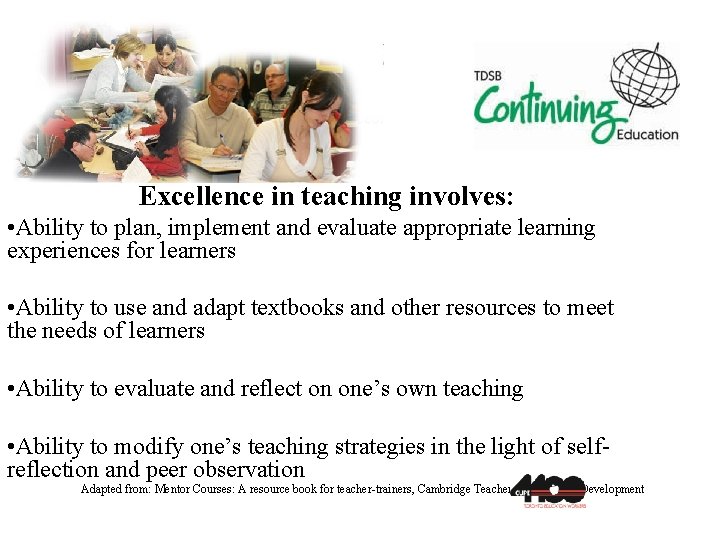
Excellence in teaching involves: • Ability to plan, implement and evaluate appropriate learning experiences for learners • Ability to use and adapt textbooks and other resources to meet the needs of learners • Ability to evaluate and reflect on one’s own teaching • Ability to modify one’s teaching strategies in the light of selfreflection and peer observation Adapted from: Mentor Courses: A resource book for teacher-trainers, Cambridge Teacher Training and Development
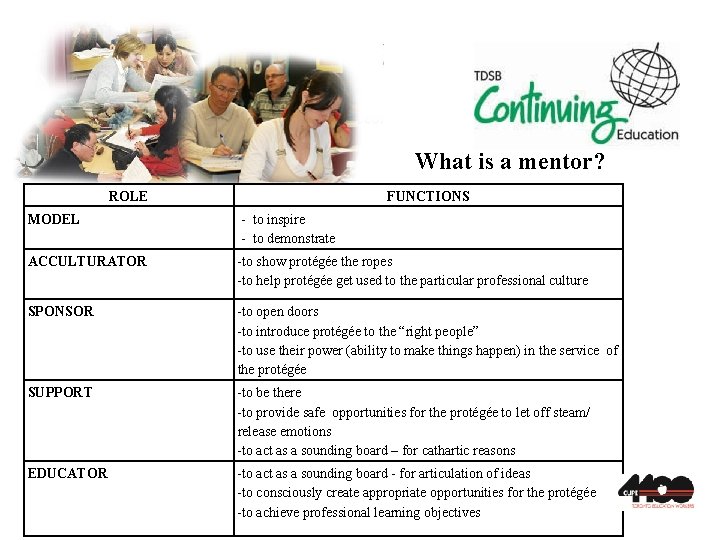
What is a mentor? ROLE FUNCTIONS MODEL - to inspire - to demonstrate ACCULTURATOR -to show protégée the ropes -to help protégée get used to the particular professional culture SPONSOR -to open doors -to introduce protégée to the “right people” -to use their power (ability to make things happen) in the service of the protégée SUPPORT -to be there -to provide safe opportunities for the protégée to let off steam/ release emotions -to act as a sounding board – for cathartic reasons EDUCATOR -to act as a sounding board - for articulation of ideas -to consciously create appropriate opportunities for the protégée -to achieve professional learning objectives
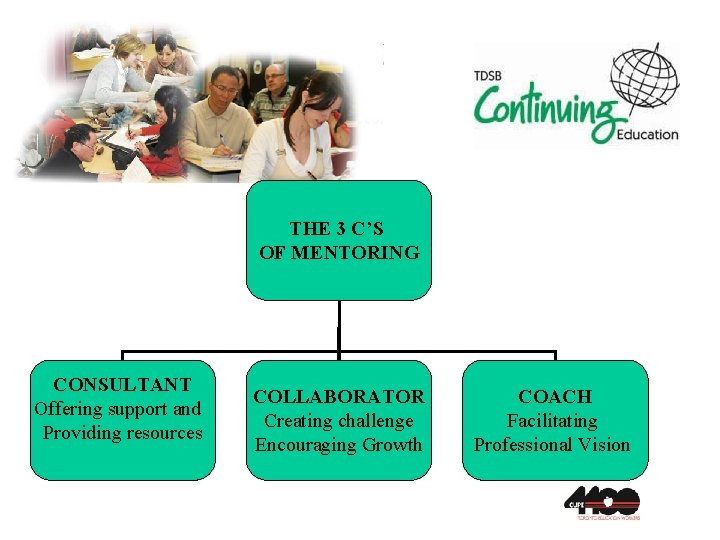
THE 3 C’S OF MENTORING CONSULTANT Offering support and Providing resources COLLABORATOR Creating challenge Encouraging Growth COACH Facilitating Professional Vision
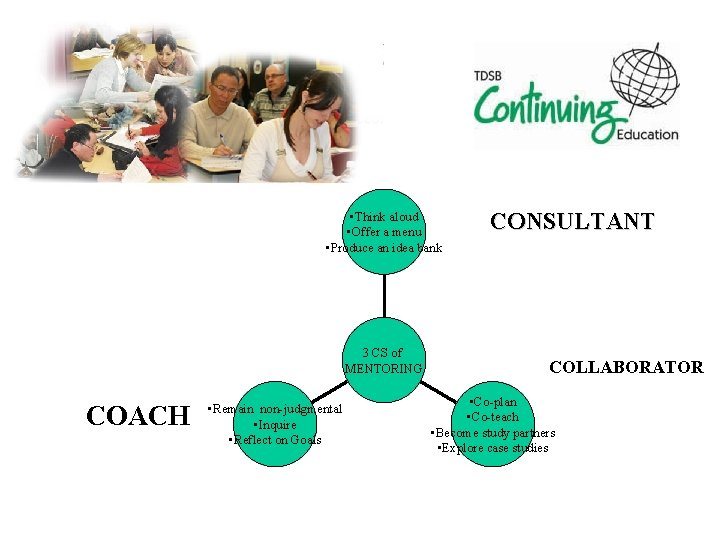
• Think aloud • Offer a menu • Produce an idea bank 3 CS of MENTORING COACH • Remain non-judgmental • Inquire • Reflect on Goals CONSULTANT COLLABORATOR • Co-plan • Co-teach • Become study partners • Explore case studies
What is mentoring? Think of a positive mentoring experience you have had – Why was it so meaningful? – Was it effective? Why?
Peer – mentors are… • Committed to communicating to share and discuss issues of concern • Committed to listening without judgment • Committed to keeping discussions confidential
The Art of Active Listening • • Elegant Paraphrase Explore options Plan next steps Self – evaluation for Protégé
Mutual benefits • Reciprocity is an essential element of a mentoring relationship, both mentee and mentor engage in the relationship. Each has specific responsibilities, contributes to the relationship and learns from the other. When reciprocity exists, mentees and mentors are able to say that their perspectives are expanded, they gain new knowledge and mentoring is a valueadded relationship for them. This discovery of reciprocity and mutuality frequently surprises first time mentors. Lois Zachary
The process Orientation Session – April 1 st, 2011 Observation 2 Feedback session Before May 15 th, 2011 May 16 th, 2011
Context • Effective Teaching • The ESL classroom • Planning continuum
Effective teaching is… • • Inclusive Instructionally precise Attributes-based Learning-Focused environment
The ESL classroom – Learners – Teachers – Materials and Assignments – Classroom Environment
The planning continuum • • Needs assessment Term plan Stages of lesson Assessment of learning
What’s the problem? (Protégée's Point of View) • Identifying the issue • Articulating a goal • Asking the right questions in the context of the 4 areas: L/S/R/W
What is it that I do? (Mentor’s Point of View) • My objectives (with reference to 4 areas) • How I achieve these objectives • What classroom activity will demonstrate this to my partner
Forms • Annotated lesson plan (detailed lesson plan with comments on key elements) • Observation Forms • Schedule Form
Logistics • Scheduling • Debriefing • Roles in the observation