
Promoting Program Quality through Reflective Processes Karen Shores
- Slides: 27
Promoting Program Quality through Reflective Processes Karen Shores – CA Department of Education Mike Henson – National Academy Foundation Beth Kay – National Academy Foundation Arlene La. Plante – Connect. Ed: The California Center for College and Career
Welcome and Introductions • Outcome - to understand how to move from selfassessment and reflection to program improvement
• Why self-assessment and certification? • What are the advantages and disadvantages of doing this work to align the quality criteria/standards/strategic actions and reflective processes?
Assessment and Recognition CALIFORNIA PARTNERSHIP ACADEMIES CALIFORNIA DEPARTMENT OF EDUCATION Tom Torlakson, State Superintendent of Public Instruction
How are CPAs Evaluated? Tom Torlakson State Superintendent of Public Instruction • CA Partnership Academy Annual Report (CAPAAR) – due October 15 each year. • Proposed annual budget • Communications with Academies • Site visits • New: Assessment and Recognition Tool (ART)
Role of CPA ART Tom Torlakson State Superintendent of Public Instruction • Self-Assessment for successes, needs, compliance, and improvement • Assessment by peers (Lighthouse Academies) for feedback on accomplishments and needs • Directions for technical assistance • Recognition by the California Department of Education (CDE)
CPA ART in Relation to Connect. Ed & NAF Certifications Tom Torlakson State Superintendent of Public Instruction • Similar intent, goals and standards • Similar formats – criteria and examples of evidence • Overlap in many categories since all are based on the National Standards for Career Academies • Some criteria are specific to each model
Challenge Tom Torlakson State Superintendent of Public Instruction • How to respect the validity of, and need for, each assessment tool as they evaluate the implementation of the specific career pathway models (CPA, Connect. Ed, and NAF) • And avoid the need for schools and programs to prepare for multiple, very similar assessments
Solution Tom Torlakson State Superintendent of Public Instruction • Collaboration • For those programs with multiple models: – Find areas of overlap and similarity and unite to one set of standards in those areas whenever possible – Find areas of differences and add section to tool for requirements unique to each model.
Current Solution Tom Torlakson State Superintendent of Public Instruction • Include section 2 of CPA “ART” to Connect. Ed Certification Tool when assessing a CA Partnership Academy. – This section addresses specific Education Code requirements for funded CPAs – Most other criteria found in the CPA ART are addressed in sections of the Connect. Ed Certification Tool. • Continue to collaborate and refine
Thank You California Department of Education High School Transformation Unit Tom Torlakson State Superintendent of Public Instruction Karen Shores kshores@cde. ca. gov 916 -319 -0478 CPA Website: http: //www. cde. ca. gov/ci/gs/hs/cpagen. asp Career Academy Support Network CPA Website, And California Partnership Academy Assessment & Recognition Tool: http: //casn. berkeley. edu/cpa. php 11
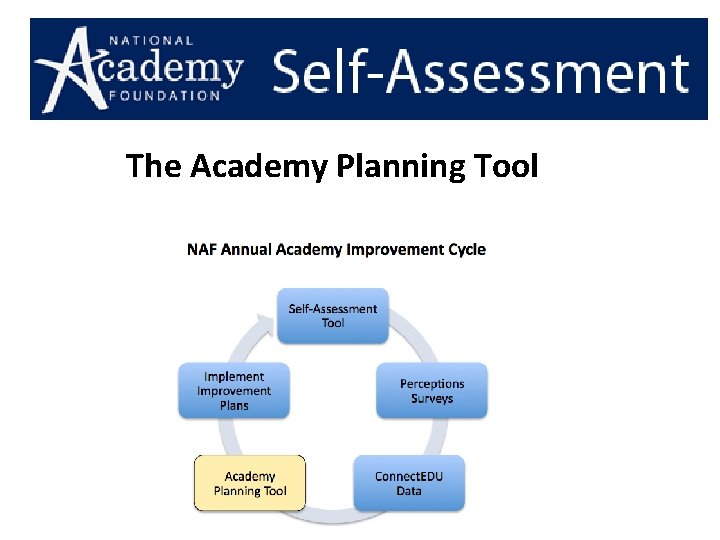
The Academy Planning Tool
MIKE HENSON, NETWORK SERVICES DIRECTOR mhenson@naf. org BETH KAY, ACADEMY DEVELOPMENT MANAGER bkay@naf. org Cindy Mc. Hugh, Partnership Development Manager cmchugh@naf. org Aazam Irilian, Curriculum Specialist airilian@naf. org Ana Morrison, Network Liaison amorrison@naf. org
llllllllllll. Why Certifiction of Pathway Quality? • To achieve desired results • To guide sites in planning and implementing pathways • To use the Quality Criteria to meet stakeholders’ needs: Ø For pathway team members - a guide to build, improve, and sustain high-quality pathways Ø For others - a way to deepen understanding by describing the elements of a high-quality pathway.
Developing the Process and the Tools • Formation of Design Tea • Designing process and creating tools • Field Test • Pilot
Llllllllllll l Why Self-Assessment of Pathway Quality? Rubric for Linked Learning Pathway Certification – a tool for pathway teams to use for. . . Ø Visioning—gain a common understanding of what a high-quality pathway looks like; Ø Self-assessment—analyze the current status and quality of each element of the pathway; Ø Planning –identify and set priorities for areas of improvement from which to develop annual action plans; Ø Quality review – external reviewers can assess and validate program quality.
Pathway Certification Process Self-assessment Ø Collection and review of evidence Ø Reflective narratives Ø Data collection Site visit Final Report Action Plan
Pathway Certification Process Possible outcomes Ø Certified Ø Model Ø In Progress
• Look at the 3 sets of criteria/standards (CPA/NAF/Linked Learning): Ø Determine where they do/don’t align. Ø Determine what you would need to do to bring them to alignment. Ø Be specific. What would the aligned standards/criteria look like? If a standard/criteria can’t be aligned, how would you proceed to create one certification process that will work for all?
Break
Case Study
Creating the Plan of Action • Review the Final Report and develop a plan of action for pathway improvement.
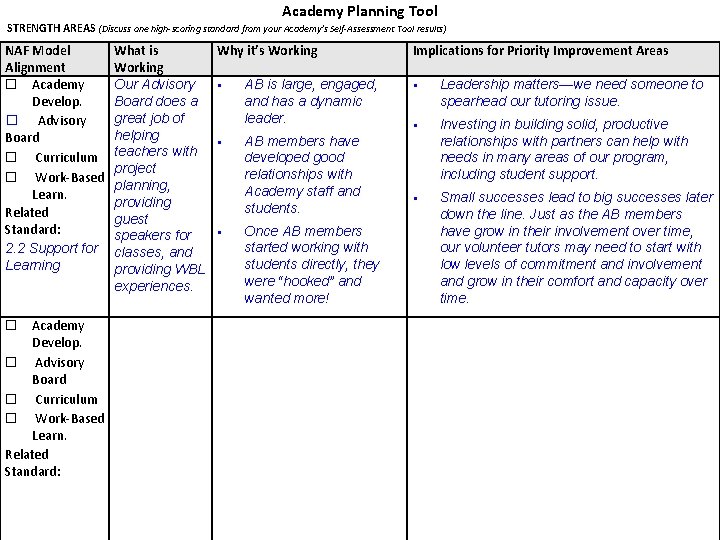
Academy Planning Tool STRENGTH AREAS (Discuss one high-scoring standard from your Academy’s Self-Assessment Tool results) NAF Model Alignment Academy Develop. � Advisory Board Curriculum Work-Based Learn. Related Standard: 2. 2 Support for Learning Academy Develop. Advisory Board Curriculum Work-Based Learn. Related Standard: What is Why it’s Working Our Advisory AB is large, engaged, Board does a and has a dynamic great job of leader. helping AB members have teachers with developed good project relationships with planning, Academy staff and providing students. guest Once AB members speakers for started working with classes, and students directly, they providing WBL were “hooked” and experiences. wanted more! Implications for Priority Improvement Areas Leadership matters—we need someone to spearhead our tutoring issue. Investing in building solid, productive relationships with partners can help with needs in many areas of our program, including student support. Small successes lead to big successes later down the line. Just as the AB members have grow in their involvement over time, our volunteer tutors may need to start with low levels of commitment and involvement and grow in their comfort and capacity over time.
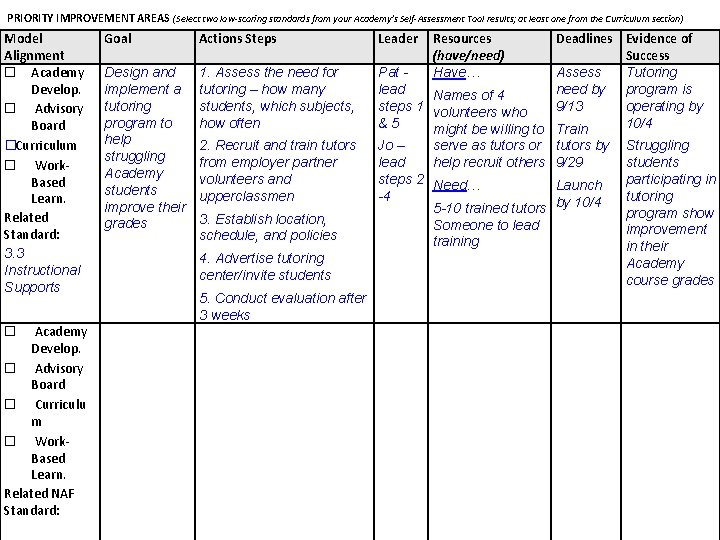
PRIORITY IMPROVEMENT AREAS (Select two low-scoring standards from your Academy’s Self-Assessment Tool results; at least one from the Curriculum section) Model Alignment Academy Develop. Advisory Board �Curriculum Work. Based Learn. Related Standard: 3. 3 Instructional Supports Academy Develop. Advisory Board Curriculu m Work. Based Learn. Related NAF Standard: Goal Actions Steps Design and implement a tutoring program to help struggling Academy students improve their grades 1. Assess the need for tutoring – how many students, which subjects, how often 2. Recruit and train tutors from employer partner volunteers and upperclassmen 3. Establish location, schedule, and policies 4. Advertise tutoring center/invite students 5. Conduct evaluation after 3 weeks Leader Resources (have/need) Have… Deadlines Evidence of Success Pat Assess Tutoring lead need by program is Names of 4 steps 1 volunteers who 9/13 operating by &5 10/4 might be willing to Train Jo – serve as tutors or tutors by Struggling lead help recruit others 9/29 students steps 2 Need… participating in Launch -4 tutoring 5 -10 trained tutors by 10/4 program show Someone to lead improvement training in their Academy course grades
How Good is Good Enough? • Group discussion – How good is good enough? and How will you know it?
• Karen Shores kshores@cde. ca. gov • Mike Henson mhenson@naf. org • Beth Kay bkay@naf. org • Arlene La. Plante alaplante@connectedcalifornia. org
Next steps • And. . . EVALUATION FORMS