
Promoting Literacy in Practice Meaningful Early Literacy Experiences
- Slides: 8
Promoting Literacy in Practice Meaningful Early Literacy Experiences for Young Children Kathleen Roskos October 2, 2004
Overview of the Topic • A short definition of ‘literacy in practice’ • Why it is important • Guiding principles for ‘authentic pedagogy’ in early literacy instruction
About ‘literacy in practice’ • learning about print through learning about the world • participating in content-rich activities that include reading and writing • engaging in increasingly more mature play in literacy-rich settings and contexts • achieving through active learning aimed toward high standards
Literacy in Practice is different from… • Memorizing isolated facts about print • Reproducing information • Passing acquaintance with significant concepts and skills • Focusing on compliance with drills and routines • Reciting information and responses • Meeting low expectations
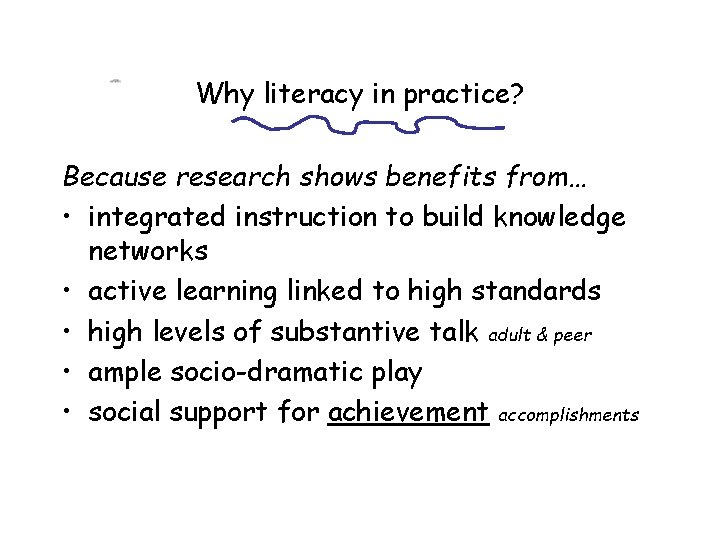
Why literacy in practice? Because research shows benefits from… • integrated instruction to build knowledge networks • active learning linked to high standards • high levels of substantive talk adult & peer • ample socio-dramatic play • social support for achievement accomplishments
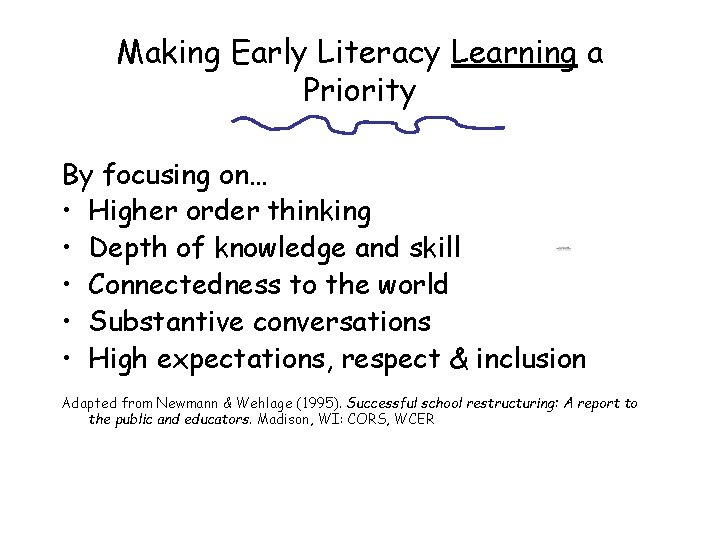
Making Early Literacy Learning a Priority By focusing on… • Higher order thinking • Depth of knowledge and skill • Connectedness to the world • Substantive conversations • High expectations, respect & inclusion Adapted from Newmann & Wehlage (1995). Successful school restructuring: A report to the public and educators. Madison, WI: CORS, WCER
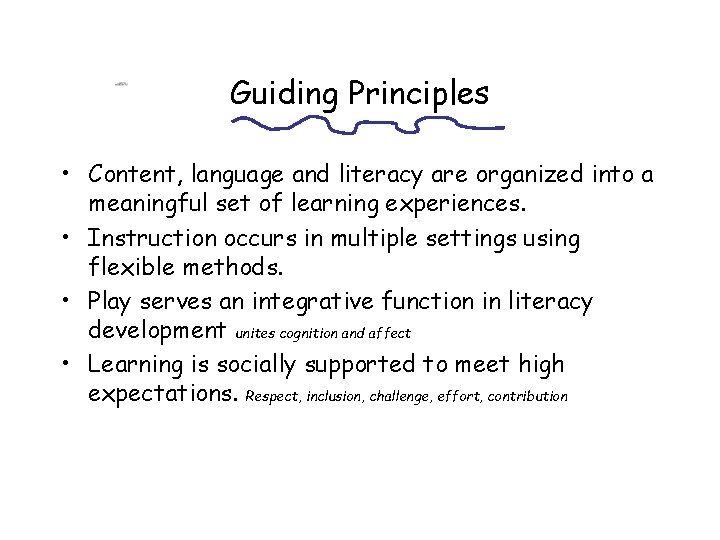
Guiding Principles • Content, language and literacy are organized into a meaningful set of learning experiences. • Instruction occurs in multiple settings using flexible methods. • Play serves an integrative function in literacy development unites cognition and affect • Learning is socially supported to meet high expectations. Respect, inclusion, challenge, effort, contribution
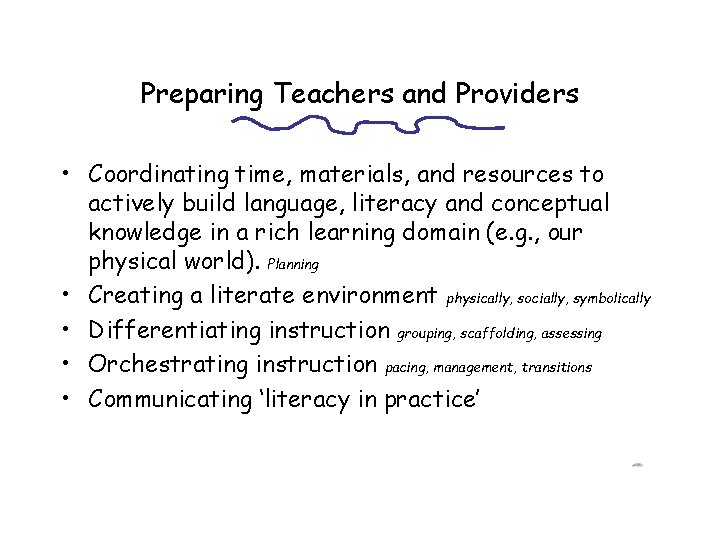
Preparing Teachers and Providers • Coordinating time, materials, and resources to actively build language, literacy and conceptual knowledge in a rich learning domain (e. g. , our physical world). Planning • Creating a literate environment physically, socially, symbolically • Differentiating instruction grouping, scaffolding, assessing • Orchestrating instruction pacing, management, transitions • Communicating ‘literacy in practice’