
Promoting Industry Alignment within Ed D Curriculum Development


- Slides: 25
Promoting Industry Alignment within Ed. D Curriculum Development: Best Practices Patricia Akojie, Ph. D Shawishi Haynes, Ed. D Myrene Magabo, Ph. D Margo Patterson, DNP-C, MD Rheanna R. Reed, DM Louise Underdahl, Ph. D Tanyetta White, DM August 13, 2021 Knowledge Without Boundaries Research Summit
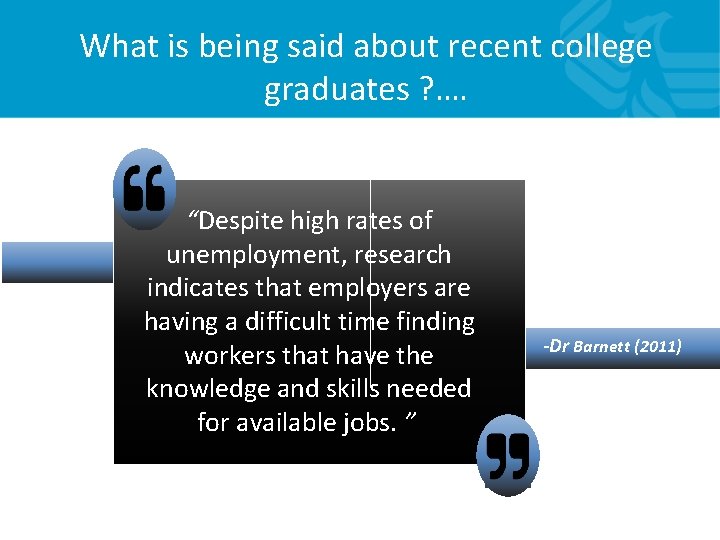
What is being said about recent college graduates ? …. “Despite high rates of unemployment, research indicates that employers are having a difficult time finding workers that have the knowledge and skills needed for available jobs. ” -Dr Barnett (2011)
Research Team
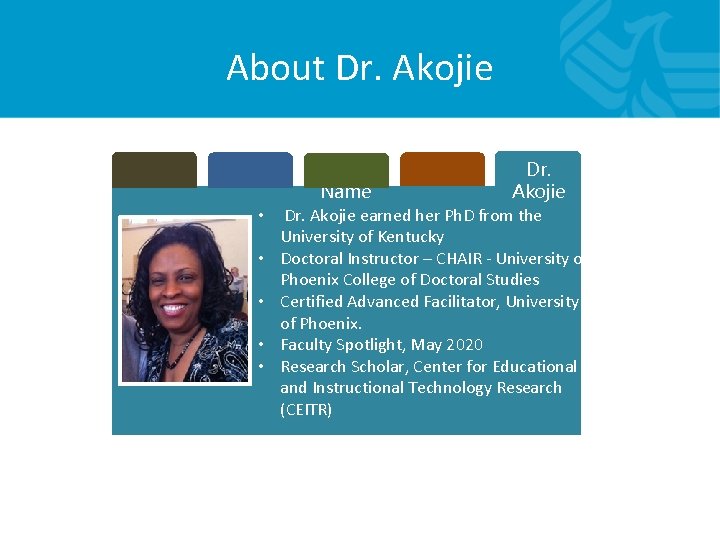
About Dr. Akojie • • • Tab Dr. Name Akojie Dr. Akojie earned her Ph. D from the University of Kentucky Doctoral Instructor – CHAIR ‐ University of Phoenix College of Doctoral Studies Certified Advanced Facilitator, University of Phoenix. Faculty Spotlight, May 2020 Research Scholar, Center for Educational and Instructional Technology Research (CEITR)
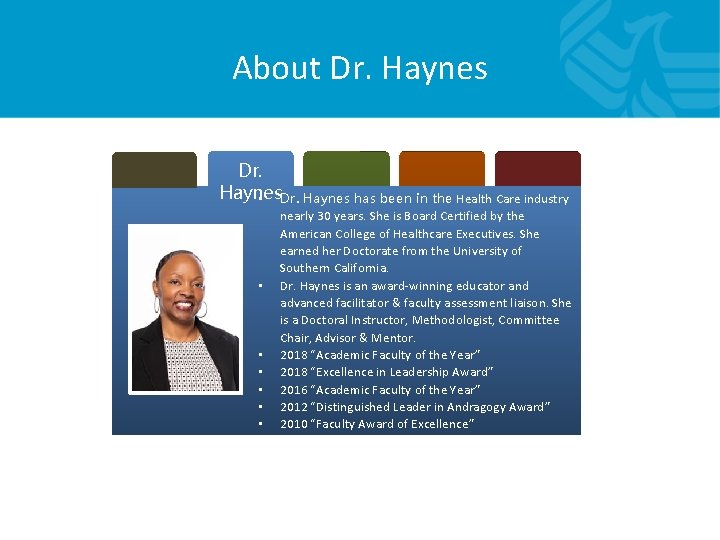
About Dr. Haynes • Dr. Haynes has been in the Health Care industry • • nearly 30 years. She is Board Certified by the American College of Healthcare Executives. She earned her Doctorate from the University of Southern California. Dr. Haynes is an award‐winning educator and advanced facilitator & faculty assessment liaison. She is a Doctoral Instructor, Methodologist, Committee Chair, Advisor & Mentor. 2018 “Academic Faculty of the Year” 2018 “Excellence in Leadership Award” 2016 “Academic Faculty of the Year” 2012 “Distinguished Leader in Andragogy Award” 2010 “Faculty Award of Excellence” 2013 “Academic Faculty of the Year”
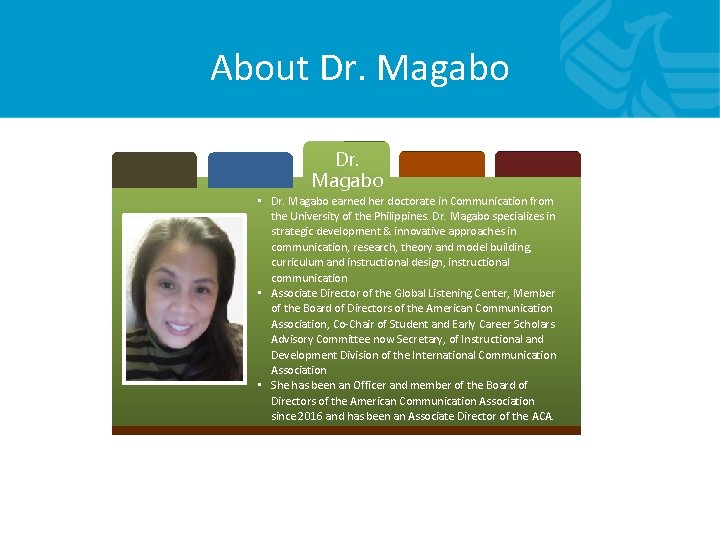
About Dr. Magabo • Dr. Magabo earned her doctorate in Communication from the University of the Philippines. Dr. Magabo specializes in strategic development & innovative approaches in communication, research, theory and model building, curriculum and instructional design, instructional communication • Associate Director of the Global Listening Center, Member of the Board of Directors of the American Communication Association, Co‐Chair of Student and Early Career Scholars Advisory Committee now Secretary, of Instructional and Development Division of the International Communication Association • She has been an Officer and member of the Board of Directors of the American Communication Association since 2016 and has been an Associate Director of the ACA.
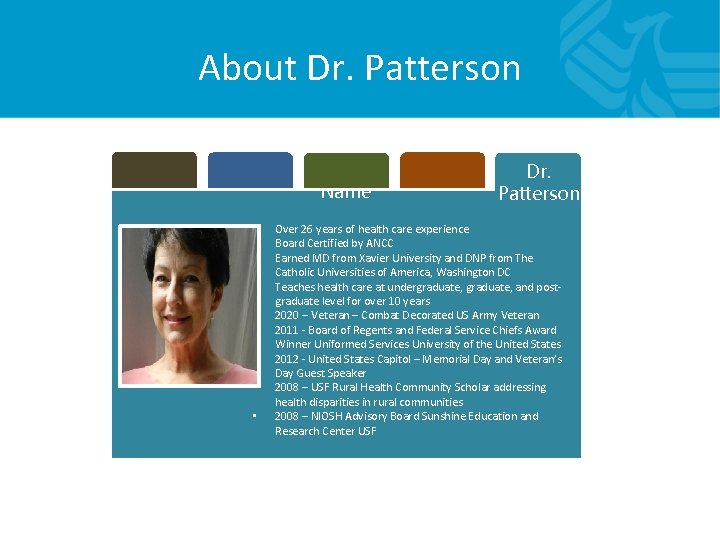
About Dr. Patterson Tab Name • • • Dr. Patterson Over 26 years of health care experience Board Certified by ANCC Earned MD from Xavier University and DNP from The Catholic Universities of America, Washington DC Teaches health care at undergraduate, and post‐ graduate level for over 10 years 2020 – Veteran – Combat Decorated US Army Veteran 2011 ‐ Board of Regents and Federal Service Chiefs Award Winner Uniformed Services University of the United States 2012 ‐ United States Capitol – Memorial Day and Veteran’s Day Guest Speaker 2008 – USF Rural Health Community Scholar addressing health disparities in rural communities 2008 – NIOSH Advisory Board Sunshine Education and Research Center USF
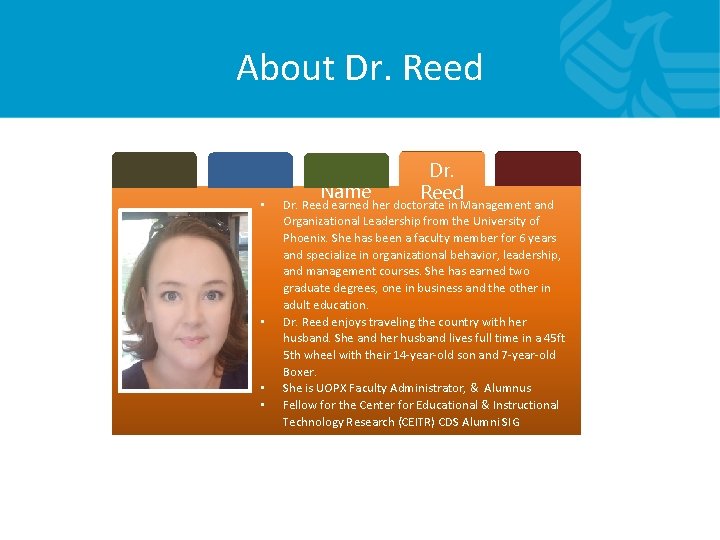
About Dr. Reed • • Tab Name Dr. Reed earned her doctorate in Management and Organizational Leadership from the University of Phoenix. She has been a faculty member for 6 years and specialize in organizational behavior, leadership, and management courses. She has earned two graduate degrees, one in business and the other in adult education. Dr. Reed enjoys traveling the country with her husband. She and her husband lives full time in a 45 ft 5 th wheel with their 14‐year‐old son and 7‐year‐old Boxer. She is UOPX Faculty Administrator, & Alumnus Fellow for the Center for Educational & Instructional Technology Research (CEITR) CDS Alumni SIG
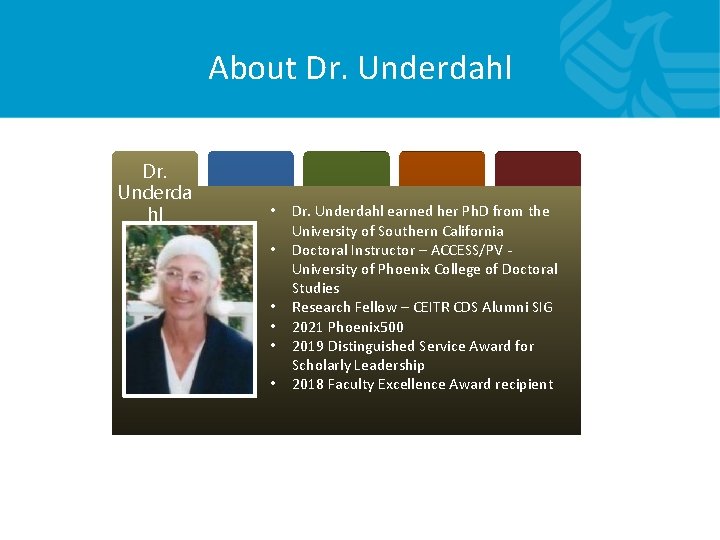
About Dr. Underdahl Dr. Underda hl • • • Dr. Underdahl earned her Ph. D from the University of Southern California Doctoral Instructor – ACCESS/PV ‐ University of Phoenix College of Doctoral Studies Research Fellow – CEITR CDS Alumni SIG 2021 Phoenix 500 2019 Distinguished Service Award for Scholarly Leadership 2018 Faculty Excellence Award recipient
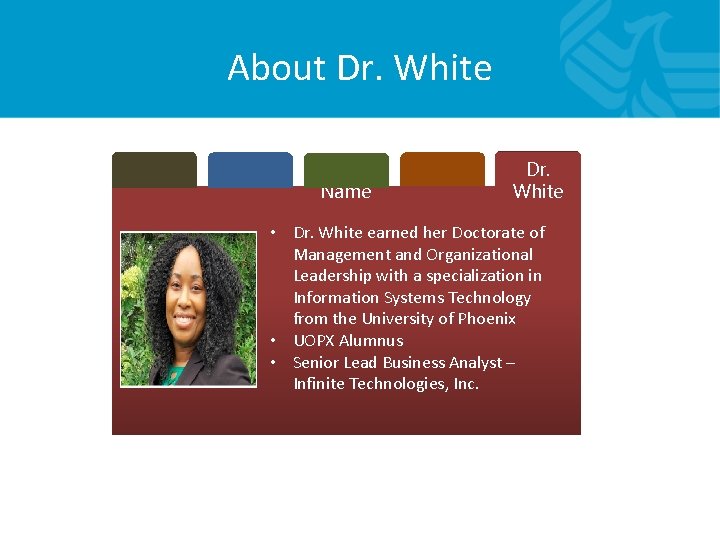
About Dr. White Tab Name Dr. White • Dr. White earned her Doctorate of Management and Organizational Leadership with a specialization in Information Systems Technology from the University of Phoenix • UOPX Alumnus • Senior Lead Business Analyst – Infinite Technologies, Inc.
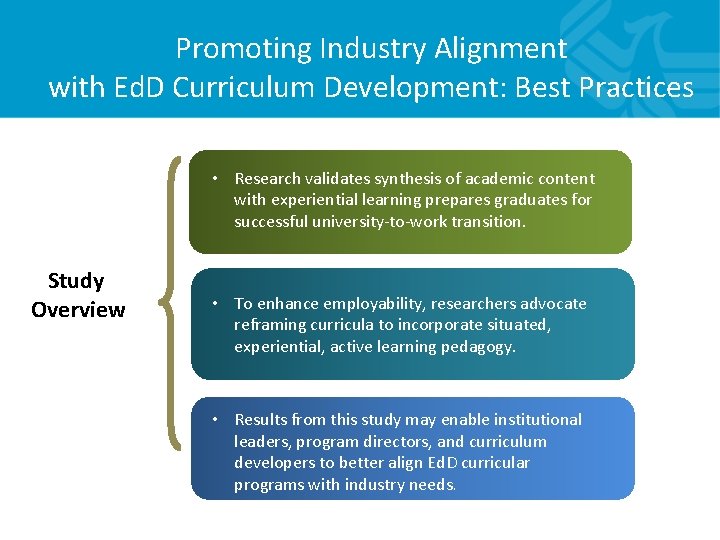
Promoting Industry Alignment with Ed. D Curriculum Development: Best Practices • Research validates synthesis of academic content with experiential learning prepares graduates for successful university‐to‐work transition. Study Overview • To enhance employability, researchers advocate reframing curricula to incorporate situated, experiential, active learning pedagogy. • Results from this study may enable institutional leaders, program directors, and curriculum developers to better align Ed. D curricular programs with industry needs.
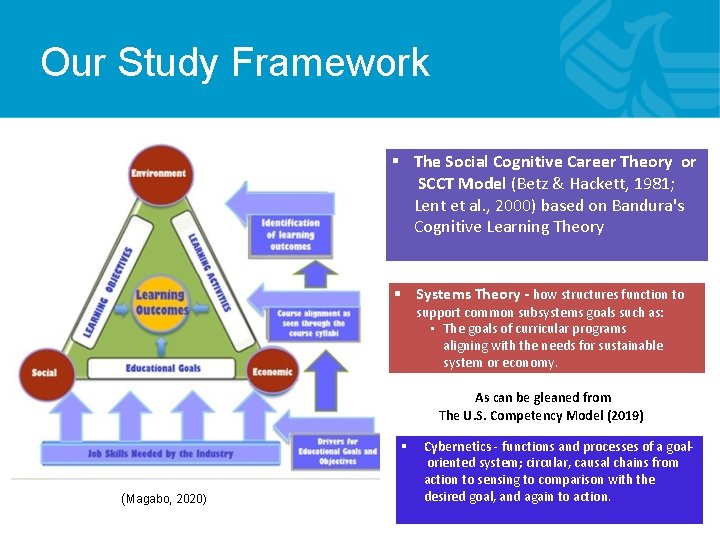
Our Study Framework § The Social Cognitive Career Theory or SCCT Model (Betz & Hackett, 1981; Lent et al. , 2000) based on Bandura's Cognitive Learning Theory § Systems Theory - how structures function to support common subsystems goals such as: • The goals of curricular programs aligning with the needs for sustainable system or economy. As can be gleaned from The U. S. Competency Model (2019) § (Magabo, 2020) Cybernetics - functions and processes of a goal‐ oriented system; circular, causal chains from action to sensing to comparison with the desired goal, and again to action.
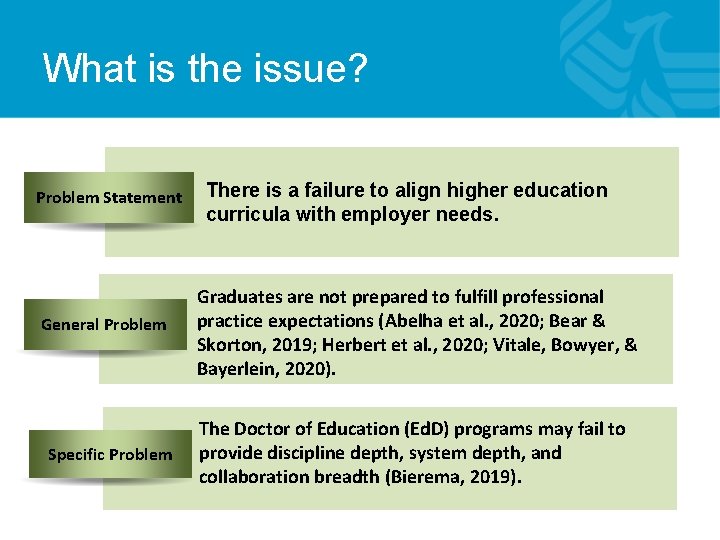
What is the issue? Problem Statement General Problem Specific Problem There is a failure to align higher education curricula with employer needs. Graduates are not prepared to fulfill professional practice expectations (Abelha et al. , 2020; Bear & Skorton, 2019; Herbert et al. , 2020; Vitale, Bowyer, & Bayerlein, 2020). The Doctor of Education (Ed. D) programs may fail to provide discipline depth, system depth, and collaboration breadth (Bierema, 2019).
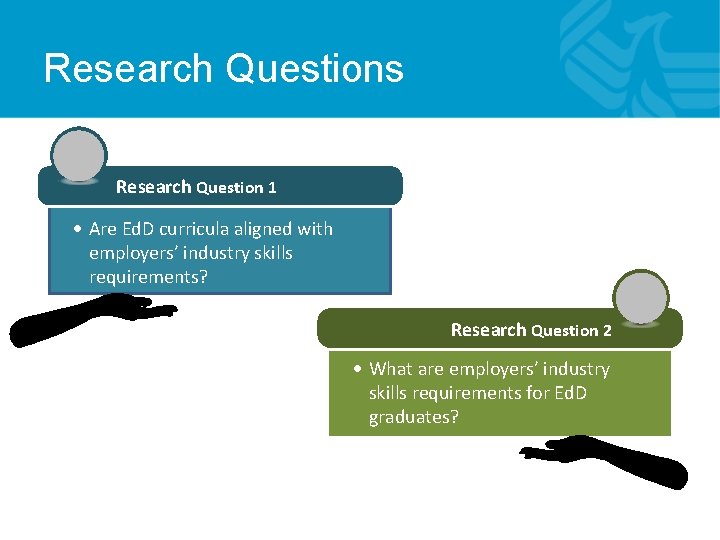
Research Questions Research Question 1 Are Ed. D curricula aligned with employers’ industry skills requirements? Research Question 2 What are employers’ industry skills requirements for Ed. D graduates?
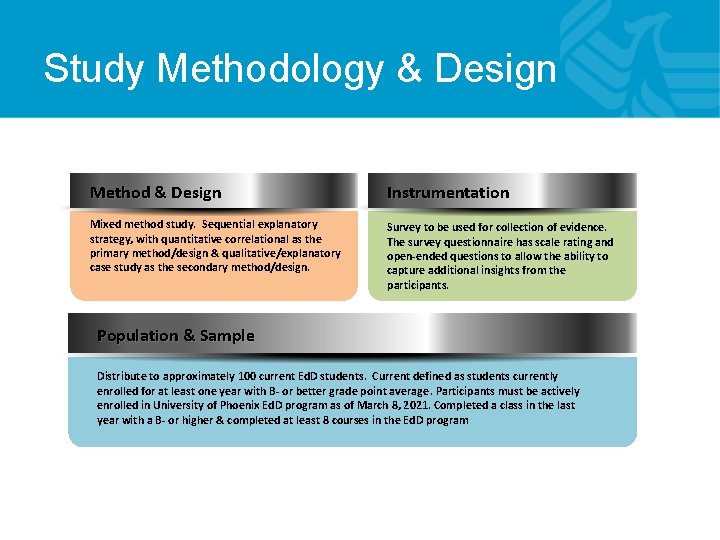
Study Methodology & Design Method & Design Instrumentation Mixed method study. Sequential explanatory strategy, with quantitative correlational as the primary method/design & qualitative/explanatory case study as the secondary method/design. Survey to be used for collection of evidence. The survey questionnaire has scale rating and open-ended questions to allow the ability to capture additional insights from the participants. Population & Sample Distribute to approximately 100 current Ed. D students. Current defined as students currently enrolled for at least one year with B- or better grade point average. Participants must be actively enrolled in University of Phoenix Ed. D program as of March 8, 2021. Completed a class in the last year with a B- or higher & completed at least 8 courses in the Ed. D program
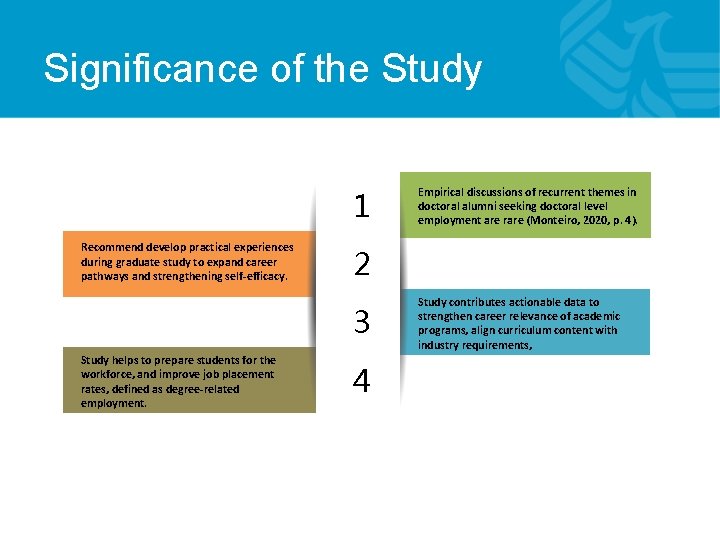
Significance of the Study 1 Recommend develop practical experiences during graduate study to expand career pathways and strengthening self-efficacy. 2 3 Study helps to prepare students for the workforce, and improve job placement rates, defined as degree-related employment. Empirical discussions of recurrent themes in doctoral alumni seeking doctoral level employment are rare (Monteiro, 2020, p. 4). 4 Study contributes actionable data to strengthen career relevance of academic programs, align curriculum content with industry requirements,
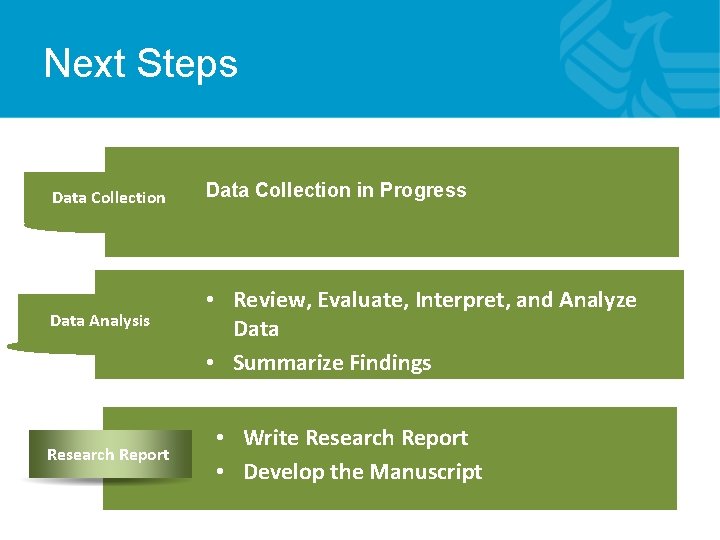
Next Steps Data Collection Data Analysis Research Report Data Collection in Progress • Review, Evaluate, Interpret, and Analyze Data • Summarize Findings • Write Research Report • Develop the Manuscript
Suggestions? Thoughts on our methodology? What else might we consider?
Q & A Session Thank you for your time! QUESTIONS
References
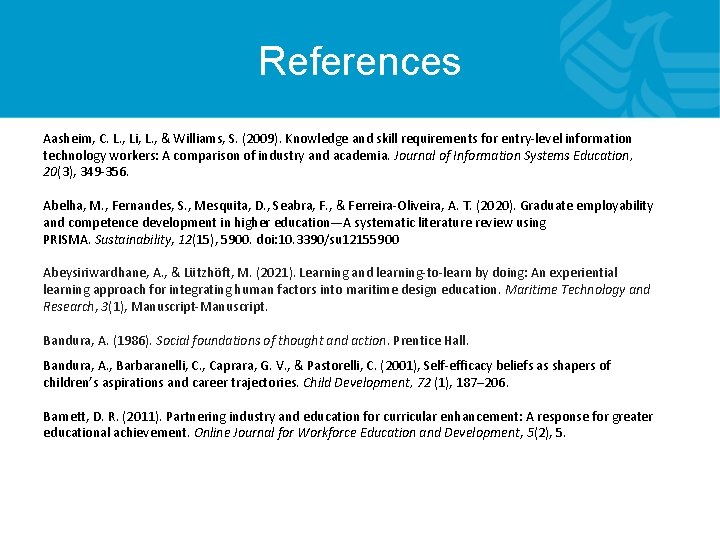
References Aasheim, C. L. , Li, L. , & Williams, S. (2009). Knowledge and skill requirements for entry‐level information technology workers: A comparison of industry and academia. Journal of Information Systems Education, 20(3), 349‐ 356. Abelha, M. , Fernandes, S. , Mesquita, D. , Seabra, F. , & Ferreira‐Oliveira, A. T. (2020). Graduate employability and competence development in higher education—A systematic literature review using PRISMA. Sustainability, 12(15), 5900. doi: 10. 3390/su 12155900 Abeysiriwardhane, A. , & Lützhöft, M. (2021). Learning and learning‐to‐learn by doing: An experiential learning approach for integrating human factors into maritime design education. Maritime Technology and Research, 3(1), Manuscript‐Manuscript. Bandura, A. (1986). Social foundations of thought and action. Prentice Hall. Bandura, A. , Barbaranelli, C. , Caprara, G. V. , & Pastorelli, C. (2001), Self‐efficacy beliefs as shapers of children’s aspirations and career trajectories. Child Development, 72 (1), 187– 206. Barnett, D. R. (2011). Partnering industry and education for curricular enhancement: A response for greater educational achievement. Online Journal for Workforce Education and Development, 5(2), 5.
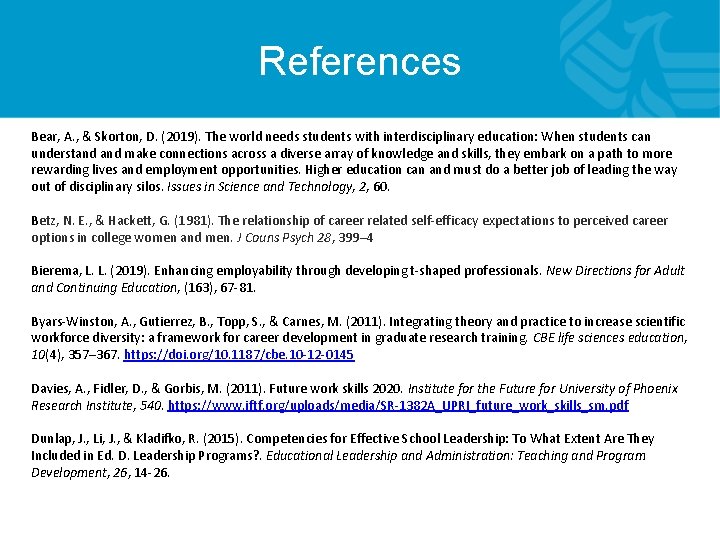
References Bear, A. , & Skorton, D. (2019). The world needs students with interdisciplinary education: When students can understand make connections across a diverse array of knowledge and skills, they embark on a path to more rewarding lives and employment opportunities. Higher education can and must do a better job of leading the way out of disciplinary silos. Issues in Science and Technology, 2, 60. Betz, N. E. , & Hackett, G. (1981). The relationship of career related self‐efficacy expectations to perceived career options in college women and men. J Couns Psych 28, 399– 4 Bierema, L. L. (2019). Enhancing employability through developing t‐shaped professionals. New Directions for Adult and Continuing Education, (163), 67‐ 81. Byars‐Winston, A. , Gutierrez, B. , Topp, S. , & Carnes, M. (2011). Integrating theory and practice to increase scientific workforce diversity: a framework for career development in graduate research training. CBE life sciences education, 10(4), 357– 367. https: //doi. org/10. 1187/cbe. 10‐ 12‐ 0145 Davies, A. , Fidler, D. , & Gorbis, M. (2011). Future work skills 2020. Institute for the Future for University of Phoenix Research Institute, 540. https: //www. iftf. org/uploads/media/SR‐ 1382 A_UPRI_future_work_skills_sm. pdf Dunlap, J. , Li, J. , & Kladifko, R. (2015). Competencies for Effective School Leadership: To What Extent Are They Included in Ed. D. Leadership Programs? . Educational Leadership and Administration: Teaching and Program Development, 26, 14‐ 26.
References Glen, S. (2021, February 17). Slovin's Formula: What is it and When do I use it? Statistics. How. To. com. https: //www. statisticshowto. com/how‐to‐use‐slovins‐formula/ Harvard Graduate School of Education. (2021). https: //www. gse. harvard. edu/ Herbert, I. P. , Rothwell, A. T. , Glover, J. L. , & Lambert, S. A. (2020). Graduate employability, employment prospects and work‐readiness in the changing field of professional work. The International Journal of Management Education, 18(2). https: //doi. org/10. 1016/j. ijme. 2020. 100378 King, G. , & Persily, N. (2020). A new model for industry–academic partnerships. PS: Political Science & Politics, 53(4), 703‐ 709. Landry, L. (2019, September 24). 8 careers you can pursue with a doctorate in education. Northeastern University. https: //www. northeastern. edu/graduate/blog/careers‐with‐doctorate‐in‐education/ Lent, R. W. , Brown, S. D. , & Hackett, G. (2000). Contextual supports and barriers to career choice: a social cognitive analysis. J Couns Psychol, 7, 36– 49. Monteiro, S. , Almeida, L. , & García‐Aracil, A. (2020). “It's a very different world”: work transition and employability of higher education graduates. Higher Education, Skills and Work-Based Learning.
References Morris, T. H. (2019). Adaptivity through self‐directed learning to meet the challenges of our ever‐changing world. Adult Learning, 30(2), 56– 66. https: //doi. org/10. 1177/1045159518814486 Nagy, E. (2014, July/August). A leader has to keep saying the same things over and over again. Fast Company, p. 39‐ 40. National Center for Science and Engineering Statistics, National Science Foundation. 2019. Doctorate Recipients from U. S. Universities: 2019. NSF 21‐ 308. Alexandria, VA. Available at https: //ncses. nsf. gov/pubs/nsf 21308/ National Science Foundation. (2017). Early Career Doctorates Survey Questionnaire for a web‐based survey. https: //www. nsf. gov/statistics/srvyecd/surveys/srvyecd‐ 2017. pdf Sahin, Y. G. , & Celikkan, U. (2020). Information technology asymmetry and gaps between higher education institutions and industry. Journal of Information Technology Education: Research, 19, 339‐ 365. https: //doi. org/10. 28945/4553 Sampling. (2016). Sphweb. bumc. bu. edu. http: //sphweb. bumc. bu. edu/otlt/mph‐ modules/bs/bs 704_probability 2. html
References Saturation Survey. (2017). Insights Association. Insightsassociation. org. http: //www. insightsassociation. org/issues‐policies/glossary/saturation‐survey Sladek, M. R. (2017, June). Qualitative and mixed methods research. Psychological Science Agenda. http: //www. apa. org/science/about/psa/2017/06/qualitative‐mixed‐methods The Competency Model Clearinghouse ‐ Building Blocks Model. United States Department of Labor, Employment & Training Administration Vitale, C. , Bowyer, D. , & Bayerlein, L. (2020). Developing and Presenting a Framework for Meeting Industry, Student and Educator Expectations in University Degrees. E-Journal of Business Education & Scholarship of Teaching, 14(1), 57– 65. Wolff, R. , & Booth, M. (2017). Bridging the gap: Creating a new approach for assuring 21 st century employability skills. Change: The Magazine of Higher Learning, 49(6), 51‐ 54.