
Promoting inclusion to prevent exclusion tackling disruptive behaviour
Promoting inclusion to prevent exclusion: tackling disruptive behaviour Dr Jane L Heslop
What I intend to cover: • Range and complexity of factors that can cause and impact upon disruptive behaviour at school. • Multi-level strategies and interventions which may promote inclusion and therefore help to reduce exclusion. • Support from Hull City Psychological Service
Case study - Jack has recently transitioned into Year 6. His behaviour has escalated throughout Key Stage 2. He now continually disrupts lessons, refuses to follow instructions and is physically and verbally abusive to his peers. He has had two fixed term exclusions since the summer term in Year 5. Following these exclusions, Jack was anxious returning to school as he doesn’t like his behaviour being discussed publically. Jack states that ‘teachers are unfair’ and he spends lesson time focusing on consequences. He likes his teachers but he does not like detentions. He really enjoys reading. Jack has a ‘time out’ pass though he wanders around the school corridors disrupting others. Jack was diagnosed with ADHD when he was in Year 3, though is not medicated. His parents separated when he was 7 years old and his father is an inconsistent presence. Jack has no siblings. According to his mother, he is very protective and controlling of her. She feels that the school is putting too much pressure on SATS which is contributing to Jack’s anxiety.
Case Study - Jack In pairs/small groups read the case study and discuss: 1. What factors could be impacting upon Jack’s behaviour? 2. What strategies or interventions would be appropriate for Jack? 3. Who would you involve? What assessments would be useful?

Case study - Jack Functional analysis/multi-element plan? Possible strategies: Anxiety management /reduced exam focus Emotional literacy sessions Deal with relational conflict using restorative practice Friendship group / clubs Key adult especially for transitions Teaching strategies for attentional difficulties Provide Jack ‘boundaried’ means to express his grievances • Structured ‘time out’ in a specific space • No public discussions of Jack’s behaviour and be mindful of language used about/to him • •
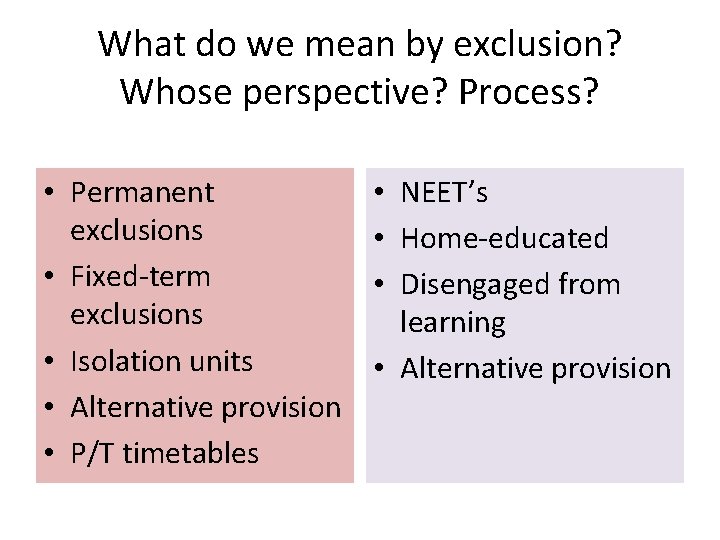
What do we mean by exclusion? Whose perspective? Process? • Permanent exclusions • Fixed-term exclusions • Isolation units • Alternative provision • P/T timetables • NEET’s • Home-educated • Disengaged from learning • Alternative provision

Who are these excluded pupils? • Free school meals (X 4 more likely to be perm. excluded than peers) • SEND (X 6 more likely to be excluded than peers) • Some ethnic groups (X 3 more likely) • Children with diagnosed mental health problems (X 17 more likely to be excluded) • Persistent disruptive behaviour most common reason for exclusion (Menzies and Baars, 2015)
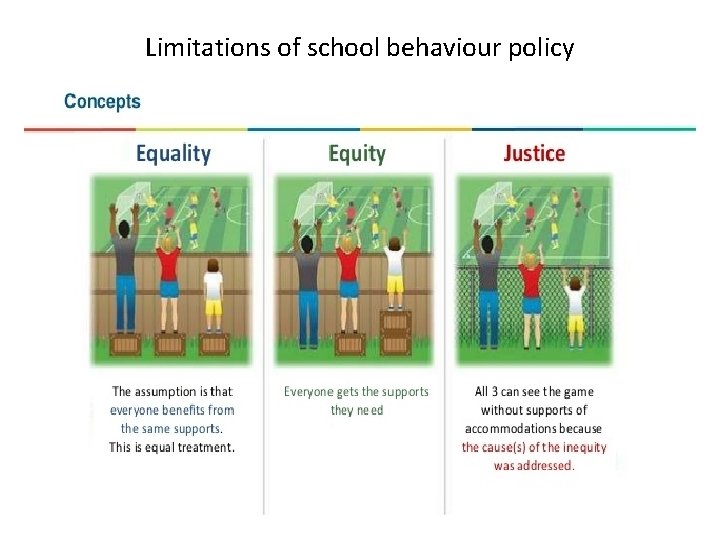
Limitations of school behaviour policy
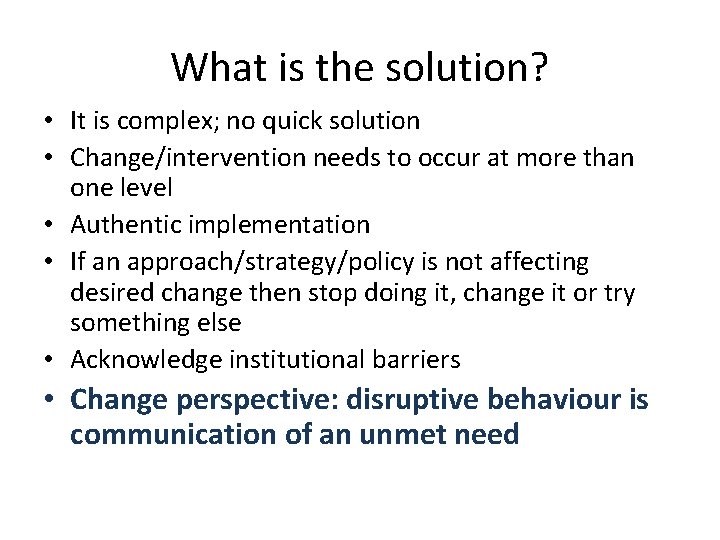
What is the solution? • It is complex; no quick solution • Change/intervention needs to occur at more than one level • Authentic implementation • If an approach/strategy/policy is not affecting desired change then stop doing it, change it or try something else • Acknowledge institutional barriers • Change perspective: disruptive behaviour is communication of an unmet need
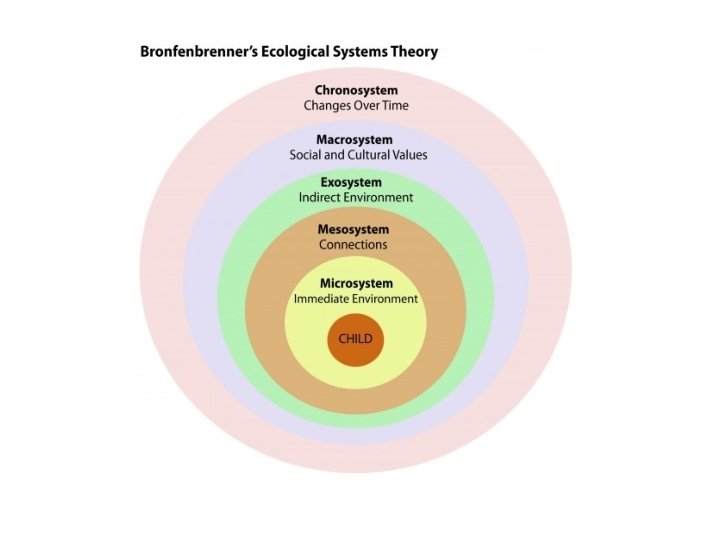
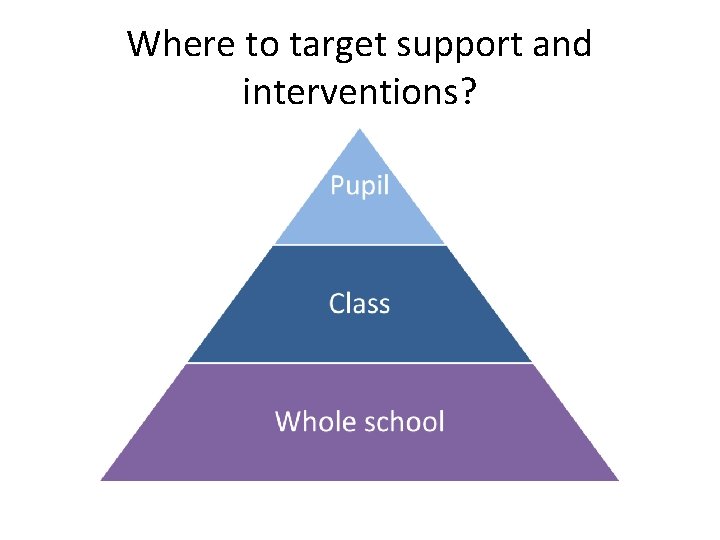
Where to target support and interventions?

Graduated response • Appropriate target setting and information-sharing • Appropriate assessment to identify and meet the wellbeing needs of children such as Boxall profile or ELSA assessment tools • Authentic implementation • Timely review
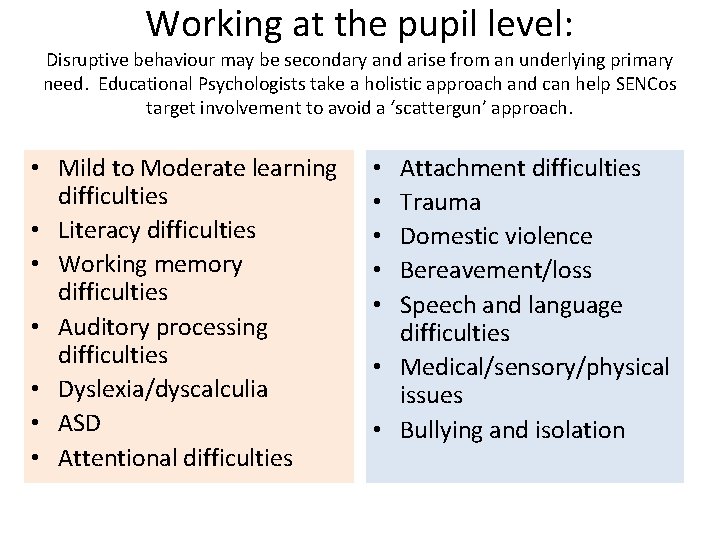
Working at the pupil level: Disruptive behaviour may be secondary and arise from an underlying primary need. Educational Psychologists take a holistic approach and can help SENCos target involvement to avoid a ‘scattergun’ approach. • Mild to Moderate learning difficulties • Literacy difficulties • Working memory difficulties • Auditory processing difficulties • Dyslexia/dyscalculia • ASD • Attentional difficulties Attachment difficulties Trauma Domestic violence Bereavement/loss Speech and language difficulties • Medical/sensory/physical issues • Bullying and isolation • • •
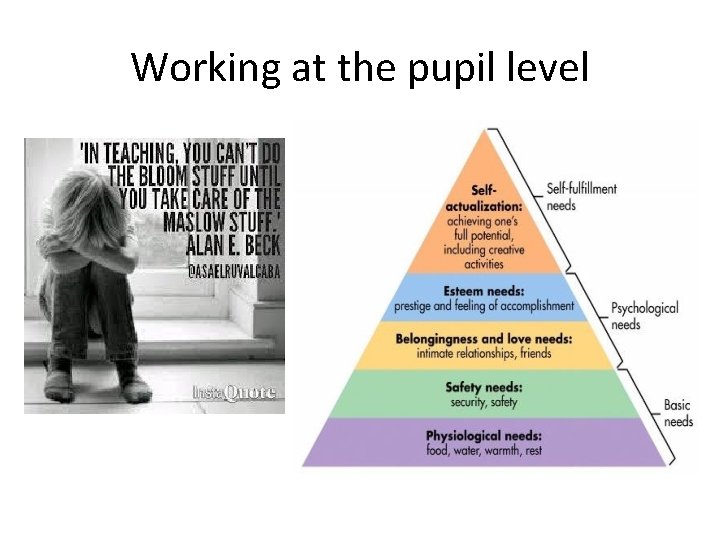
Working at the pupil level
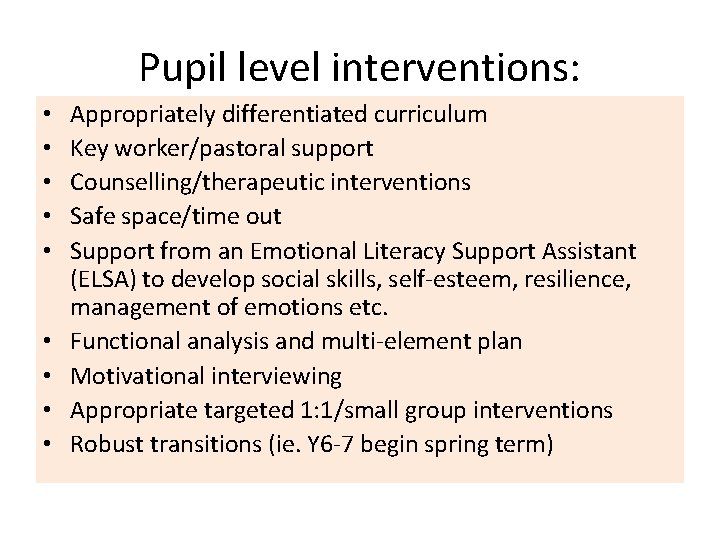
Pupil level interventions: • • • Appropriately differentiated curriculum Key worker/pastoral support Counselling/therapeutic interventions Safe space/time out Support from an Emotional Literacy Support Assistant (ELSA) to develop social skills, self-esteem, resilience, management of emotions etc. Functional analysis and multi-element plan Motivational interviewing Appropriate targeted 1: 1/small group interventions Robust transitions (ie. Y 6 -7 begin spring term)
Benefits of developing emotional literacy • • Pupils develop greater self-awareness. Pupils learn to talk about difficulties. Pupils develop coping strategies. Pupils interact more successfully with others. • Pupils feel better about themselves. • Pupils manage better in school. • Pupils will be able to access and make progress within the curriculum.
Working at the classroom level • Creation of low-anxiety culture within classrooms • Teachers have information and communication regarding their pupils • Use self-determination theory for motivation: develop pupil autonomy, competence and relatedness (Ryan and Deci, 2000) • Effective use of (and relationships with) support staff • Training needs may include behaviour for learning, understanding emotional literacy, attachment, autism, managing conflict, differentiation etc.
Working at the school level This is where real change can yield benefits to all! • Staff support and supervision: develop well-being and selfefficacy • Restorative approaches to behaviour/conflict • ELSA values embedded within the school culture to enhance wellbeing • Peer mentoring/buddy systems for vulnerable pupils • Nurture groups • Internal ‘reintegration’ units to develop social, emotional and study skills • Robust transition support • Challenging negative within-child narratives such as ‘at risk’, ‘no hoper’, ‘disaffected’ etc. • Whole school programmes such as the Sandwell Charter
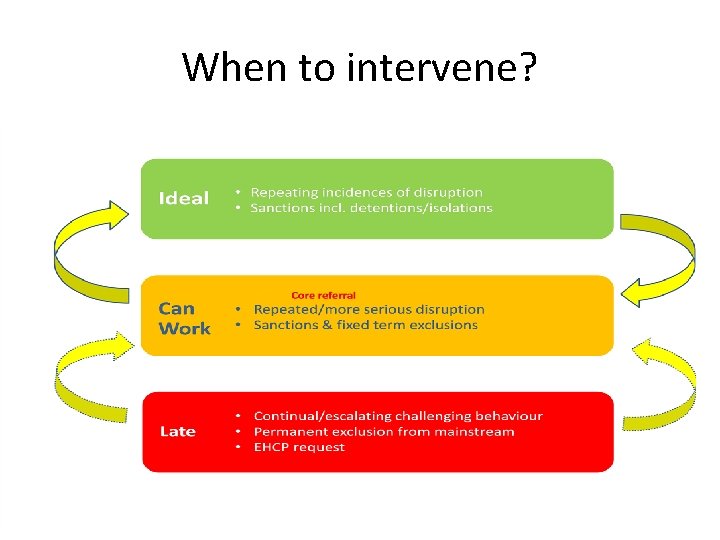
Hull City Psychological Service (HCPS) • Developed and piloting Core Offer for working with pupils at risk of exclusion. • ‘Promoting inclusion to prevent exclusion’ resource booklets for schools • Schools to contact Hayley O Grady to initiate referral • If specific criteria are met then an EP will become involved • A review is an integrated part of the work
When to intervene?
• What next ? • Questions • Evaluation
- Slides: 21