
Promoting Creativity in the Classroom Teaching Creativity On
- Slides: 29
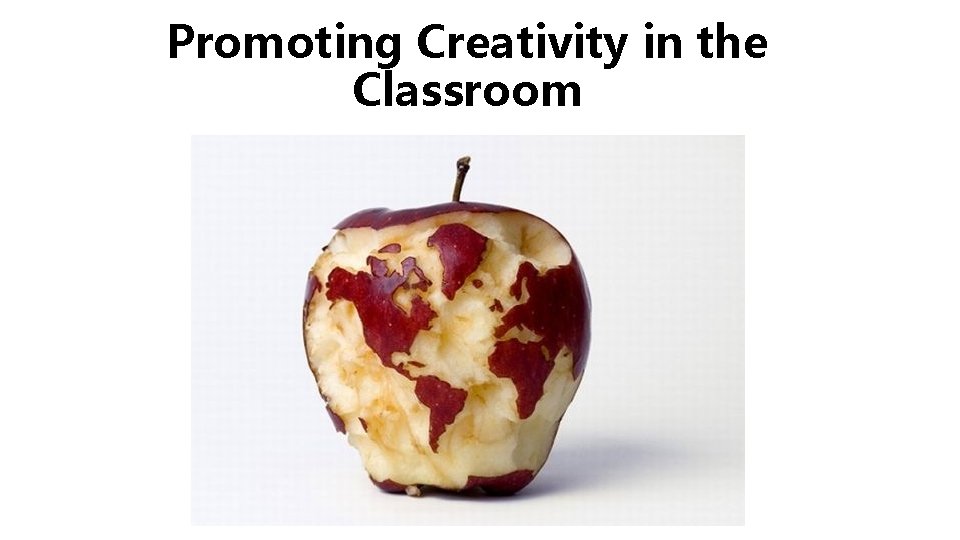
Promoting Creativity in the Classroom
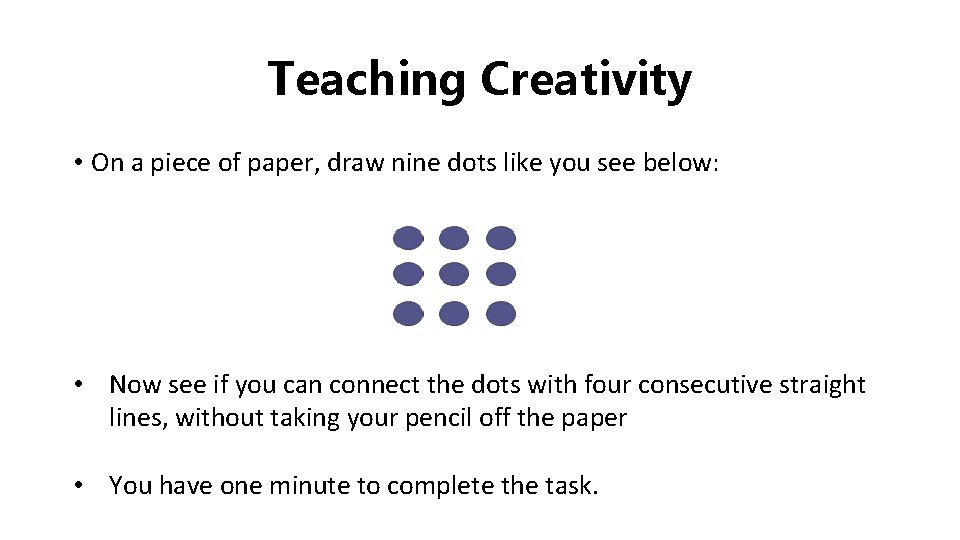
Teaching Creativity • On a piece of paper, draw nine dots like you see below: • Now see if you can connect the dots with four consecutive straight lines, without taking your pencil off the paper • You have one minute to complete the task.
Create: (kre at’)To bring into existence out of nothing; to originate; to make. The act of creating. Any original production of the human mind.
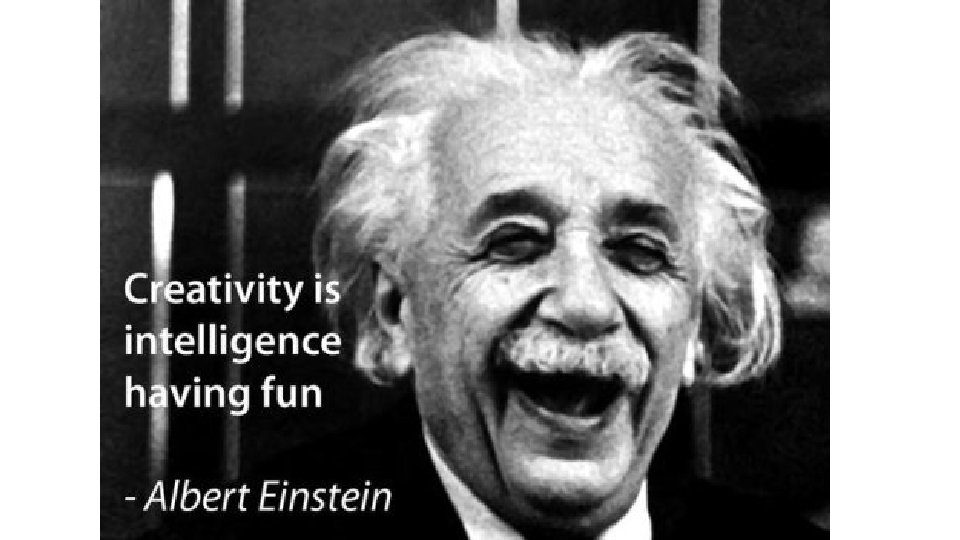
A hunch is creativity trying to tell you something. Frank Capra Try it yourself: Come up with a fourth word that connects the first three Time – Hair – Stretch Manners – Round – Tennis Ache – Hunter – Cabbage Imagination is more important than knowledge. Albert Einstein
Teaching creativity • Students cannot be taught to be creative any more than seeds can be taught to grow. • However, we can prepare the optimum environment for seeds to grow: Likewise we can create the optimum environment for creativity to flourish. • Here’s a riddle used in a recent study showing that people are more creative when they’re tired: A man has married 20 women in a small town. All of the women are still alive and none of them are divorced. The man has broken no laws. Who is the man?
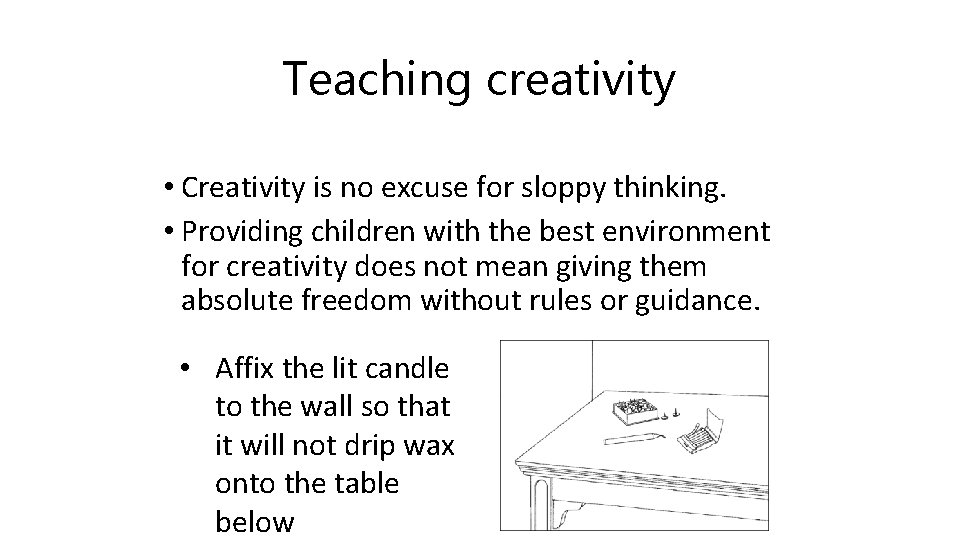
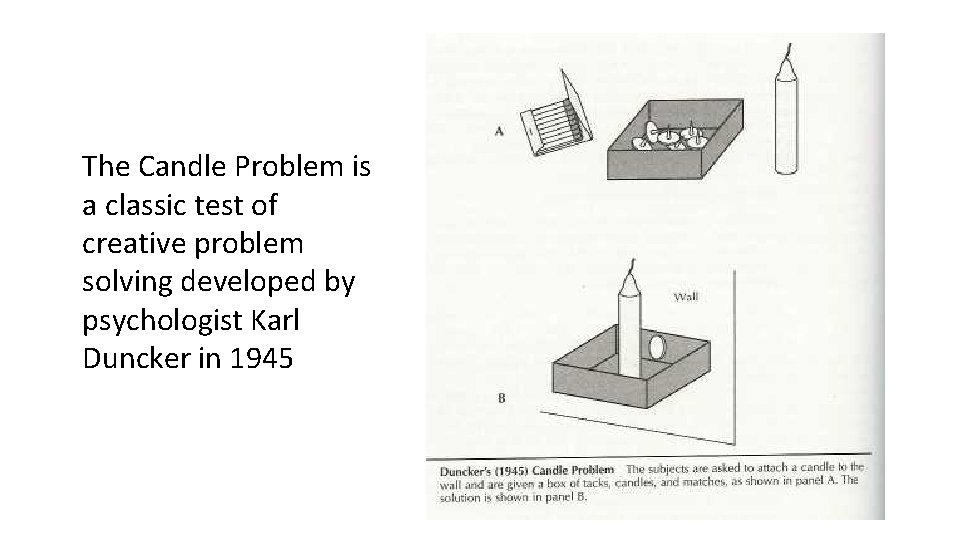
Teaching creativity • Creativity is no excuse for sloppy thinking. • Providing children with the best environment for creativity does not mean giving them absolute freedom without rules or guidance. • Affix the lit candle to the wall so that it will not drip wax onto the table below
The Candle Problem is a classic test of creative problem solving developed by psychologist Karl Duncker in 1945
Teaching creativity • Why encourage creativity? • The opposite of creativity is repression. • Thoughts are only ours when we have thought them ourselves. • Creativity will influence future prosperity. • The more students practice, the more creative they will be. • Allows for the practice of divergent thinking. • Most school assignments are convergent (have definitive limits – one answer).
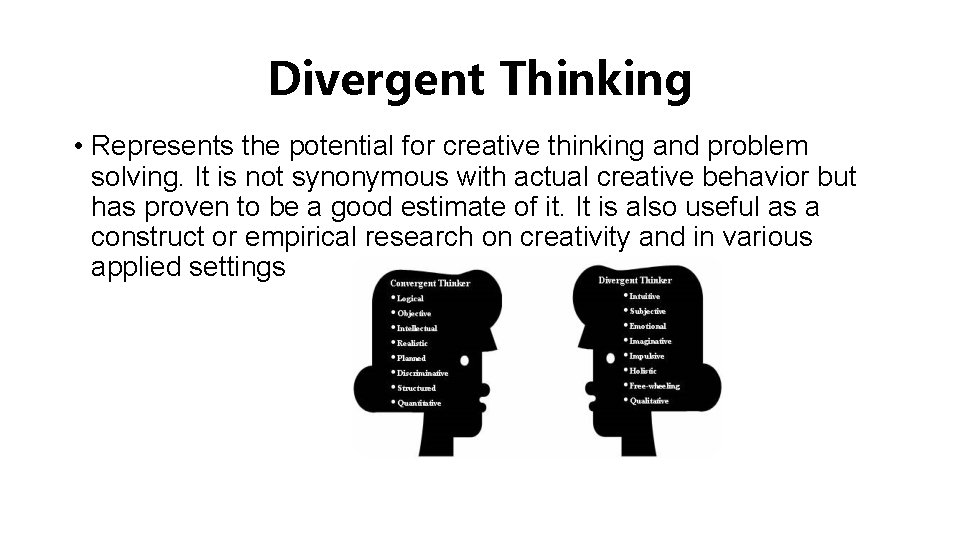
Divergent Thinking • Represents the potential for creative thinking and problem solving. It is not synonymous with actual creative behavior but has proven to be a good estimate of it. It is also useful as a construct or empirical research on creativity and in various applied settings
Creativity and Children • All children arrive at school with creative abilities • Schools are a thinly disguised conspiracy to quash creativity • Creativity is taught out of the student • To be creative, one must be willing to take a chance, and maybe be wrong! • STEM teachers must be constantly in search of opportunities to cover the content while allowing for student creativity—divergent thinking • It is not enough for a curriculum activity to be fun for the students, without covering important content
A Lesson that has Creativity at the Core Provides Chances to: View problems from many angles Hear differing points of view Take things apart/see how things work Reason, analyze, and brainstorm Adapt ideas of others/self Add a new twist to old idea Find new uses for old ideas Simplify solutions to old problems & ideas o Explore “gut feelings” o o o o o Rearrange components of old solution to create new one o Combine previous ideas to create new one o Use the non-rational part of brains o Visualize and use mental imagery o Collaborate/learn from others o Apply basic ideas and concepts o Take risks and build self-confidence o Become more tolerant of the unknown o Become more open to new experiences
Thoughts from Re-imagine by Tom Peters • Need to develop a school that believes: • Learning is natural • Love of learning is normal • Real learning is passionate learning • Questions are more important than answers • Creativity is more important than fact recognition • Individuality more important than conformity • Creative experiences build brain capacity
“The most important developments in civilization have come through the creative process, but ironically, most people have not been taught to be creative. ” Robert Fritz As teachers, we have one of the largest potential influences on children's willingness to take a risk and be creative. We can support or thwart that creativity.
Creativity Literature Review • Creativity should not be confused with talent. • Everyone therefore has the potential to be creative. • The key component to stimulate creativity is motivation or ‘the inner spark’ (Amabile, 1996) • There is however a misconception that ‘creativity’ is just the process of creating something new (Pink, 2005) • Experiential learning is constructivist learning, where learners are active learners, constructing their own knowledge, rather than observing the teacher demonstrate (Itin, 1999) • Because experiential learning is active learning, learners more readily understand what they are learning and thus retain the knowledge to a greater degree than when merely having information presented to them by another. • The hands-on nature of experiential learning is highly motivating for learners.
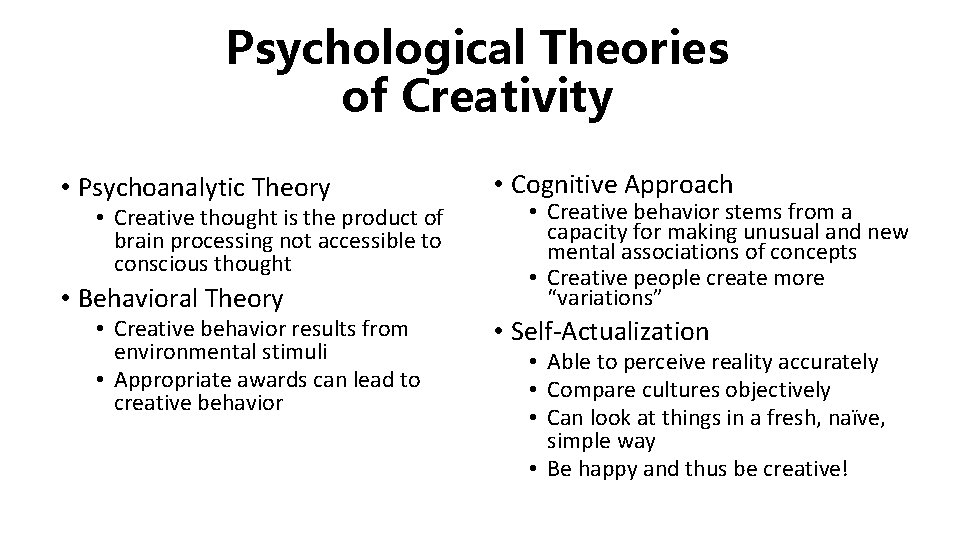
Psychological Theories of Creativity • Psychoanalytic Theory • Creative thought is the product of brain processing not accessible to conscious thought • Behavioral Theory • Creative behavior results from environmental stimuli • Appropriate awards can lead to creative behavior • Cognitive Approach • Creative behavior stems from a capacity for making unusual and new mental associations of concepts • Creative people create more “variations” • Self-Actualization • Able to perceive reality accurately • Compare cultures objectively • Can look at things in a fresh, naïve, simple way • Be happy and thus be creative!
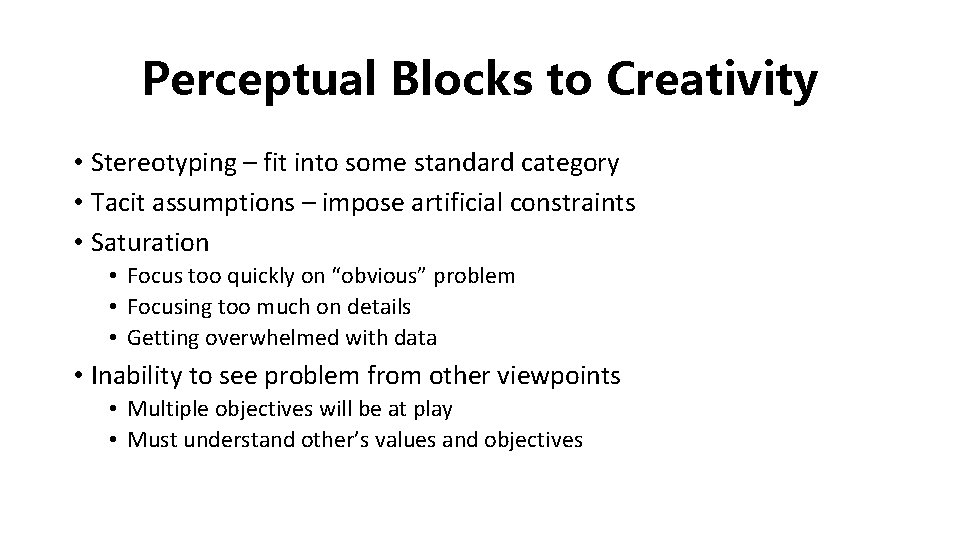
Perceptual Blocks to Creativity • Stereotyping – fit into some standard category • Tacit assumptions – impose artificial constraints • Saturation • Focus too quickly on “obvious” problem • Focusing too much on details • Getting overwhelmed with data • Inability to see problem from other viewpoints • Multiple objectives will be at play • Must understand other’s values and objectives
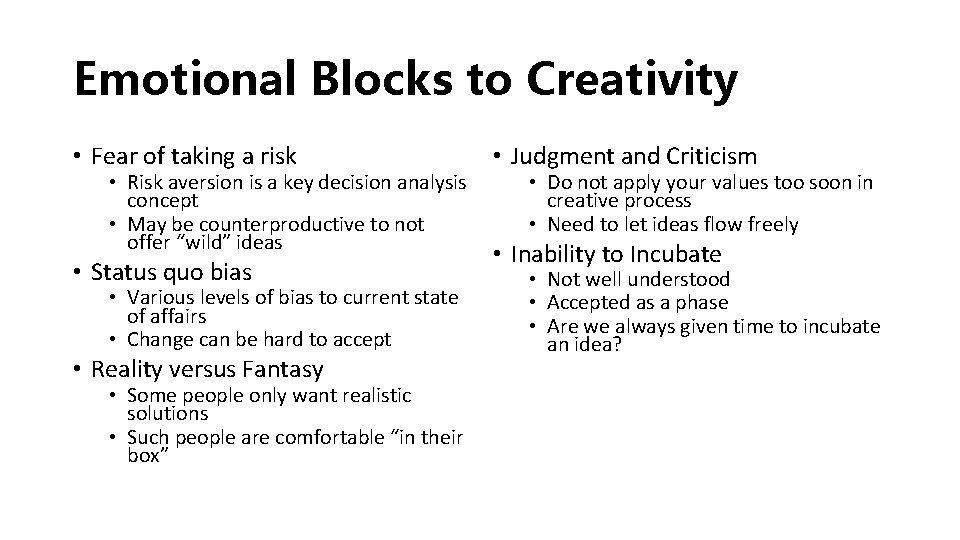
Emotional Blocks to Creativity • Fear of taking a risk • Risk aversion is a key decision analysis concept • May be counterproductive to not offer “wild” ideas • Status quo bias • Various levels of bias to current state of affairs • Change can be hard to accept • Reality versus Fantasy • Some people only want realistic solutions • Such people are comfortable “in their box” • Judgment and Criticism • Do not apply your values too soon in creative process • Need to let ideas flow freely • Inability to Incubate • Not well understood • Accepted as a phase • Are we always given time to incubate an idea?
Cultural Blocks to Creativity • Taboos • Views of culturally accept behavior may block ideas • Humor • Setting too formal: Good ideas can be obtained in an informal setting • Informal setting with lots of joking can be effective • Reason and Logic prevails • Overly analytical thinking (even though it is important) • Tradition and change • Often a strong resistance to changes • The status quo got the decision maker where they are
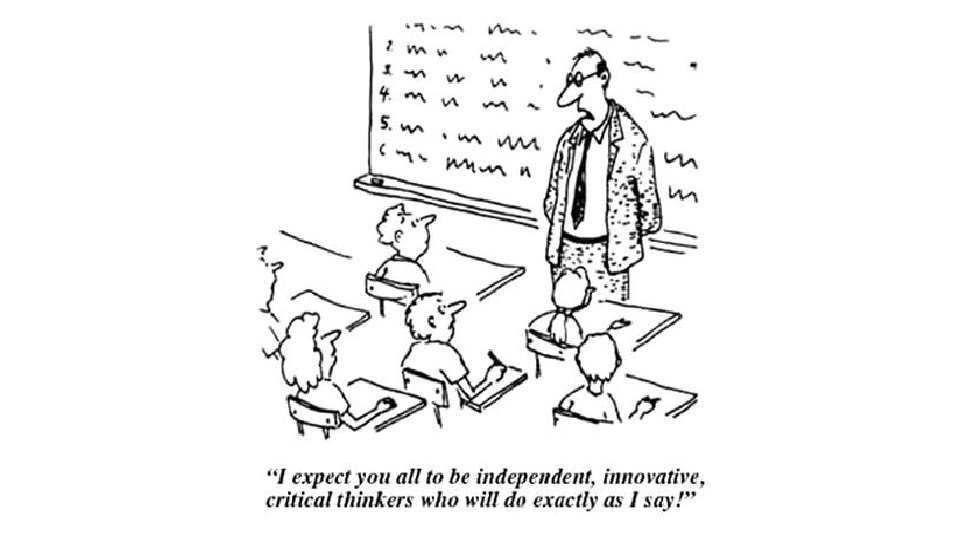
Environmental Blocks to Creativity • Non-supportive environment • Environment that dissuades humor and playfulness • Classroom is overly structured and routine • Autocratic teacher • Teacher has all of the answers • Over focus on winning, competition and impressing teacher • Overly strict timelines • Often a tight suspense can lead to good results
Brainstorming • Introduced in 1930 s by Osborn • Based on idea of eliminating perceptual blocking filters • Two Principles: • Defer judgment • Quantity breeds quality • Four rules • • Rule out criticism Welcome freewheeling Seek large quantities of ideas Encourage combination and improvement of ideas • Works due to its synergistic effect • Among participants • Combining of ideas is not just additive • Combine ideas to get new ideas • Generally regarded as a group technique based on a specific objective • Specificity focuses the efforts • Useful in situations calling for idea generation rather than judgment
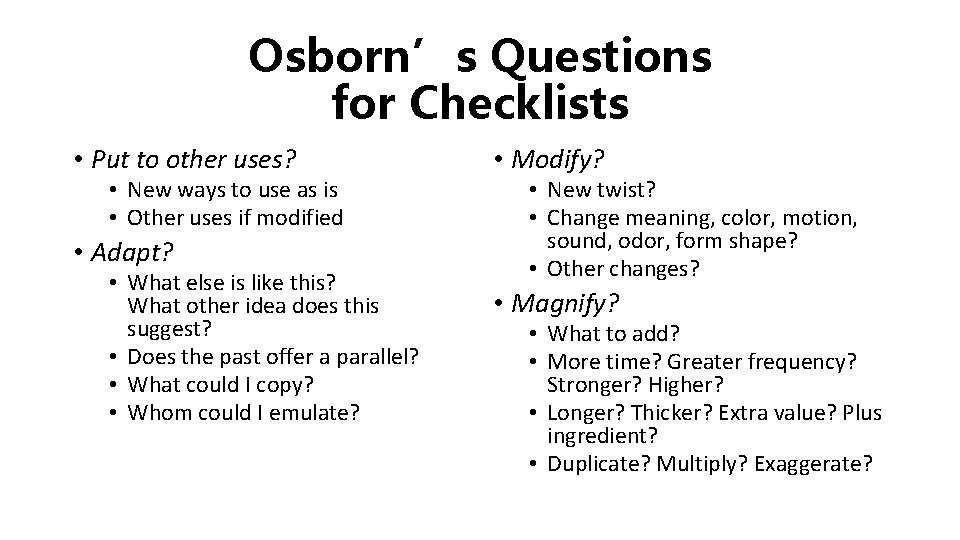
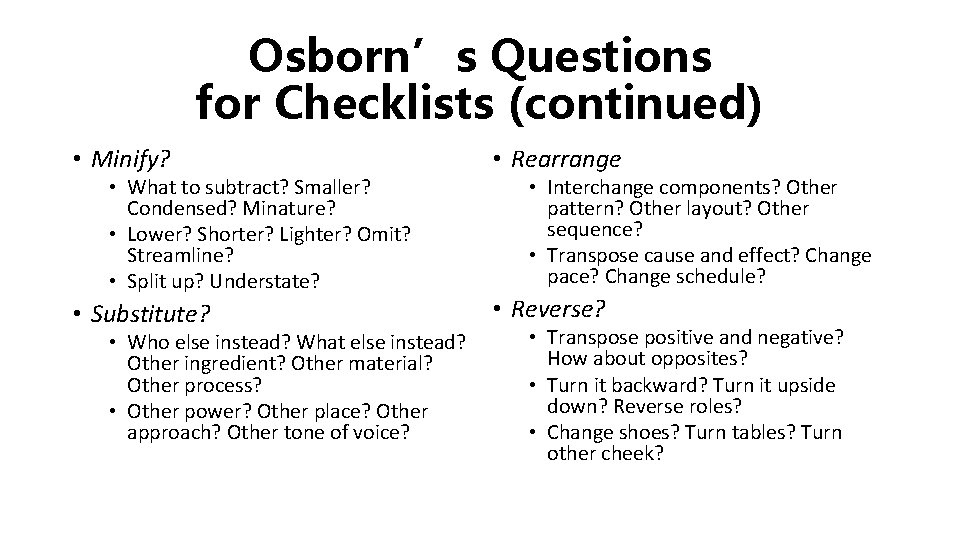
Checklists • Very simple means of generating ideas • Ask and list answers to series of questions. For instance • • • Are there other uses? Can something be adapted? Can something be modified? Can components be re-arranged? Can components be combined? Can some substitution be made? • Osborn (1963) offered a series of idea spurring questions.
Osborn’s Questions for Checklists • Put to other uses? • New ways to use as is • Other uses if modified • Adapt? • What else is like this? What other idea does this suggest? • Does the past offer a parallel? • What could I copy? • Whom could I emulate? • Modify? • New twist? • Change meaning, color, motion, sound, odor, form shape? • Other changes? • Magnify? • What to add? • More time? Greater frequency? Stronger? Higher? • Longer? Thicker? Extra value? Plus ingredient? • Duplicate? Multiply? Exaggerate?
Osborn’s Questions for Checklists (continued) • Minify? • Rearrange • Substitute? • Reverse? • What to subtract? Smaller? Condensed? Minature? • Lower? Shorter? Lighter? Omit? Streamline? • Split up? Understate? • Who else instead? What else instead? Other ingredient? Other material? Other process? • Other power? Other place? Other approach? Other tone of voice? • Interchange components? Other pattern? Other layout? Other sequence? • Transpose cause and effect? Change pace? Change schedule? • Transpose positive and negative? How about opposites? • Turn it backward? Turn it upside down? Reverse roles? • Change shoes? Turn tables? Turn other cheek?
What does Creativity Look Like in the Classroom? • Creative students are curious, question and challenge, and don’t always follow the rules. • They think laterally and make associations between things that are not usually connected. • They imagine, see possibilities, ask ‘what if? ’, picture alternatives, and look at things from different view points. • They play with ideas, try alternatives and fresh approaches, keep open minds and modify their ideas to achieve creative results. • They reflect critically on ideas, actions and outcomes. They review progress, invite and use feedback, criticize constructively and make perceptive observations.
Teachers Who Encourage Creativity… • Give students extended, unhurried time to explore and do their best work. • Don’t interfere when students are productively engaged and motivated to complete tasks in which they are fully engaged. • Create an inviting and exciting classroom environment. • Provide students with space to leave unfinished work for later completion and quiet space for contemplation. • Provide an abundant supply of interesting and useful materials and resources. • Create a classroom climate where students feel mistakes are acceptable and risk-taking is encouraged. • Appropriate noise, mess and autonomy are accepted.