
Promoting Communication and Social Skills Communication Strategies for
- Slides: 36
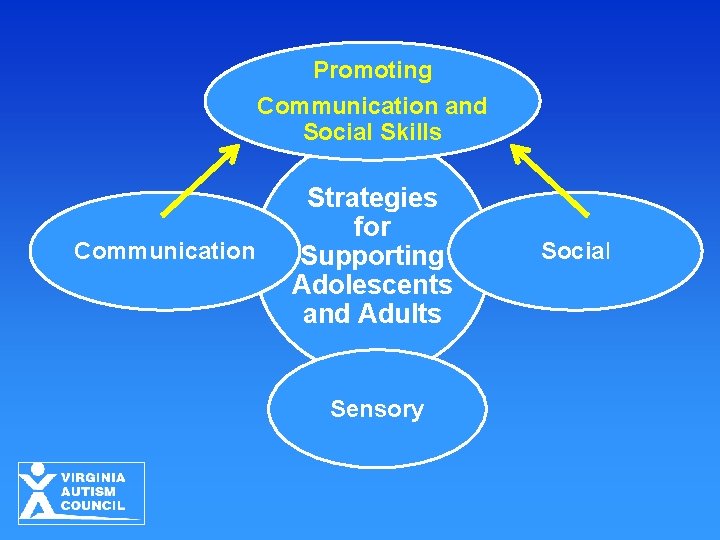
Promoting Communication and Social Skills Communication Strategies for Supporting Adolescents and Adults Sensory Social
Topics • Communication and Social Skills are linked • Purpose of promoting communication and social skill strategies • Specific Communication strategies • Social Skills Strategies • Bringing it all together
Communication and Social Skills Strategies
Communication Challenges • • Nonverbal Communication Verbal Language skills can vary Conversational Skills Receptive Language and Processing Skills
Social Skills Challenges • Limited Attention→Limited Communication Skills → Limited Social Understanding • Responding to social cues and knowing social rules • Social Hierarchy – Varying conversational style
Determine the Communication Goals! • • Verbal Nonverbal Receptive Conversation
Strategies for Promoting Communication and Social Skills • Identify supports • Take advantage of naturally occurring opportunities • Create additional opportunities • Ensure motivation / reinforcement • Teach through routines • Alter the environment
Promoting Communication & Social Skills • Teach during naturally occurring opportunities • Create opportunities to teach communication
Promoting Communication & Social Skills • Teach in context to promote meaning and generalization
Promoting Communication & Social Skills • Teach through motivational activities to create desire and interest
Promoting Communication & Social Skills • Teach through routines to provide opportunity for repetition – Build communication into developed routines – Alter established routine to elicit communication
Promoting Communication & Social Skills • Teach through environmental modifications to provide frequent opportunities – Set up obstacles to desired objects or activities – Set up problem-solving situations
Communication Supports
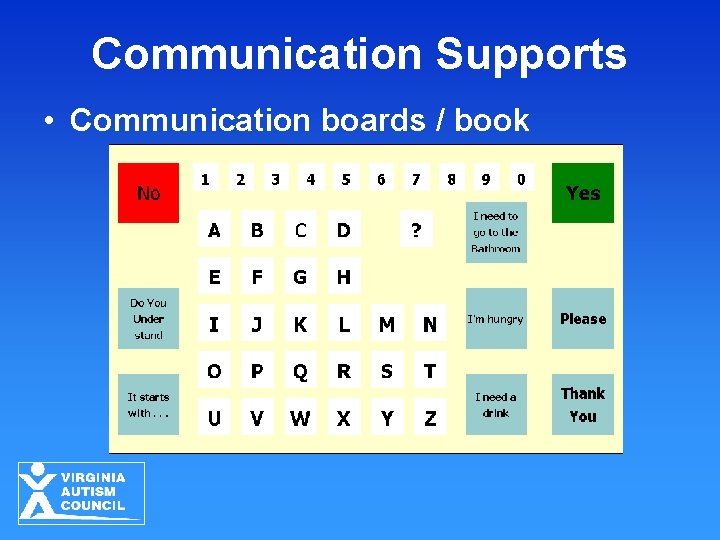
Communication Supports • Communication boards / book
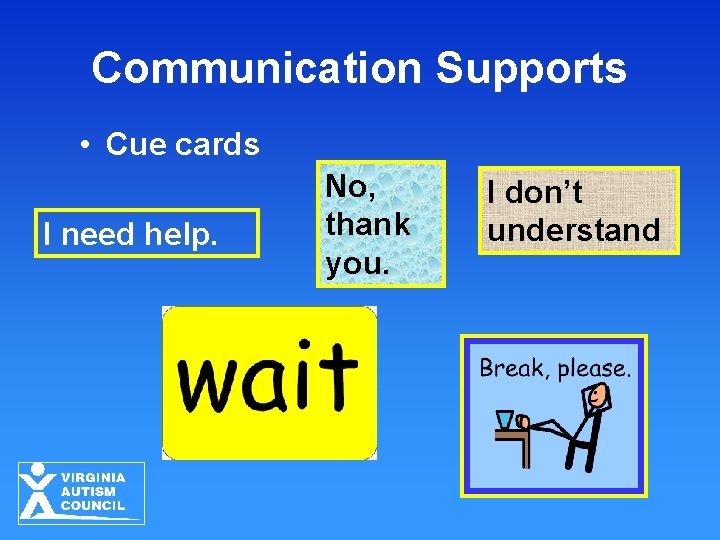
Communication Supports • Cue cards I need help. No, thank you. I don’t understand
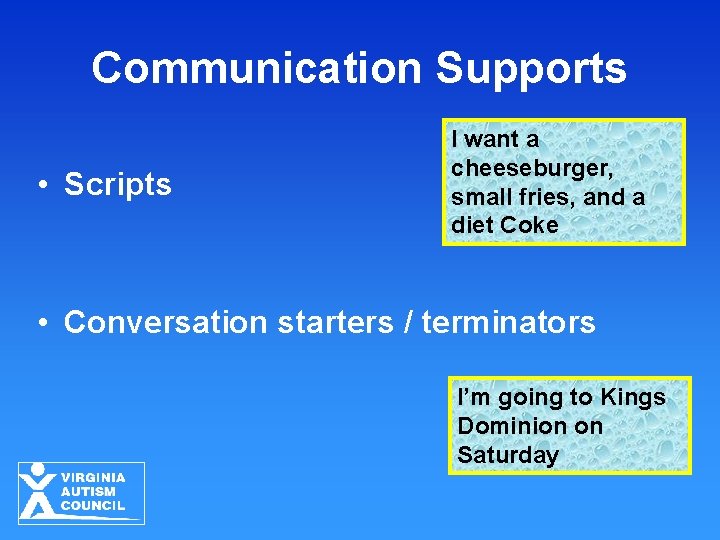
Communication Supports • Scripts I want a cheeseburger, small fries, and a diet Coke • Conversation starters / terminators I’m going to Kings Dominion on Saturday
Communication Supports • Topic boards
Communication Supports • Peers – Provide nonverbal cues – Provide verbal assistance
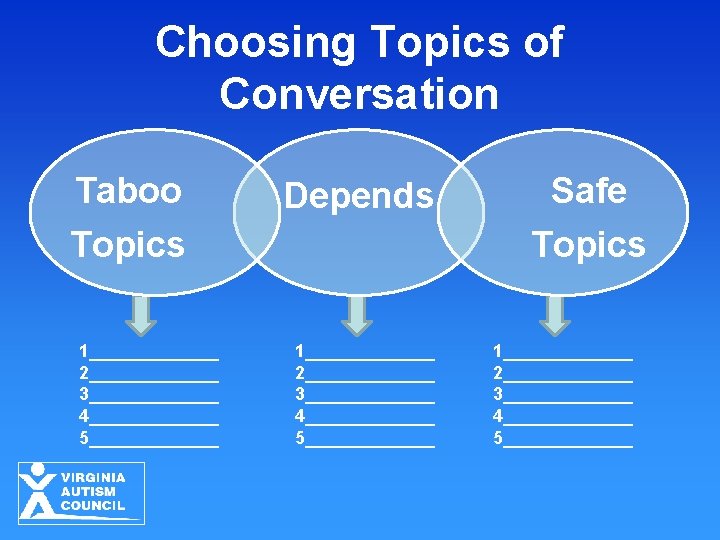
Choosing Topics of Conversation Taboo Depends Topics 1_______ 2_______ 3_______ 4_______ 5_______ Safe Topics 1_____________ 2_____________ 3_____________ 4_____________ 5_____________
Activity: Steven • Take advantage of naturally occurring opportunities • Create additional opportunities • Ensure motivation / reinforcement • Teach through routines • Alter the environment • Use communication supports
Video Social Thinking to Enhance Communication
Activity: Communication Teaching Strategies and Activities • Select a goal • Complete the chart • Share with group .
Social Skills Supports Mentoring / Peer support l Task analysis l Role playing l Social narratives • Social scripting • Video modeling l
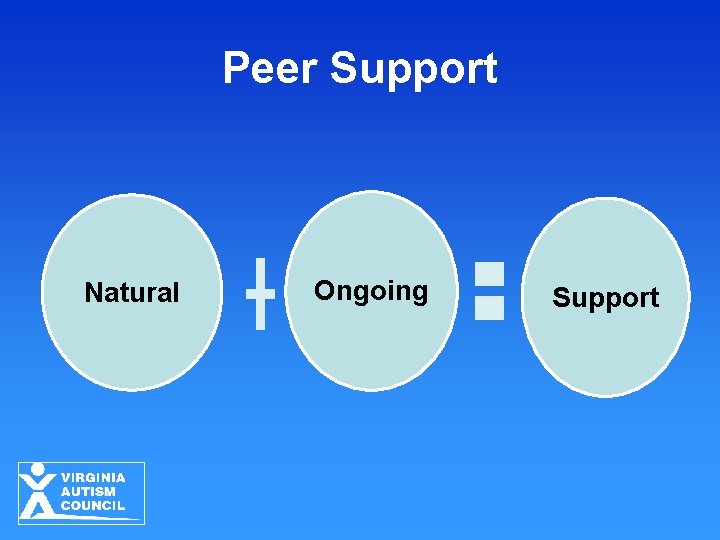
Peer Support Natural Ongoing Support
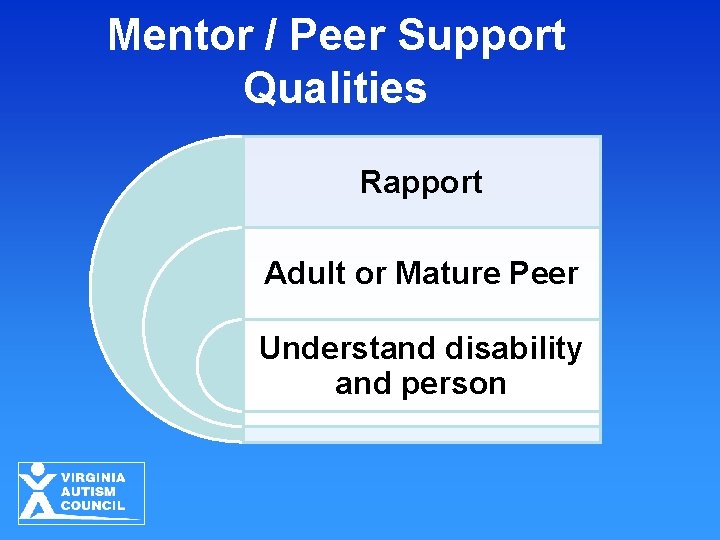
Mentor / Peer Support Qualities Rapport Adult or Mature Peer Understand disability and person
Mentor / Peer Support Role • Structure the social environment • Educate others • Provide assistance • Provide reinforcement
Steps to Develop Peer Support Step 1. Observe and work with Individual with ASD to determine needs and interests Step 2. Select peers Step 3. Educate and train peers Step 4. Help peers to problem solve
Video Project SEARCH Strategies to address social challenges in the work place
Task Analysis 1. Define the steps needed to demonstrate a social skill 2. Teach the person steps in order 3. Reinforce the person with positive reinforcement for demonstrating steps
Task Analysis for Accepting ‘No’ Response After you have asked for something: 1. Look at adult 2. Listen to response 3. Take a deep breath 4. Say, “OK” 5. Ask, “Can I have it later? ” 6. Listen to response 7. Say, “OK”
Implementing Task Analysis for Accepting ‘No’ Response 1. Support person demonstrates skill 2. Individual and support person role play skill 3. Skill is worked on in natural environment
Role Playing / Rehearsal • Conduct in a natural environment • Add difficulty to the role-play as the individual progresses • Perform a significant number of repetitions of the newly introduced skill • Treat as you would when teaching any other skill
What Is a Social Narrative? A written account of a social situation describing: • What occurs in a given situation • Relevant social cues • Why something occurs • Common responses
Social Narrative Example Most people shower every day. (Descriptive) They like to feel clean and smell good to other people. (Perspective) If I don’t shower, I smell bad. (Descriptive) My smell bothers other people. (Perspective) I will try to take a shower every day. (Perspective) Taking a shower may help other people want to be around me. (Perspective)
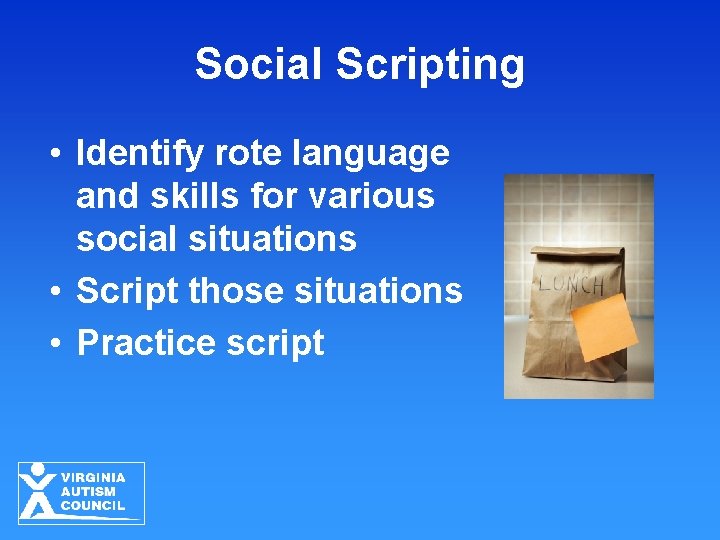
Social Scripting • Identify rote language and skills for various social situations • Script those situations • Practice script
Video Modeling 1. Videotape the person, a mentor, or a respected peer demonstrating a social skill 2. Individual with ASD watches the video and immediately practices the skill