
Promoting Clear Identification of Diabetic Peripheral Neuropathy ICD9
Promoting Clear Identification of Diabetic Peripheral Neuropathy ICD-9 -CM Coordination and Maintenance Committee Meeting October 8 th, 2004 Edward J. Bastyr III, MD 1
Overview • Clinical Manifestations and Diagnosis of Diabetic Peripheral Neuropathy • Disease Epidemiology • Inadequacy of Current Diagnostic Codes • Proposed Modifications and Clarification • Discussion 2

Diabetic Peripheral Neuropathy • Diabetic peripheral neuropathy (DPN) is a frequent complication of diabetes associated with significant morbidity and mortality 1 — Risk factor for ulcers and amputations 2 — Impairs quality of life 1 • Significant resources are spent to treat patients with DPN — Estimated total annual cost in US $4. 6 - $13. 7 billion 3 • Only effective intervention is prevention by tight control of patient’s diabetes 1. Vinik AI, et. al. Diabetologia 2000; 43: 957 -973. 2. Standards of Medical Care in Diabetes Care. 2004; S 1: 15 -35. 3. Gordois A, et. al. Diabetes Care. 2003; 26: 1790 -1795 3
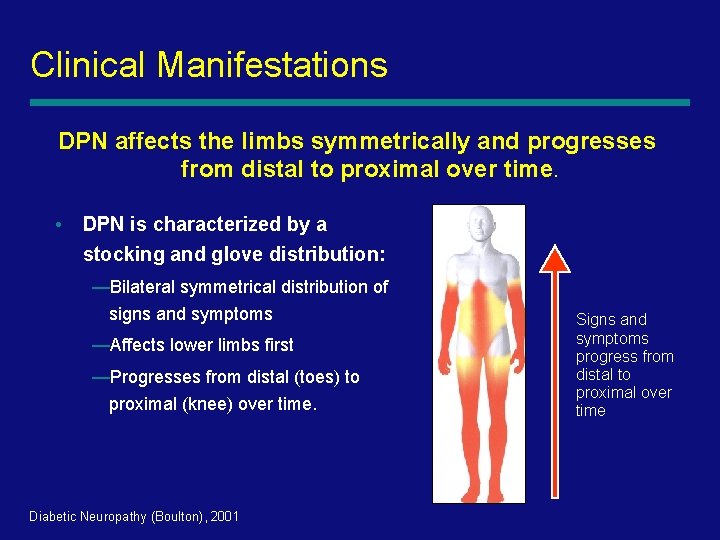
Clinical Manifestations DPN affects the limbs symmetrically and progresses from distal to proximal over time. • DPN is characterized by a stocking and glove distribution: —Bilateral symmetrical distribution of signs and symptoms —Affects lower limbs first —Progresses from distal (toes) to proximal (knee) over time. Diabetic Neuropathy (Boulton), 2001 Signs and symptoms progress from distal to proximal over time 4
Diagnosis • Symptoms — Numbness — Tingling — Painful Sensations • Signs — Lost Reflexes, Decreased Sensation — Joint Deformity, Skin changes • Perception Measures — Quantitative Sensory Testing § § § Vibration Detection Threshold Cold Detection Threshold Heat Pain Threshold • Objective Measures — Electrophysiology (Nerve Conduction Studies) 5
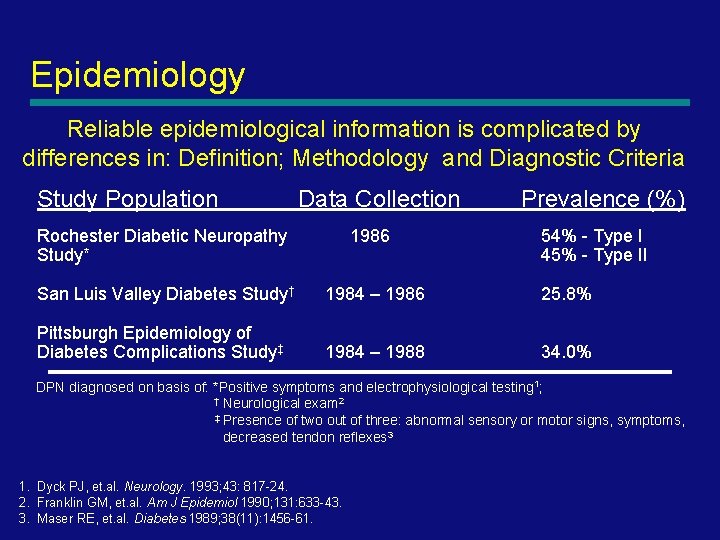
Epidemiology Reliable epidemiological information is complicated by differences in: Definition; Methodology and Diagnostic Criteria Study Population Data Collection Prevalence (%) Rochester Diabetic Neuropathy Study* 1986 54% - Type I 45% - Type II San Luis Valley Diabetes Study† 1984 – 1986 25. 8% Pittsburgh Epidemiology of Diabetes Complications Study‡ 1984 – 1988 34. 0% DPN diagnosed on basis of: *Positive symptoms and electrophysiological testing 1; † Neurological exam 2 ‡ Presence of two out of three: abnormal sensory or motor signs, symptoms, decreased tendon reflexes 3 1. Dyck PJ, et. al. Neurology. 1993; 43: 817 -24. 2. Franklin GM, et. al. Am J Epidemiol 1990; 131: 633 -43. 3. Maser RE, et. al. Diabetes 1989; 38(11): 1456 -61. 6

Neuropathy Clinical Classification Stage 0 50% No Neuropathy Stage 1 38% Asymptomatic Neuropathy Abn NCV, NIS<2 NSC<1 Abn NCV, NIS>2, NSC <1 Abn NCV, NIS>2 NIS(Q 21)<4, NSC>1 Stage 2 Stage 3 8 -12% Symptomatic Neuropathy 1 -3% Disabling Neuropathy NCV=nerve conduction velocity NIS=neuropathy impairment score NSC=neuropathy symptom and change score Dyck PJ, et. al. Neurology. 1993; 43: 817 -24. Abn NCV, NIS>2 NIS(Q 21)>4, NSC>1 Disabling Symptoms - Ulcers; deformity; non-traumatic amputation Abnormal NCV and Nerve Exam 7
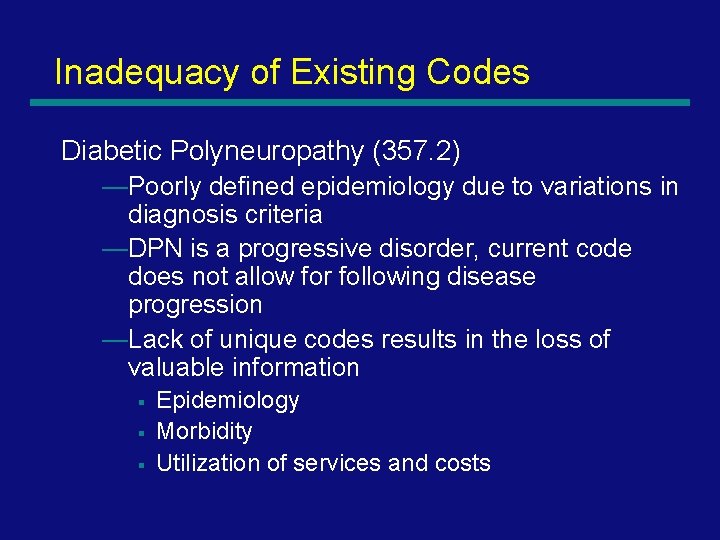
Inadequacy of Existing Codes Diabetic Polyneuropathy (357. 2) —Poorly defined epidemiology due to variations in diagnosis criteria —DPN is a progressive disorder, current code does not allow for following disease progression —Lack of unique codes results in the loss of valuable information § § § Epidemiology Morbidity Utilization of services and costs 8
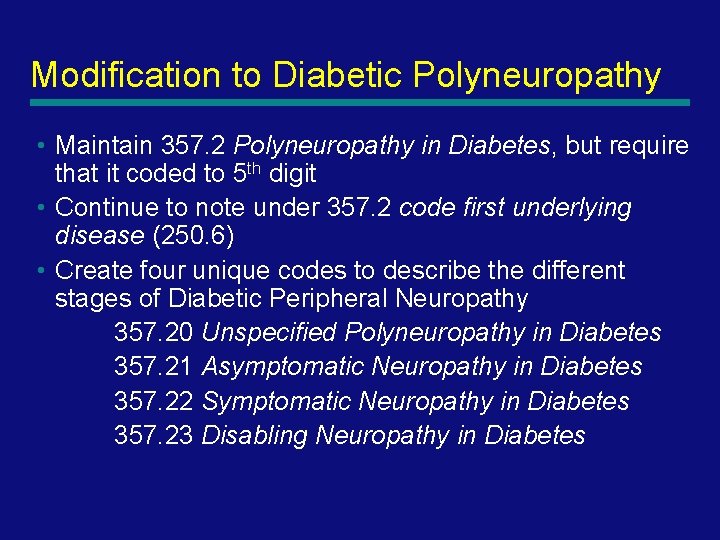
Modification to Diabetic Polyneuropathy • Maintain 357. 2 Polyneuropathy in Diabetes, but require that it coded to 5 th digit • Continue to note under 357. 2 code first underlying disease (250. 6) • Create four unique codes to describe the different stages of Diabetic Peripheral Neuropathy 357. 20 Unspecified Polyneuropathy in Diabetes 357. 21 Asymptomatic Neuropathy in Diabetes 357. 22 Symptomatic Neuropathy in Diabetes 357. 23 Disabling Neuropathy in Diabetes 9

Conclusion • DPN is a frequent, progressive complication of diabetes associated with significant morbidity and costs • Current ICD-9 -CM codes do not allow for categorization of the different stages of DPN resulting in the loss of valuable information on the epidemiology and costs of the disease • Modification of current Polyneuropathy in Diabetes (357. 2) code will better represent the clinical presentation of DPN § § 357. 20 Unspecified Polyneuropathy in Diabetes 357. 21 Asymptomatic Neuropathy in Diabetes 357. 22 Symptomatic Neuropathy in Diabetes 357. 23 Disabling Neuropathy in Diabetes 10

11
- Slides: 11