
Promoting Child Safety Addressing Complaints Against Staff Objectives
Promoting Child Safety Addressing Complaints Against Staff
Objectives v Understand your responsibility to promote a safe environment for children through appropriate and professional interactions v Know how to identify when a staff member is behaving inappropriately v Understand what happens when a complaint is made about inappropriate behaviour
Key child protection responsibilities v Respond to suspected risk of significant harm and wellbeing concerns v To interact professionally at all times with children v Address complaints of inappropriate behaviour by a staff member towards any child
What do we mean by Professional Behaviour
Professional Behaviour 1. Exercise duty of care 2. Maintain professional boundaries
Professional Behaviour 1. Duty of care v Ensure children are not exposed to foreseeable risk of harm v Take action to minimise risk v Supervision of children v Follow policies and procedures for welfare and wellbeing v If you observe others acting inappropriately towards children report your concerns
Professional Behaviour 2. Maintain professional boundaries v Demonstrate professional relationships with children that cannot be misinterpreted as overly personal or intimate v Remain within the responsibilities of your role v Physical contact to be minimised and appropriate v Treat children with respect, sensitivity, fairness and consistency
Developing Professional Relationships EXAMPLES OF BEHAVIOURS THAT YOU SHOULD AVOID … DON’T Student management and care • • • Use confrontational behaviour management styles, or threatening comments or gestures Leave a student inadequately supervised Fail to attend to and or seek assistance for a student who is injured Physical contact with students • • • Use physical force to impose compliance Use physical touch to demonstrate an action without warning or permission Throw articles at a student in anger or frustration Communication with students • • • Engage in personal correspondence by letter, email, phone, SMS text, Facebook etc Make inappropriate comments about a students appearance Use inappropriate humour or sexual innuendo 8
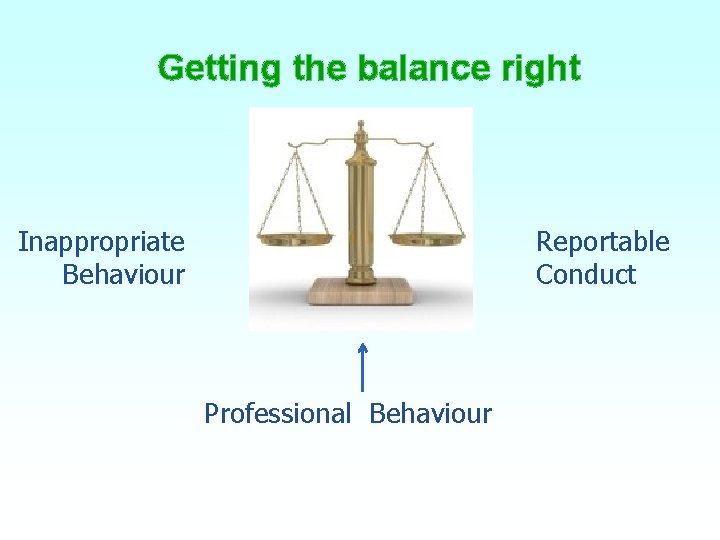
Getting the balance right Inappropriate Behaviour Reportable Conduct Professional Behaviour
What is Reportable Conduct? v Types of complaints against staff which must be reported to NSW Ombudsman: Ø Ø Ø Physical assault Ill treatment Neglect Psychological harm Sexual offence Sexual misconduct v Assessed and investigated by CP Team
What is exempt conduct? v Types of complaints against staff which are not reported to the NSW Ombudsman: a) Reasonable for the discipline, management or care of students. E. g. Touching a child to attract attention, guide them or to comfort them when distressed, etc. b) Use of physical force that is trivial or negligible. E. g. Soft push or poke, a light tap, etc. c) Any minor physical assault resulting in a minor injury eg bruises, red mark. v Assessed by CP team and mostly investigated at School level.

CASE STUDIES 12
Your Responsibilities If you see, hear, are told about or are involved in an incident that may involve reportable conduct. Your responsibility is to: • • • Provide assistance and support as needed Advise your Principal/Manager Document the information
What happens when a complaint is made
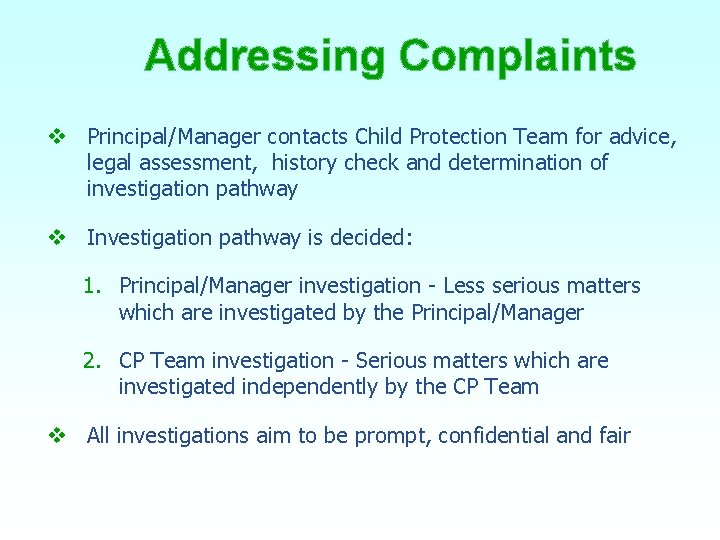
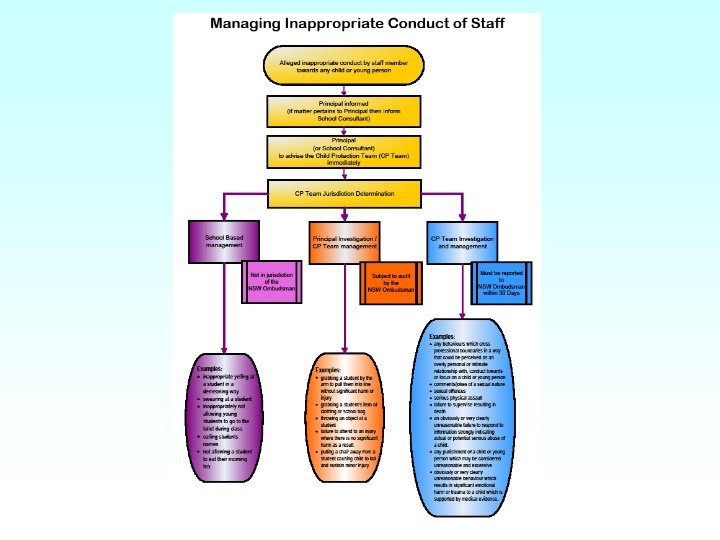
Addressing Complaints v Principal/Manager contacts Child Protection Team for advice, legal assessment, history check and determination of investigation pathway v Investigation pathway is decided: 1. Principal/Manager investigation - Less serious matters which are investigated by the Principal/Manager 2. CP Team investigation - Serious matters which are investigated independently by the CP Team v All investigations aim to be prompt, confidential and fair
16
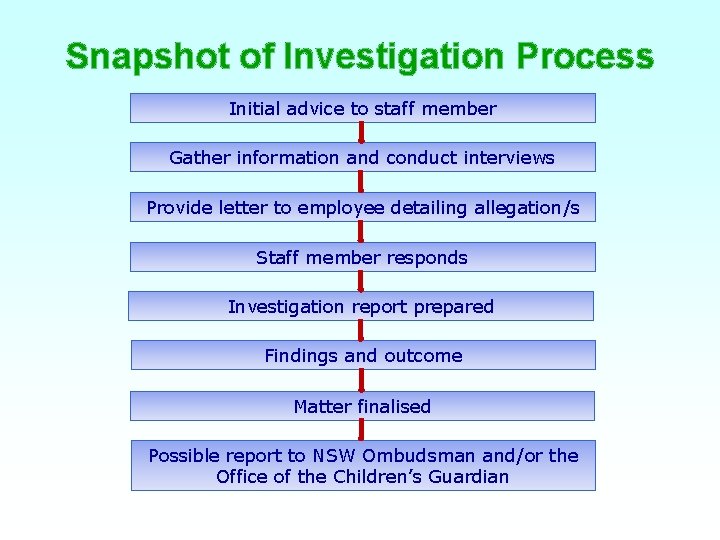
Snapshot of Investigation Process Initial advice to staff member Gather information and conduct interviews Provide letter to employee detailing allegation/s Staff member responds Investigation report prepared Findings and outcome Matter finalised Possible report to NSW Ombudsman and/or the Office of the Children’s Guardian
Outcomes of an Investigation could be: v No further action v Disciplinary action including: • increased supervision • monitoring • suspension • caution • termination v Changes to policy/practice E. g. training, staffing, documents v Notification to the Office of the Children’s Guardian (OCG)
Office of the Children’s Guardian (OCG) Notifications Ø A notification must be made to OCG if there is a sustained finding of: • Sexual Offence • Sexual Misconduct or • Serious physical assault Ø The notification will trigger a risk assessment when the person next seeks another position working with children (Working With Children Check)
Employees do have rights and responsibilities v Procedural fairness v Right to information v Right to support v Maintain confidentiality v Right of review
CASE STUDIES REVISITED 21
Group Discussion How can you minimise complaints about inappropriate behaviour?
Child Protection Team - Contact Details � Tamara Hughes, Child Protection Team Leader Phone: 9847 0610 (M) 0409 399 543 � Marina Best, Child Protection Officer (Tues, Thurs & Fri) Phone: 9847 0616 (M) 0427 206 194 � Cathy Mc. Clellan, Child Protection Officer (Mon, Tues, Wed & Fri) Phone: 9847 0620 (M)0410 342 015 � Wendy Collins (Admin. Support) Phone: 9847 0618 CP Office Fax: 9847 0611
- Slides: 23