
Promoting and Supporting CHWs A Network Collaboration and

Promoting and Supporting CHWs A Network Collaboration and Analysis Network Planning Virtual Grantee Meeting January 28, 2021 Gina Brien Executive Director Appalachian Kentucky Health Access Network
Working together to increase the number of CHWs in KY to improve health care access and positive health outcomes for all rural Kentuckians 1. Expand CHW programming throughout Kentucky 2. Develop quality training and tools for statewide utilization 3. Explore viability of a certification process for Kentucky CHWs 4. Support CHW workforce development
Definition of a Community Health Worker • “A Community Health Worker (CHW) is a frontline public health worker who is a trusted member of and/or has an unusually close understanding of the community served. This trusting relationship enables the CHW to serve as a liaison/link/intermediary between health/social services and the community to facilitate access to services and improve the quality and cultural competence of service delivery. A CHW also builds individual and community capacity by increasing health knowledge and self-sufficiency through a range of activities such as outreach, community education, informal counseling, social support and advocacy. ” 3

“CHW: ” A Role with Many Names https: //www. cthealth. org/wp-content/uploads/2019/02/r 4 -CHF-0039 -Health-Infographic. pdf 4
Why CHWs • • • Bridge the gap between communities and the health and social service systems Navigate the health and human services system Advocate for individual and community needs Provide direct services Build individual and community capacity 5
Why Evaluation • In this case a systematic method to answer questions regarding CHW projects, programs and policies by: • Collecting Data • Analyzing Data • Utilizing Data • Purpose: To determine efficiency and effectiveness of the above 6
Impact of Evaluation • Important questions can be answered such as: • How the CHW program can be improved? • Whether the CHW program is cost effective? • Whethere are better alternatives to this program? • Are there unintended outcomes of the program? • Are the program goals appropriate and useful? • Stakeholders who want to know if the programs they are funding, implementing, voting for, receiving or objecting to are actually are having the intended effect. 7
Evaluation • • • A 1 C scores decreased from the client’s first score (M = 8. 69) to the client’s second score (M = 7. 435) General self-efficacy scores increased from client’s first score (M = 28. 218) to second score (M = 29. 338) Visits to Emergency Room decreased from the client’s first score to the second A Return on Investment (ROI) analysis estimated an annual savings of $303, 711. 3 due to statistically significant reduction in unnecessary ER visits. ROI analysis estimated that for every $1 invested, $1. 84 is saved or returned. 8
Evaluation • Program Integrity External evaluator, CHES Solutions – non-profit organization analyzes and extrapolates key data elements to determine outcomes Based on a Logic Model 9
AKHCAN Training Model • • Skill building approach based on 8 Core Competencies Tier-based (general – specialized) Both classroom and online modules Includes evidence-based programs Consistent, individual, adaptable Network approved Evaluated and revised annually 10
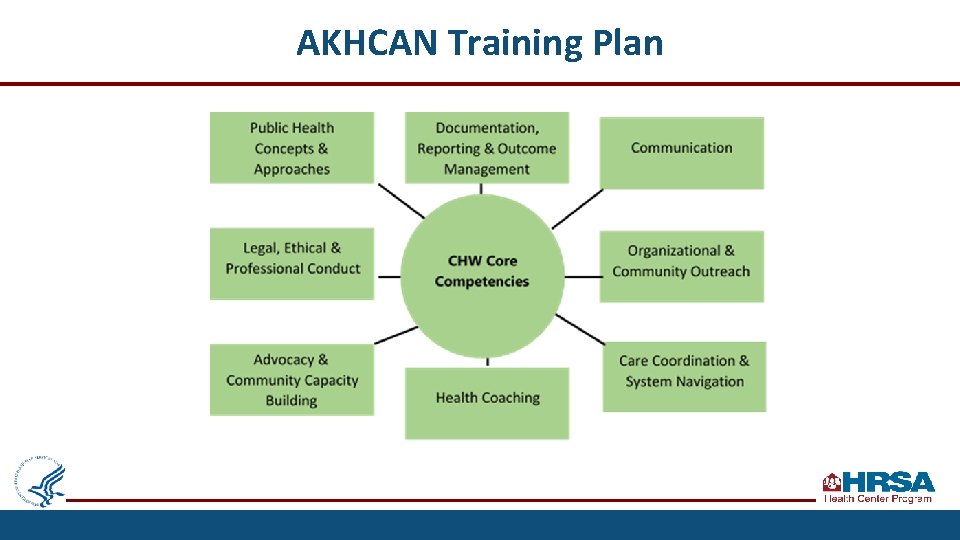
AKHCAN Training Plan
Kentucky CHW Certification Benefits • • • Acknowledgement of CHWs’ training, experience and diverse skillsets Furthering career goals and increase opportunities for employment and formal education Building individual CHW confidence Staying abreast of current research and opportunities through continuing education Increased respect and recognition for CHWs’ work in communities Advocates and supports the CHW workforce 12
CHW Certification Pathways • A “formal” CHW training program • The training must provide at least 40 hours of didactic classroom experience based on the approved CHW Core Competencies • Complete a 40 -hour mentorship • Supervisor must verify that the CHW achieved all Core Competencies OR • Work experience • 2, 500 hours working as a CHW or in a similar role within the past three years (patient navigator, community outreach worker, promotores) • Recertification – Ten (10) continuing education units are required annually. 13
Kentucky Association of Community Health Workers (KYACHW) • • Kentucky Association of Community Health Workers (KYACHW) was formed in 2016 to advocate and promote the profession of community health workers (CHWs) in the Commonwealth Purpose • Provide a unified association of community health workers in Kentucky with the purpose to spread knowledge and advocate for recognition of CHWs and our communities • Build community and systems capacity for better health through the integration of community health worker strategies • Recognize CHWs as professionals who work together for community health Provide quarterly meetings and trainings to association members Provide an annual day-long conference for CHWs 14
Next Steps • • Sustainability • Funding/ reimbursement Validating the CHW workforce • Promoting CHW’s role in the patient-centered medical model, member of the health care team • Defining the expectations through evaluation and outcomes • Adoption of education requirements and curriculum 15
- Slides: 15