
Promoting a Respectful Working Environment A workshop for
- Slides: 37
Promoting a Respectful Working Environment A workshop for the Rocky Mountain Association of Collegiate Registrars and Admissions Officers July 17, 2013 Tom Sebok University of Colorado Boulder Ombuds Office
Observations about respect from the Ombuds Office. . . �Most people are acutely aware of how and when they feel disrespected by others. �People - sometimes intentionally and sometimes unintentionally - act in ways others perceive as “disrespectful. ” �When people do this deliberately, they usually tell themselves they are “justified. ”
Observations from the Ombuds Office (continued) Not a big surprise but. . . When someone responds to perceived disrespect by acting disrespectfully in return, this usually does not elicit MORE respectful behavior from the person whose behavior s/he initially perceived as disrespectful.
What tends to work better? �Focus your attention on what you can do to promote a respectful working environment -ESPECIALLY if/when you feel disrespected �Avoid giving others reasons to perceive that you are disrespecting them
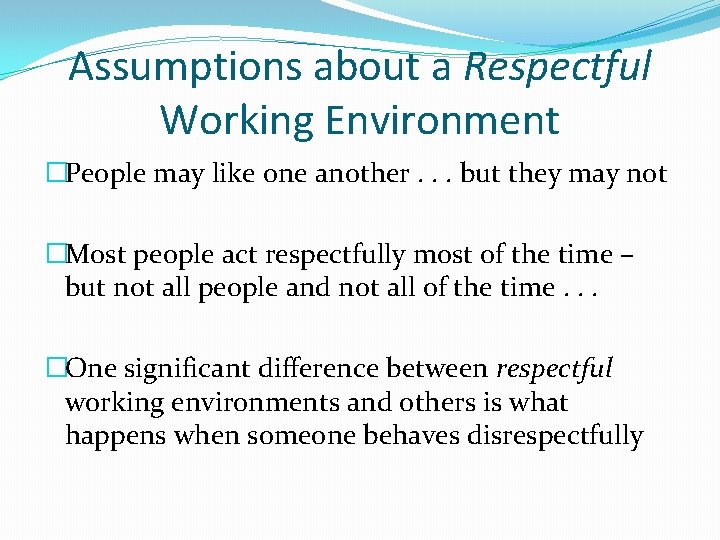
Assumptions about a Respectful Working Environment �People may like one another. . . but they may not �Most people act respectfully most of the time – but not all people and not all of the time. . . �One significant difference between respectful working environments and others is what happens when someone behaves disrespectfully
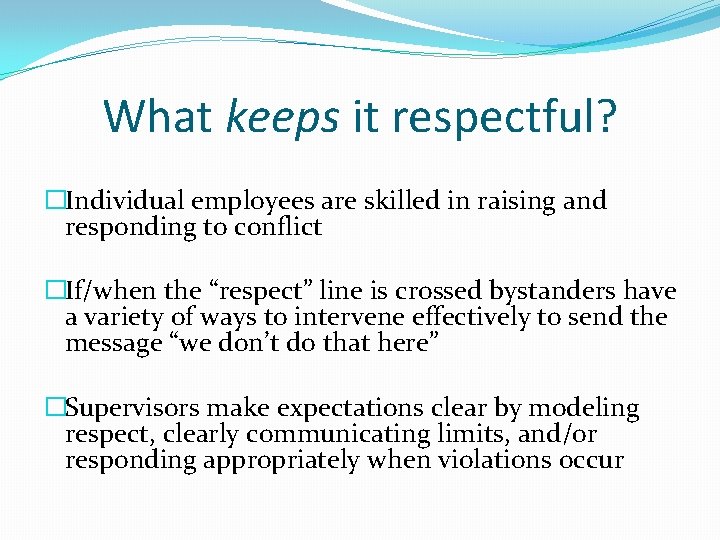
What keeps it respectful? �Individual employees are skilled in raising and responding to conflict �If/when the “respect” line is crossed bystanders have a variety of ways to intervene effectively to send the message “we don’t do that here” �Supervisors make expectations clear by modeling respect, clearly communicating limits, and/or responding appropriately when violations occur
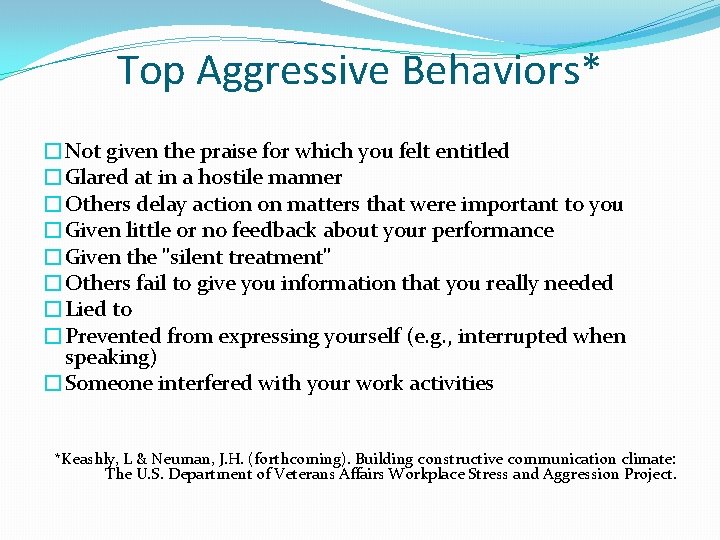
Top Aggressive Behaviors* �Not given the praise for which you felt entitled �Glared at in a hostile manner �Others delay action on matters that were important to you �Given little or no feedback about your performance �Given the "silent treatment" �Others fail to give you information that you really needed �Lied to �Prevented from expressing yourself (e. g. , interrupted when speaking) �Someone interfered with your work activities *Keashly, L & Neuman, J. H. (forthcoming). Building constructive communication climate: The U. S. Department of Veterans Affairs Workplace Stress and Aggression Project.
Question Although it can occur at other times, the time when behavior is MOST LIKELY to be perceived as “disrespectful” occurs when people are engaged in. . . CONFLICT!
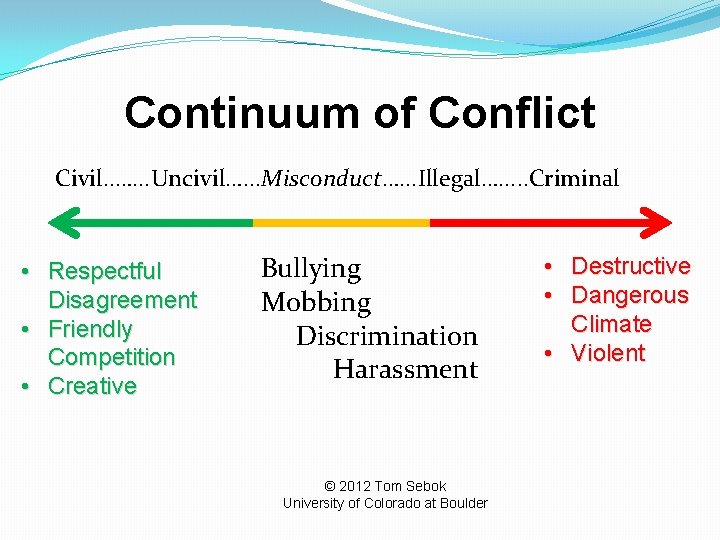
Continuum of Conflict Civil. . …. . . Uncivil…. . . Misconduct…. . . Illegal…. . . Criminal • Respectful Disagreement • Friendly Competition • Creative Bullying Mobbing Discrimination Harassment © 2012 Tom Sebok University of Colorado at Boulder • Destructive • Dangerous Climate • Violent
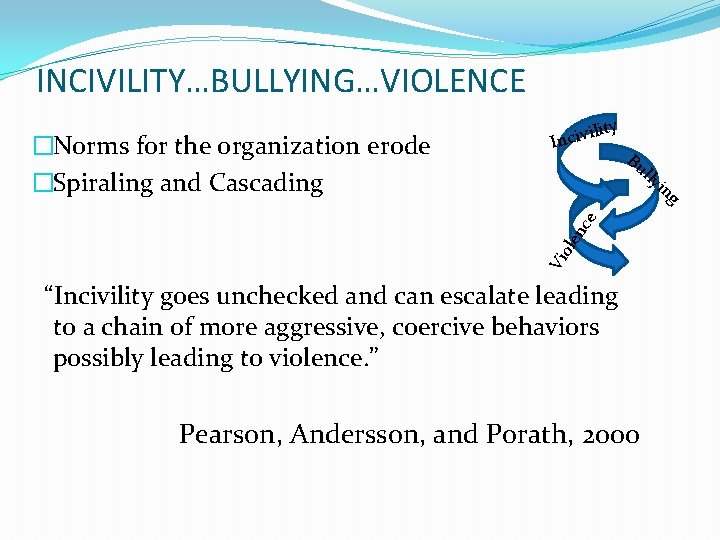
INCIVILITY…BULLYING…VIOLENCE lity Bu lly Vi ole nc e �Norms for the organization erode �Spiraling and Cascading i Inciv “Incivility goes unchecked and can escalate leading to a chain of more aggressive, coercive behaviors possibly leading to violence. ” Pearson, Andersson, and Porath, 2000 in g
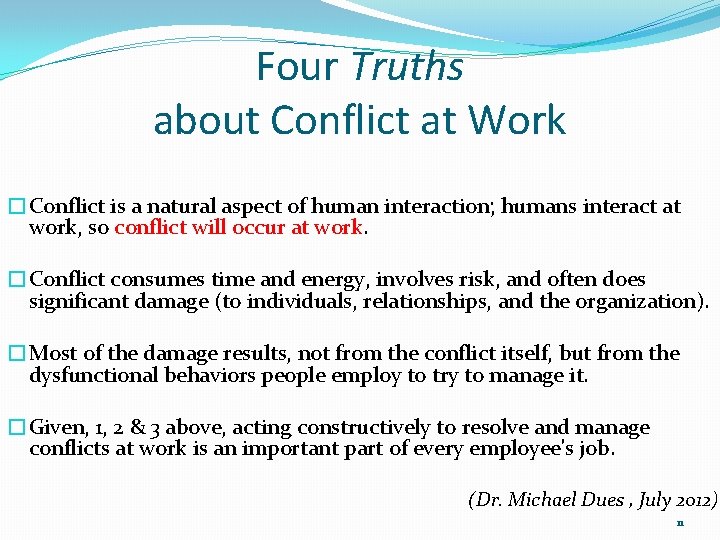
Four Truths about Conflict at Work �Conflict is a natural aspect of human interaction; humans interact at work, so conflict will occur at work. �Conflict consumes time and energy, involves risk, and often does significant damage (to individuals, relationships, and the organization). �Most of the damage results, not from the conflict itself, but from the dysfunctional behaviors people employ to try to manage it. �Given, 1, 2 & 3 above, acting constructively to resolve and manage conflicts at work is an important part of every employee's job. (Dr. Michael Dues , July 2012) 11
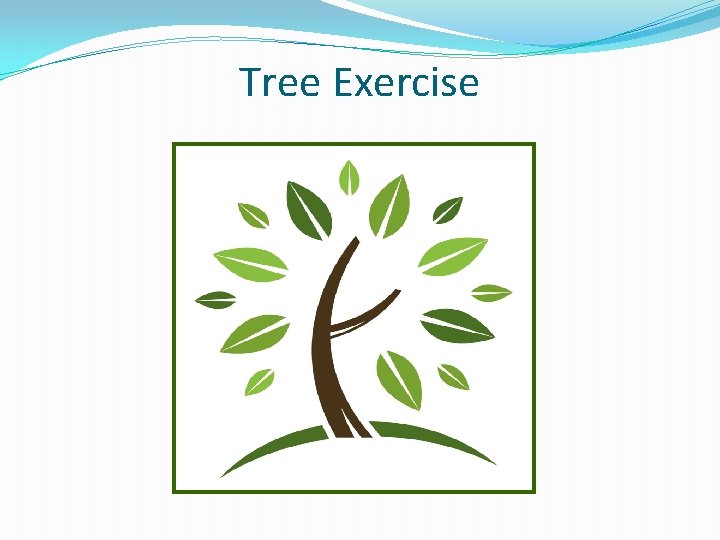
Tree Exercise
Instructions for Tree Exercise �Roots: Things organizations (or society) can put in place to provide a foundation so that respect takes root in the workplace �Branches: respectful behaviors by individuals �Fruit: What propagates as a result of respectful behavior? What are the benefits?
Every CU-Boulder job announcement includes the following statement: “The University of Colorado Boulder is committed to providing a safe and productive learning, living and working community. ”
Policy 1: University of Colorado Legal Origins, Guiding Principles, and Principles of Ethical Behavior 2. Respect for Others �The University of Colorado values academic freedom, diversity, and respect for all persons. … �University employees are expected to treat colleagues, co-workers, and students with respect, professionalism, and dignity in all interactions and communications.
Q: In a respectful working environment… How would people who dislike one another behave toward one another when they have conflict at work?
Developing Your Own Conflict Communication Protocols Goal: Answer questions and provide input about what you would like your FUTURE group norms to be for dealing with conflict. IF the group wants to develop actual conflict communication protocols, this information will help – and an actual protocol will be developed in the next two months.
Two requests. . . 1. Please do not raise past or present disputes, complaints, or criticisms with or about other group members – including making coded references to events or behaviors. 2. Please do not interrupt the person speaking.
When Developing a Protocol. . . �SPECIFICALLY how people will act when conflict arises must be clear to everyone BEFORE it arises. �After an interaction, people need to be able to tell unambiguously whether they and others followed the protocol. �The only way to do this is to identify specific behaviors everyone will follow when they have conflict (NOT attitudes, intentions, reminders, platitudes, etc. )
Are these “specific behaviors? ” �Be respectful �Be cool �Find common ground �Don’t hold grudges �Don’t retaliate �Be open-minded �Communicate openly �Be assertive �Be accountable
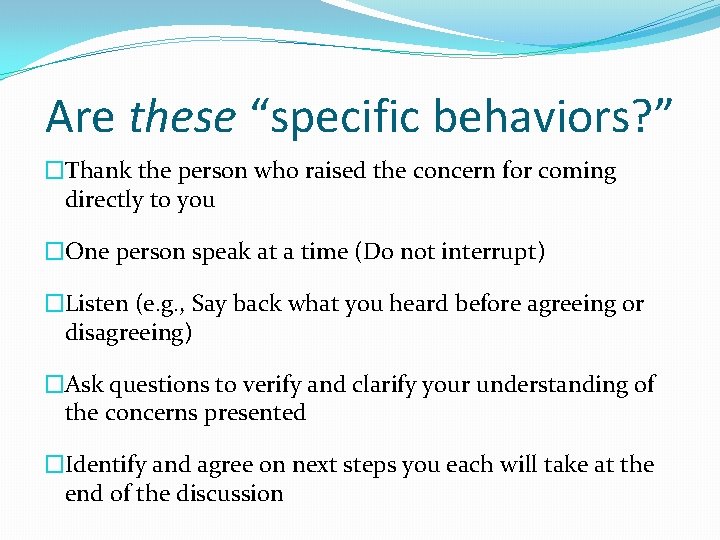
Are these “specific behaviors? ” �Thank the person who raised the concern for coming directly to you �One person speak at a time (Do not interrupt) �Listen (e. g. , Say back what you heard before agreeing or disagreeing) �Ask questions to verify and clarify your understanding of the concerns presented �Identify and agree on next steps you each will take at the end of the discussion
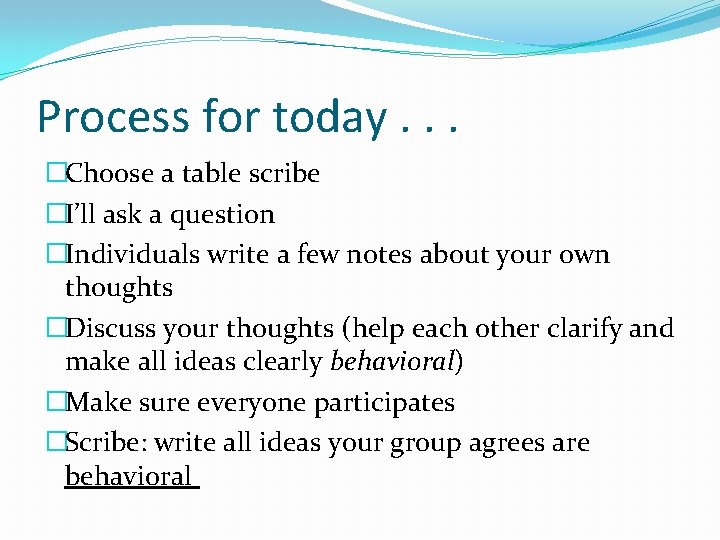
Process for today. . . �Choose a table scribe �I’ll ask a question �Individuals write a few notes about your own thoughts �Discuss your thoughts (help each other clarify and make all ideas clearly behavioral) �Make sure everyone participates �Scribe: write all ideas your group agrees are behavioral
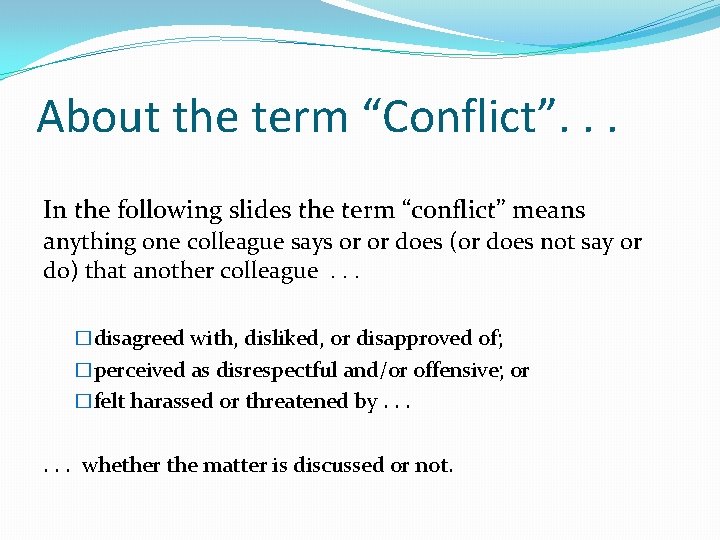
About the term “Conflict”. . . In the following slides the term “conflict” means anything one colleague says or or does (or does not say or do) that another colleague. . . �disagreed with, disliked, or disapproved of; �perceived as disrespectful and/or offensive; or �felt harassed or threatened by. . . whether the matter is discussed or not.
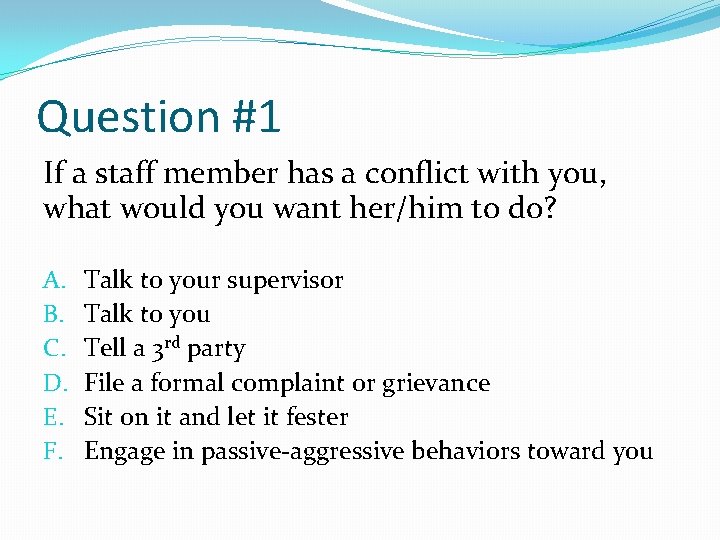
Question #1 If a staff member has a conflict with you, what would you want her/him to do? A. B. C. D. E. F. Talk to your supervisor Talk to you Tell a 3 rd party File a formal complaint or grievance Sit on it and let it fester Engage in passive-aggressive behaviors toward you
Observation: �Almost everyone says, “If someone has a problem with me I want her or him to come to ME. ” �VERY often people do not do that!
Related Question to Supervisor: Are there any conflict-related circumstances where you want staff members to come directly to you (rather than trying to resolve differences privately)?
Question #2 - initiating. . . If a colleague approaches you to discuss a conflict s/he has with you, what, specifically, will s/he do to help the conversation be both honest and respectful? Hints: 1. What behaviors would make it as easy as possible for you to listen– regardless of the issue(s)? 2. Thinking about things you do NOT want her to do might help you identify things you DO what her to do. (But only say what you DO want!)
Question #3 – responding. . . If you approach a colleague to discuss a conflict, what specifically, will s/he do to help the conversation to be both honest and respectful? Hints: 1. What could she do that, while talking, would make you glad you talked to her? 2. Thinking about things you do NOT want her to do might help you identify things you DO what her to do. (But only say what you DO want!)
Question #4 If someone in the department comes to talk to you about a conflict she has with someone else in the department, A. What is acceptable for the person approached to do? B. What is unacceptable?
Question #5 (A and B) If you still have an unresolved conflict after using the strategies above, what are acceptable options regarding what can happen?
Question #6 If you developed your own conflict communication protocol, what could be done to increase the chances that everyone will follow it?
How is criticism handled in a respectful working/learning environment? In a respectful working/learning environment how do people: A. Give Criticism. . . B. Receive Criticism. . .
Video: “The ARTS of CRITICISM: GIVING AND TAKING”
What are some options? If one colleague observes another colleague engaging in behavior that violates the “respectful” norm?
Table Discussion Questions In addition to developing and following a conflict communication protocol. . . 1. What can employees (i. e. , those without supervisory responsibilities) do to promote a respectful working/learning environment? 2. What can supervisors and organizational leaders do to promote a respectful working/learning environment?
Acknowledgements �Larry Hoover, University of California-Davis, “Developing Departmental Communication Protocols” in the Conflict Management in Higher Education Report, October 2003, Volume 4, Number 1, (http: //www. campusadr. org/cmher/Report. Articles/Edition 4_1/hoover 4_1 a. html) �Thanks to Mary Chavez Rudolph, Ph. D and Lisa Neale (University of Colorado Denver Ombuds Office) for the “Tree Exercise. ”
Ombuds Office Center for Community, N-440 303 -492 -5077 https: //ombuds. colorado. edu