
Promiscuity and the Pecking Order The Relationship between
Promiscuity and the Pecking Order: The Relationship between Childhood Birth Order and Sexual Promiscuity in Adulthood
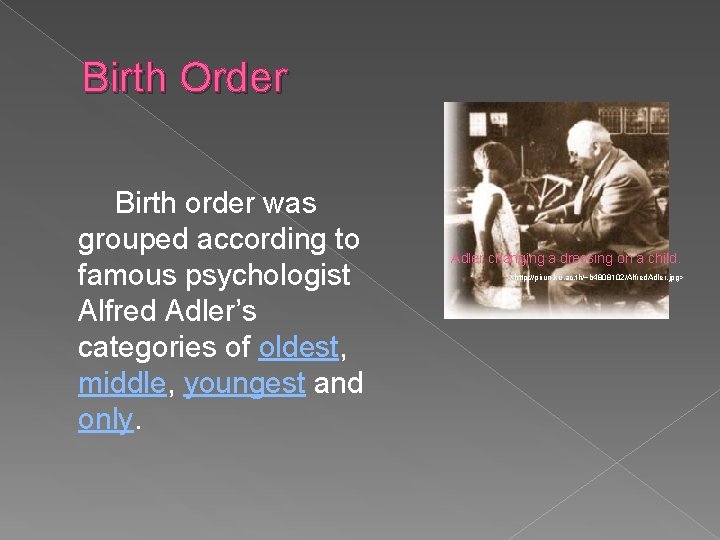
Birth Order Birth order was grouped according to famous psychologist Alfred Adler’s categories of oldest, middle, youngest and only. Adler changing a dressing on a child. <http: //pirun. ku. ac. th/~b 4808102/Alfred. Adler. jpg>
Personality Traits � Lew Goldberg’s Big Five Personality Traits modified by John and Srivastava 1999. � Extraversion- the participant’s outgoingness. � Conscientiousness- how scrupulous and careful the participant is. � Neuroticism- the participant’s anxiousness, obsessiveness and sensitivity. � Agreeableness- the participant’s friendliness and willingness to comply to others. � Openness- the level of honesty and vulnerability the participant gives to others.
Promiscuity attitudes and subjective norms The Brief Sexual Attitudes Scale by Hendrick and Hendrick 2006, a 23 item, five point Likert scale. � Permissiveness- the participant’s tolerance of their own and other’s sexuality. Birth Control- the participant’s beliefs on birth control and who should take Responsibility, male or female. � Communion- the participant’s beliefs on sex as a communicative shared interaction. � Instrumentality- the participant’s beliefs on the purpose of sex. � Safe Sex- the participant’s beliefs in practicing STD/STI protection. � Self-comparison- how the participant views their sexual drive as compared to their peers. Measured according to the two statements “ I have more sex than others my age ” and “I have more present/past sexual partners than others my age. ” �

Promiscuity behavioral intentions Schmitt and Buss’s 2000 “Sexy Seven”. Sexual Attractiveness- how sexually attractive and seductive the participant believes themselves to be. � Relationship Exclusivity- the participant’s willingness/attitudes about engaging in a committed, exclusive relationship. � Sexual Restraint- the participants believed ability to resist sexual temptation. � Erotophilic Disposition- the participants sexuality in relation to their personality, i. e. the participants level of guilt about sex, willingness to talk about sex and attitudes toward sexual explicit material. � Emotional Investment –the amount of emotional investment participants find necessary for a sexual relationship. �
Promiscuous behaviors � Promiscuous behaviors were measure via a participant’s sexual history using a modified survey from Davis, Yarber, Bauserman, Schreer and Davis’s 1998 “Handbook of Sexually-related Measures”.
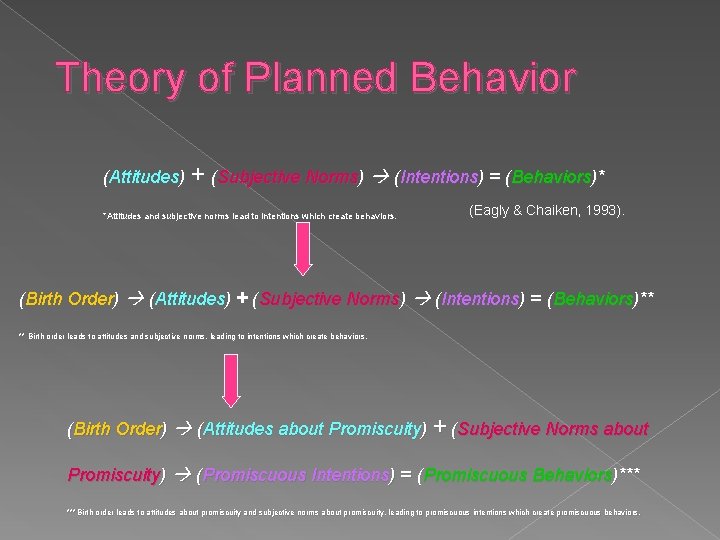
Theory of Planned Behavior (Attitudes) + (Subjective Norms) (Intentions) = (Behaviors)* *Attitudes and subjective norms lead to intentions which create behaviors. (Eagly & Chaiken, 1993). (Birth Order) (Attitudes) + (Subjective Norms) (Intentions) = (Behaviors)** ** Birth order leads to attitudes and subjective norms, leading to intentions which create behaviors. (Birth Order) (Attitudes about Promiscuity) + (Subjective Norms about Promiscuity) (Promiscuous Intentions) = (Promiscuous Behaviors)*** ***Birth order leads to attitudes about promiscuity and subjective norms about promiscuity, leading to promiscuous intentions which create promiscuous behaviors.

“The interpersonal meaning of sexual promiscuity” Markey & Markey (2007) “Extraverted antagonistic individuals are likely to be sexually promiscuous. ” promiscuous http: //i. dailymail. co. uk/i/pix/2008/11/30/article-0 -05794 E 7 D 0000044 D-526_468 x 321. jpg Promiscuity has a negative connotation. “It seems plausible that such dominant individuals are sexually promiscuous because they may not be shy about seeking out partners with whom they can engage in these behaviors. ” “Understanding the combination(s) of interpersonal qualities that predict promiscuity has implications for health promotion and intervention efforts. ” intervention efforts
![“Personality and riskier sexual behavior: motivational mediators” Ingledew & Ferguson (2007) “Personality traits [that]](http://slidetodoc.com/presentation_image/90049a20f39943f2f118f28dc9bc793d/image-9.jpg "“Personality and riskier sexual behavior: motivational mediators” Ingledew & Ferguson (2007) “Personality traits [that]")
“Personality and riskier sexual behavior: motivational mediators” Ingledew & Ferguson (2007) “Personality traits [that] Influence [an] individual’s participation motives and personality also directly influences selfdetermination of safer sexual behavior. ” Sexually experienced compared to those with none were more extraverted and less controlled in their motivation for safer sex. http: //www. dailymail. co. uk/news/article-1090612/Now-Britain-leading-world--promiscuity. html “Agreeable [and conscientious] individuals feel more autonomous in their motivation for safer sex and as a result behave less riskily. This… can be explained by their greater inclination to have sex for reasons of intimacy. ” “It may be that extraverts, being more hedonistic, seek out sexual experience earlier or it may be that extraverts, being more gregarious, simply encounter sexual opportunities earlier. ”
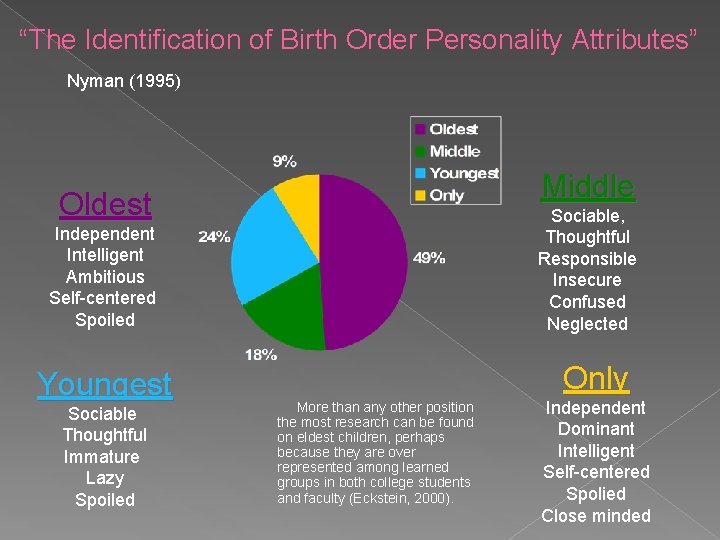
“The Identification of Birth Order Personality Attributes” Nyman (1995) Middle Oldest Sociable, Thoughtful Responsible Insecure Confused Neglected Independent Intelligent Ambitious Self-centered Spoiled Youngest Sociable Thoughtful Immature Lazy Spoiled Only More than any other position the most research can be found on eldest children, perhaps because they are over represented among learned groups in both college students and faculty (Eckstein, 2000). Independent Dominant Intelligent Self-centered Spolied Close minded
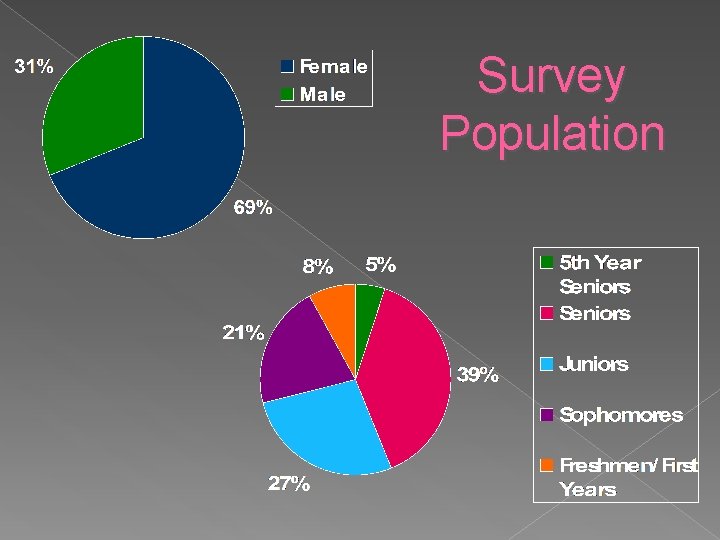
Survey Population
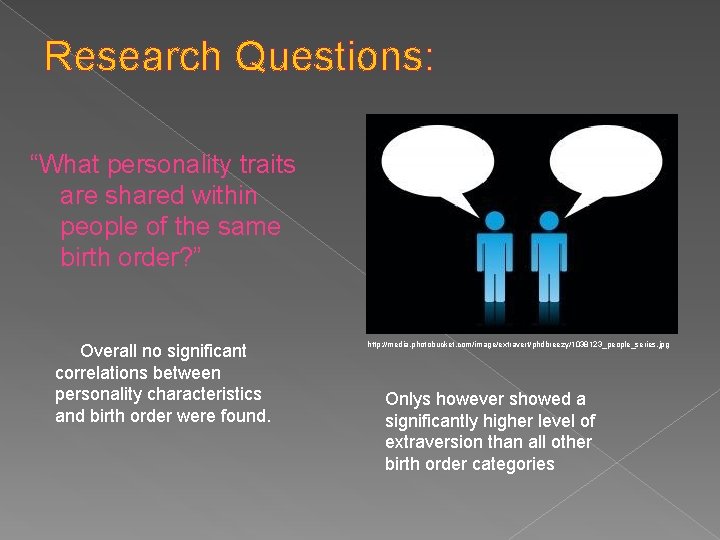
Research Questions: “What personality traits are shared within people of the same birth order? ” Overall no significant correlations between personality characteristics and birth order were found. http: //media. photobucket. com/image/extravert/phdbreezy/1038123_people_series. jpg Onlys however showed a significantly higher level of extraversion than all other birth order categories
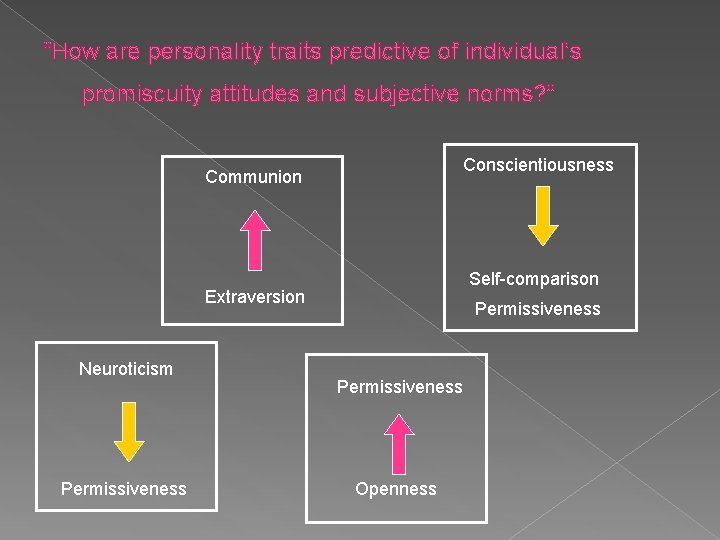
“How are personality traits predictive of individual’s promiscuity attitudes and subjective norms? ” Conscientiousness Communion Self-comparison Extraversion Neuroticism Permissiveness Openness
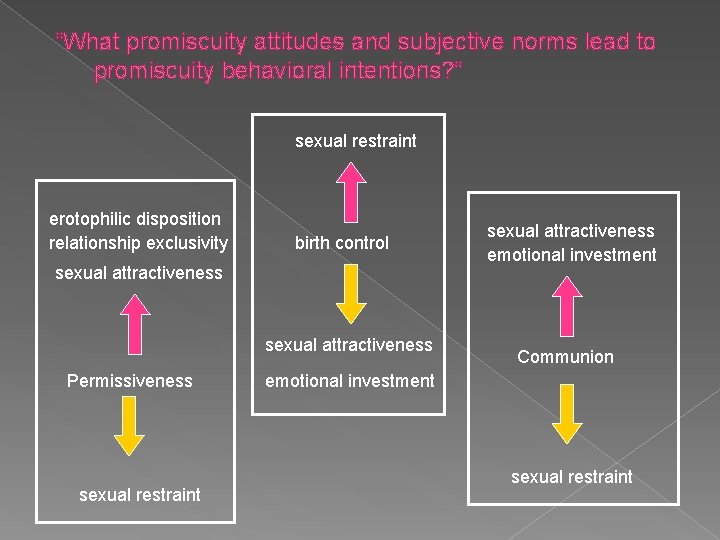
“What promiscuity attitudes and subjective norms lead to promiscuity behavioral intentions? ” sexual restraint erotophilic disposition relationship exclusivity birth control sexual attractiveness Permissiveness sexual restraint sexual attractiveness emotional investment Communion emotional investment sexual restraint
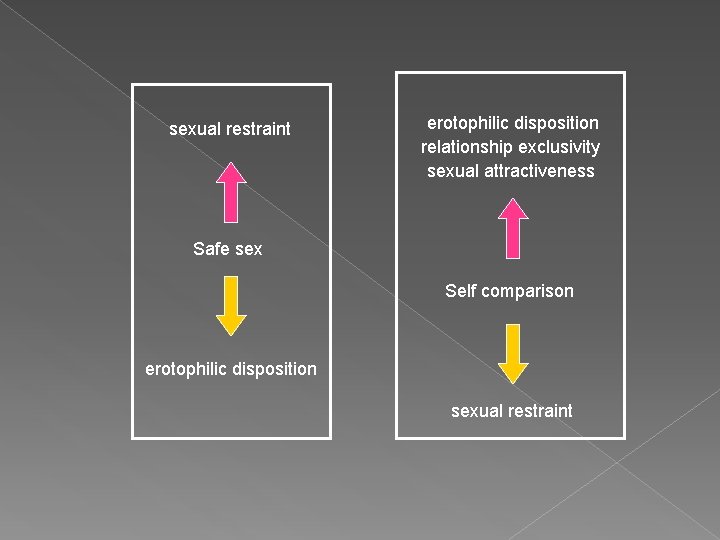
sexual restraint erotophilic disposition relationship exclusivity sexual attractiveness Safe sex Self comparison erotophilic disposition sexual restraint
For more information: Visit www. facebook. com Join the group “Personality, Sexual Attitudes, Sexual History! I need YOUR opinions!” Created by: Ariel Nieman
Works Cited � � � � � � � � � � Davis, C. M. , Yarber, W. L. , Bauserman, R. , Schreer, G. , & Davis S. L. (Eds. ). (1998). Handbook of sexually-related measures. USA: SAGE Publications, Inc. Eagly, A. H. , & Chaiken, S. (1993). The psychology of attitudes. Orlando: Harcourt, Inc. Eckstein, D. (2000). Empirical studies indicating significant birth-order-related personality differences. The Journal of Individual Psychology. 56, 481 -494. (2009). Esurveyspro: Premium survey services. Retrieved April 1, 2009, from e. Surveys. Pro Web site: http: //www. esurveyspro. com/ Hendrick, C. , Hendrick, S. S. , & Reich, D. A. (2006). The brief sexual attitudes scale. Journal of Sex Research. 43, 76 -86. Ingledew, D. K. , & Ferguson, E. (2007). Personality and riskier sexual behavior: Motivation mediators. Psychology and Health. 22, 291 -315. International Personality Item Pool: A Scientific Collaboratory for the Development of Advanced Measures of Personality Traits and Other Individual Differences (http: //ipip. ori. org/). Internet Web Site. Lohman, J. F. , Lohman, T. G. , & Christensen, O. (1985). Psychological position and perceived sibling differences. Individual Psychology: The Journal of Adlerian Theory, Research & Practice. 41, 313 -327. Markey, P. M. , & Markey, C. N. (2007). The interpersonal meaning of sexual promiscuity. Journal of Research in Personality. 41, 1199 -1212. Michalski, R. L. , & Shackelford, T. K. (2002). Birth order and sexual strategy. Personality and Individual Differences. 33, 661 -667. Nieman, A. G. (2009, March 31). Personality, sexual attitudes, sexual history! I need your opinions!. Retrieved April 1, 2009, from Facebook Web site: http: //www. facebook. com/group. php? gid=63169558211&ref=mf&nctrct=123864 0319863 Nyman, L. (1995). The identification of birth order personality attributes. The Journal of Psychology. 129, 51 -59. Pervin, L. , & John, O. P. (Eds. ). (1999). Handbook of personality: Theory and research. New York: Guilford. Schmitt, D. P. , & Buss, D. M. (2000). Sexual dimensions of person description: Beyond and subsumed by the big five? . Journal of Research in Personality. 34, 141 -177. Schmitt, D. P. (2004). The big five related to risky sexual behavior across 10 world regions: Differential personality associations of sexual promiscuity and relationship infidelity. European Journal of Personality. 18, 301 -319. Sollod, R. N. , Wilson, J. P. , & Monte, C. F. (2009). Beneath the mask: An introduction to theories of personality. USA: John Wiley & Sons, Inc. Srivastava, S. (2009). Measuring the Big Five Personality Factors. Retrieved March 13, 2009 from http: //www. uoregon. edu/~sanjay/bigfive. html Stewart, A. E. , Stewart, E. A. , & Campbell, L. F. (2001). The relationship of psychological birth order to the family atmosphere and to personality. The Journal of Individual Psychology. 57, 363 -387. Touhey, J. C. (1971). Birth order and virginity. Psychological Reports. 28, 894.
- Slides: 17