
Prokaryotic gene regulation Group 1 Akhtar Ali Lucile
- Slides: 30
Prokaryotic gene regulation Group # 1 Akhtar Ali Lucile Mc. Cook Marcella Hackney Sarah Lea Anglin Anne Grove (Facilitator)
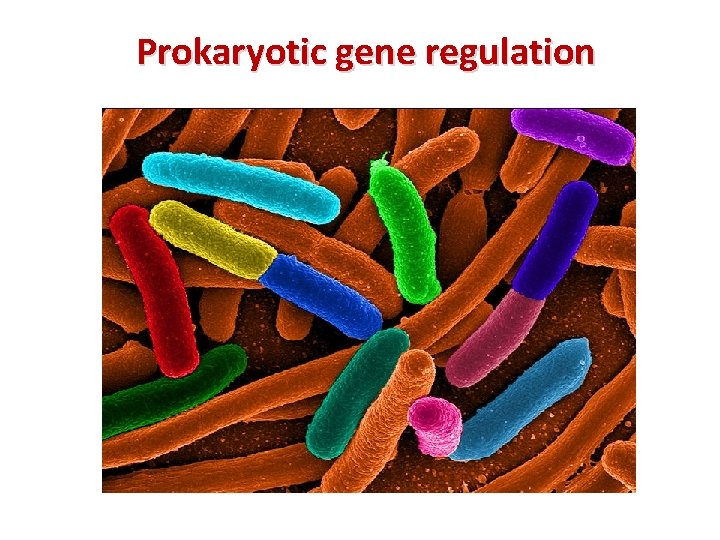
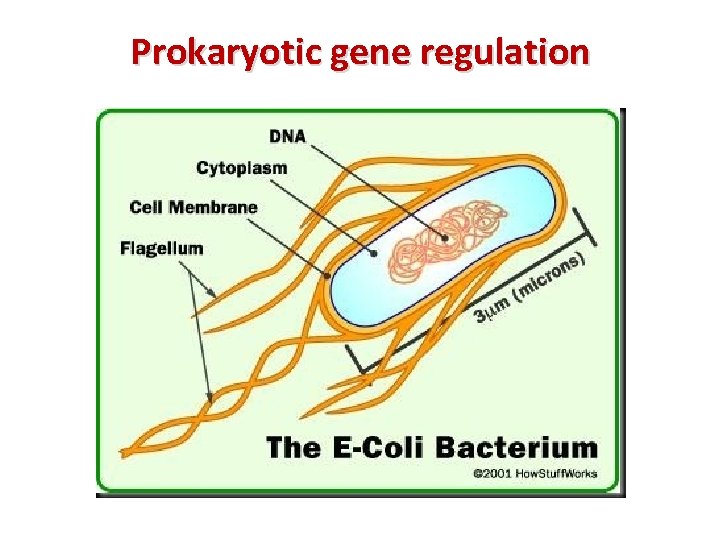
Prokaryotic gene regulation
Context Target Audience: Intro Biology for Freshmen
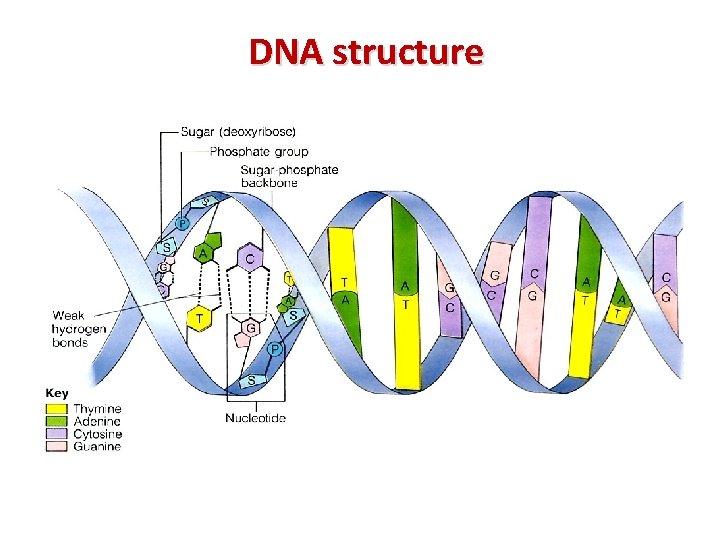
DNA structure
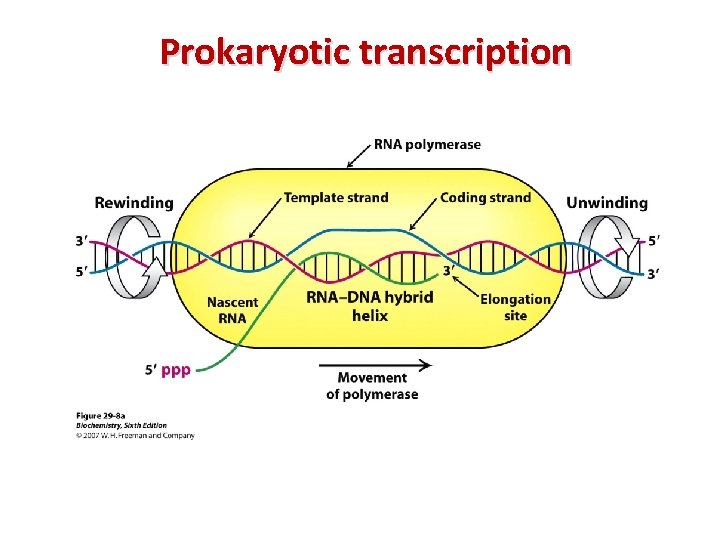
Prokaryotic transcription
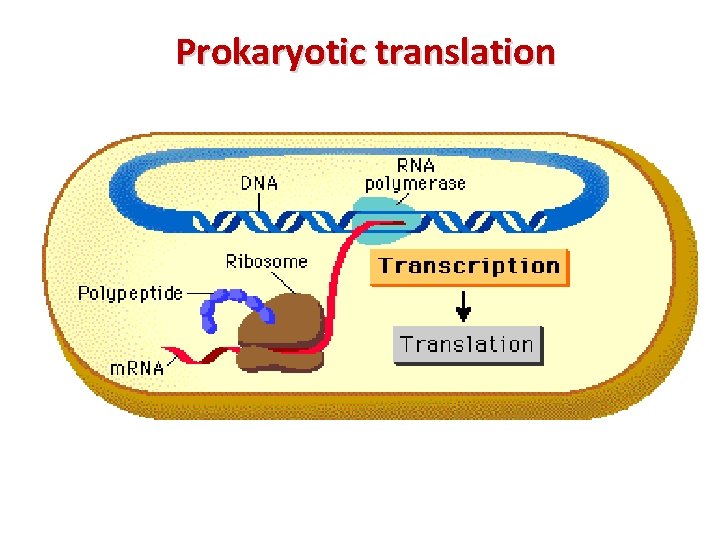
Prokaryotic translation
Context Students have already covered transcription and translation Now we are talking about gene regulation
Learning Objective The overall goal of the teachable unit is for students to understand why and how genes are regulated
Learning Goals The learning objective is to understand the role of the lac repressor in regulating the lac operon The goal of Teachable Tidbit # 1 is to define the terms that are required to understand the functions of operons Teachable Tidbit # 2 is to use this terminology to model the structure and functions of the lac operon
Outcomes Students will be able to understand terms in a functional context with regard to prokaryotic gene regulation specifically using the example of lac operon
Prokaryotic gene regulation
Tidbit # 1 Forming Term. Analogies
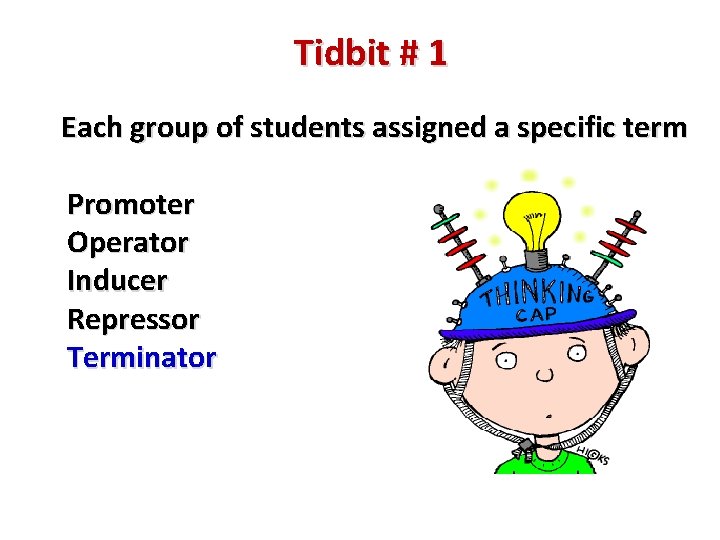
Tidbit # 1 Each group of students assigned a specific term Promoter Operator Inducer Repressor Terminator
Terminator
Promoter Operator Inducer Repressor
Instructions FIRST: devise a non-science (lay person, normal earth person) definition of/use of/function for the term SECOND: find/determine the scientific definition of the term with regard to gene expression THIRD: look for the similarities of how the term is used to gain an understanding of it in the scientific context Write/draw this information on the paper provided (5 min total)
Instructions-continued One team member will then explain these to the class, providing a FUNCTIONAL definition of the scientific term
Instructions-continued The terms will then be used to develop ideas of how each one functions in controlling the lac operon (the beginning of a model for the operon)—NEXT ACTIVITY
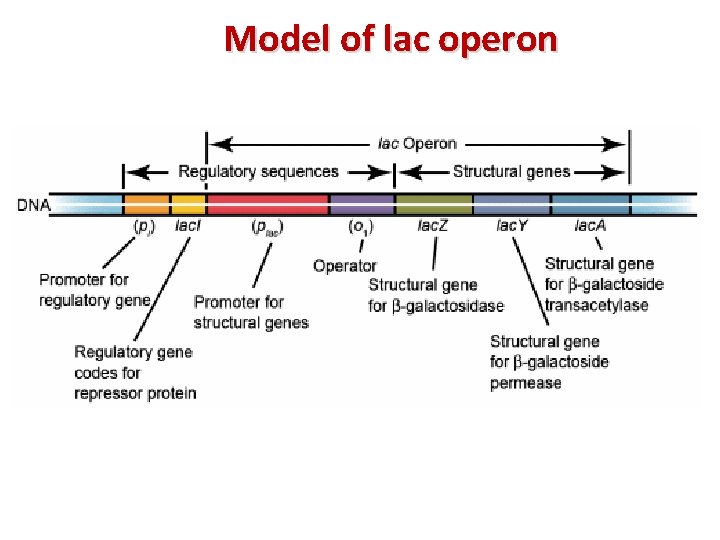
Model of lac operon
Instructions for the teacher This activity is an interactive physical demonstration of steps in lac operon function FIRST: Post and discuss the model of the lac operon SECOND: Assign students into groups to discuss the sequence of the events that must happen in the model
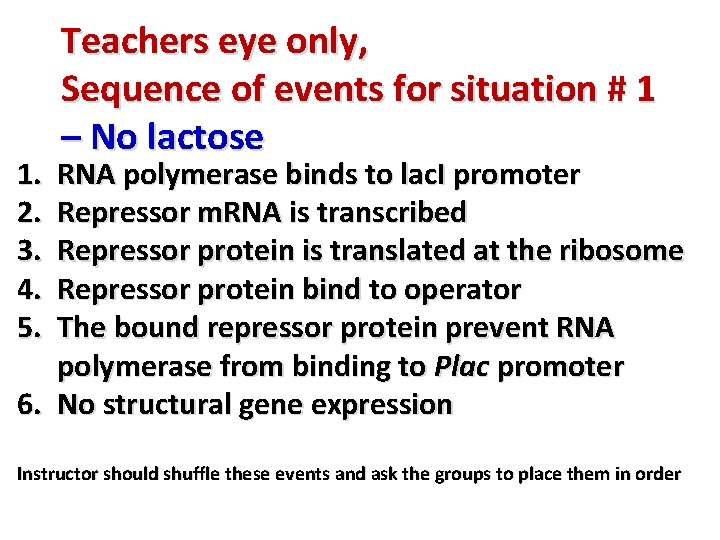
1. 2. 3. 4. 5. Teachers eye only, Sequence of events for situation # 1 – No lactose RNA polymerase binds to lac. I promoter Repressor m. RNA is transcribed Repressor protein is translated at the ribosome Repressor protein bind to operator The bound repressor protein prevent RNA polymerase from binding to Plac promoter 6. No structural gene expression Instructor should shuffle these events and ask the groups to place them in order
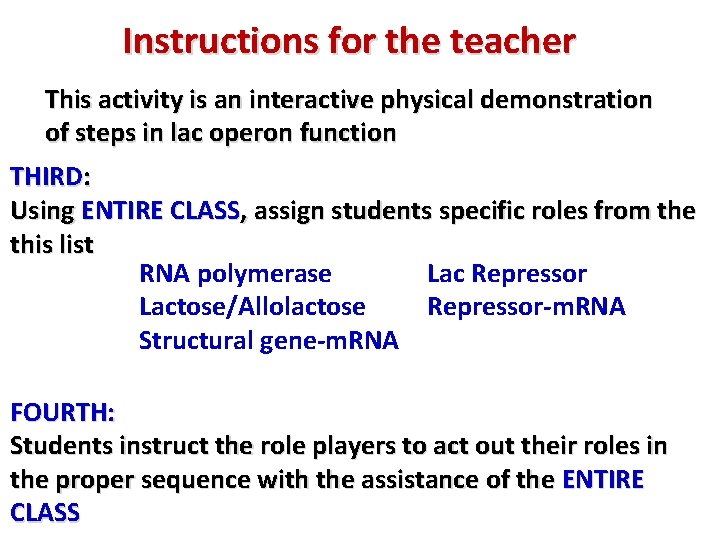
Instructions for the teacher This activity is an interactive physical demonstration of steps in lac operon function THIRD: Using ENTIRE CLASS, assign students specific roles from the this list RNA polymerase Lac Repressor Lactose/Allolactose Repressor-m. RNA Structural gene-m. RNA FOURTH: Students instruct the role players to act out their roles in the proper sequence with the assistance of the ENTIRE CLASS
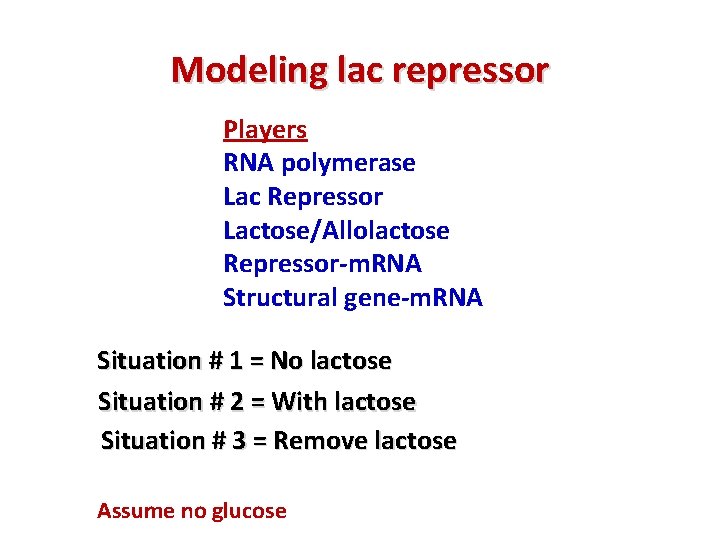
Modeling lac repressor Players RNA polymerase Lac Repressor Lactose/Allolactose Repressor-m. RNA Structural gene-m. RNA Situation # 1 = No lactose Situation # 2 = With lactose Situation # 3 = Remove lactose Assume no glucose
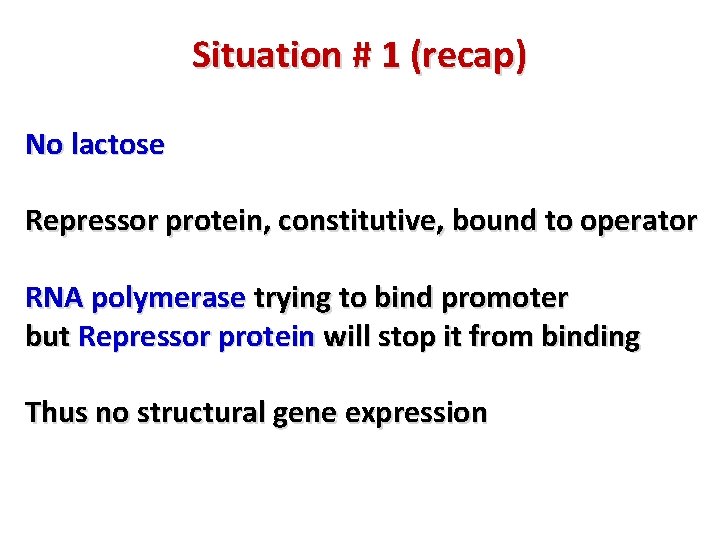
Situation # 1 (recap) No lactose Repressor protein, constitutive, bound to operator RNA polymerase trying to bind promoter but Repressor protein will stop it from binding Thus no structural gene expression
Situation # 2 (recap) Repressor protein binds inducer (Allolactose) and dissociates from operator RNA polymerase attaches to the promoter and synthesizes m. RNA, dissociates at terminator Keep synthesizing m. RNA until all Allolactose is gone (Situation # 3)
Formative Assessment Write the steps in sequence for both situations on note cards
Assessment (clicker? ) 1. Where does the repressor comes from? 2. Once ONE m. RNA is produced, does it just stop? 3. Can only one repressor block all the RNA polymerases? 4. How many places does RNA polymerase bind? 5. Why does this gene need to be regulated? 6. Where does lactose comes from and where does it go? 7. How many lac operons are in a single E. coli cell? 8. How long would it take in real time?
Diversity 1. Images 2. Term definitions 3. Analogies 4. Actors/role play 5. Clicker questions 6. Group work 7. Mini lectures 8. Shout
Ideas for modification and extension 1. Use this process with transcription early in the semester using similar props 2. Add the rest of the chromosome (or on separate slide) 3. Teach term. Analogy in one lecture and send them home with home work 4. Next lecture shall be modeling (Tidbit #2) 5. (optional) Embedded clicker questions between situation 1 and 2 6. Slow the process if the students did not pick it up 7. Place the students into groups how it will be modeled 8. Could be extended to other operons (tryptophan) 9. Individual final formative assessment (brief assignment) 10. Instructor should prompt the student if the class is unable to do it 11. Use multiple RNA polymerases, m. RNA and Allolactose
Thanks for being Good Listeners and Participants