
PROKARYOTIC CELLS Topic 2 2 IB Biology Miss
PROKARYOTIC CELLS Topic 2. 2 IB Biology Miss Werba
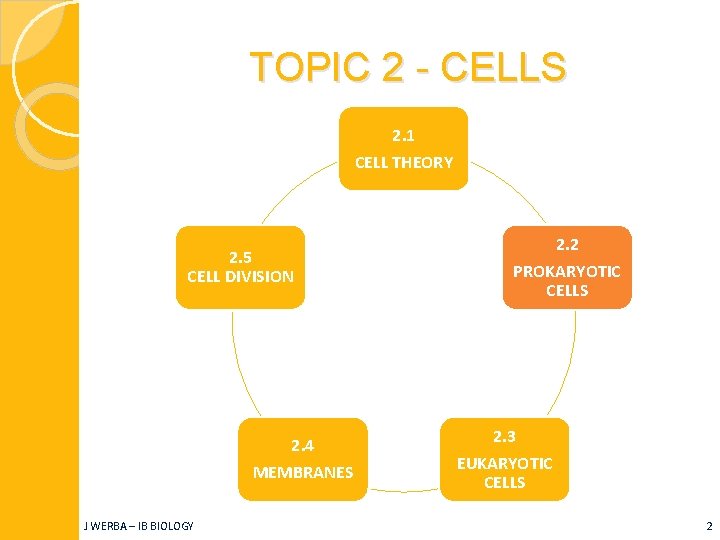
TOPIC 2 - CELLS 2. 1 CELL THEORY 2. 5 CELL DIVISION 2. 4 MEMBRANES J WERBA – IB BIOLOGY 2. 2 PROKARYOTIC CELLS 2. 3 EUKARYOTIC CELLS 2
THINGS TO COVER � Ultrastructure of a prokaryotic cell � Functions of cell structures � Structures identifiable under an EM � Binary fission J WERBA – IB BIOLOGY 3
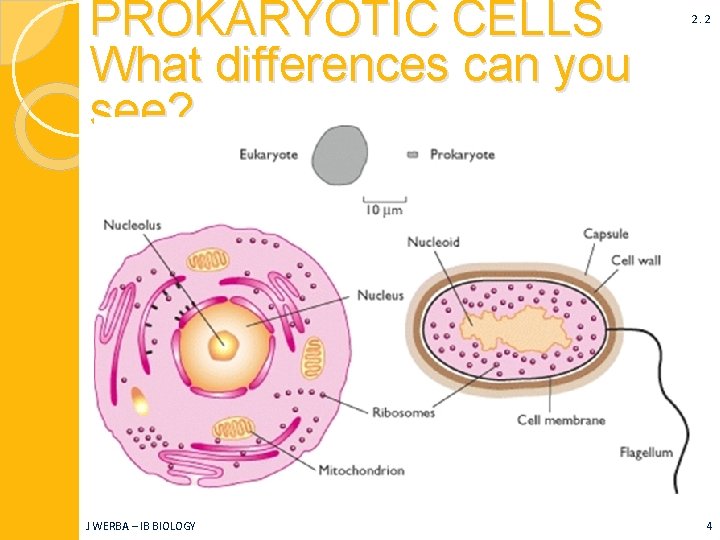
PROKARYOTIC CELLS What differences can you see? J WERBA – IB BIOLOGY 2. 2 4
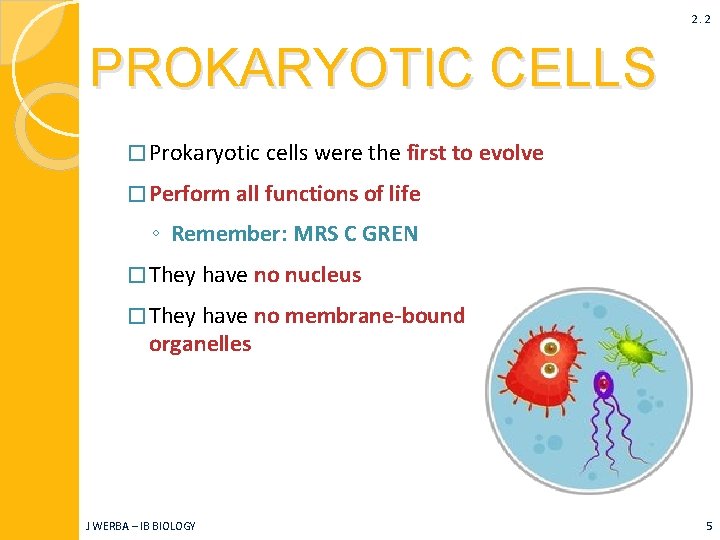
2. 2 PROKARYOTIC CELLS � Prokaryotic cells were the first to evolve � Perform all functions of life ◦ Remember: MRS C GREN � They have no nucleus � They have no membrane-bound organelles J WERBA – IB BIOLOGY 5
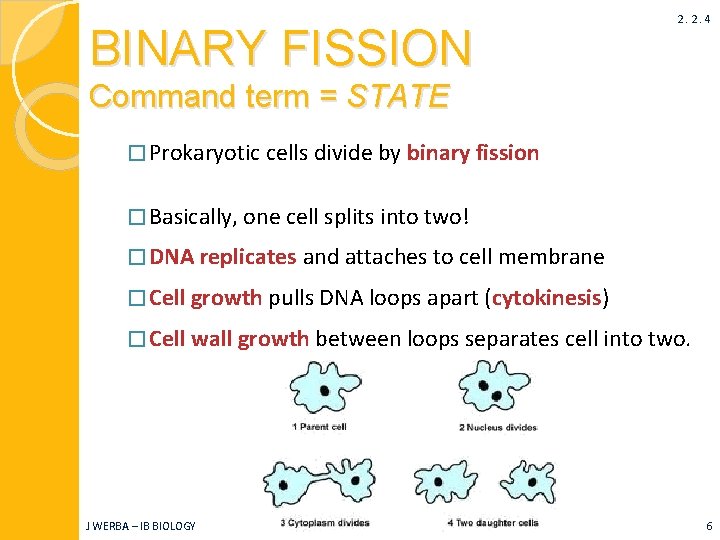
BINARY FISSION 2. 2. 4 Command term = STATE � Prokaryotic cells divide by binary fission � Basically, one cell splits into two! � DNA replicates and attaches to cell membrane � Cell growth pulls DNA loops apart (cytokinesis) � Cell wall growth between loops separates cell into two. J WERBA – IB BIOLOGY 6
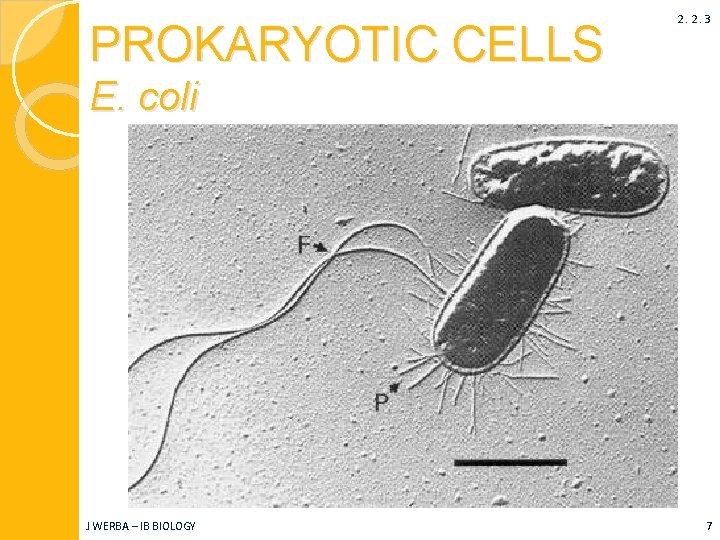
PROKARYOTIC CELLS 2. 2. 3 E. coli J WERBA – IB BIOLOGY 7
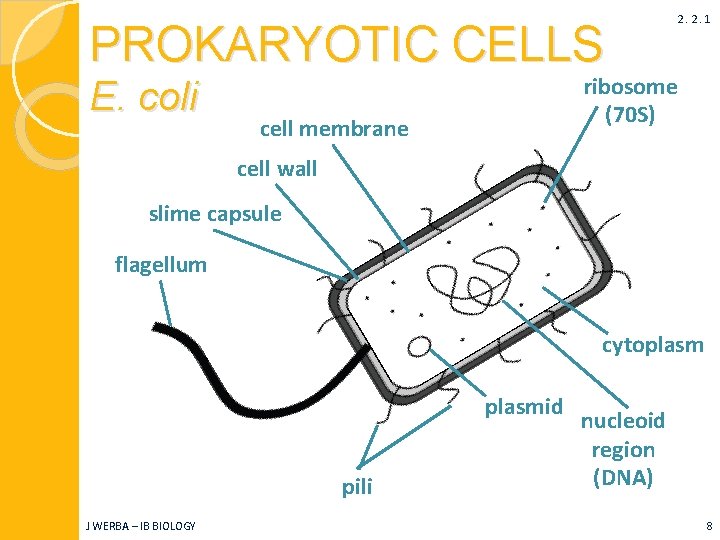
PROKARYOTIC CELLS E. coli 2. 2. 1 ribosome (70 S) cell membrane cell wall slime capsule flagellum cytoplasmid pili J WERBA – IB BIOLOGY nucleoid region (DNA) 8
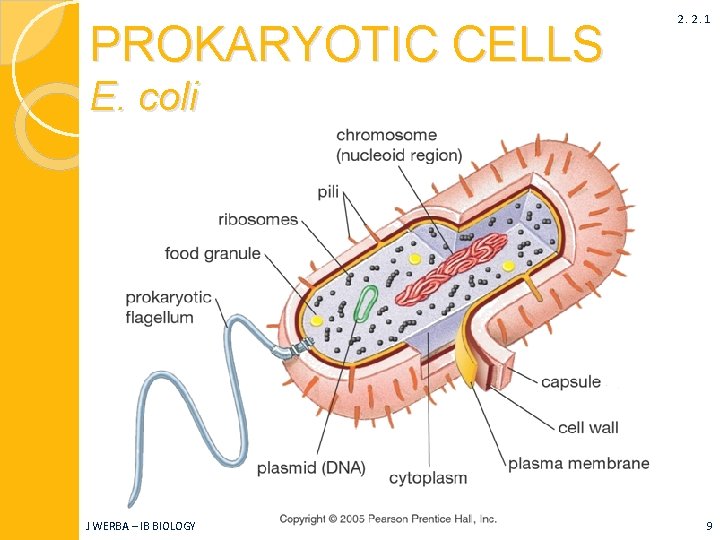
PROKARYOTIC CELLS 2. 2. 1 E. coli J WERBA – IB BIOLOGY 9
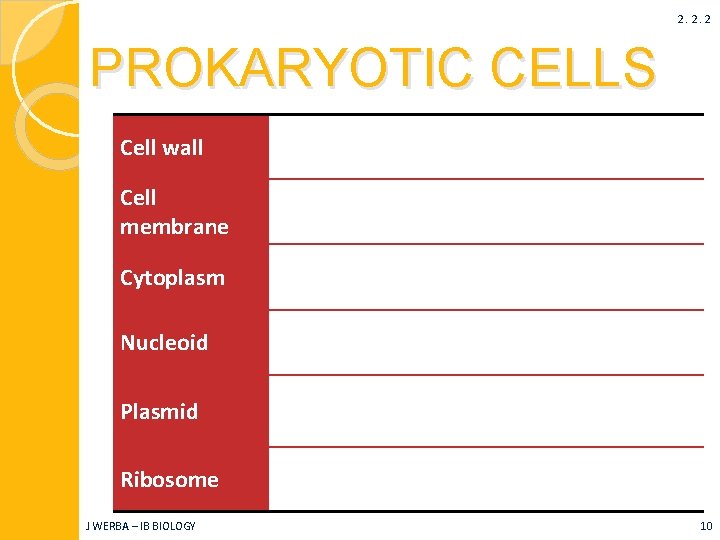
2. 2. 2 PROKARYOTIC CELLS Cell wall A rigid outer layer that maintains shape and protects the cell from damage or bursting if internal pressure is high Cell membrane Semi-permeable barrier that controls the entry and exit of substances Cytoplasm Fluid component which contains enzymes needed for cell metabolism Nucleoid Region of the cytoplasm which contains the DNA Plasmid Additional DNA molecule that can exist and replicate independently - it can be transmitted between bacterial species Ribosome Protein synthesis (prokaryotic ribosomes smaller than eukaryotic - 70 S) J WERBA – IB BIOLOGY 10
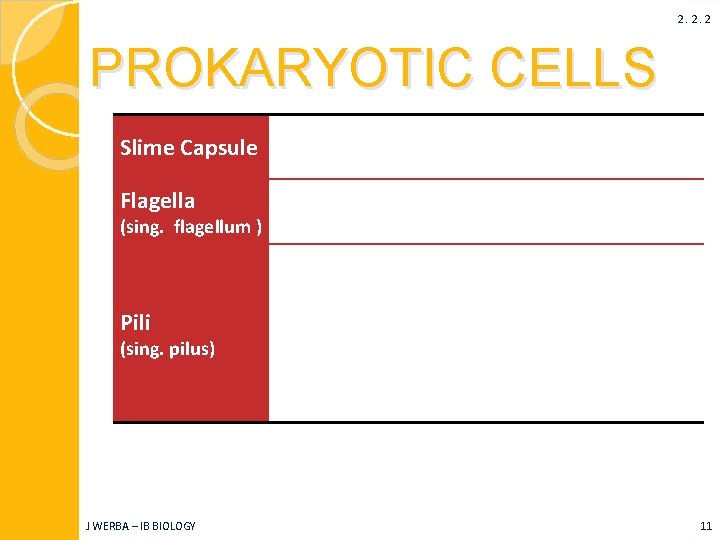
2. 2. 2 PROKARYOTIC CELLS Slime Capsule Protects against desiccation (drying out) and phagocytosis Flagella Long, slender projection which spins like a propeller, (sing. flagellum ) enabling movement Pili (sing. pilus) J WERBA – IB BIOLOGY Hair-like extensions which can serve for attachment or communication. Attachment pili: Shorter in length, allow adhesion to other bacteria or surfaces Communication pili: Longer in length, allow for the exchange of plasmids 11
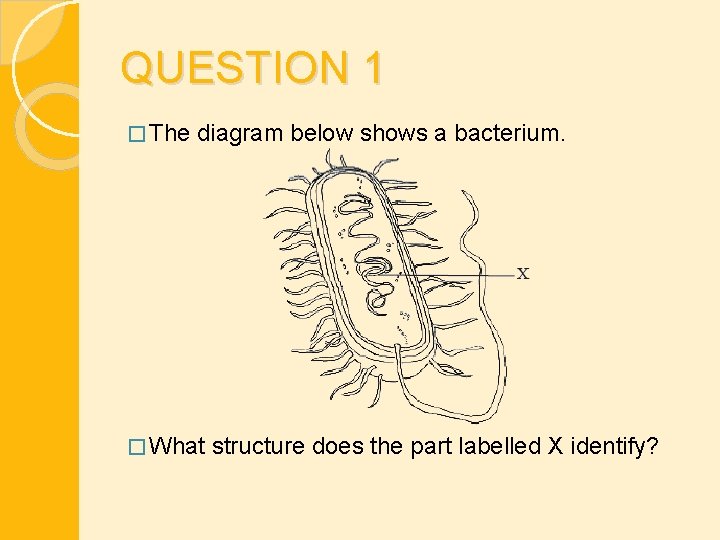
QUESTION 1 � The diagram below shows a bacterium. � What structure does the part labelled X identify?

QUESTION 1 - answer �X = Nucleoid
QUESTION 2 � Escherichia coli is a unicellular organism, so each cell must carry out all of the processes required for life. Outline the functions of each of the structures in the cells of Escherichia coli. (9 marks)
QUESTION 2 � Escherichia coli is a unicellular organism, so each cell must carry out all of the processes required for life. Outline the functions of each of the structures in the cells of Escherichia coli. (9 marks) Step 1: Command term What does the ‘OUTLINE’ command term ask for?
QUESTION 2 � Escherichia coli is a unicellular organism, so each cell must carry out all of the processes required for life. Outline the functions of each of the structures in the cells of Escherichia coli. (9 marks) Give a brief account or summary. May or may not involved a diagram.
QUESTION 2 � Escherichia coli is a unicellular organism, so each cell must carry out all of the processes required for life. Outline the functions of each of the structures in the cells of Escherichia coli. (9 marks) Step 2: Relevant words What vocab words would be relevant?
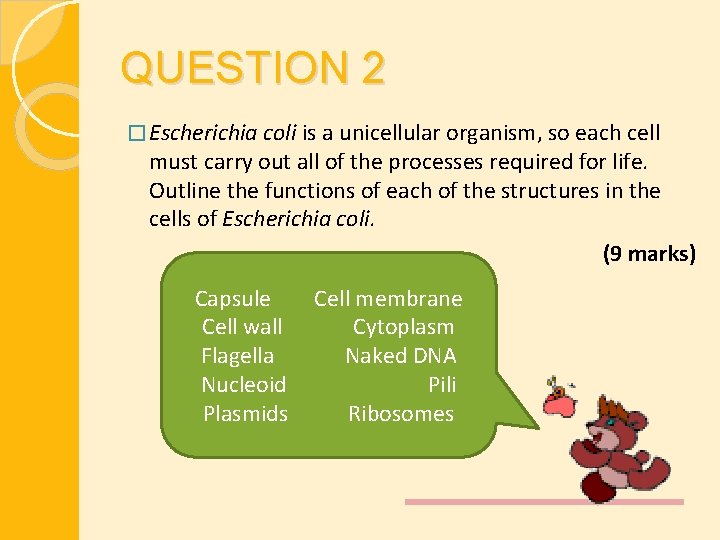
QUESTION 2 � Escherichia coli is a unicellular organism, so each cell must carry out all of the processes required for life. Outline the functions of each of the structures in the cells of Escherichia coli. (9 marks) Capsule Cell wall Flagella Nucleoid Plasmids Cell membrane Cytoplasm Naked DNA Pili Ribosomes
QUESTION 2 � Escherichia coli is a unicellular organism, so each cell must carry out all of the processes required for life. Outline the functions of each of the structures in the cells of Escherichia coli. (9 marks) Step 3: Order ideas Can you put some order to your ideas?
QUESTION 2 � Escherichia coli is a unicellular organism, so each cell must carry out all of the processes required for life. Outline the functions of each of the structures in the cells of Escherichia coli. (9 marks) Might be good to make a little flowchart or for this question, work from the outside in or vice versa
QUESTION 2 � Escherichia coli is a unicellular organism, so each cell must carry out all of the processes required for life. Outline the functions of each of the structures in the cells of Escherichia coli. (9 marks) Step 4: Check the mark allocation Do you have enough to get all the marks?
QUESTION 2 � Escherichia coli is a unicellular organism, so each cell must carry out all of the processes required for life. Outline the functions of each of the structures in the cells of Escherichia coli. (9 marks) 9 marks = 9 separate statements There were at least 10 words on the list!
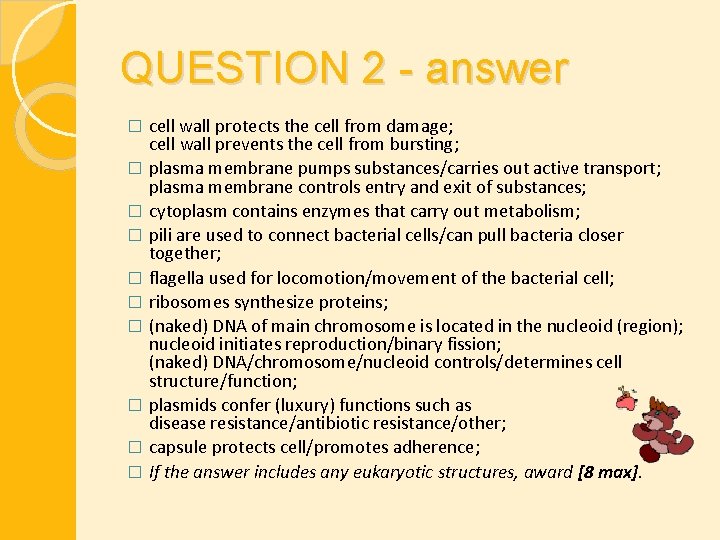
QUESTION 2 - answer � � � � � cell wall protects the cell from damage; cell wall prevents the cell from bursting; plasma membrane pumps substances/carries out active transport; plasma membrane controls entry and exit of substances; cytoplasm contains enzymes that carry out metabolism; pili are used to connect bacterial cells/can pull bacteria closer together; flagella used for locomotion/movement of the bacterial cell; ribosomes synthesize proteins; (naked) DNA of main chromosome is located in the nucleoid (region); nucleoid initiates reproduction/binary fission; (naked) DNA/chromosome/nucleoid controls/determines cell structure/function; plasmids confer (luxury) functions such as disease resistance/antibiotic resistance/other; capsule protects cell/promotes adherence; If the answer includes any eukaryotic structures, award [8 max].
- Slides: 23