
Prokaryotic Cells IB Topic 2 2 Identifying Cells
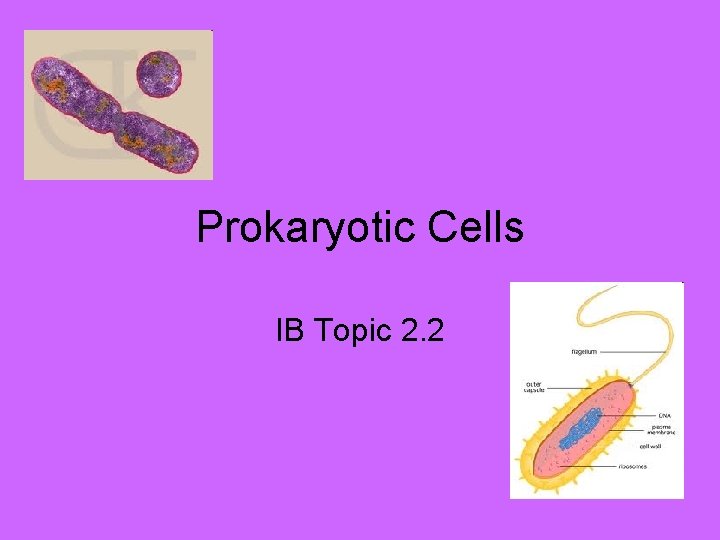
Prokaryotic Cells IB Topic 2. 2
Identifying Cells • Cells are divided into groups based on major characteristics • Cells are divided into two major groups: – Prokaryotic cells – Eukaryotic cells
Prokaryotic Cells • Much smaller and simpler than eukaryotic cells – Less than 1 μm in diameter • Thought to have appeared on Earth first • Bacteria are prokaryotic cells – Fun fact: • The word “pro” means before • The word “karyon” means kernel (referring to the nucleus) • Both are Greek
Features of Prokaryotic Cells • • • Cell wall Plasma membrane Flagella Ribosomes Nucleoid See Figure 2. 1 (page 22)
The Cell Wall • Cell wall – Protects and maintains the shape of the cell – Composed of carbohydrate-protein complex called peptidoglycan – Some bacteria have an extra layer (polysaccharide) outside the cell wall • Allows bacteria to stick to teeth, skin, and food
The Plasma Membrane • Just inside the cell wall • Controls the movement of materials in and out of the cell • Plays a role in binary fission • Cytoplasm occupies the complete interior of the cell – Jelly-like material – All cellular processes take place in the cytoplasm
Fun Fact • Some bacteria, like the ones that cause pneumonia and meningitis have a thick outer layer called a capsule – Made of sugars • Increases chance of survival • Decreases chance of immune system destroying them
Pili and Flagella • Pili – Hair-like growths outside the cell wall – Used for attachment – Main function: joining bacteria cells to transfer DNA from one cell to another • Flagella (or flagellum) – Longer than pili – Allow for mobility
Ribosomes • Site of protein synthesis • Very small structures • Appear in very large numbers in cells with high protein production
The nucleoid region • Non-compartmentalized • Contains a single, long, continuous, circular thread of DNA • This region is involved in: – Cell control and reproduction • Also contain plasmids: – – Small, circular DNA Not connected to the main bacterial chromosome Replicate independently Not required by the cell • May help the cell adapt to unusual circumstances
How do prokaryotic cells divide? • Binary Fission • Simple process: – DNA is copied – The two daughter chromosomes become attached to different regions on the plasma membrane – The cell splits (divides) into two genetically identical daughter cells – In some bacterial cells, this takes ~20 minutes • Huge populations. . Greater potential for infection
In conclusion: • DNA is not enclosed within a membrane and is one circular chromosome • Their DNA is free, not attached to proteins • They lack membrane-bound organelles – But do have ribosomes • Cell wall is made up of peptidoglycan • Divide by binary fission • Small in size (1 -10 μm)
- Slides: 12