
Prokaryotes Prokaryotes Classification of prokaryotes has dramatically changed
- Slides: 14
Prokaryotes
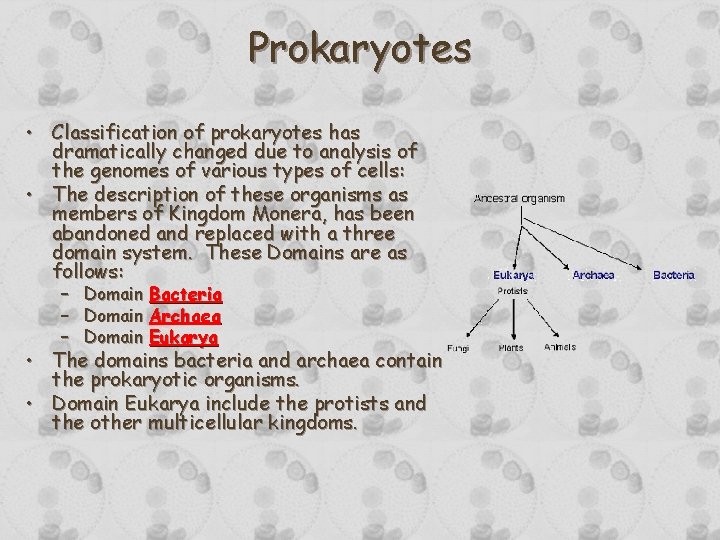
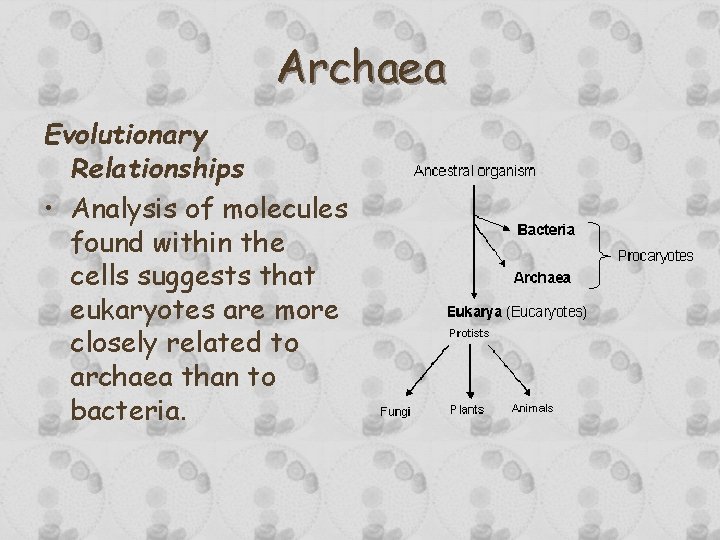
Prokaryotes • Classification of prokaryotes has dramatically changed due to analysis of the genomes of various types of cells: • The description of these organisms as members of Kingdom Monera, has been abandoned and replaced with a three domain system. These Domains are as follows: – – – Domain Bacteria Domain Archaea Domain Eukarya • The domains bacteria and archaea contain the prokaryotic organisms. • Domain Eukarya include the protists and the other multicellular kingdoms.
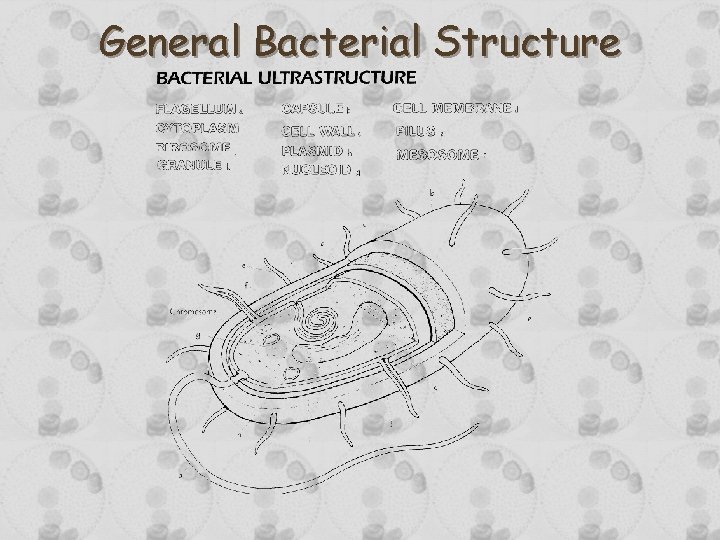
General Bacterial Structure
General Characteristics • Bacteria are the smallest "living" organisms • Are prokaryotic cells • Lack Nucleus • DNA is naked. - a single loop - not bound into a chromosome. • May contain plasmids (small circular fragments of DNA) • Lack membrane-bound organelles • Usually have an outer Cell Wall. • Sometimes have an Outer Capsule - These stain red in a Gram Stain test and are called Gram Negative bacteria. • Those without an outer capsule stain blue in the gram stain test and are called Gram Positive Bacteria
BACTERIAL CLASSIFICATION: • Bacteria are classified generally by 3 characteristics – – – The bacterial cell shape The bacterial cell arrangements Ability to accept a Gram stain
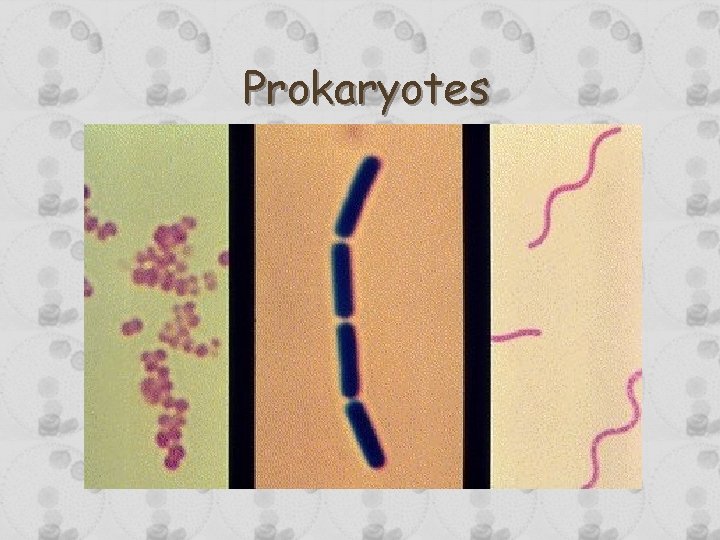
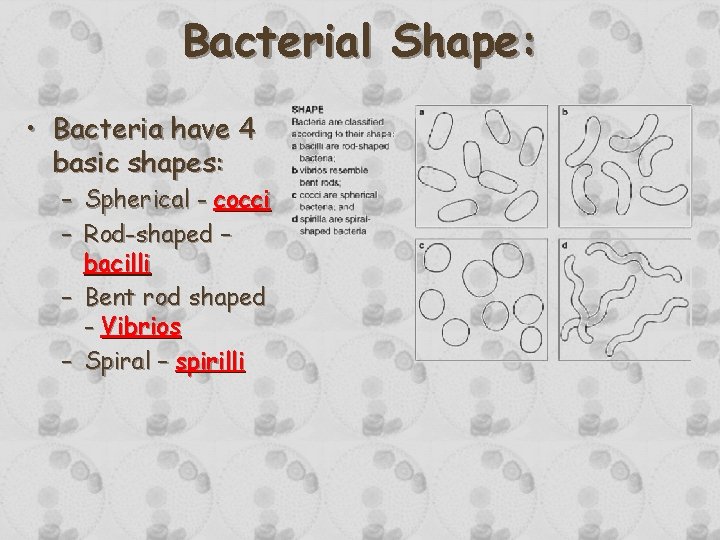
Bacterial Shape: • Bacteria have 4 basic shapes: – Spherical - cocci – Rod-shaped – bacilli – Bent rod shaped - Vibrios – Spiral – spirilli
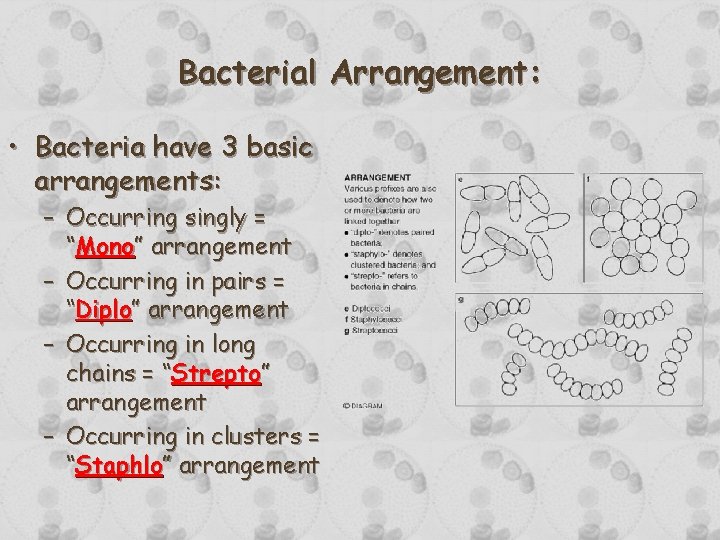
Bacterial Arrangement: • Bacteria have 3 basic arrangements: – Occurring singly = “Mono” arrangement – Occurring in pairs = “Diplo” arrangement – Occurring in long chains = “Strepto” arrangement – Occurring in clusters = “Staphlo” arrangement
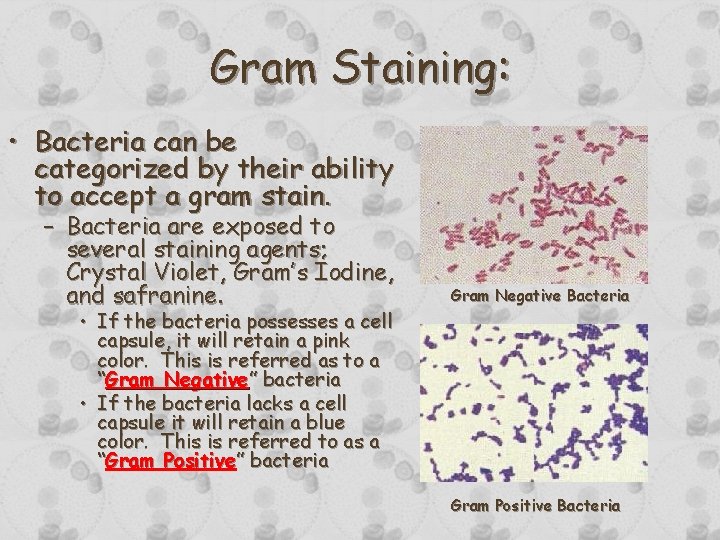
Gram Staining: • Bacteria can be categorized by their ability to accept a gram stain. – Bacteria are exposed to several staining agents; Crystal Violet, Gram’s Iodine, and safranine. • If the bacteria possesses a cell capsule, it will retain a pink color. This is referred as to a “Gram Negative” bacteria • If the bacteria lacks a cell capsule it will retain a blue color. This is referred to as a “Gram Positive” bacteria Gram Negative Bacteria Gram Positive Bacteria
How Bacteria obtain energy: • Two major categories: – Autotrophs - Make their own energy - 2 types • Phototrophic autotrophs - Get energy from sunlight • Chemotrophic autotrophs - Get energy from inorganic molecules (eg. Sulfides) – Heterotrophs - Energy obtained from other organisms • Chemotrophic heterotrophs - obtain energy by dissolving/absorbing organic material • Phototrophic heterotrophs - meet some energy needs from photosynthesis, but must absorb organic compounds.
Bacterial Respiration 3 major categories • Obligate aerobes. - Must have O 2 in order to live • Obligate anaerobes - Must live in an O 2 free environment • Facultative anaerobes - Can live with or without O 2.
Bacterial Reproduction: • Bacteria reproduce through binary fission. • Can engage in primitive sexual reproduction called conjugation. – A bridge is formed between 2 bacteria – Plasmids are shared across bridge, thus exchanging genetic information. – In times of harsh conditions, bacteria can form endospores, to encapsulate themselves in a dormant state, until conditions improve.
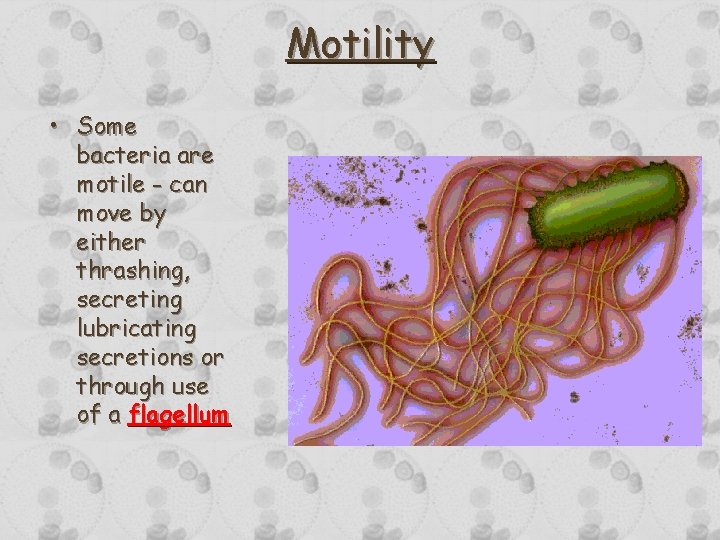
Motility • Some bacteria are motile - can move by either thrashing, secreting lubricating secretions or through use of a flagellum
Archaea Evolutionary Relationships • Analysis of molecules found within the cells suggests that eukaryotes are more closely related to archaea than to bacteria.
Major Groups of Archaea • Three major groups of archaea are found in extreme habitats. – Methanogens are found in anaerobic environments. such as marshes and in the intestinal tracts of animals. They produce methane as a result of cellular respiration. – Halophiles are found in environments with high salt concentration such as the great salt lake or soil with a high salt concentration. – Thermoacidophiles live in hot, acidic environments such as hot springs and hydrothermal vents.