
Projects Phase II Design What is expected 5
- Slides: 11
Projects: Phase II, Design • What is expected – 5 minute presentation – 4 -6 pages in ACM format (can include multiple figures showing interfaces, architecture) • This is an extension of prior submission so you are just adding to the report already submitted for Phase I • What to discuss – What will it look like? Where are the key features related to this class in the interface? – Why is the design? What other options did you consider? – Who will do what to instantiate this design?
Communicative Resources
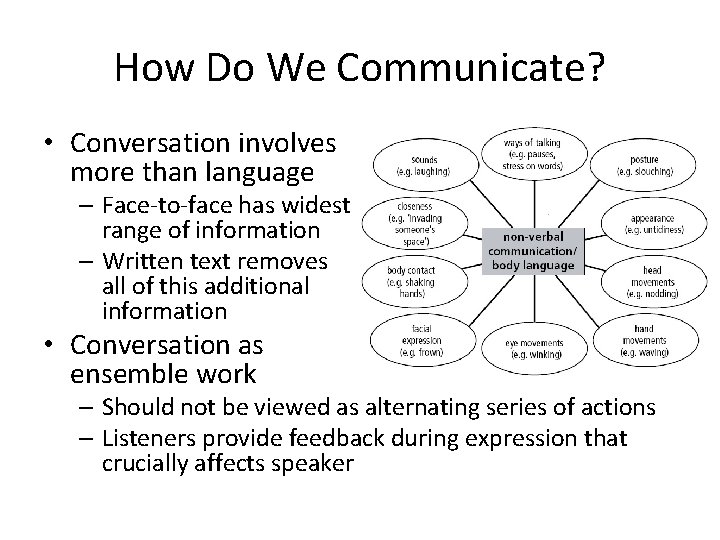
How Do We Communicate? • Conversation involves more than language – Face-to-face has widest range of information – Written text removes all of this additional information • Conversation as ensemble work – Should not be viewed as alternating series of actions – Listeners provide feedback during expression that crucially affects speaker
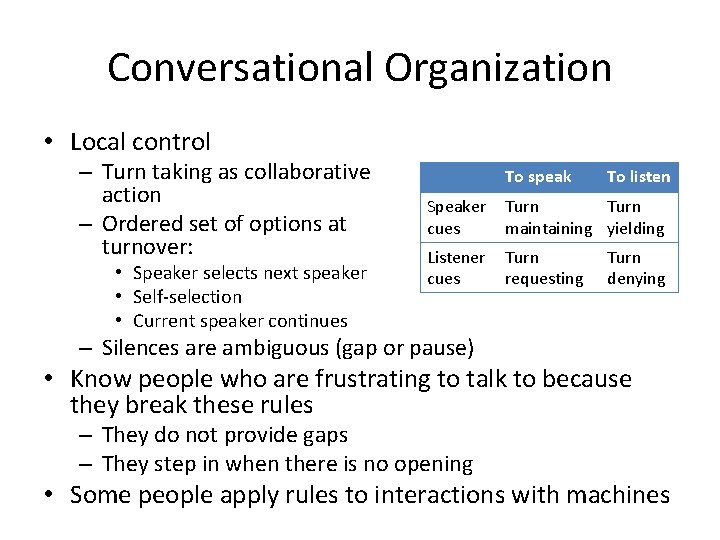
Conversational Organization • Local control – Turn taking as collaborative action – Ordered set of options at turnover: • Speaker selects next speaker • Self-selection • Current speaker continues To speak To listen Speaker cues Turn maintaining yielding Listener cues Turn requesting Turn denying – Silences are ambiguous (gap or pause) • Know people who are frustrating to talk to because they break these rules – They do not provide gaps – They step in when there is no opening • Some people apply rules to interactions with machines
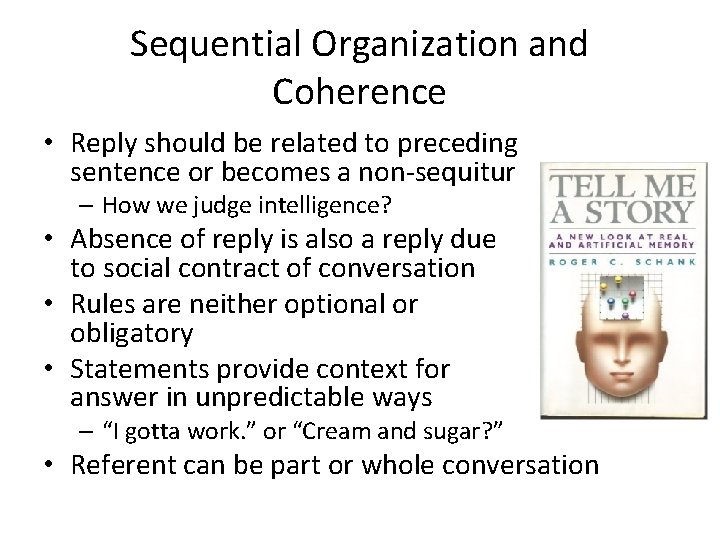
Sequential Organization and Coherence • Reply should be related to preceding sentence or becomes a non-sequitur – How we judge intelligence? • Absence of reply is also a reply due to social contract of conversation • Rules are neither optional or obligatory • Statements provide context for answer in unpredictable ways – “I gotta work. ” or “Cream and sugar? ” • Referent can be part or whole conversation
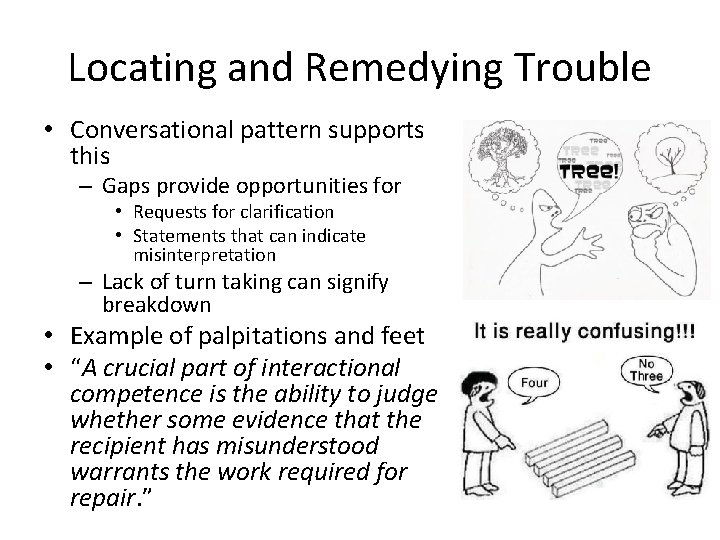
Locating and Remedying Trouble • Conversational pattern supports this – Gaps provide opportunities for • Requests for clarification • Statements that can indicate misinterpretation – Lack of turn taking can signify breakdown • Example of palpitations and feet • “A crucial part of interactional competence is the ability to judge whether some evidence that the recipient has misunderstood warrants the work required for repair. ”
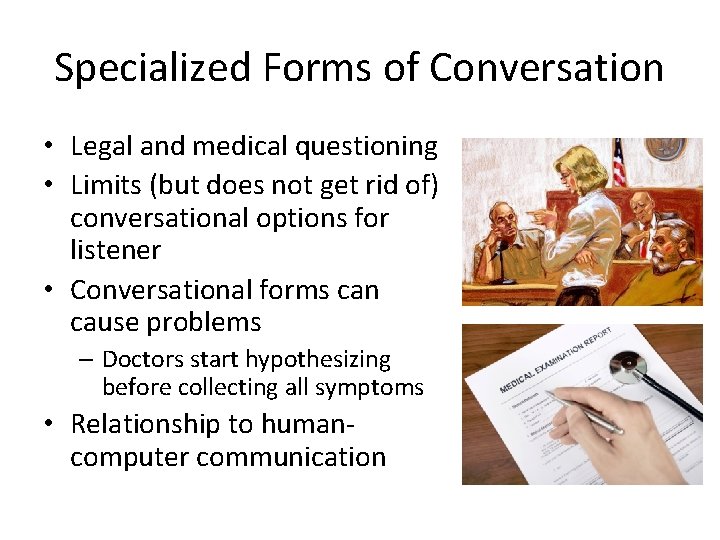
Specialized Forms of Conversation • Legal and medical questioning • Limits (but does not get rid of) conversational options for listener • Conversational forms can cause problems – Doctors start hypothesizing before collecting all symptoms • Relationship to humancomputer communication
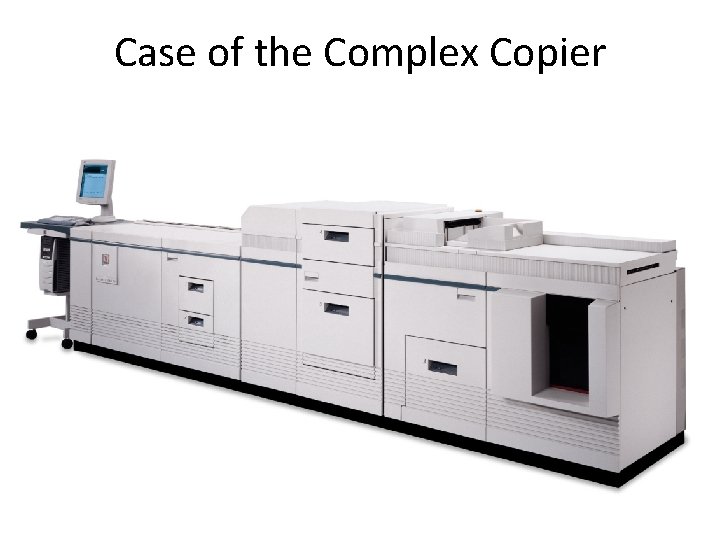
Case of the Complex Copier
Case of the Complex Copier • Expert help system – Maps user’s goals to job specification to plans • Goals constrained by functionality • Plans must accommodate semi-ordered actions – Plans recognized part-way points – Changes in preconditions • Some actions produce recognizable effects
Instructions • Following instructions turns partial descriptions into concrete actions • Instructions rely on recipient’s ability to anchor descriptions – Although system/we see only effect of that • Execution can include “unpredictable” interpretations (e. g. lucky pan) • Communicating instructions can rely on a combination of language, materials, history • Existence of interaction more important to success than whether instructions are written or spoken
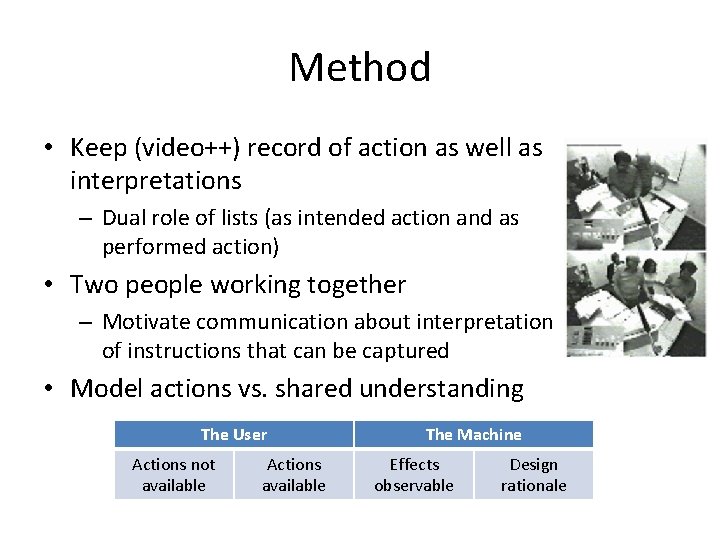
Method • Keep (video++) record of action as well as interpretations – Dual role of lists (as intended action and as performed action) • Two people working together – Motivate communication about interpretation of instructions that can be captured • Model actions vs. shared understanding The User Actions not available Actions available The Machine Effects observable Design rationale