
Projects of Common Interest 2018 2019 Meeting of
- Slides: 47
Projects of Common Interest 2018 - 2019 Meeting of TEN-E cross - Regional Group on electricity DG ENER, Networks & Régional Initiatives https: //webcast. ec. europa. eu/pci-electricity Energy
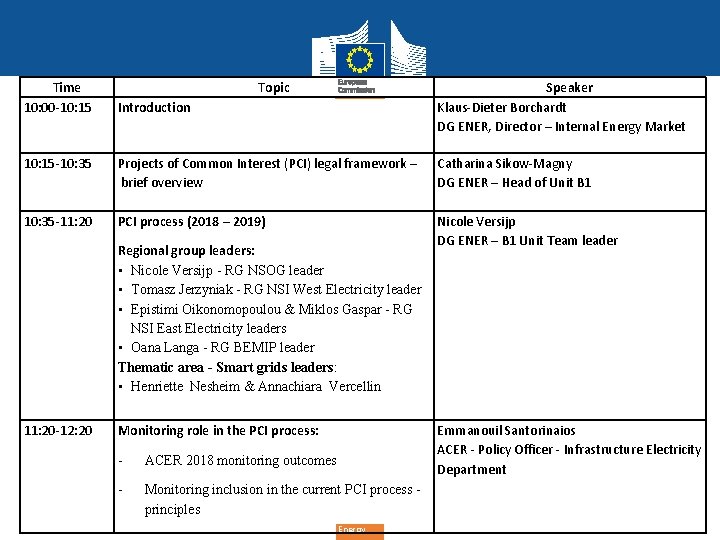
Time 10: 00 -10: 15 Topic Introduction Speaker Klaus-Dieter Borchardt DG ENER, Director – Internal Energy Market 10: 15 -10: 35 Projects of Common Interest (PCI) legal framework – brief overview Catharina Sikow-Magny DG ENER – Head of Unit B 1 10: 35 -11: 20 PCI process (2018 – 2019) Nicole Versijp DG ENER – B 1 Unit Team leader Regional group leaders: • Nicole Versijp - RG NSOG leader • Tomasz Jerzyniak - RG NSI West Electricity leader • Epistimi Oikonomopoulou & Miklos Gaspar - RG NSI East Electricity leaders • Oana Langa - RG BEMIP leader Thematic area - Smart grids leaders: • Henriette Nesheim & Annachiara Vercellin 11: 20 -12: 20 Monitoring role in the PCI process: Emmanouil Santorinaios ACER - Policy Officer - Infrastructure Electricity Department - ACER 2018 monitoring outcomes - Monitoring inclusion in the current PCI process principles Energy
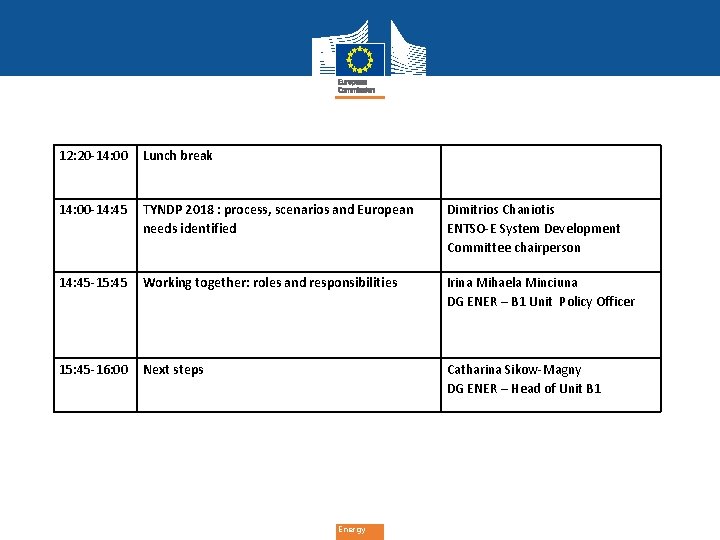
12: 20 -14: 00 Lunch break 14: 00 -14: 45 TYNDP 2018 : process, scenarios and European needs identified Dimitrios Chaniotis ENTSO-E System Development Committee chairperson 14: 45 -15: 45 Working together: roles and responsibilities Irina Mihaela Minciuna DG ENER – B 1 Unit Policy Officer 15: 45 -16: 00 Next steps Catharina Sikow-Magny DG ENER – Head of Unit B 1 Energy
Projects of Common Interest Legal framework Energy
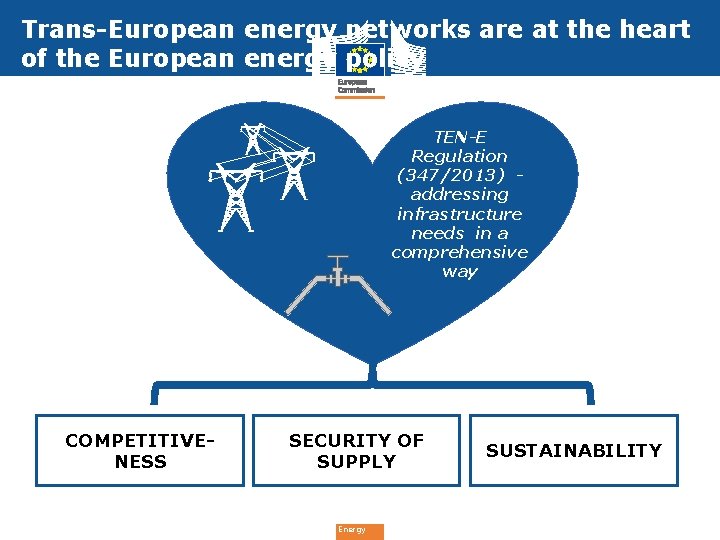
Trans-European energy networks are at the heart of the European energy policy TEN-E Regulation (347/2013) addressing infrastructure needs in a comprehensive way COMPETITIVENESS SECURITY OF SUPPLY Energy SUSTAINABILITY
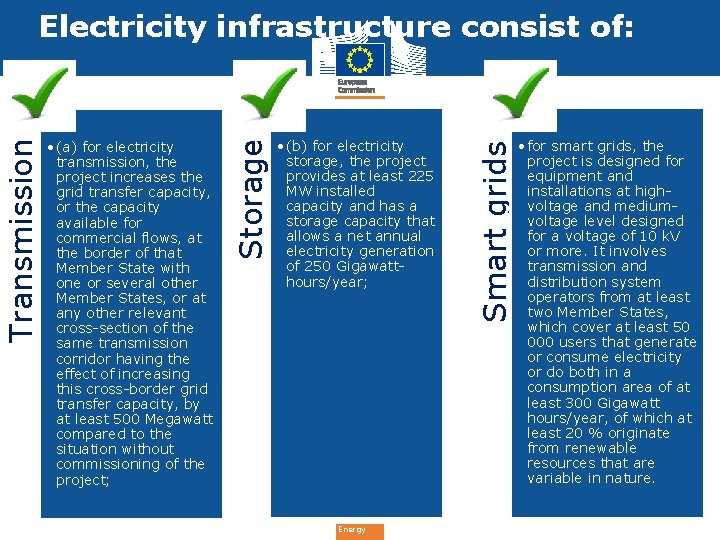
• (b) for electricity storage, the project provides at least 225 MW installed capacity and has a storage capacity that allows a net annual electricity generation of 250 Gigawatthours/year; Energy Smart grids • (a) for electricity transmission, the project increases the grid transfer capacity, or the capacity available for commercial flows, at the border of that Member State with one or several other Member States, or at any other relevant cross-section of the same transmission corridor having the effect of increasing this cross-border grid transfer capacity, by at least 500 Megawatt compared to the situation without commissioning of the project; Storage Transmission Electricity infrastructure consist of: • for smart grids, the project is designed for equipment and installations at highvoltage and mediumvoltage level designed for a voltage of 10 k. V or more. It involves transmission and distribution system operators from at least two Member States, which cover at least 50 000 users that generate or consume electricity or do both in a consumption area of at least 300 Gigawatt hours/year, of which at least 20 % originate from renewable resources that are variable in nature.
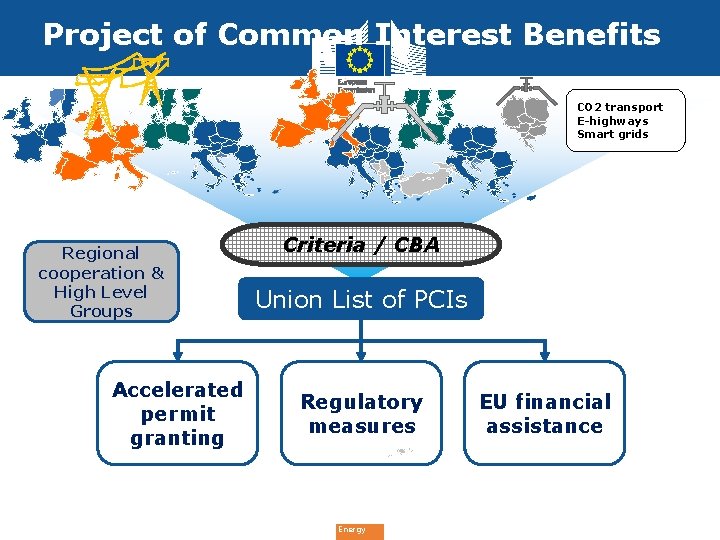
Project of Common Interest Benefits CO 2 transport E-highways Smart grids Regional cooperation & High Level Groups Accelerated permit granting Criteria / CBA Union List of PCIs Regulatory measures Energy EU financial assistance
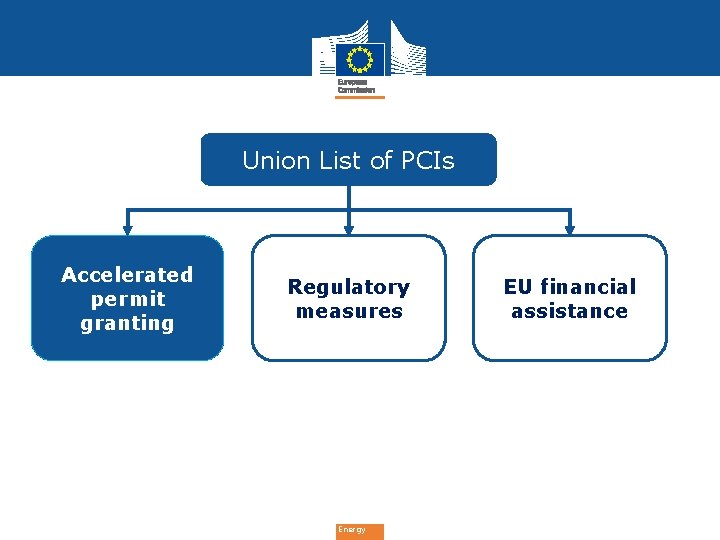
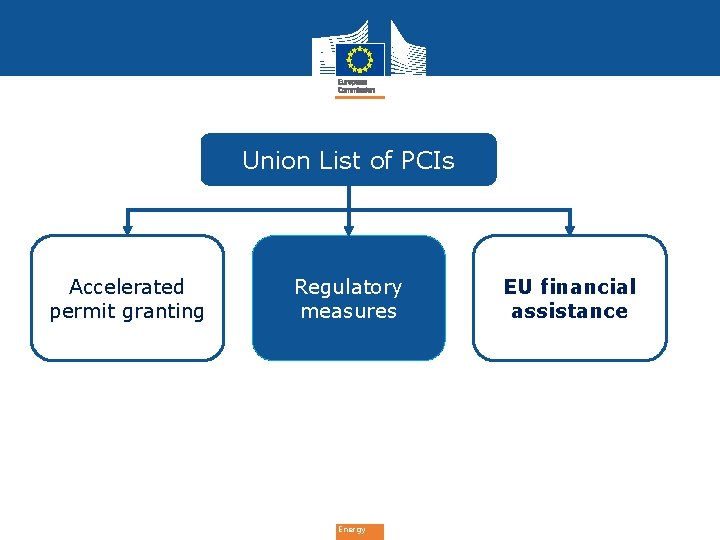
Union List of PCIs Accelerated permit granting Regulatory measures Energy EU financial assistance
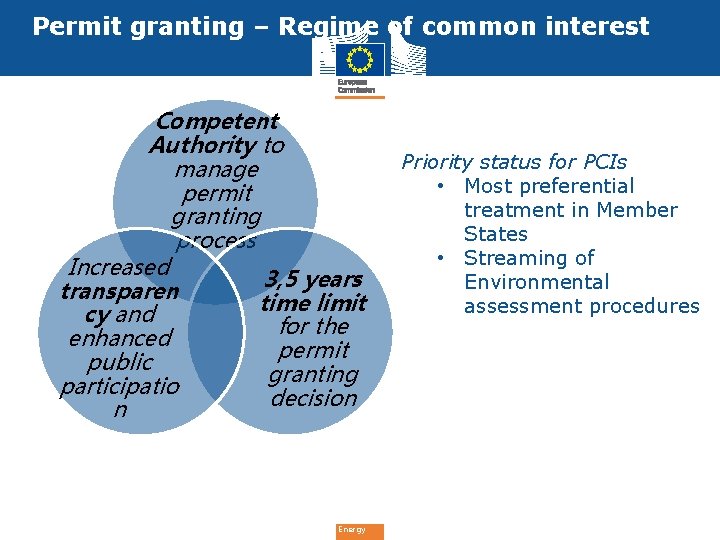
Permit granting – Regime of common interest Competent Authority to manage permit granting process Increased 3, 5 years transparen time limit cy and for the enhanced permit public granting participatio decision n Energy Priority status for PCIs • Most preferential treatment in Member States • Streaming of Environmental assessment procedures
Union List of PCIs Accelerated permit granting Regulatory measures Energy EU financial assistance
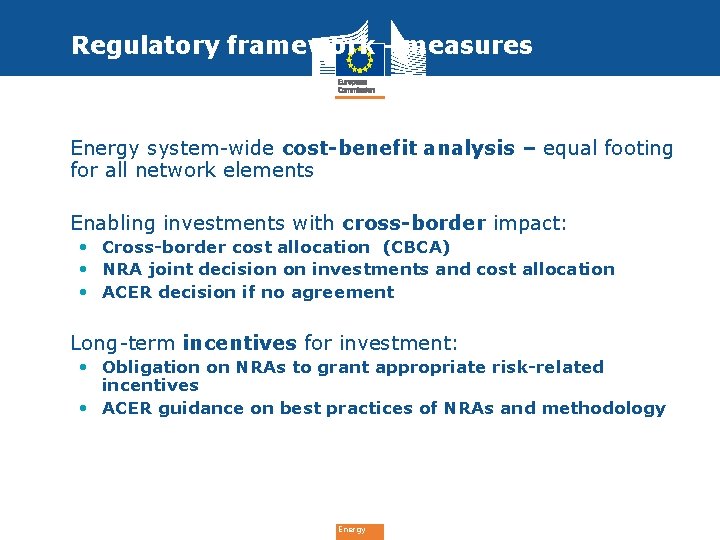
Regulatory framework - measures • Energy system-wide cost-benefit analysis – equal footing for all network elements • Enabling investments with cross-border impact: • Cross-border cost allocation (CBCA) • NRA joint decision on investments and cost allocation • ACER decision if no agreement • Long-term incentives for investment: • Obligation on NRAs to grant appropriate risk-related incentives • ACER guidance on best practices of NRAs and methodology Energy
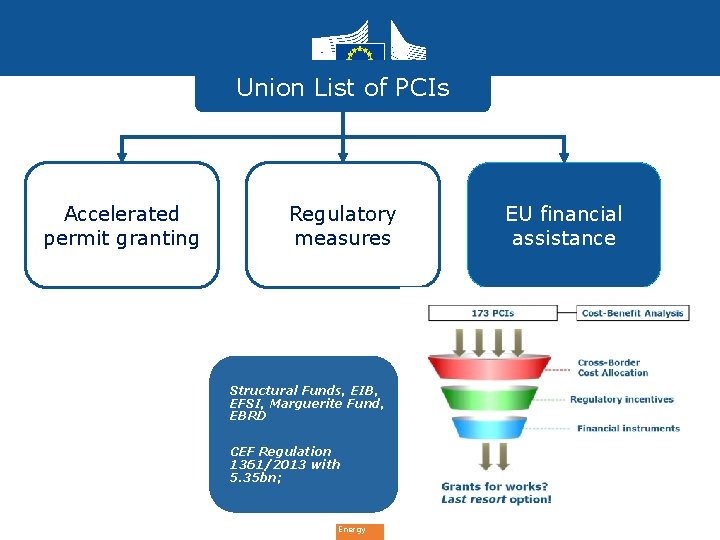
Union List of PCIs Accelerated permit granting Regulatory measures Structural Funds, EIB, EFSI, Marguerite Fund, EBRD CEF Regulation 1361/2013 with 5. 35 bn; Energy EU financial assistance
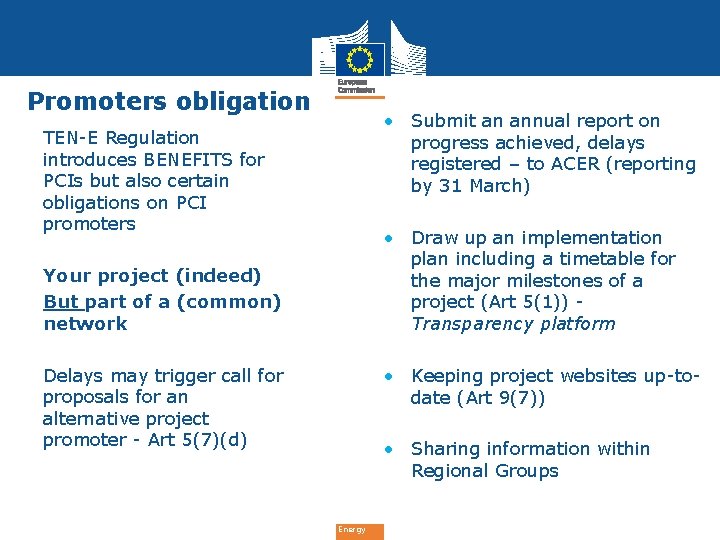
Promoters obligation • Submit an annual report on progress achieved, delays registered – to ACER (reporting by 31 March) TEN-E Regulation introduces BENEFITS for PCIs but also certain obligations on PCI promoters • Draw up an implementation plan including a timetable for the major milestones of a project (Art 5(1)) Transparency platform Your project (indeed) But part of a (common) network • Keeping project websites up-todate (Art 9(7)) Delays may trigger call for proposals for an alternative project promoter - Art 5(7)(d) • Sharing information within Regional Groups Energy
Projects of Common Interest (PCI) Process Energy
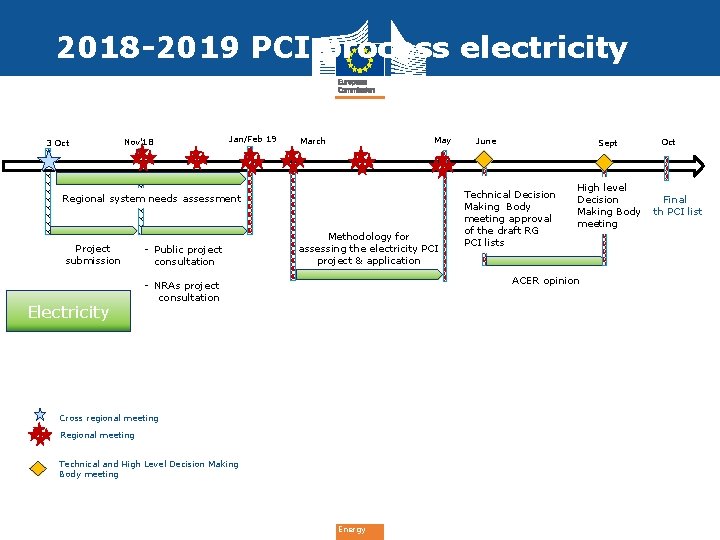
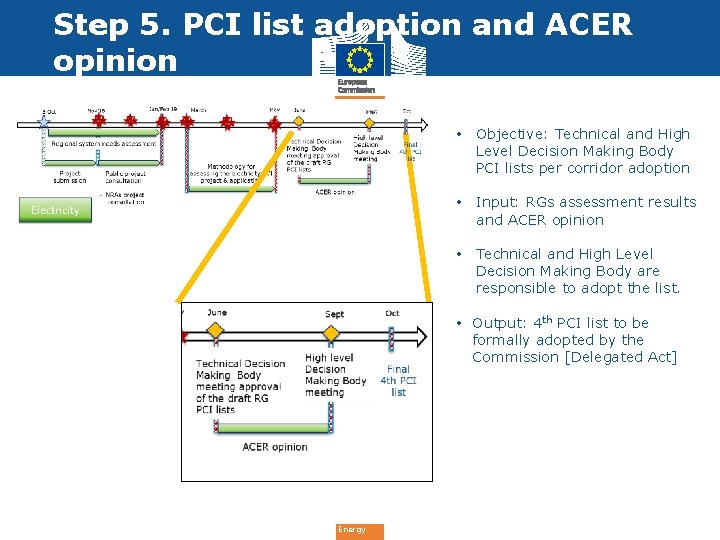
2018 -2019 PCI process electricity 3 Oct Nov’ 18 Jan/Feb 19 May March Regional system needs assessment Project submission Electricity - Public project consultation Methodology for assessing the electricity PCI project & application June Sept Technical Decision Making Body meeting approval of the draft RG PCI lists High level Decision Final Making Body 4 th PCI list meeting ACER opinion - NRAs project consultation Cross regional meeting Regional meeting Technical and High Level Decision Making Body meeting Energy Oct
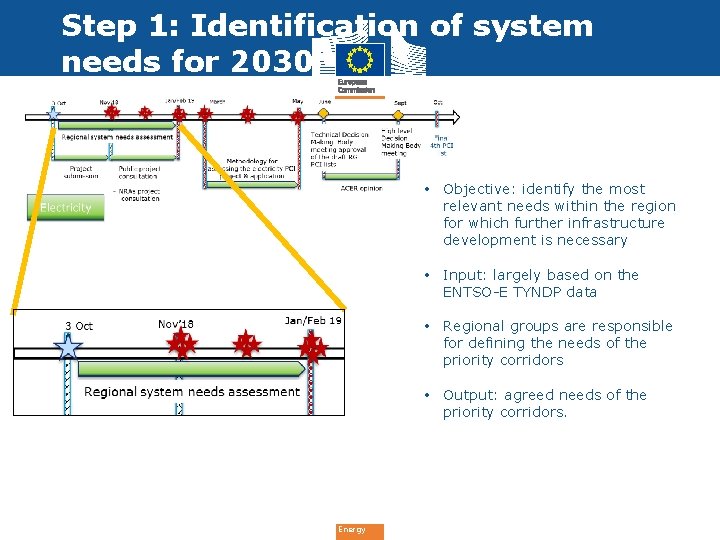
Step 1: Identification of system needs for 2030 • Objective: identify the most relevant needs within the region for which further infrastructure development is necessary • Input: largely based on the ENTSO-E TYNDP data • Regional groups are responsible for defining the needs of the priority corridors • Output: agreed needs of the priority corridors. Energy
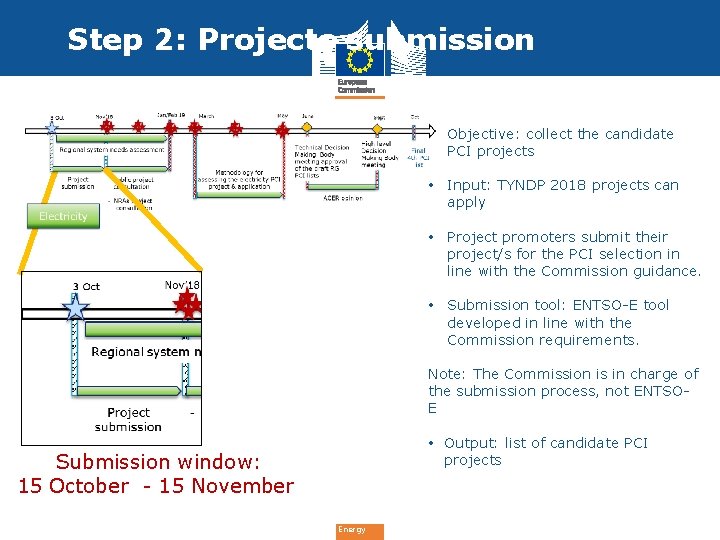
Step 2: Projects submission • Objective: collect the candidate PCI projects • Input: TYNDP 2018 projects can apply • Project promoters submit their project/s for the PCI selection in line with the Commission guidance. • Submission tool: ENTSO-E tool developed in line with the Commission requirements. Note: The Commission is in charge of the submission process, not ENTSOE • Output: list of candidate PCI projects Submission window: 15 October - 15 November Energy
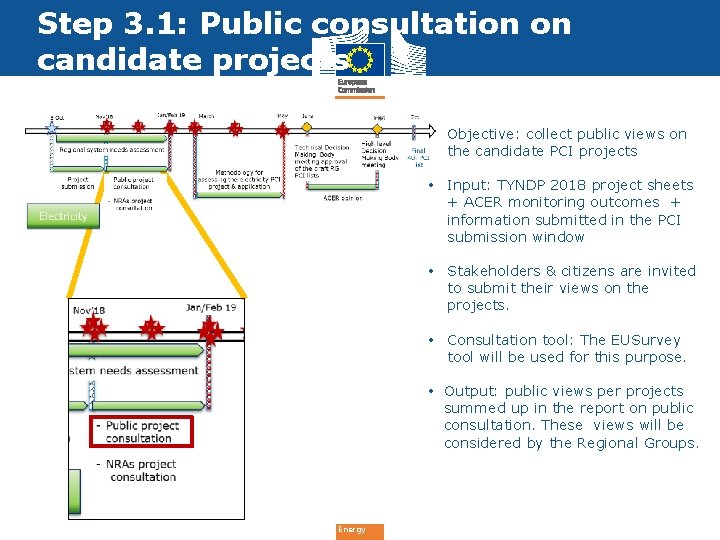
Step 3. 1: Public consultation on candidate projects • Objective: collect public views on the candidate PCI projects • Input: TYNDP 2018 project sheets + ACER monitoring outcomes + information submitted in the PCI submission window • Stakeholders & citizens are invited to submit their views on the projects. • Consultation tool: The EUSurvey tool will be used for this purpose. • Output: public views per projects summed up in the report on public consultation. These views will be considered by the Regional Groups. Energy
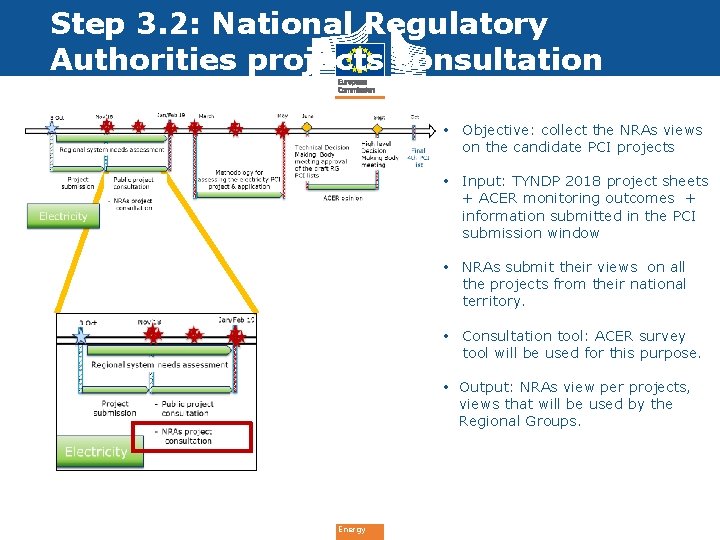
Step 3. 2: National Regulatory Authorities projects consultation • Objective: collect the NRAs views on the candidate PCI projects • Input: TYNDP 2018 project sheets + ACER monitoring outcomes + information submitted in the PCI submission window • NRAs submit their views on all the projects from their national territory. • Consultation tool: ACER survey tool will be used for this purpose. • Output: NRAs view per projects, views that will be used by the Regional Groups. Energy
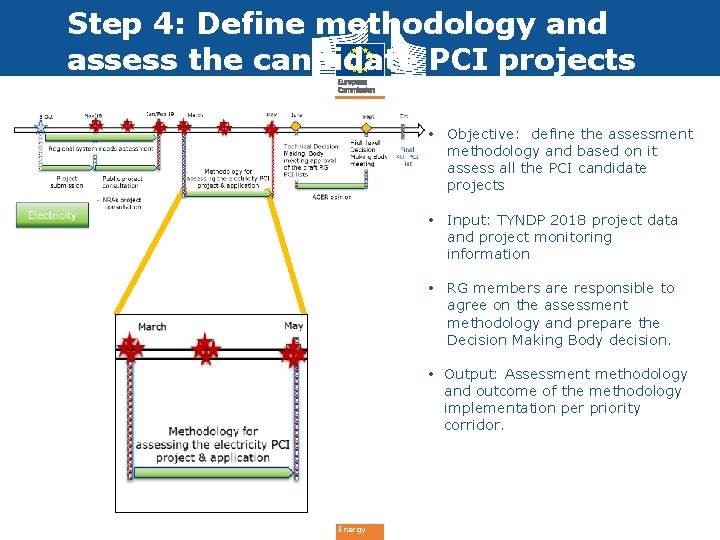
Step 4: Define methodology and assess the candidate PCI projects • Objective: define the assessment methodology and based on it assess all the PCI candidate projects • Input: TYNDP 2018 project data and project monitoring information • RG members are responsible to agree on the assessment methodology and prepare the Decision Making Body decision. • Output: Assessment methodology and outcome of the methodology implementation per priority corridor. Energy
Step 5. PCI list adoption and ACER opinion • Objective: Technical and High Level Decision Making Body PCI lists per corridor adoption • Input: RGs assessment results and ACER opinion • Technical and High Level Decision Making Body are responsible to adopt the list. • Output: 4 th PCI list to be formally adopted by the Commission [Delegated Act] Energy
Projects of Common Interest (PCI) Electricity Regional Groups & Smart grids thematic group Energy
• Electricity regional group leaders: § Nicole Versijp - RG NSOG § Tomasz Jerzyniak - RG NSI West § Epistimi Oikonomopoulou & Miklos Gaspar - RG NSI East § Oana Langa - RG BEMIP • Thematic area - Smart grids leaders: Henriette Nesheim & Annachiara Vercellin Energy
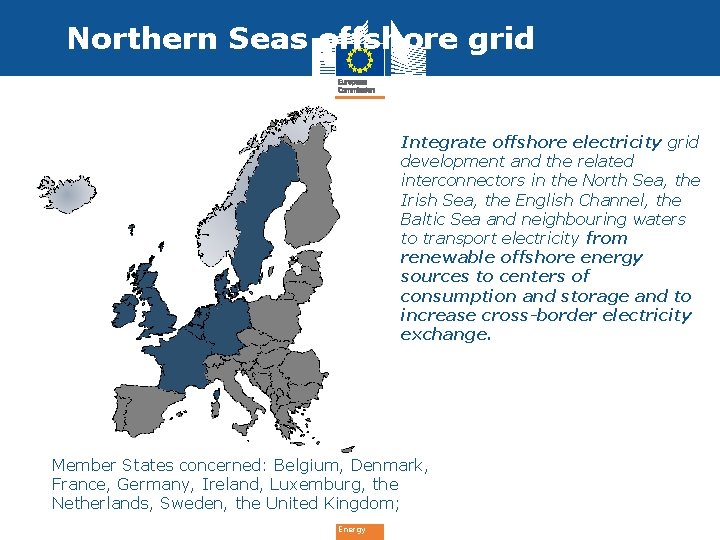
Northern Seas offshore grid Integrate offshore electricity grid development and the related interconnectors in the North Sea, the Irish Sea, the English Channel, the Baltic Sea and neighbouring waters to transport electricity from renewable offshore energy sources to centers of consumption and storage and to increase cross-border electricity exchange. Member States concerned: Belgium, Denmark, France, Germany, Ireland, Luxemburg, the Netherlands, Sweden, the United Kingdom; Energy
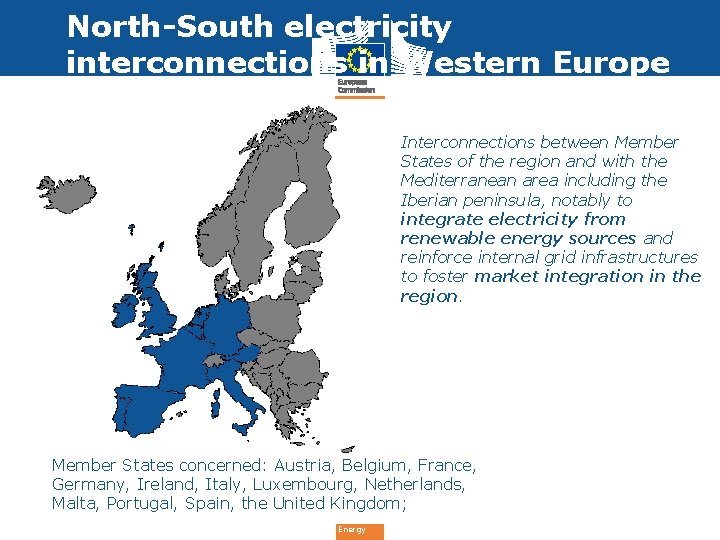
North-South electricity interconnections in Western Europe Interconnections between Member States of the region and with the Mediterranean area including the Iberian peninsula, notably to integrate electricity from renewable energy sources and reinforce internal grid infrastructures to foster market integration in the region. Member States concerned: Austria, Belgium, France, Germany, Ireland, Italy, Luxembourg, Netherlands, Malta, Portugal, Spain, the United Kingdom; Energy
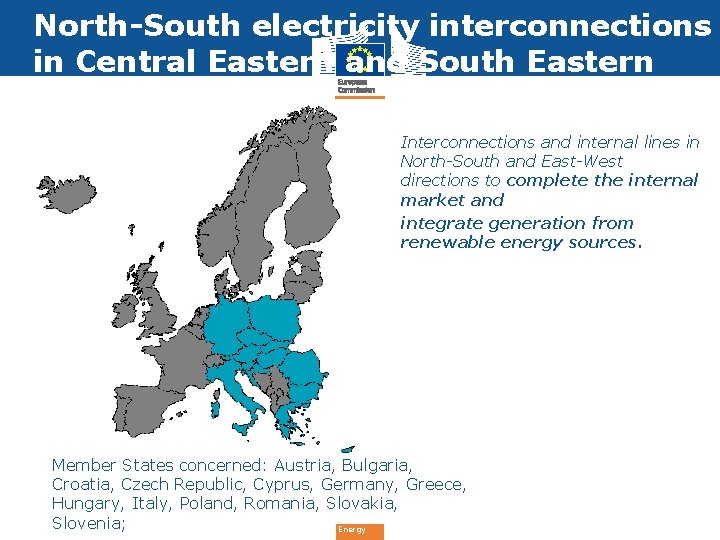
North-South electricity interconnections in Central Eastern and South Eastern Europe Interconnections and internal lines in North-South and East-West directions to complete the internal market and integrate generation from renewable energy sources. Member States concerned: Austria, Bulgaria, Croatia, Czech Republic, Cyprus, Germany, Greece, Hungary, Italy, Poland, Romania, Slovakia, Slovenia; Energy
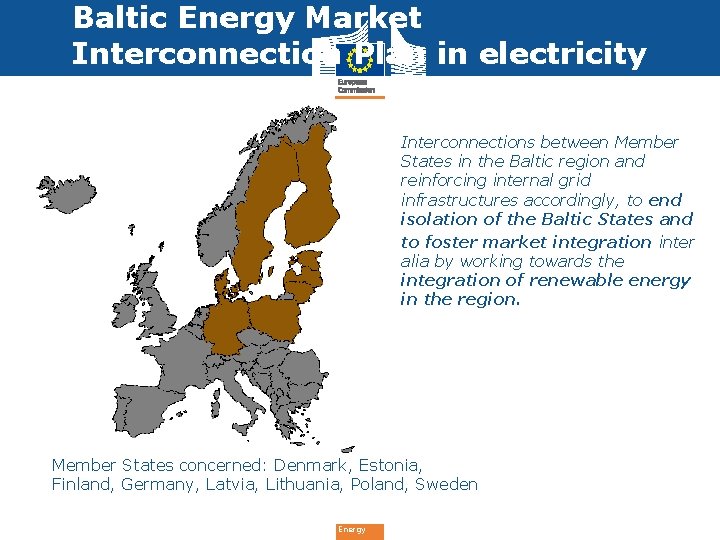
Baltic Energy Market Interconnection Plan in electricity Interconnections between Member States in the Baltic region and reinforcing internal grid infrastructures accordingly, to end isolation of the Baltic States and to foster market integration inter alia by working towards the integration of renewable energy in the region. Member States concerned: Denmark, Estonia, Finland, Germany, Latvia, Lithuania, Poland, Sweden Energy
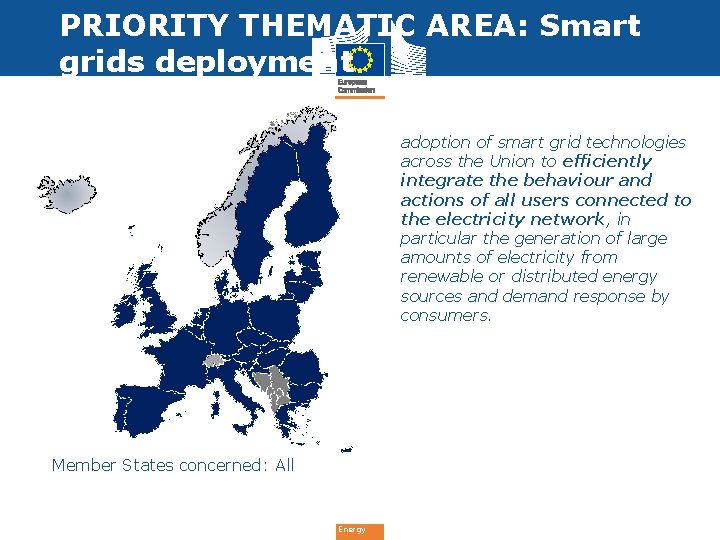
PRIORITY THEMATIC AREA: Smart grids deployment adoption of smart grid technologies across the Union to efficiently integrate the behaviour and actions of all users connected to the electricity network, in particular the generation of large amounts of electricity from renewable or distributed energy sources and demand response by consumers. Member States concerned: All Energy
ACER monitoring 2018 outcomes Energy
Inclusion of monitoring in the PCI process Energy
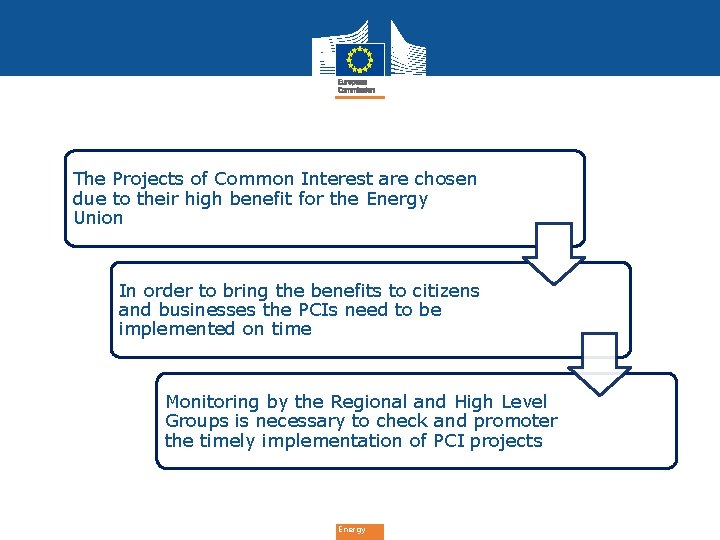
The Projects of Common Interest are chosen due to their high benefit for the Energy Union In order to bring the benefits to citizens and businesses the PCIs need to be implemented on time Monitoring by the Regional and High Level Groups is necessary to check and promoter the timely implementation of PCI projects Energy
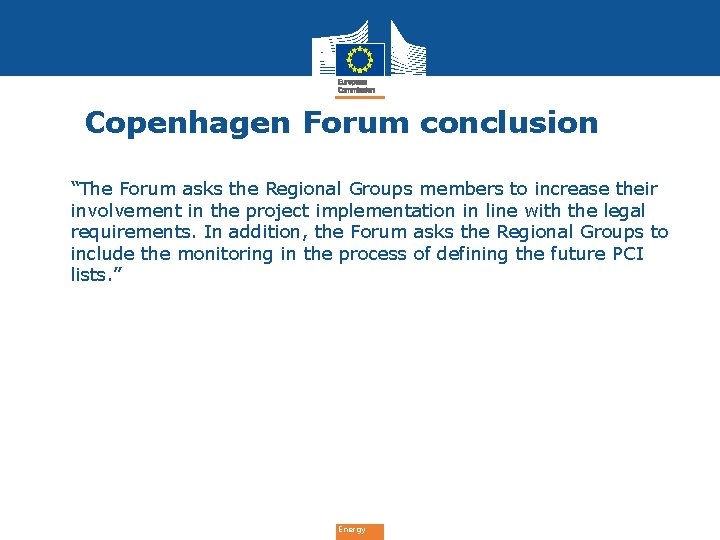
Copenhagen Forum conclusion • “The Forum asks the Regional Groups members to increase their involvement in the project implementation in line with the legal requirements. In addition, the Forum asks the Regional Groups to include the monitoring in the process of defining the future PCI lists. ” Energy
Regional Group members: • 1. acknowledge the importance of monitoring for projects’ implementation • 2. agree to include the PCI monitoring outcomes in the PCI assessment methodology • 3. follow and support the PCIs implementation under the Regional and High Level Groups fora Energy
Working together: roles and responsibilities Energy
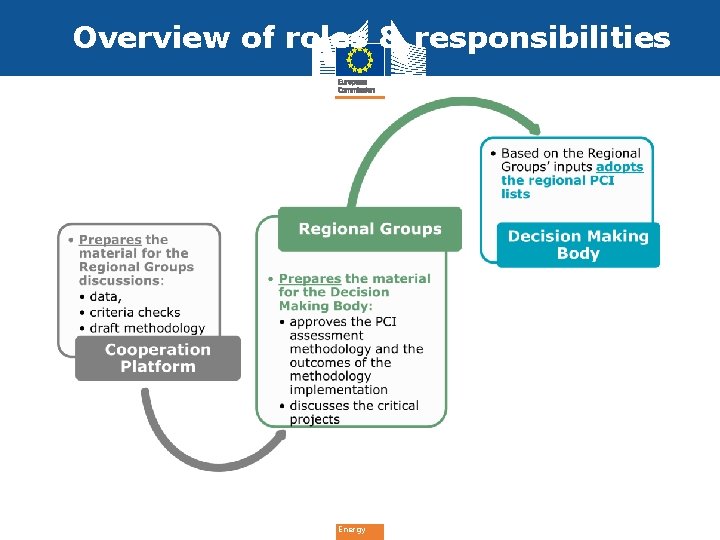
Overview of roles & responsibilities Energy
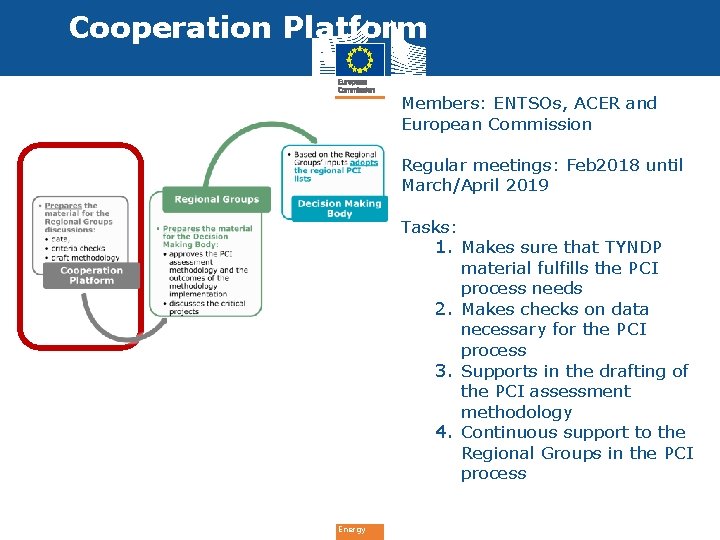
Cooperation Platform Members: ENTSOs, ACER and European Commission Regular meetings: Feb 2018 until March/April 2019 Tasks: 1. Makes sure that TYNDP material fulfills the PCI process needs 2. Makes checks on data necessary for the PCI process 3. Supports in the drafting of the PCI assessment methodology 4. Continuous support to the Regional Groups in the PCI process Energy
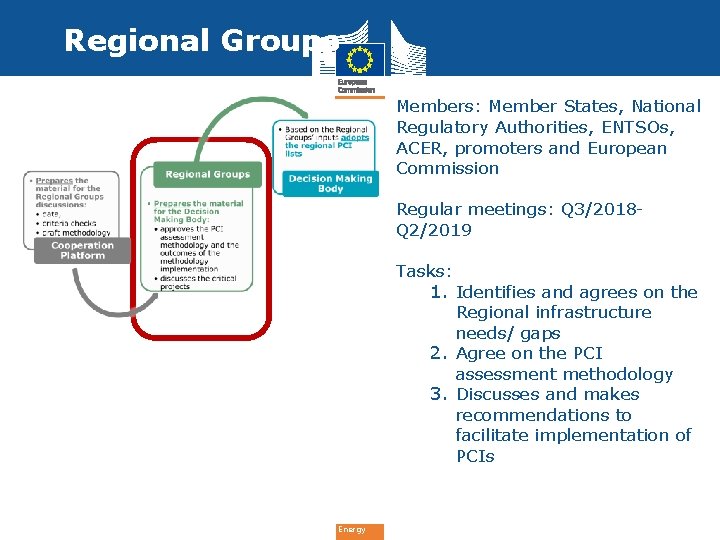
Regional Groups Members: Member States, National Regulatory Authorities, ENTSOs, ACER, promoters and European Commission Regular meetings: Q 3/2018 Q 2/2019 Tasks: 1. Identifies and agrees on the Regional infrastructure needs/ gaps 2. Agree on the PCI assessment methodology 3. Discusses and makes recommendations to facilitate implementation of PCIs Energy
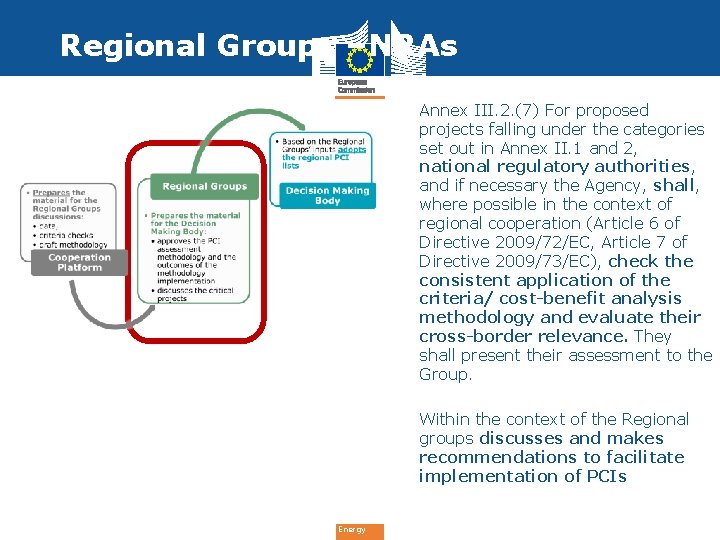
Regional Groups –NRAs 1. Annex III. 2. (7) For proposed projects falling under the categories set out in Annex II. 1 and 2, national regulatory authorities, and if necessary the Agency, shall, where possible in the context of regional cooperation (Article 6 of Directive 2009/72/EC, Article 7 of Directive 2009/73/EC), check the consistent application of the criteria/ cost-benefit analysis methodology and evaluate their cross-border relevance. They shall present their assessment to the Group. 2. Within the context of the Regional groups discusses and makes recommendations to facilitate implementation of PCIs Energy
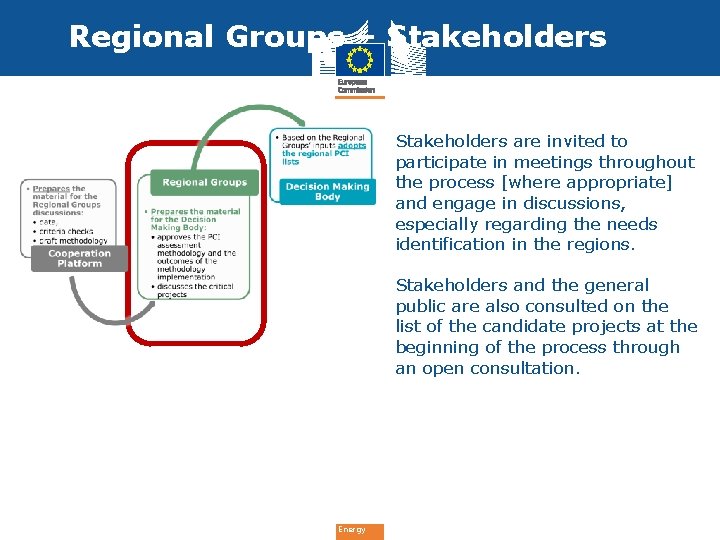
Regional Groups – Stakeholders are invited to participate in meetings throughout the process [where appropriate] and engage in discussions, especially regarding the needs identification in the regions. Stakeholders and the general public are also consulted on the list of the candidate projects at the beginning of the process through an open consultation. Energy
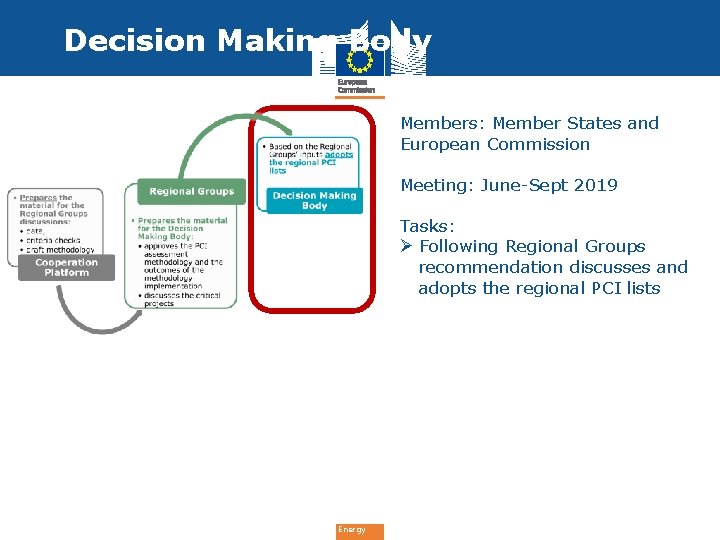
Decision Making Body Members: Member States and European Commission Meeting: June-Sept 2019 Tasks: Ø Following Regional Groups recommendation discusses and adopts the regional PCI lists Energy
ENTSO-E TYNDP 2018 Energy
NEXT STEPS Energy
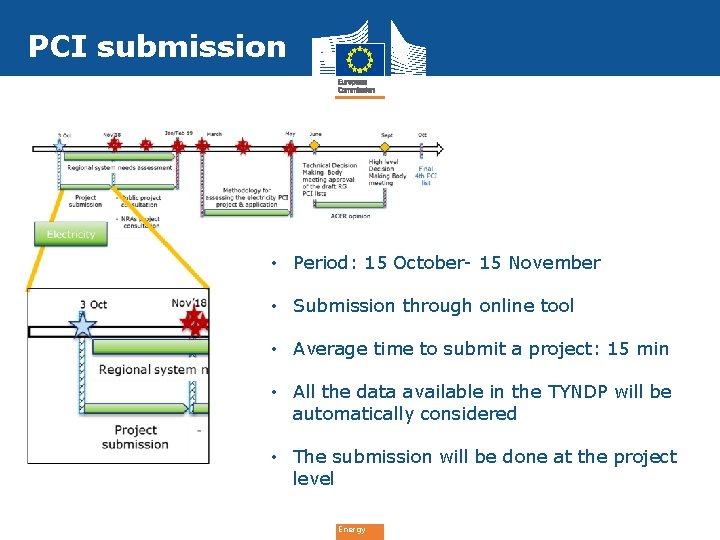
PCI submission • Period: 15 October- 15 November • Submission through online tool • Average time to submit a project: 15 min • All the data available in the TYNDP will be automatically considered • The submission will be done at the project level Energy
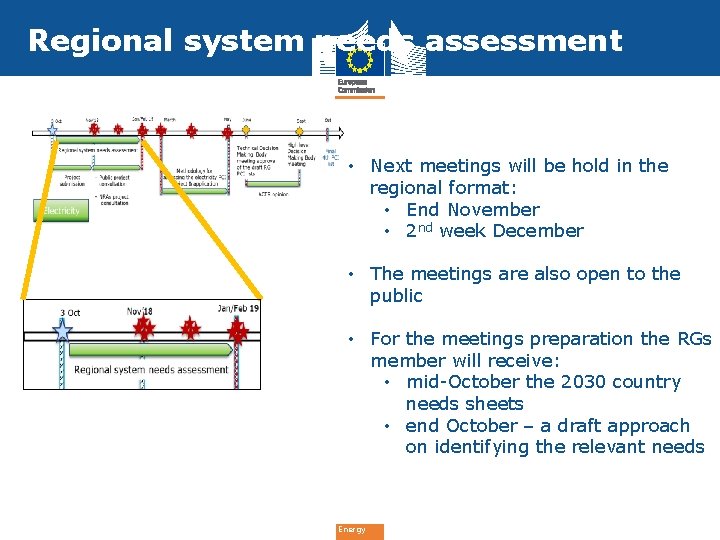
Regional system needs assessment • Next meetings will be hold in the regional format: • End November • 2 nd week December • The meetings are also open to the public • For the meetings preparation the RGs member will receive: • mid-October the 2030 country needs sheets • end October – a draft approach on identifying the relevant needs Energy
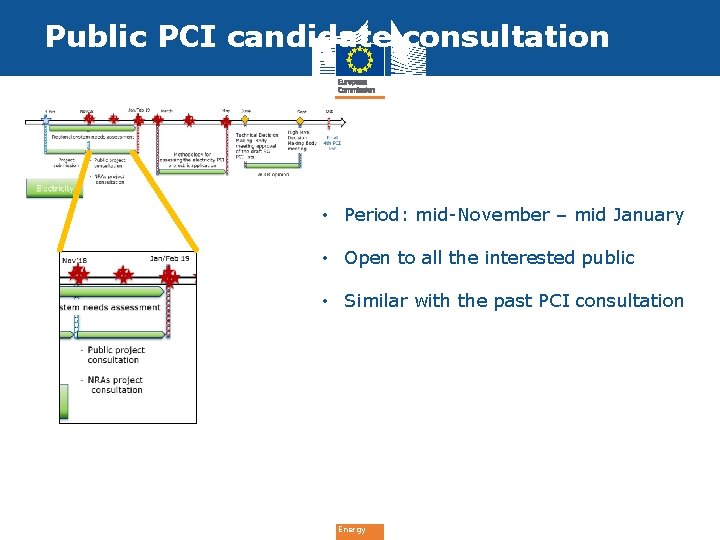
Public PCI candidate consultation • Period: mid-November – mid January • Open to all the interested public • Similar with the past PCI consultation Energy
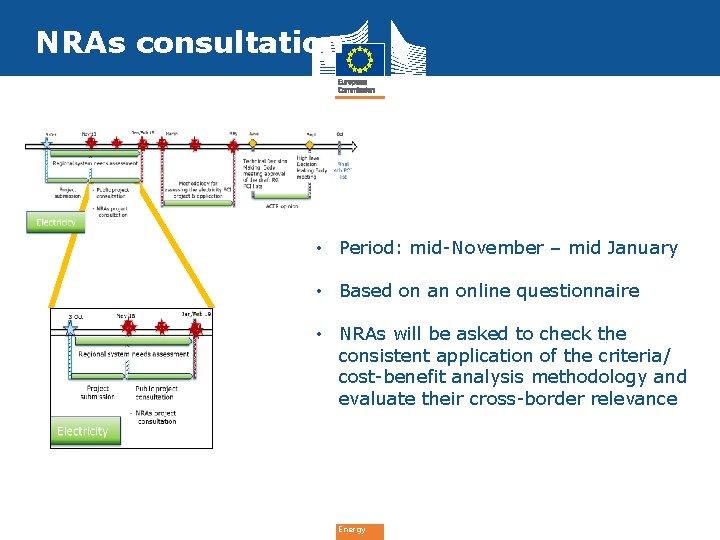
NRAs consultation • Period: mid-November – mid January • Based on an online questionnaire • NRAs will be asked to check the consistent application of the criteria/ cost-benefit analysis methodology and evaluate their cross-border relevance Energy
European Commission contacts – PCI process: For general inquiries: ENER-B 1 -PROJECTS@ec. europa. eu Regional group leaders: RG NSOG leader: Nicole Versijp Email: Nicole. Versijp@ec. europa. eu Phone: +32 229 -66664 RG NSI West Electricity leader - Tomasz Jerzyniak Email: Tomasz. JERZYNIAK@ec. europa. eu Phone: +32 229 -50563 RG NS East Electricity leaders: Epistimi Oikonomopoulou & Miklos Gaspar Email: Miklos. GASPAR@ec. europa. eu; Epistimi. OIKONOMOPOULOU@ec. europa. eu Phone: +32 229 -99561 or +32 229 -13544 RG BEMIP leader: Oana Langa Email: Oana. LANGA@ec. europa. eu Phone: +32 229 -50638 Thematic area - Smart grids leaders: Henriette Nesheim & Annachiara Vercellin Email: Henriette. NESHEIM@ec. europa. eu ; Annachiara. VERCELLIN@ec. europa. eu Phone: + 32 229 -54437 or +32 229 -57665 Energy