
Projects at CERN in the Large Magnet Facility
- Slides: 10
Projects at CERN in the Large Magnet Facility of the MSC group Florian Meuter 18. 01. 2019 1
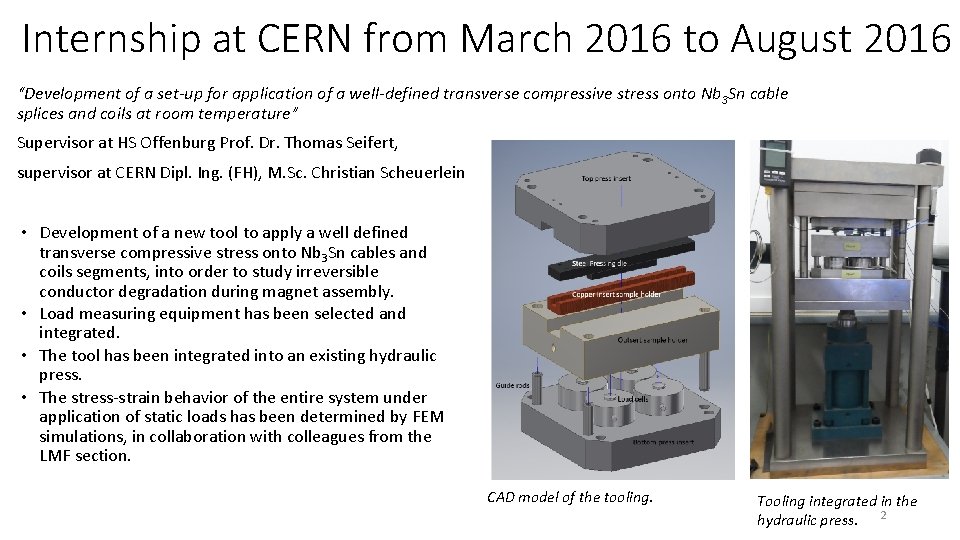
Internship at CERN from March 2016 to August 2016 “Development of a set-up for application of a well-defined transverse compressive stress onto Nb 3 Sn cable splices and coils at room temperature” Supervisor at HS Offenburg Prof. Dr. Thomas Seifert, supervisor at CERN Dipl. Ing. (FH), M. Sc. Christian Scheuerlein • Development of a new tool to apply a well defined transverse compressive stress onto Nb 3 Sn cables and coils segments, into order to study irreversible conductor degradation during magnet assembly. • Load measuring equipment has been selected and integrated. • The tool has been integrated into an existing hydraulic press. • The stress-strain behavior of the entire system under application of static loads has been determined by FEM simulations, in collaboration with colleagues from the LMF section. CAD model of the tooling. Tooling integrated in the hydraulic press. 2
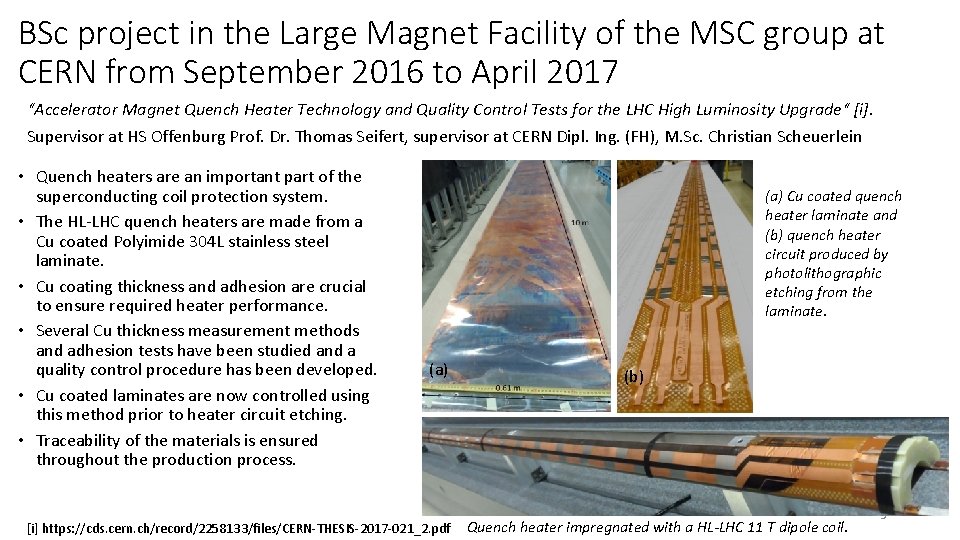
BSc project in the Large Magnet Facility of the MSC group at CERN from September 2016 to April 2017 “Accelerator Magnet Quench Heater Technology and Quality Control Tests for the LHC High Luminosity Upgrade“ [i]. Supervisor at HS Offenburg Prof. Dr. Thomas Seifert, supervisor at CERN Dipl. Ing. (FH), M. Sc. Christian Scheuerlein • Quench heaters are an important part of the superconducting coil protection system. • The HL-LHC quench heaters are made from a Cu coated Polyimide 304 L stainless steel laminate. • Cu coating thickness and adhesion are crucial to ensure required heater performance. • Several Cu thickness measurement methods and adhesion tests have been studied and a quality control procedure has been developed. • Cu coated laminates are now controlled using this method prior to heater circuit etching. • Traceability of the materials is ensured throughout the production process. (a) Cu coated quench heater laminate and (b) quench heater circuit produced by photolithographic etching from the laminate. (a) [i] https: //cds. cern. ch/record/2258133/files/CERN-THESIS-2017 -021_2. pdf (b) Quench heater impregnated with a HL-LHC 11 T dipole coil. 3
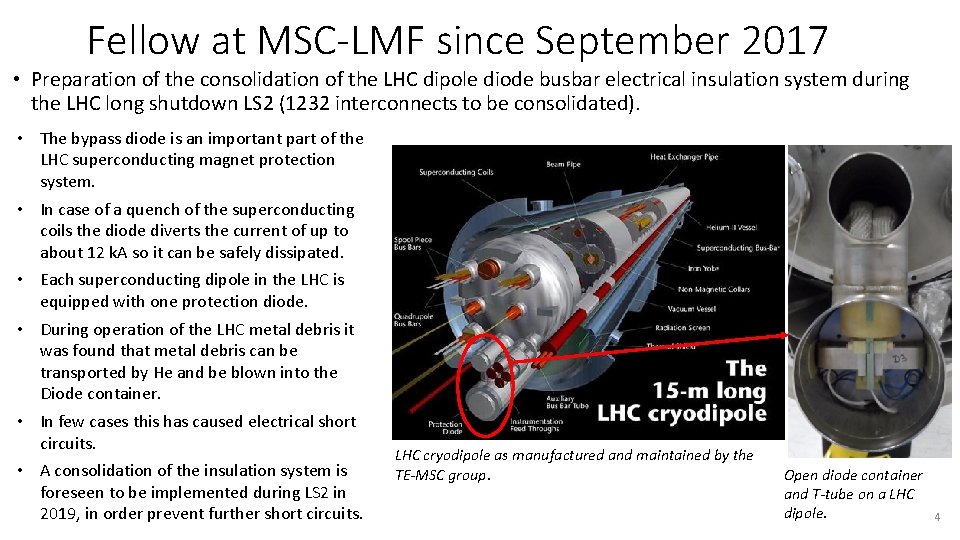
Fellow at MSC-LMF since September 2017 • Preparation of the consolidation of the LHC dipole diode busbar electrical insulation system during the LHC long shutdown LS 2 (1232 interconnects to be consolidated). • The bypass diode is an important part of the LHC superconducting magnet protection system. • In case of a quench of the superconducting coils the diode diverts the current of up to about 12 k. A so it can be safely dissipated. • Each superconducting dipole in the LHC is equipped with one protection diode. • During operation of the LHC metal debris it was found that metal debris can be transported by He and be blown into the Diode container. • In few cases this has caused electrical short circuits. • A consolidation of the insulation system is foreseen to be implemented during LS 2 in 2019, in order prevent further short circuits. LHC cryodipole as manufactured and maintained by the TE-MSC group. Open diode container and T-tube on a LHC dipole. 4
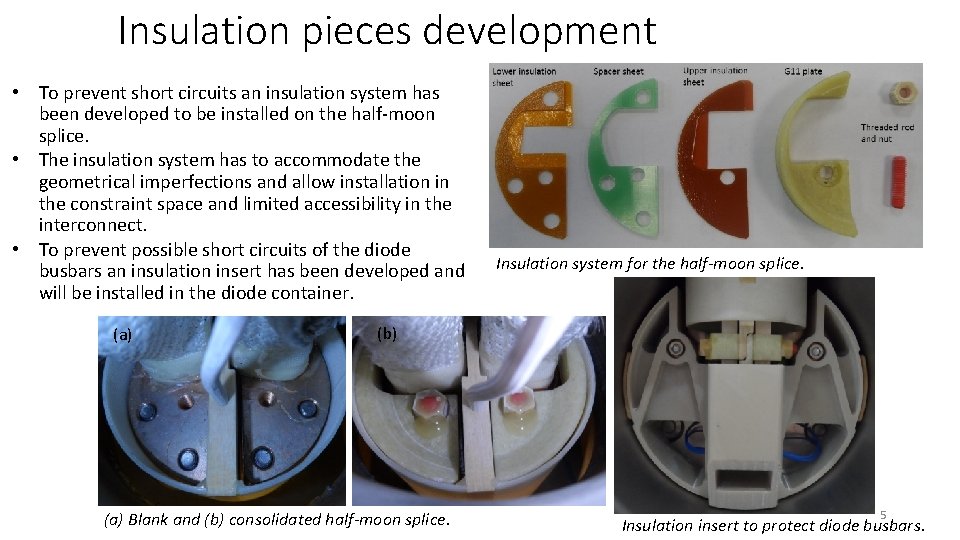
Insulation pieces development • To prevent short circuits an insulation system has been developed to be installed on the half-moon splice. • The insulation system has to accommodate the geometrical imperfections and allow installation in the constraint space and limited accessibility in the interconnect. • To prevent possible short circuits of the diode busbars an insulation insert has been developed and will be installed in the diode container. (a) Insulation system for the half-moon splice. (b) (a) Blank and (b) consolidated half-moon splice. 5 Insulation insert to protect diode busbars.
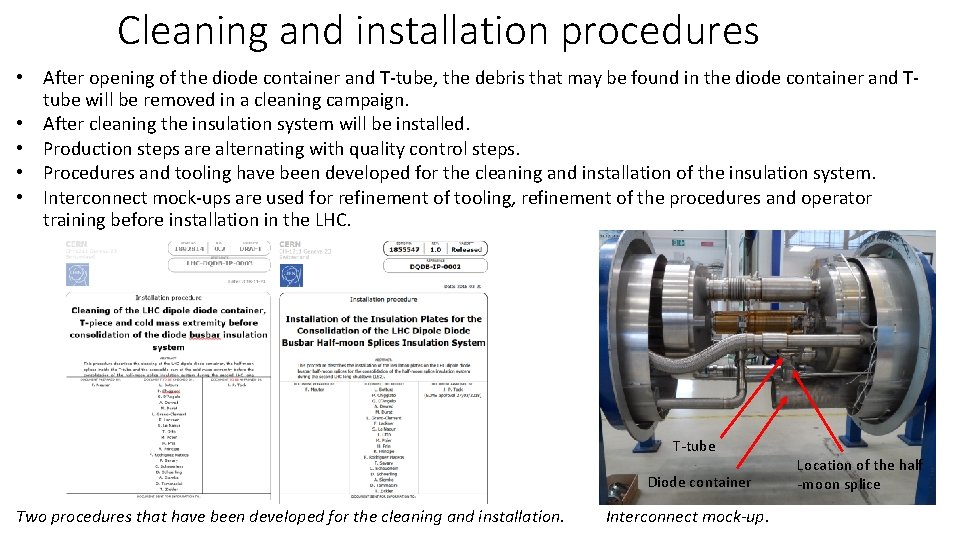
Cleaning and installation procedures • After opening of the diode container and T-tube, the debris that may be found in the diode container and Ttube will be removed in a cleaning campaign. • After cleaning the insulation system will be installed. • Production steps are alternating with quality control steps. • Procedures and tooling have been developed for the cleaning and installation of the insulation system. • Interconnect mock-ups are used for refinement of tooling, refinement of the procedures and operator training before installation in the LHC. T-tube Diode container Two procedures that have been developed for the cleaning and installation. Interconnect mock-up. Location of the half -moon splice
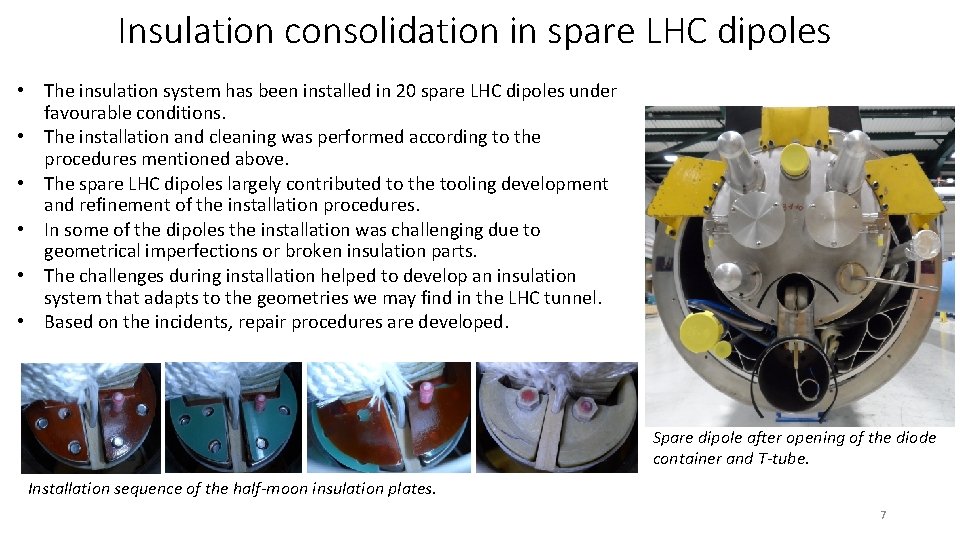
Insulation consolidation in spare LHC dipoles • The insulation system has been installed in 20 spare LHC dipoles under favourable conditions. • The installation and cleaning was performed according to the procedures mentioned above. • The spare LHC dipoles largely contributed to the tooling development and refinement of the installation procedures. • In some of the dipoles the installation was challenging due to geometrical imperfections or broken insulation parts. • The challenges during installation helped to develop an insulation system that adapts to the geometries we may find in the LHC tunnel. • Based on the incidents, repair procedures are developed. Spare dipole after opening of the diode container and T-tube. Installation sequence of the half-moon insulation plates. 7
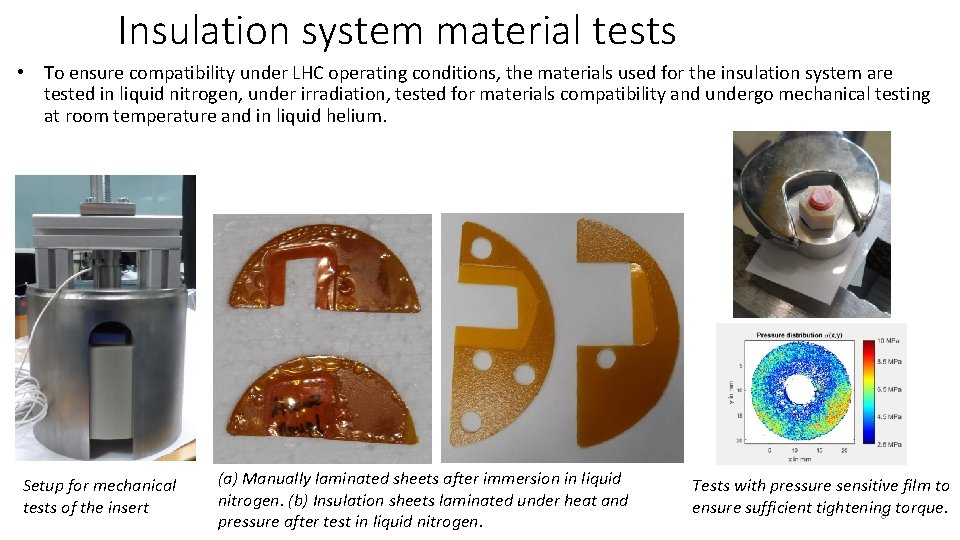
Insulation system material tests • To ensure compatibility under LHC operating conditions, the materials used for the insulation system are tested in liquid nitrogen, under irradiation, tested for materials compatibility and undergo mechanical testing at room temperature and in liquid helium. Setup for mechanical tests of the insert (a) Manually laminated sheets after immersion in liquid nitrogen. (b) Insulation sheets laminated under heat and pressure after test in liquid nitrogen. Tests with pressure sensitive film to ensure sufficient tightening 8 torque.
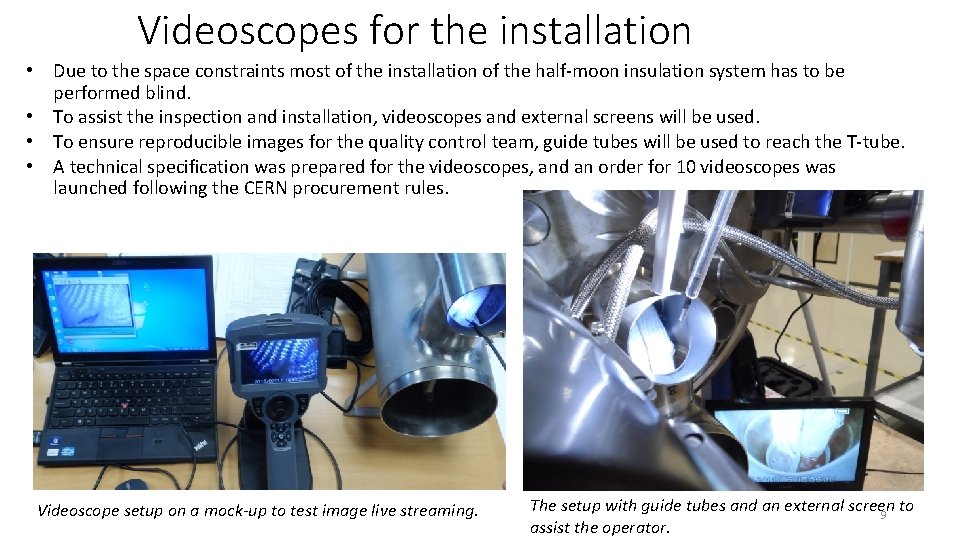
Videoscopes for the installation • Due to the space constraints most of the installation of the half-moon insulation system has to be performed blind. • To assist the inspection and installation, videoscopes and external screens will be used. • To ensure reproducible images for the quality control team, guide tubes will be used to reach the T-tube. • A technical specification was prepared for the videoscopes, and an order for 10 videoscopes was launched following the CERN procurement rules. Videoscope setup on a mock-up to test image live streaming. The setup with guide tubes and an external screen to 9 assist the operator.
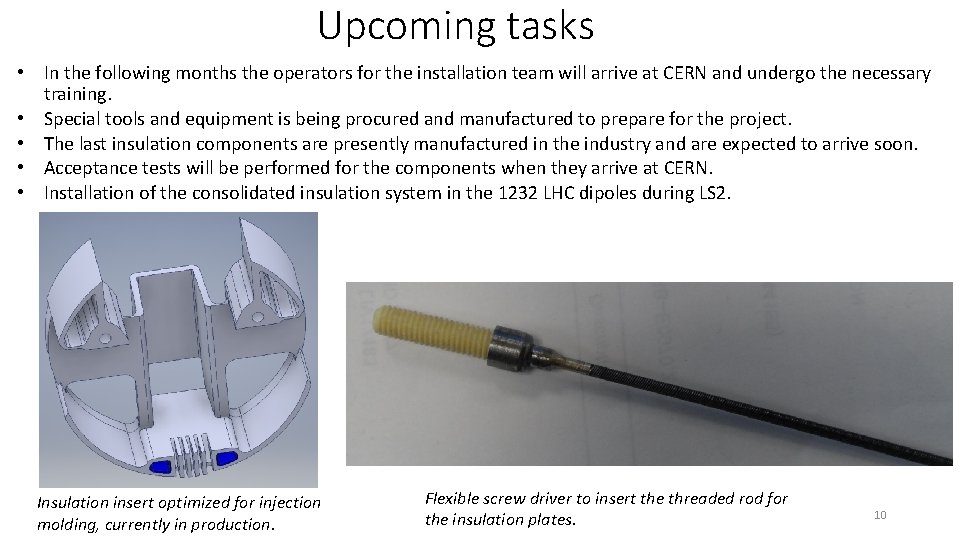
Upcoming tasks • In the following months the operators for the installation team will arrive at CERN and undergo the necessary training. • Special tools and equipment is being procured and manufactured to prepare for the project. • The last insulation components are presently manufactured in the industry and are expected to arrive soon. • Acceptance tests will be performed for the components when they arrive at CERN. • Installation of the consolidated insulation system in the 1232 LHC dipoles during LS 2. Insulation insert optimized for injection molding, currently in production. Flexible screw driver to insert the threaded rod for the insulation plates. 10