
Projective 2 D 3 D geometry course 2

- Slides: 28
Projective 2 D & 3 D geometry course 2
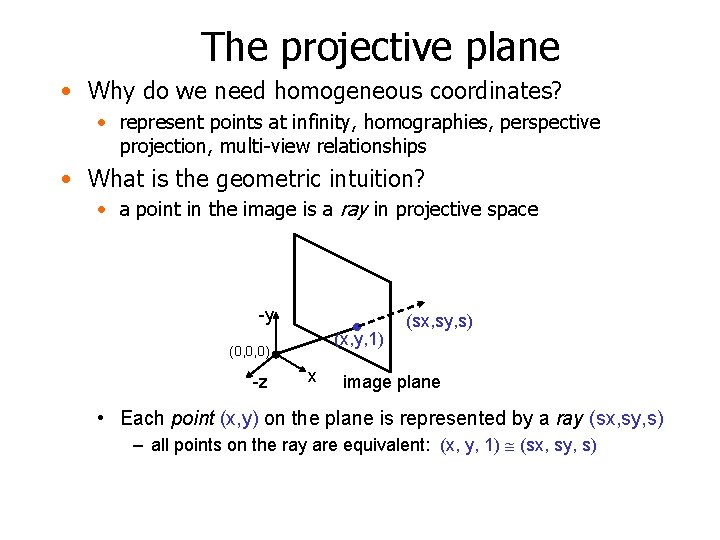
The projective plane • Why do we need homogeneous coordinates? • represent points at infinity, homographies, perspective projection, multi-view relationships • What is the geometric intuition? • a point in the image is a ray in projective space -y (x, y, 1) (0, 0, 0) -z x (sx, sy, s) image plane • Each point (x, y) on the plane is represented by a ray (sx, sy, s) – all points on the ray are equivalent: (x, y, 1) (sx, sy, s)
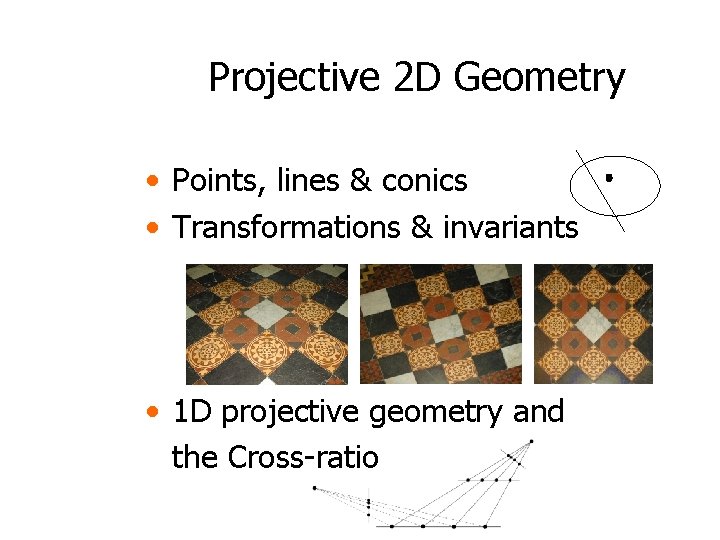
Projective 2 D Geometry • Points, lines & conics • Transformations & invariants • 1 D projective geometry and the Cross-ratio
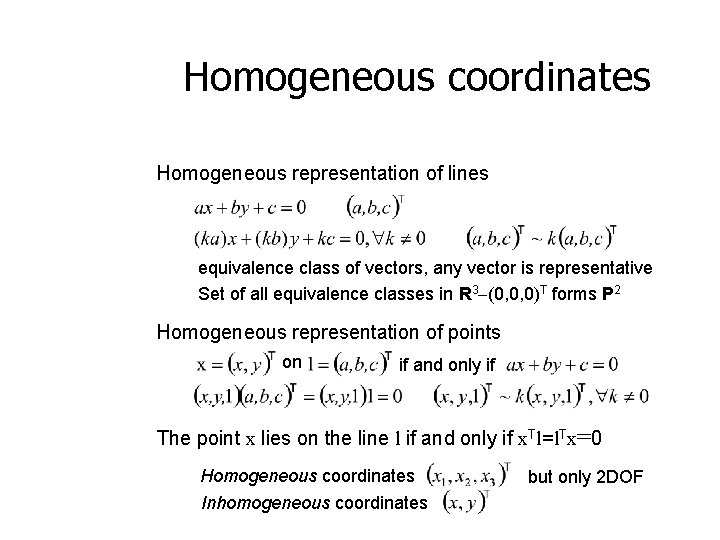
Homogeneous coordinates Homogeneous representation of lines equivalence class of vectors, any vector is representative Set of all equivalence classes in R 3 (0, 0, 0)T forms P 2 Homogeneous representation of points on if and only if The point x lies on the line l if and only if x. Tl=l. Tx=0 Homogeneous coordinates Inhomogeneous coordinates but only 2 DOF
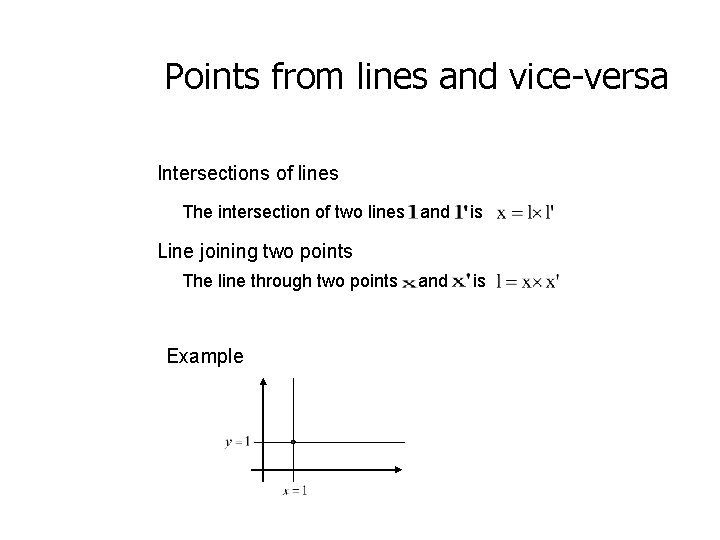
Points from lines and vice-versa Intersections of lines The intersection of two lines and is Line joining two points The line through two points Example and is
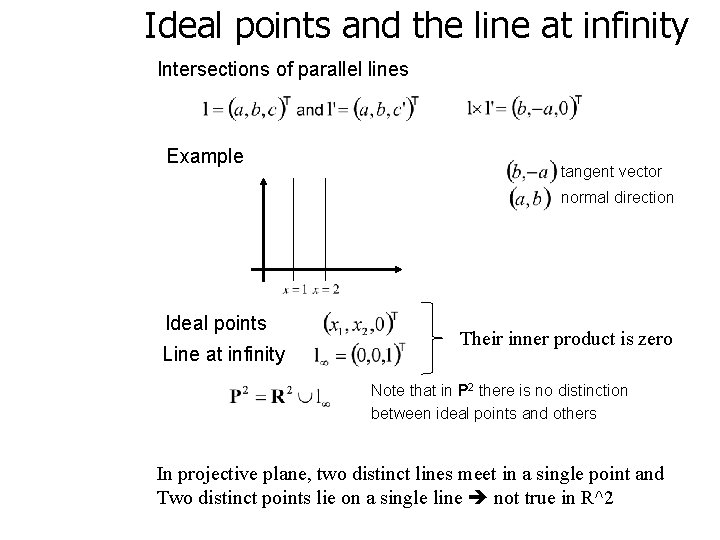
Ideal points and the line at infinity Intersections of parallel lines Example tangent vector normal direction Ideal points Line at infinity Their inner product is zero Note that in P 2 there is no distinction between ideal points and others In projective plane, two distinct lines meet in a single point and Two distinct points lie on a single line not true in R^2
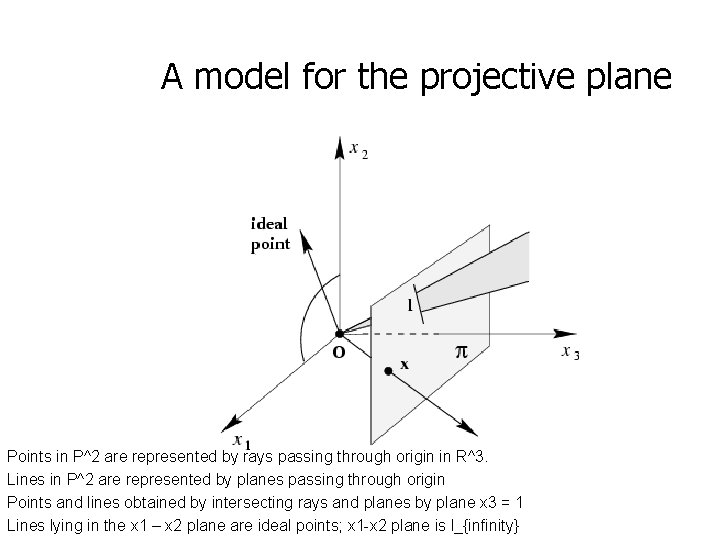
A model for the projective plane Points in P^2 are represented by rays passing through origin in R^3. Lines in P^2 are represented by planes passing through origin Points and lines obtained by intersecting rays and planes by plane x 3 = 1 Lines lying in the x 1 – x 2 plane are ideal points; x 1 -x 2 plane is l_{infinity}
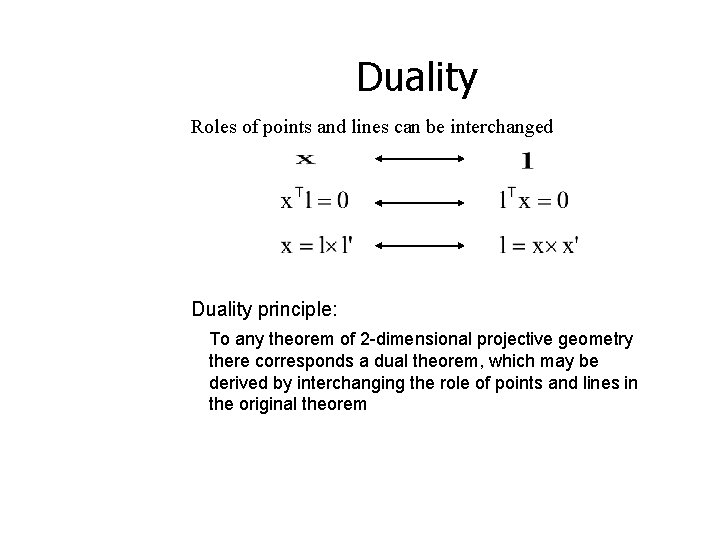
Duality Roles of points and lines can be interchanged Duality principle: To any theorem of 2 -dimensional projective geometry there corresponds a dual theorem, which may be derived by interchanging the role of points and lines in the original theorem
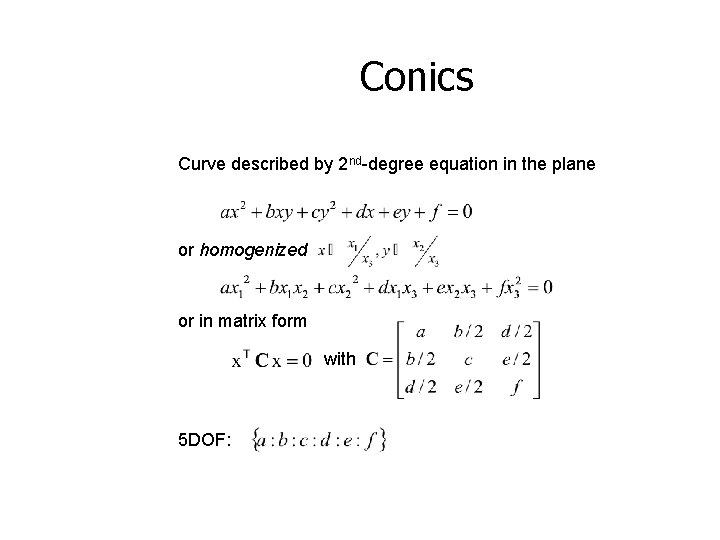
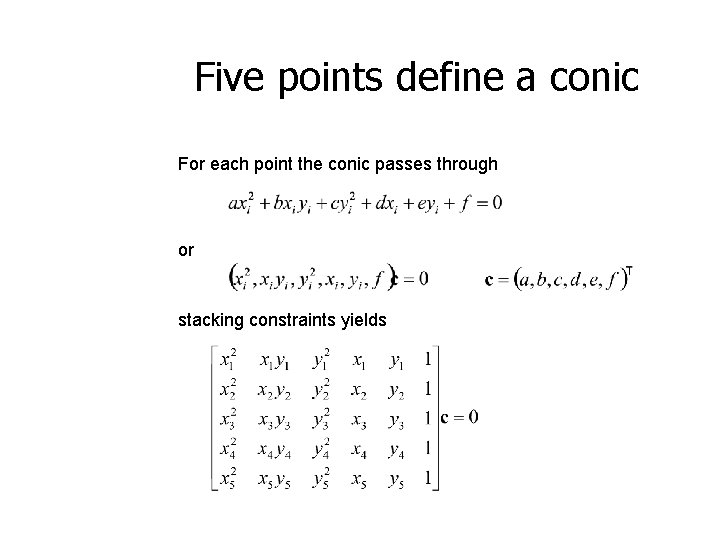
Conics Curve described by 2 nd-degree equation in the plane or homogenized or in matrix form with 5 DOF:
Five points define a conic For each point the conic passes through or stacking constraints yields
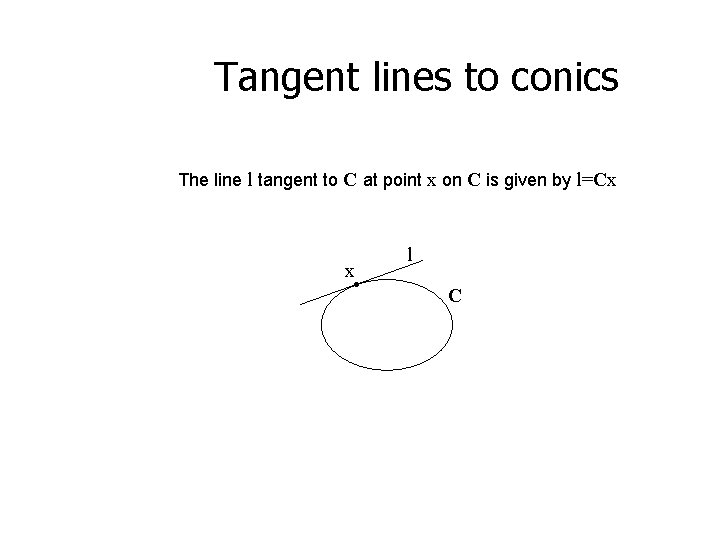
Tangent lines to conics The line l tangent to C at point x on C is given by l=Cx x l C
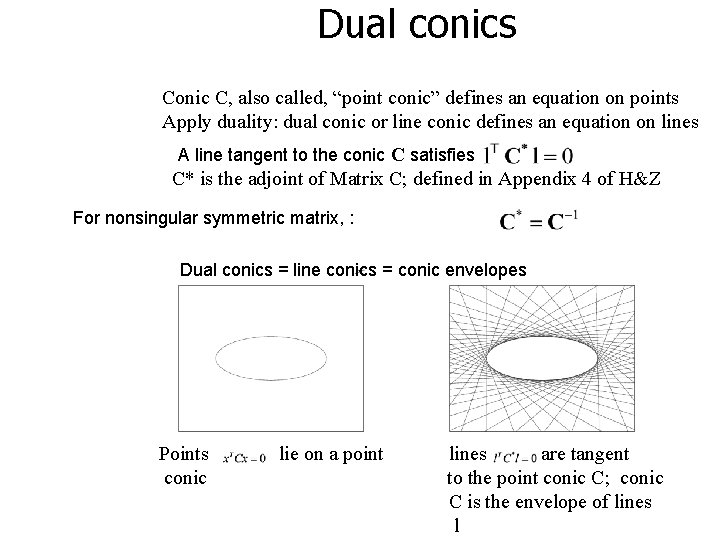
Dual conics Conic C, also called, “point conic” defines an equation on points Apply duality: dual conic or line conic defines an equation on lines A line tangent to the conic C satisfies C* is the adjoint of Matrix C; defined in Appendix 4 of H&Z For nonsingular symmetric matrix, : Dual conics = line conics = conic envelopes Points conic lie on a point lines are tangent to the point conic C; conic C is the envelope of lines l
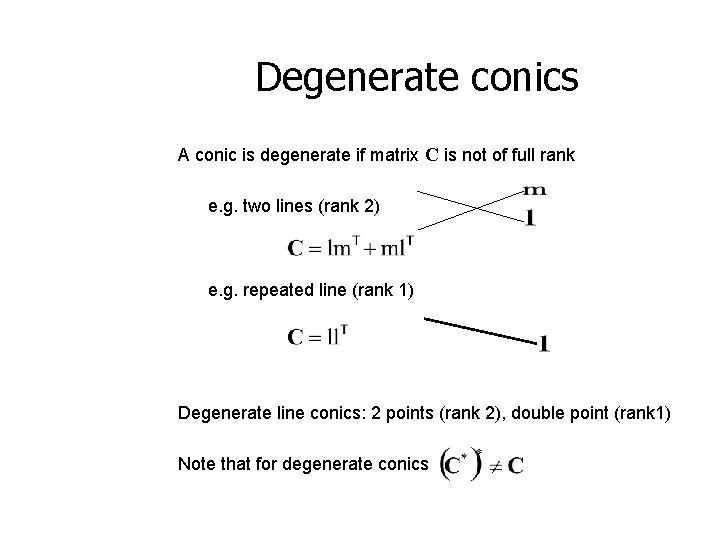
Degenerate conics A conic is degenerate if matrix C is not of full rank e. g. two lines (rank 2) e. g. repeated line (rank 1) Degenerate line conics: 2 points (rank 2), double point (rank 1) Note that for degenerate conics
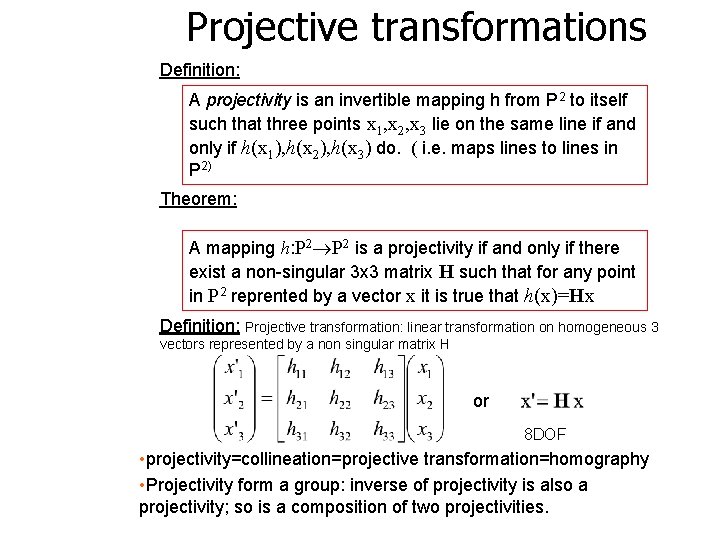
Projective transformations Definition: A projectivity is an invertible mapping h from P 2 to itself such that three points x 1, x 2, x 3 lie on the same line if and only if h(x 1), h(x 2), h(x 3) do. ( i. e. maps lines to lines in P 2) Theorem: A mapping h: P 2 is a projectivity if and only if there exist a non-singular 3 x 3 matrix H such that for any point in P 2 reprented by a vector x it is true that h(x)=Hx Definition: Projective transformation: linear transformation on homogeneous 3 vectors represented by a non singular matrix H or 8 DOF • projectivity=collineation=projective transformation=homography • Projectivity form a group: inverse of projectivity is also a projectivity; so is a composition of two projectivities.
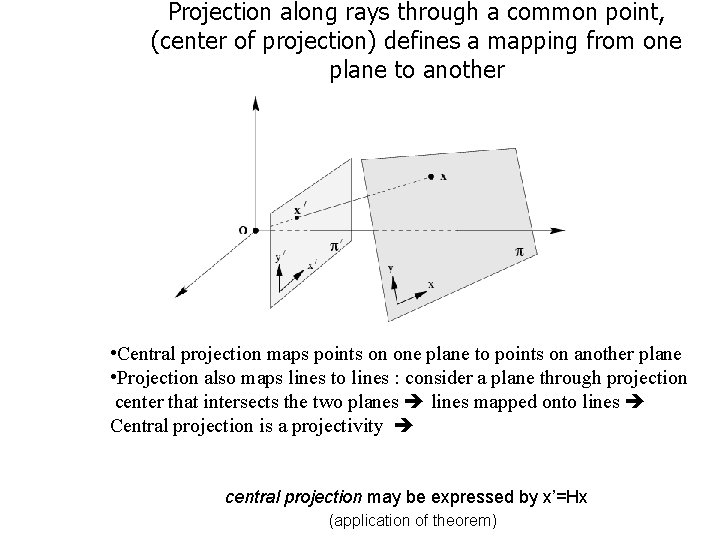
Projection along rays through a common point, (center of projection) defines a mapping from one plane to another • Central projection maps points on one plane to points on another plane • Projection also maps lines to lines : consider a plane through projection center that intersects the two planes lines mapped onto lines Central projection is a projectivity central projection may be expressed by x’=Hx (application of theorem)
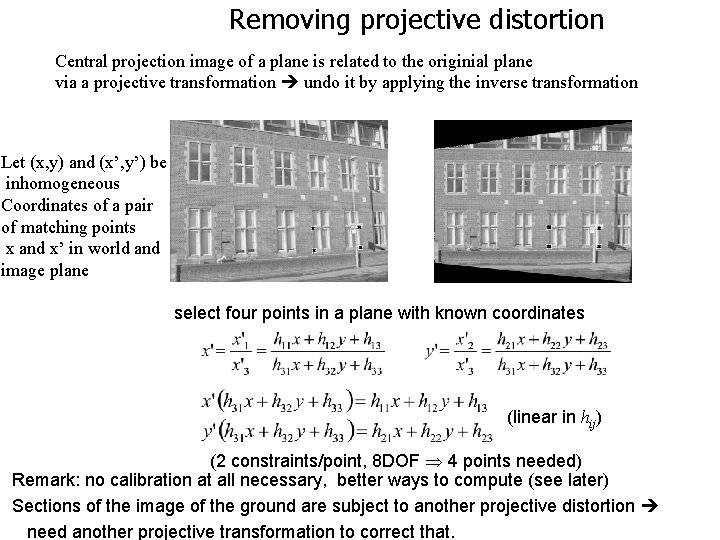
Removing projective distortion Central projection image of a plane is related to the originial plane via a projective transformation undo it by applying the inverse transformation Let (x, y) and (x’, y’) be inhomogeneous Coordinates of a pair of matching points x and x’ in world and image plane select four points in a plane with known coordinates (linear in hij) (2 constraints/point, 8 DOF 4 points needed) Remark: no calibration at all necessary, better ways to compute (see later) Sections of the image of the ground are subject to another projective distortion need another projective transformation to correct that.
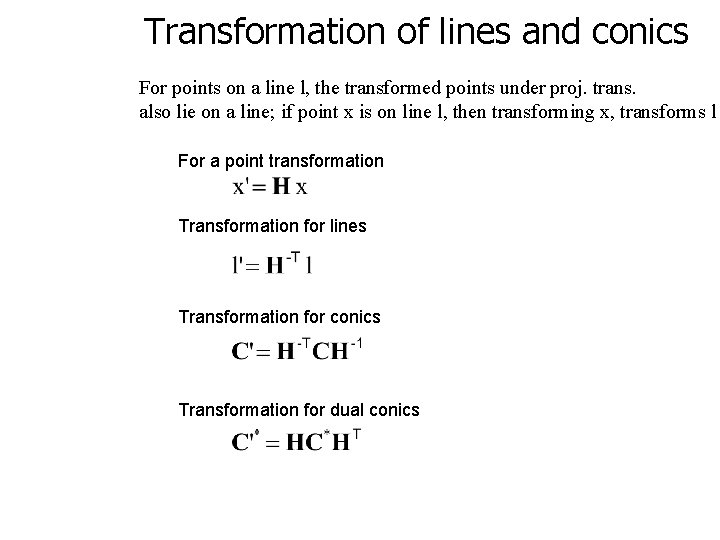
Transformation of lines and conics For points on a line l, the transformed points under proj. trans. also lie on a line; if point x is on line l, then transforming x, transforms l For a point transformation Transformation for lines Transformation for conics Transformation for dual conics
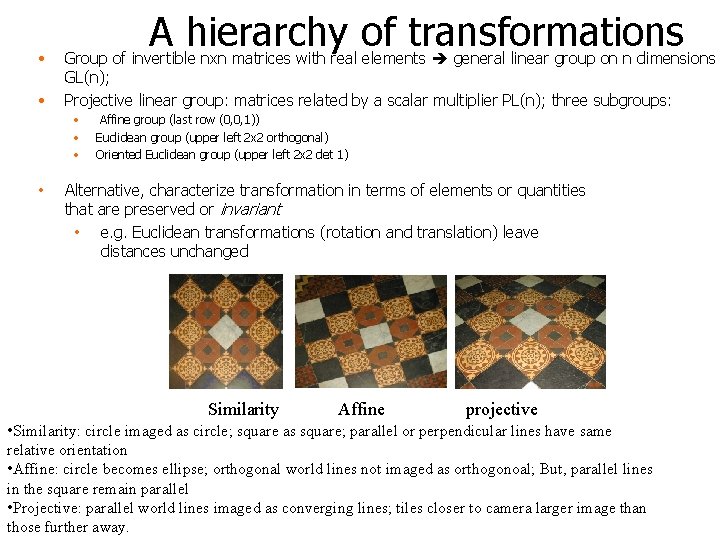
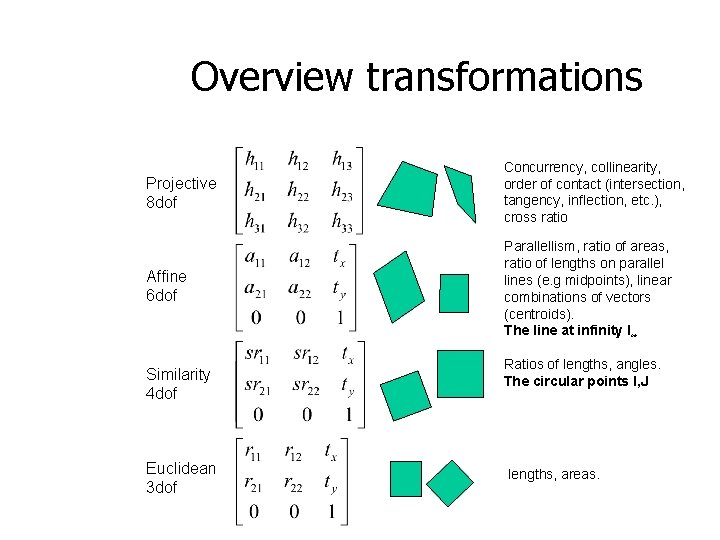
• • A hierarchy of transformations Group of invertible nxn matrices with real elements general linear group on n dimensions GL(n); Projective linear group: matrices related by a scalar multiplier PL(n); three subgroups: • • Affine group (last row (0, 0, 1)) Euclidean group (upper left 2 x 2 orthogonal) Oriented Euclidean group (upper left 2 x 2 det 1) Alternative, characterize transformation in terms of elements or quantities that are preserved or invariant • e. g. Euclidean transformations (rotation and translation) leave distances unchanged Similarity Affine projective • Similarity: circle imaged as circle; square as square; parallel or perpendicular lines have same relative orientation • Affine: circle becomes ellipse; orthogonal world lines not imaged as orthogonoal; But, parallel lines in the square remain parallel • Projective: parallel world lines imaged as converging lines; tiles closer to camera larger image than those further away.
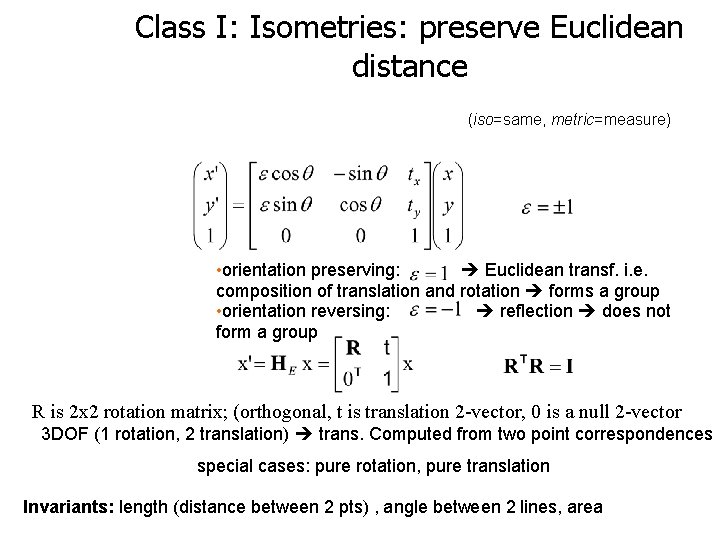
Class I: Isometries: preserve Euclidean distance (iso=same, metric=measure) • orientation preserving: Euclidean transf. i. e. composition of translation and rotation forms a group • orientation reversing: reflection does not form a group R is 2 x 2 rotation matrix; (orthogonal, t is translation 2 -vector, 0 is a null 2 -vector 3 DOF (1 rotation, 2 translation) trans. Computed from two point correspondences special cases: pure rotation, pure translation Invariants: length (distance between 2 pts) , angle between 2 lines, area
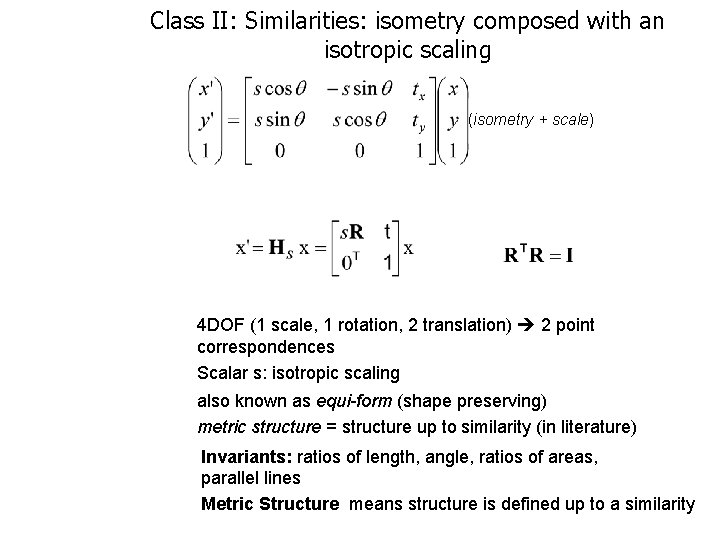
Class II: Similarities: isometry composed with an isotropic scaling (isometry + scale) 4 DOF (1 scale, 1 rotation, 2 translation) 2 point correspondences Scalar s: isotropic scaling also known as equi-form (shape preserving) metric structure = structure up to similarity (in literature) Invariants: ratios of length, angle, ratios of areas, parallel lines Metric Structure means structure is defined up to a similarity
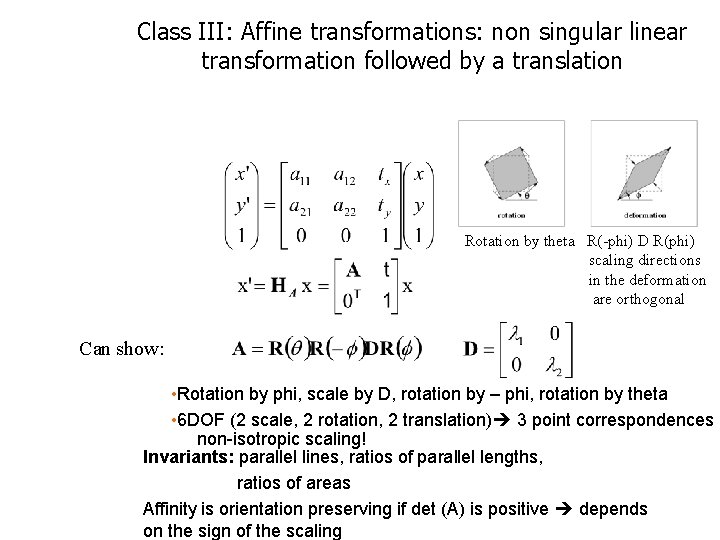
Class III: Affine transformations: non singular linear transformation followed by a translation Rotation by theta R(-phi) D R(phi) scaling directions in the deformation are orthogonal Can show: • Rotation by phi, scale by D, rotation by – phi, rotation by theta • 6 DOF (2 scale, 2 rotation, 2 translation) 3 point correspondences non-isotropic scaling! Invariants: parallel lines, ratios of parallel lengths, ratios of areas Affinity is orientation preserving if det (A) is positive depends on the sign of the scaling
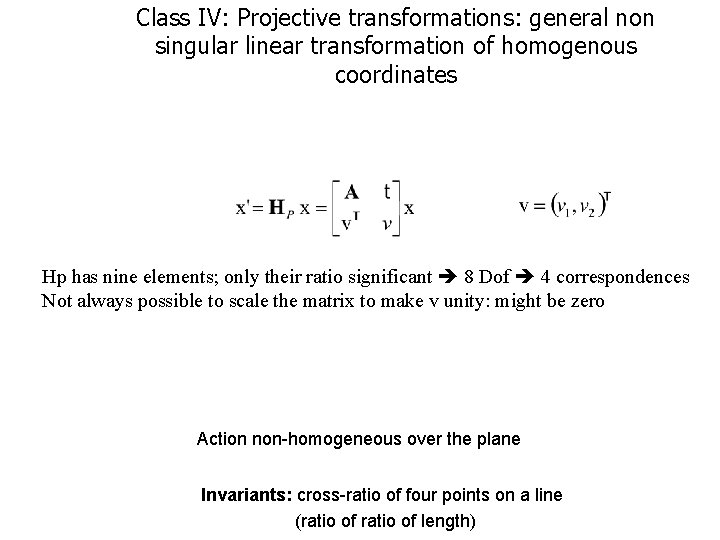
Class IV: Projective transformations: general non singular linear transformation of homogenous coordinates Hp has nine elements; only their ratio significant 8 Dof 4 correspondences Not always possible to scale the matrix to make v unity: might be zero Action non-homogeneous over the plane Invariants: cross-ratio of four points on a line (ratio of length)
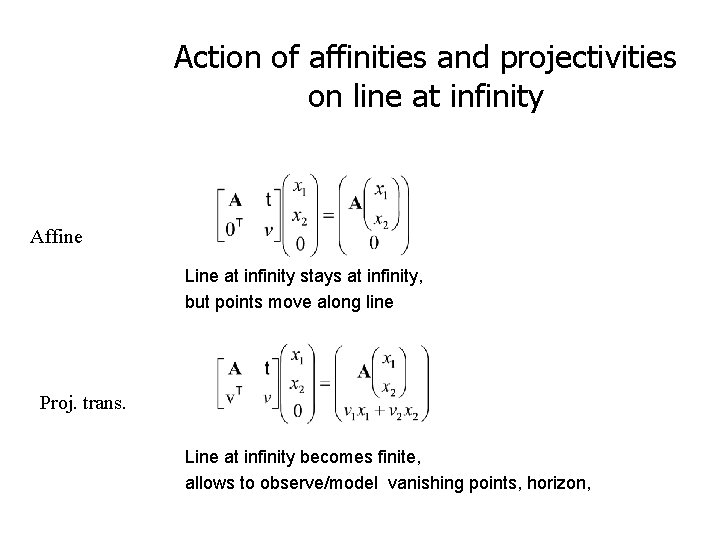
Action of affinities and projectivities on line at infinity Affine Line at infinity stays at infinity, but points move along line Proj. trans. Line at infinity becomes finite, allows to observe/model vanishing points, horizon,
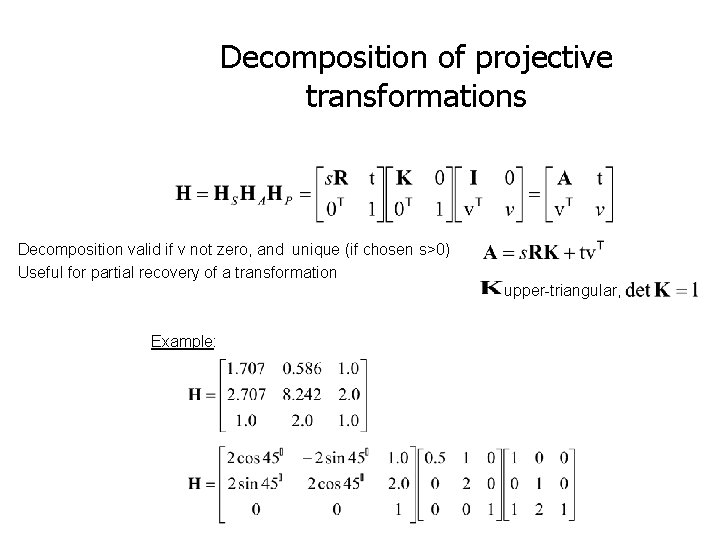
Decomposition of projective transformations Decomposition valid if v not zero, and unique (if chosen s>0) Useful for partial recovery of a transformation upper-triangular, Example:
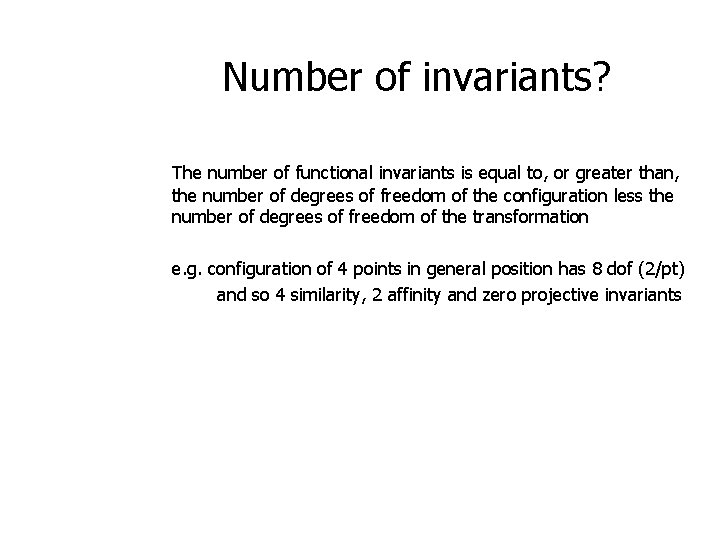
Number of invariants? The number of functional invariants is equal to, or greater than, the number of degrees of freedom of the configuration less the number of degrees of freedom of the transformation e. g. configuration of 4 points in general position has 8 dof (2/pt) and so 4 similarity, 2 affinity and zero projective invariants
Overview transformations Projective 8 dof Concurrency, collinearity, order of contact (intersection, tangency, inflection, etc. ), cross ratio Affine 6 dof Parallellism, ratio of areas, ratio of lengths on parallel lines (e. g midpoints), linear combinations of vectors (centroids). The line at infinity l∞ Similarity 4 dof Euclidean 3 dof Ratios of lengths, angles. The circular points I, J lengths, areas.
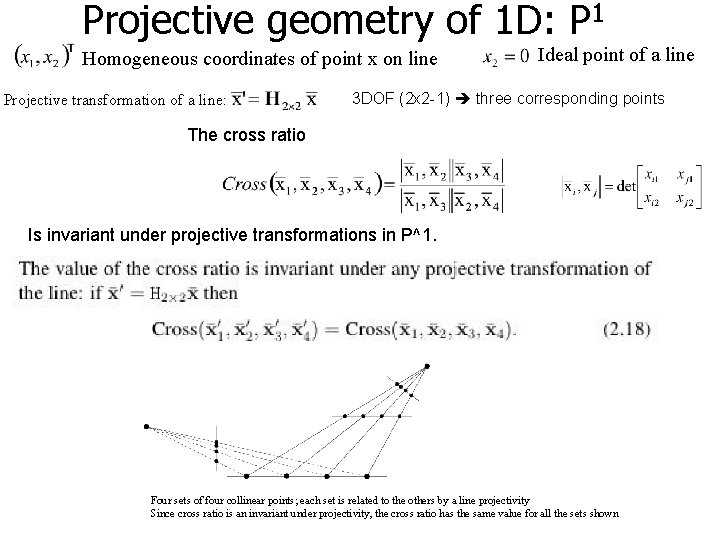
Projective geometry of 1 D: P 1 Homogeneous coordinates of point x on line Projective transformation of a line: Ideal point of a line 3 DOF (2 x 2 -1) three corresponding points The cross ratio Is invariant under projective transformations in P^1. Four sets of four collinear points; each set is related to the others by a line projectivity Since cross ratio is an invariant under projectivity, the cross ratio has the same value for all the sets shown
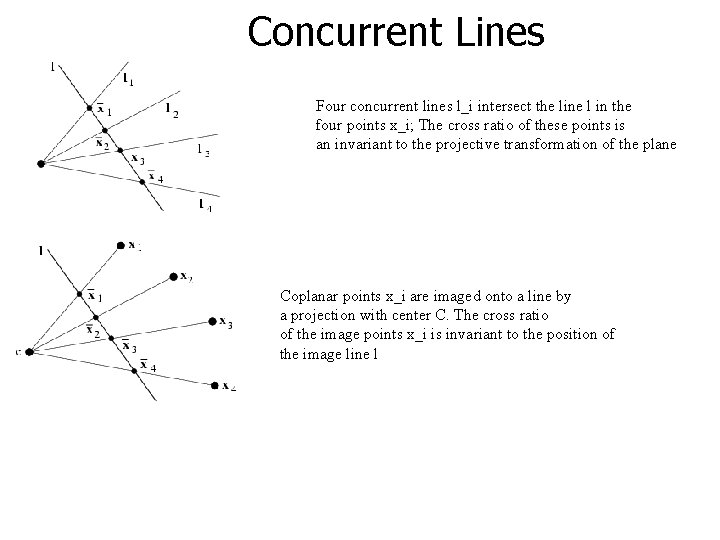
Concurrent Lines Four concurrent lines l_i intersect the line l in the four points x_i; The cross ratio of these points is an invariant to the projective transformation of the plane Coplanar points x_i are imaged onto a line by a projection with center C. The cross ratio of the image points x_i is invariant to the position of the image line l