
PROJECTIONS OF PLANES In this topic various plane

- Slides: 31
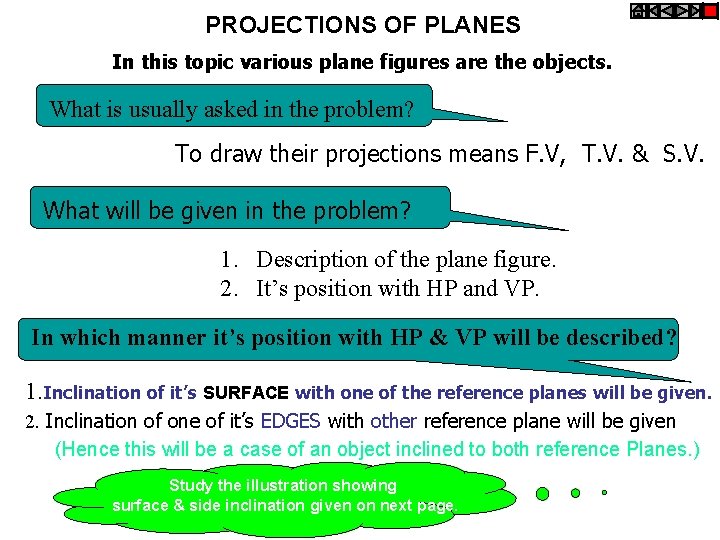
PROJECTIONS OF PLANES In this topic various plane figures are the objects. What is usually asked in the problem? To draw their projections means F. V, T. V. & S. V. What will be given in the problem? 1. Description of the plane figure. 2. It’s position with HP and VP. In which manner it’s position with HP & VP will be described? 1. Inclination of it’s SURFACE with one of the reference planes will be given. 2. Inclination of one of it’s EDGES with other reference plane will be given (Hence this will be a case of an object inclined to both reference Planes. ) Study the illustration showing surface & side inclination given on next page.
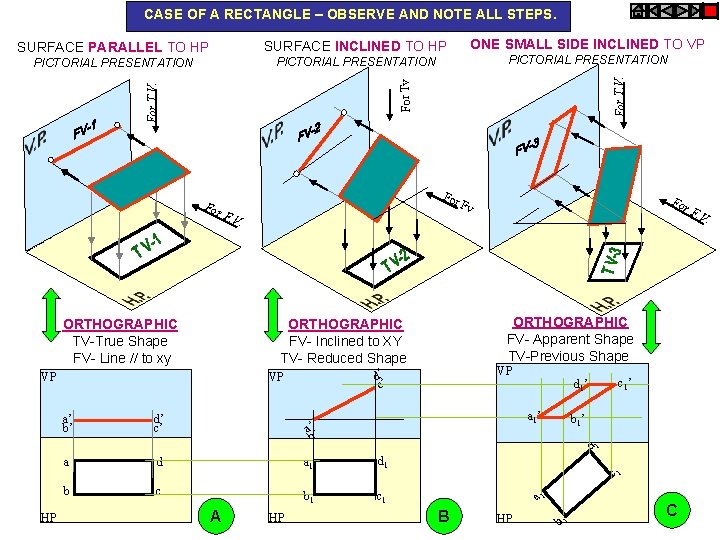
CASE OF A RECTANGLE – OBSERVE AND NOTE ALL STEPS. SURFACE INCLINED TO HP PICTORIAL PRESENTATION ORTHOGRAPHIC TV-True Shape FV- Line // to xy For F. V. d’ c’ r. F VP d’ c’ VP Fo Fv ORTHOGRAPHIC FV- Apparent Shape TV-Previous Shape ORTHOGRAPHIC FV- Inclined to XY TV- Reduced Shape VP HP PICTORIAL PRESENTATION For Tv For T. V. For a’ b’ ONE SMALL SIDE INCLINED TO VP For T. V. SURFACE PARALLEL TO HP a 1’ a’ ’ b d a 1 d 1 b c b 1 c 1 HP b 1’ d 1 a A c 1’ d 1’ c 1 a 1 B HP b 1 C . V.
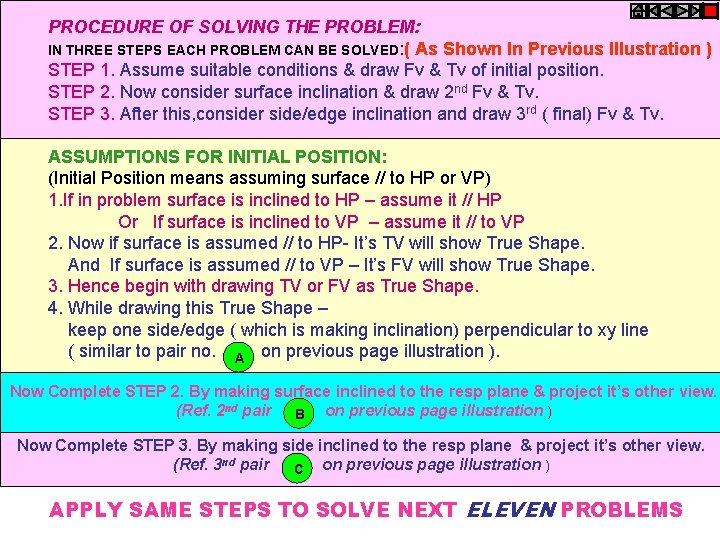
PROCEDURE OF SOLVING THE PROBLEM: IN THREE STEPS EACH PROBLEM CAN BE SOLVED: ( As Shown In Previous Illustration ) STEP 1. Assume suitable conditions & draw Fv & Tv of initial position. STEP 2. Now consider surface inclination & draw 2 nd Fv & Tv. STEP 3. After this, consider side/edge inclination and draw 3 rd ( final) Fv & Tv. ASSUMPTIONS FOR INITIAL POSITION: (Initial Position means assuming surface // to HP or VP) 1. If in problem surface is inclined to HP – assume it // HP Or If surface is inclined to VP – assume it // to VP 2. Now if surface is assumed // to HP- It’s TV will show True Shape. And If surface is assumed // to VP – It’s FV will show True Shape. 3. Hence begin with drawing TV or FV as True Shape. 4. While drawing this True Shape – keep one side/edge ( which is making inclination) perpendicular to xy line ( similar to pair no. A on previous page illustration ). Now Complete STEP 2. By making surface inclined to the resp plane & project it’s other view. (Ref. 2 nd pair B on previous page illustration ) Now Complete STEP 3. By making side inclined to the resp plane & project it’s other view. (Ref. 3 nd pair C on previous page illustration ) APPLY SAME STEPS TO SOLVE NEXT ELEVEN PROBLEMS
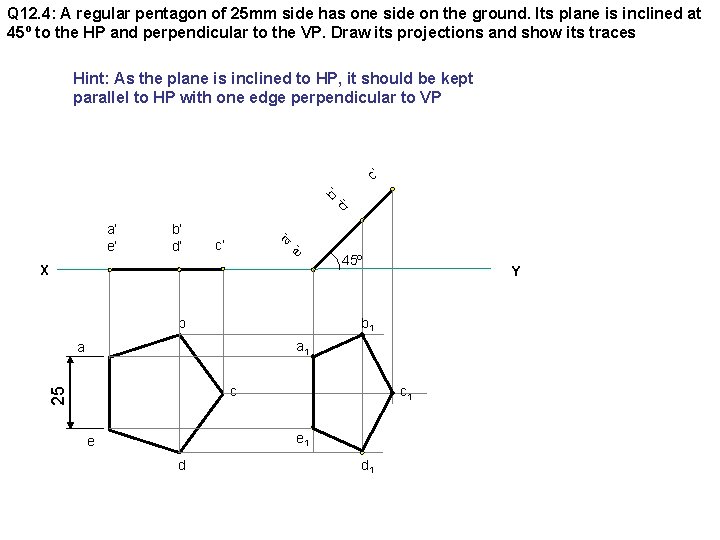
Q 12. 4: A regular pentagon of 25 mm side has one side on the ground. Its plane is inclined at 45º to the HP and perpendicular to the VP. Draw its projections and show its traces b d’ ’ c’ Hint: As the plane is inclined to HP, it should be kept parallel to HP with one edge perpendicular to VP b’ d’ c’ a e’ ’ a’ e’ X b 45º Y b 1 a c 1 25 c e 1 e d d 1
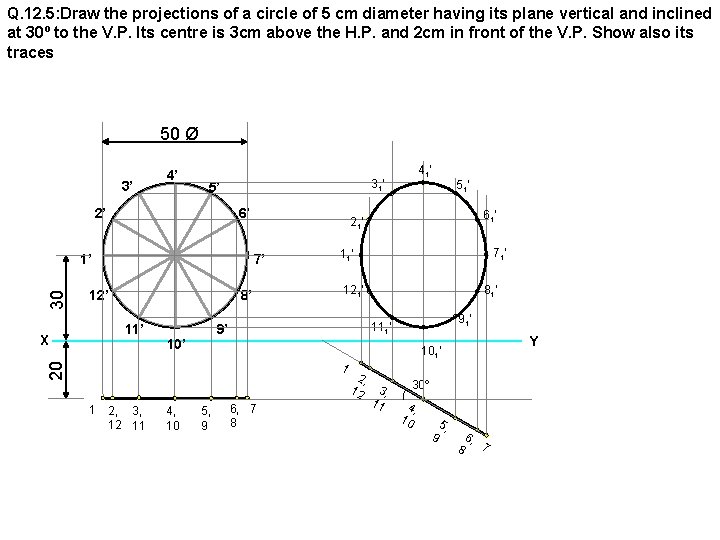
Q. 12. 5: Draw the projections of a circle of 5 cm diameter having its plane vertical and inclined at 30º to the V. P. Its centre is 3 cm above the H. P. and 2 cm in front of the V. P. Show also its traces 50 Ø 3’ 4’ 5’ 2’ 6’ 30 1’ 8’ 11’ X 4, 10 81’ 91’ 111’ Y 101’ 20 2, 3, 12 11 71’ 121’ 1 1 61’ 11’ 9’ 10’ 51’ 21’ 7’ 12’ 41’ 31’ 5, 9 6, 7 8 2, 12 3, 11 30º 4, 10 9 5, 8 6, 7
X Y
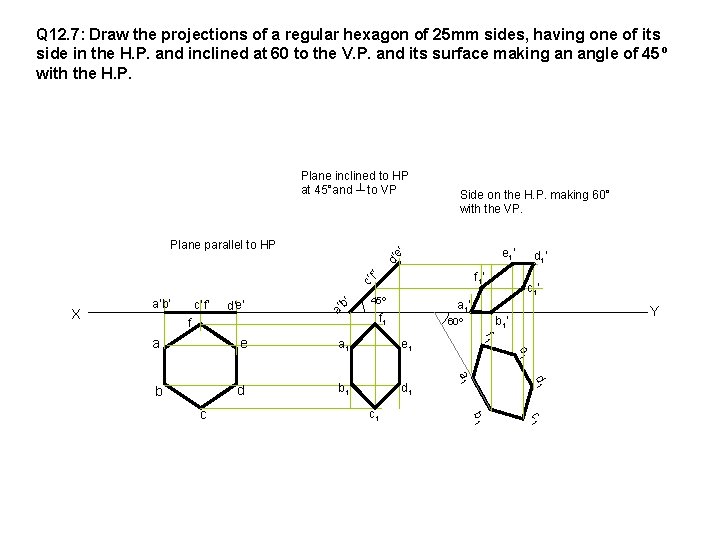
Q 12. 7: Draw the projections of a regular hexagon of 25 mm sides, having one of its side in the H. P. and inclined at 60 to the V. P. and its surface making an angle of 45º with the H. P. Plane inclined to HP at 45°and ┴ to VP Plane parallel to HP c’ X a’ b’ c’ f’ d’e’ f a’ b’ f’ e’ d’ 45º a 1’ f 1 b 1 d 1 d Y e 1 b c 1’ f 1 e 1 a 1 d 1’ b 1’ 60º e c 1 b 1 c 1 e 1’ f 1’ a c Side on the H. P. making 60° with the VP.
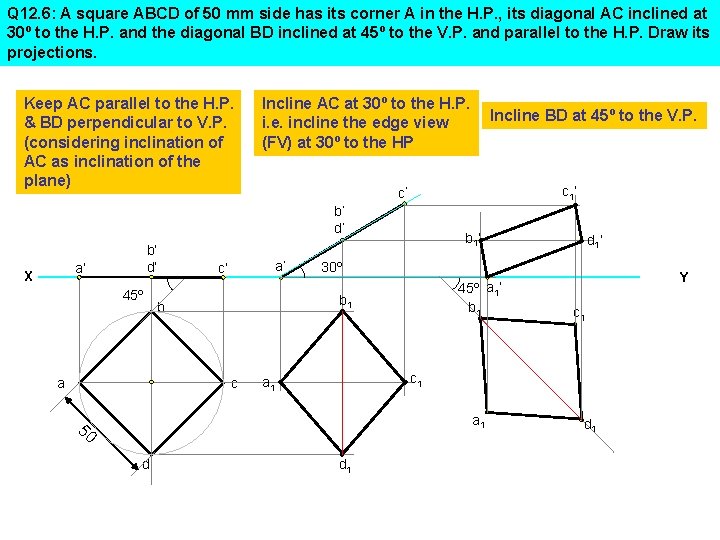
Q 12. 6: A square ABCD of 50 mm side has its corner A in the H. P. , its diagonal AC inclined at 30º to the H. P. and the diagonal BD inclined at 45º to the V. P. and parallel to the H. P. Draw its projections. Keep AC parallel to the H. P. & BD perpendicular to V. P. (considering inclination of AC as inclination of the plane) Incline AC at 30º to the H. P. i. e. incline the edge view (FV) at 30º to the HP c 1’ c’ b’ d’ a’ X 45º a a’ c’ b 1’ 45º a 1’ b 1 Y c 1 a 1 50 d d 1’ 30º b 1 b c Incline BD at 45º to the V. P. d 1
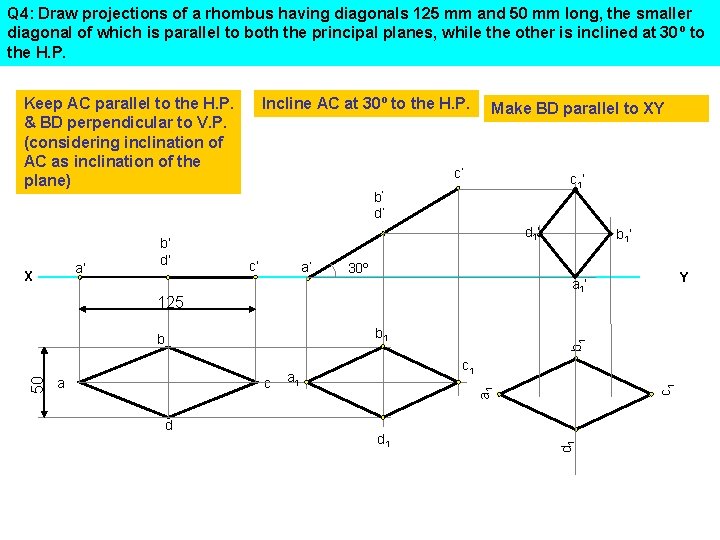
Q 4: Draw projections of a rhombus having diagonals 125 mm and 50 mm long, the smaller diagonal of which is parallel to both the principal planes, while the other is inclined at 30º to the H. P. Keep AC parallel to the H. P. & BD perpendicular to V. P. (considering inclination of AC as inclination of the plane) Make BD parallel to XY c’ c 1’ b’ d’ d 1’ a’ 30º 125 c d c 1 a 1 50 a b 1 b Y a 1’ c 1 c’ b 1’ d 1 a’ X b’ d’ Incline AC at 30º to the H. P.
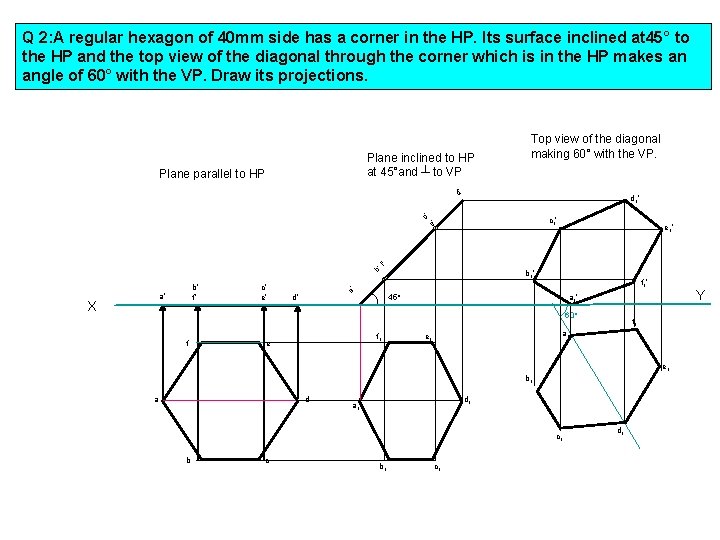
Q 2: A regular hexagon of 40 mm side has a corner in the HP. Its surface inclined at 45° to the HP and the top view of the diagonal through the corner which is in the HP makes an angle of 60° with the VP. Draw its projections. Plane inclined to HP at 45°and ┴ to VP Plane parallel to HP Top view of the diagonal making 60° with the VP. d’ d 1’ c’ ’ e b’ f’ a’ X c’ e’ d’ e 1’ f’ a’ b’ c 1’ b 1’ f 1’ 45° 60° f f 1 e Y a 1’ f 1 a 1 e 1 b 1 a d d 1 a 1 c 1 b c b 1 c 1 d 1
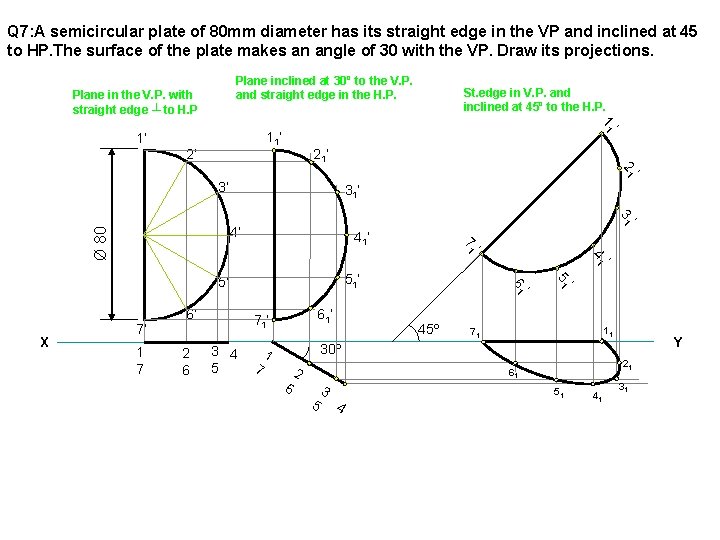
Q 7: A semicircular plate of 80 mm diameter has its straight edge in the VP and inclined at 45 to HP. The surface of the plate makes an angle of 30 with the VP. Draw its projections. Plane inclined at 30º to the V. P. and straight edge in the H. P. Plane in the V. P. with straight edge ┴ to H. P ’ 11 11’ 1’ 2’ St. edge in V. P. and inclined at 45º to the H. P. 21’ ’ 21 3’ 31’ ’ 31 41’ ’ 41 1 7 2 6 61’ 71’ 3 4 5 7 45º ’ 51 7’ 6’ ’ 61 51’ 5’ X ’ 71 Ø 80 4’ 11 71 Y 30º 1 6 2 21 61 5 3 4 51 41 31
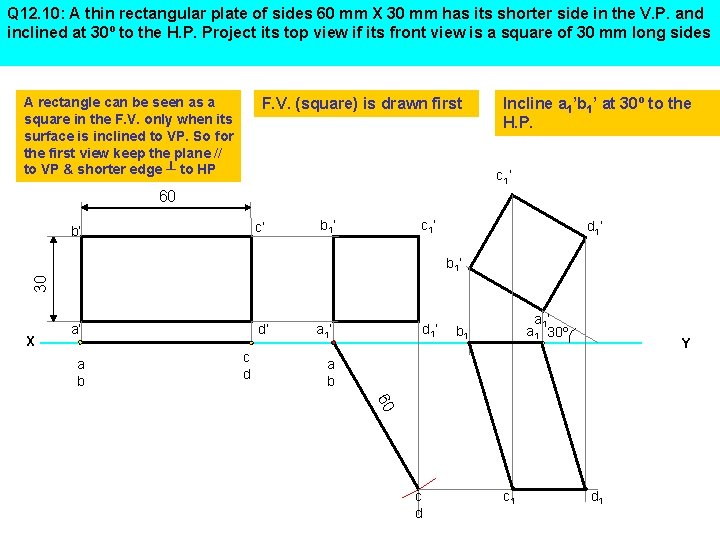
Q 12. 10: A thin rectangular plate of sides 60 mm X 30 mm has its shorter side in the V. P. and inclined at 30º to the H. P. Project its top view if its front view is a square of 30 mm long sides A rectangle can be seen as a square in the F. V. only when its surface is inclined to VP. So for the first view keep the plane // to VP & shorter edge ┴ to HP F. V. (square) is drawn first Incline a 1’b 1’ at 30º to the H. P. c 1’ 60 c’ b’ b 1’ c 1’ d 1’ 30 b 1’ X d’ a’ a b c d d 1’ a 1 30º b 1 Y a b 60 c d c 1 d 1
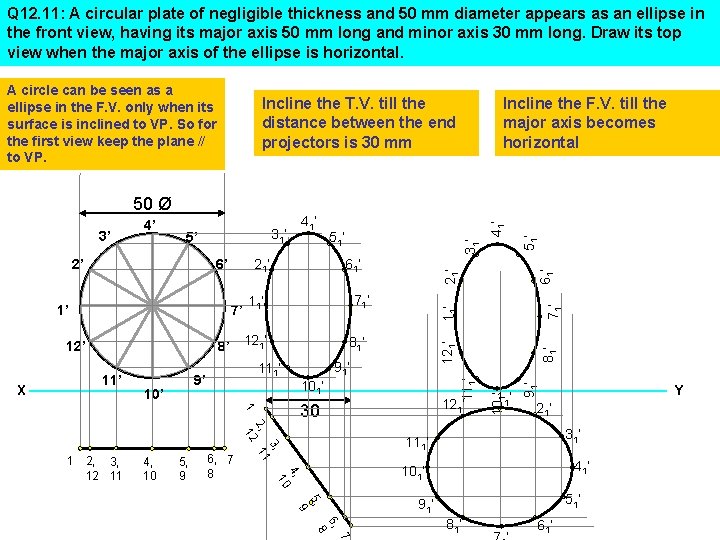
Q 12. 11: A circular plate of negligible thickness and 50 mm diameter appears as an ellipse in the front view, having its major axis 50 mm long and minor axis 30 mm long. Draw its top view when the major axis of the ellipse is horizontal. 71’ 11’ 8’ 121’ 11’ 91’ 111’ 9’ 10’ 81’ 111’ 12’ 61’ 51’ 7’ 61’ 81’ 21’ 101’ 121’ 1 30 11’ 91’ 1’ 51’ 11’ 6’ 41’ 21’ 5’ 2’ X 31’ 121’ 3’ 4’ 31’ 50 Ø Incline the F. V. till the major axis becomes horizontal 41’ Incline the T. V. till the distance between the end projectors is 30 mm 101’ A circle can be seen as a ellipse in the F. V. only when its surface is inclined to VP. So for the first view keep the plane // to VP. 21’ 2, 12 6, 7 8 41’ 10 5, 9 4, 10 11 2, 3, 12 11 31’ 111’ 3, 1 Y 51’ 5, 91’ 9 6, 8 81’ 61’ 7
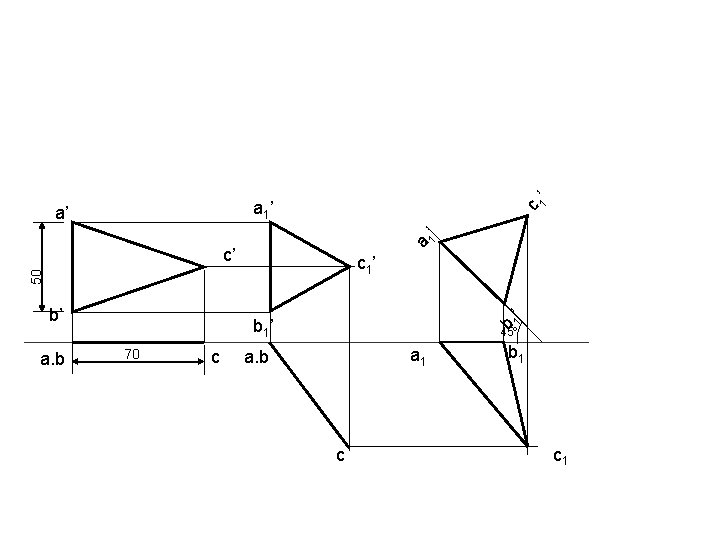
a 1’ c 1’ a 1 ’ a’ c’ b’ a. b 1’ 50 c 1’ 70 c b b 1 ’ 45º a 1 a. b c b 1 c 1
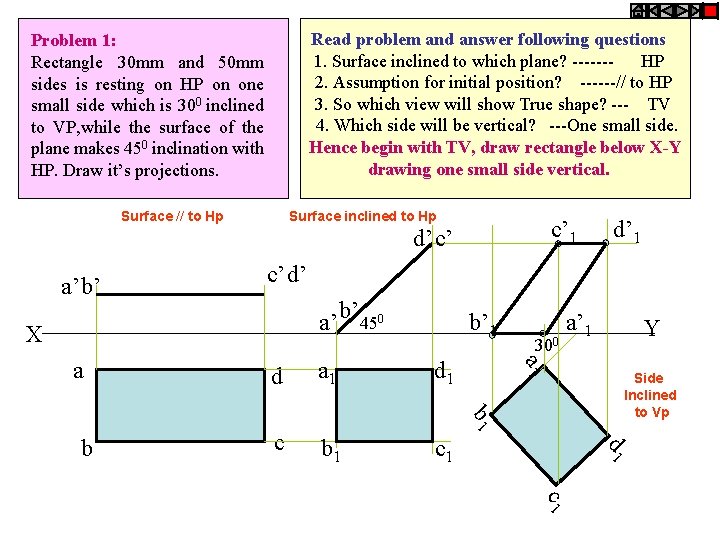
Read problem and answer following questions 1. Surface inclined to which plane? ------HP 2. Assumption for initial position? ------// to HP 3. So which view will show True shape? --- TV 4. Which side will be vertical? ---One small side. Hence begin with TV, draw rectangle below X-Y drawing one small side vertical. Problem 1: Rectangle 30 mm and 50 mm sides is resting on HP on one small side which is 300 inclined to VP, while the surface of the plane makes 450 inclination with HP. Draw it’s projections. Surface // to Hp Surface inclined to Hp c’ 1 d’c’ a’b’ c’d’ a’ b’ 450 X d a 1 d 1 c b 1 c 1 300 a’ 1 b 1 Y Side Inclined to Vp d 1 b b’ 1 a d’ 1 c 1
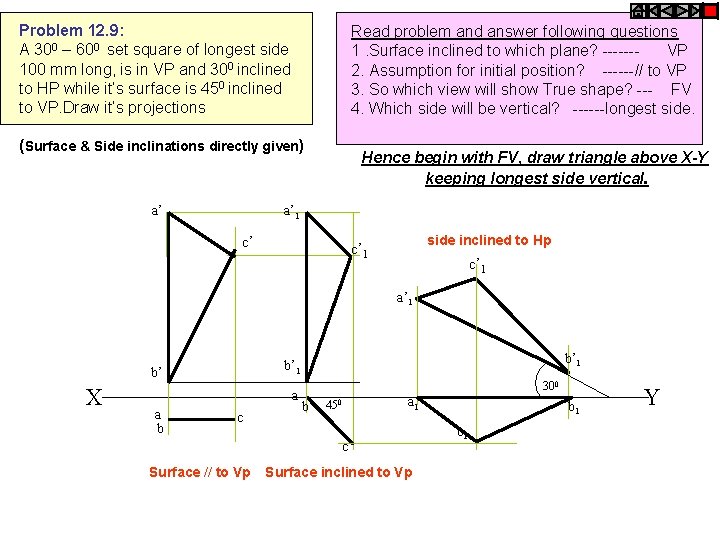
Problem 12. 9: A 300 – 600 set square of longest side 100 mm long, is in VP and 300 inclined to HP while it’s surface is 450 inclined to VP. Draw it’s projections Read problem and answer following questions 1. Surface inclined to which plane? ------VP 2. Assumption for initial position? ------// to VP 3. So which view will show True shape? --- FV 4. Which side will be vertical? ------longest side. (Surface & Side inclinations directly given) a’ Hence begin with FV, draw triangle above X-Y keeping longest side vertical. a’ 1 c’ side inclined to Hp c’ 1 a’ 1 b’ X a a b b’ 1 c 300 b a 1 450 c Surface // to Vp Surface inclined to Vp b 1 c 1 Y
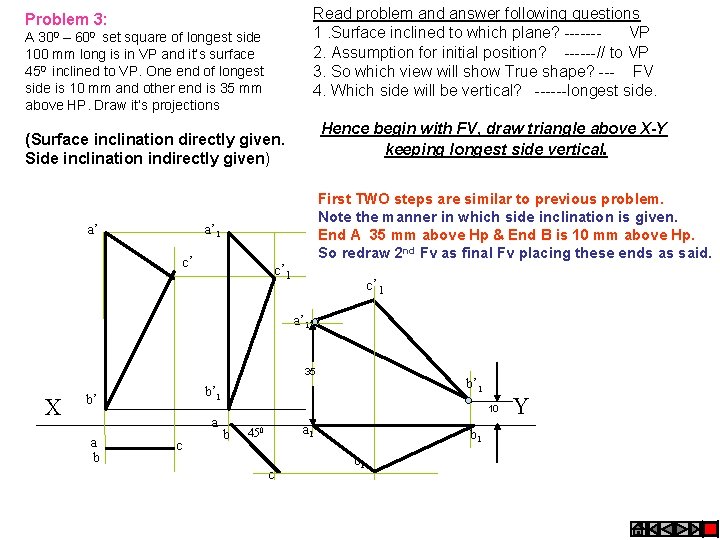
Read problem and answer following questions 1. Surface inclined to which plane? ------VP 2. Assumption for initial position? ------// to VP 3. So which view will show True shape? --- FV 4. Which side will be vertical? ------longest side. Problem 3: A 300 – 600 set square of longest side 100 mm long is in VP and it’s surface 450 inclined to VP. One end of longest side is 10 mm and other end is 35 mm above HP. Draw it’s projections Hence begin with FV, draw triangle above X-Y keeping longest side vertical. (Surface inclination directly given. Side inclination indirectly given) a’ First TWO steps are similar to previous problem. Note the manner in which side inclination is given. End A 35 mm above Hp & End B is 10 mm above Hp. So redraw 2 nd Fv as final Fv placing these ends as said. a’ 1 c’ c’ 1 a’ 1 35 X 10 a a b b’ 1 b’ c b a 1 450 c b 1 c 1 Y
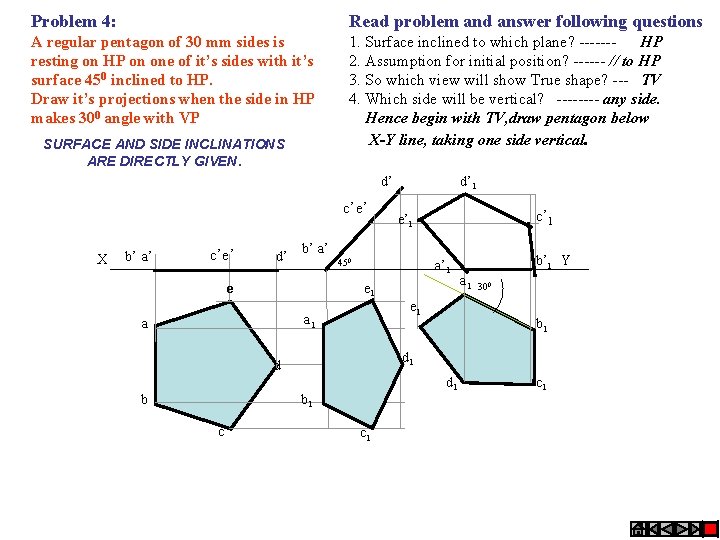
Problem 4: Read problem and answer following questions A regular pentagon of 30 mm sides is resting on HP on one of it’s sides with it’s surface 450 inclined to HP. Draw it’s projections when the side in HP makes 300 angle with VP 1. Surface inclined to which plane? ------HP 2. Assumption for initial position? ------ // to HP 3. So which view will show True shape? --- TV 4. Which side will be vertical? ---- any side. Hence begin with TV, draw pentagon below X-Y line, taking one side vertical. SURFACE AND SIDE INCLINATIONS ARE DIRECTLY GIVEN. d’ c’e’ X b’ a’ c’e’ d’ 450 a’ 1 e 1 a b’ 1 Y a 1 300 b 1 d d 1 b 1 c c’ 1 e’ 1 b’ a’ e b d’ 1 c 1
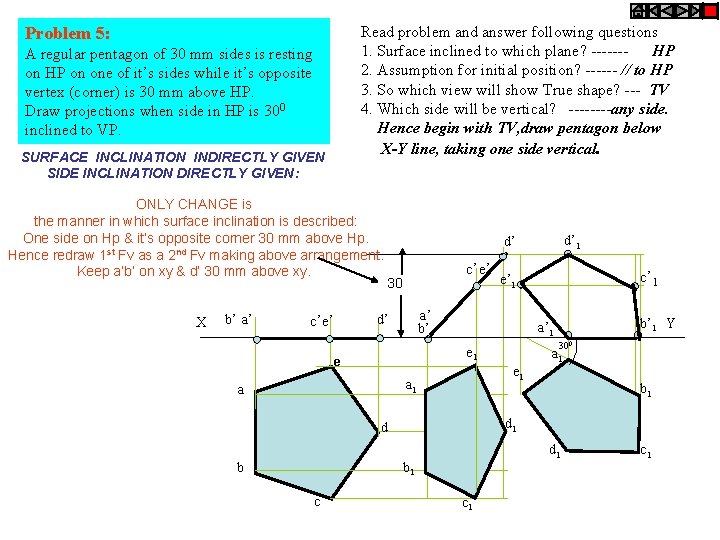
Read problem and answer following questions 1. Surface inclined to which plane? ------HP 2. Assumption for initial position? ------ // to HP 3. So which view will show True shape? --- TV 4. Which side will be vertical? ----any side. Hence begin with TV, draw pentagon below X-Y line, taking one side vertical. Problem 5: A regular pentagon of 30 mm sides is resting on HP on one of it’s sides while it’s opposite vertex (corner) is 30 mm above HP. Draw projections when side in HP is 300 inclined to VP. SURFACE INCLINATION INDIRECTLY GIVEN SIDE INCLINATION DIRECTLY GIVEN: ONLY CHANGE is the manner in which surface inclination is described: One side on Hp & it’s opposite corner 30 mm above Hp. Hence redraw 1 st Fv as a 2 nd Fv making above arrangement. Keep a’b’ on xy & d’ 30 mm above xy. X b’ a’ c’e’ 30 300 e 1 a 1 b 1 d d 1 b 1 c b’ 1 Y a’ 1 e 1 a c’ 1 e’ 1 a’ b’ d’ e b d’ 1 d’ c 1
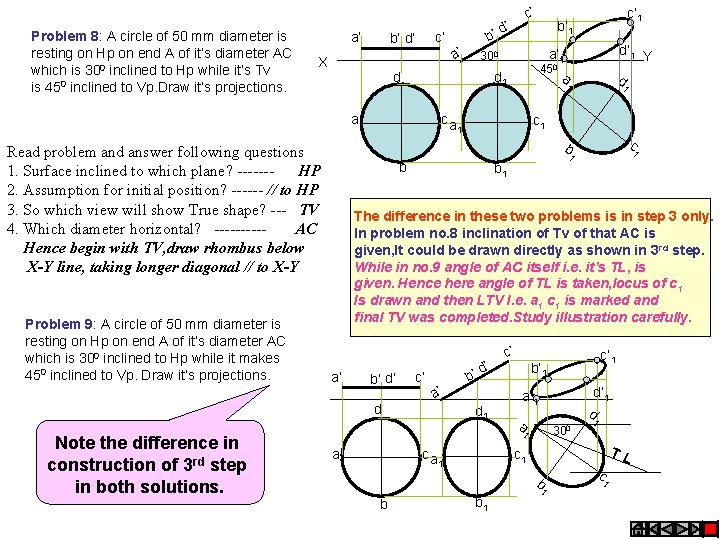
Problem 8: A circle of 50 mm diameter is resting on Hp on end A of it’s diameter AC which is 300 inclined to Hp while it’s Tv is 450 inclined to Vp. Draw it’s projections. a’ c’ b’ d’ X d’ 1 Y a’ 1 300 450 d 1 ca c’ 1 b’ 1 a d 1 1 c b Read problem and answer following questions 1. Surface inclined to which plane? ------HP 2. Assumption for initial position? ------ // to HP 3. So which view will show True shape? --- TV 4. Which diameter horizontal? -----AC Hence begin with TV, draw rhombus below X-Y line, taking longer diagonal // to X-Y 1 1 b b 1 The difference in these two problems is in step 3 only. In problem no. 8 inclination of Tv of that AC is given, It could be drawn directly as shown in 3 rd step. While in no. 9 angle of AC itself i. e. it’s TL, is given. Hence here angle of TL is taken, locus of c 1 Is drawn and then LTV I. e. a 1 c 1 is marked and final TV was completed. Study illustration carefully. a’ b’ d’ d Note the difference in construction of 3 rd step in both solutions. d’ b’ d a Problem 9: A circle of 50 mm diameter is resting on Hp on end A of it’s diameter AC which is 300 inclined to Hp while it makes 450 inclined to Vp. Draw it’s projections. a’ c’ c’ a’ d’ b’ d 1 c’ b’ 1 d a’ 1 a 300 1 a ca 1 TL c 1 1 b b c’ 1 b 1 1 c 1
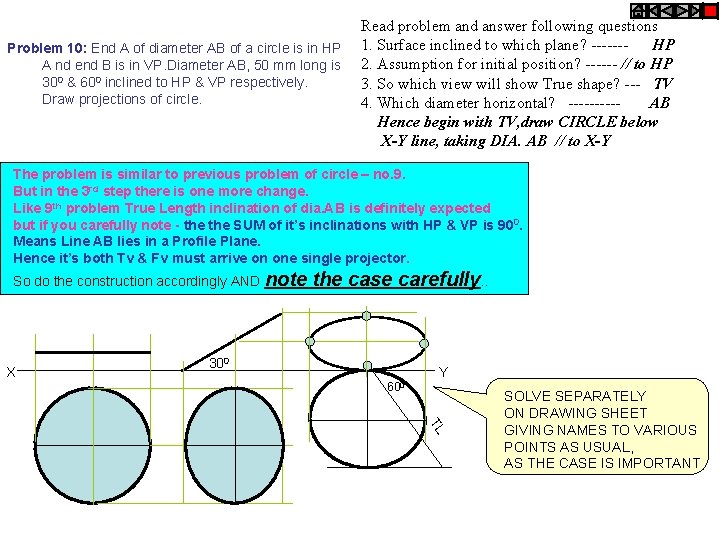
Problem 10: End A of diameter AB of a circle is in HP A nd end B is in VP. Diameter AB, 50 mm long is 300 & 600 inclined to HP & VP respectively. Draw projections of circle. Read problem and answer following questions 1. Surface inclined to which plane? ------HP 2. Assumption for initial position? ------ // to HP 3. So which view will show True shape? --- TV 4. Which diameter horizontal? -----AB Hence begin with TV, draw CIRCLE below X-Y line, taking DIA. AB // to X-Y The problem is similar to previous problem of circle – no. 9. But in the 3 rd step there is one more change. Like 9 th problem True Length inclination of dia. AB is definitely expected but if you carefully note - the SUM of it’s inclinations with HP & VP is 900. Means Line AB lies in a Profile Plane. Hence it’s both Tv & Fv must arrive on one single projector. So do the construction accordingly AND note X the case carefully. . 300 Y 600 TL SOLVE SEPARATELY ON DRAWING SHEET GIVING NAMES TO VARIOUS POINTS AS USUAL, AS THE CASE IS IMPORTANT
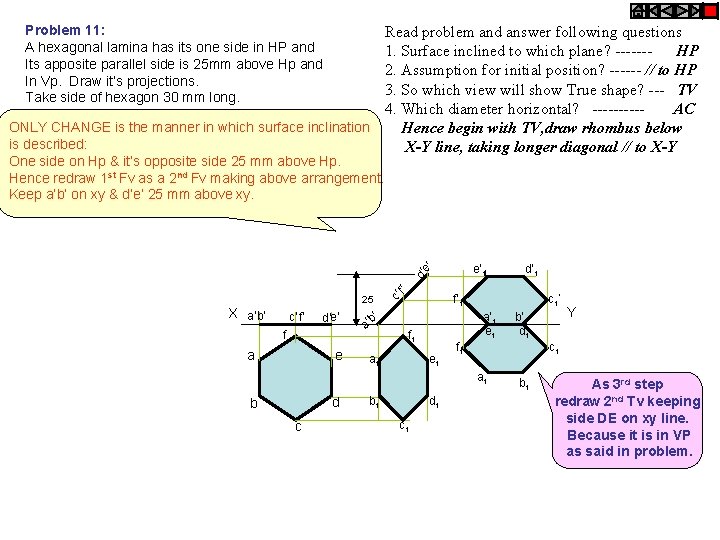
Problem 11: A hexagonal lamina has its one side in HP and Its apposite parallel side is 25 mm above Hp and In Vp. Draw it’s projections. Take side of hexagon 30 mm long. Read problem and answer following questions 1. Surface inclined to which plane? ------HP 2. Assumption for initial position? ------ // to HP 3. So which view will show True shape? --- TV 4. Which diameter horizontal? -----AC ONLY CHANGE is the manner in which surface inclination Hence begin with TV, draw rhombus below is described: X-Y line, taking longer diagonal // to X-Y One side on Hp & it’s opposite side 25 mm above Hp. Hence redraw 1 st Fv as a 2 nd Fv making above arrangement. Keep a’b’ on xy & d’e’ 25 mm above xy. 25 X a’b’ c’ f’ d’e’ f a e a’ c’ e’ d’ f’ e’ 1 f’ 1 b’ a’ 1 e 1 f 1 a 1 c 1’ e 1 d c b 1 d 1 c 1 b’ 1 d 1 f 1 Y c 1 a 1 b d’ 1 b 1 As 3 rd step redraw 2 nd Tv keeping side DE on xy line. Because it is in VP as said in problem.
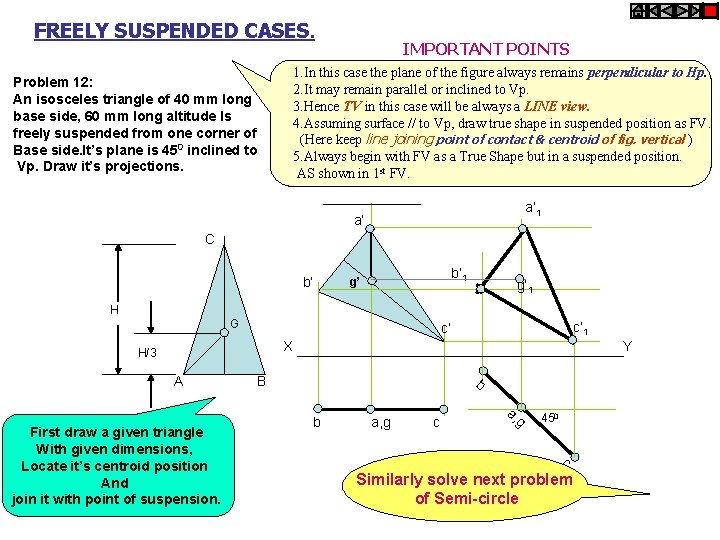
FREELY SUSPENDED CASES. Problem 12: An isosceles triangle of 40 mm long base side, 60 mm long altitude Is freely suspended from one corner of Base side. It’s plane is 450 inclined to Vp. Draw it’s projections. IMPORTANT POINTS 1. In this case the plane of the figure always remains perpendicular to Hp. 2. It may remain parallel or inclined to Vp. 3. Hence TV in this case will be always a LINE view. 4. Assuming surface // to Vp, draw true shape in suspended position as FV. (Here keep line joining point of contact & centroid of fig. vertical ) 5. Always begin with FV as a True Shape but in a suspended position. AS shown in 1 st FV. a’ 1 a’ C b’ b’ 1 g’ g’ 1 H G c’ 1 c’ X H/3 A First draw a given triangle With given dimensions, Locate it’s centroid position And join it with point of suspension. Y B b b a, g c a, g 450 c Similarly solve next problem of Semi-circle
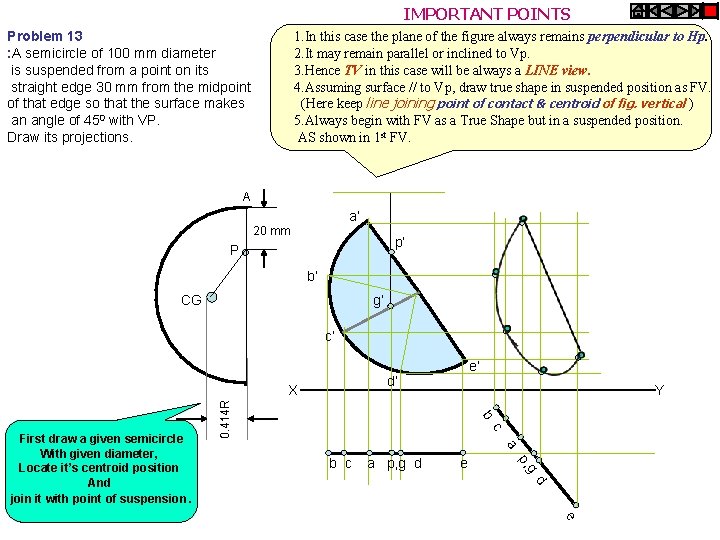
IMPORTANT POINTS Problem 13 : A semicircle of 100 mm diameter is suspended from a point on its straight edge 30 mm from the midpoint of that edge so that the surface makes an angle of 450 with VP. Draw its projections. 1. In this case the plane of the figure always remains perpendicular to Hp. 2. It may remain parallel or inclined to Vp. 3. Hence TV in this case will be always a LINE view. 4. Assuming surface // to Vp, draw true shape in suspended position as FV. (Here keep line joining point of contact & centroid of fig. vertical ) 5. Always begin with FV as a True Shape but in a suspended position. AS shown in 1 st FV. A a’ 20 mm p’ P b’ G CG g’ c’ d’ Y b 0. 414 R X c a a p, g d e g b c p, d First draw a given semicircle With given diameter, Locate it’s centroid position And join it with point of suspension. e’ e
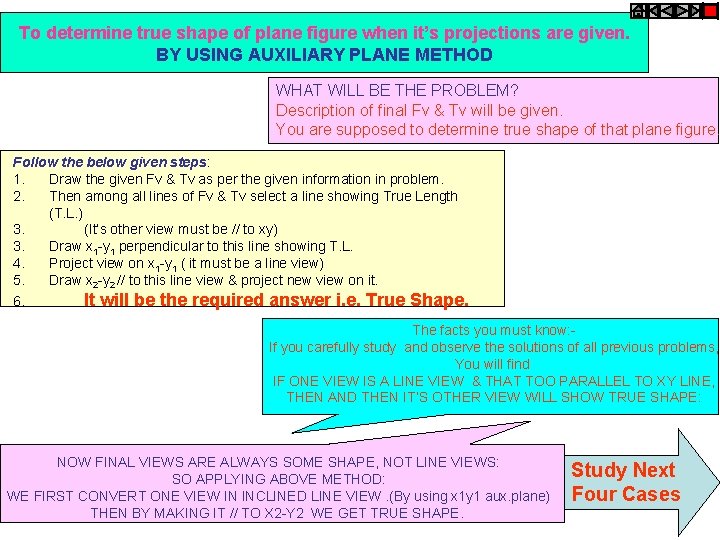
To determine true shape of plane figure when it’s projections are given. BY USING AUXILIARY PLANE METHOD WHAT WILL BE THE PROBLEM? Description of final Fv & Tv will be given. You are supposed to determine true shape of that plane figure. Follow the below given steps: 1. Draw the given Fv & Tv as per the given information in problem. 2. Then among all lines of Fv & Tv select a line showing True Length (T. L. ) 3. (It’s other view must be // to xy) 3. Draw x 1 -y 1 perpendicular to this line showing T. L. 4. Project view on x 1 -y 1 ( it must be a line view) 5. Draw x 2 -y 2 // to this line view & project new view on it. 6. It will be the required answer i. e. True Shape. The facts you must know: If you carefully study and observe the solutions of all previous problems, You will find IF ONE VIEW IS A LINE VIEW & THAT TOO PARALLEL TO XY LINE, THEN AND THEN IT’S OTHER VIEW WILL SHOW TRUE SHAPE: NOW FINAL VIEWS ARE ALWAYS SOME SHAPE, NOT LINE VIEWS: SO APPLYING ABOVE METHOD: WE FIRST CONVERT ONE VIEW IN INCLINED LINE VIEW. (By using x 1 y 1 aux. plane) THEN BY MAKING IT // TO X 2 -Y 2 WE GET TRUE SHAPE. Study Next Four Cases
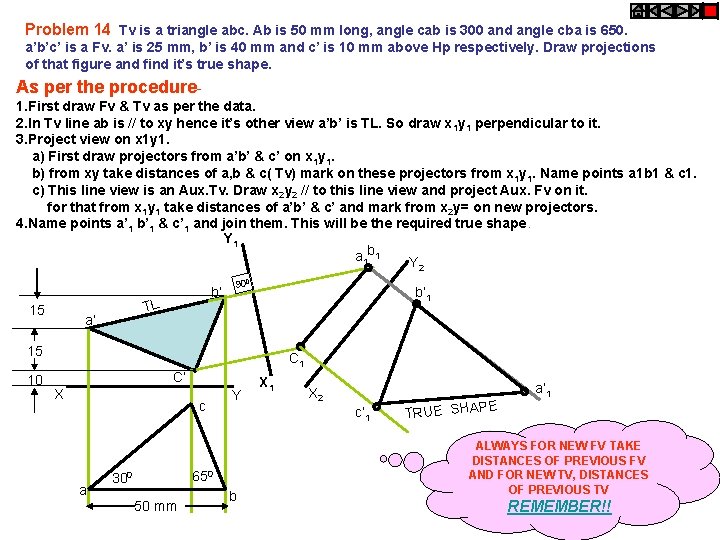
Problem 14 Tv is a triangle abc. Ab is 50 mm long, angle cab is 300 and angle cba is 650. a’b’c’ is a Fv. a’ is 25 mm, b’ is 40 mm and c’ is 10 mm above Hp respectively. Draw projections of that figure and find it’s true shape. As per the procedure 1. First draw Fv & Tv as per the data. 2. In Tv line ab is // to xy hence it’s other view a’b’ is TL. So draw x 1 y 1 perpendicular to it. 3. Project view on x 1 y 1. a) First draw projectors from a’b’ & c’ on x 1 y 1. b) from xy take distances of a, b & c( Tv) mark on these projectors from x 1 y 1. Name points a 1 b 1 & c 1. c) This line view is an Aux. Tv. Draw x 2 y 2 // to this line view and project Aux. Fv on it. for that from x 1 y 1 take distances of a’b’ & c’ and mark from x 2 y= on new projectors. 4. Name points a’ 1 b’ 1 & c’ 1 and join them. This will be the required true shape. Y 1 a 1 b 1 Y 2 15 b’ TL a’ 900 b’ 1 15 10 C 1 C’ X c a Y 50 mm X 2 c’ 1 650 300 X 1 b E TRUE SHAP a’ 1 ALWAYS FOR NEW FV TAKE DISTANCES OF PREVIOUS FV AND FOR NEW TV, DISTANCES OF PREVIOUS TV REMEMBER!!
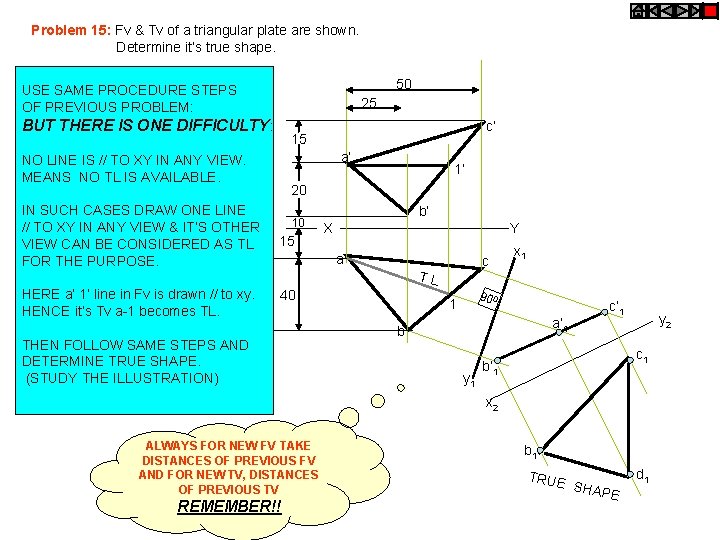
Problem 15: Fv & Tv of a triangular plate are shown. Determine it’s true shape. 50 USE SAME PROCEDURE STEPS OF PREVIOUS PROBLEM: 25 BUT THERE IS ONE DIFFICULTY: 15 a’ NO LINE IS // TO XY IN ANY VIEW. MEANS NO TL IS AVAILABLE. IN SUCH CASES DRAW ONE LINE // TO XY IN ANY VIEW & IT’S OTHER VIEW CAN BE CONSIDERED AS TL FOR THE PURPOSE. HERE a’ 1’ line in Fv is drawn // to xy. HENCE it’s Tv a-1 becomes TL. c’ 1’ 20 10 15 b’ X Y a c TL 40 THEN FOLLOW SAME STEPS AND DETERMINE TRUE SHAPE. (STUDY THE ILLUSTRATION) x 1 90 0 1 a’ 1 b y 1 c’ 1 y 2 c 1 b’ 1 x 2 ALWAYS FOR NEW FV TAKE DISTANCES OF PREVIOUS FV AND FOR NEW TV, DISTANCES OF PREVIOUS TV REMEMBER!! b 1 TRUE d 1 SHAP E
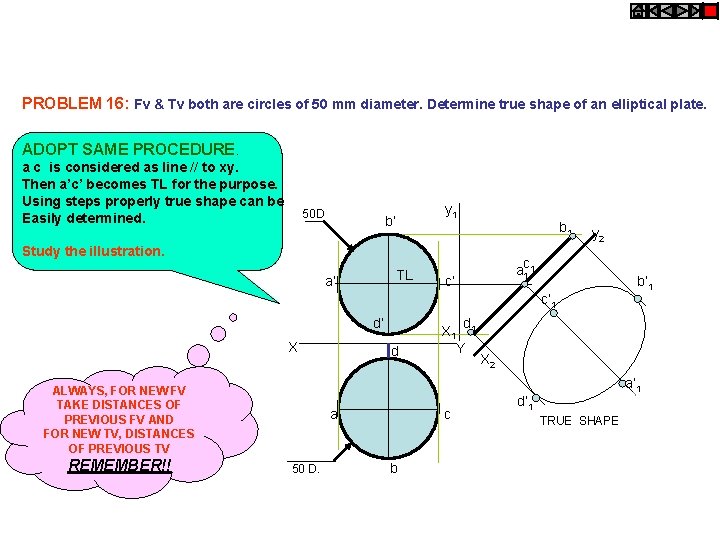
PROBLEM 16: Fv & Tv both are circles of 50 mm diameter. Determine true shape of an elliptical plate. ADOPT SAME PROCEDURE. a c is considered as line // to xy. Then a’c’ becomes TL for the purpose. Using steps properly true shape can be Easily determined. 50 D y 1 b’ b 1 Study the illustration. TL a’ y 2 ac 1 1 c’ c’ 1 d’ X ALWAYS, FOR NEW FV TAKE DISTANCES OF PREVIOUS FV AND FOR NEW TV, DISTANCES OF PREVIOUS TV REMEMBER!! d a 50 D. d X 1 1 Y c b b’ 1 X 2 a’ 1 d’ 1 TRUE SHAPE
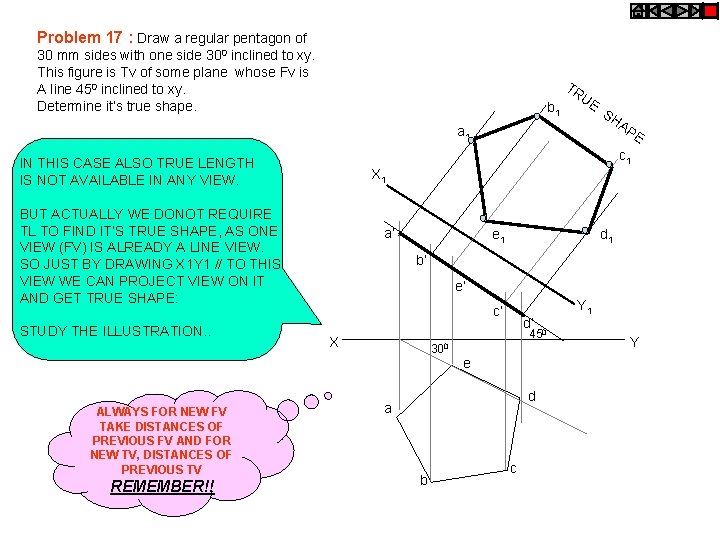
Problem 17 : Draw a regular pentagon of 30 mm sides with one side 300 inclined to xy. This figure is Tv of some plane whose Fv is A line 450 inclined to xy. Determine it’s true shape. TR b 1 UE AP a 1 X 1 BUT ACTUALLY WE DONOT REQUIRE TL TO FIND IT’S TRUE SHAPE, AS ONE VIEW (FV) IS ALREADY A LINE VIEW. SO JUST BY DRAWING X 1 Y 1 // TO THIS VIEW WE CAN PROJECT VIEW ON IT AND GET TRUE SHAPE: a’ e 1 d 1 b’ e’ c’ d’ 450 X 300 e ALWAYS FOR NEW FV TAKE DISTANCES OF PREVIOUS FV AND FOR NEW TV, DISTANCES OF PREVIOUS TV REMEMBER!! E c 1 IN THIS CASE ALSO TRUE LENGTH IS NOT AVAILABLE IN ANY VIEW. STUDY THE ILLUSTRATION. . SH d a b c Y 1 Y