
Projection Slides Probability Slide 0 epi STEMe 200911
Projection Slides Probability Slide 0 © epi. STEMe 2009/11
Lesson 1: What do you know about probability? Slide 1 © epi. STEMe 2009/11
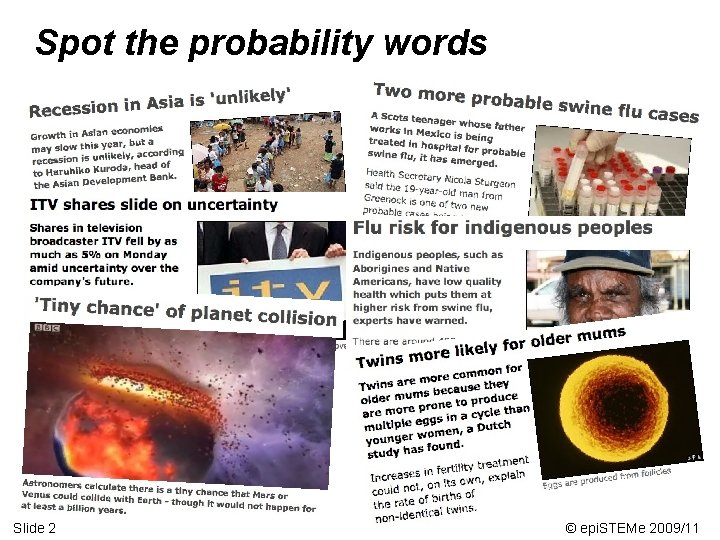
Spot the probability words Slide 2 © epi. STEMe 2009/11
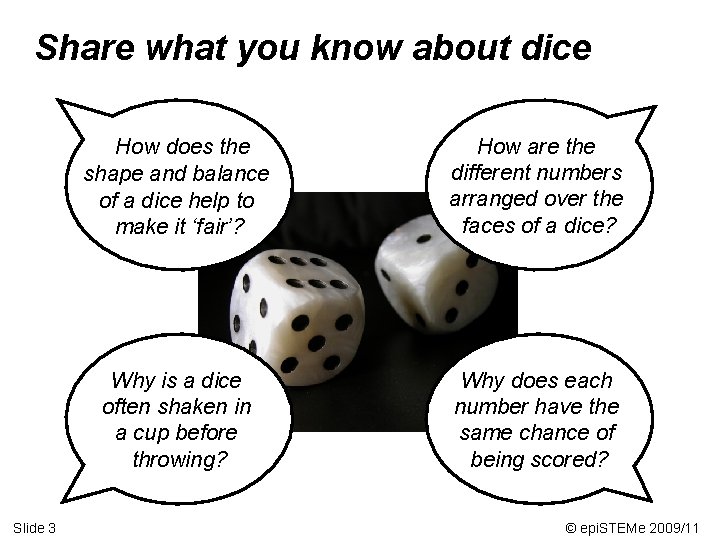
Share what you know about dice Slide 3 How does the shape and balance of a dice help to make it ‘fair’? How are the different numbers arranged over the faces of a dice? Why is a dice often shaken in a cup before throwing? Why does each number have the same chance of being scored? © epi. STEMe 2009/11
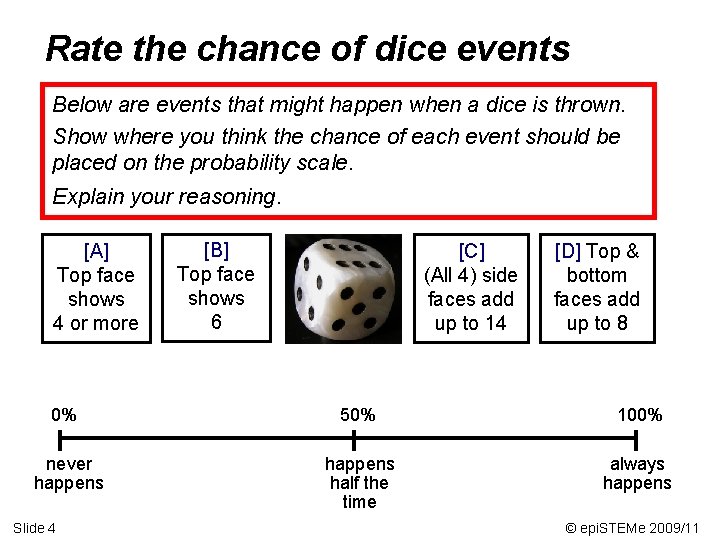
Rate the chance of dice events Below are events that might happen when a dice is thrown. Show where you think the chance of each event should be placed on the probability scale. Explain your reasoning. [A] Top face shows 4 or more [B] Top face shows 6 [C] (All 4) side faces add up to 14 [D] Top & bottom faces add up to 8 0% 50% 100% never happens half the time always happens Slide 4 © epi. STEMe 2009/11
Lesson 2: The game of ‘Fives’ Slide 5 © epi. STEMe 2009/11
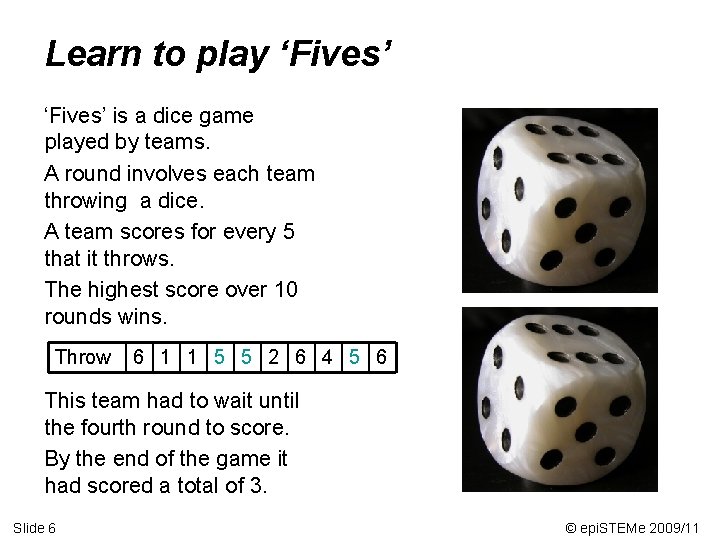
Learn to play ‘Fives’ is a dice game played by teams. A round involves each team throwing a dice. A team scores for every 5 that it throws. The highest score over 10 rounds wins. Throw 6 1 1 5 5 2 6 4 5 6 This team had to wait until the fourth round to score. By the end of the game it had scored a total of 3. Slide 6 © epi. STEMe 2009/11
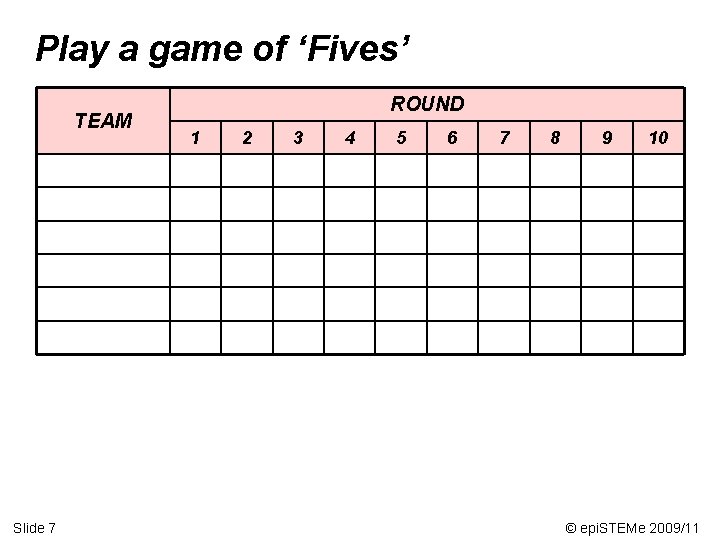
Play a game of ‘Fives’ TEAM Slide 7 ROUND 1 2 3 4 5 6 7 8 9 10 © epi. STEMe 2009/11
Fair game? Chance game? Do the rules of ‘Fives’ give any team an advantage over the others? If a team plays ‘Fives’ fairly, is there anything they can do to gain an advantage over other teams? Is ‘Fives’ purely a game of chance? Is ‘Fives’ a fair game? Slide 8 © epi. STEMe 2009/11
Review ‘Fives’ results Look at the class results from your game of ‘Fives’. How many 5 s were thrown in each round of the game? Did all the possible numbers of 5 s in a round occur? What were typical numbers of 5 s for a round? What was the average number of 5 s for a round? Are the results surprising? Why (not)? Suppose your class was going to play lots and lots more games of ‘Fives’. What do you predict would be the average number of 5 s in a round? What do you predict would be the least common number of 5 s in a round? Explain the reasoning behind your answers. Slide 9 © epi. STEMe 2009/11

Review ‘Fives’ results (spreadsheet) Slide 10 © epi. STEMe 2009/11
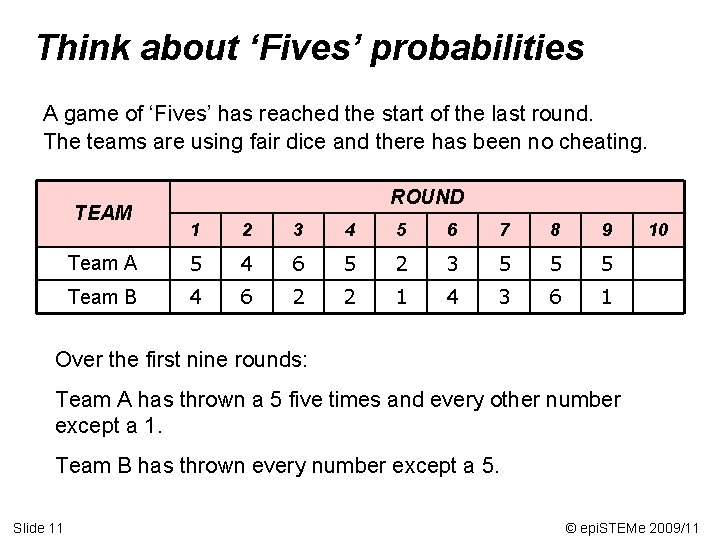
Think about ‘Fives’ probabilities A game of ‘Fives’ has reached the start of the last round. The teams are using fair dice and there has been no cheating. TEAM ROUND 1 2 3 4 5 6 7 8 9 Team A 5 4 6 5 2 3 5 5 5 Team B 4 6 2 2 1 4 3 6 1 10 Over the first nine rounds: Team A has thrown a 5 five times and every other number except a 1. Team B has thrown every number except a 5. Slide 11 © epi. STEMe 2009/11
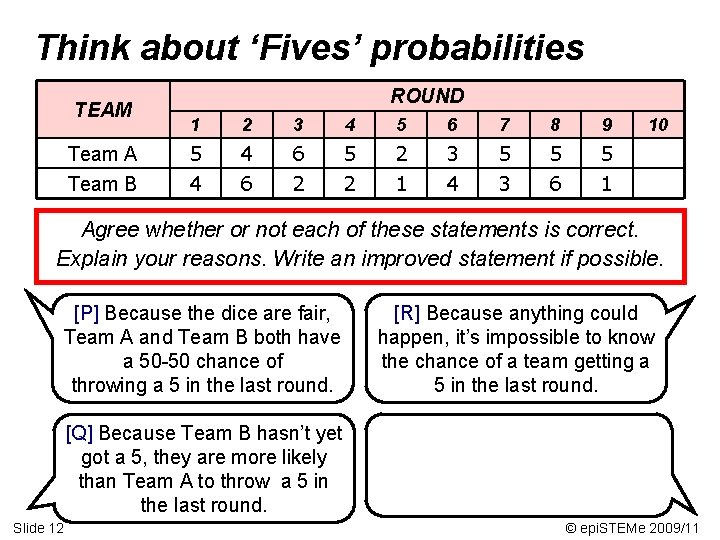
Think about ‘Fives’ probabilities TEAM Team A Team B ROUND 1 2 3 4 5 6 7 8 9 5 4 4 6 6 2 5 2 2 1 3 4 5 3 5 6 5 1 10 Agree whether or not each of these statements is correct. Explain your reasons. Write an improved statement if possible. [P] Because the dice are fair, Team A and Team B both have a 50 -50 chance of throwing a 5 in the last round. [R] Because anything could happen, it’s impossible to know the chance of a team getting a 5 in the last round. [Q] Because Team B hasn’t yet got a 5, they are more likely than Team A to throw a 5 in the last round. Slide 12 © epi. STEMe 2009/11
Lesson 3: Tools for thinking about probability Slide 13 © epi. STEMe 2009/11
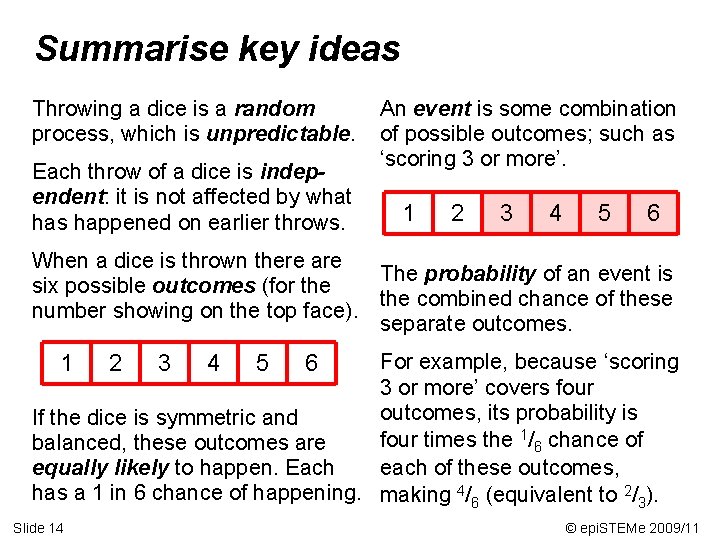
Summarise key ideas Throwing a dice is a random process, which is unpredictable. Each throw of a dice is independent: it is not affected by what has happened on earlier throws. An event is some combination of possible outcomes; such as ‘scoring 3 or more’. 1 2 3 4 5 6 When a dice is thrown there are The probability of an event is six possible outcomes (for the combined chance of these number showing on the top face). separate outcomes. For example, because ‘scoring 3 or more’ covers four outcomes, its probability is If the dice is symmetric and four times the 1/6 chance of balanced, these outcomes are each of these outcomes, equally likely to happen. Each has a 1 in 6 chance of happening. making 4/6 (equivalent to 2/3). 1 Slide 14 2 3 4 5 6 © epi. STEMe 2009/11
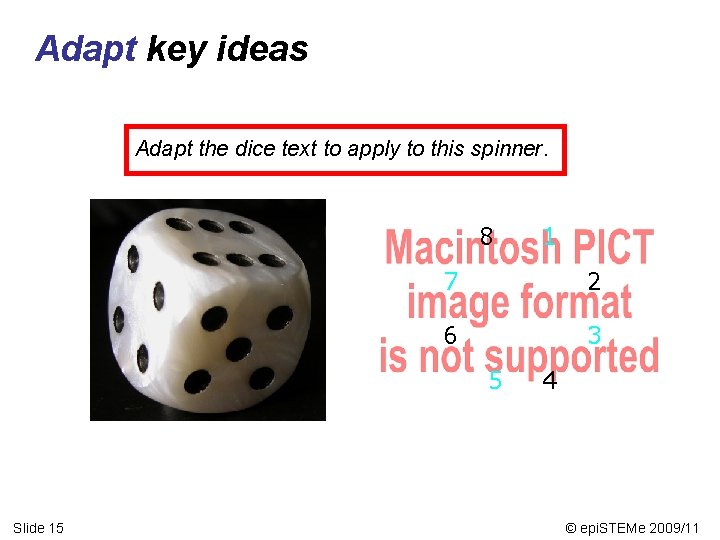
Adapt key ideas Adapt the dice text to apply to this spinner. 8 7 2 6 3 5 Slide 15 1 4 © epi. STEMe 2009/11
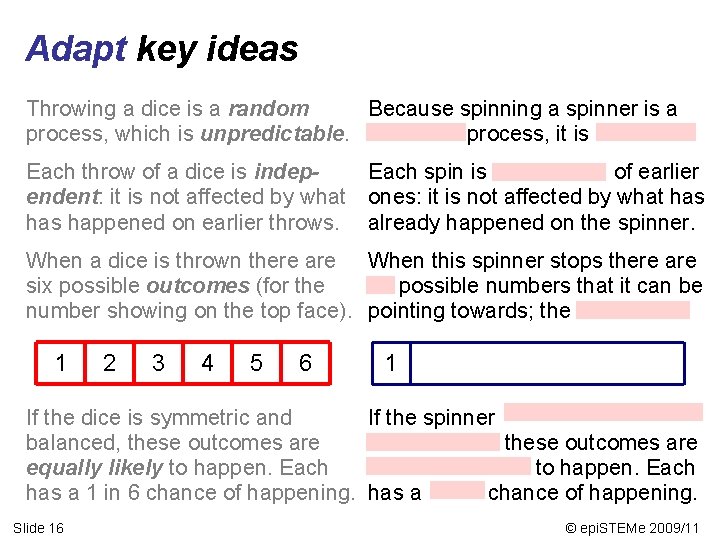
Adapt key ideas Throwing a dice is a random Because spinning a spinner is a process, which is unpredictable. random process, it is. Each throw of a dice is indep. Each spin is independentof earlier endent: it is not affected by what ones: it is not affected by what has happened on earlier throws. already happened on the spinner. When a dice is thrown there are When this spinner stops there are six possible outcomes (for the 8 possible numbers that it can be number showing on the top face). pointing towards; the 1 2 3 4 5 6 If the dice is symmetric and balanced, these outcomes are equally likely to happen. Each has a 1 in 6 chance of happening. Slide 16 1 If the spinner is symmetric an these outcomes are equally likely to happen. Each has a 1 in 6 chance of happening. © epi. STEMe 2009/11
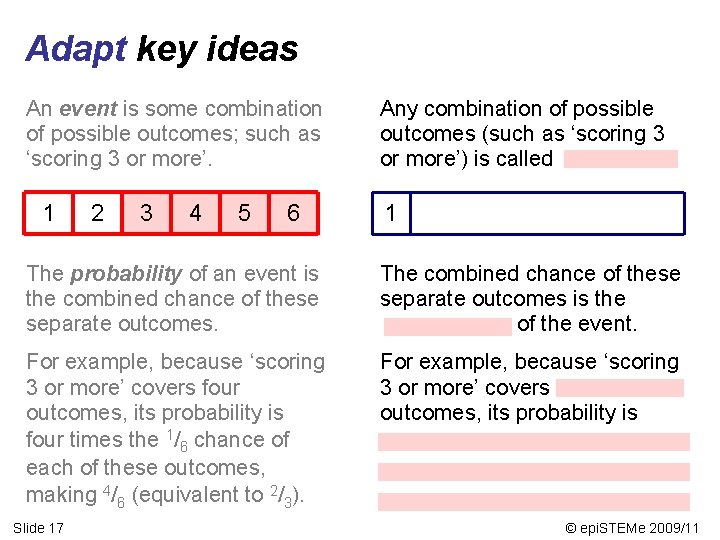
Adapt key ideas An event is some combination of possible outcomes; such as ‘scoring 3 or more’. 1 2 3 4 5 6 Any combination of possible outcomes (such as ‘scoring 3 or more’) is called 1 The probability of an event is the combined chance of these separate outcomes. The combined chance of these separate outcomes is the probability of the event. For example, because ‘scoring 3 or more’ covers four outcomes, its probability is four times the 1/6 chance of each of these outcomes, making 4/6 (equivalent to 2/3). Slide 17 © epi. STEMe 2009/11
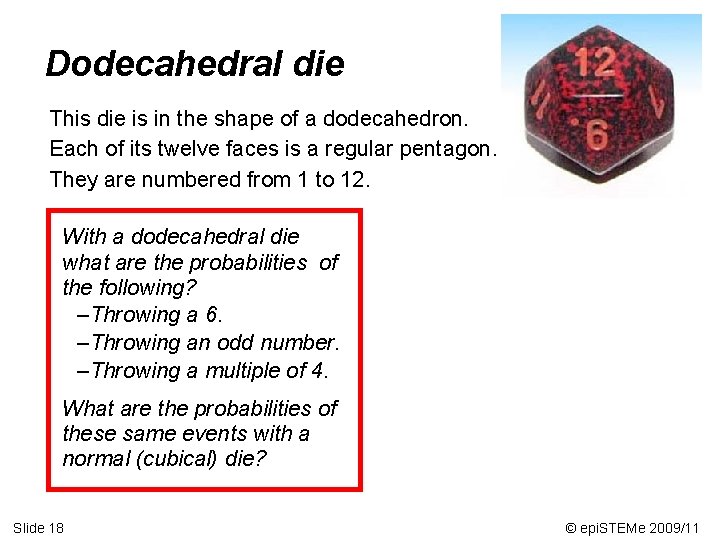
Dodecahedral die This die is in the shape of a dodecahedron. Each of its twelve faces is a regular pentagon. They are numbered from 1 to 12. With a dodecahedral die what are the probabilities of the following? –Throwing a 6. –Throwing an odd number. –Throwing a multiple of 4. What are the probabilities of these same events with a normal (cubical) die? Slide 18 © epi. STEMe 2009/11
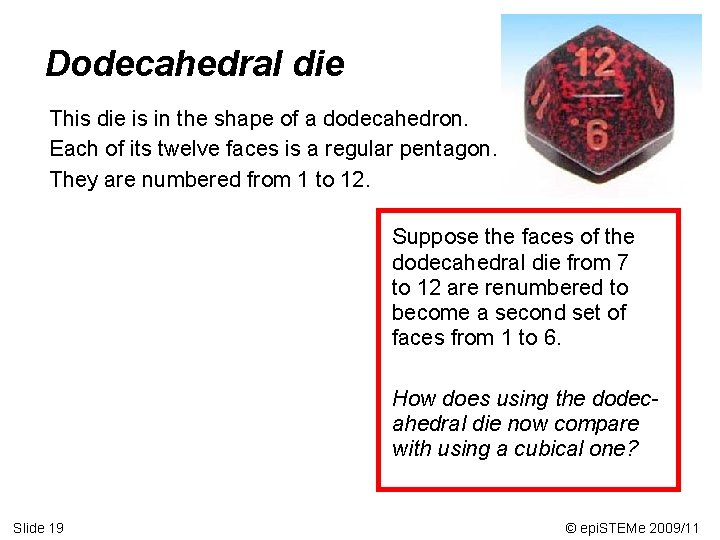
Dodecahedral die This die is in the shape of a dodecahedron. Each of its twelve faces is a regular pentagon. They are numbered from 1 to 12. Suppose the faces of the dodecahedral die from 7 to 12 are renumbered to become a second set of faces from 1 to 6. How does using the dodecahedral die now compare with using a cubical one? Slide 19 © epi. STEMe 2009/11
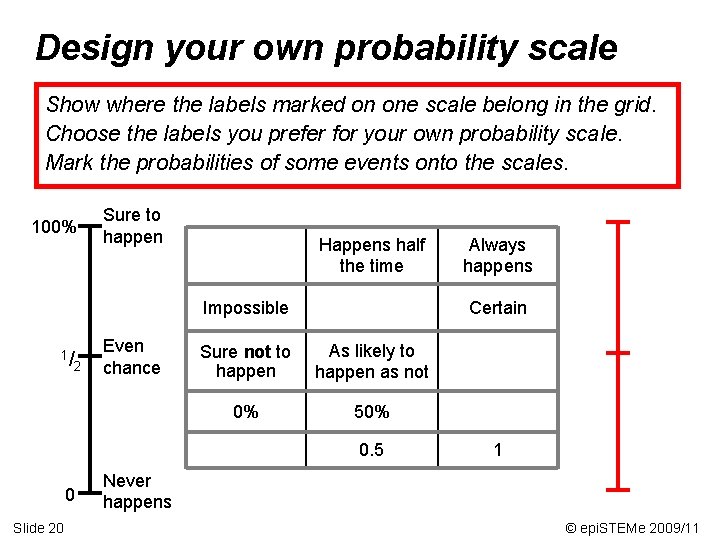
Design your own probability scale Show where the labels marked on one scale belong in the grid. Choose the labels you prefer for your own probability scale. Mark the probabilities of some events onto the scales. 100% Sure to happen Happens half the time Impossible 1/ 2 Even chance Certain Sure not to happen As likely to happen as not 0% 50% 0. 5 0 Slide 20 Always happens 1 Never happens © epi. STEMe 2009/11
Homework: How well can you explain probability? Slide 21 © epi. STEMe 2009/11
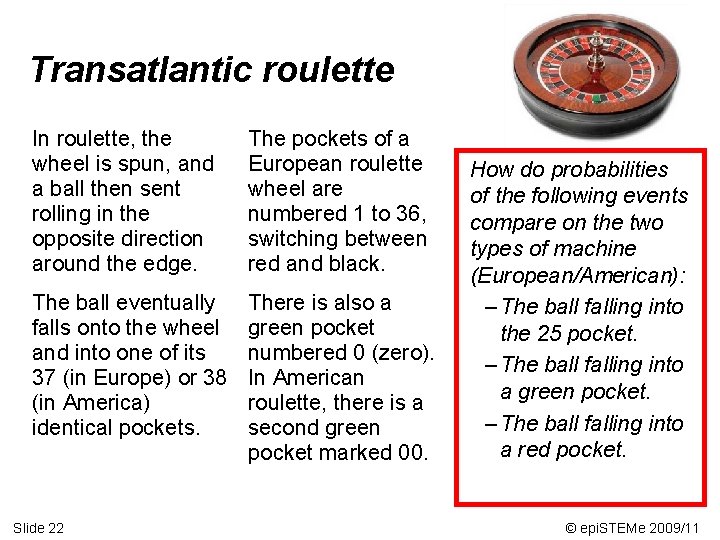
Transatlantic roulette In roulette, the wheel is spun, and a ball then sent rolling in the opposite direction around the edge. The pockets of a European roulette wheel are numbered 1 to 36, switching between red and black. The ball eventually falls onto the wheel and into one of its 37 (in Europe) or 38 (in America) identical pockets. There is also a green pocket numbered 0 (zero). In American roulette, there is a second green pocket marked 00. Slide 22 How do probabilities of the following events compare on the two types of machine (European/American): – The ball falling into the 25 pocket. – The ball falling into a green pocket. – The ball falling into a red pocket. © epi. STEMe 2009/11
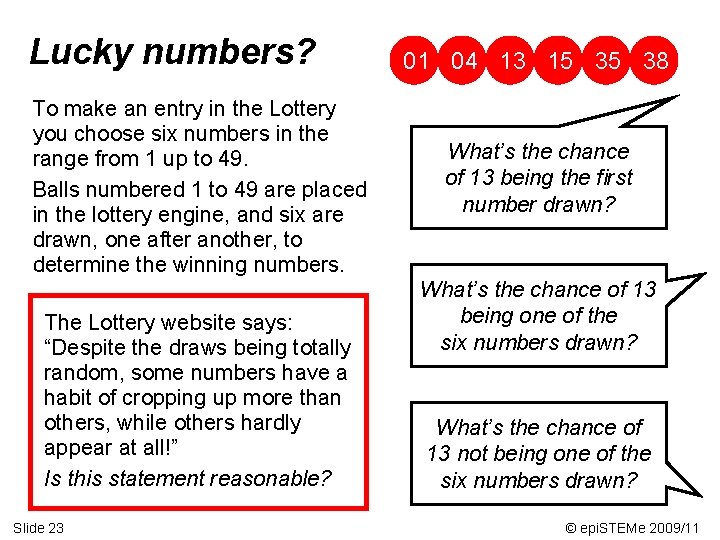
Lucky numbers? To make an entry in the Lottery you choose six numbers in the range from 1 up to 49. Balls numbered 1 to 49 are placed in the lottery engine, and six are drawn, one after another, to determine the winning numbers. The Lottery website says: “Despite the draws being totally random, some numbers have a habit of cropping up more than others, while others hardly appear at all!” Is this statement reasonable? Slide 23 01 04 13 15 35 38 What’s the chance of 13 being the first number drawn? What’s the chance of 13 being one of the six numbers drawn? What’s the chance of 13 not being one of the six numbers drawn? © epi. STEMe 2009/11
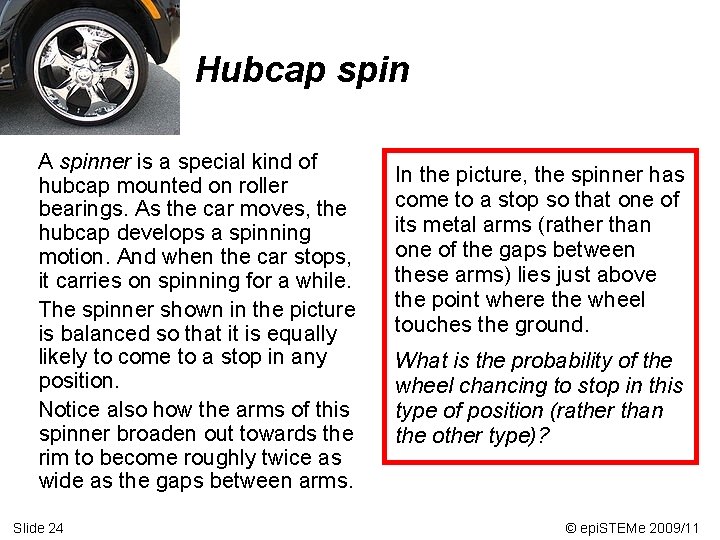
Hubcap spin A spinner is a special kind of hubcap mounted on roller bearings. As the car moves, the hubcap develops a spinning motion. And when the car stops, it carries on spinning for a while. The spinner shown in the picture is balanced so that it is equally likely to come to a stop in any position. Notice also how the arms of this spinner broaden out towards the rim to become roughly twice as wide as the gaps between arms. Slide 24 In the picture, the spinner has come to a stop so that one of its metal arms (rather than one of the gaps between these arms) lies just above the point where the wheel touches the ground. What is the probability of the wheel chancing to stop in this type of position (rather than the other type)? © epi. STEMe 2009/11
Lesson 4: A brief history of probability Slide 25 © epi. STEMe 2009/11
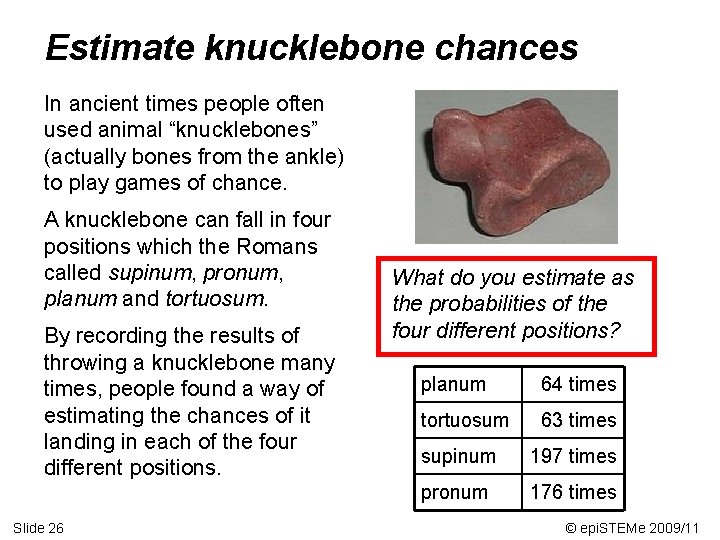
Estimate knucklebone chances In ancient times people often used animal “knucklebones” (actually bones from the ankle) to play games of chance. A knucklebone can fall in four positions which the Romans called supinum, pronum, planum and tortuosum. By recording the results of throwing a knucklebone many times, people found a way of estimating the chances of it landing in each of the four different positions. Slide 26 What do you estimate as the probabilities of the four different positions? planum 64 times tortuosum 63 times supinum 197 times pronum 176 times © epi. STEMe 2009/11
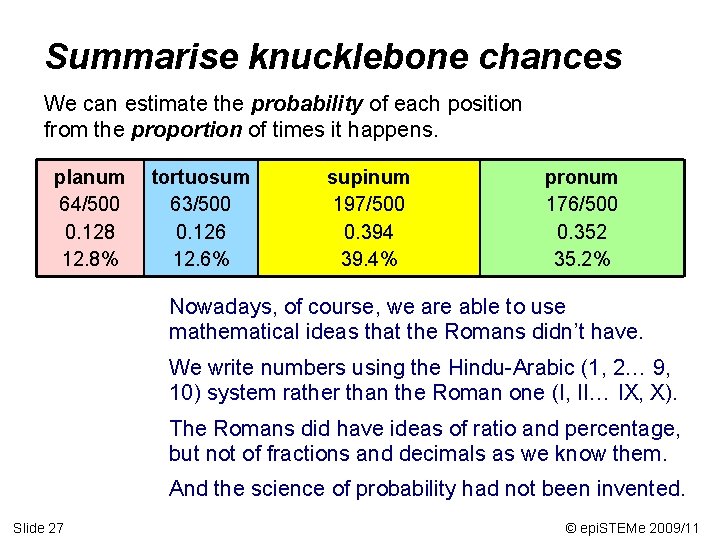
Summarise knucklebone chances We can estimate the probability of each position from the proportion of times it happens. planum 64/500 0. 128 12. 8% tortuosum 63/500 0. 126 12. 6% supinum 197/500 0. 394 39. 4% pronum 176/500 0. 352 35. 2% Nowadays, of course, we are able to use mathematical ideas that the Romans didn’t have. We write numbers using the Hindu-Arabic (1, 2… 9, 10) system rather than the Roman one (I, II… IX, X). The Romans did have ideas of ratio and percentage, but not of fractions and decimals as we know them. And the science of probability had not been invented. Slide 27 © epi. STEMe 2009/11
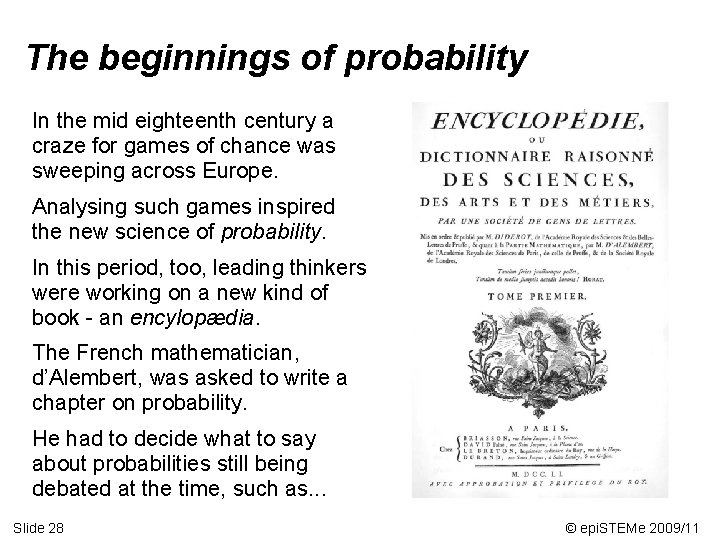
The beginnings of probability In the mid eighteenth century a craze for games of chance was sweeping across Europe. Analysing such games inspired the new science of probability. In this period, too, leading thinkers were working on a new kind of book - an encylopædia. The French mathematician, d’Alembert, was asked to write a chapter on probability. He had to decide what to say about probabilities still being debated at the time, such as. . . Slide 28 © epi. STEMe 2009/11
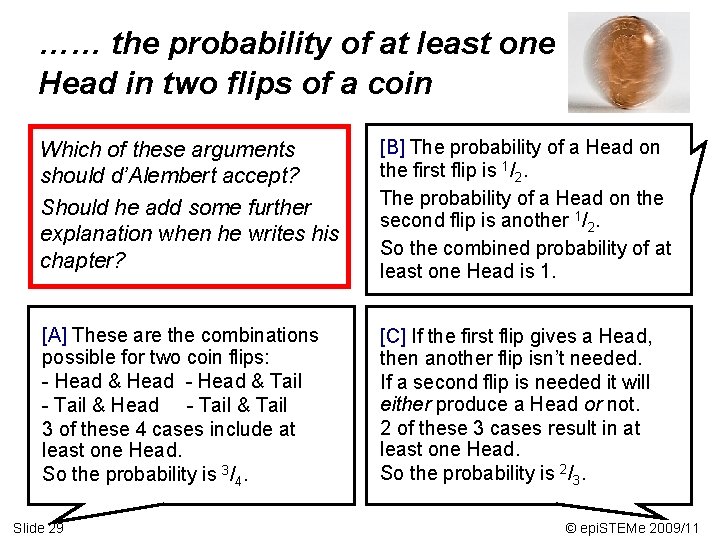
…… the probability of at least one Head in two flips of a coin Which of these arguments should d’Alembert accept? Should he add some further explanation when he writes his chapter? [B] The probability of a Head on the first flip is 1/2. The probability of a Head on the second flip is another 1/2. So the combined probability of at least one Head is 1. [A] These are the combinations possible for two coin flips: - Head & Head - Head & Tail - Tail & Head - Tail & Tail 3 of these 4 cases include at least one Head. So the probability is 3/4. [C] If the first flip gives a Head, then another flip isn’t needed. If a second flip is needed it will either produce a Head or not. 2 of these 3 cases result in at least one Head. So the probability is 2/3. Slide 29 © epi. STEMe 2009/11
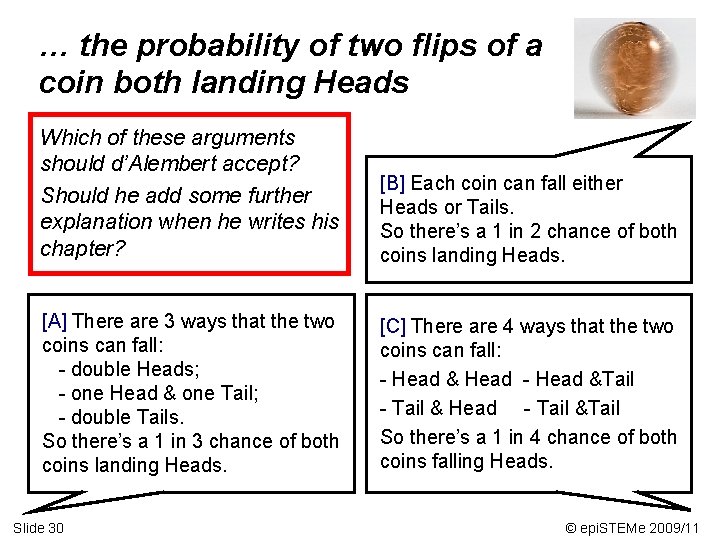
… the probability of two flips of a coin both landing Heads Which of these arguments should d’Alembert accept? Should he add some further explanation when he writes his chapter? [B] Each coin can fall either Heads or Tails. So there’s a 1 in 2 chance of both coins landing Heads. [A] There are 3 ways that the two coins can fall: - double Heads; - one Head & one Tail; - double Tails. So there’s a 1 in 3 chance of both coins landing Heads. [C] There are 4 ways that the two coins can fall: - Head & Head - Head &Tail - Tail & Head - Tail &Tail So there’s a 1 in 4 chance of both coins falling Heads. Slide 30 © epi. STEMe 2009/11
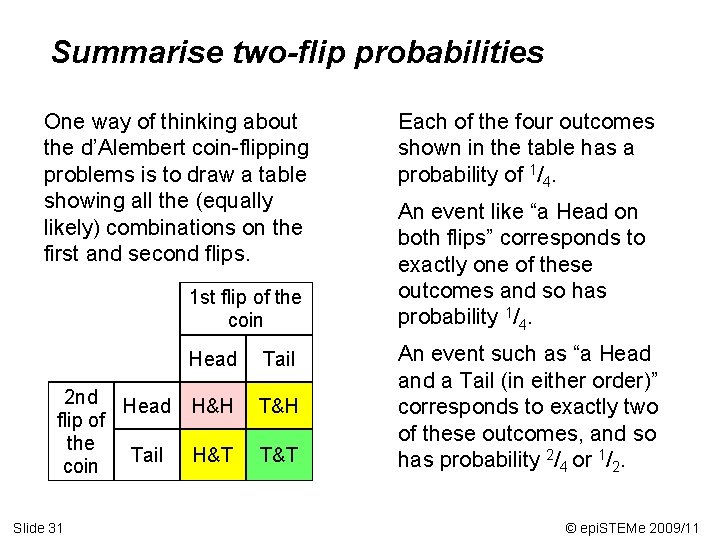
Summarise two-flip probabilities One way of thinking about the d’Alembert coin-flipping problems is to draw a table showing all the (equally likely) combinations on the first and second flips. 1 st flip of the coin 2 nd Head flip of the Tail coin Slide 31 Head Tail H&H T&H H&T T&T Each of the four outcomes shown in the table has a probability of 1/4. An event like “a Head on both flips” corresponds to exactly one of these outcomes and so has probability 1/4. An event such as “a Head and a Tail (in either order)” corresponds to exactly two of these outcomes, and so has probability 2/4 or 1/2. © epi. STEMe 2009/11
Lesson 5: The earlobe lottery Slide 32 © epi. STEMe 2009/11
From coins to genes Once mathematicians had got to grips with the probability of coin flipping, it turned out that scientists would find these methods of reasoning very useful in building models of chance situations and processes in nature. Slide 33 An example is the science of genetics, where one of the questions studied is how people inherit characteristics from their biological parents. © epi. STEMe 2009/11
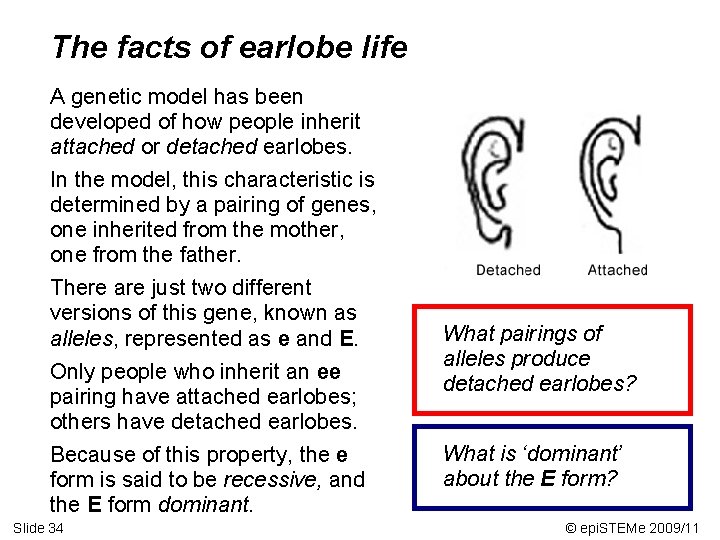
The facts of earlobe life A genetic model has been developed of how people inherit attached or detached earlobes. In the model, this characteristic is determined by a pairing of genes, one inherited from the mother, one from the father. There are just two different versions of this gene, known as alleles, represented as e and E. Only people who inherit an ee pairing have attached earlobes; others have detached earlobes. Because of this property, the e form is said to be recessive, and the E form dominant. Slide 34 What pairings of alleles produce detached earlobes? What is ‘dominant’ about the E form? © epi. STEMe 2009/11
The spin on earlobes Children inherit one form of the earlobe gene (one allele) from each parent. A parent can’t pass on an allele that’s not in their own pairing. If a parent has both alleles, then these are equally likely to be passed on. If a father-to-be has a mixed pairing of e and E alleles, what is the probability of his child inheriting the e form from him? Slide 35 If a mother-to-be has attached earlobes, how likely is she to pass on the e allele to her child? © epi. STEMe 2009/11
Earlobe problems to pierce A couple are expecting their first baby. Both parents have a mixed pairing of e and E alleles. How likely is their baby to have this same pairing? Another couple, another baby on the way. The mother has a double e pairing of alleles. The father has mixed e and E pairing. How likely is their baby to have attached earlobes? Another expectant couple. The mother has an ee pairing of alleles; the father has EE. How likely is their baby to have the same type of earlobes as the mother? And the same type as the father? Slide 36 © epi. STEMe 2009/11
Lesson 6: Chance combinations Slide 37 © epi. STEMe 2009/11
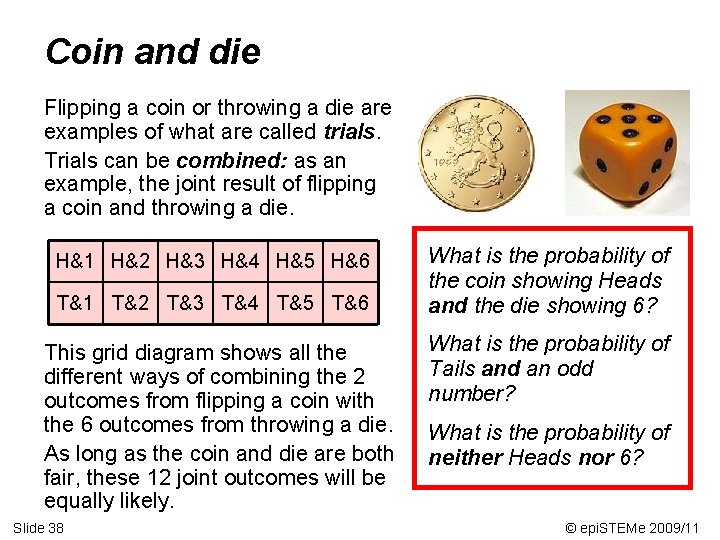
Coin and die Flipping a coin or throwing a die are examples of what are called trials. Trials can be combined: as an example, the joint result of flipping a coin and throwing a die. H&1 H&2 H&3 H&4 H&5 H&6 T&1 T&2 T&3 T&4 T&5 T&6 This grid diagram shows all the different ways of combining the 2 outcomes from flipping a coin with the 6 outcomes from throwing a die. As long as the coin and die are both fair, these 12 joint outcomes will be equally likely. Slide 38 What is the probability of the coin showing Heads and the die showing 6? What is the probability of Tails and an odd number? What is the probability of neither Heads nor 6? © epi. STEMe 2009/11
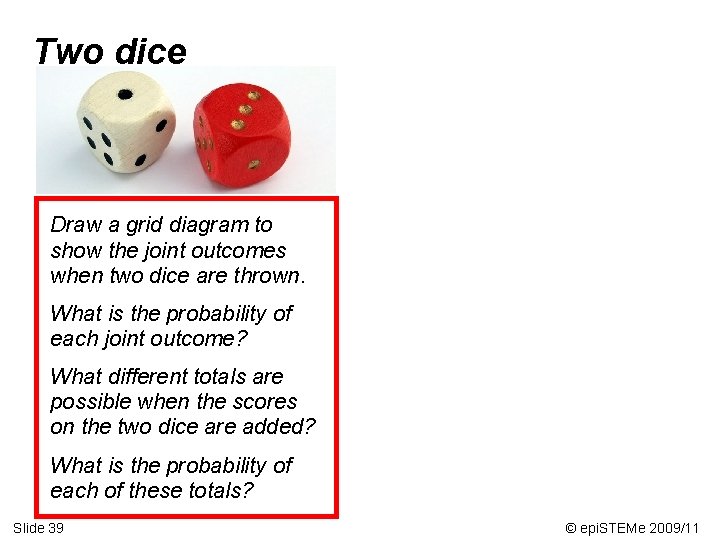
Two dice Draw a grid diagram to show the joint outcomes when two dice are thrown. What is the probability of each joint outcome? What different totals are possible when the scores on the two dice are added? What is the probability of each of these totals? Slide 39 © epi. STEMe 2009/11
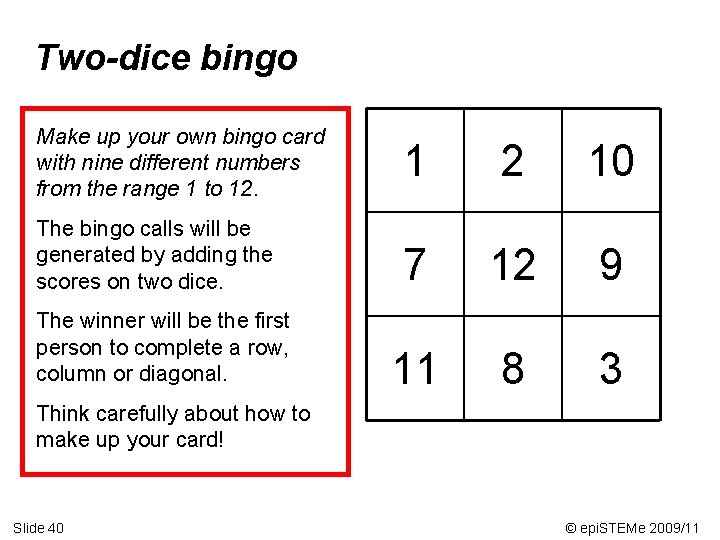
Two-dice bingo Make up your own bingo card with nine different numbers from the range 1 to 12. 1 2 10 The bingo calls will be generated by adding the scores on two dice. 7 12 9 11 8 3 The winner will be the first person to complete a row, column or diagonal. Think carefully about how to make up your card! Slide 40 © epi. STEMe 2009/11
Lesson 7: Climate chance Slide 41 © epi. STEMe 2009/11
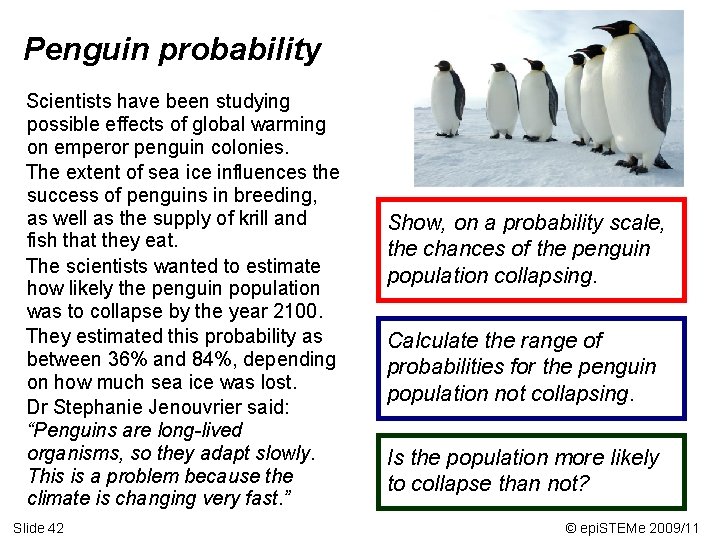
Penguin probability Scientists have been studying possible effects of global warming on emperor penguin colonies. The extent of sea ice influences the success of penguins in breeding, as well as the supply of krill and fish that they eat. The scientists wanted to estimate how likely the penguin population was to collapse by the year 2100. They estimated this probability as between 36% and 84%, depending on how much sea ice was lost. Dr Stephanie Jenouvrier said: “Penguins are long-lived organisms, so they adapt slowly. This is a problem because the climate is changing very fast. ” Slide 42 Show, on a probability scale, the chances of the penguin population collapsing. Calculate the range of probabilities for the penguin population not collapsing. Is the population more likely to collapse than not? © epi. STEMe 2009/11
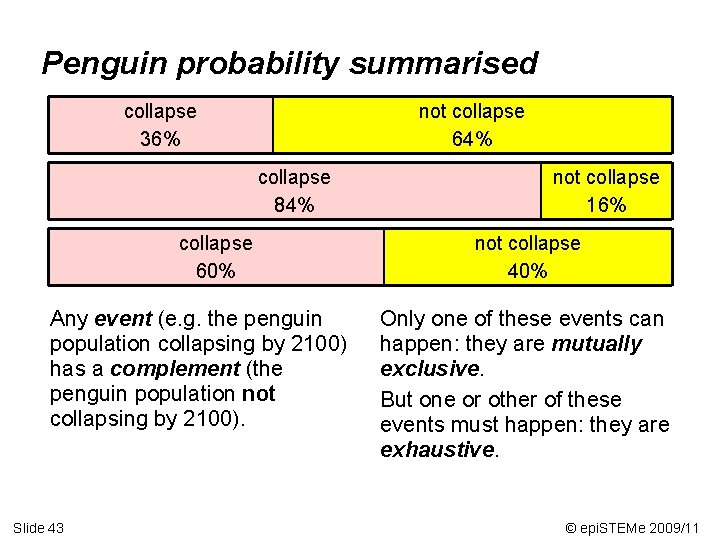
Penguin probability summarised collapse 36% not collapse 64% collapse 84% collapse 60% Any event (e. g. the penguin population collapsing by 2100) has a complement (the penguin population not collapsing by 2100). Slide 43 not collapse 16% not collapse 40% Only one of these events can happen: they are mutually exclusive. But one or other of these events must happen: they are exhaustive. © epi. STEMe 2009/11
![Icesheet impact The West Antarctic Ice Sheet [WAIS] contains 13% of all the ice](http://slidetodoc.com/presentation_image/4bd27050825ec820eee47869ab987c11/image-45.jpg "Icesheet impact The West Antarctic Ice Sheet [WAIS] contains 13% of all the ice")
Icesheet impact The West Antarctic Ice Sheet [WAIS] contains 13% of all the ice in Antarctica. Scientists have estimated the chances of it melting within the next 200 years. There is a 30% chance that WAIS will melt enough to produce a rise of at least 1 metre in sea level. There is a 5% chance that WAIS will melt entirely producing a 4 metre rise in sea level. Dr David Vaughan commented: “Although our study shows the probability of ice sheet collapse is reasonably low, the potential impacts are severe - fantastically expensive for developed nations with coastal cities, and just dire for populations in low -lying coastal areas. ” Slide 44 Show, on a probability scale, the two probabilities given. Calculate the probability of the sea level rising less than 1 metre due to WAIS melting. Calculate the probability of WAIS not disappearing entirely but melting enough for the sea level to rise at least 1 metre. © epi. STEMe 2009/11
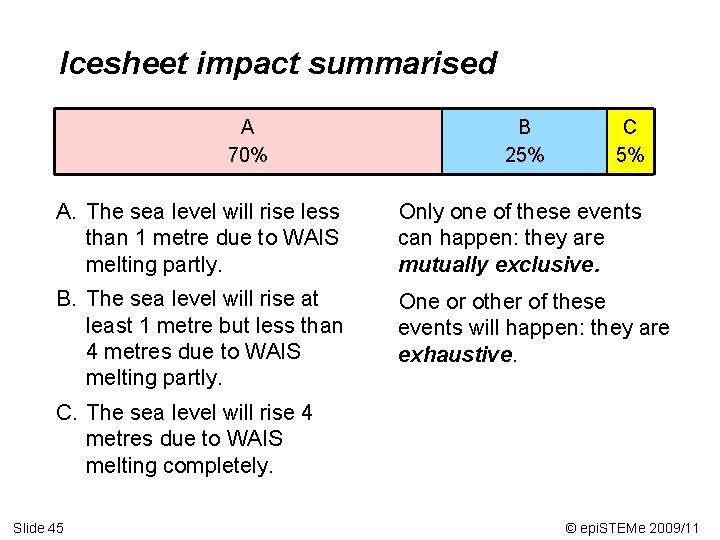
Icesheet impact summarised A 70% B 25% C 5% A. The sea level will rise less than 1 metre due to WAIS melting partly. Only one of these events can happen: they are mutually exclusive. B. The sea level will rise at least 1 metre but less than 4 metres due to WAIS melting partly. One or other of these events will happen: they are exhaustive. C. The sea level will rise 4 metres due to WAIS melting completely. Slide 45 © epi. STEMe 2009/11
- Slides: 46