
PROJECTILES LAUNCHED AT AN ANGLE PROJECTILE MOTION EQUATIONS
- Slides: 3
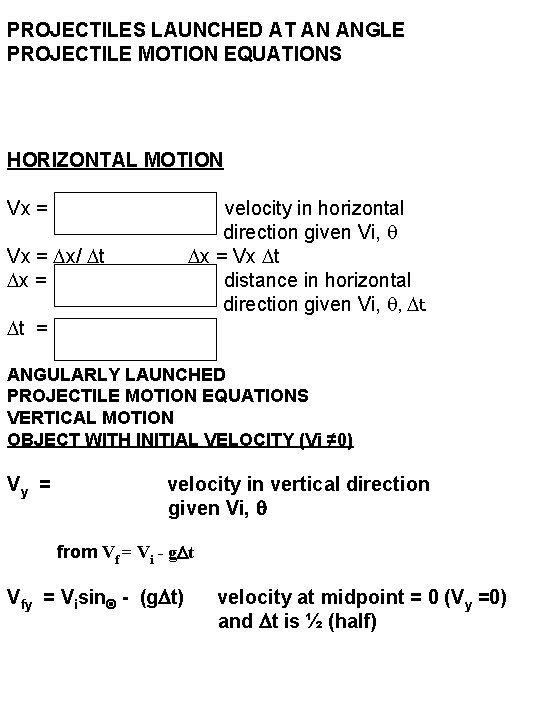
PROJECTILES LAUNCHED AT AN ANGLE PROJECTILE MOTION EQUATIONS HORIZONTAL MOTION Vx = velocity in horizontal direction given Vi, q Dx = Vx Dt distance in horizontal direction given Vi, q, Dt Vx = Dx/ Dt Dx = Dt = ANGULARLY LAUNCHED PROJECTILE MOTION EQUATIONS VERTICAL MOTION OBJECT WITH INITIAL VELOCITY (Vi ≠ 0) Vy = velocity in vertical direction given Vi, q from Vf = Vi - g. Dt Vfy = Visin. Q - (g. Dt) velocity at midpoint = 0 (Vy =0) and Dt is ½ (half)
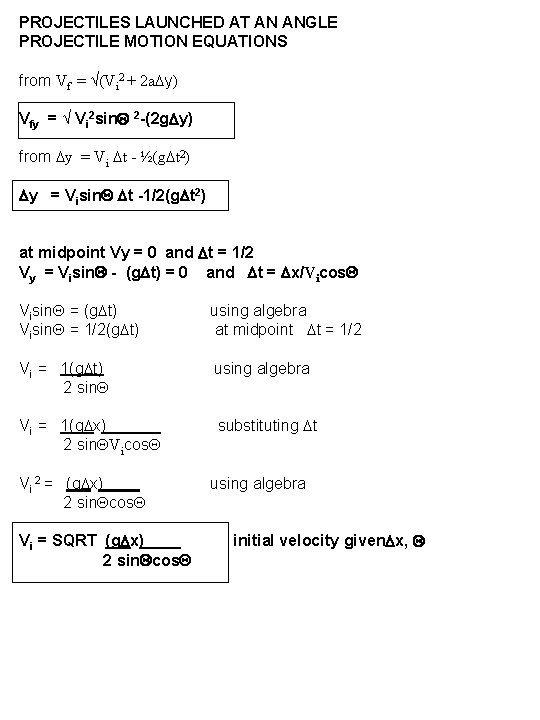
PROJECTILES LAUNCHED AT AN ANGLE PROJECTILE MOTION EQUATIONS from Vf = √(Vi 2 + 2 a. Dy) Vfy = √ Vi 2 sin. Q 2 -(2 g. Dy) from Dy = Vi Dt - ½(g. Dt 2) Dy = Visin. Q Dt -1/2(g. Dt 2) at midpoint Vy = 0 and Dt = 1/2 Vy = Visin. Q - (g. Dt) = 0 and Dt = Dx/Vicos. Q Visin. Q = (g. Dt) Visin. Q = 1/2(g. Dt) using algebra at midpoint Dt = 1/2 Vi = 1(g. Dt) 2 sin. Q using algebra Vi = 1(g. Dx) 2 sin. QVicos. Q substituting Dt Vi 2 = (g. Dx) 2 sin. Qcos. Q Vi = SQRT (g. Dx) 2 sin. Qcos. Q using algebra initial velocity given. Dx, Q
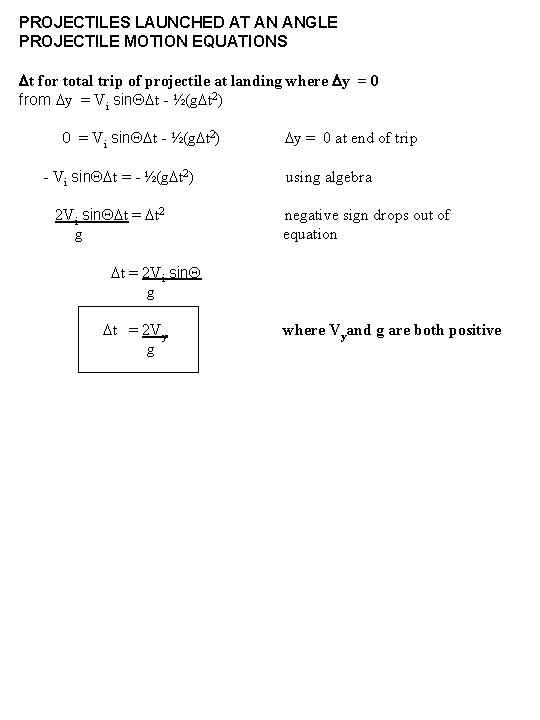
PROJECTILES LAUNCHED AT AN ANGLE PROJECTILE MOTION EQUATIONS Dt for total trip of projectile at landing where Dy = 0 from Dy = Vi sin. QDt - ½(g. Dt 2) 0 = Vi sin. QDt - ½(g. Dt 2) - Vi sin. QDt = - ½(g. Dt 2) 2 Vi sin. QDt = Dt 2 g Dy = 0 at end of trip using algebra negative sign drops out of equation Dt = 2 Vi sin. Q g Dt = 2 Vy g where Vyand g are both positive