
Projectile Motion What is the rocks velocity when
- Slides: 22
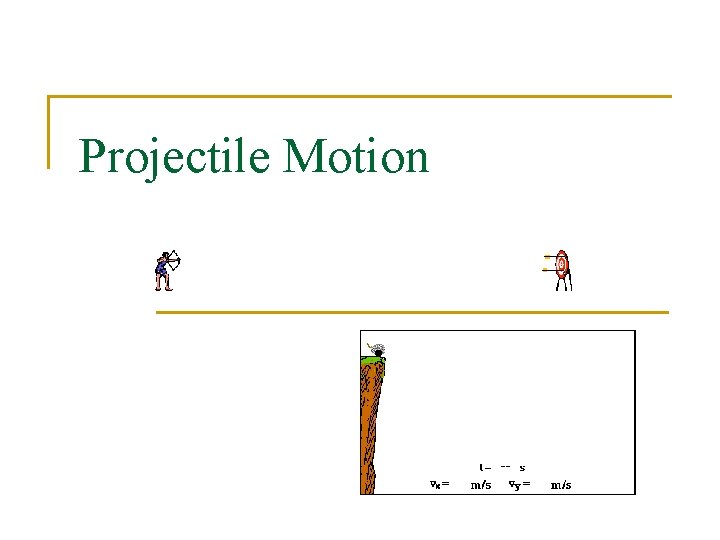
Projectile Motion
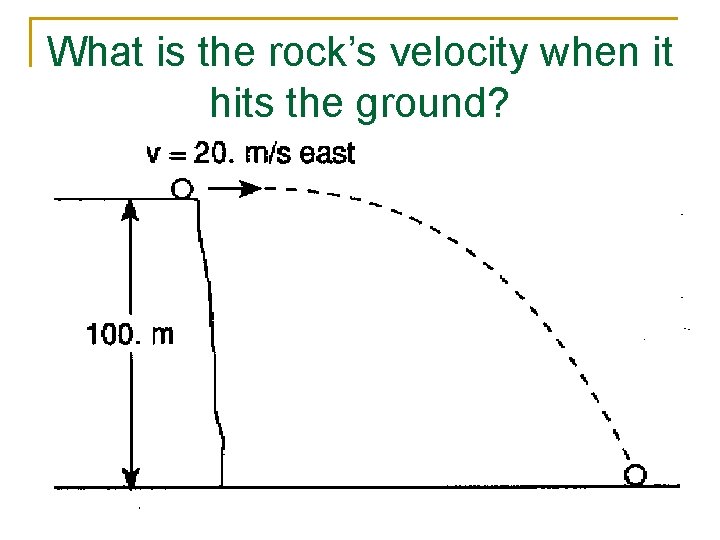
What is the rock’s velocity when it hits the ground?
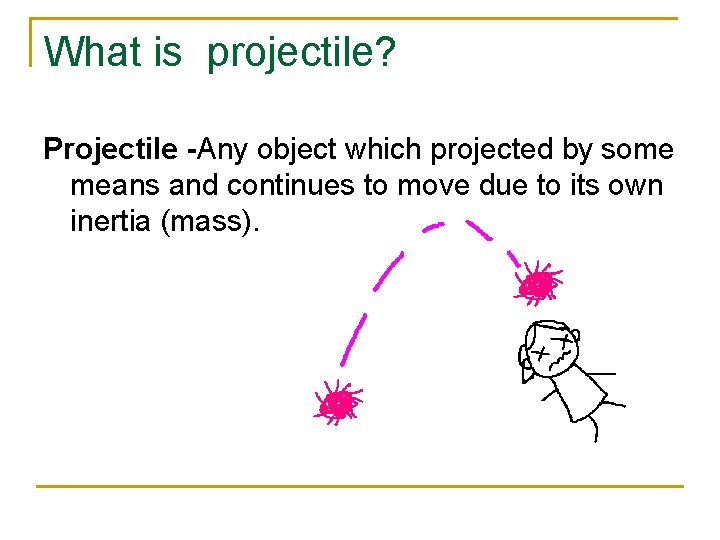
What is projectile? Projectile -Any object which projected by some means and continues to move due to its own inertia (mass).
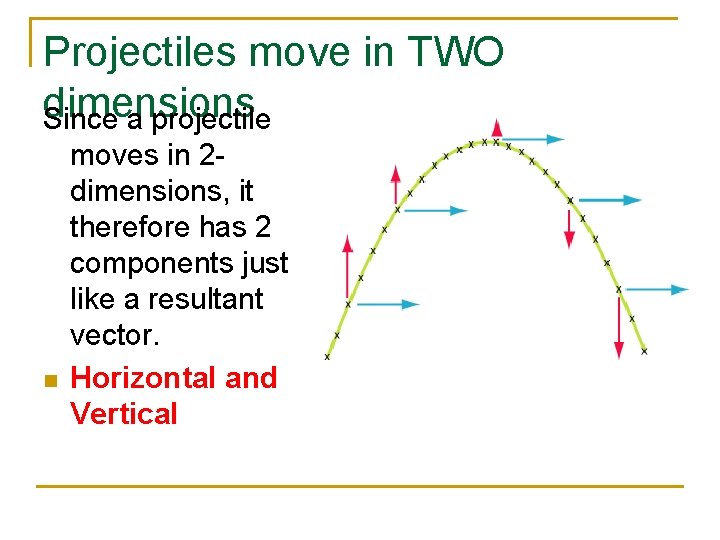
Projectiles move in TWO dimensions Since a projectile n moves in 2 dimensions, it therefore has 2 components just like a resultant vector. Horizontal and Vertical
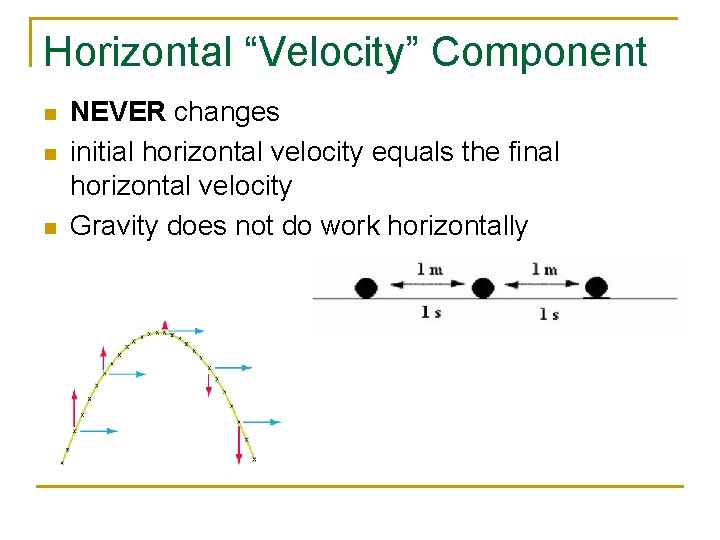
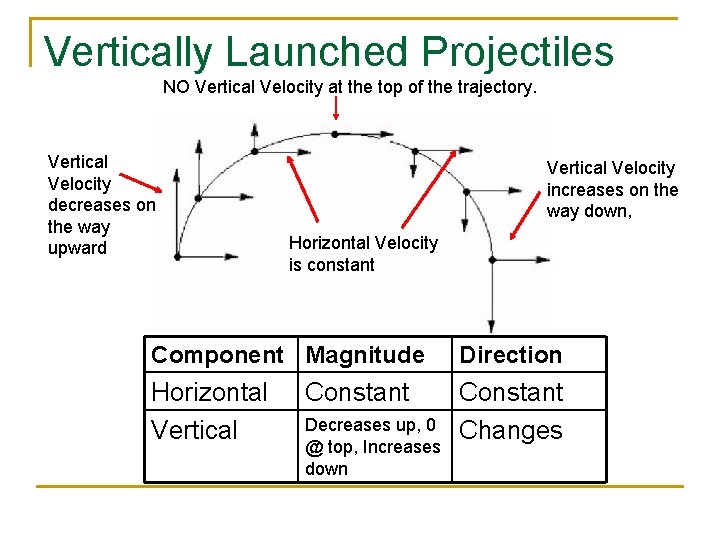
Horizontal “Velocity” Component n n n NEVER changes initial horizontal velocity equals the final horizontal velocity Gravity does not do work horizontally
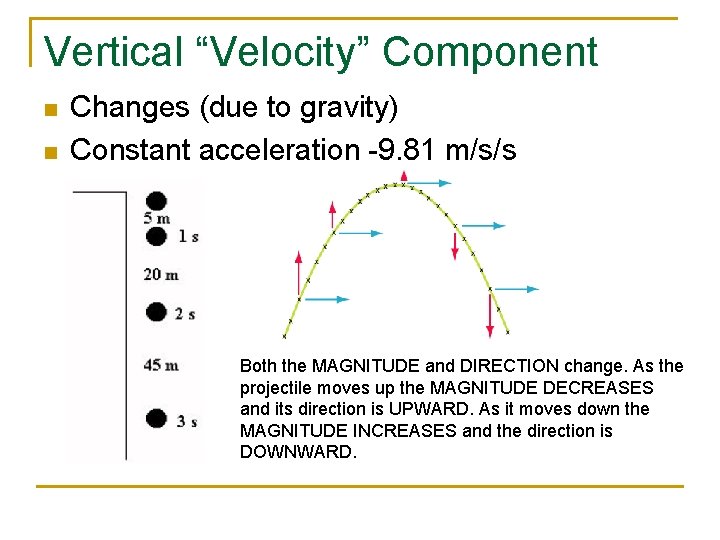
Vertical “Velocity” Component n n Changes (due to gravity) Constant acceleration -9. 81 m/s/s Both the MAGNITUDE and DIRECTION change. As the projectile moves up the MAGNITUDE DECREASES and its direction is UPWARD. As it moves down the MAGNITUDE INCREASES and the direction is DOWNWARD.
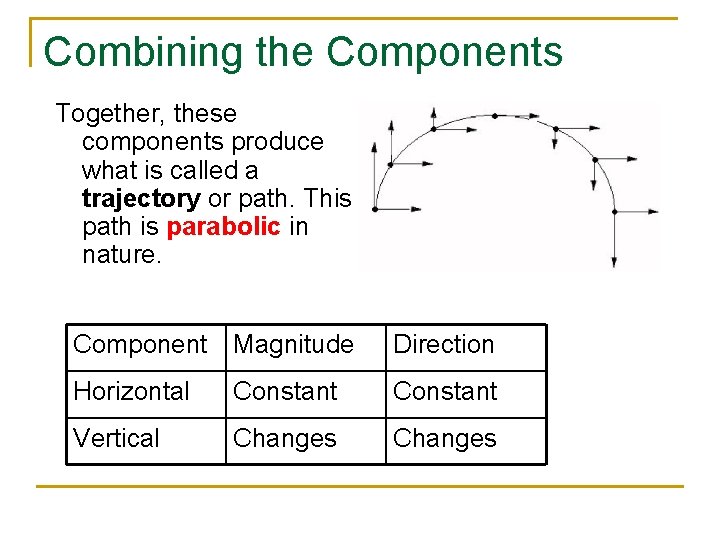
Combining the Components Together, these components produce what is called a trajectory or path. This path is parabolic in nature. Component Magnitude Direction Horizontal Constant Vertical Changes
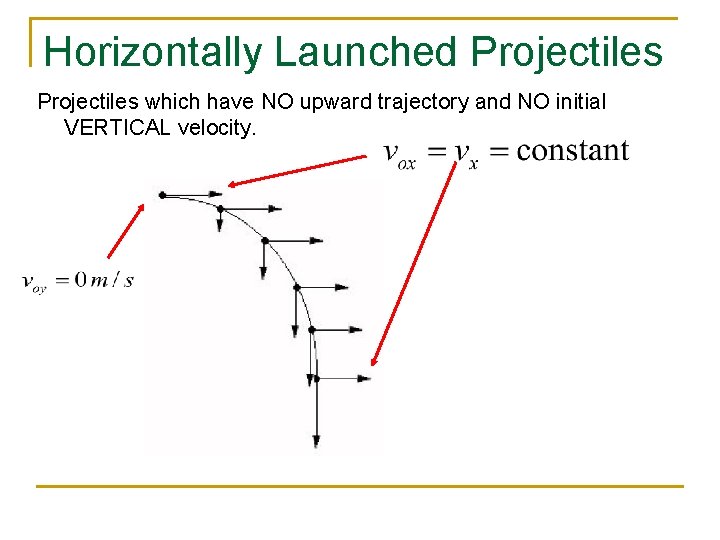
Horizontally Launched Projectiles which have NO upward trajectory and NO initial VERTICAL velocity.
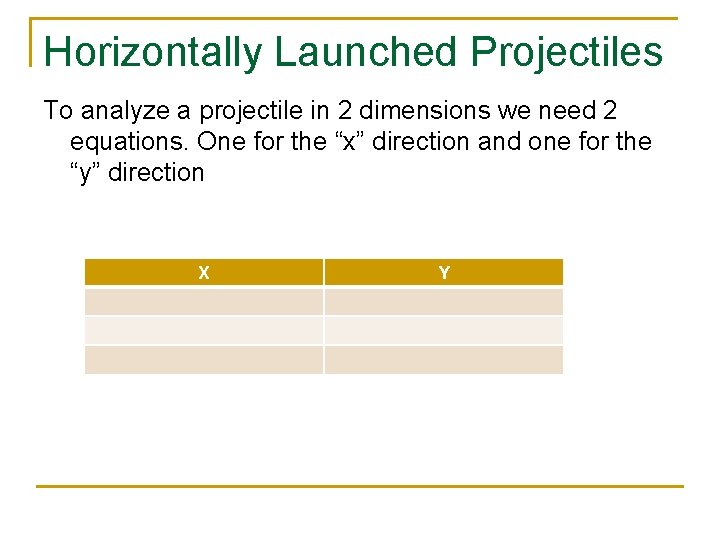
Horizontally Launched Projectiles To analyze a projectile in 2 dimensions we need 2 equations. One for the “x” direction and one for the “y” direction X Y
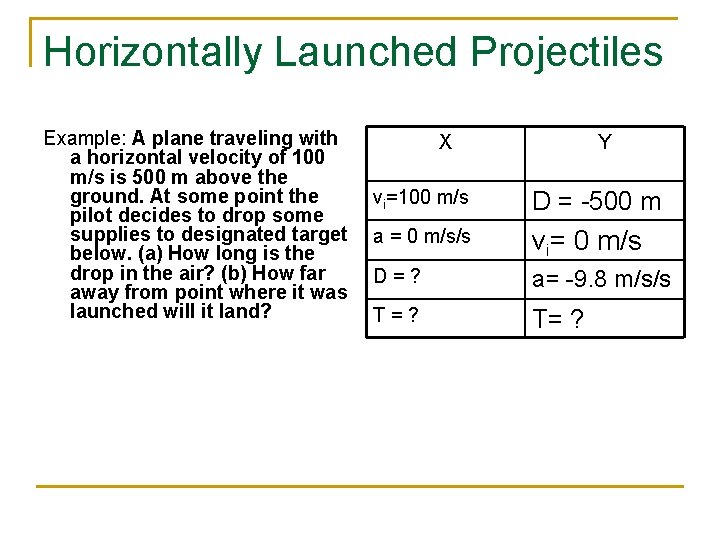
Horizontally Launched Projectiles Example: A plane traveling with a horizontal velocity of 100 m/s is 500 m above the ground. At some point the pilot decides to drop some supplies to designated target below. (a) How long is the drop in the air? (b) How far away from point where it was launched will it land? X Y vi=100 m/s D = -500 m a = 0 m/s/s vi= 0 m/s D=? a= -9. 8 m/s/s T=? T= ?
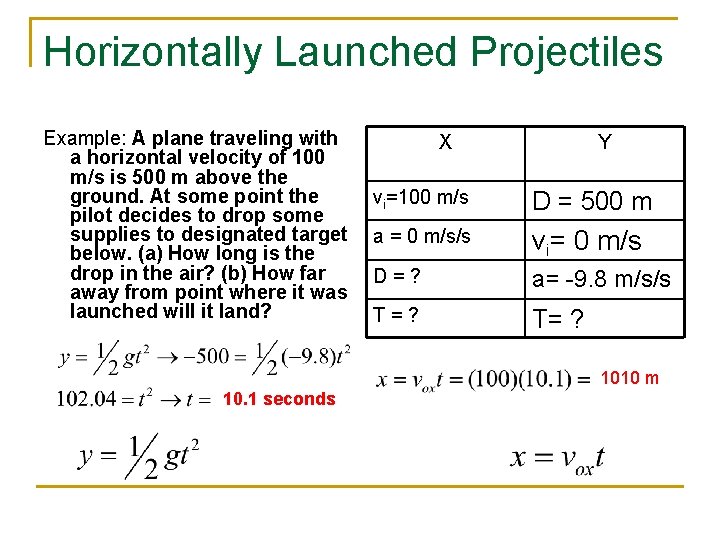
Horizontally Launched Projectiles Example: A plane traveling with a horizontal velocity of 100 m/s is 500 m above the ground. At some point the pilot decides to drop some supplies to designated target below. (a) How long is the drop in the air? (b) How far away from point where it was launched will it land? X Y vi=100 m/s D = 500 m a = 0 m/s/s vi= 0 m/s D=? a= -9. 8 m/s/s T=? T= ? 1010 m 10. 1 seconds
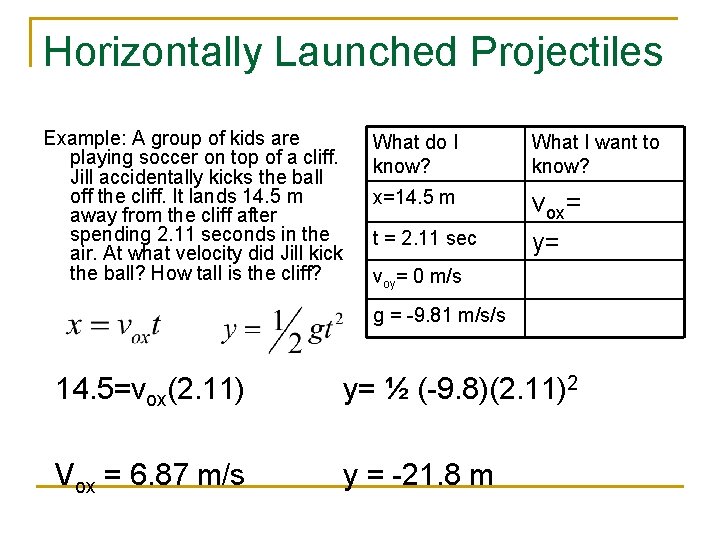
Horizontally Launched Projectiles Example: A group of kids are playing soccer on top of a cliff. Jill accidentally kicks the ball off the cliff. It lands 14. 5 m away from the cliff after spending 2. 11 seconds in the air. At what velocity did Jill kick the ball? How tall is the cliff? What do I know? What I want to know? x=14. 5 m vox= t = 2. 11 sec y= voy= 0 m/s g = -9. 81 m/s/s 14. 5=vox(2. 11) y= ½ (-9. 8)(2. 11)2 Vox = 6. 87 m/s y = -21. 8 m
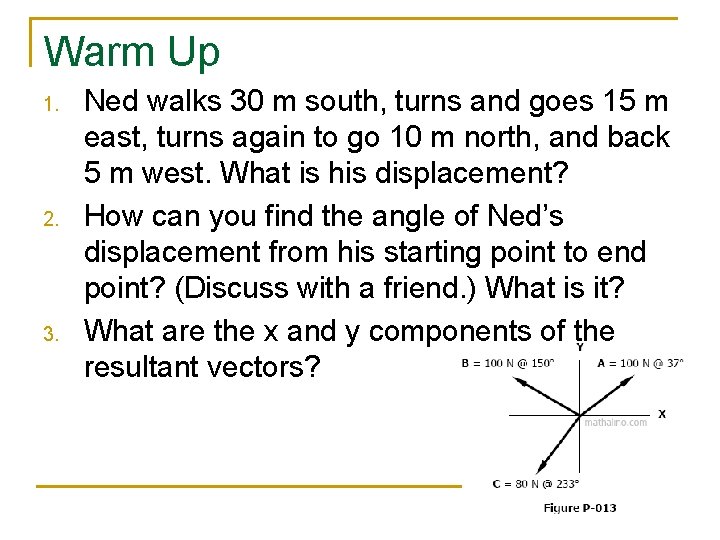
Warm Up 1. 2. 3. Ned walks 30 m south, turns and goes 15 m east, turns again to go 10 m north, and back 5 m west. What is his displacement? How can you find the angle of Ned’s displacement from his starting point to end point? (Discuss with a friend. ) What is it? What are the x and y components of the resultant vectors?
Another Example… n A pool ball leaves a 0. 60 -meter high table with an initial horizontal velocity of 2. 4 m/s. Predict the time required for the pool ball to fall to the ground and the horizontal distance between the table's edge and the ball's landing location.
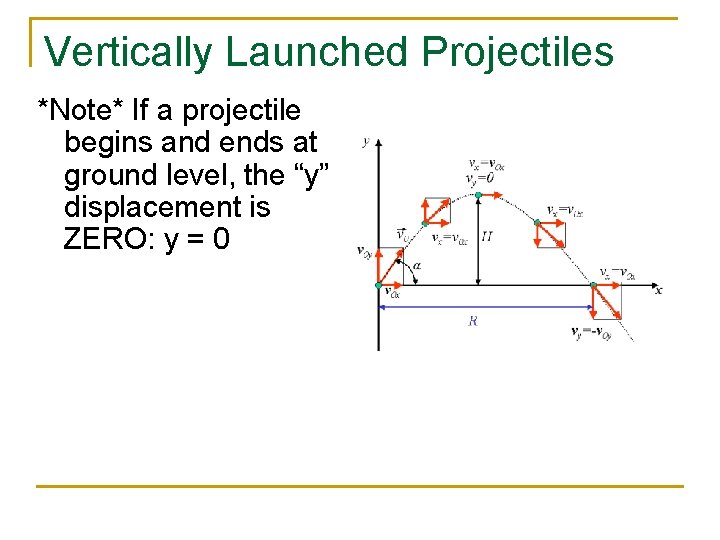
Vertically Launched Projectiles NO Vertical Velocity at the top of the trajectory. Vertical Velocity decreases on the way upward Vertical Velocity increases on the way down, Horizontal Velocity is constant Component Magnitude Direction Horizontal Vertical Constant Changes Constant Decreases up, 0 @ top, Increases down
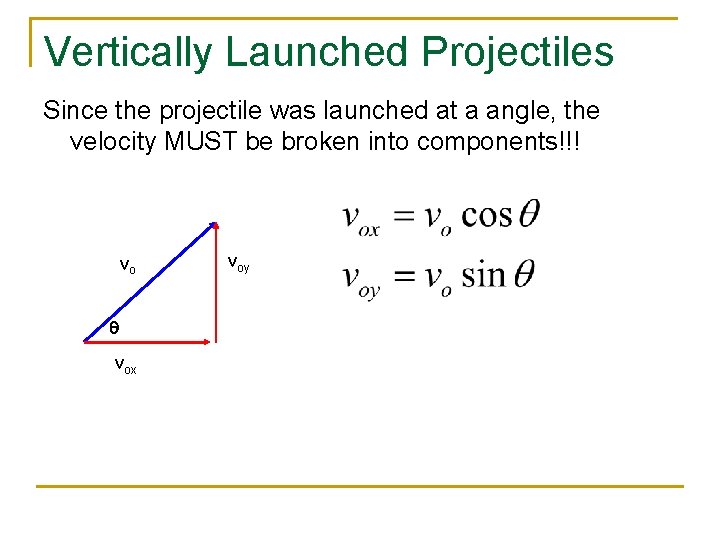
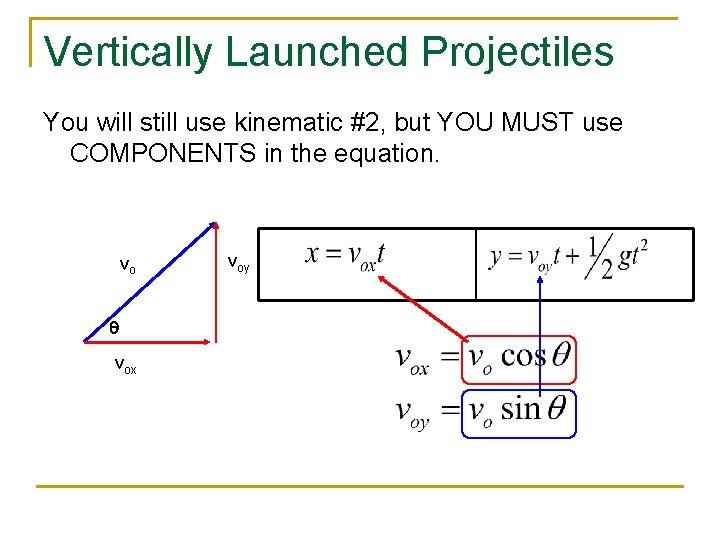
Vertically Launched Projectiles Since the projectile was launched at a angle, the velocity MUST be broken into components!!! vo q vox voy
Vertically Launched Projectiles *Note* If a projectile begins and ends at ground level, the “y” displacement is ZERO: y = 0
Vertically Launched Projectiles You will still use kinematic #2, but YOU MUST use COMPONENTS in the equation. vo q vox voy
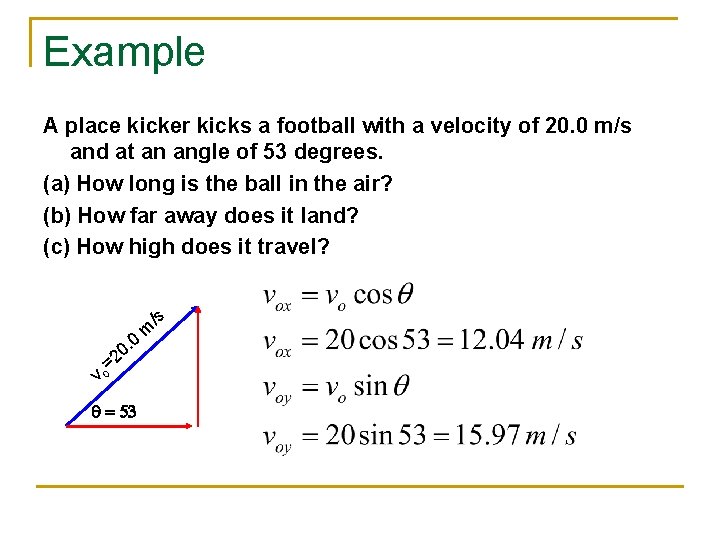
Example A place kicker kicks a football with a velocity of 20. 0 m/s and at an angle of 53 degrees. (a) How long is the ball in the air? (b) How far away does it land? (c) How high does it travel? /s 0 0. v 2 = o q = 53 m
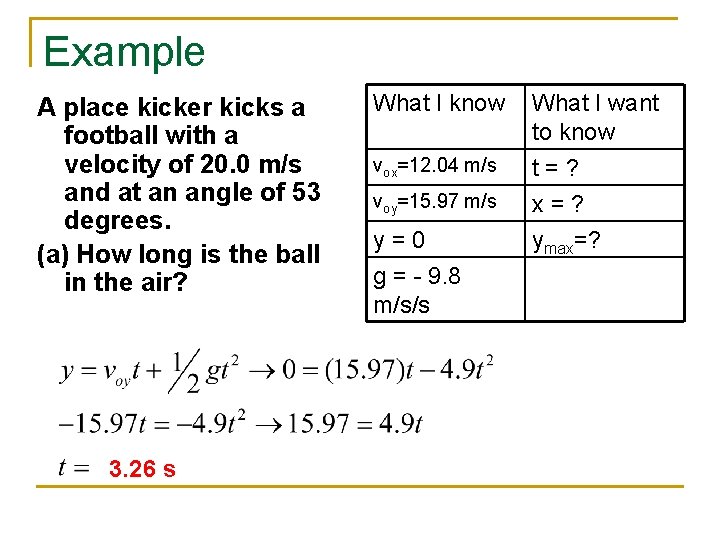
Example A place kicker kicks a football with a velocity of 20. 0 m/s and at an angle of 53 degrees. (a) How long is the ball in the air? 3. 26 s What I know What I want to know vox=12. 04 m/s t=? voy=15. 97 m/s x=? y=0 ymax=? g = - 9. 8 m/s/s
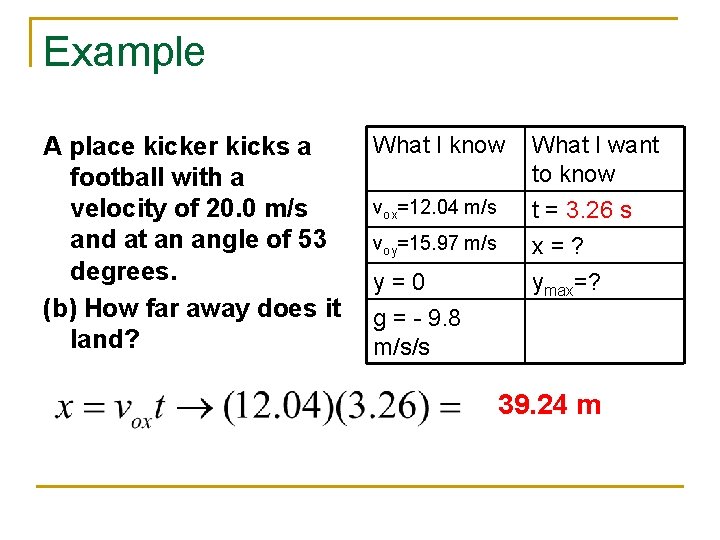
Example A place kicker kicks a football with a velocity of 20. 0 m/s and at an angle of 53 degrees. (b) How far away does it land? What I know What I want to know vox=12. 04 m/s t = 3. 26 s voy=15. 97 m/s x=? y=0 ymax=? g = - 9. 8 m/s/s 39. 24 m
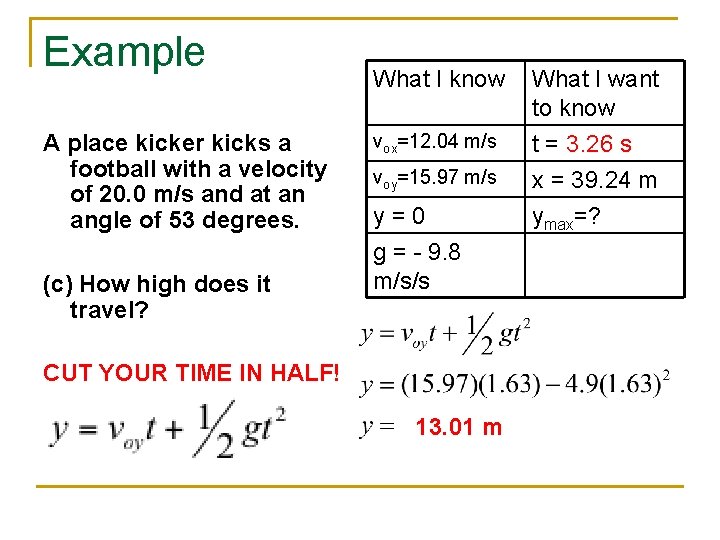
Example A place kicker kicks a football with a velocity of 20. 0 m/s and at an angle of 53 degrees. (c) How high does it travel? What I know What I want to know vox=12. 04 m/s t = 3. 26 s voy=15. 97 m/s x = 39. 24 m y=0 ymax=? g = - 9. 8 m/s/s CUT YOUR TIME IN HALF! 13. 01 m