
Projectile Fragmentation at the Fragment Separator Andreas Heinz

- Slides: 23
Projectile Fragmentation at the Fragment Separator Andreas Heinz Wright Nuclear Structure Laboratory, Yale University for the CHARMS Collaboration Symposium on 30 Years of Projectile Fragmentation, ACS meeting, San Francisco, September 10 -11, 2006
CHARMS Collaboration for High-Accuracy Experiments on Nuclear Reaction Mechanisms with Magnetic Spectrometers P. Armbruster 1, A. Bacquias 1, L. Giot 1, V. Henzl 1, 12, D. Henzlova 1, 12, A. Kelić1, S. Lukić1, R. Pleskač1, M. V. Ricciardi 1, K. -H. Schmidt 1, O. Yordanov 1, J. Benlliure 2, J. Pereira 2, 12, E. Casarejos 2, M. Fernandez 2, T. Kurtukian 2, C. -O. Bacri 3, M. Bernas 3, L. Tassan-Got 3, L. Audouin 3, C. Stéphan 3, A. Boudard 4, S. Leray 4, C. Volant 4, C. Villagrasa 4, B. Fernandez 4, J. -E. Ducret 4, J. Taïeb 5, C. Schmitt 6, B. Jurado 7, F. Reymund 8, P. Napolitani 8, D. Boilley 8, A. Junghans 9, A. Wagner 9, A. Kugler 10, V. Wagner 10, A. Krasa 10, A. Heinz 11, P. Danielewicz 12, L. Shi 12, T. Enqvist 13, K. Helariutta 14, A. Ignatyuk 15, A. Botvina 16 1 GSI, Darmstadt, Germany Santiago de Compostela, Sant. de Compostela, Spain 3 IPN Orsay, France 4 DAPNIA/SPh. N, CEA Saclay, Gif sur Yvette, France 5 DEN/DMS 2 S/SERMA/LENR, CEA Saclay, Gif sur Yvette , France 6 IPNL, Universite Lyon, Groupe Materie Nucleaire 4, Villeurbanne, France 7 CENBG, Bordeau-Gradignan, France 8 GANIL, Caen France 9 Forschungszentrum Rossendorf, Dresden, Germany 10 Nuclear Physics Institute, Rez, Czech Republic 11 Wright Nuclear Structure Laboratory, Yale University, New Haven, USA 12 NSCL and Physics and Astronomy Department, Michigan State University, East Lansing, USA 13 CUPP Project, Pyhasalmi, Finland 14 Univeristy of Helsinki, Finland 15 IPPE Obninsk, Russia 16 Institute for Nuclear Research, Russian Academy of Sciences, Moscow, Russia 2 Univ.
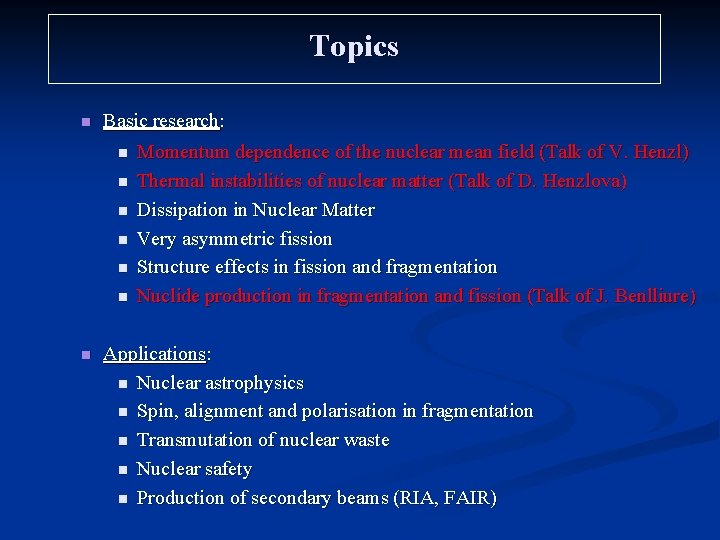
Topics n Basic research: n n n n Momentum dependence of the nuclear mean field (Talk of V. Henzl) Thermal instabilities of nuclear matter (Talk of D. Henzlova) Dissipation in Nuclear Matter Very asymmetric fission Structure effects in fission and fragmentation Nuclide production in fragmentation and fission (Talk of J. Benlliure) Applications: n Nuclear astrophysics n Spin, alignment and polarisation in fragmentation n Transmutation of nuclear waste n Nuclear safety n Production of secondary beams (RIA, FAIR)
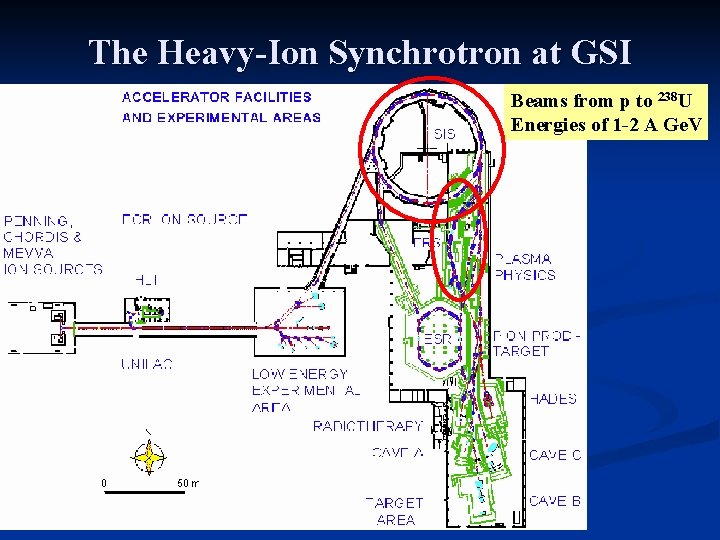
The Heavy-Ion Synchrotron at GSI Beams from p to 238 U Energies of 1 -2 A Ge. V
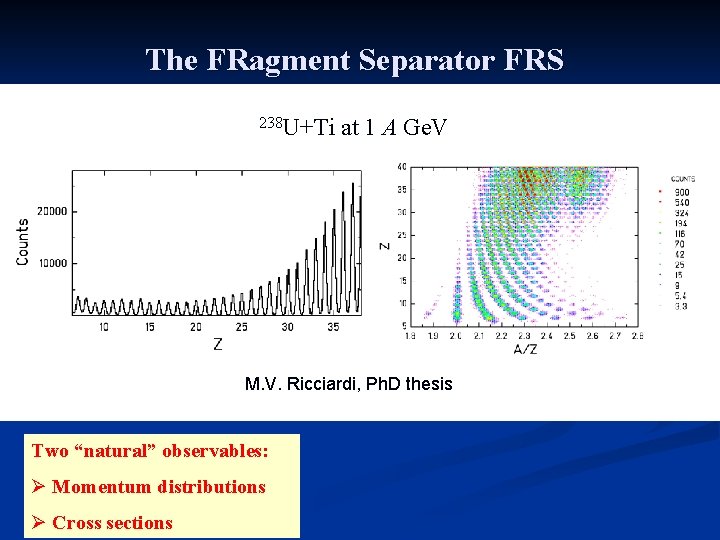
The FRagment Separator FRS 238 U+Ti at 1 A Ge. V A / A 400 Z / Z 200 ( )/ 5· 10 -4 M. V. Ricciardi, Ph. D thesis Two “natural” observables: Ø Momentum distributions Ø Cross sections
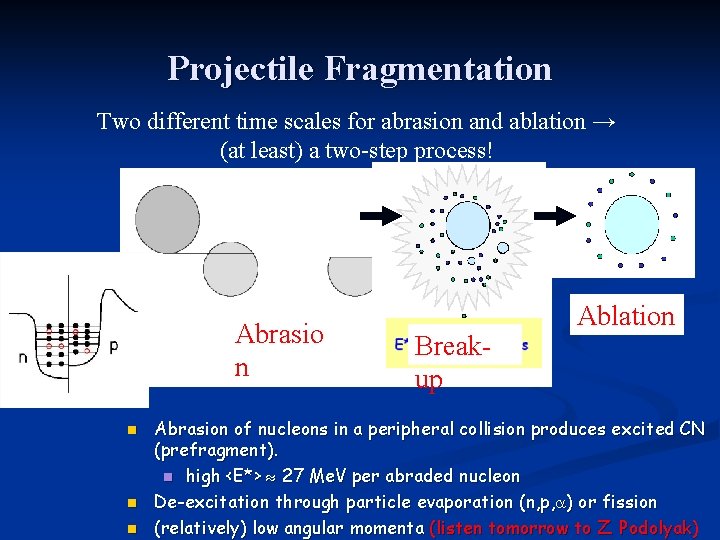
Projectile Fragmentation Two different time scales for abrasion and ablation → (at least) a two-step process! Abrasio n n Breakup Ablation Abrasion of nucleons in a peripheral collision produces excited CN (prefragment). n high <E*> 27 Me. V per abraded nucleon De-excitation through particle evaporation (n, p, ) or fission (relatively) low angular momenta (listen tomorrow to Z. Podolyak)
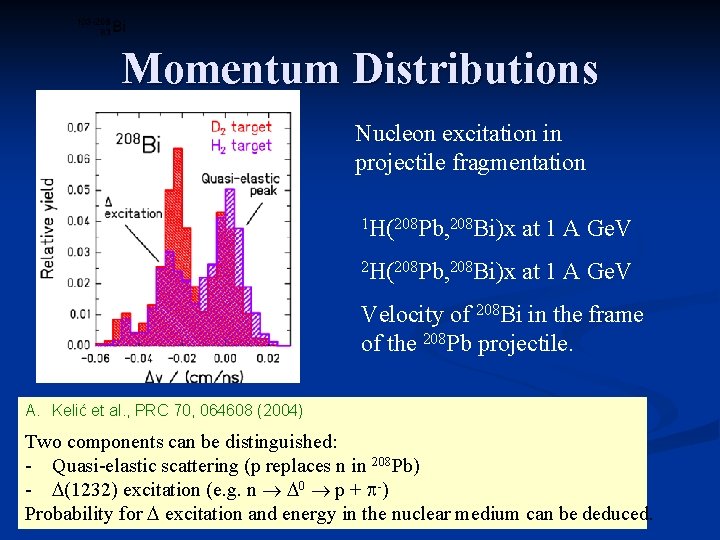
Momentum Distributions Nucleon excitation in projectile fragmentation 1 H(208 Pb, 208 Bi)x at 1 A Ge. V 2 H(208 Pb, 208 Bi)x at 1 A Ge. V Velocity of 208 Bi in the frame of the 208 Pb projectile. A. Kelić et al. , PRC 70, 064608 (2004) Two components can be distinguished: - Quasi-elastic scattering (p replaces n in 208 Pb) - (1232) excitation (e. g. n 0 p + -) Probability for excitation and energy in the nuclear medium can be deduced.
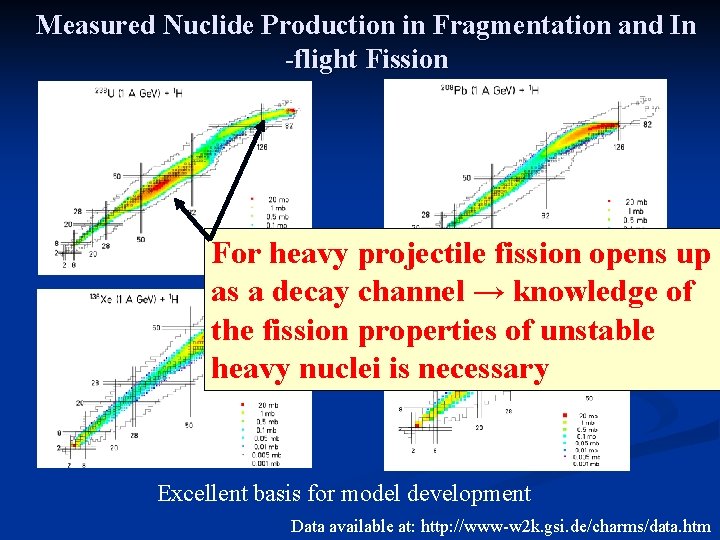
Measured Nuclide Production in Fragmentation and In -flight Fission For heavy projectile fission opens up as a decay channel → knowledge of the fission properties of unstable heavy nuclei is necessary Excellent basis for model development Data available at: http: //www-w 2 k. gsi. de/charms/data. htm
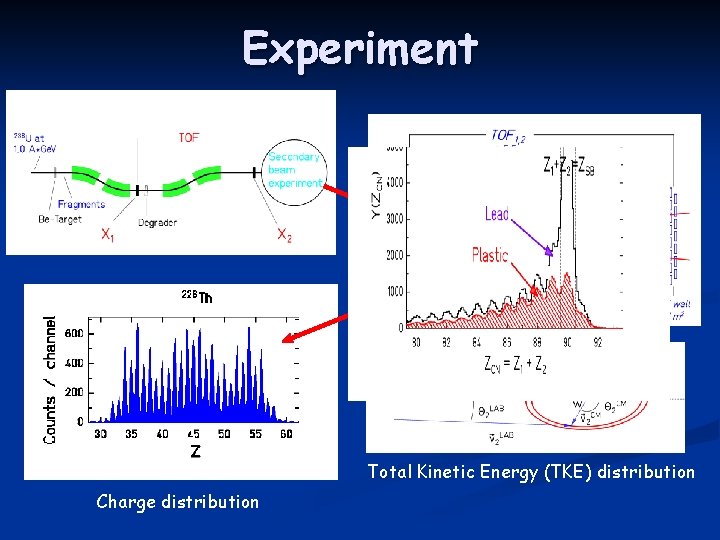
Experiment Total Kinetic Energy (TKE) distribution Charge distribution
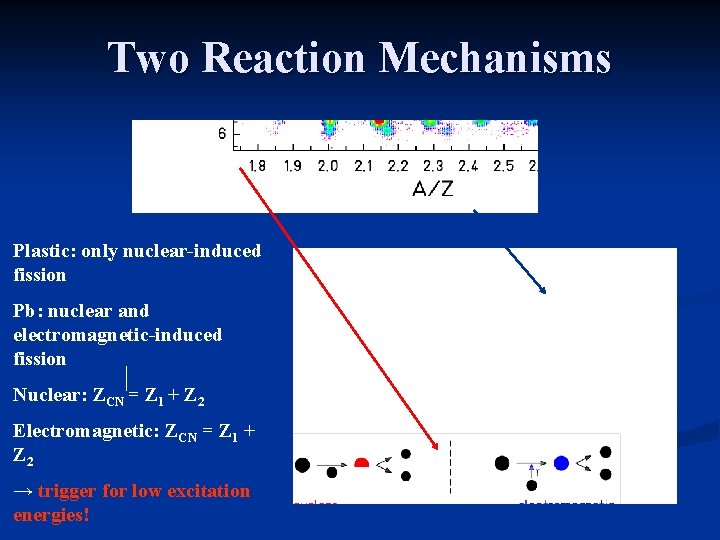
Two Reaction Mechanisms Plastic: only nuclear-induced fission Pb: nuclear and electromagnetic-induced fission Nuclear: ZCN = Z 1 + Z 2 Electromagnetic: ZCN = Z 1 + Z 2 → trigger for low excitation energies!
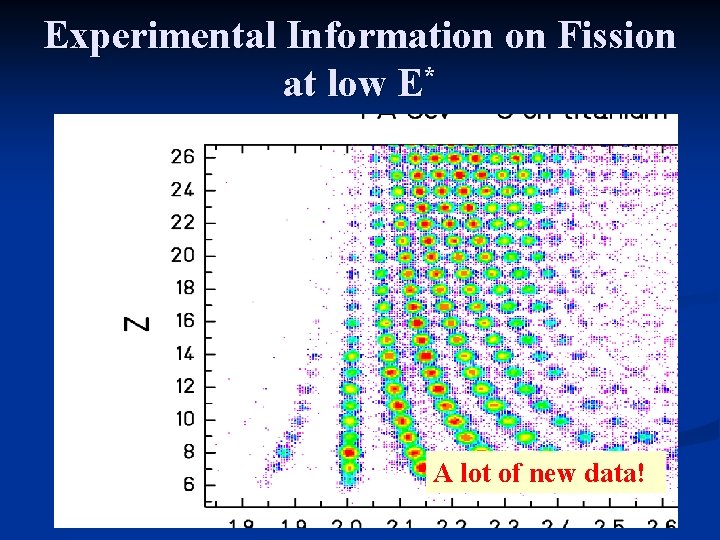
Experimental Information on Fission at low E* E*-Bf < 10 Me. V A lot of new data! E. Konecny et al. , Proc. Third IAEA Symp. Phys. Chem. Fission Vol 2, 1974, p. 3
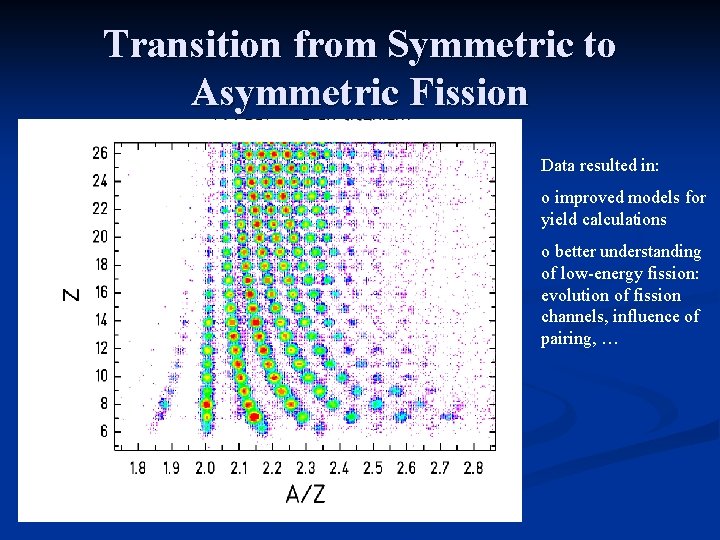
Transition from Symmetric to Asymmetric Fission Data resulted in: o improved models for yield calculations o better understanding of low-energy fission: evolution of fission channels, influence of pairing, …
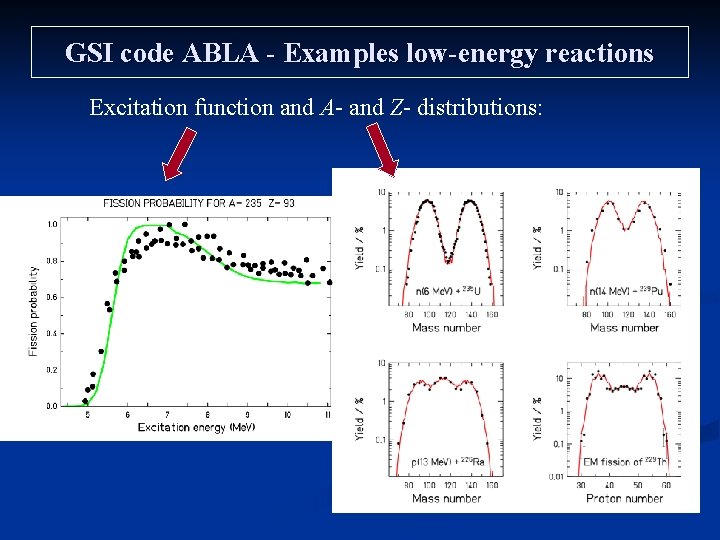
GSI code ABLA - Examples low-energy reactions Excitation function and A- and Z- distributions:
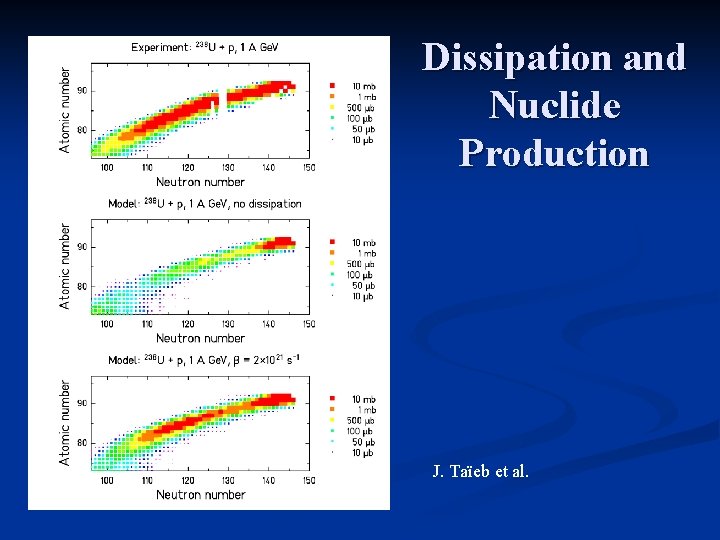
Dissipation and Nuclide Production J. Taïeb et al.
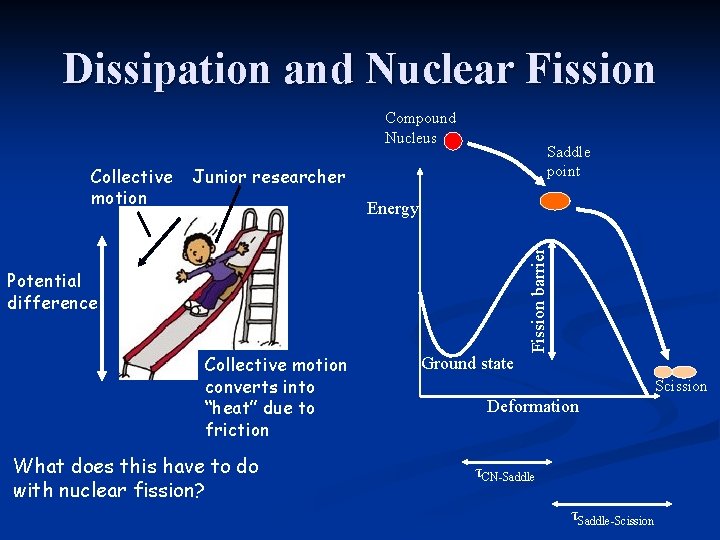
Dissipation and Nuclear Fission Compound Nucleus Junior researcher Energy Fission barrier Collective motion Saddle point Potential difference Collective motion converts into “heat” due to friction What does this have to do with nuclear fission? Ground state Scission Deformation τCN-Saddle τSaddle-Scission
Dissipation and the Saddle Point Temperature Compound Nucleus Energy Saddle point ΔE If there is any dissipation τneutron < τfission → mneutron and ΔE get larger → Tsaddle is smaller Ground state Deformation Reminder: the connection between temperature and excitation energy Level density parameter τCN-Saddle τSaddle-Scission
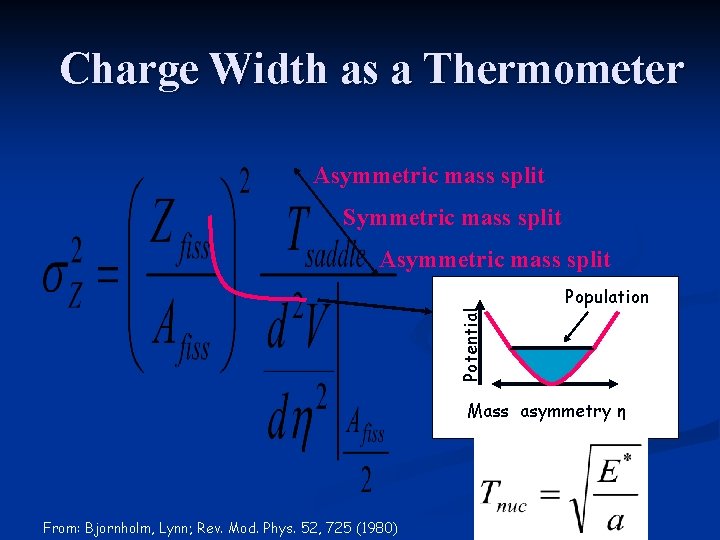
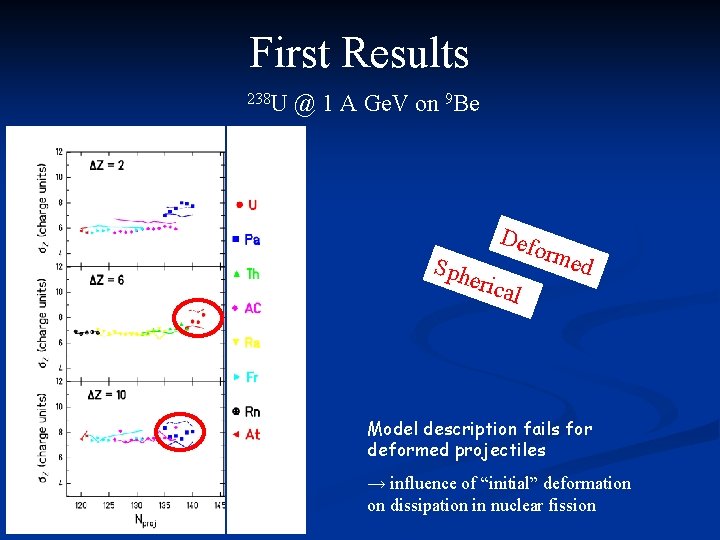
Charge Width as a Thermometer Asymmetric mass split Symmetric mass split Asymmetric mass split Potential Population Mass asymmetry η From: Bjornholm, Lynn; Rev. Mod. Phys. 52, 725 (1980)
First Results 238 U @ 1 A Ge. V on 9 Be Def Sph eric al orm ed Model description fails for deformed projectiles → influence of “initial” deformation on dissipation in nuclear fission
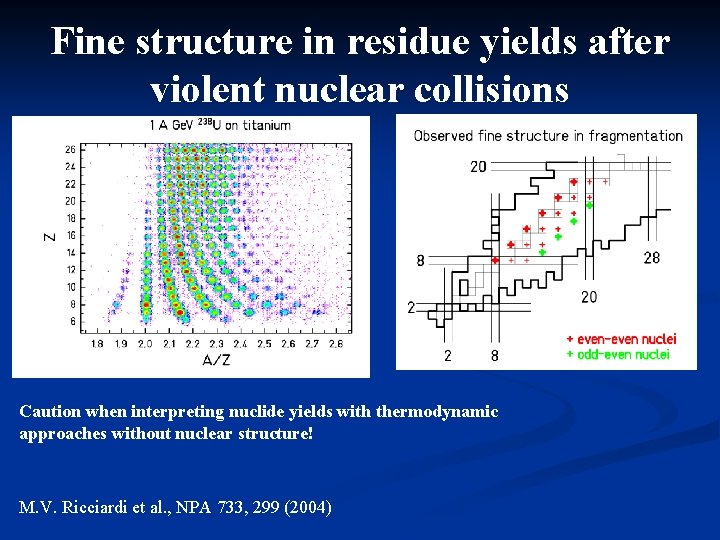
Fine structure in residue yields after violent nuclear collisions Caution when interpreting nuclide yields with thermodynamic approaches without nuclear structure! M. V. Ricciardi et al. , NPA 733, 299 (2004)
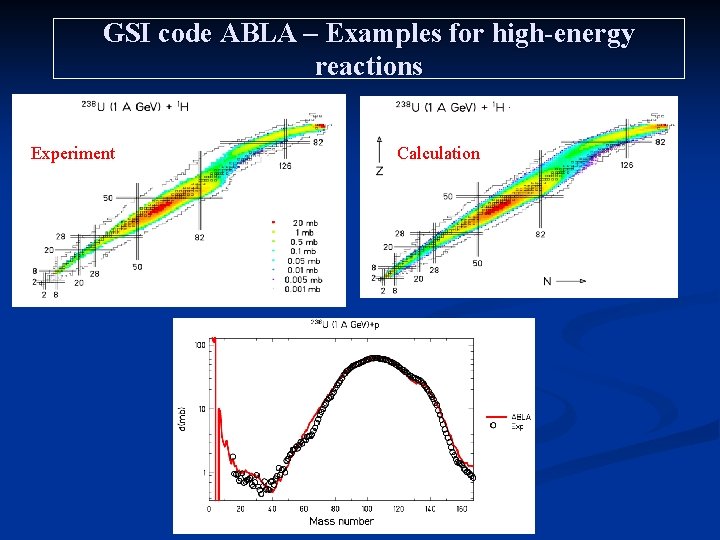
GSI code ABLA – Examples for high-energy reactions Experiment Calculation
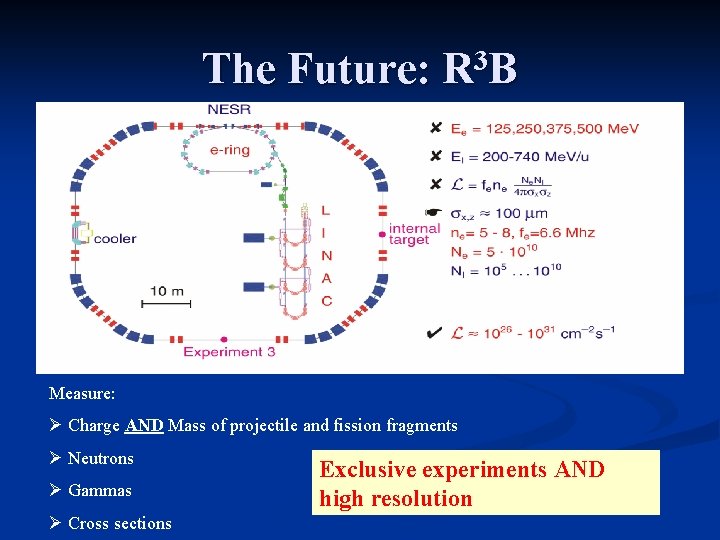
The Future: R 3 B Measure: Ø Charge AND Mass of projectile and fission fragments Ø Neutrons Ø Gammas Ø Cross sections Exclusive experiments AND high resolution
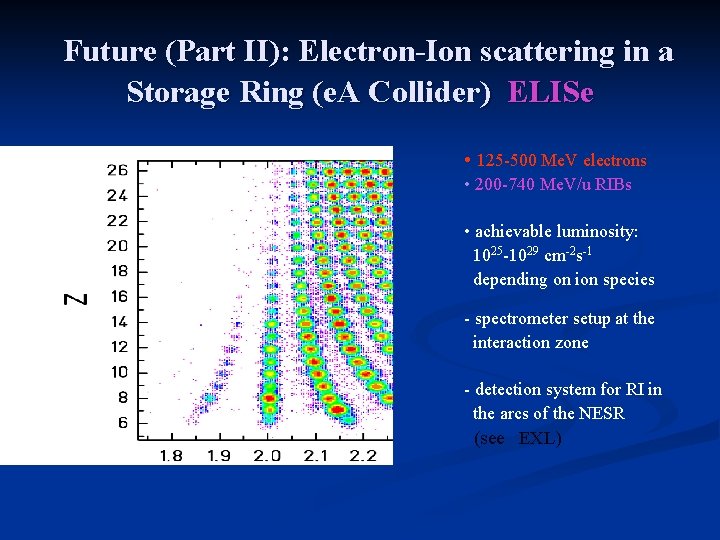
Future (Part II): Electron-Ion scattering in a Storage Ring (e. A Collider) ELISe • 125 -500 Me. V electrons • 200 -740 Me. V/u RIBs • achievable luminosity: 1025 -1029 cm-2 s-1 depending on ion species - spectrometer setup at the interaction zone - detection system for RI in the arcs of the NESR (see EXL)
Conclusions n n n A lot of progress in the understanding of projectile fragmentation. Heavy beams and high resolution spectrometers are excellent tools. Don’t forget the influence of nuclear structure and nucleonic exciations. A wealth of new data from projectile fragmentation, spallation, in-flight fission and fission of secondary beams allowed for the development of realistic models with predictive power. Applications in accelerator driven systems, nuclear astrophysics, . . . The future looks bright!