
Projected changes to freshwater aquaculture Presented by Timothy
Projected changes to freshwater aquaculture Presented by Timothy Pickering
Authors • This presentation is based on Chapter 11 ‘Vulnerability of aquaculture in the tropical Pacific to climate change’ in the book Vulnerability of Tropical Pacific Fisheries and Aquaculture to Climate Change, edited by JD Bell, JE Johnson and AJ Hobday and published by SPC in 2011. • The authors of Chapter 11 are: Timothy D Pickering, Ben Ponia, Cathy A Hair, Paul C Southgate, Elvira S Poloczanska, Luc Della Patrona, Antoine Teitelbaum, Chadag V Mohan, Michael J Phillips, Johann D Bell and Sena De Silva
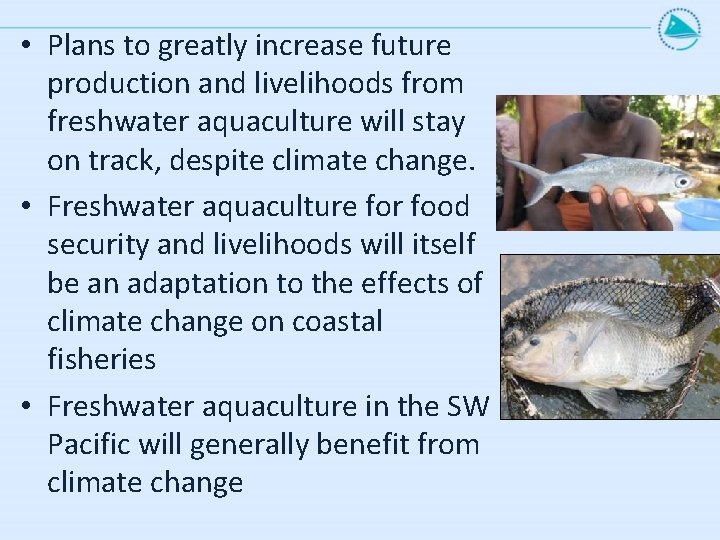
• Plans to greatly increase future production and livelihoods from freshwater aquaculture will stay on track, despite climate change. • Freshwater aquaculture for food security and livelihoods will itself be an adaptation to the effects of climate change on coastal fisheries • Freshwater aquaculture in the SW Pacific will generally benefit from climate change
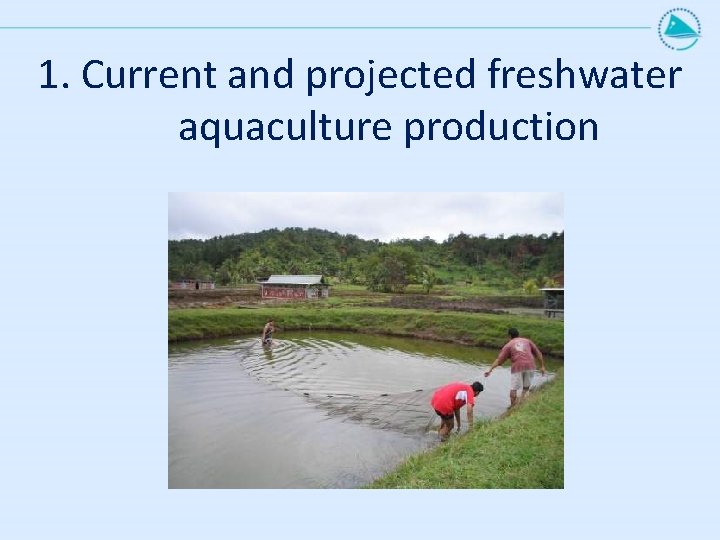
1. Current and projected freshwater aquaculture production
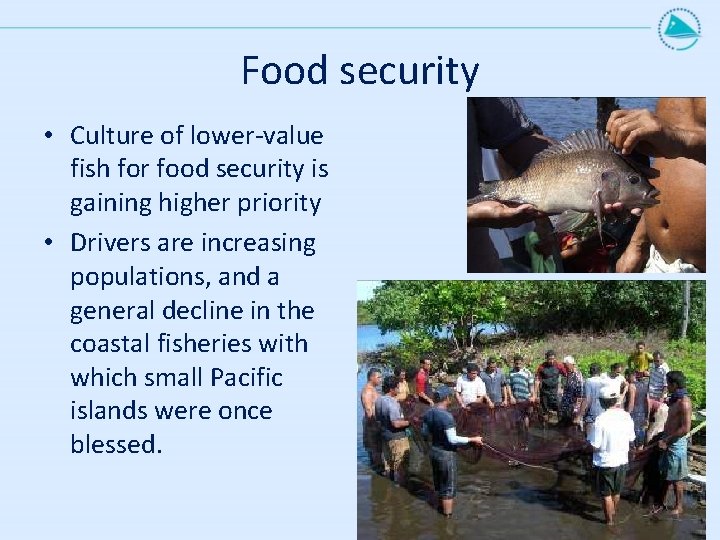
Food security • Culture of lower-value fish for food security is gaining higher priority • Drivers are increasing populations, and a general decline in the coastal fisheries with which small Pacific islands were once blessed.
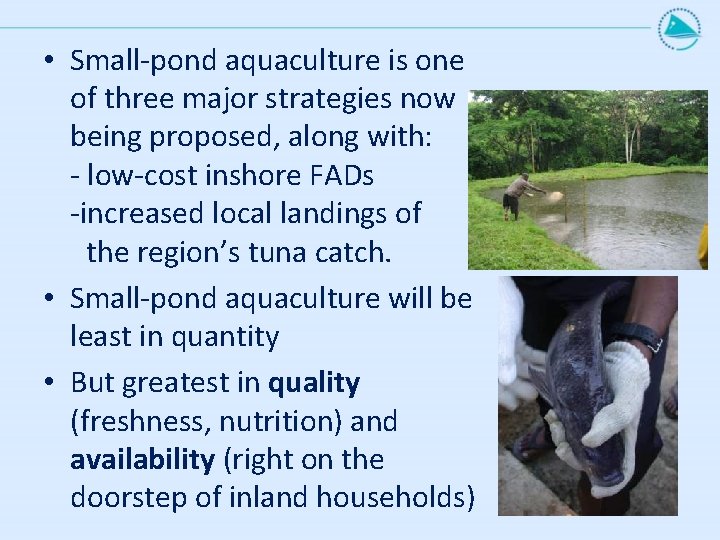
• Small-pond aquaculture is one of three major strategies now being proposed, along with: - low-cost inshore FADs -increased local landings of the region’s tuna catch. • Small-pond aquaculture will be least in quantity • But greatest in quality (freshness, nutrition) and availability (right on the doorstep of inland households)
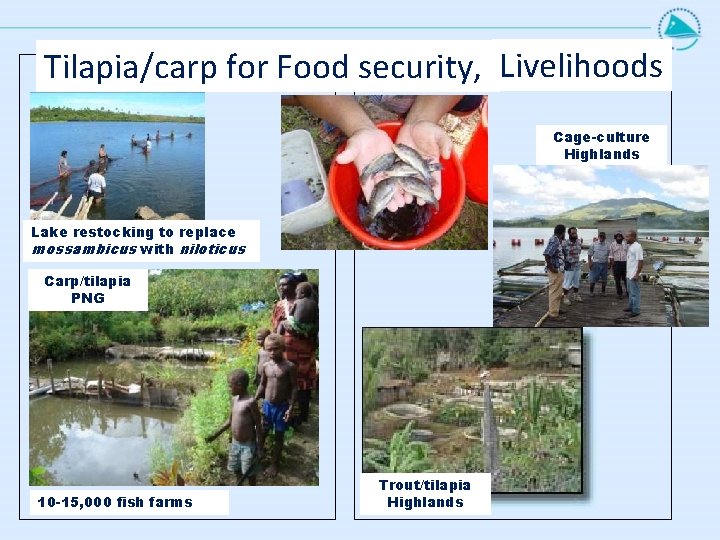
Tilapia/carp for Food security, Livelihoods Cage-culture Highlands Lake restocking to replace mossambicus with niloticus Carp/tilapia PNG 10 -15, 000 fish farms Trout/tilapia Highlands
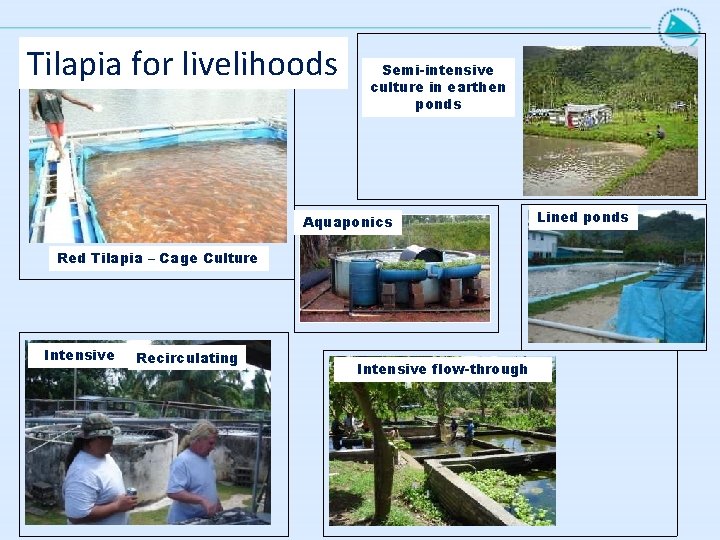
Tilapia for livelihoods Semi-intensive culture in earthen ponds Aquaponics Red Tilapia – Cage Culture Intensive Recirculating Intensive flow-through Lined ponds
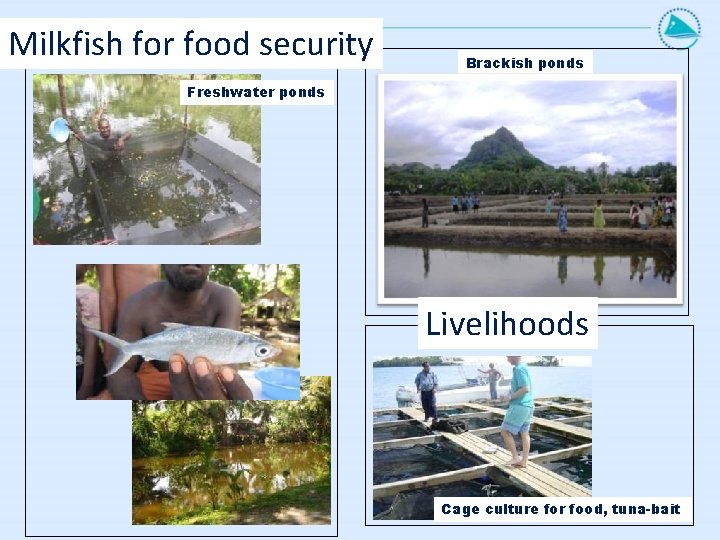
Milkfish for food security Brackish ponds Freshwater ponds Livelihoods Cage culture for food, tuna-bait
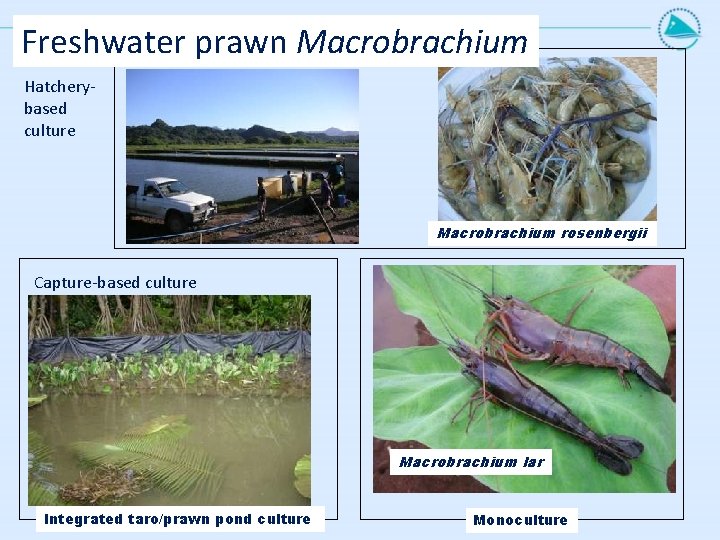
Freshwater prawn Macrobrachium Hatcherybased culture Macrobrachium rosenbergii Capture-based culture Macrobrachium lar Integrated taro/prawn pond culture Monoculture
SME approaches to food security • Small household level aquaculture for subsistence consumption is only viable with ongoing government support and subsidy of farm inputs, but is viewed as important by PICTs • Inland aquaculture for livelihoods also contributes to food security • The next challenge is to add a layer of viable SME -scale commercial-market aquaculture for periurban markets
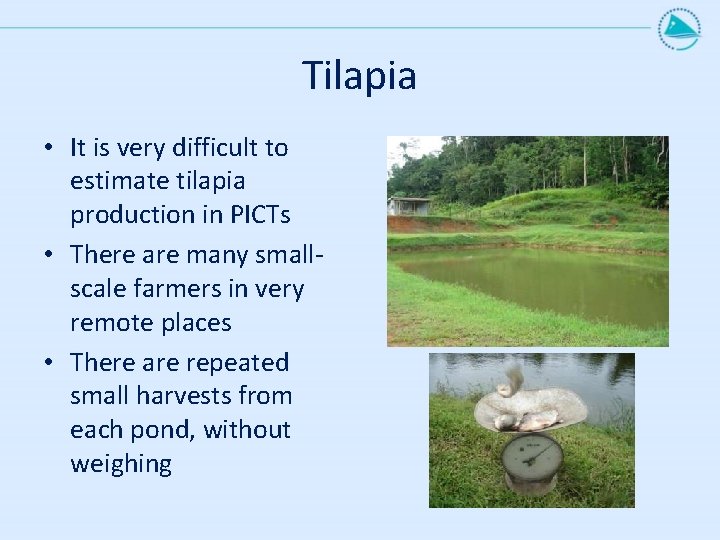
Tilapia • It is very difficult to estimate tilapia production in PICTs • There are many smallscale farmers in very remote places • There are repeated small harvests from each pond, without weighing
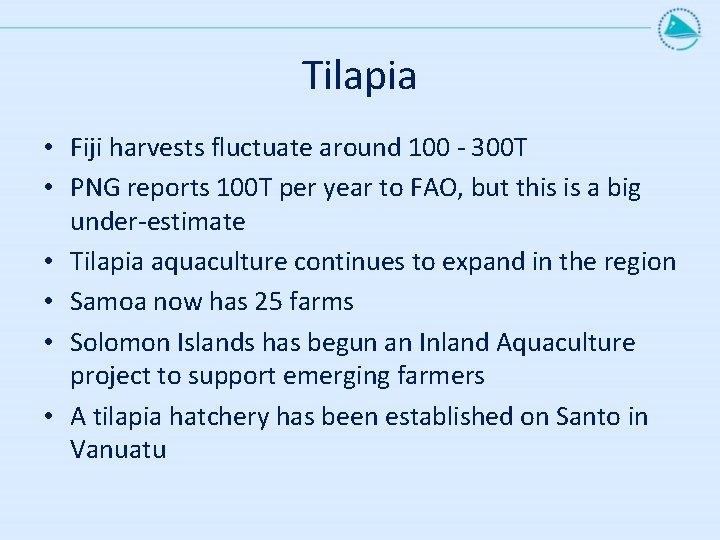
Tilapia • Fiji harvests fluctuate around 100 - 300 T • PNG reports 100 T per year to FAO, but this is a big under-estimate • Tilapia aquaculture continues to expand in the region • Samoa now has 25 farms • Solomon Islands has begun an Inland Aquaculture project to support emerging farmers • A tilapia hatchery has been established on Santo in Vanuatu
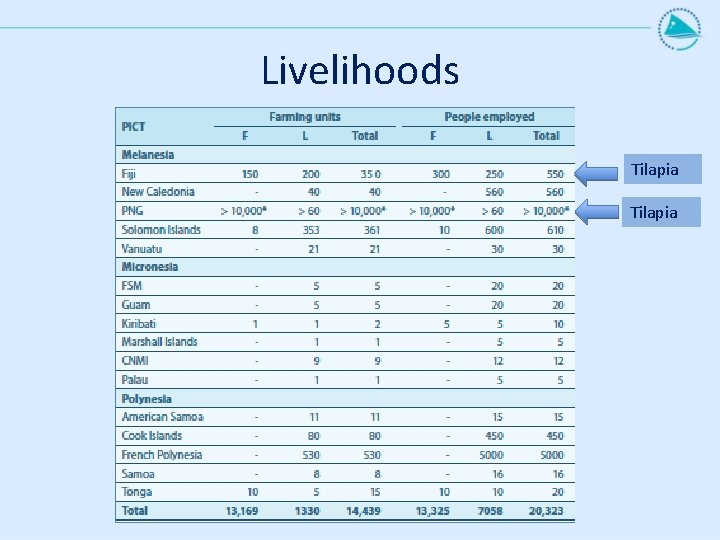
Livelihoods Tilapia
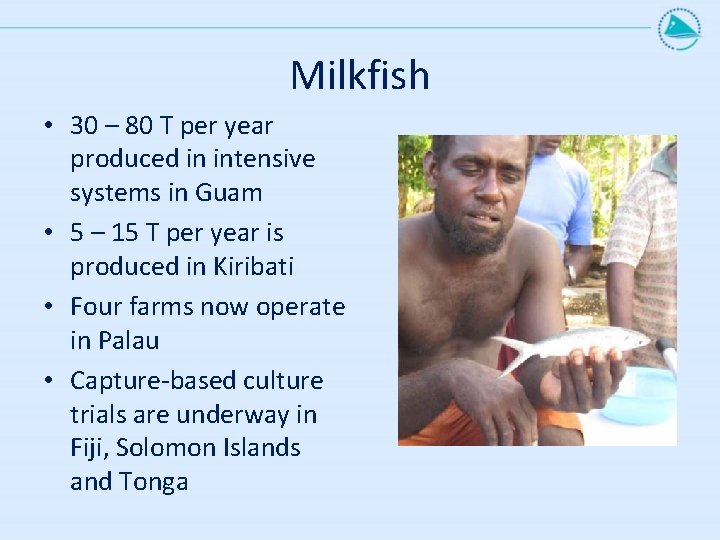
Milkfish • 30 – 80 T per year produced in intensive systems in Guam • 5 – 15 T per year is produced in Kiribati • Four farms now operate in Palau • Capture-based culture trials are underway in Fiji, Solomon Islands and Tonga
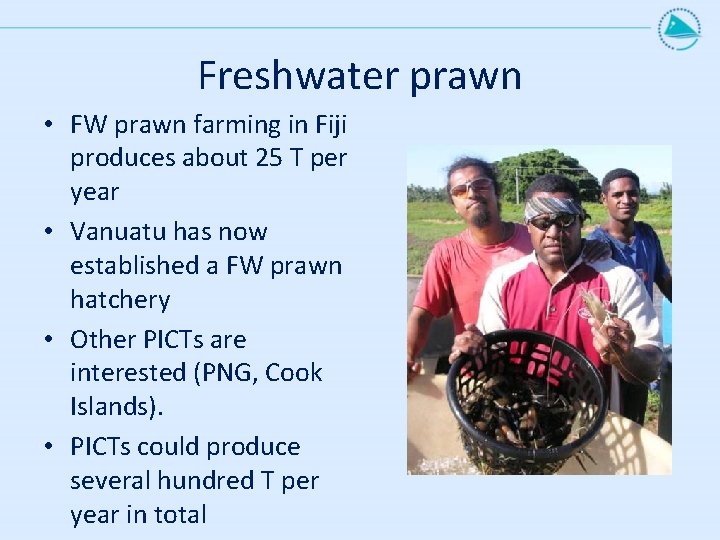
Freshwater prawn • FW prawn farming in Fiji produces about 25 T per year • Vanuatu has now established a FW prawn hatchery • Other PICTs are interested (PNG, Cook Islands). • PICTs could produce several hundred T per year in total
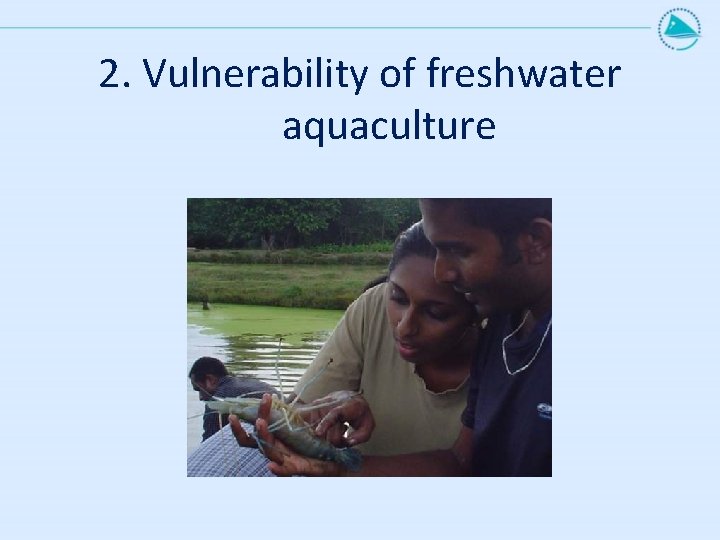
2. Vulnerability of freshwater aquaculture
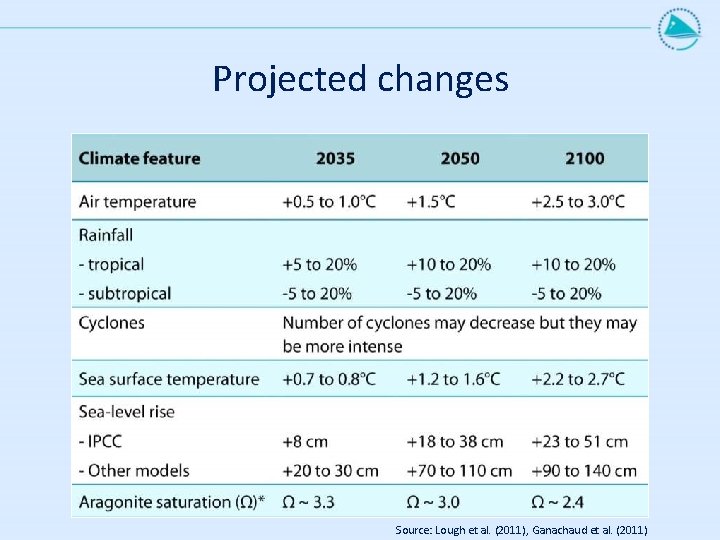
Projected changes Source: Lough et al. (2011), Ganachaud et al. (2011)
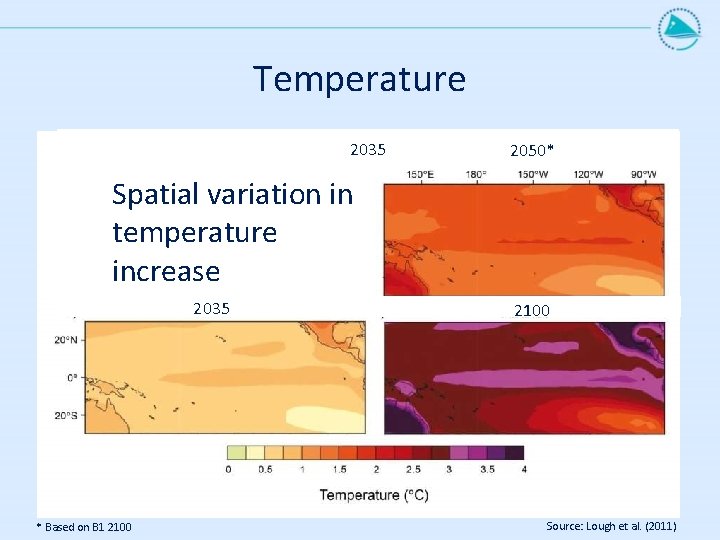
Temperature 2035 2050* Spatial variation in temperature increase 2035 * Based on B 1 2100 Source: Lough et al. (2011)
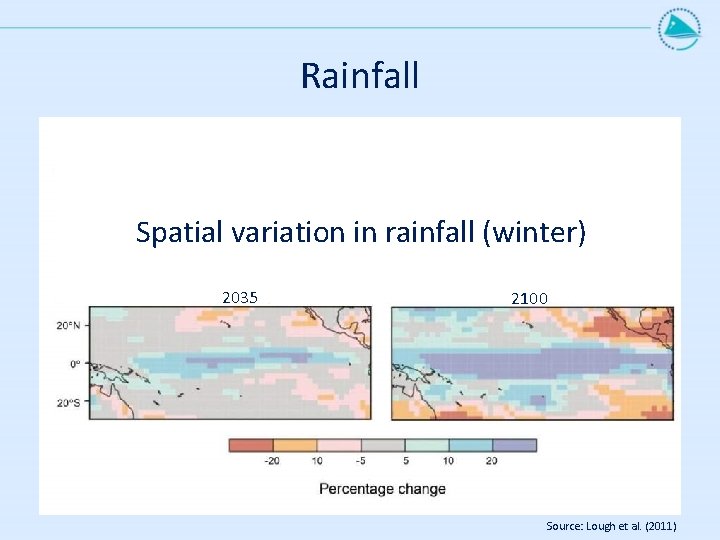
Rainfall Spatial variation in rainfall (winter) 2035 2100 Source: Lough et al. (2011)
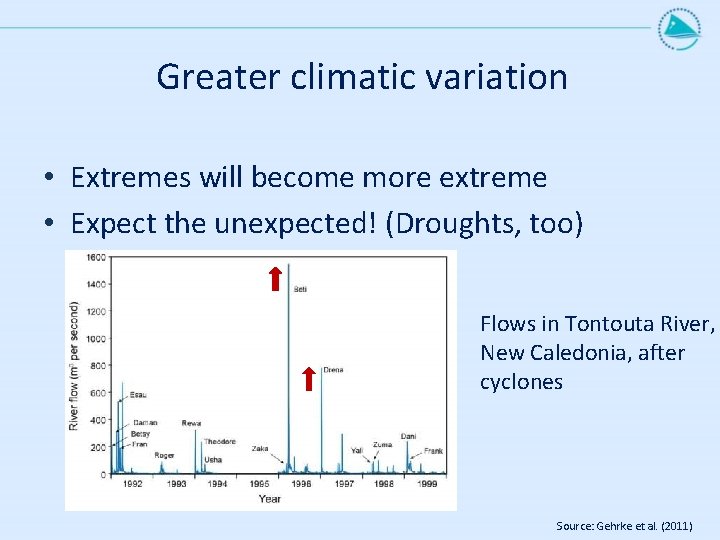
Greater climatic variation • Extremes will become more extreme • Expect the unexpected! (Droughts, too) Flows in Tontouta River, New Caledonia, after cyclones Source: Gehrke et al. (2011)
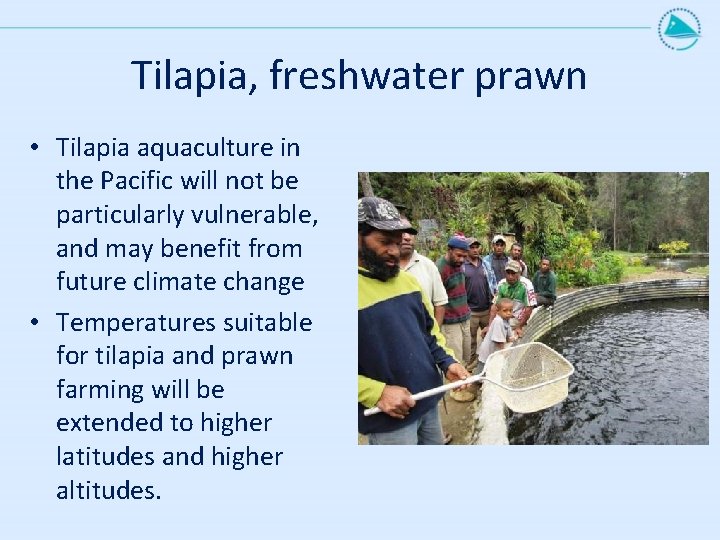
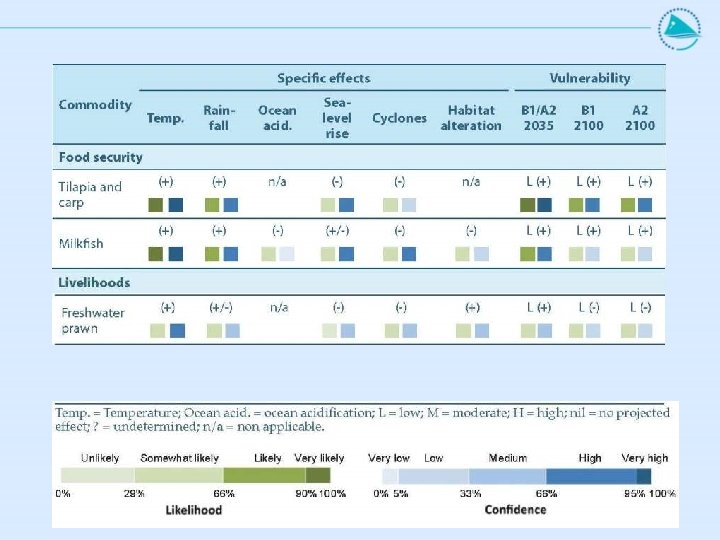
Tilapia, freshwater prawn • Tilapia aquaculture in the Pacific will not be particularly vulnerable, and may benefit from future climate change • Temperatures suitable for tilapia and prawn farming will be extended to higher latitudes and higher altitudes.
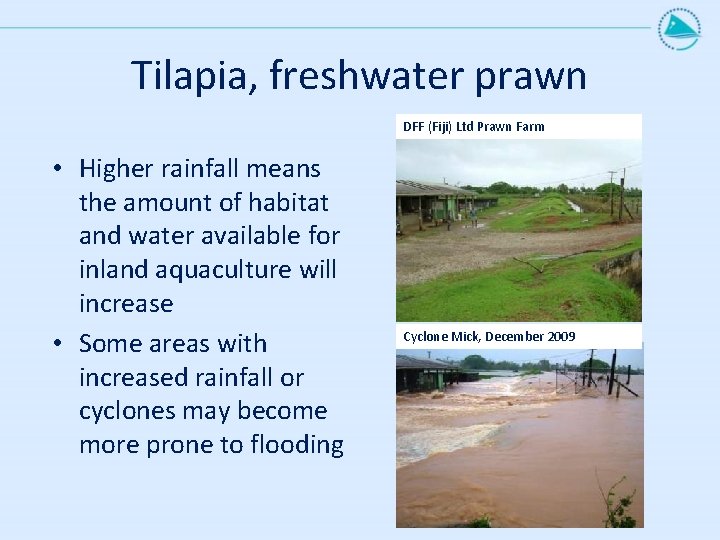
Tilapia, freshwater prawn DFF (Fiji) Ltd Prawn Farm • Higher rainfall means the amount of habitat and water available for inland aquaculture will increase • Some areas with increased rainfall or cyclones may become more prone to flooding Cyclone Mick, December 2009
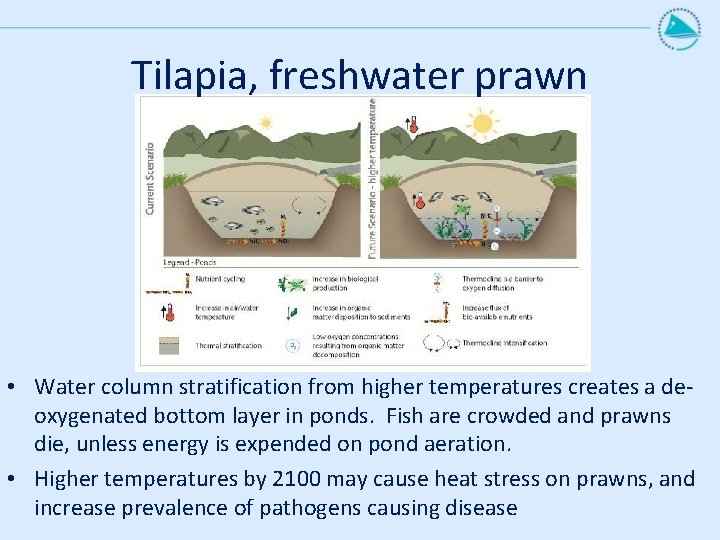
Tilapia, freshwater prawn • Water column stratification from higher temperatures creates a deoxygenated bottom layer in ponds. Fish are crowded and prawns die, unless energy is expended on pond aeration. • Higher temperatures by 2100 may cause heat stress on prawns, and increase prevalence of pathogens causing disease
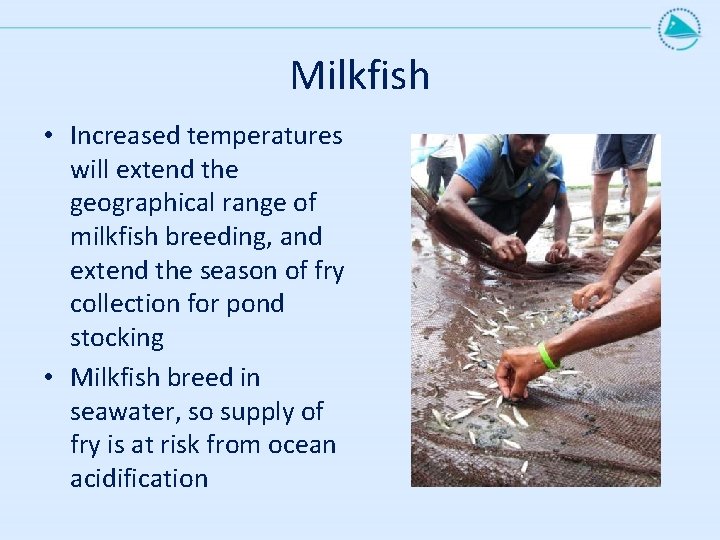
Milkfish • Increased temperatures will extend the geographical range of milkfish breeding, and extend the season of fry collection for pond stocking • Milkfish breed in seawater, so supply of fry is at risk from ocean acidification
3. Key responses and adaptations
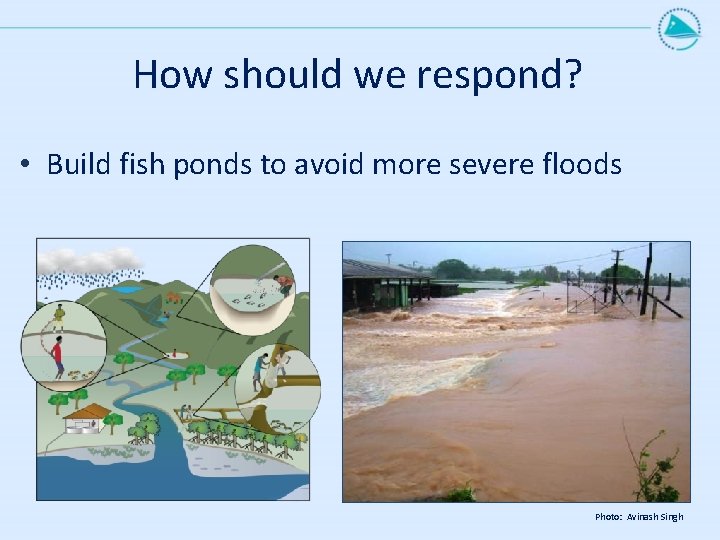
How should we respond? • Build fish ponds to avoid more severe floods Photo: Avinash Singh
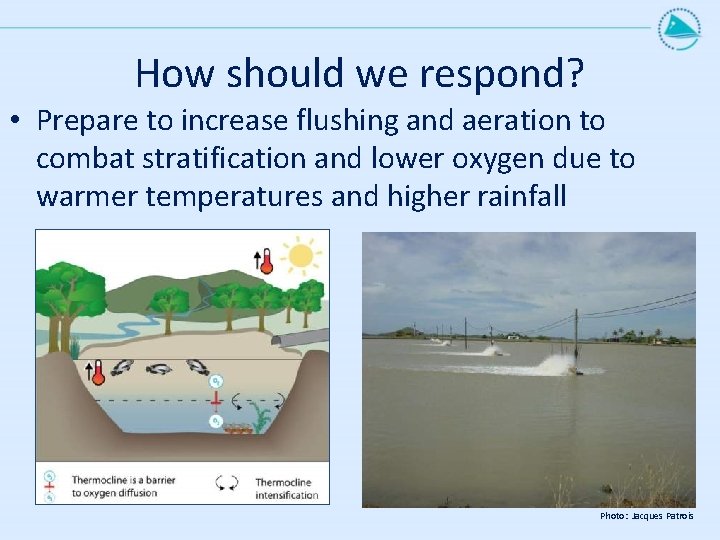
How should we respond? • Prepare to increase flushing and aeration to combat stratification and lower oxygen due to warmer temperatures and higher rainfall Photo: Jacques Patrois
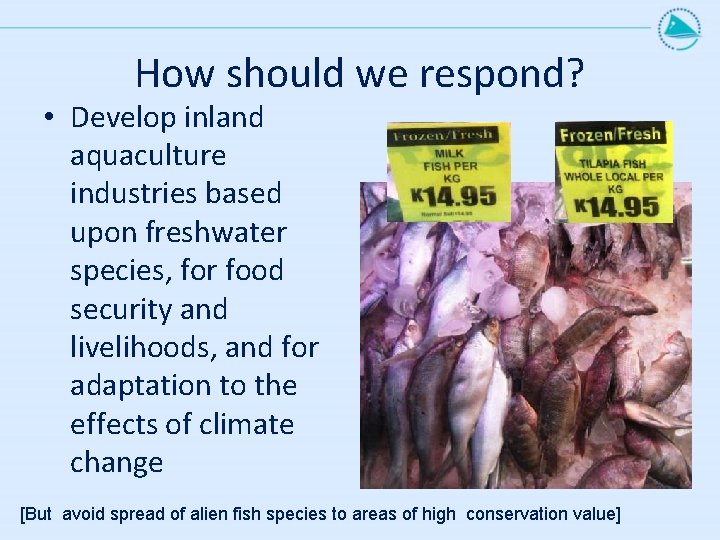
How should we respond? • Develop inland aquaculture industries based upon freshwater species, for food security and livelihoods, and for adaptation to the effects of climate change [But avoid spread of alien fish species to areas of high conservation value]
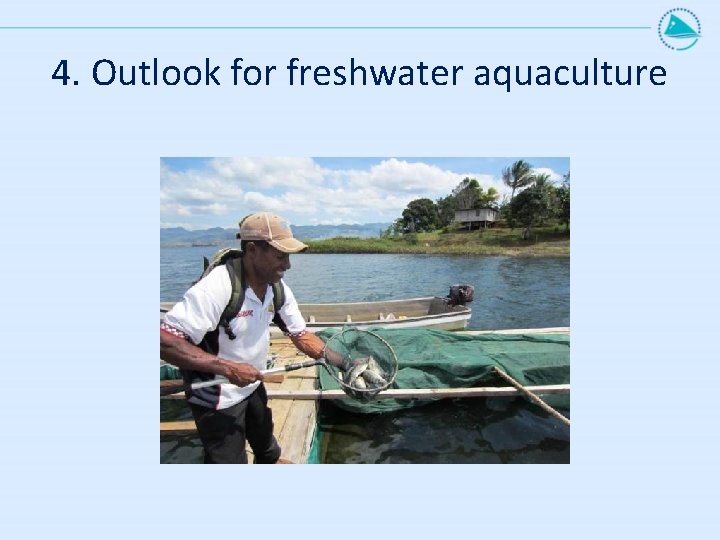
4. Outlook for freshwater aquaculture
Outlook • Aspirations for significant future production (1000 - 2000 T per highisland PICT) and livelihoods (between 10, 000 to 20, 000 persons part-time) from inland aquaculture are still likely to be realised.
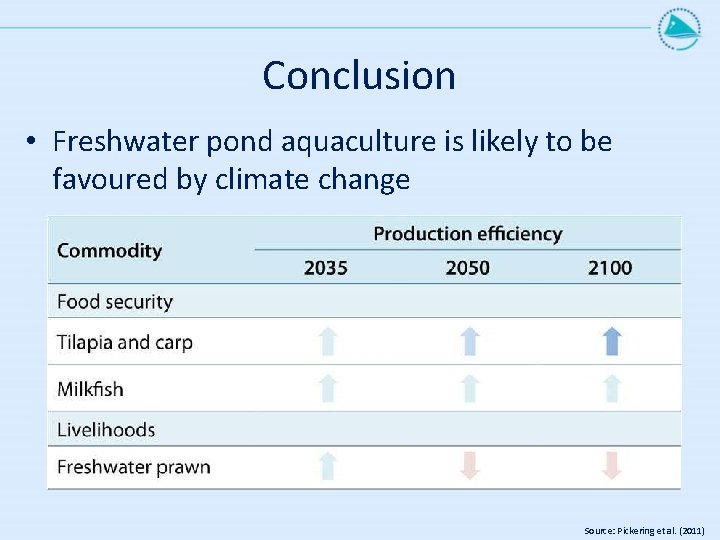
Conclusion • Freshwater pond aquaculture is likely to be favoured by climate change Source: Pickering et al. (2011)
Thank you
- Slides: 34