
ProjectBased Learning PBL Javier Cavazos Vela Ph D
Project-Based Learning (PBL) Javier Cavazos Vela, Ph. D. Director, Center for Teaching Excellence (CTE) Assistant Professor, College of Education and P-16 Integration
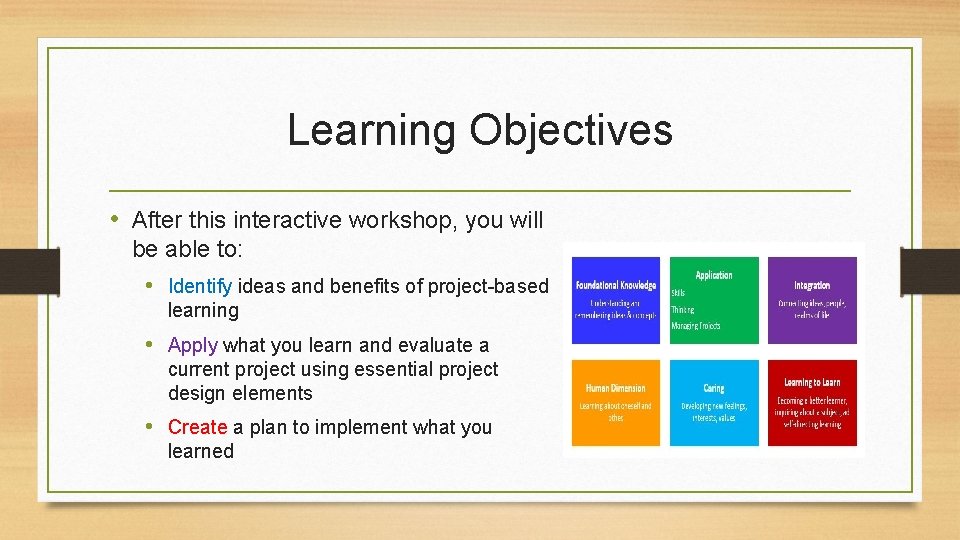
Learning Objectives • After this interactive workshop, you will be able to: • Identify ideas and benefits of project-based learning • Apply what you learn and evaluate a current project using essential project design elements • Create a plan to implement what you learned
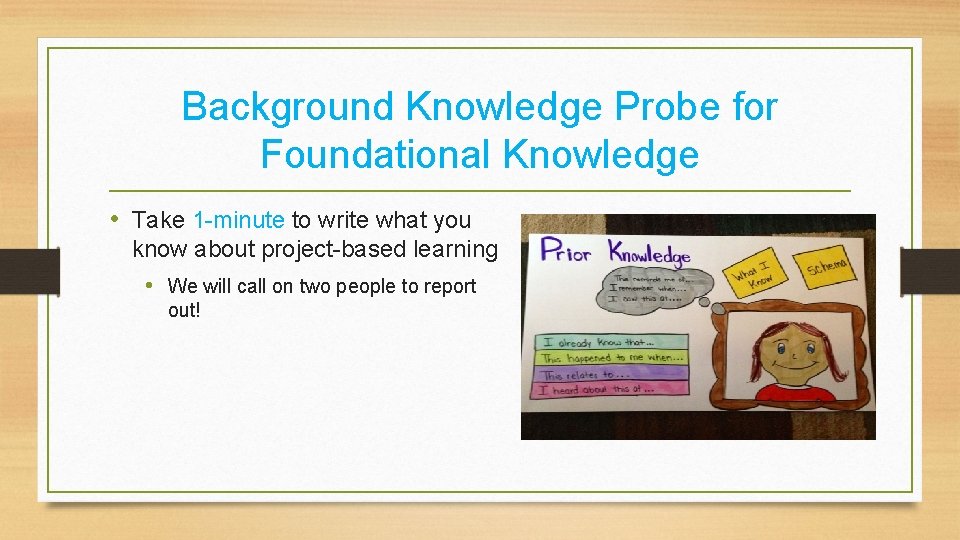
Background Knowledge Probe for Foundational Knowledge • Take 1 -minute to write what you know about project-based learning • We will call on two people to report out!
What is Project Based Learning (PBL)? • Markham (2003) defined PBL as an “extended inquiry process structured around complex, authentic questions and carefully designed products and tasks” (p. 4). • Problem-based learning is focused on the process while project-based is focused on the product and solution to the problem • Differences between project-based and problem-based are not clear (Prince & Felder, 2007) and are often used interchangeably
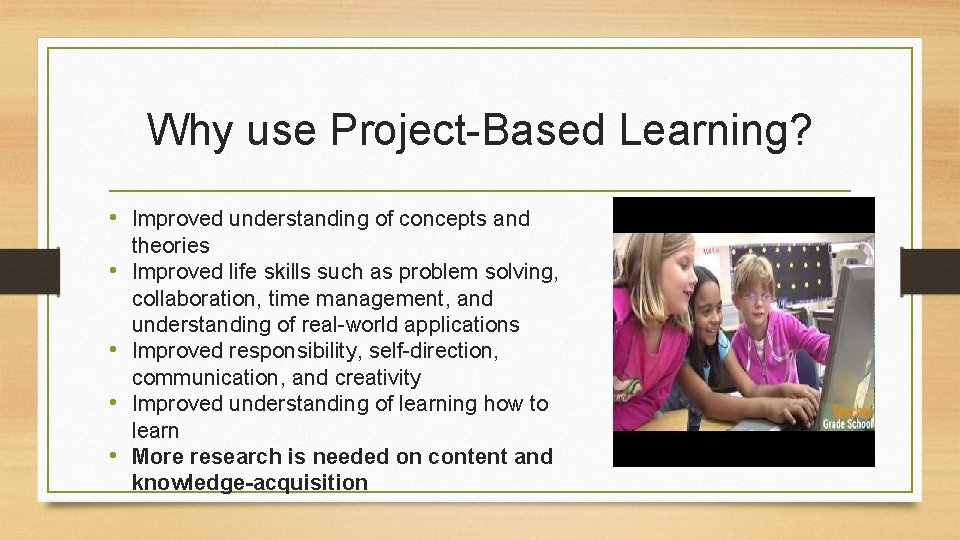
Why use Project-Based Learning? • Improved understanding of concepts and • • theories Improved life skills such as problem solving, collaboration, time management, and understanding of real-world applications Improved responsibility, self-direction, communication, and creativity Improved understanding of learning how to learn More research is needed on content and knowledge-acquisition
Gold Standard PBL: Teaching Practices • • Design and plan Align to standards Build the culture Manage activities Scaffold student learning Assess student learning Engage and coach
Sample PBL Projects • A group of Engineering students developed a playground design for a local elementary school • A group of Biology students tested water quality in California and educated the public about improving water quality • A group of Chemical Engineering students developed a plan to evaluate Texas distillation practices and policies • A group of Introduction to Research students conducted a needs assessment and evaluated a community-based organization • A group of College of Education students developed a plan to improve a Parent Teacher Association (PTA)
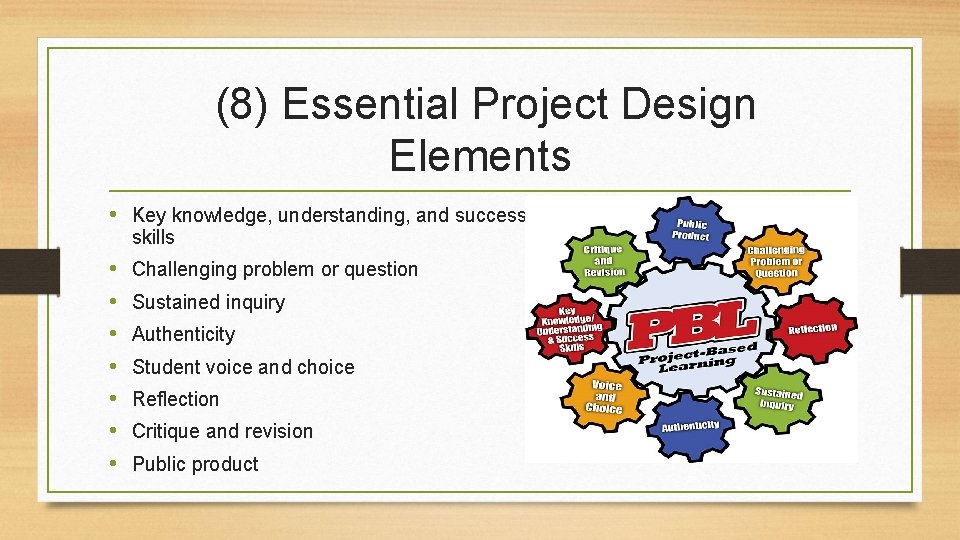
(8) Essential Project Design Elements • Key knowledge, understanding, and success skills • • Challenging problem or question Sustained inquiry Authenticity Student voice and choice Reflection Critique and revision Public product

Essential Project Design Elements • (1) Key knowledge and understanding • Application to real world experiences • Create high quality public products • (1) Key success or 21 st Century skills • • Critical thinking Problem-solving Collaboration Self-management
Project Design Elements • (2) Challenging problem or question • Open-ended, engaging, and ability to investigate (e. g. , “How do you find the soul of the community and translate it into your design? ”) • (3) Sustained inquiry • Long-term, reflection, deep analysis, and identification of resources (e. g. , students visited a community center and conducted laboratory work for an entire semester)
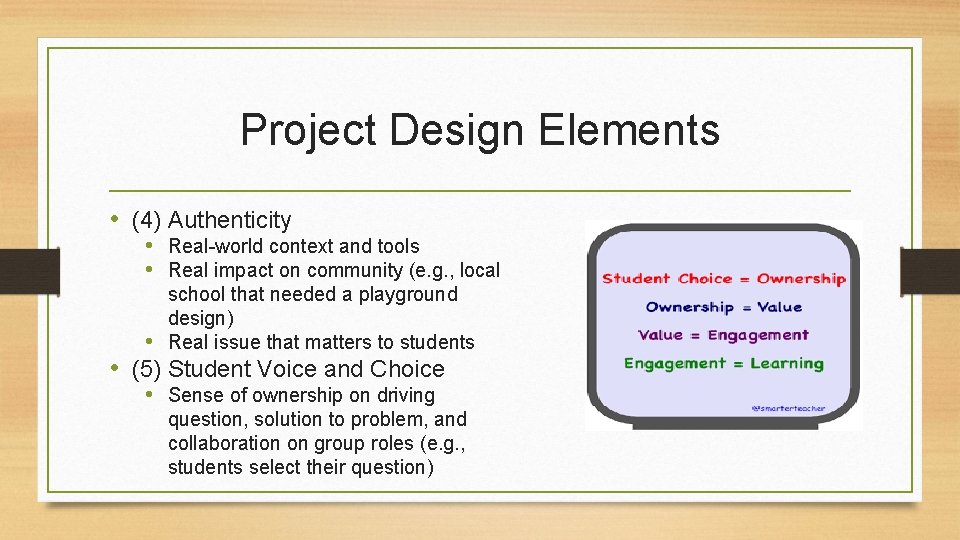
Project Design Elements • (4) Authenticity • Real-world context and tools • Real impact on community (e. g. , local school that needed a playground design) • Real issue that matters to students • (5) Student Voice and Choice • Sense of ownership on driving question, solution to problem, and collaboration on group roles (e. g. , students select their question)
Project Design Elements • (6) Reflection • What students are learning • How students are learning • The impact of what students are learning (e. g. , before, during, and after) • (7) Critique and Revision • Peer feedback (e. g. , students receive feedback on drafts, ideas, and final products) • (8) Public Product • Poster display with other students and administrators • Showcase learning experiences and impact on community (e. g. , students developed a playground design and presented plan to local school board)
Focus Activity • You have two options for this activity that will take 10 -minutes: • (1) Get into a group of 3 and make sure that all Essential Project Design Elements of somebody’s project are met. Make sure to address how your project meets or will meet each criterion. • (2) Get into a group of 3 and create a new project that meets all 8 Essential Project Design Elements Checklist. Make sure to address how your project will meet each criterion.
Final Remarks • Thank you for participating in this interactive workshop where we hope you met session objectives and developed a plan to apply what you learned. • Please complete evaluation questions about your learning experiences and level of satisfaction. • Please also take a look at “resources” on our website “utrgv. edu/cte” which will provide helpful and additional information.
References and Helpful Resources • Barak, M. , & Dori, Y. J. (2005). Enhancing undergraduate students’ chemistry understanding through project-based learning in an IT environment. Science Education, 89, 117 -139. • Buck Institute for Education (2015). Gold standard PBL: Project based teaching practices. • Hall, W. , Palmer, S. , & Bennet, M. (2012). A longitudinal evaluation of a project-based learning initiative in an engineering undergraduate programs. European Journal of Engineering Education, 37, 155 -165. • Krauss, J. , & Boss, S. (2013). Thinking through project based learning: Guiding deeper inquiry. Thousand Oaks, CA: Corwin. • Wallace, M. F. G. , & Webb, A. W. (2016). In the midst of a shift: Undergraduate STEM education and “PBL” enactment. Journal of College Science Teaching, 46, 47 -55. • Wurdinger, S. , & Qureshi, M. (2015). Enhancing college students’ life skills through project based learning. Innovative Higher Education, 40, 279 -286.
- Slides: 15