
Project X Collaboration Meeting LBNL PXIE RFQ Engineering
Project X Collaboration Meeting @ LBNL PXIE RFQ Engineering Design Steve Virostek Engineering Division Lawrence Berkeley National Laboratory April 10, 2012
Topics • LBNL RFQ experience • PXIE RFQ design approach • PXIE RFQ design details • Thermal, RF and mechanical analyses • Current progress • Upcoming tasks S. Virostek: PXIE RFQ Engineering Design Project X Collaboration Meeting, Berkeley, CA April 10, 2012
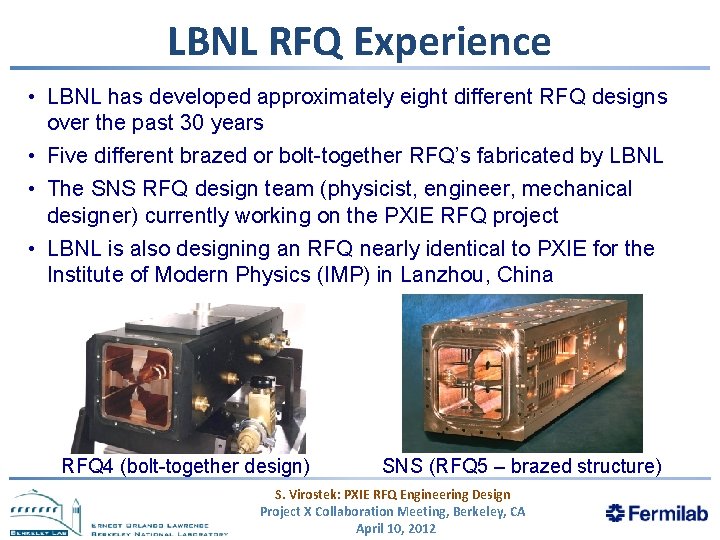
LBNL RFQ Experience • LBNL has developed approximately eight different RFQ designs over the past 30 years • Five different brazed or bolt-together RFQ’s fabricated by LBNL • The SNS RFQ design team (physicist, engineer, mechanical designer) currently working on the PXIE RFQ project • LBNL is also designing an RFQ nearly identical to PXIE for the Institute of Modern Physics (IMP) in Lanzhou, China RFQ 4 (bolt-together design) SNS (RFQ 5 – brazed structure) S. Virostek: PXIE RFQ Engineering Design Project X Collaboration Meeting, Berkeley, CA April 10, 2012
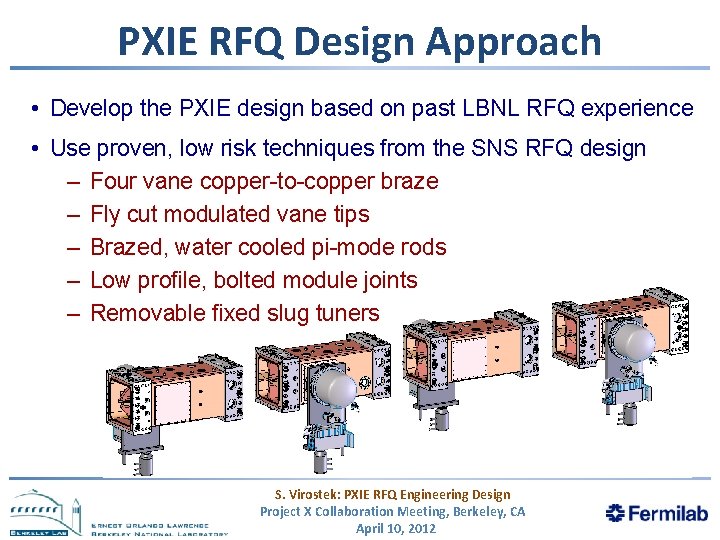
PXIE RFQ Design Approach • Develop the PXIE design based on past LBNL RFQ experience • Use proven, low risk techniques from the SNS RFQ design – Four vane copper-to-copper braze – Fly cut modulated vane tips – Brazed, water cooled pi-mode rods – Low profile, bolted module joints – Removable fixed slug tuners S. Virostek: PXIE RFQ Engineering Design Project X Collaboration Meeting, Berkeley, CA April 10, 2012
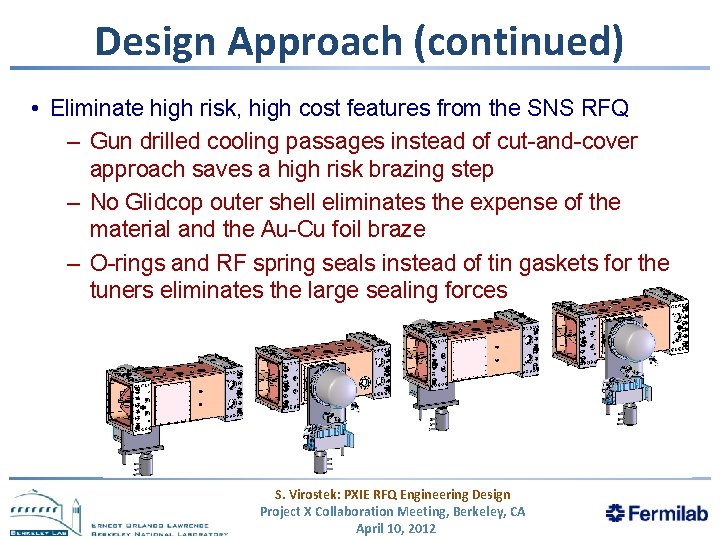
Design Approach (continued) • Eliminate high risk, high cost features from the SNS RFQ – Gun drilled cooling passages instead of cut-and-cover approach saves a high risk brazing step – No Glidcop outer shell eliminates the expense of the material and the Au-Cu foil braze – O-rings and RF spring seals instead of tin gaskets for the tuners eliminates the large sealing forces S. Virostek: PXIE RFQ Engineering Design Project X Collaboration Meeting, Berkeley, CA April 10, 2012
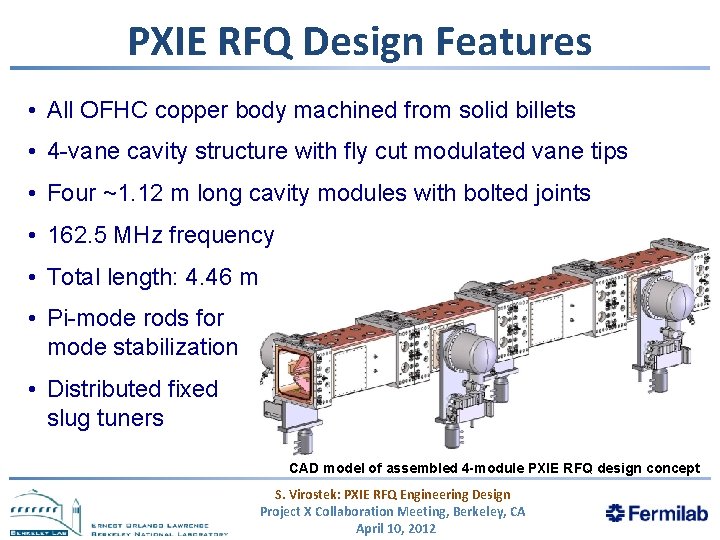
PXIE RFQ Design Features • All OFHC copper body machined from solid billets • 4 -vane cavity structure with fly cut modulated vane tips • Four ~1. 12 m long cavity modules with bolted joints • 162. 5 MHz frequency • Total length: 4. 46 m • Pi-mode rods for mode stabilization • Distributed fixed slug tuners CAD model of assembled 4 -module PXIE RFQ design concept S. Virostek: PXIE RFQ Engineering Design Project X Collaboration Meeting, Berkeley, CA April 10, 2012
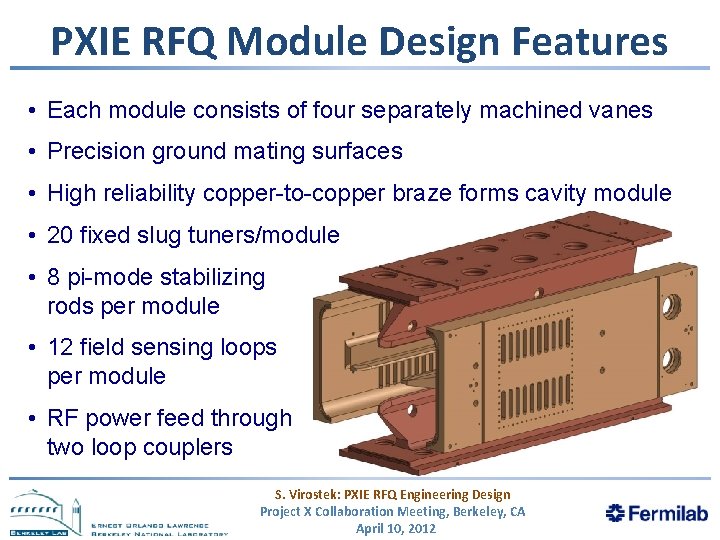
PXIE RFQ Module Design Features • Each module consists of four separately machined vanes • Precision ground mating surfaces • High reliability copper-to-copper braze forms cavity module • 20 fixed slug tuners/module • 8 pi-mode stabilizing rods per module • 12 field sensing loops per module • RF power feed through two loop couplers S. Virostek: PXIE RFQ Engineering Design Project X Collaboration Meeting, Berkeley, CA April 10, 2012
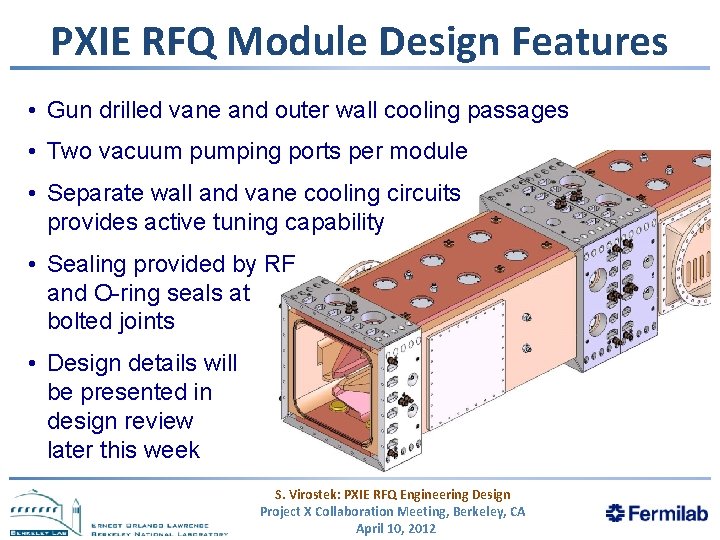
PXIE RFQ Module Design Features • Gun drilled vane and outer wall cooling passages • Two vacuum pumping ports per module • Separate wall and vane cooling circuits provides active tuning capability • Sealing provided by RF and O-ring seals at bolted joints • Design details will be presented in design review later this week S. Virostek: PXIE RFQ Engineering Design Project X Collaboration Meeting, Berkeley, CA April 10, 2012
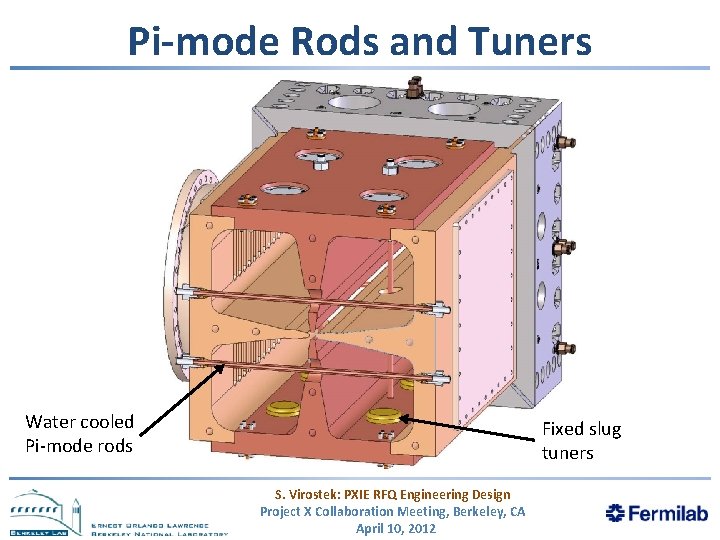
Pi-mode Rods and Tuners Water cooled Pi‐mode rods Fixed slug tuners S. Virostek: PXIE RFQ Engineering Design Project X Collaboration Meeting, Berkeley, CA April 10, 2012
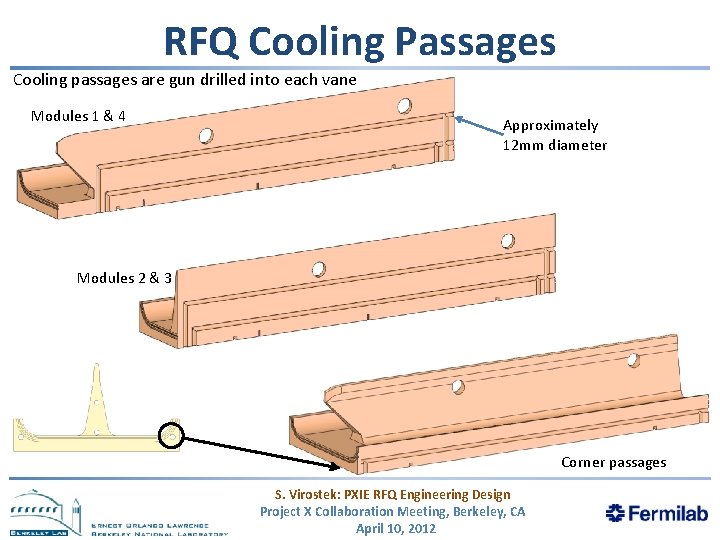
RFQ Cooling Passages Cooling passages are gun drilled into each vane Modules 1 & 4 Approximately 12 mm diameter Modules 2 & 3 Corner passages S. Virostek: PXIE RFQ Engineering Design Project X Collaboration Meeting, Berkeley, CA April 10, 2012
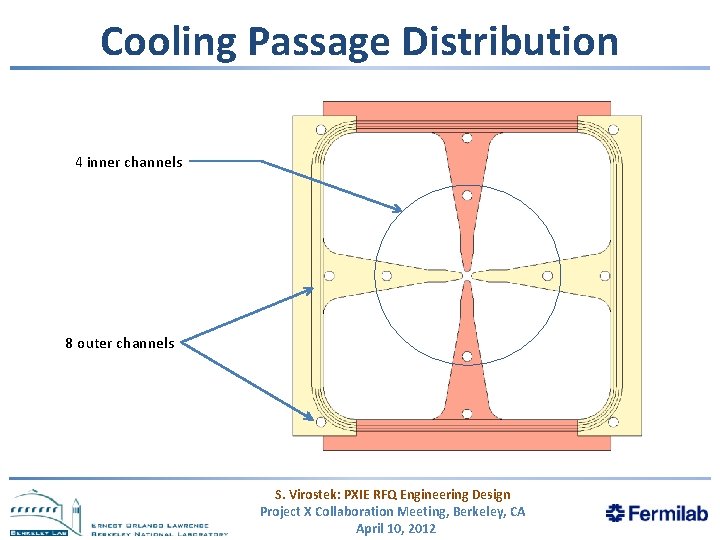
Cooling Passage Distribution 4 inner channels 8 outer channels S. Virostek: PXIE RFQ Engineering Design Project X Collaboration Meeting, Berkeley, CA April 10, 2012
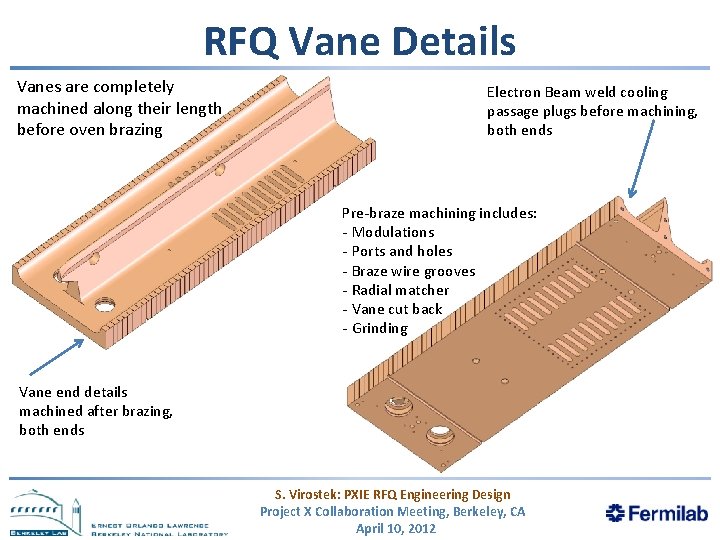
RFQ Vane Details Vanes are completely machined along their length before oven brazing Electron Beam weld cooling passage plugs before machining, both ends Pre‐braze machining includes: ‐ Modulations ‐ Ports and holes ‐ Braze wire grooves ‐ Radial matcher ‐ Vane cut back ‐ Grinding Vane end details machined after brazing, both ends S. Virostek: PXIE RFQ Engineering Design Project X Collaboration Meeting, Berkeley, CA April 10, 2012
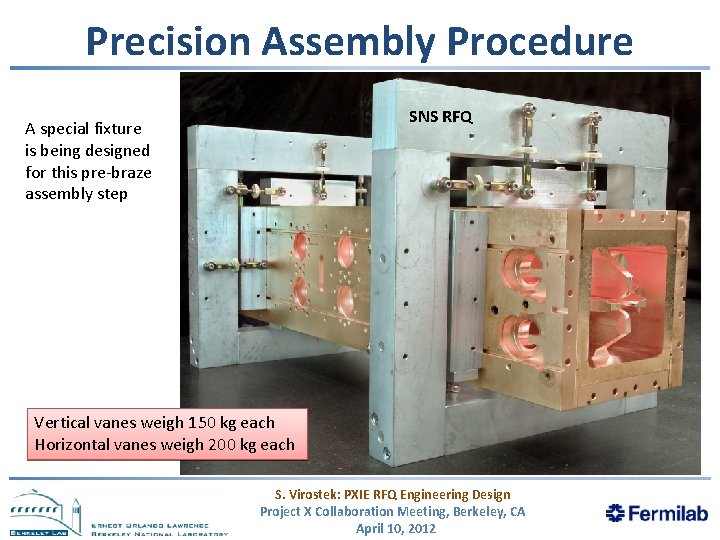
Precision Assembly Procedure SNS RFQ A special fixture is being designed for this pre‐braze assembly step Vertical vanes weigh 150 kg each Horizontal vanes weigh 200 kg each S. Virostek: PXIE RFQ Engineering Design Project X Collaboration Meeting, Berkeley, CA April 10, 2012
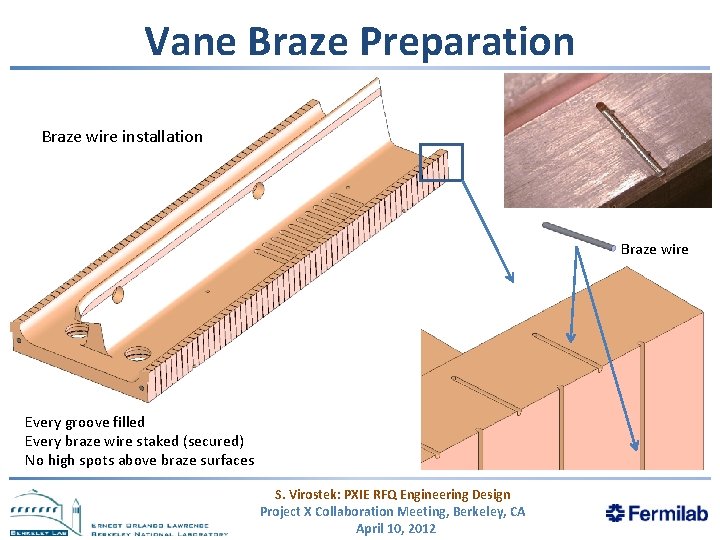
Vane Braze Preparation Braze wire installation Braze wire Every groove filled Every braze wire staked (secured) No high spots above braze surfaces S. Virostek: PXIE RFQ Engineering Design Project X Collaboration Meeting, Berkeley, CA April 10, 2012
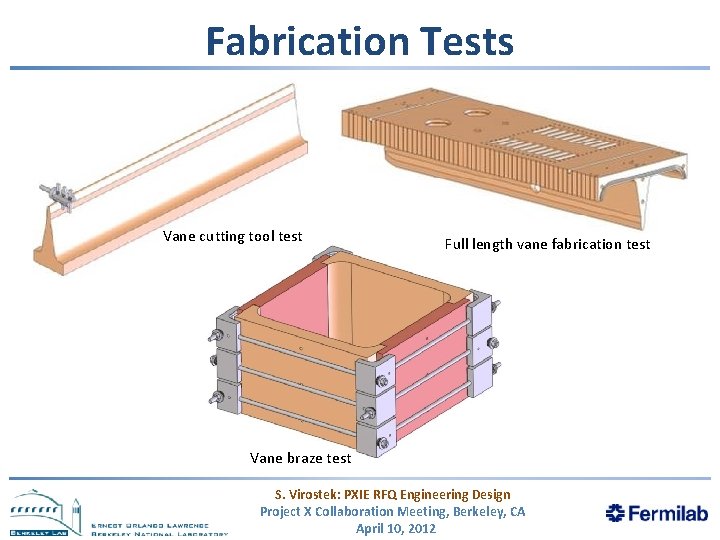
Fabrication Tests Vane cutting tool test Full length vane fabrication test Vane braze test S. Virostek: PXIE RFQ Engineering Design Project X Collaboration Meeting, Berkeley, CA April 10, 2012
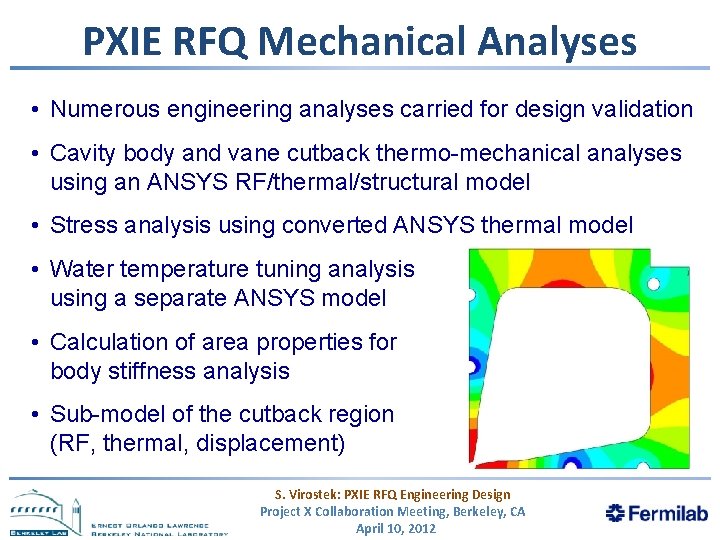
PXIE RFQ Mechanical Analyses • Numerous engineering analyses carried for design validation • Cavity body and vane cutback thermo-mechanical analyses using an ANSYS RF/thermal/structural model • Stress analysis using converted ANSYS thermal model • Water temperature tuning analysis using a separate ANSYS model • Calculation of area properties for body stiffness analysis • Sub-model of the cutback region (RF, thermal, displacement) S. Virostek: PXIE RFQ Engineering Design Project X Collaboration Meeting, Berkeley, CA April 10, 2012
Current Progress § RFQ engineering design nearly complete - finalize with input from upcoming design review • Accurate 3 D CAD model of 4 -module RFQ is complete • Model includes: vanes w/gun drilled passages, pi-mode rods, tuner ports, vacuum ports, sensing loop ports, RF drive ports • Model contains detail necessary to generate fab drawings § Preliminary design of RFQ related subsystems is complete • RFQ cooling scheme (body, cutbacks, pi-mode rods) • RFQ vacuum system configuration (analysis TBD) § Fabrication tests designed and under way § Thermal, RF and mechanical analyses are nearly complete S. Virostek: PXIE RFQ Engineering Design Project X Collaboration Meeting, Berkeley, CA April 10, 2012
Additional Engineering Tasks § Carry out fabrication tests (at LBNL and IMP-Lanzhou) • Write engineering notes describing the test procedures • Procure all necessary material § Perform additional analyses • Vacuum system analysis • Tuner RF/heating analysis • Final RFQ support points – stress and deflection analysis § Complete final version of the RFQ 3 D CAD model (close) § Generate complete set of multi-step fabrication drawings § Write a detailed engineering notes to document the final RFQ design and the results of the analyses S. Virostek: PXIE RFQ Engineering Design Project X Collaboration Meeting, Berkeley, CA April 10, 2012
- Slides: 18