
Project Workshops Presentations 1 Why is Presentation important
- Slides: 20
Project Workshops Presentations
1. Why is Presentation important? • Whatever profession you enter after graduation, you will have to stand on your feet regularly and present material to an audience. • This can be nerve-wracking if you have not had any experience of it beforehand. • This is the time for you to gain some experience. • In this project, you will have to give presentations to staff and fellow students. 2
2. Types of Presentation Three types: 1. Bench test (Week 10) • To the supervisor 2. Classroom presentation (Weeks 11 -12) • In front of students and examiners 3. Oral examination (Weeks 21 -22) • To the examiners 3
3. Preparing for the Presentation • Background information about the presentation • Preparing the contents • Formatting the presentation slides • Different types of presentation 4
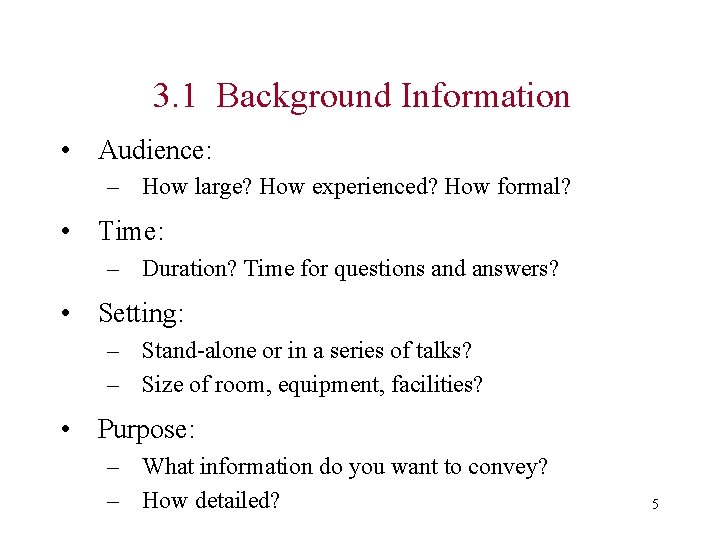
3. 1 Background Information • Audience: – How large? How experienced? How formal? • Time: – Duration? Time for questions and answers? • Setting: – Stand-alone or in a series of talks? – Size of room, equipment, facilities? • Purpose: – What information do you want to convey? – How detailed? 5
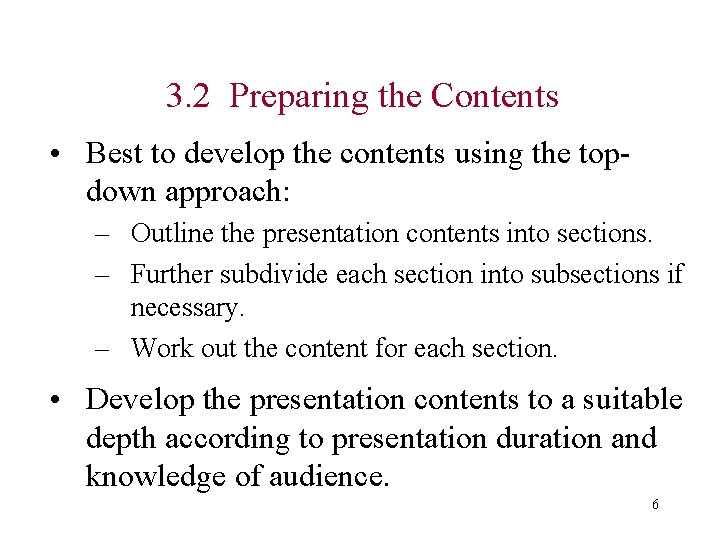
3. 2 Preparing the Contents • Best to develop the contents using the topdown approach: – Outline the presentation contents into sections. – Further subdivide each section into subsections if necessary. – Work out the content for each section. • Develop the presentation contents to a suitable depth according to presentation duration and knowledge of audience. 6
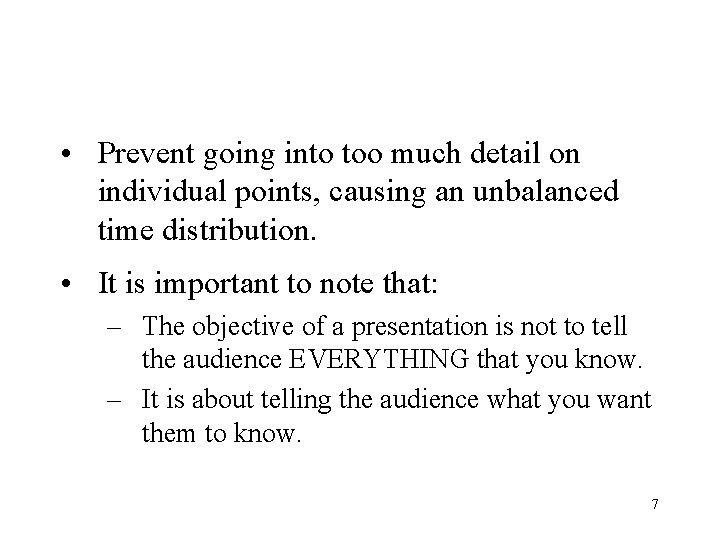
• Prevent going into too much detail on individual points, causing an unbalanced time distribution. • It is important to note that: – The objective of a presentation is not to tell the audience EVERYTHING that you know. – It is about telling the audience what you want them to know. 7
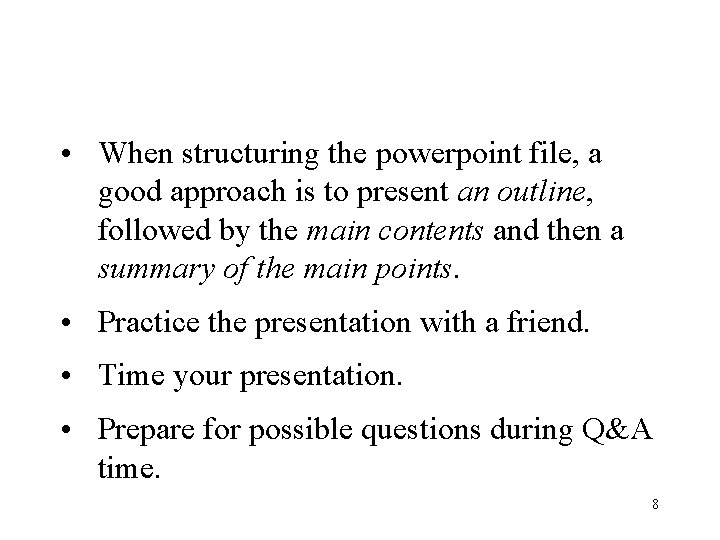
• When structuring the powerpoint file, a good approach is to present an outline, followed by the main contents and then a summary of the main points. • Practice the presentation with a friend. • Time your presentation. • Prepare for possible questions during Q&A time. 8
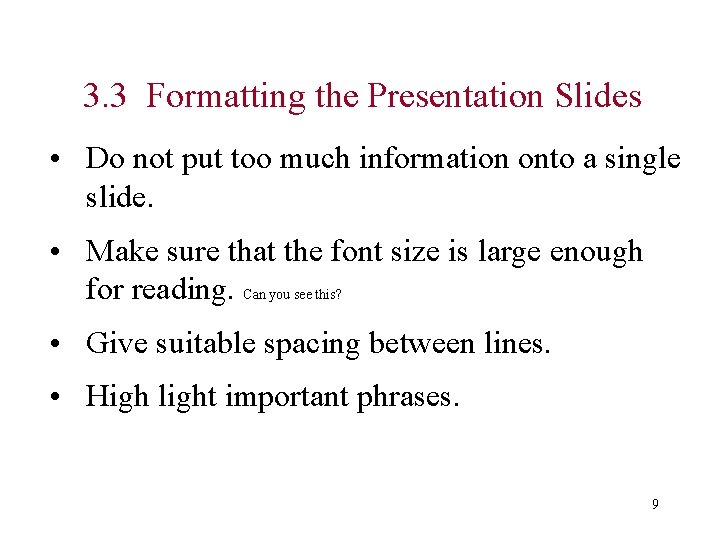
3. 3 Formatting the Presentation Slides • Do not put too much information onto a single slide. • Make sure that the font size is large enough for reading. Can you see this? • Give suitable spacing between lines. • High light important phrases. 9
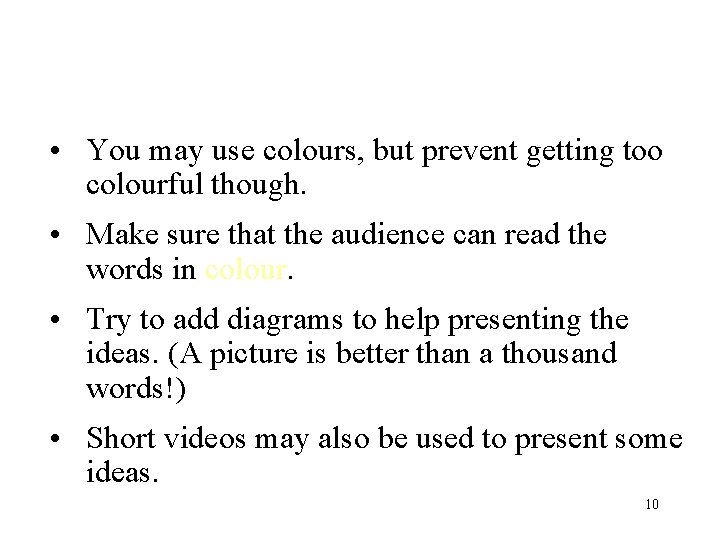
• You may use colours, but prevent getting too colourful though. • Make sure that the audience can read the words in colour. • Try to add diagrams to help presenting the ideas. (A picture is better than a thousand words!) • Short videos may also be used to present some ideas. 10
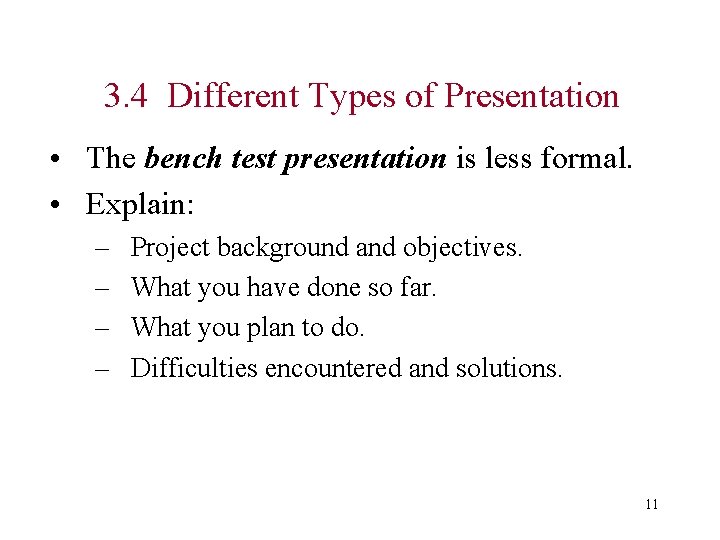
3. 4 Different Types of Presentation • The bench test presentation is less formal. • Explain: – – Project background and objectives. What you have done so far. What you plan to do. Difficulties encountered and solutions. 11
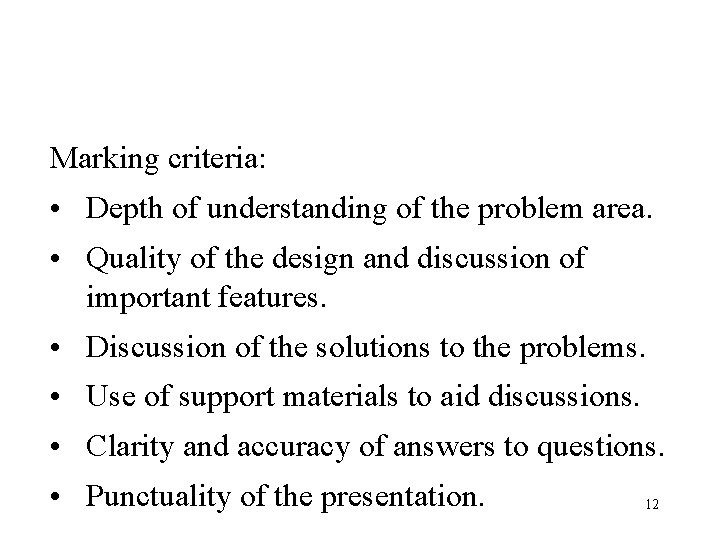
Marking criteria: • Depth of understanding of the problem area. • Quality of the design and discussion of important features. • Discussion of the solutions to the problems. • Use of support materials to aid discussions. • Clarity and accuracy of answers to questions. • Punctuality of the presentation. 12
• The classroom presentation is somewhat formal, in front of a group of students and examiners. • Explain: – – – Project background and objectives. Highlight of relevant work. What you have done so far. Results to date. What you plan to do. 13
Marking criteria: • Similar to those for the bench test. Note that: • Everyone in the room may ask questions. 14
• The oral examination is a formal presentation, in front of two examiners. • Maximum 30 mins (including Q&A) to explain: – – – Project background and objectives. Brief summary of relevant work. The work that you have done. Demonstration of results. Brief project evaluations. 15
Marking criteria: • Clarity of the presentation. • Use of support materials to aid discussions. • Clarity and accuracy of answers to questions. • Punctuality of the presentation. Although the quality of the work is not considered here, it will affect report marking. 16
4. During the Presentation • Try to avoid reading from notes – use summary cards or key notes. • Speak to the audience instead of the screen. • Prevent looking at a particular person all the time during a group presentation. • Try to keep a smile throughout the presentation. 17
• DO NOT overrun your presentation. • If you run out of time, do not try to speak twice as fast. Simply summarize what you are going to say. • If you are asked a question, think before you answer. • Do not bluff if you do not know the answer, as you may get yourself into even more troubles. 18
• Instead of just saying you do not know the answer, a good way to reply is something like “…this is a good question. Although I am not sure the answer, I guess…<a guessed answer>…. because…<justification of the guess>…” • Present your work with enthusiasm. No one would be interested in your work if you do not. 19
Further Reading A number of papers available on giving talks: • S. Peyton-Jones, J. Hughes, and J. Launchbury, “How to give a good research talk, ” ACM SIGPLAN Notices, 28(11): 9 -12, Nov 1993. • I. Parberry, “How to Present a Paper in Theoretical Computer Science, ” Bulletin of the EATCS, (37), pp. 344 -349, 1989. • www. onr. navy. mil/about/speaking_tips • www. presentersonline. com 20