
Project Vacuum Cleaner FINAL PRESENTATION SUBMITTED TO THE

Project «Vacuum Cleaner» FINAL PRESENTATION SUBMITTED TO THE SANYO Electric Co. Ltd. PRESENTED BY Institute of Innovative Design Terms: Beginning: Completion: January 01 2003 March 31 2003

Object of Analysis Vacuum cleaner SC-JT 8 D
Main Function To capture and to move dust by airflow.
Project Goals Main Goal To develop the design of cleaning system that drastically reduce the distracting noise from 62 d. B(A) to 49 db(A) or less by using TRIZ technology.
Restrictions Desirable level of results of the project - a degree of allowable changes of object: Level E. Forecasting - is not present any restrictions, down to replacement of the physical principle.

Innovative Technology of Design Data Gathering Background information Analysis of the Object Functional and Flow models, Evolution Trends, Key Disadvantages, Contradictions Problem Statement Trimming problems, Feature transfer problems, Key problems Function Based Information Gathering ANALYTICAL STAGE Function oriented information Problem Solution Engineering Solutions Supporting Information Gathering Supporting information INFORMATION STAGE Concept substantiation Concepts, Ideas for Further Development CONCEPTUAL STAGE
INFORMATION STAGE

Processing Information stage Info 1 Source information Info 2 Scientific (basic) information Info 4 Support information Info 3 Functional information Analytical stage Conceptual stage Key problems Concepts Legend: Information reply Information request

Information Search Types of Information Used INFORMATION Info 1 INFORMATION SOURCE Ø INITIAL INFORMATION FROM CUSTOMER (DIAGRAMS, SAMPLES, ETC. ) Ø DATA OF COMPETITORS PRODUCTION Info 2 SCIENTIFIC (BASIC) INFORMATION Ø BASIC SCIENTIFIC PRINCIPLES OF OBJECT ACTION (PHYSICAL, CHEMICAL, GEOMETRICAL, BIOLOGICAL) Ø OBJECT EVOLUTION Ø PARAMETERS CHARACTERIZING THE OBJECT AND ITS COMPONENTS Info 3 FUNCTIONAL INFORMATION Ø LEADING AREAS OF ENGINEERING Ø ENGINEERING DEVELOPMENTS AND THEIR COMPONENTS (EQUIPMENT, MATERIALS, ETC. I. E. DATA FORMULATION OF FUNCTIONS) Ø RESOURCES FOR STATED KEY PROBLEMS SOLVING Info 4 SUPPORTING INFORMATION Ø INFORMATION ON SPECIFIC CONCEPTS Ø SCIENTIFIC BASIS, CALCULATIONS Ø REFERENCES
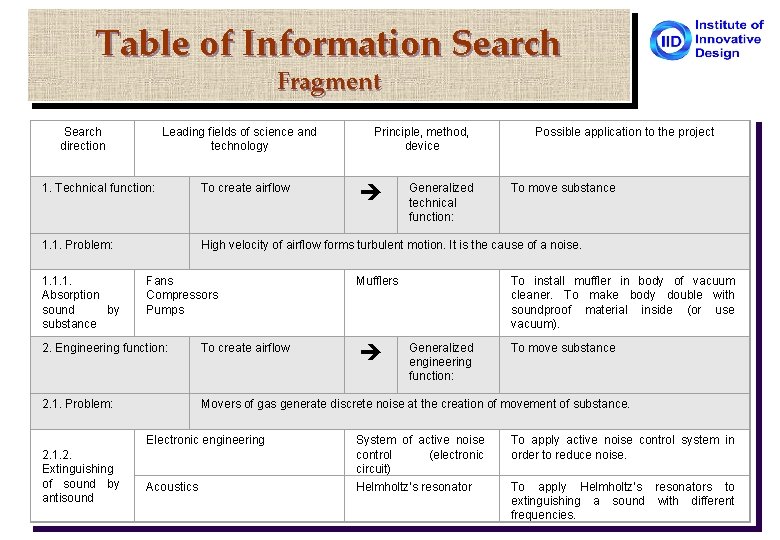
Table of Information Search Fragment Search direction Leading fields of science and technology Principle, method, device 1. Technical function: To create airflow 1. 1. Problem: High velocity of airflow forms turbulent motion. It is the cause of a noise. 1. 1. 1. Fans Absorption Compressors sound by Pumps substance 2. Engineering function: To create airflow 2. 1. Problem: 2. 1. 2. Extinguishing of sound by antisound Generalized technical function: Possible application to the project Mufflers To move substance To install muffler in body of vacuum cleaner. To make body double with soundproof material inside (or use vacuum). Generalized engineering function: To move substance Movers of gas generate discrete noise at the creation of movement of substance. Electronic engineering Acoustics System of active noise control (electronic circuit) Helmholtz’s resonator To apply active noise control system in order to reduce noise. To apply Helmholtz’s resonators to extinguishing a sound with different frequencies.
Analytical Stage
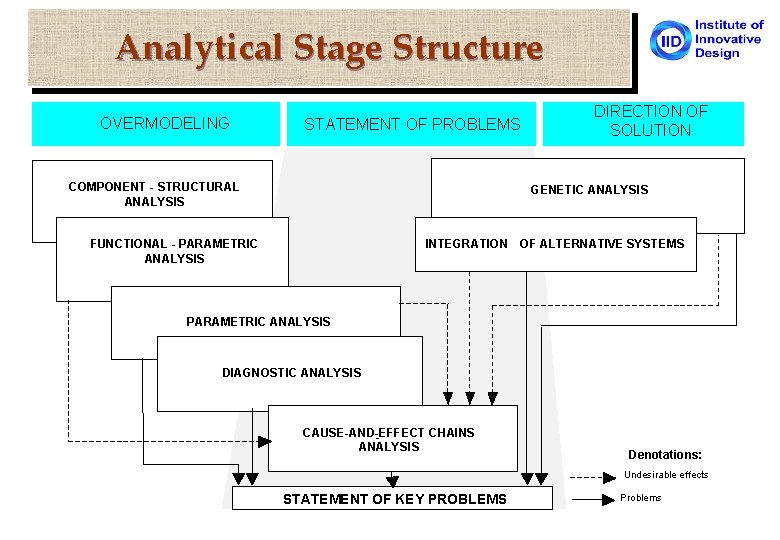
Analytical Stage Structure OVERMODELING STATEMENT OF PROBLEMS COMPONENT - STRUCTURAL ANALYSIS DIRECTION OF SOLUTION GENETIC ANALYSIS FUNCTIONAL - PARAMETRIC ANALYSIS INTEGRATION OF ALTERNATIVE SYSTEMS PARAMETRIC ANALYSIS DIAGNOSTIC ANALYSIS CAUSE-AND-EFFECT CHAINS ANALYSIS Denotations: Undesirable effects STATEMENT OF KEY PROBLEMS Problems
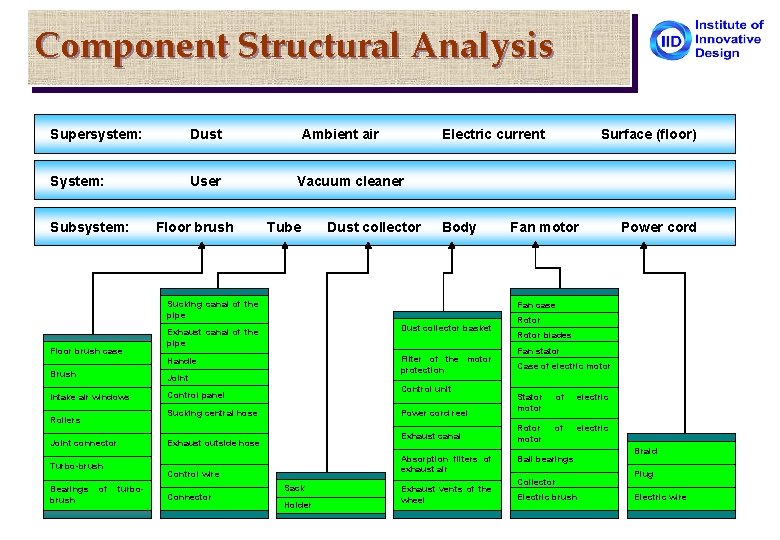
Component Structural Analysis Supersystem: Dust System: User Subsystem: Floor brush Ambient air Electric current Vacuum cleaner Tube Dust collector Body Sucking canal of the pipe Floor brush case Dust collector basket Handle Filter of the motor protection Joint Intake air windows Control panel Joint connector Power cord reel of Exhaust canal Exhaust outside hose Turbo-brush Bearings brush Control unit Sucking central hose Rollers Absorption filters of exhaust air Control wire turbo- Connector Fan motor Power cord Fan case Exhaust canal of the pipe Brush Surface (floor) Sack Holder Exhaust vents of the wheel Rotor blades Fan stator Case of electric motor Stator motor of electric Rotor motor of electric Ball bearings Collector Electric brush Braid Plug Electric wire
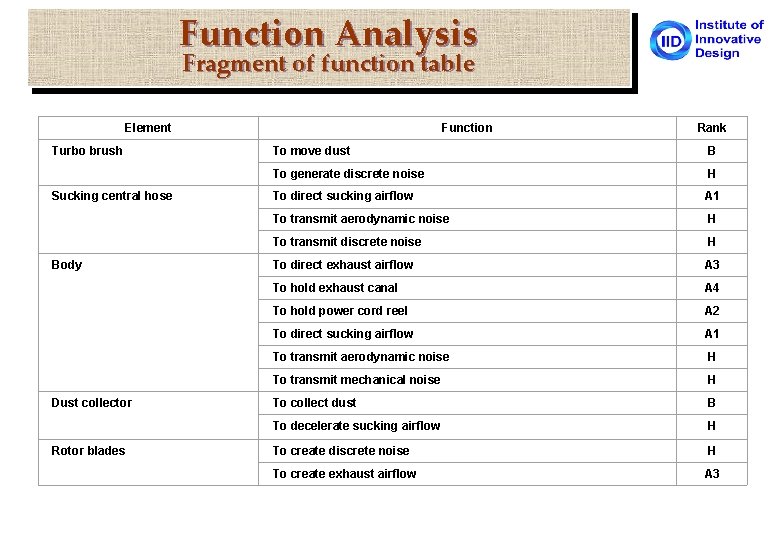
Function Analysis Fragment of function table Element Turbo brush Sucking central hose Body Dust collector Rotor blades Function Rank To move dust B To generate discrete noise H To direct sucking airflow A 1 To transmit aerodynamic noise H To transmit discrete noise H To direct exhaust airflow A 3 To hold exhaust canal A 4 To hold power cord reel A 2 To direct sucking airflow A 1 To transmit aerodynamic noise H To transmit mechanical noise H To collect dust B To decelerate sucking airflow H To create discrete noise H To create exhaust airflow A 3
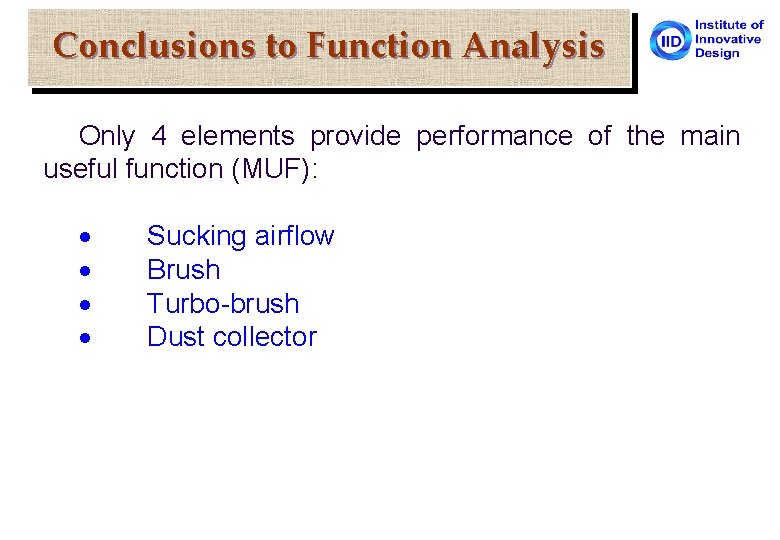
Conclusions to Function Analysis Only 4 elements provide performance of the main useful function (MUF): · Sucking airflow · Brush · Turbo-brush · Dust collector
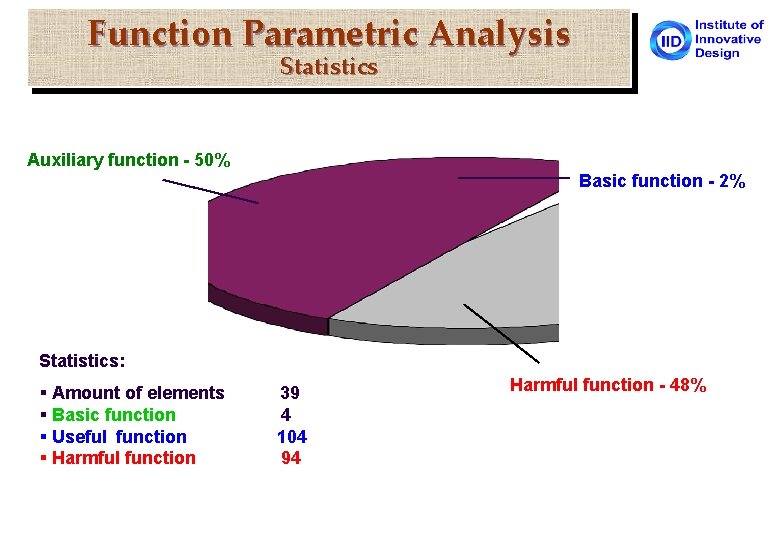
Function Parametric Analysis Statistics Auxiliary function - 50% Basic function - 2% Statistics: Amount of elements Basic function Useful function Harmful function 39 4 104 94 Harmful function - 48%
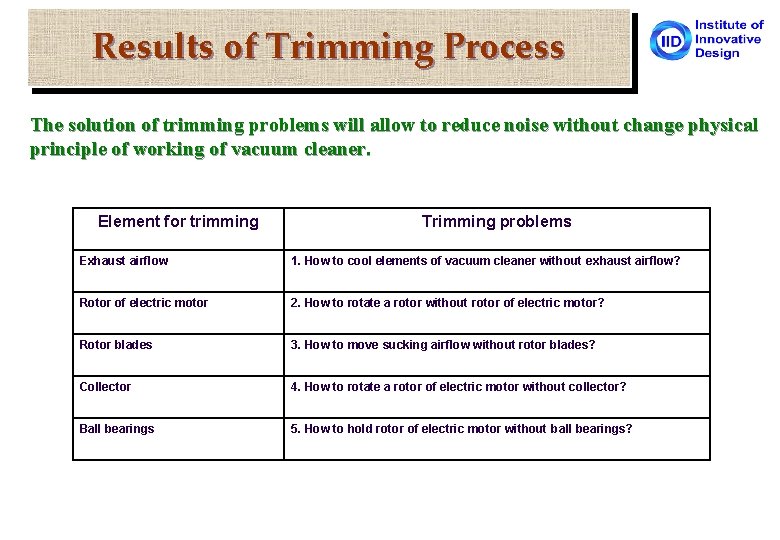
Results of Trimming Process The solution of trimming problems will allow to reduce noise without change physical principle of working of vacuum cleaner. Element for trimming Exhaust airflow Trimming problems 1. How to cool elements of vacuum cleaner without exhaust airflow? 28% Rotor of electric motor 2. How to rotate a rotor without rotor of electric motor? Rotor blades 3. How to move sucking airflow without rotor blades? Collector 4. How to rotate a rotor of electric motor without collector? Ball bearings 5. How to hold rotor of electric motor without ball bearings?
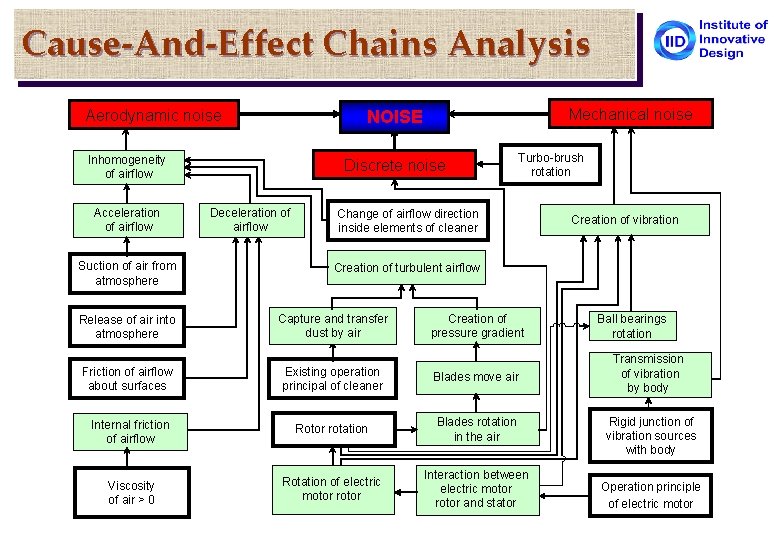
Cause-And-Effect Chains Analysis Aerodynamic noise Inhomogeneity of airflow Acceleration of airflow Suction of air from atmosphere Release of air into atmosphere Mechanical noise NOISE Discrete noise Deceleration of airflow Turbo-brush rotation Change of airflow direction inside elements of cleaner Creation of vibration Creation of turbulent airflow Capture and transfer dust by air Creation of pressure gradient Friction of airflow about surfaces Existing operation principal of cleaner Blades move air Internal friction of airflow Rotor rotation Blades rotation in the air Viscosity of air > 0 Rotation of electric motor rotor Interaction between electric motor rotor and stator Ball bearings rotation Transmission of vibration by body Rigid junction of vibration sources with body Operation principle of electric motor
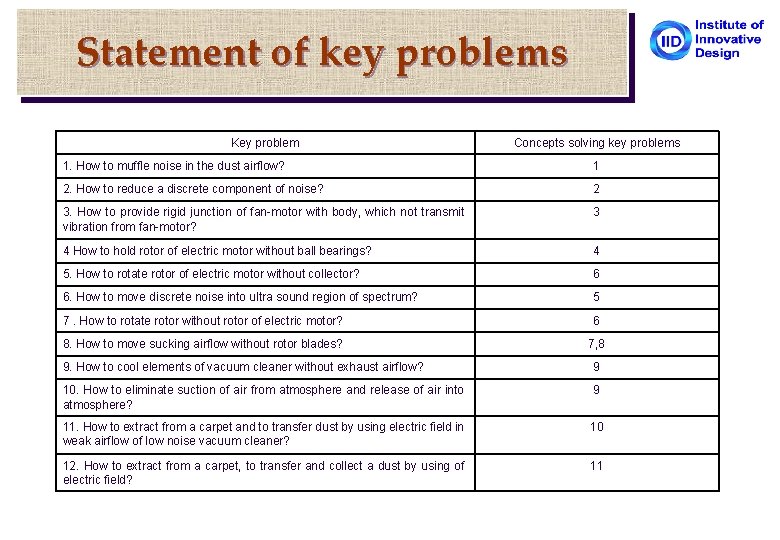
Statement of key problems Key problem Concepts solving key problems 1. How to muffle noise in the dust airflow? 1 2. How to reduce a discrete component of noise? 2 3. How to provide rigid junction of fan-motor with body, which not transmit vibration from fan-motor? 3 4 How to hold rotor of electric motor without ball bearings? 4 5. How to rotate rotor of electric motor without collector? 6 6. How to move discrete noise into ultra sound region of spectrum? 5 7. How to rotate rotor without rotor of electric motor? 6 8. How to move sucking airflow without rotor blades? 7, 8 9. How to cool elements of vacuum cleaner without exhaust airflow? 9 10. How to eliminate suction of air from atmosphere and release of air into atmosphere? 9 11. How to extract from a carpet and to transfer dust by using electric field in weak airflow of low noise vacuum cleaner? 10 12. How to extract from a carpet, to transfer and collect a dust by using of electric field? 11
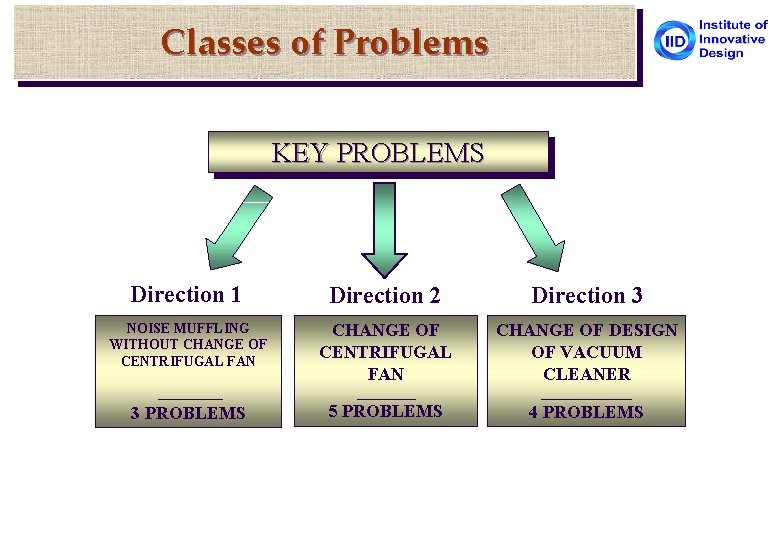
Classes of Problems KEY PROBLEMS Direction 1 Direction 2 Direction 3 NOISE MUFFLING WITHOUT CHANGE OF CENTRIFUGAL FAN CHANGE OF DESIGN OF VACUUM CLEANER _____________ 3 PROBLEMS 5 PROBLEMS 4 PROBLEMS
Conceptual Stage
Conceptual direction 1 NOISE MUFFLING WITHOUT CHANGE OF CENTRIFUGAL FAN The purpose of this direction: reduction of noise level without change of fanmotor. In concepts of the given direction fan-motor does not change, reduction of noise level is achieved by design methods with the minimal changes in system.
Concept 1 (A). Suppression of noise by the active muffler (Нelmgoltz’s resonator) 1. Sucking pipeline. 2. Handle. 3. Throat of Нelmgoltz’s resonator. 4. Нelmgoltz’s resonator. 5. System of fine tuning of Нelmg
Concept 1 (B). Suppression of noise by the active muffler (Нelmgoltz’s resonator) 1. Case of fan-motor. 2. Annular airline. 3. Resonators. 4. Fan-motor.
Concept 2. Reduction of the discrete component of noise by rotary shield. 1. Fan-motor. 2. Rotor. 3. Blades. 4. Case 5. Axis. 6. Support washer. 7. Grid. .
Concept 3. Rigid fastening of fan-motor with body of vacuum cleaner does not transmitting vibration. 1. Fan-motor. 2. Electromagnet. 3. Internal holder of fastening. 4. External holder of fastening. 5. Elastic cushions. 6. Condensing corrug
Conceptual direction 2 NOISE EXTINGUISHING WITH CHANGE OF FAN MOTOR. The purpose of this direction: reduction of noise level with change of fanmotor. In concepts of this direction reduction of noise is associated with the change of fan-motor.
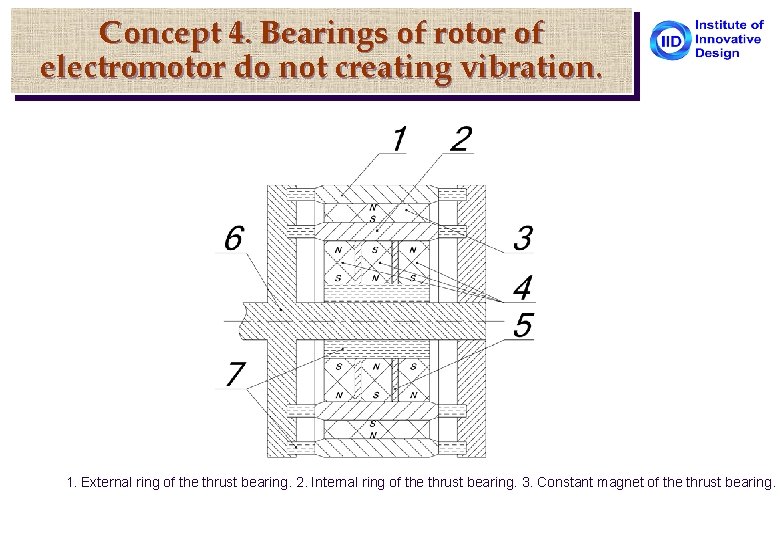
Concept 4. Bearings of rotor of electromotor do not creating vibration. 1. External ring of the thrust bearing. 2. Internal ring of the thrust bearing. 3. Constant magnet of the thrust bearing. 4
Concept 5. Application of ultrasonic siren increases sucking ability of the fan. 1. Rotor. 2. Admission stator. 3. Outlet stator. 4. Case.
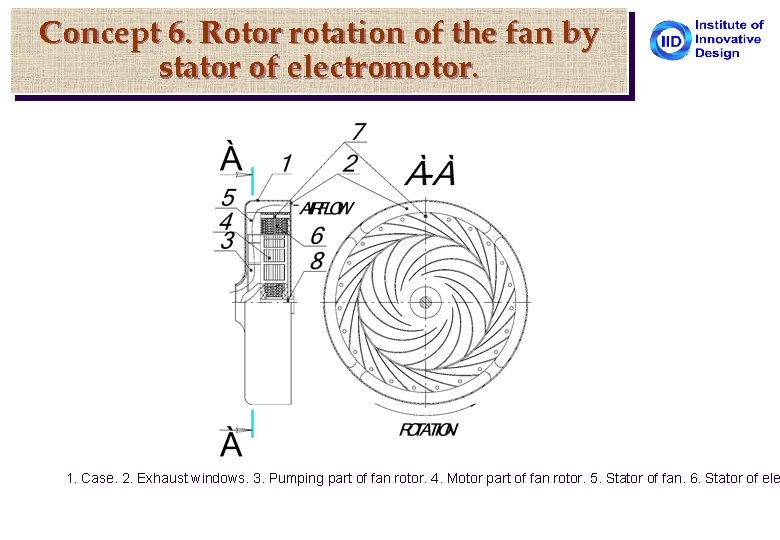
Concept 6. Rotor rotation of the fan by stator of electromotor. 1. Case. 2. Exhaust windows. 3. Pumping part of fan rotor. 4. Motor part of fan rotor. 5. Stator of fan. 6. Stator of ele

Concept 7. Bladeless disk-shaped fan. 1. Case. 2. Disks. 3. Joining grid. 4. Stator of the fan. 5. Shaft of electromotor.
Concept 8. Ejection vacuum cleaner. 1. Nozzle. 2. Dust collection room. 3. Ejector. 4. Gas-cylinder. 5. Compressor-motor. 6. Control unit. . 7. Air filter. 8. A
Conceptual direction 3 CHANGE OF DESIGN OF VACUUM CLEANER The purpose of the given direction: reduction of noise level associated with change of a design of vacuum cleaner. In concepts of the given direction reduction of noise level is achieved by change of design of a vacuum cleaner.
Concept 9. Vacuum cleaner not sucking and not exhausting ambient air. It is offered to change design not changing principle of operation in order to reduce noise of vacuum cleaner. Vacuum cleaner operates without release of air in environmental atmosphere. Air circulates inside the system (a body of vacuum cleaner - an airway - a floor brush - an airway – the body).
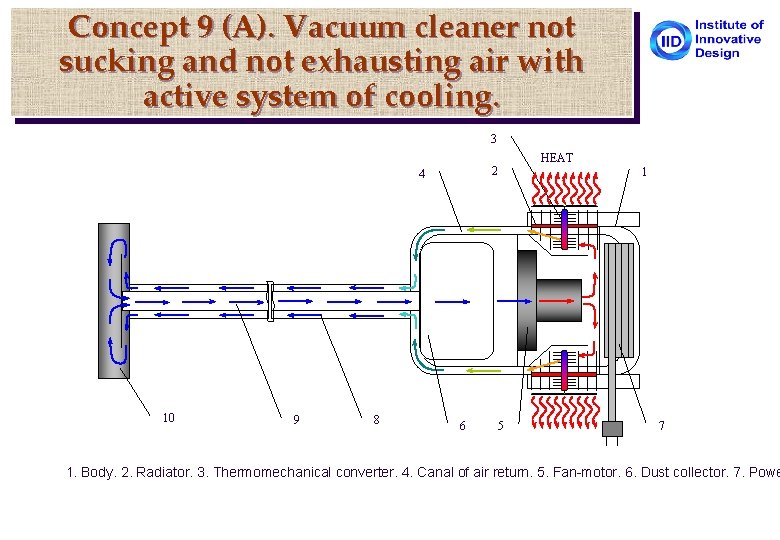
Concept 9 (A). Vacuum cleaner not sucking and not exhausting air with active system of cooling. 3 4 10 9 8 HEAT 2 6 1 5 7 1. Body. 2. Radiator. 3. Thermomechanical converter. 4. Canal of air return. 5. Fan-motor. 6. Dust collector. 7. Powe
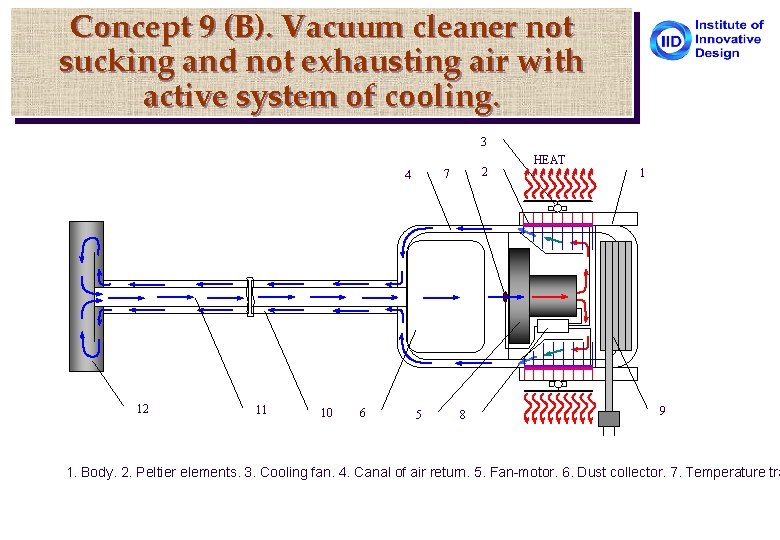
Concept 9 (B). Vacuum cleaner not sucking and not exhausting air with active system of cooling. 3 12 11 10 6 2 7 4 5 8 HEAT 1 9 1. Body. 2. Peltier elements. 3. Cooling fan. 4. Canal of air return. 5. Fan-motor. 6. Dust collector. 7. Temperature tra
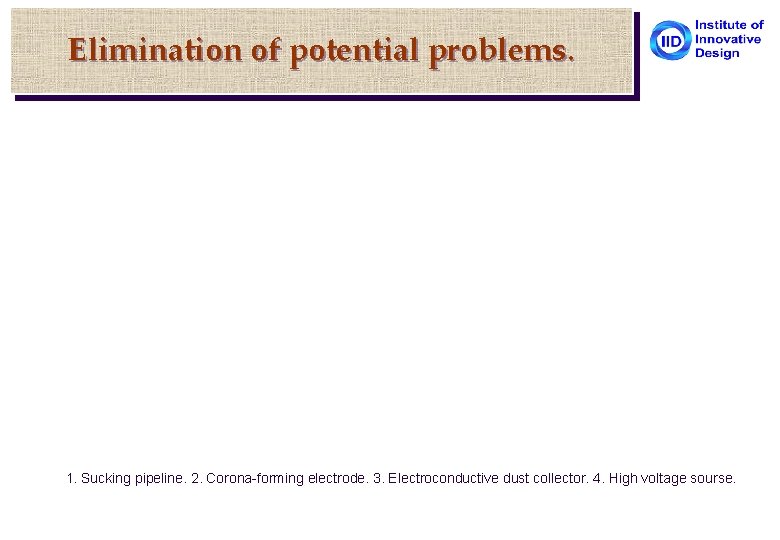
Elimination of potential problems. 1. Sucking pipeline. 2. Corona-forming electrode. 3. Electroconductive dust collector. 4. High voltage sourse.
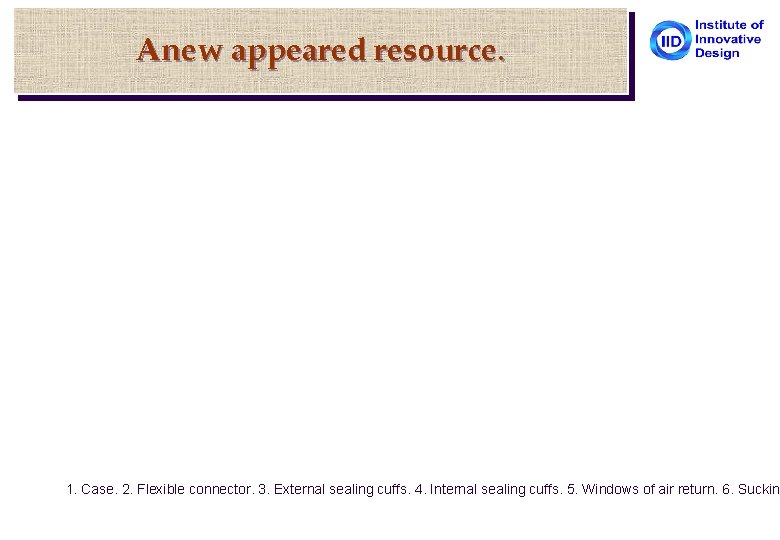
Anew appeared resource. 1. Case. 2. Flexible connector. 3. External sealing cuffs. 4. Internal sealing cuffs. 5. Windows of air return. 6. Sucking
Concept 10. Electrostatic vacuum cleaner. 1. Body of a vacuum cleaner. 2. Airway. 3. Wire of the high voltage. 4. The case of floor brush. 5. Corona-forming el
Concept 11. Electrostatic cleaner. 1. The case. 2. Rollers. 3. Brush neutralizer. 4. An axis. 5. A source of a high voltage. 6. Corona-forming electrode. 7
Ranking of concepts
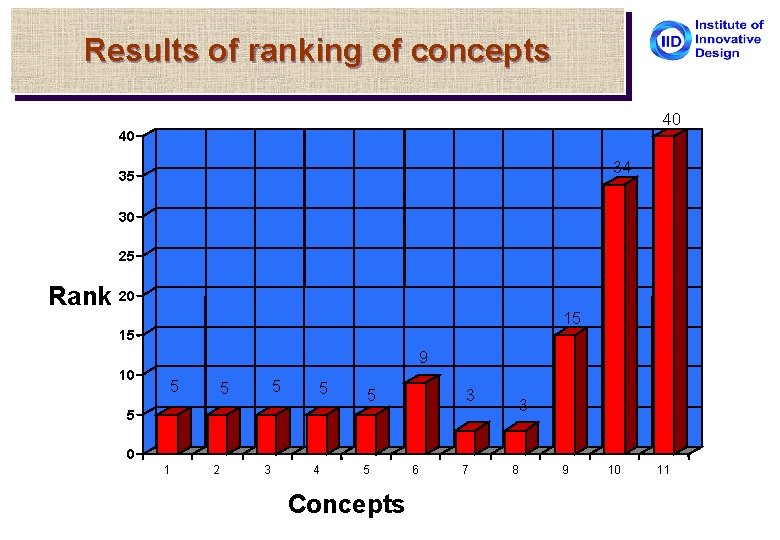
Results of ranking of concepts 40 40 34 35 30 25 Rank 20 15 15 9 10 5 5 5 3 3 5 0 1 2 3 4 5 Concepts 6 7 8 9 10 11
CONCLUSIONS 1. The three conceptual directions are detected and eleven concepts of perfecting of vacuum cleaner designed as a result of working on project. Concepts allow to reduce noise at operation of a vacuum cleaner according to requirements of the Customer. 2. Ranking of designed concepts and multicriteria quantitative estimation of their efficiency is made. 3. The most perspective direction is Conceptual direction 3: Change of design of vacuum cleaner. This direction ensures maximal effect according to the purpose of the project. 4. The most perspective concept with maximal effect on the purpose of the project is Concept 11 Electrostatic cleaner.
- Slides: 43