
Project Update A Possible New RF FOIL for

Project Update: A Possible New RF FOIL for the VELO UPGRADE Ray Mountain, Sheldon Stone Syracuse University
RF FOIL (1) -- R&D PLAN Phase I Objective: Produce a quarter-length RF Foil prototype, incorporating all difficult design features needed. – Collaboration with CMA, Inc. (compositemirrors. com) – Develop a new high performance material, likely a multi-function nanocomposite material. A candidate formulation has been identified (X 0 ≈ ½ Al. Mg 3) – Develop processing procedures for the materials and structure shape – Optimize material and process parameters by series of coupon samples – Fabricate the ¼-length prototype, incorporating the foil surface, sides, and flange in one integrated piece (no sealing) – Test and evaluate performance characteristics, including metrology, thickness uniformity, vacuum permeability, etc. – Build “accelerator simulator” as RF shielding test chamber (at SU) Evaluation Phase: Evaluate viability of prototype material and structure. Perform radiation damage testing, involve CERN LHC experts for determination of its operation in primary vacuum, etc. Phase II Objective: Design and fabricate real RF Foil for LHCb upgrade. Plan to begin Phase I in December, but awaiting funding decision (expected soon). . . R. Mountain, Syracuse University VELO Update, 5 Nov2009 -2 -

(extras) R. Mountain, Syracuse University VELO Update, 5 Nov2009 -3 -
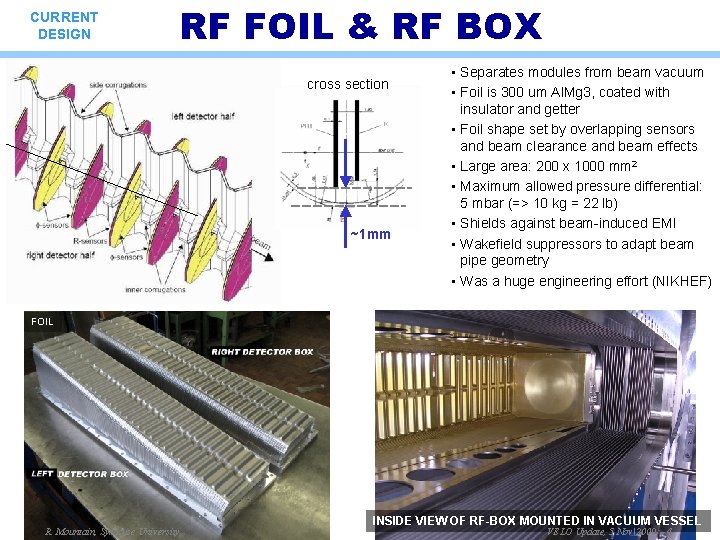
CURRENT DESIGN RF FOIL & RF BOX cross section ~1 mm • Separates modules from beam vacuum • Foil is 300 um Al. Mg 3, coated with insulator and getter • Foil shape set by overlapping sensors and beam clearance and beam effects • Large area: 200 x 1000 mm 2 • Maximum allowed pressure differential: 5 mbar (=> 10 kg = 22 lb) • Shields against beam-induced EMI • Wakefield suppressors to adapt beam pipe geometry • Was a huge engineering effort (NIKHEF) FOIL R. Mountain, Syracuse University INSIDE VIEW OF RF-BOX MOUNTED IN VACUUM VESSEL VELO Update, 5 Nov2009 -4 -
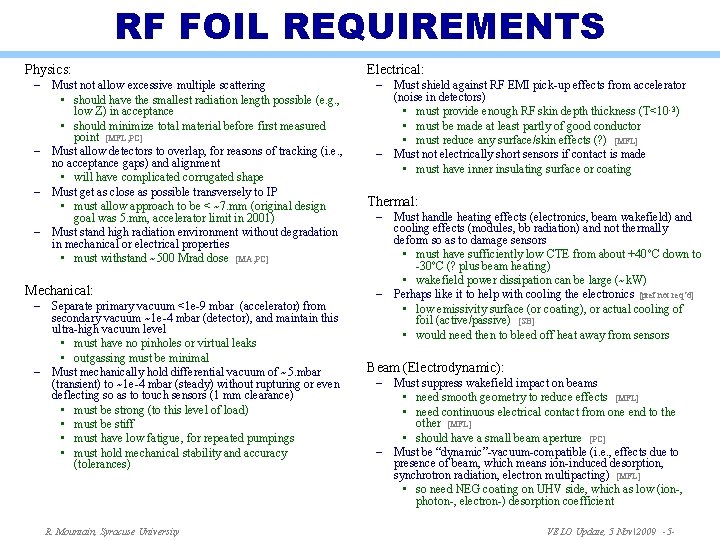
RF FOIL REQUIREMENTS Physics: – Must not allow excessive multiple scattering • should have the smallest radiation length possible (e. g. , low Z) in acceptance • should minimize total material before first measured point [MFL, PC] – Must allow detectors to overlap, for reasons of tracking (i. e. , no acceptance gaps) and alignment • will have complicated corrugated shape – Must get as close as possible transversely to IP • must allow approach to be < ~7. mm (original design goal was 5. mm, accelerator limit in 2001) – Must stand high radiation environment without degradation in mechanical or electrical properties • must withstand ~500 Mrad dose [MA, PC] Mechanical: – Separate primary vacuum <1 e-9 mbar (accelerator) from secondary vacuum ~1 e-4 mbar (detector), and maintain this ultra-high vacuum level • must have no pinholes or virtual leaks • outgassing must be minimal – Must mechanically hold differential vacuum of ~5. mbar (transient) to ~1 e-4 mbar (steady) without rupturing or even deflecting so as to touch sensors (1 mm clearance) • must be strong (to this level of load) • must be stiff • must have low fatigue, for repeated pumpings • must hold mechanical stability and accuracy (tolerances) R. Mountain, Syracuse University Electrical: – Must shield against RF EMI pick-up effects from accelerator (noise in detectors) • must provide enough RF skin depth thickness (T<10 -3) • must be made at least partly of good conductor • must reduce any surface/skin effects (? ) [MFL] – Must not electrically short sensors if contact is made • must have inner insulating surface or coating Thermal: – Must handle heating effects (electronics, beam wakefield) and cooling effects (modules, bb radiation) and not thermally deform so as to damage sensors • must have sufficiently low CTE from about +40ºC down to -30ºC (? plus beam heating) • wakefield power dissipation can be large (~k. W) – Perhaps like it to help with cooling the electronics [pref not req’d] • low emissivity surface (or coating), or actual cooling of foil (active/passive) [SB] • would need then to bleed off heat away from sensors Beam (Electrodynamic): – Must suppress wakefield impact on beams • need smooth geometry to reduce effects [MFL] • need continuous electrical contact from one end to the other [MFL] • should have a small beam aperture [PC] – Must be “dynamic”-vacuum-compatible (i. e. , effects due to presence of beam, which means ion-induced desorption, synchrotron radiation, electron multipacting) [MFL] • so need NEG coating on UHV side, which as low (ion-, photon-, electron-) desorption coefficient VELO Update, 5 Nov2009 -5 -
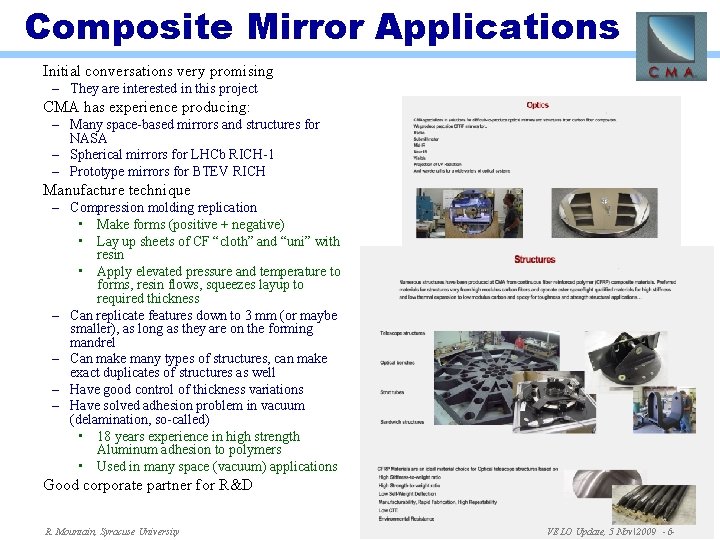
Composite Mirror Applications Inc. Initial conversations very promising – They are interested in this project CMA has experience producing: – Many space-based mirrors and structures for NASA – Spherical mirrors for LHCb RICH-1 – Prototype mirrors for BTEV RICH Manufacture technique – Compression molding replication • Make forms (positive + negative) • Lay up sheets of CF “cloth” and “uni” with resin • Apply elevated pressure and temperature to forms, resin flows, squeezes layup to required thickness – Can replicate features down to 3 mm (or maybe smaller), as long as they are on the forming mandrel – Can make many types of structures, can make exact duplicates of structures as well – Have good control of thickness variations – Have solved adhesion problem in vacuum (delamination, so-called) • 18 years experience in high strength Aluminum adhesion to polymers • Used in many space (vacuum) applications Good corporate partner for R&D R. Mountain, Syracuse University VELO Update, 5 Nov2009 -6 -
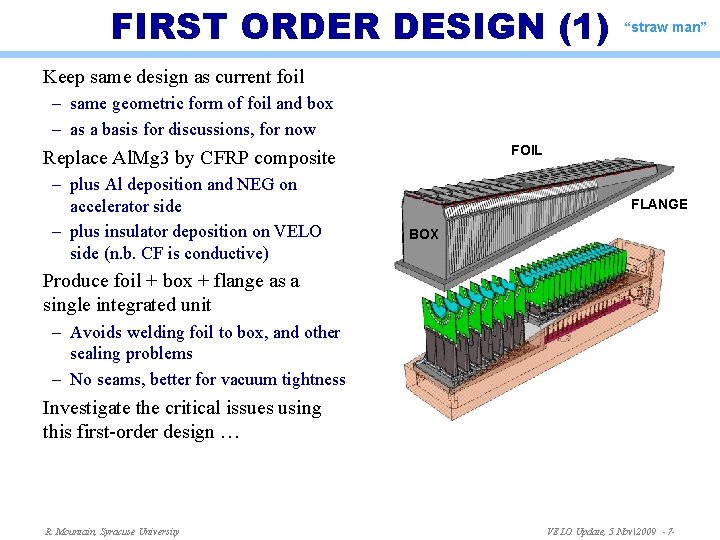
FIRST ORDER DESIGN (1) “straw man” Keep same design as current foil – same geometric form of foil and box – as a basis for discussions, for now FOIL Replace Al. Mg 3 by CFRP composite – plus Al deposition and NEG on accelerator side – plus insulator deposition on VELO side (n. b. CF is conductive) FLANGE BOX Produce foil + box + flange as a single integrated unit – Avoids welding foil to box, and other sealing problems – No seams, better for vacuum tightness Investigate the critical issues using this first-order design … R. Mountain, Syracuse University VELO Update, 5 Nov2009 -7 -
- Slides: 7