
Project Selection Three main categories of methodsapproaches Strategic

- Slides: 40
Project Selection Three main categories of methods/approaches: Strategic approach Analytical approach Financial methods
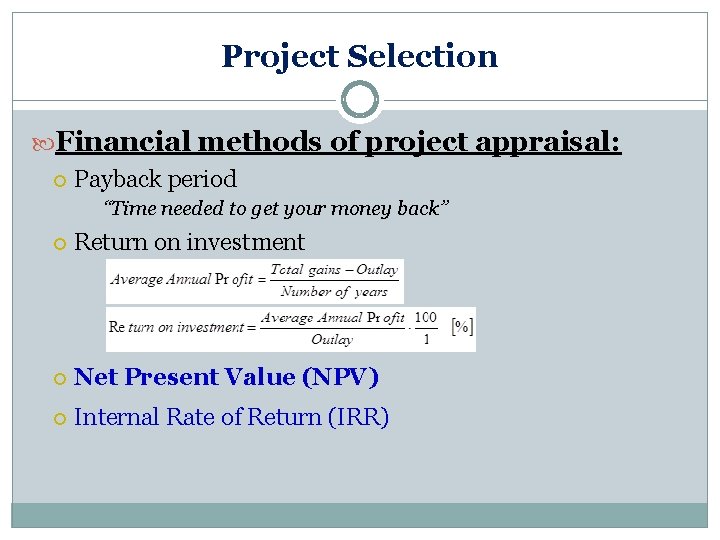
Project Selection Financial methods of project appraisal: Payback period “Time needed to get your money back” Return on investment Net Present Value (NPV) Internal Rate of Return (IRR)
Project Selection 3. Net Present Value Underlining idea: Our aim is to avoid the main weakness of both methods described earlier (the payback period and ROI) We have to take into account the time value of money.
Net Present Value Underlining idea: It is clear that a 100, - CZK today will not have the same buying power as 100, - CZK next year because of inflation - we will need more money next year to buy the same product interest rates – having 100, - CZK this year I can put them on a saving account and to get the interest next year
Net Present Value Underlining idea: For example, if the annual difference is 20%, then the value of 100, - CZK today will be 120, - CZK next year and 144, - CZK in two years time (because of compound interest calculation) 100 * 1, 2 = 120 100 * 1, 2 = 144 100 * 1, 2 = 172, 8 etc.
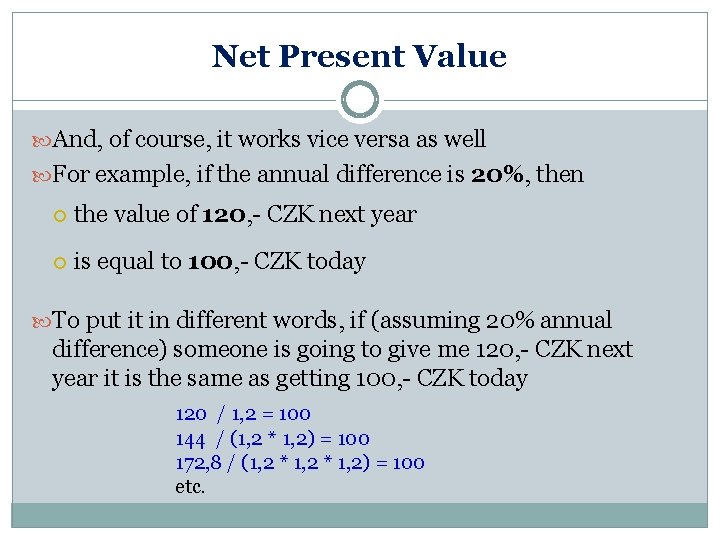
Net Present Value And, of course, it works vice versa as well For example, if the annual difference is 20%, then the value of 120, - CZK next year is equal to 100, - CZK today To put it in different words, if (assuming 20% annual difference) someone is going to give me 120, - CZK next year it is the same as getting 100, - CZK today 120 / 1, 2 = 100 144 / (1, 2 * 1, 2) = 100 172, 8 / (1, 2 * 1, 2) = 100 etc.
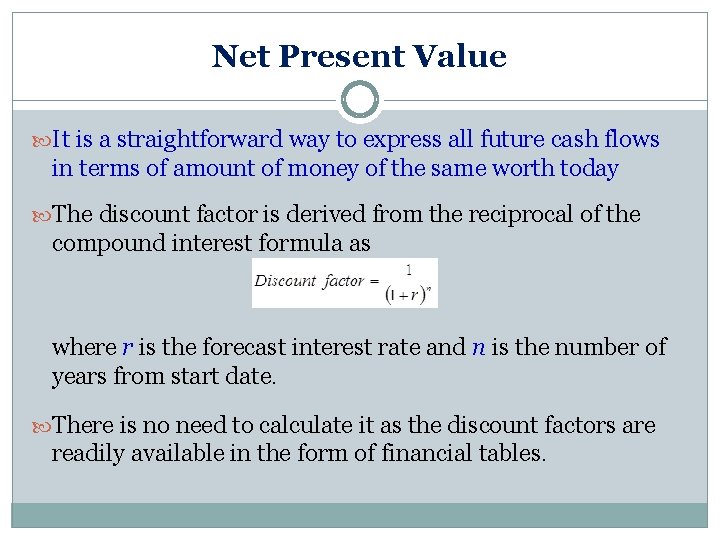
Net Present Value It is a straightforward way to express all future cash flows in terms of amount of money of the same worth today The discount factor is derived from the reciprocal of the compound interest formula as where r is the forecast interest rate and n is the number of years from start date. There is no need to calculate it as the discount factors are readily available in the form of financial tables.
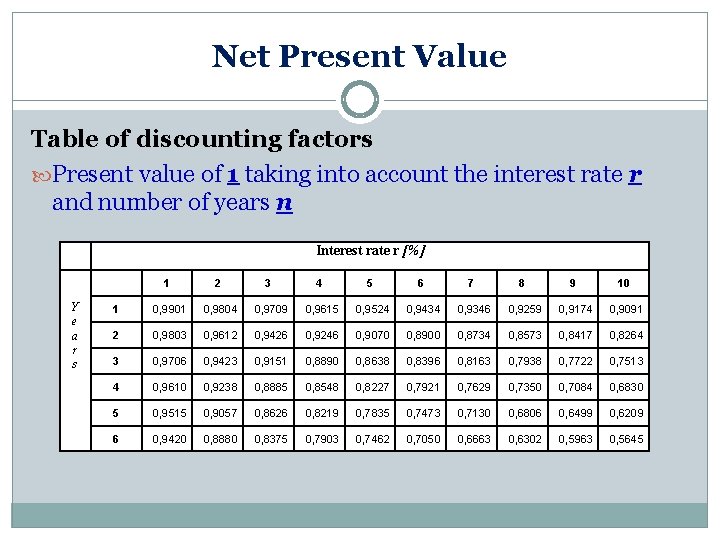
Net Present Value Table of discounting factors Present value of 1 taking into account the interest rate r and number of years n Interest rate r [%] Y e a r s 1 2 3 4 5 6 7 8 9 10 1 0, 9901 0, 9804 0, 9709 0, 9615 0, 9524 0, 9434 0, 9346 0, 9259 0, 9174 0, 9091 2 0, 9803 0, 9612 0, 9426 0, 9246 0, 9070 0, 8900 0, 8734 0, 8573 0, 8417 0, 8264 3 0, 9706 0, 9423 0, 9151 0, 8890 0, 8638 0, 8396 0, 8163 0, 7938 0, 7722 0, 7513 4 0, 9610 0, 9238 0, 8885 0, 8548 0, 8227 0, 7921 0, 7629 0, 7350 0, 7084 0, 6830 5 0, 9515 0, 9057 0, 8626 0, 8219 0, 7835 0, 7473 0, 7130 0, 6806 0, 6499 0, 6209 6 0, 9420 0, 8880 0, 8375 0, 7903 0, 7462 0, 7050 0, 6663 0, 6302 0, 5963 0, 5645
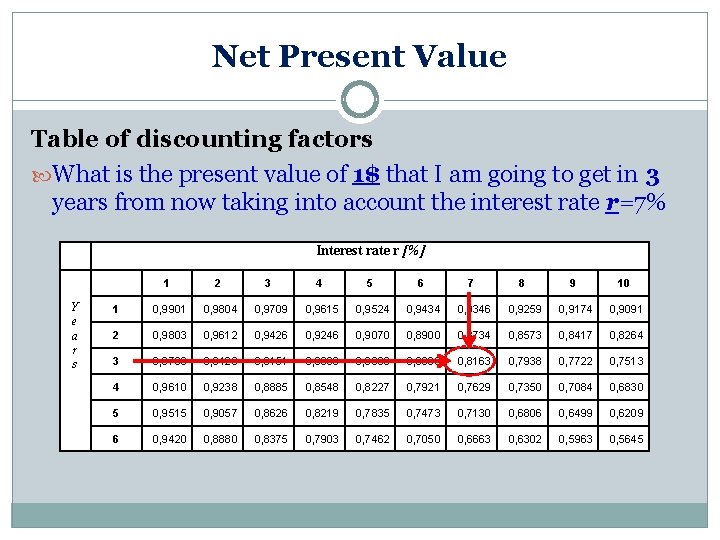
Net Present Value Table of discounting factors What is the present value of 1$ that I am going to get in 3 years from now taking into account the interest rate r=7% Interest rate r [%] Y e a r s 1 2 3 4 5 6 7 8 9 10 1 0, 9901 0, 9804 0, 9709 0, 9615 0, 9524 0, 9434 0, 9346 0, 9259 0, 9174 0, 9091 2 0, 9803 0, 9612 0, 9426 0, 9246 0, 9070 0, 8900 0, 8734 0, 8573 0, 8417 0, 8264 3 0, 9706 0, 9423 0, 9151 0, 8890 0, 8638 0, 8396 0, 8163 0, 7938 0, 7722 0, 7513 4 0, 9610 0, 9238 0, 8885 0, 8548 0, 8227 0, 7921 0, 7629 0, 7350 0, 7084 0, 6830 5 0, 9515 0, 9057 0, 8626 0, 8219 0, 7835 0, 7473 0, 7130 0, 6806 0, 6499 0, 6209 6 0, 9420 0, 8880 0, 8375 0, 7903 0, 7462 0, 7050 0, 6663 0, 6302 0, 5963 0, 5645
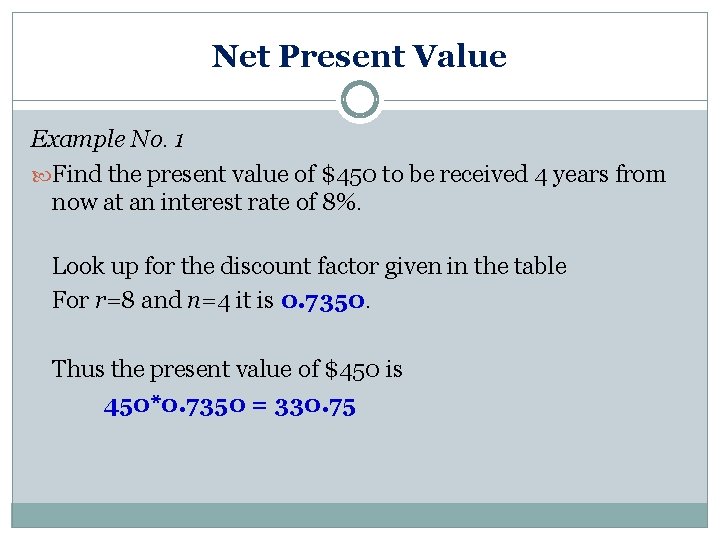
Net Present Value Example No. 1 Find the present value of $450 to be received 4 years from now at an interest rate of 8%. Look up for the discount factor given in the table For r=8 and n=4 it is 0. 7350. Thus the present value of $450 is 450*0. 7350 = 330. 75
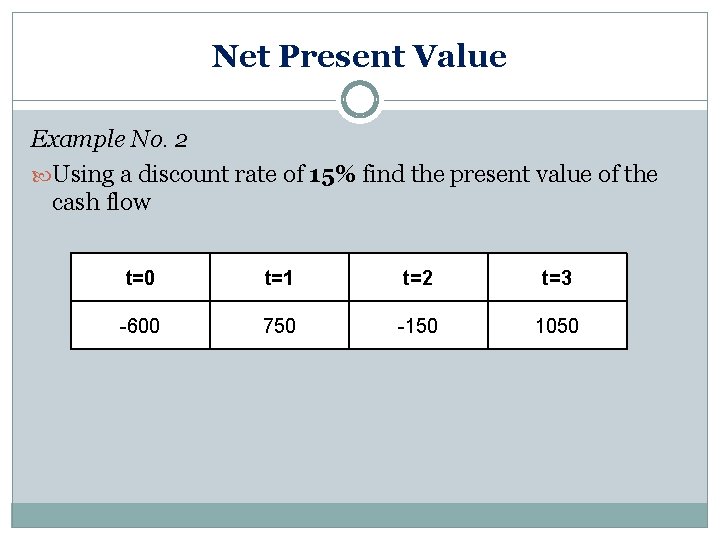
Net Present Value Example No. 2 Using a discount rate of 15% find the present value of the cash flow t=0 t=1 t=2 t=3 -600 750 -150 1050
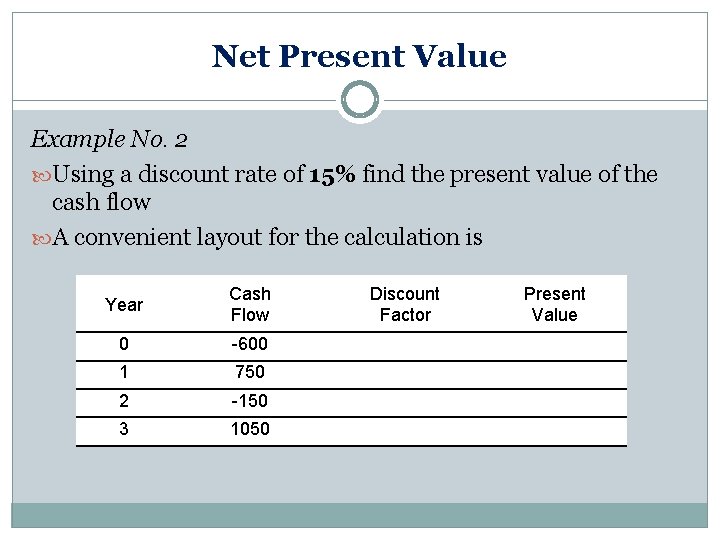
Net Present Value Example No. 2 Using a discount rate of 15% find the present value of the cash flow A convenient layout for the calculation is Year Cash Flow 0 -600 1 750 2 -150 3 1050 Discount Factor Present Value
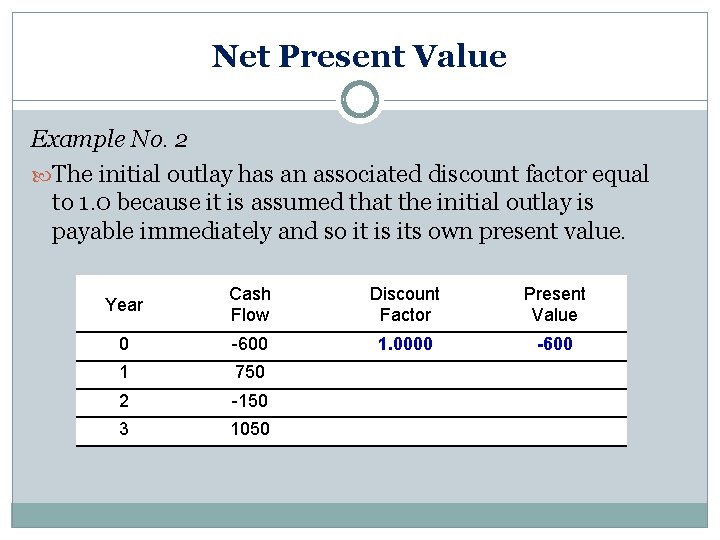
Net Present Value Example No. 2 The initial outlay has an associated discount factor equal to 1. 0 because it is assumed that the initial outlay is payable immediately and so it is its own present value. Year Cash Flow Discount Factor Present Value 0 -600 1. 0000 -600 1 750 2 -150 3 1050
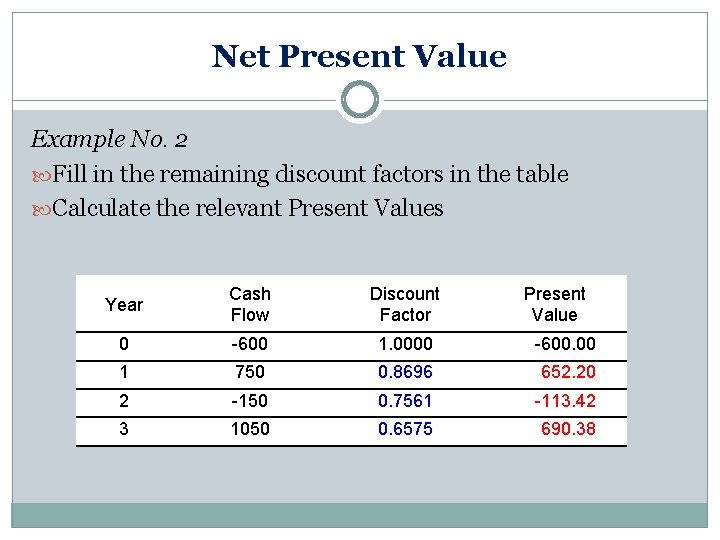
Net Present Value Example No. 2 Fill in the remaining discount factors in the table Calculate the relevant Present Values Year Cash Flow Discount Factor Present Value 0 -600 1. 0000 -600. 00 1 750 0. 8696 652. 20 2 -150 0. 7561 -113. 42 3 1050 0. 6575 690. 38
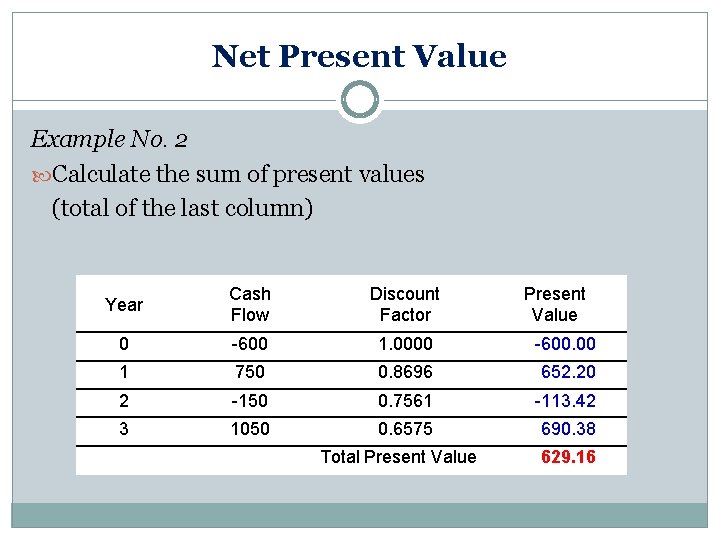
Net Present Value Example No. 2 Calculate the sum of present values (total of the last column) Year Cash Flow Discount Factor 0 -600 1. 0000 -600. 00 1 750 0. 8696 652. 20 2 -150 0. 7561 -113. 42 3 1050 0. 6575 690. 38 Total Present Value 629. 16
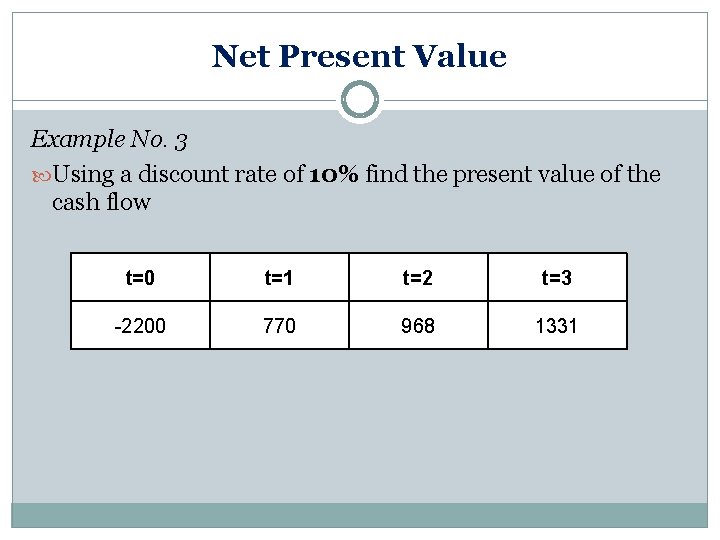
Net Present Value Example No. 3 Using a discount rate of 10% find the present value of the cash flow t=0 t=1 t=2 t=3 -2200 770 968 1331
Net Present Value (NPV) - Summary The net present value (NPV) is the reverse of compound interest. If you are offered 120, -CZK one year from now and the inflation & interest rate was 20%, working backwards its value in today terms will be 100, -CZK. This is called the present value, and when the cash flows over a number of years are combined in this manner the total figure is called the net present value (NPV).
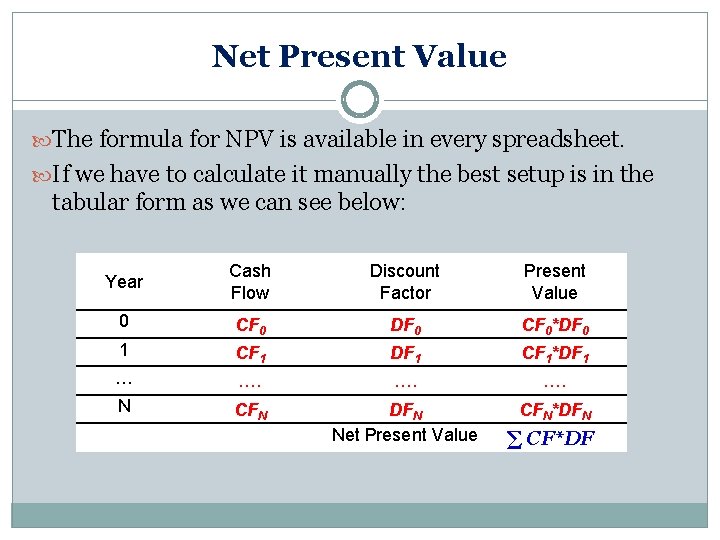
Net Present Value The formula for NPV is available in every spreadsheet. If we have to calculate it manually the best setup is in the tabular form as we can see below: Year Cash Flow Discount Factor Present Value 0 CF 0 DF 0 CF 0*DF 0 1 CF 1 DF 1 CF 1*DF 1 … …. …. N CFN DFN Net Present Value CFN*DFN ∑ CF*DF
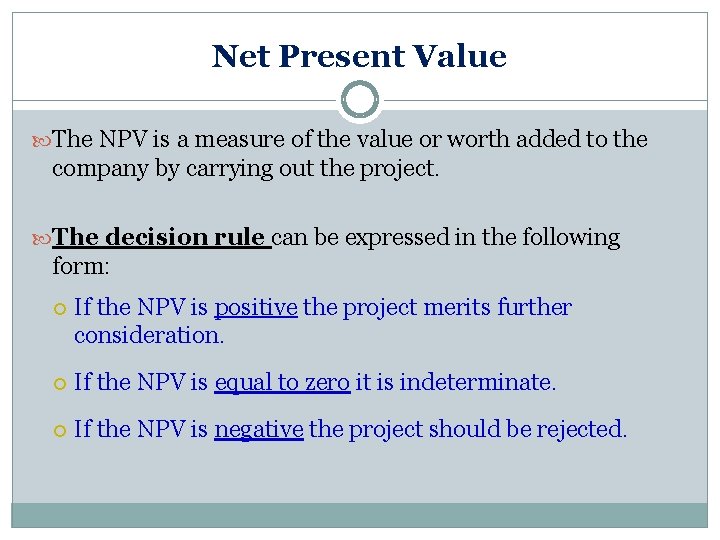
Net Present Value The NPV is a measure of the value or worth added to the company by carrying out the project. The decision rule can be expressed in the following form: If the NPV is positive the project merits further consideration. If the NPV is equal to zero it is indeterminate. If the NPV is negative the project should be rejected.
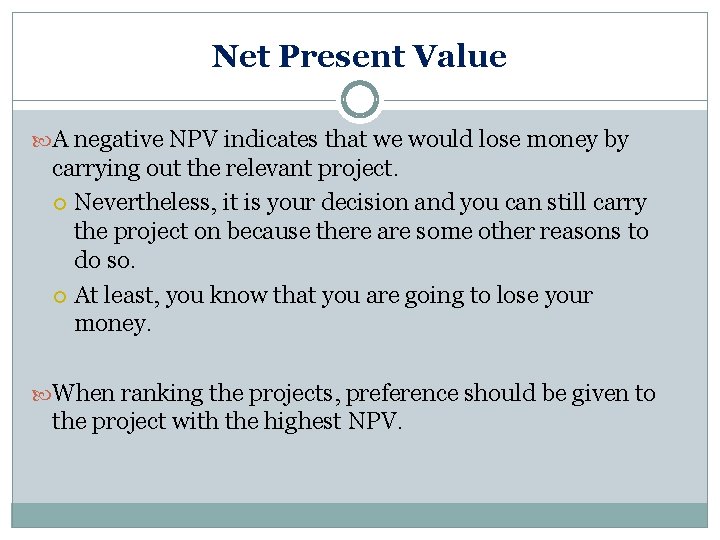
Net Present Value A negative NPV indicates that we would lose money by carrying out the relevant project. Nevertheless, it is your decision and you can still carry the project on because there are some other reasons to do so. At least, you know that you are going to lose your money. When ranking the projects, preference should be given to the project with the highest NPV.
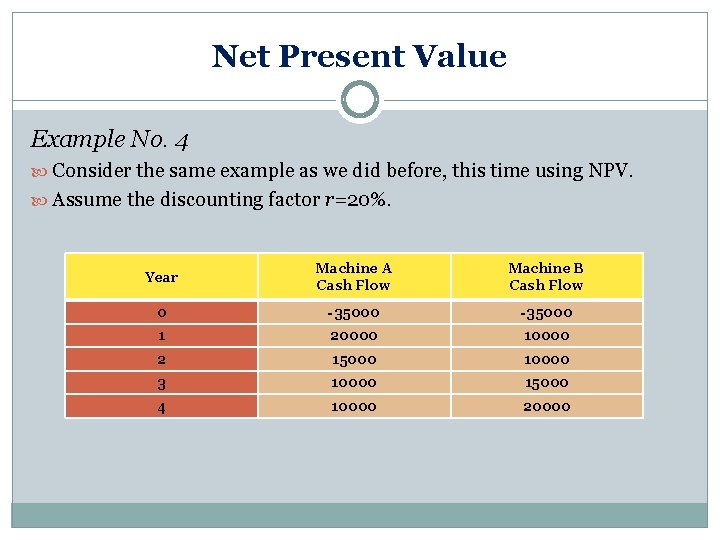
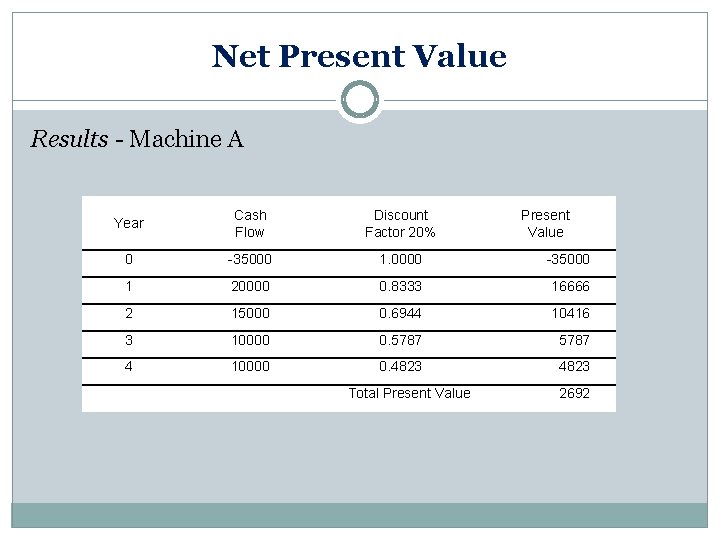
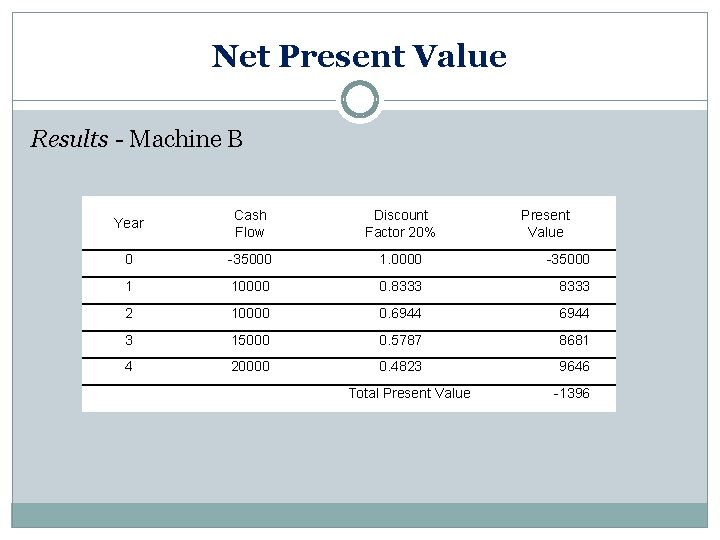
Net Present Value Example No. 4 Consider the same example as we did before, this time using NPV. Assume the discounting factor r=20%. Year Machine A Cash Flow Machine B Cash Flow 0 -35000 1 20000 10000 2 15000 10000 3 10000 15000 4 10000 20000
Net Present Value Results - Machine A Year Cash Flow Discount Factor 20% 0 -35000 1. 0000 -35000 1 20000 0. 8333 16666 2 15000 0. 6944 10416 3 10000 0. 5787 4 10000 0. 4823 Total Present Value 2692
Net Present Value Results - Machine B Year Cash Flow Discount Factor 20% 0 -35000 1. 0000 -35000 1 10000 0. 8333 2 10000 0. 6944 3 15000 0. 5787 8681 4 20000 0. 4823 9646 Total Present Value -1396
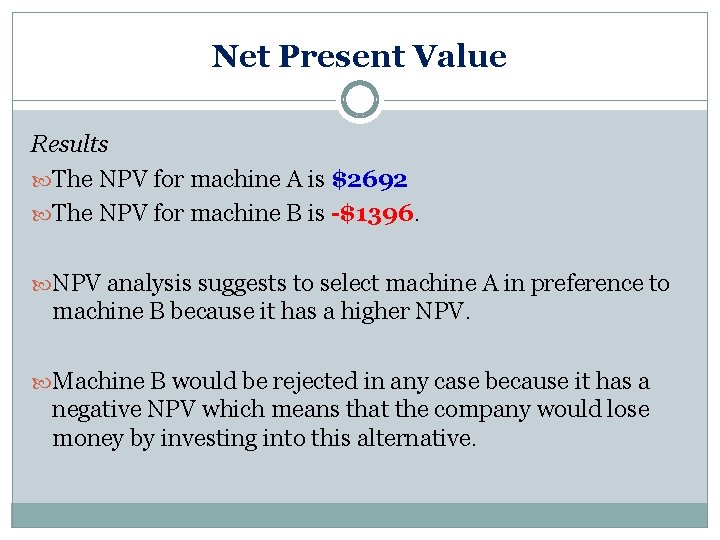
Net Present Value Results The NPV for machine A is $2692 The NPV for machine B is -$1396. NPV analysis suggests to select machine A in preference to machine B because it has a higher NPV. Machine B would be rejected in any case because it has a negative NPV which means that the company would lose money by investing into this alternative.
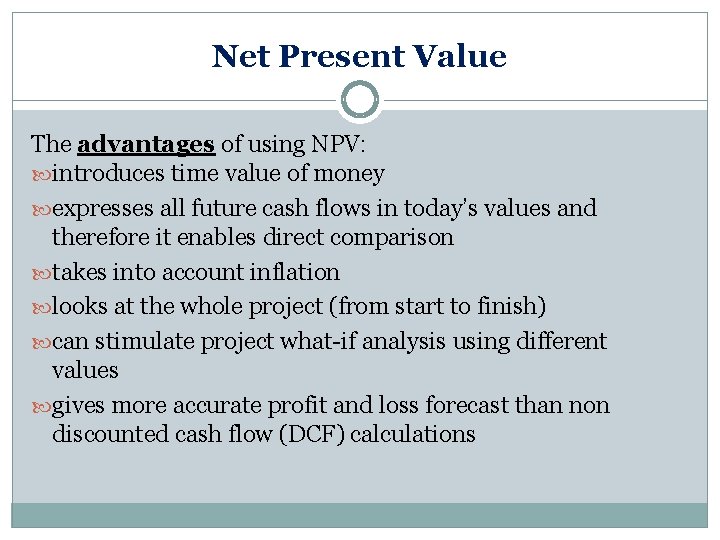
Net Present Value The advantages of using NPV: introduces time value of money expresses all future cash flows in today’s values and therefore it enables direct comparison takes into account inflation looks at the whole project (from start to finish) can stimulate project what-if analysis using different values gives more accurate profit and loss forecast than non discounted cash flow (DCF) calculations
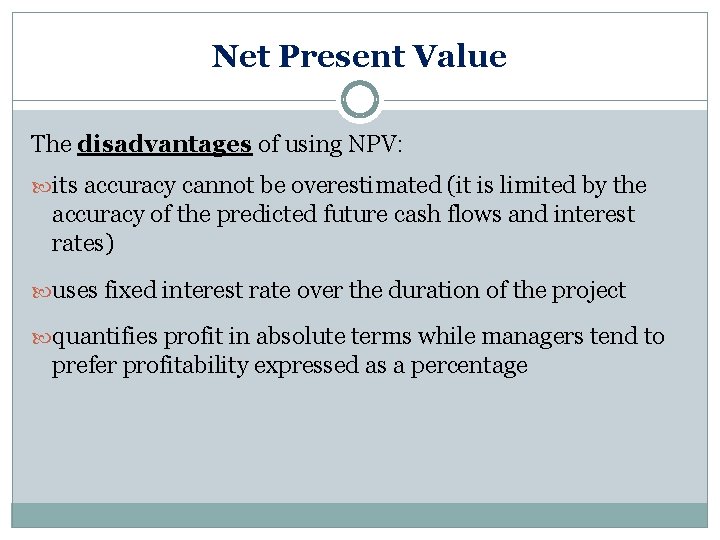
Net Present Value The disadvantages of using NPV: its accuracy cannot be overestimated (it is limited by the accuracy of the predicted future cash flows and interest rates) uses fixed interest rate over the duration of the project quantifies profit in absolute terms while managers tend to prefer profitability expressed as a percentage
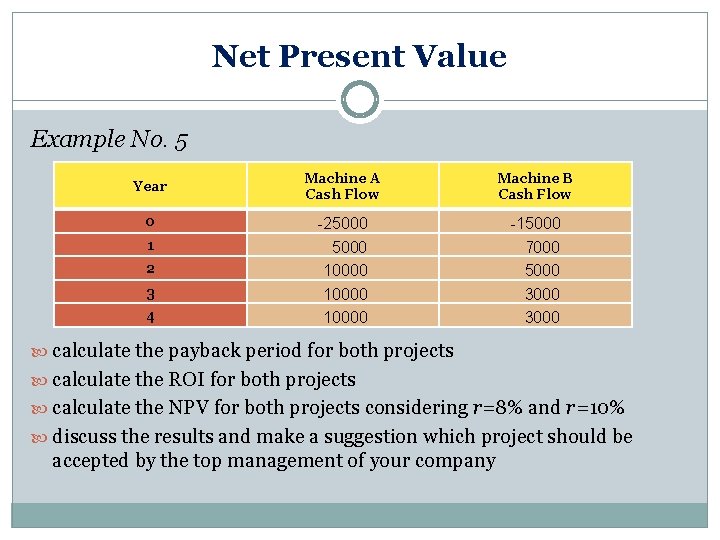
Net Present Value Example No. 5 Year 0 1 2 3 4 Machine A Cash Flow Machine B Cash Flow -25000 10000 -15000 7000 5000 3000 calculate the payback period for both projects calculate the ROI for both projects calculate the NPV for both projects considering r=8% and r=10% discuss the results and make a suggestion which project should be accepted by the top management of your company
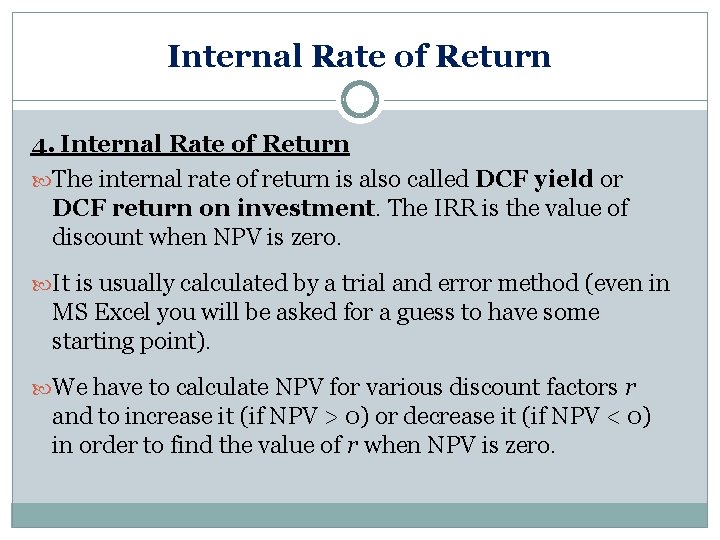
Internal Rate of Return 4. Internal Rate of Return The internal rate of return is also called DCF yield or DCF return on investment. The IRR is the value of discount when NPV is zero. It is usually calculated by a trial and error method (even in MS Excel you will be asked for a guess to have some starting point). We have to calculate NPV for various discount factors r and to increase it (if NPV > 0) or decrease it (if NPV < 0) in order to find the value of r when NPV is zero.
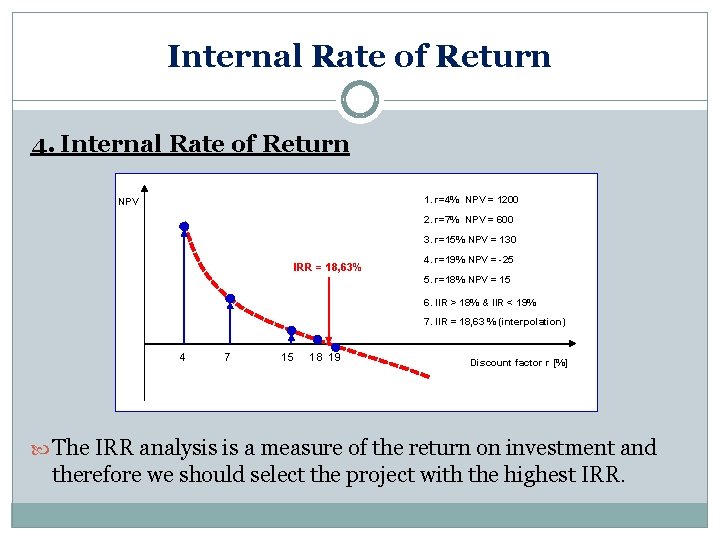
Internal Rate of Return 4. Internal Rate of Return 1. r=4% NPV = 1200 NPV 2. r=7% NPV = 600 3. r=15% NPV = 130 IRR = 18, 63% 4. r=19% NPV = -25 5. r=18% NPV = 15 6. IIR > 18% & IIR < 19% 7. IIR = 18, 63 % (interpolation) 4 7 15 18 19 Discount factor r [%] The IRR analysis is a measure of the return on investment and therefore we should select the project with the highest IRR.
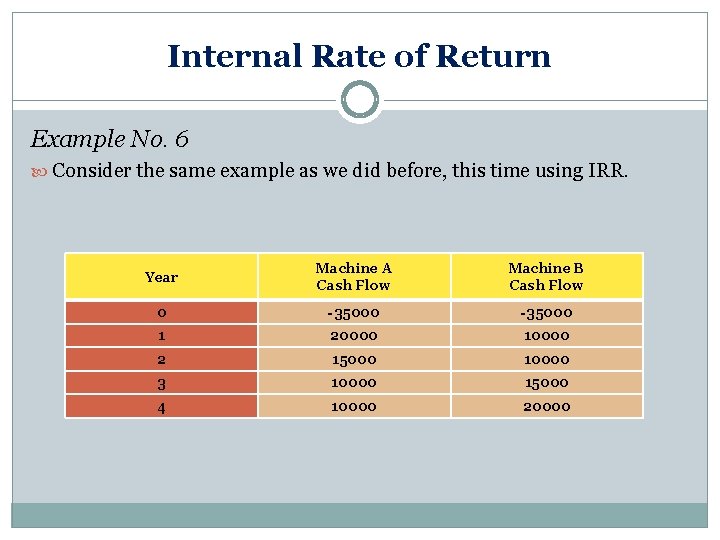
Internal Rate of Return Example No. 6 Consider the same example as we did before, this time using IRR. Year Machine A Cash Flow Machine B Cash Flow 0 -35000 1 20000 10000 2 15000 10000 3 10000 15000 4 10000 20000
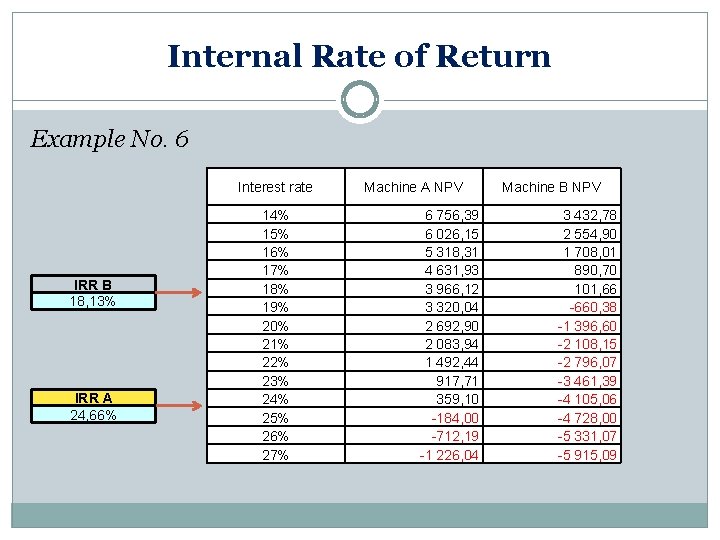
Internal Rate of Return Example No. 6 Interest rate IRR B 18, 13% IRR A 24, 66% 14% 15% 16% 17% 18% 19% 20% 21% 22% 23% 24% 25% 26% 27% Machine A NPV 6 756, 39 6 026, 15 5 318, 31 4 631, 93 3 966, 12 3 320, 04 2 692, 90 2 083, 94 1 492, 44 917, 71 359, 10 -184, 00 -712, 19 -1 226, 04 Machine B NPV 3 432, 78 2 554, 90 1 708, 01 890, 70 101, 66 -660, 38 -1 396, 60 -2 108, 15 -2 796, 07 -3 461, 39 -4 105, 06 -4 728, 00 -5 331, 07 -5 915, 09
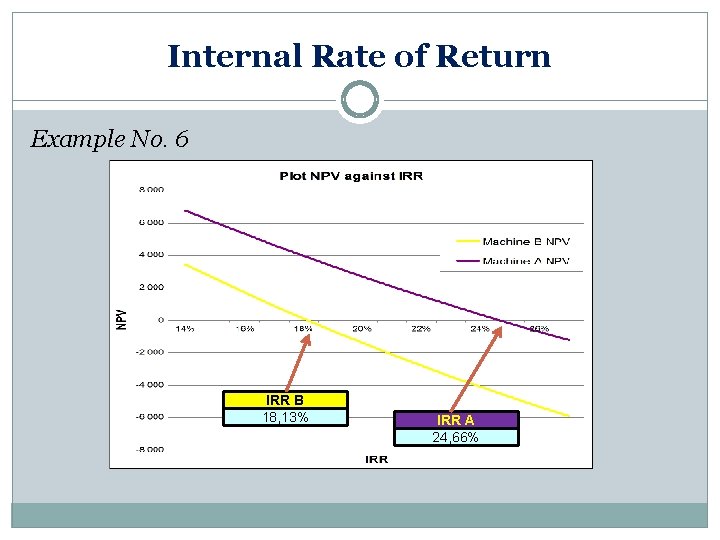
Internal Rate of Return Example No. 6 IRR B 18, 13% IRR A 24, 66%
Internal Rate of Return The advantages of using IRR: takes into account the time value of money looks at the whole project (from start to finish) allows the manager to compare IRR with the current interest rates the result is easy to understand to interpret
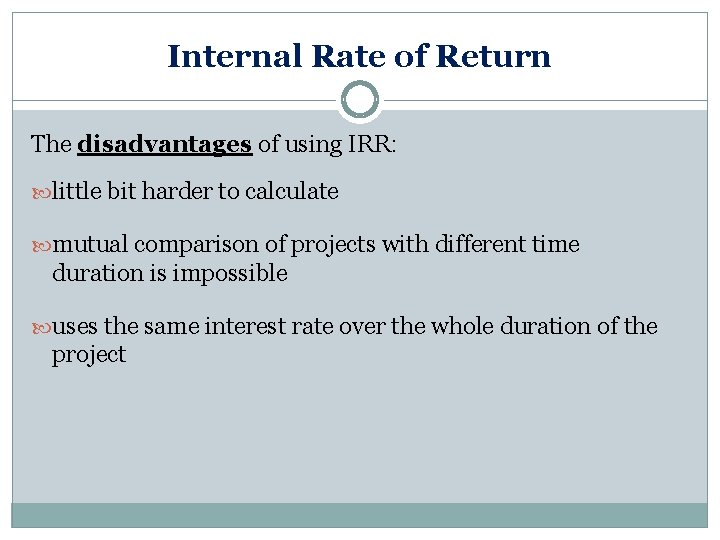
Internal Rate of Return The disadvantages of using IRR: little bit harder to calculate mutual comparison of projects with different time duration is impossible uses the same interest rate over the whole duration of the project
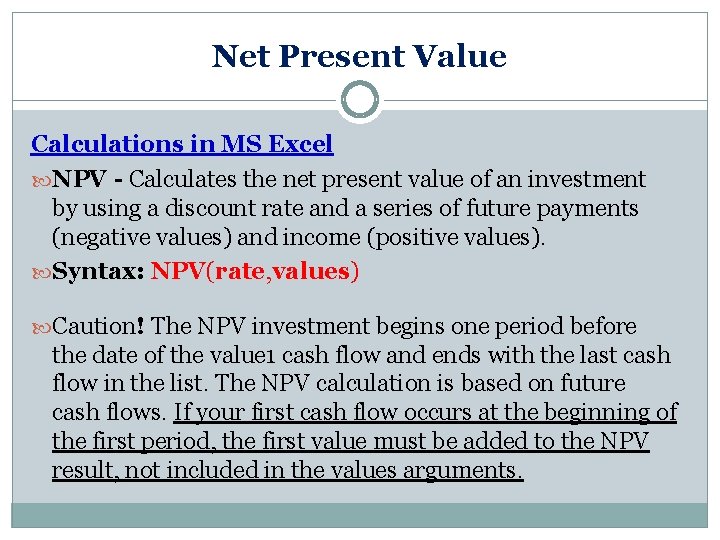
Net Present Value Calculations in MS Excel NPV - Calculates the net present value of an investment by using a discount rate and a series of future payments (negative values) and income (positive values). Syntax: NPV(rate, values) Caution! The NPV investment begins one period before the date of the value 1 cash flow and ends with the last cash flow in the list. The NPV calculation is based on future cash flows. If your first cash flow occurs at the beginning of the first period, the first value must be added to the NPV result, not included in the values arguments.
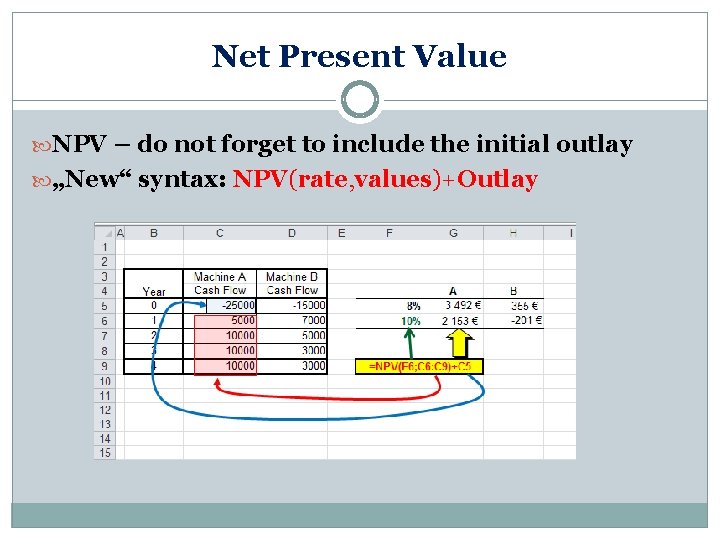
Net Present Value NPV – do not forget to include the initial outlay „New“ syntax: NPV(rate, values)+Outlay
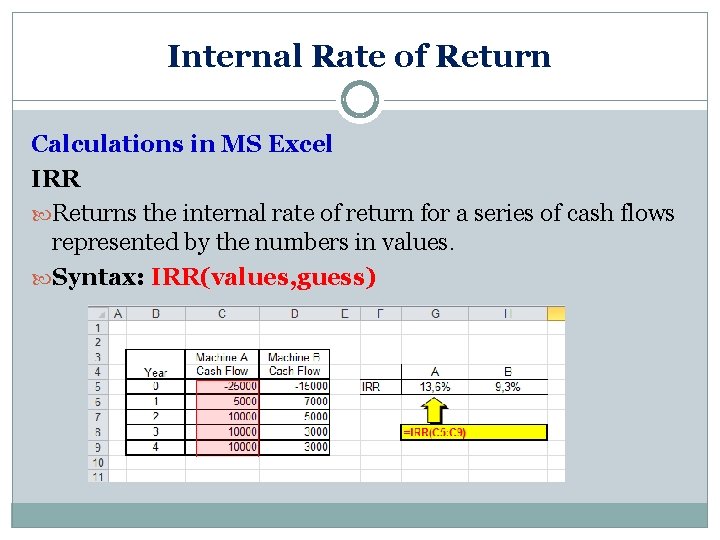
Internal Rate of Return Calculations in MS Excel IRR Returns the internal rate of return for a series of cash flows represented by the numbers in values. Syntax: IRR(values, guess)
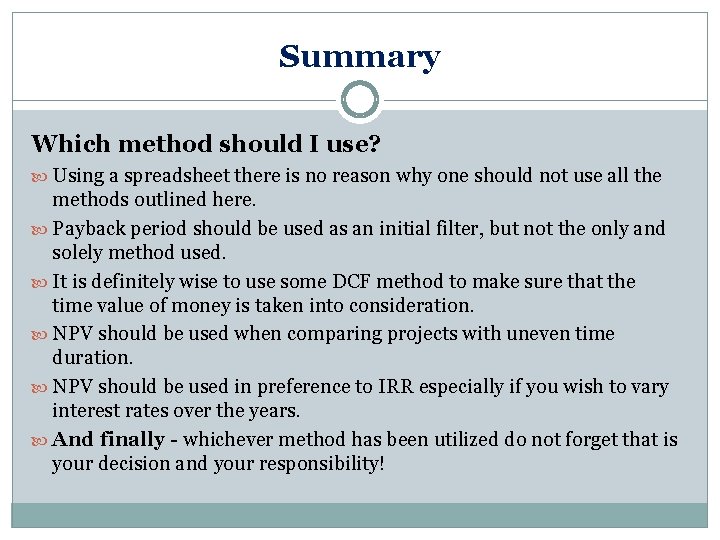
Summary Which method should I use? Using a spreadsheet there is no reason why one should not use all the methods outlined here. Payback period should be used as an initial filter, but not the only and solely method used. It is definitely wise to use some DCF method to make sure that the time value of money is taken into consideration. NPV should be used when comparing projects with uneven time duration. NPV should be used in preference to IRR especially if you wish to vary interest rates over the years. And finally - whichever method has been utilized do not forget that is your decision and your responsibility!
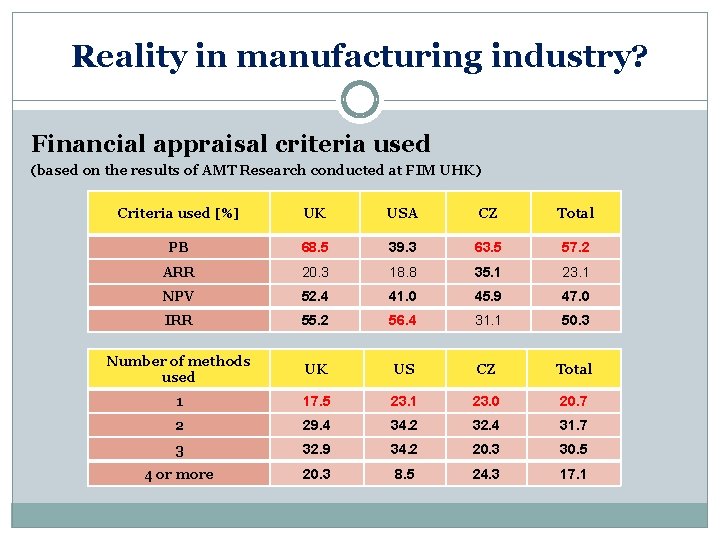
Reality in manufacturing industry? Financial appraisal criteria used (based on the results of AMT Research conducted at FIM UHK) Criteria used [%] UK USA CZ Total PB 68. 5 39. 3 63. 5 57. 2 ARR 20. 3 18. 8 35. 1 23. 1 NPV 52. 4 41. 0 45. 9 47. 0 IRR 55. 2 56. 4 31. 1 50. 3 Number of methods used UK US CZ Total 1 17. 5 23. 1 23. 0 20. 7 2 29. 4 34. 2 32. 4 31. 7 3 32. 9 34. 2 20. 3 30. 5 4 or more 20. 3 8. 5 24. 3 17. 1
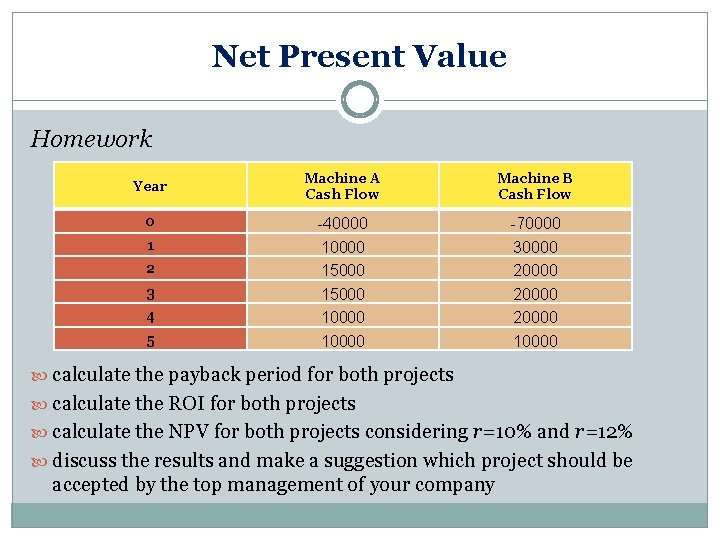
Net Present Value Homework Year 0 1 2 3 4 5 Machine A Cash Flow Machine B Cash Flow -40000 15000 10000 -70000 30000 20000 10000 calculate the payback period for both projects calculate the ROI for both projects calculate the NPV for both projects considering r=10% and r=12% discuss the results and make a suggestion which project should be accepted by the top management of your company