
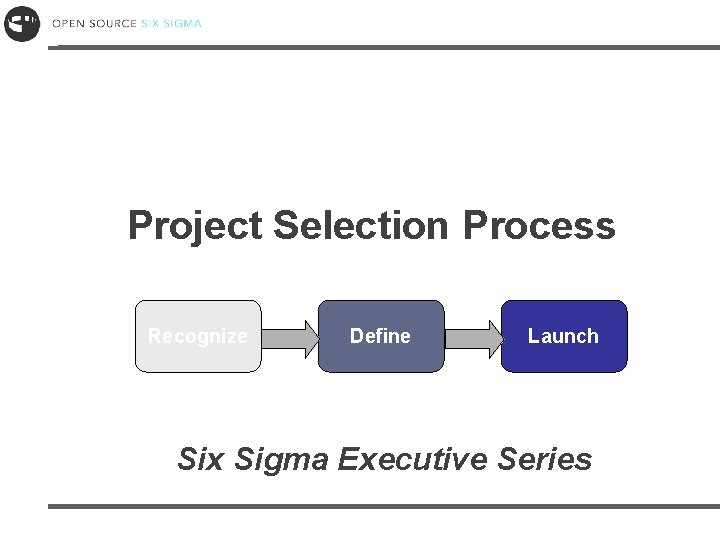
Project Selection Process Recognize Define Launch Six Sigma
- Slides: 25
Project Selection Process Recognize Define Launch Six Sigma Executive Series
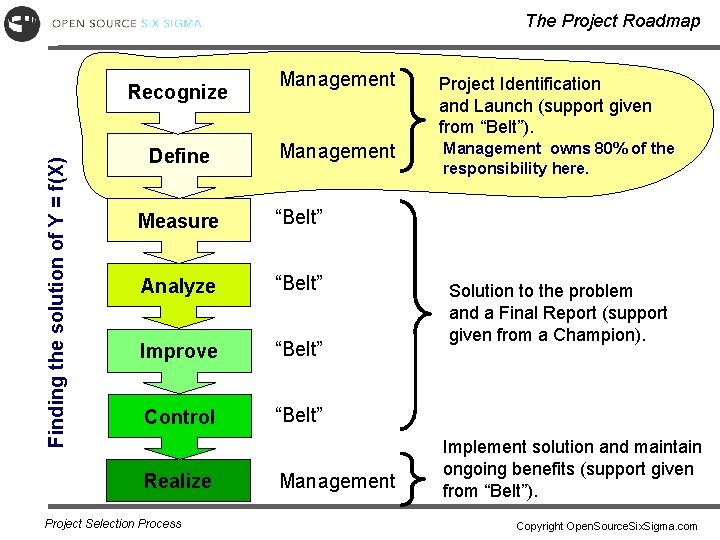
The Project Roadmap Finding the solution of Y = f(X) Recognize Define Management Project Identification and Launch (support given from “Belt”). Management owns 80% of the responsibility here. Measure “Belt” Analyze “Belt” Improve “Belt” Control “Belt” Realize Project Selection Process Management Solution to the problem and a Final Report (support given from a Champion). Implement solution and maintain ongoing benefits (support given from “Belt”). Copyright Open. Source. Six. Sigma. com
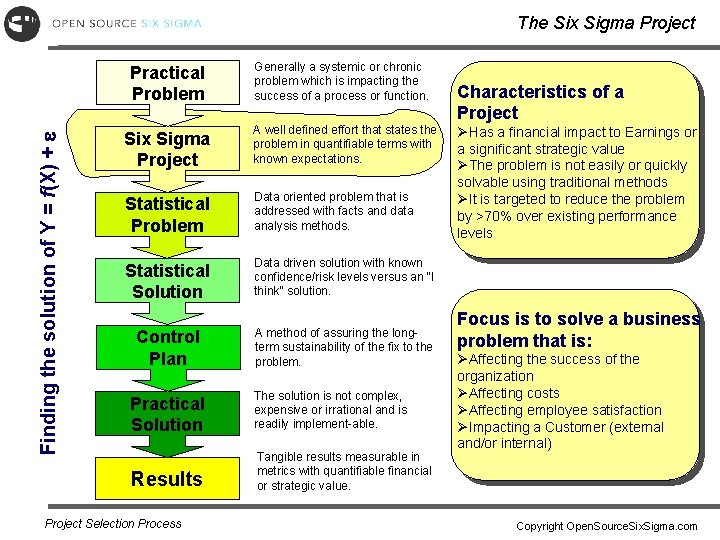
Finding the solution of Y = f(X) + e The Six Sigma Project Practical Problem Generally a systemic or chronic problem which is impacting the success of a process or function. Six Sigma Project A well defined effort that states the problem in quantifiable terms with known expectations. Statistical Problem Data oriented problem that is addressed with facts and data analysis methods. Statistical Solution Data driven solution with known confidence/risk levels versus an “I think” solution. Control Plan A method of assuring the longterm sustainability of the fix to the problem. Practical Solution The solution is not complex, expensive or irrational and is readily implement-able. Results Tangible results measurable in metrics with quantifiable financial or strategic value. Project Selection Process Characteristics of a Project ØHas a financial impact to Earnings or a significant strategic value ØThe problem is not easily or quickly solvable using traditional methods ØIt is targeted to reduce the problem by >70% over existing performance levels Focus is to solve a business problem that is: ØAffecting the success of the organization ØAffecting costs ØAffecting employee satisfaction ØImpacting a Customer (external and/or internal) Copyright Open. Source. Six. Sigma. com
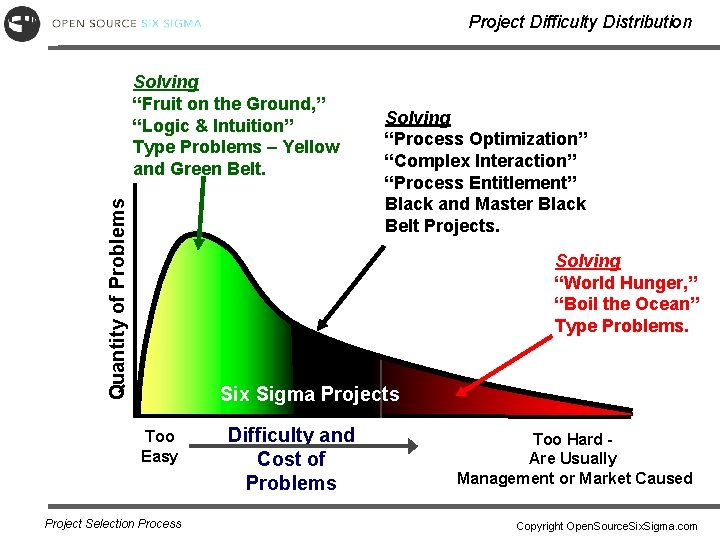
Project Difficulty Distribution Quantity of Problems Solving “Fruit on the Ground, ” “Logic & Intuition” Type Problems – Yellow and Green Belt. Solving “Process Optimization” “Complex Interaction” “Process Entitlement” Black and Master Black Belt Projects. Solving “World Hunger, ” “Boil the Ocean” Type Problems. Six Sigma Projects Too Easy Project Selection Process Difficulty and Cost of Problems Too Hard Are Usually Management or Market Caused Copyright Open. Source. Six. Sigma. com
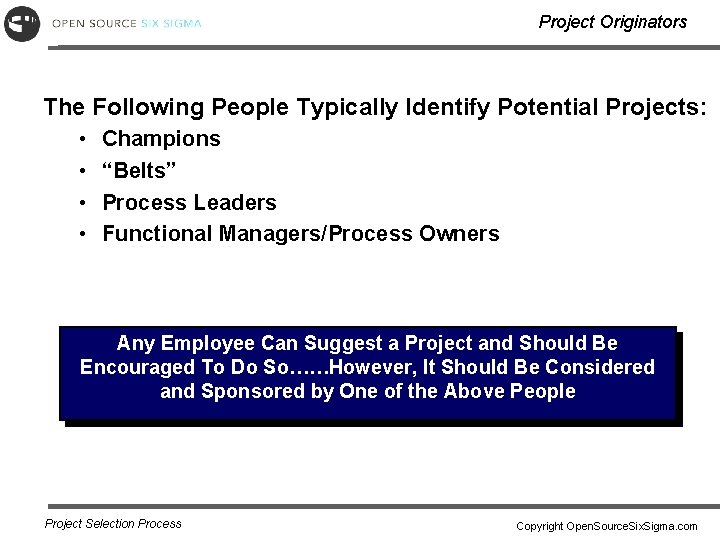
Project Originators The Following People Typically Identify Potential Projects: • • Champions “Belts” Process Leaders Functional Managers/Process Owners Any Employee Can Suggest a Project and Should Be Encouraged To Do So……However, It Should Be Considered and Sponsored by One of the Above People Project Selection Process Copyright Open. Source. Six. Sigma. com
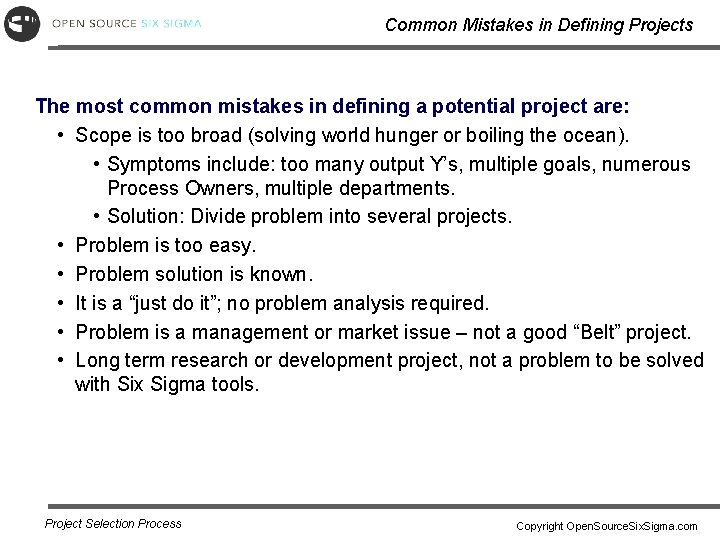
Common Mistakes in Defining Projects The most common mistakes in defining a potential project are: • Scope is too broad (solving world hunger or boiling the ocean). • Symptoms include: too many output Y’s, multiple goals, numerous Process Owners, multiple departments. • Solution: Divide problem into several projects. • Problem is too easy. • Problem solution is known. • It is a “just do it”; no problem analysis required. • Problem is a management or market issue – not a good “Belt” project. • Long term research or development project, not a problem to be solved with Six Sigma tools. Project Selection Process Copyright Open. Source. Six. Sigma. com
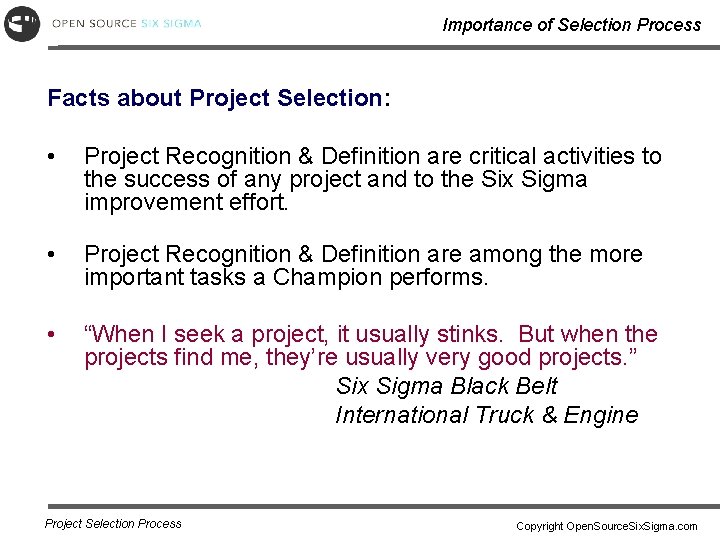
Importance of Selection Process Facts about Project Selection: • Project Recognition & Definition are critical activities to the success of any project and to the Six Sigma improvement effort. • Project Recognition & Definition are among the more important tasks a Champion performs. • “When I seek a project, it usually stinks. But when the projects find me, they’re usually very good projects. ” Six Sigma Black Belt International Truck & Engine Project Selection Process Copyright Open. Source. Six. Sigma. com
RECOGNIZE PHASE Recognize Finding Areas Needing Improvement “Writing the Business Case”
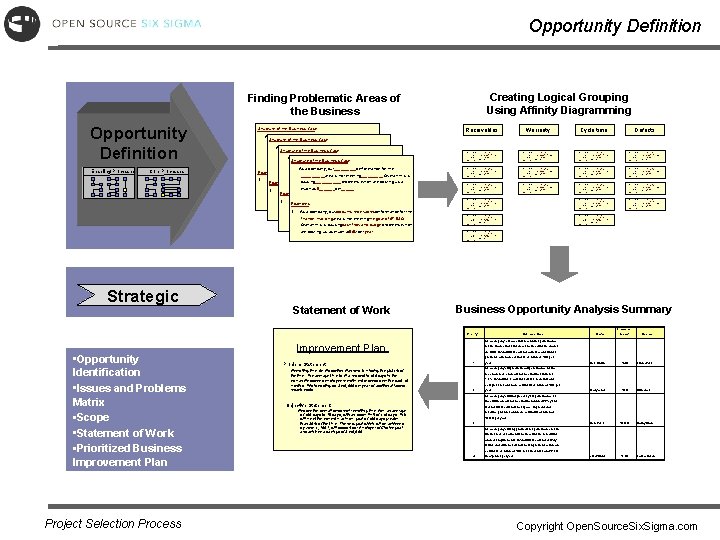
Opportunity Definition Step 1 Opportunity Definition Enabling Processes Core Processes Creating Logical Grouping Using Affinity Diagramming Finding Problematic Areas of the Business Structure of the Business Case As a company, our_____ performance for the Structure of the Business Case ______area is not meeting_____. Overall this is As a company, our_____performance for the causing______ problems Structure of the Businesswhich Caseare costing us a ______area is not meeting_____. Overall this is much as$_______ per______. As a company, our_____ performance for the Structure of theproblems Businesswhich Caseare costing us a causing______area is not meeting_____. Overall this is much as$_______ per______. As a company, our_____performance for the causing______problems which are costing us a Examples ______area is not meeting_____. Overall this is much as$_______ per______. 1. As a company, ourcausing______ accounts receivables performance for the problems which are costing us a Examples finance invoicingarea is not meetingthe goal of 47 DSO. much per______. 1. As a company, ouras$_______ accounts receivablesperformance for the Overall. Examples this is causingcash flow and budgetproblems which finance invoicingarea is not meetingthe goal of 47 DSO. are costing us as much as$4 M per year. receivablesperformance for the 1. As a company, ouraccounts Overall this is causingcash flow and budgetproblems which finance invoicingarea is not meetingthe goal of 47 DSO. are costing us as much as$4 M per year. Overall this is causingcash flow and budgetproblems which are costing us as much as$4 M per year. Receivables As a company, our accounts receivables performance for the finance invoicing is not meeting the goal of 47 DSO this is causing Warranty As a company, our area. Overall cash flow and budget Cycle time accounts receivables performance for the As a company, our finance invoicing is not meeting the goal of 47 DSO this is causing area. Overall cash flow and budget Defects accounts receivables performance for the finance invoicing is not meeting the goal of 47 DSO this is causing As a company, our area accounts receivables performance for the . Overall finance invoicing is not meeting cash flow and budget the goal of 47 DSO this is causing problems which are costing us as much as $4 M $4 M per year . As a company, our accounts receivables performance for the finance invoicing is not meeting the goal of 47 DSO this is causing per year . As a company, our area. Overall cash flow and budget accounts receivables performance for the goal of 47 DSO year . As a company, our finance invoicing is not meeting this is causing per area. Overall cash flow and budget accounts receivables performance for the finance invoicing is not meeting the goal of 47 DSO this is causing per year . As a company, our area accounts receivables performance for the . Overall finance invoicing is not meeting cash flow and budget the goal of 47 DSO this is causing problems which are costing us as much as $4 M $4 M year . As a company, our accounts receivables performance for the finance invoicing is not meeting the goal of 47 DSO this is causing per year . As a company, our area. Overall cash flow and budget accounts receivables performance for the goal of 47 DSO this is causing year . As a company, our finance invoicing is not meeting per area. Overall cash flow and budget accounts receivables performance for the finance invoicing is not meeting the goal of 47 DSO this is causing per year . As a company, our area accounts receivables performance for the . Overall finance invoicing is not meeting cash flow and budget the goal of 47 DSO this is causing problems which are costing us as much as $4 M $4 M year . As a company, our per year . accounts receivables performance for the finance invoicing is not meeting the goal of 47 DSO this is causing per year . As a company, our area accounts receivables performance for the . Overall finance invoicing is not meeting cash flow and budget the goal of 47 DSO this is causing problems which are costing us as much as $4 M $4 M year . As a company, our accounts receivables performance for the finance invoicing is not meeting the goal of 47 DSO this is causing per year . As a company, our area finance invoicing is not meeting the goal of 47 DSO this is causing $4 M . As a company, our per area . area. Overall cash flow and budget problems which are costing us as much as $4 M year accounts receivables performance for the . Overall cash flow and budget problems which are costing us as much as per area. Overall cash flow and budget problems which are costing us as much as year . accounts receivables performance for the finance invoicing is not meeting the goal of 47 DSO this is causing area. Overall cash flow and budget problems which are costing us as much as $4 M Strategic Statement of Work per year . Business Opportunity Analysis Summary Financial Priority • Opportunity Identification • Issues and Problems Matrix • Scope • Statement of Work • Prioritized Business Improvement Plan Project Selection Process Business Case Owner Impact Sponsor As a company, our accounts receivables performance Improvement Plan for the finance invoicing area is not meeting the goal of 47 DSO. Overall this is causing cash flow and budget problems which are costing us as much as $4 M per Problem Statement Recruiting time for Production Planners is missing the goa l 81% of the time. The average time to fill a request is 155 days in the Human Resources employee recruitment process over the past 15 months. This is costing us $145, 000 per year of additional labor and rework costs. 1 year. Bob Smith $4 M Ellen West Mary Jones $2 M Bill Jones Ken Parks $900 K Kathy Shank Jill Williams $1. 5 M Earl Johnson As a company our product recall performance for the ice cream market area is not meeting the budget of 1. 5%. Overall this is causing logistics, materials and cost problems which are costing us as much as $2 M per 2 year. As a company our final process yield performance for the culture area is not meeting the targeted 88% yield. Objective Statement Reduce the overall personnel recruiting time from an average of 155 days to 75 days, with an upper limit of 110 days. This will meet the current maximum goal of 100 days greater than 95% of the time. The new goal which will be achieved by June 1, 2002, will support our Employer of Choice goal and achieve a savings of $145, 000. Overall this is causing Floor space, shipment and resource problems which are costing us as much as $900 K per year. 3 As a company our shipping logistics performance for the Smith’s market segment is not meeting the scheduling and cost requirements. Overall this is causing delivery issues and customer dissatisfaction problems which are costing us as much as $3 M in lost revenues and $1. 5 M 4 in expenses per year. Copyright Open. Source. Six. Sigma. com
Finding Areas Needing Improvement RECOGNIZE Starts With the Highest Level View and Moves Downward Into More Specifics to Formulate Six Sigma Projects • Start by assessing the higher level needs of the company; using any knowledge obtained from the Voice of the Customer (VOC) and/or the Voice of the Business (VOB). • Identify gaps in achieving the higher level needs of the company, the critical success factors or key goals and objectives of the company. • Achieving these goals should deliver customer satisfaction and business results • Business areas or processes which are impacting your goals are identified • Six Sigma projects are then selected with the goal of substantially improving these key processes • Select those areas or functions of the business related to the gaps which are performing poorly based on expectations, competitive knowledge or known deficiencies in performance. • Problems at this level usually are related to quality, cost or delivery Project Selection Process Copyright Open. Source. Six. Sigma. com
Finding Areas Needing Improvement Problem “themes” will then become visible, such as: • Product returns/warranty costs • Customer complaints • Accounts receivable and invoicing issues • Cycle time/responsiveness • Inefficiencies of defective services • Yield and subsequent rework or scrap • Capacity constraints • Inventory levels You have now recognized where problems exist which need to be resolved in order to achieve our objectives. Project Selection Process Copyright Open. Source. Six. Sigma. com
Finding Areas Needing Improvement Writing a Business Case identifies the problem area, a description/characterization of the high level problem and an estimate of the financial benefit if solved to expectations. • When doing this the intent is not to define a Six Sigma project but to identify a problematic area. • The description of the high level business problem does not have to be very detailed. The details come when defining the project(s) to resolve the Business Case. It can be as simple as: • Warranty returns are excessive • Accounts receivables are higher than target • Product test yield and cost is not competitive • Sales order responsiveness is causing customer complaints • The potential financial benefit is our current best estimate given the data/knowledge we have. “Just get the number in the ballpark. ” Project Selection Process Copyright Open. Source. Six. Sigma. com
Opportunity Analysis Summary 1. At the corporate level, the Opportunity Analysis Summary becomes a high-level road map for the Business Process Improvement Program. – It identifies, with some specificity, which areas of the business and which metrics are to be improved and what impact such improvement will have. 2. It serves, then, as a tool to assure subsequent project selection criteria remain focused on issues pertinent to the corporate objectives. – As management, you want projects to improve metrics relevant to the corporate strategy. Using the Opportunity Analysis Summary as a first-level qualifier for project selection keeps the program focused on that which is important to the business. 3. For those just beginning a Six Sigma or Business Improvement Program, it is also used to develop a training program. – The complexity of the issues identified dictates the training mix of Champion, Black, Green and Yellow Belts. The time frame in which the issues will be addressed as desired by Management dictates the quantity of each. Project Selection Process Copyright Open. Source. Six. Sigma. com
Problematic Areas Finding Problematic Areas of the Business • It begins by writing a Problem Statement which identifies: 1. A problem area. 2. A description/characterization summary. 3. An estimate of the financial benefit if solved to expectations. • When doing this, your intent is not to define a project, but to identify a problematic area which may later become an improvement project. • The description of the business problem does not have to be overly detailed at this stage. The details come when defining the project(s) to resolve it. • The potential financial benefit is your current best estimate given the data/knowledge you have. “Just get the number in the ballpark. ” Project Selection Process Copyright Open. Source. Six. Sigma. com
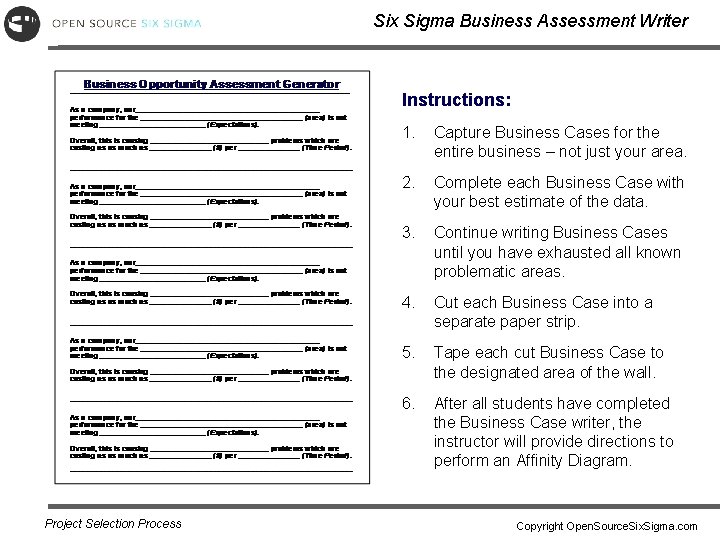
Six Sigma Business Assessment Writer Instructions: Project Selection Process 1. Capture Business Cases for the entire business – not just your area. 2. Complete each Business Case with your best estimate of the data. 3. Continue writing Business Cases until you have exhausted all known problematic areas. 4. Cut each Business Case into a separate paper strip. 5. Tape each cut Business Case to the designated area of the wall. 6. After all students have completed the Business Case writer, the instructor will provide directions to perform an Affinity Diagram. Copyright Open. Source. Six. Sigma. com
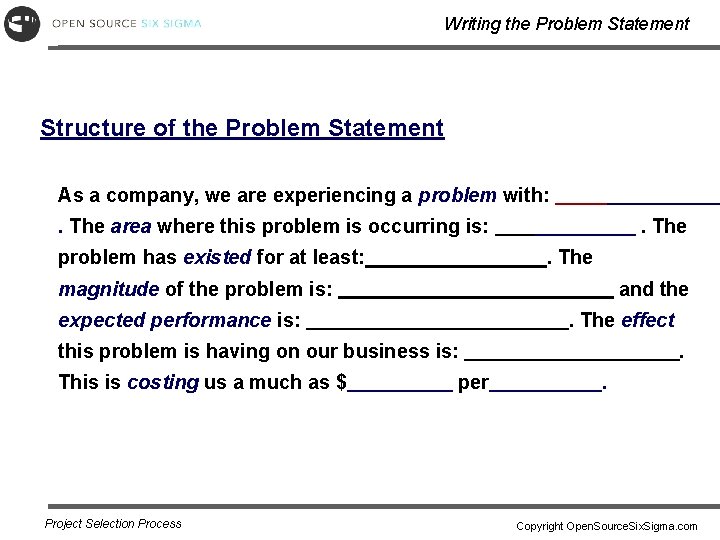
Writing the Problem Statement Structure of the Problem Statement As a company, we are experiencing a problem with: . The area where this problem is occurring is: problem has existed for at least: . The magnitude of the problem is: and the expected performance is: . The effect this problem is having on our business is: This is costing us a much as $ Project Selection Process per . . Copyright Open. Source. Six. Sigma. com
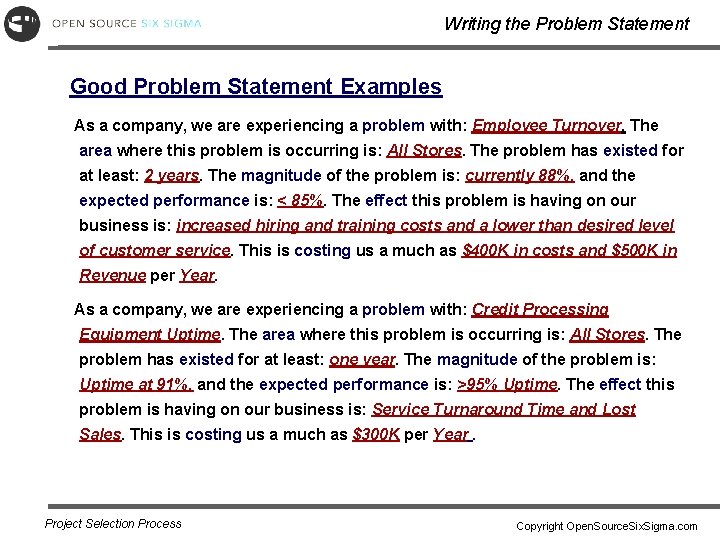
Writing the Problem Statement Good Problem Statement Examples As a company, we are experiencing a problem with: Employee Turnover. The area where this problem is occurring is: All Stores. The problem has existed for at least: 2 years. The magnitude of the problem is: currently 88%, and the expected performance is: < 85%. The effect this problem is having on our business is: increased hiring and training costs and a lower than desired level of customer service. This is costing us a much as $400 K in costs and $500 K in Revenue per Year. As a company, we are experiencing a problem with: Credit Processing Equipment Uptime. The area where this problem is occurring is: All Stores. The problem has existed for at least: one year. The magnitude of the problem is: Uptime at 91%, and the expected performance is: >95% Uptime. The effect this problem is having on our business is: Service Turnaround Time and Lost Sales. This is costing us a much as $300 K per Year. Project Selection Process Copyright Open. Source. Six. Sigma. com
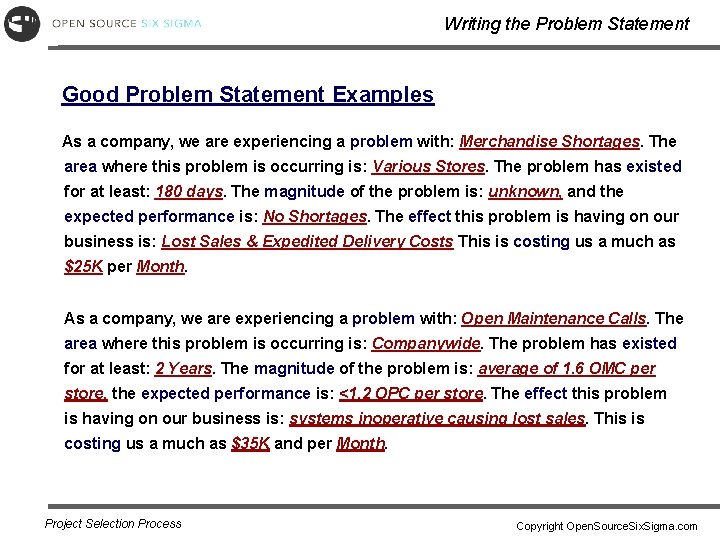
Writing the Problem Statement Good Problem Statement Examples As a company, we are experiencing a problem with: Merchandise Shortages. The area where this problem is occurring is: Various Stores. The problem has existed for at least: 180 days. The magnitude of the problem is: unknown, and the expected performance is: No Shortages. The effect this problem is having on our business is: Lost Sales & Expedited Delivery Costs This is costing us a much as $25 K per Month. As a company, we are experiencing a problem with: Open Maintenance Calls. The area where this problem is occurring is: Companywide. The problem has existed for at least: 2 Years. The magnitude of the problem is: average of 1. 6 OMC per store, the expected performance is: <1. 2 OPC per store. The effect this problem is having on our business is: systems inoperative causing lost sales. This is costing us a much as $35 K and per Month. Project Selection Process Copyright Open. Source. Six. Sigma. com
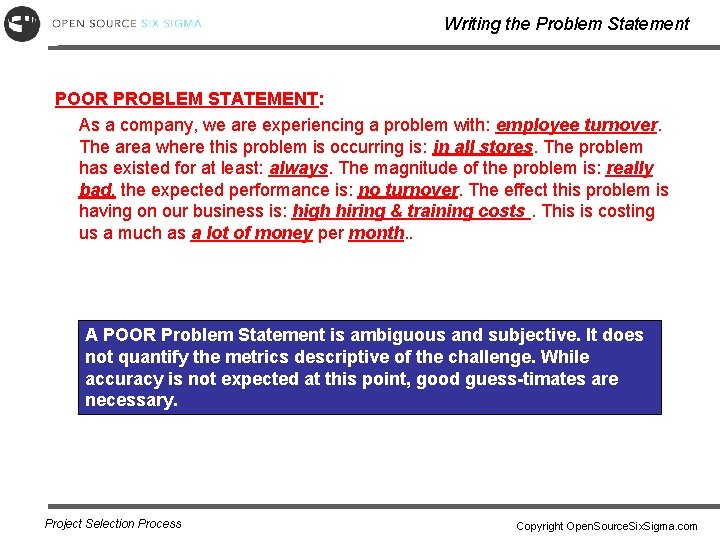
Writing the Problem Statement POOR PROBLEM STATEMENT: As a company, we are experiencing a problem with: employee turnover. The area where this problem is occurring is: in all stores. The problem has existed for at least: always. The magnitude of the problem is: really bad, the expected performance is: no turnover. The effect this problem is having on our business is: high hiring & training costs. This is costing us a much as a lot of money per month. . A POOR Problem Statement is ambiguous and subjective. It does not quantify the metrics descriptive of the challenge. While accuracy is not expected at this point, good guess-timates are necessary. Project Selection Process Copyright Open. Source. Six. Sigma. com
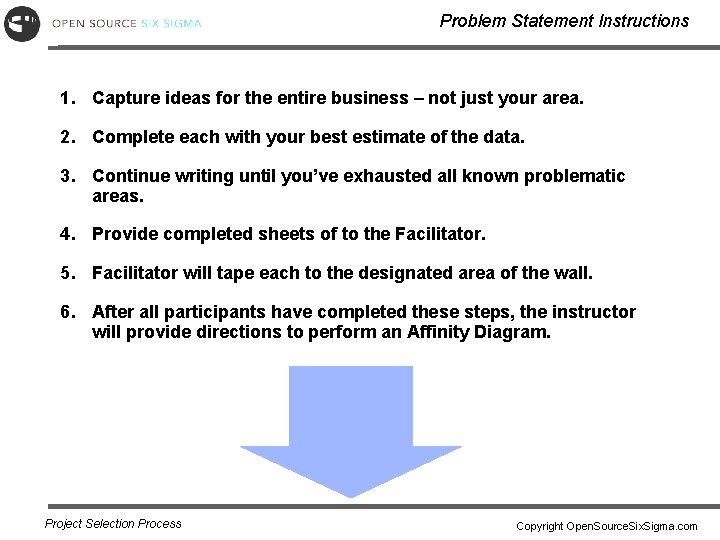
Problem Statement Instructions 1. Capture ideas for the entire business – not just your area. 2. Complete each with your best estimate of the data. 3. Continue writing until you’ve exhausted all known problematic areas. 4. Provide completed sheets of to the Facilitator. 5. Facilitator will tape each to the designated area of the wall. 6. After all participants have completed these steps, the instructor will provide directions to perform an Affinity Diagram. Project Selection Process Copyright Open. Source. Six. Sigma. com
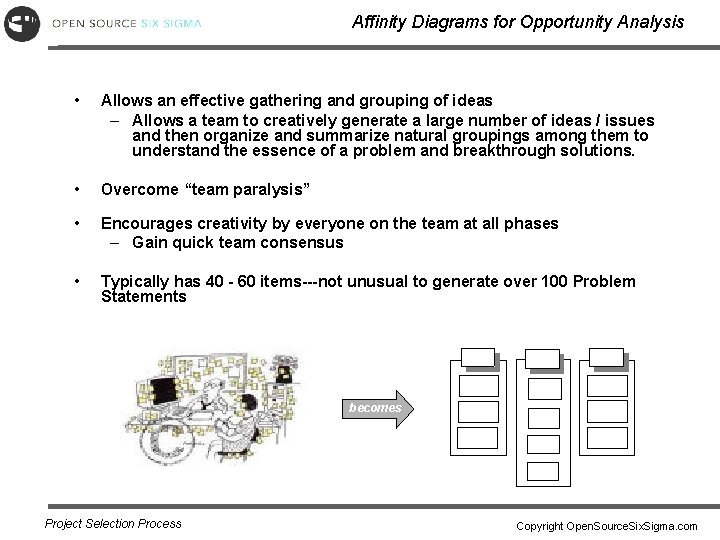
Affinity Diagrams for Opportunity Analysis • Allows an effective gathering and grouping of ideas – Allows a team to creatively generate a large number of ideas / issues and then organize and summarize natural groupings among them to understand the essence of a problem and breakthrough solutions. • Overcome “team paralysis” • Encourages creativity by everyone on the team at all phases – Gain quick team consensus • Typically has 40 - 60 items---not unusual to generate over 100 Problem Statements becomes Project Selection Process Copyright Open. Source. Six. Sigma. com
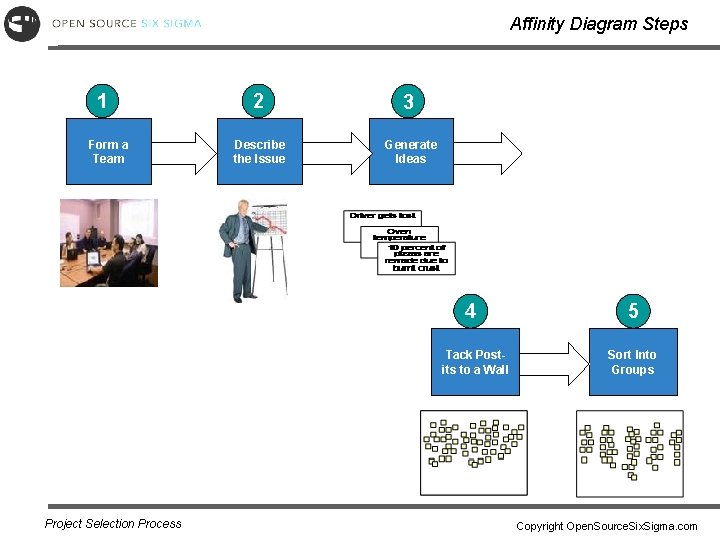
Affinity Diagram Steps 1 Form a Team 2 3 Describe the Issue Generate Ideas 4 Tack Postits to a Wall Project Selection Process 5 Sort Into Groups Copyright Open. Source. Six. Sigma. com
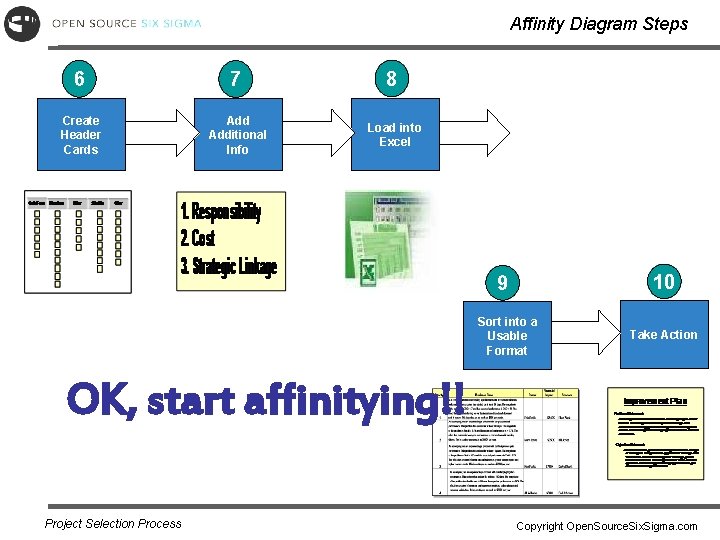
Affinity Diagram Steps 6 7 8 Create Header Cards Additional Info Load into Excel 10 9 Sort into a Usable Format Take Action OK, start affinitying!! Project Selection Process Copyright Open. Source. Six. Sigma. com
Organizing the Knowledge Upon finalization of the Business Opportunity Analysis groupings, the information is entered into the Opportunity Analysis Matrix. This becomes a high-level road map to Project Selection. Headings: • Project No. • Function Owner • Problem/Opportunity • Dept. /Division • Problem Owner • Expectation • Impact • Financial Impact • Project in Process • Key Goal/Objective Project Selection Process Copyright Open. Source. Six. Sigma. com
Opportunity Analysis Matrix Project Selection Process Copyright Open. Source. Six. Sigma. com